





1. Introduction
A characteristic of many Veneto dialects is the progressive weakening—and in many cases deletion—of the lateral consonant /l/ in intervocalic and, in some varieties, word-initial (prevocalic) position. This phenomenon is commonly known as the Veneto elle evanescente, translated here as the evanescent /l/. First attested in the mid-nineteenth century, the phenomenon has been most comprehensively described by Tomasin (Reference Tomasin, Ruffino and D’Agostino2010), who documents its emergence in Venetian (spoken in Venice), where it likely originated before spreading to mainland varieties, particularly throughout Central Veneto. Tomasin (Reference Tomasin, Ruffino and D’Agostino2010: 729) characterizes the elle evanescente as a three-way allophonic alternation of /l/, which surfaces as follows:
-
(1) [l] in pre- and post-consonantal position (e.g., fo[l]po ‘polyp’; ca[l]do ‘hot’);
-
(2) ‘evanescent’ glide [e̯] intervocalically—both word-internally and across word boundaries—unless adjacent to a front vowel (e.g., ba[e̯]on ‘ball’; so[e̯]o ‘alone’; no [e̯]a vogio ‘I don’t want it’);Footnote 1
-
(3)
 $\emptyset$
in the same intervocalic environments as in (2) when adjacent to a front vowel (e.g., vea ‘candle’, cf. It. vela; de ana ‘of wool’, cf. It. di lana).

Although widely attested, the precise allophonic distribution and phonetic properties of the intervocalic glide vary across Veneto localities, and its phonetic realization and phonological status remain underexplored. This study focuses on Estense Veneto, a Central Veneto variety spoken in the town of Este (province of Padova), providing a fine-grained acoustic (and articulatory) analysis of the evanescent /l/ and situating it within the broader progression of sound change.
Henceforth, the term /l/-mutation will be used to refer collectively to the realizations described in (2) and (3). Vocalization, or the traditional term evanescent glide, will refer specifically to the glide alternant described in (2), while deletion will designate the zero alternant described in (3). The term evanescent /l/ or evanescent lateral refers to the three-way alternation as a whole. Throughout, back vowels refer to [a, ɔ, o, u] and front vowels to Veneto [i, e, ɛ].
What follows in this paper is organized as follows. The remainder of Section 1 provides the background necessary to situate the phenomenon within broader patterns of /l/-vocalization and introduces the goals of the current study. Section 2 outlines the methods used for data collection and analysis, Section 3 presents the results, while Section 4 discusses these findings, exploring the acoustic and articulatory profile of the vocalized /l/ segment, and considers how it fits into existing research on sound change. Finally, Section 5 concludes the study with a summary of the main findings and contributions.
1.1. Background
Lateral vocalization is a known process in many languages, including, but not limited to, Polish, English (Hardcastle & Barry Reference Hardcastle and Barry1985; Turton Reference Turton2017; among others), Ukrainian, Serbo-Croatian, Bulgarian, and Slovene (Recasens Reference Recasens, Solé and Recasens2012). Vocalization can result in either a front or a back glide. Across Romance diachrony, /l/-vocalization is widely attested, though predominantly syllable-finally before heterosyllabic consonants. Gallo-Romance varieties, for example, commonly exhibit /l/-vocalization in pre-consonantal coda position (e.g., Lat. TALPA > Fr. taupe; Lat. ALTERU > Fr. autre ‘other’; note also Sp. otro and Port. outro in Ibero-Romance). In French, this vocalization even operates across word boundaries when the pre-consonantal environment is present (e.g., Lat. NOVELLU AMICU > Fr. nouvel ami ‘new friend’ vs. Lat. NOVELLU CANE > Fr. nouveau chien ‘new dog’) (Alkire & Rosen Reference Alkire and Rosen2010: 50). Two distinct mechanisms have been proposed for dark /l/ vocalization: direct replacement (/Vl/ > [Vw]) and glide insertion (/Vl/ > [Vwl] > [Vw]) (Recasens Reference Recasens, Solé and Recasens2012: 58). An example of pre-consonantal /l/-vocalization resulting in a front glide is Lat. MULTU resulting in Port. muito or Sp. buitre ‘vulture’ from Lat. VULTURE (Alkire & Rosen Reference Alkire and Rosen2010: 84).
Another common position for /l/-vocalization is word-finally, though preconsonantal vocalization tends to be more frequent across languages (Recasens Reference Recasens, Solé and Recasens2012). Within Romance, word-final /l/-vocalization is observed in subsets of French, some Northern Italian dialects, Gascon, and modern Brazilian Portuguese (e.g., BrPort. Brasil [bɾaˈziw] ‘Brazil’, legal [leˈɡaw] ‘legal’). The greater cross-linguistic frequency of preconsonantal vocalization has been attributed to the overlapping articulation between /l/ and the following consonant, a feature absent prepausally. Word-final vocalization, by contrast, may be triggered by anticipatory tongue dorsum lowering and backing that accompanies the tongue tip raising gesture of syllable-final dark /l/ (Recasens Reference Recasens, Solé and Recasens2012). An example of word-final /l/-vocalization into a front glide can be found in Cibaeño Dominican Spanish, as in papel > [paˈpej] ‘paper’, but papeles > [paˈpeles] ‘papers’ (Baković Reference Baković2007: 248; Golibart Reference Golibart1976).
In contrast, intervocalic syllable-initial vocalization is rare in Romance and attested only in a few dialects, all resulting in back glides. Examples include Western Campidanese (e.g., Lat. SALE > [ˈsawi] ‘salt’; Lat. SOLE > [ˈsowi]), Northern Occitan (e.g., Lat. ALA > [ˈawo] ‘wing’), and Calabrian (e.g., Lat. PALA > [ˈpawa] ‘spade’) (Recasens Reference Recasens, Solé and Recasens2012: 59). Portuguese is known to have historically undergone intervocalic /l/ deletion, though no intermediate glide stage is attested (e.g., Lat PALA > Port. pá ‘spade’; Lat. DOLŌRE > Port. dor ‘pain’, Lat DOLENTE > Port. doente ‘sick’). Against this background, the Veneto evanescent /l/ is typologically unusual: it involves the vocalization of an intervocalic ‘light’ /l/—and in some cases, reportedly even an intervocalic word-initial /l/—that yields what is traditionally believed to be a front glide, unlike the more typical Romance /l/-vocalizations, which occur mainly in coda position and favor back glides.
1.1.1. Phonetic characterization of the evanescent /l/
Despite the extensive dialectological documentation of the evanescent /l/, its phonetic nature remains incompletely understood. While previous work has established the existence and geographic distribution of the phenomenon, several issues remain unresolved regarding the precise phonetic properties of the vocalized segment, its phonological identity, and its relationship to other glide-like segments in the system. In particular, much of the descriptive literature relies on impressionistic observation, and only very recently have instrumental acoustic and articulatory studies begun to address these questions directly.
Previous descriptions in the literature offer varied accounts of its quality and articulatory properties, though most of these were largely impressionistic. Lepschy (Reference Lepschy1962: 18–19) described it as a relaxed dorsopalatal consonant, akin to [i̯] and transcribed as [l̯], produced with airflow through a depression in the tongue dorsum raised toward the palate, with lateral contact at the dental ridge (see also Marcato & Ursini Reference Marcato and Ursini1998: 451). Building on this, Zamboni (Reference Zamboni and Cortelazzo1974a: 13–14; Reference Zamboni and Cortelazzo1974b: 23) described the phenomenon as a lenition process, whereby the lateral weakens into a glide. He proposed a progression [l] > [e̯] > [i̯] > Ø, arguing that the intermediate segment is best transcribed as [e̯], a front-mid vocoid, especially in intervocalic position (e.g. [ˈkɔe̯a] for It. colla ‘glue’), and that the glide subsequently deletes next to front vowels or the palatal glide, due to the lack of perceptual contrast with its phonetic environment (Zamboni Reference Zamboni and Cortelazzo1974a: 13–14). Later authors have largely converged on this front-mid glide analysis: Mafera and Roman (Reference Mafera and Roman2006: 28–29) characterized it as a fleeting [e]-like sound with tongue-body raising and loss of alveolar contact, while Pescarini (Reference Pescarini, Bertocci, Castro and Rossi2022: 29) described it as a ‘(semi)vocale anteriore (medio)alta’ [front high-mid semivowel], and Tomasin (Reference Tomasin, Ruffino and D’Agostino2010) likewise supported an [e̯] interpretation. By contrast, Canepari (Reference Canepari and Cortelazzo1979: 68) proposed a rather different solution, describing the sound instead as a pre-velar approximant.
Until recently, instrumental data were largely absent from the discussion. The only available acoustic study to date is Pecoraro’s (Reference Pecoraro2022) unpublished Bachelor’s Thesis, which provides empirical support for the front-mid glide hypothesis. Based on formant point-based measurements from five speakers, Pecoraro showed that the evanescent segment in Venetian (i.e., the variety spoken in Venice) patterns distinctly from both lateral [l] and palatal glide [j], occupying an intermediate acoustic space consistent with a front-mid vocoid. Complementing this, a preliminary articulatory study with two speakers from northern Central Veneto by Dian & Burroni (Reference Dian, Burroni, Haro, Repede and Naciri-Azzouz2026), using electromagnetic articulography (EMA), likewise lends support to the [e̯] analysis, showing reduced tongue-tip involvement and a dorsopalatal constriction that is lower than that of the canonical palatal glide.
1.2. Current study
The previous studies on the evanescent /l/ in Veneto have been limited in scope, both in terms of the number of speakers—so far restricted to very small samples—and the range of dialectal varieties considered. In contrast, the present study draws on data from ten speakers, allowing for a more robust phonetic characterization of the phenomenon within a single variety. Given the well-documented microvariation within Veneto, broader geographic coverage is necessary to fully characterize the phenomenon. While dialectological work has outlined the general area in which the evanescent /l/ occurs, detailed phonetic analyses have so far been restricted to a small subset of central varieties. By focusing on Estense Veneto (southern Central Veneto), a variety that has not previously been examined phonetically (or descriptively, for that matter), the present study helps to triangulate the geographic domain in which this phenomenon has been documented and empirically investigated. Moreover, Canepari (Reference Canepari and Cortelazzo1979: 68) impressionistically described the evanescent allophone in some varieties of Central Veneto as distinct from the Venetian variant [e̯], characterizing it as more yod-like and transcribing it as [ʝ]. In the present study, we investigate whether this distinction holds or whether the segment remains phonetically separate from the canonical Estense Veneto [j].
In addition, neither Dian & Burroni (Reference Dian, Burroni, Haro, Repede and Naciri-Azzouz2026) nor Pecoraro (Reference Pecoraro2022) address reports from Central and Southern Veneto of occasional /l/-deletion even between back vowels, where the typical reflex in other varieties is /l/-vocalization (Tomasin Reference Tomasin, Ruffino and D’Agostino2010: 732; Canepari Reference Canepari and Cortelazzo1979: 68). These reports raise the empirical question of whether such cases reflect a categorically distinct outcome or emerge from continuous phonetic variation in the realization of the evanescent segment. More generally, it remains unclear whether the time-varying acoustic trajectories associated with /l/-mutation naturally organize into distinct dynamic patterns, and whether any such patterns correspond to perceptually salient differences. Equally important is determining which acoustic and temporal cues signal the presence of vocalization versus deletion, as these factors are critical for understanding the conditioning of /l/-mutation.
Finally, whereas Dian & Burroni’s (Reference Dian, Burroni, Haro, Repede and Naciri-Azzouz2026) EMA study and Pecoraro’s (Reference Pecoraro2022) acoustic study are limited to isolated words in carrier phrases, the present study examines /l/-mutation in more naturalistic connected speech—a factor that may explain why previous work was unable to capture instances of deletion between back vowels and gradient realizations of the glide.
2. Methods
2.1. Participants
The Veneto region of northeastern Italy is characterized by widespread bilingualism between Standard Italian and regional Romance varieties (commonly referred to as ‘dialects’). These are not regional accents of Italian, but distinct Romance languages with independent historical development from Latin (Maiden Reference Maiden1995; Loporcaro Reference Loporcaro2009). Among these, Veneto is the primary regional language and shows significant internal variation (Zamboni Reference Zamboni and Cortelazzo1974a). In contemporary usage, Italian dominates formal domains, while Veneto is largely restricted to informal and familial settings (ISTAT 2017). There are currently no monolingual speakers of Veneto.
Given this sociolinguistic background, ten native speakers of Estense Veneto were recruited for this study, comprising four female and six male participants. The group included four younger speakers (two female, two male) aged between 23 and 35 years, and six older speakers (two female, four male) aged between 60 and 75 years. All participants were born, raised, and currently residing in the town of Este or the surrounding frazioni within its jurisdiction, ensuring a homogeneous dialectal background.
All participants were native speakers of Italian. The younger group reported Italian as their first language and described acquiring Veneto mainly by listening to older family members, with usage largely confined to the home environment. In contrast, the older group identified Veneto as their first language, but having received formal education in Italian were currently more dominant in Italian. Nevertheless, they maintained a strong identification as ‘dialettofoni’ (i.e., habitual speakers of a regional dialect) and reported actively using Veneto in family, social, and professional settings.
2.2. Procedure
Participants completed an information gap task in five pairs, designed to elicit spontaneous, conversational speech. This specific methodology (an image-based comparison task) was chosen because a more structured elicitation format could have inadvertently led speakers to produce more Italian and suppress Veneto features. Given the pervasive code-mixing between regional Italian and the Veneto dialect in the community and the sociolinguistic pressures related to stigma and language attitudes, it was important to use a task that would encourage naturalistic use of Veneto. Pairings were made intentionally by age group (younger vs. older), while gender pairing occurred naturally. The four younger speakers were recorded in one female–female pair and one male–male pair; the six older speakers were likewise recorded in one female–female pair and two male–male pairs.
Speakers were recorded in Este in a quiet room in a public building. Acoustic data were recorded using a Zoom H6 recorder equipped with a detachable microphone capsule mounted on top. The microphone was positioned approximately 50 cm from the speakers’ mouths, with the input sensitivity dial set between 8.5 and 10 depending on the individual speaking volume of each pair.
Each participant received a sheet of paper containing a set of 42 images. The task required them to describe their images to one another in order to collaboratively identify differences between the two sets. While most images differed only subtly, some were identical, and a few were entirely different or absent in the other participant’s set.
Target items were designed to elicit words containing etymological intervocalic /l/s across a variety of vocalic environments and word positions. For example, an image of a horse was used to elicit the word cavalo (word-internal /l/, a_o), and an image of the Capitoline she-wolf was used to elicit la lupa (word-initial /l/, a_u). Items containing intervocalic /j/ were also included—for instance, an image of a leaf was used to elicit fòja—to allow for comparison between the evanescent glide of interest in this study, [e̯], and the traditional palatal glide, /j/. Additional images, such as a picture of a tiger (tigre), served as fillers to obscure the phonological focus of the task. Because the task involved conversational speech, not all words analyzed later were intentionally elicited; the image stimuli were included primarily to encourage natural production of /l/ across the dialogue. Therefore, a total of 281 distinct target words—both elicited and spontaneously produced—were analyzed in the data. Across all recordings, the final dataset consisted of a total of 1588 total tokens, from approximately 110 minutes of audio. 916 tokens were from older speakers and 672 from the younger cohort. Of the 1451 tokens with etymological intervocalic or post-pausal (prevocalic) /l/s, 1159 were realized with /l/-mutation. Of these 298 were perceived as vocalized, where this segment was realized as a glide, and 861 as involving complete deletion of the etymological lateral. In agreement with previous reports, the specific vowel context conditioned the presence or absence of a glide to a large extent. In contact with a preceding or following front vowel, deletion was almost categorical (643 tokens), with only 11 instances of vocalization. Instead, between two back vowels, we found similar numbers of vocalized /l/ (216 tokens) and deleted /l/ (194 tokens). Since we are interested in acoustically characterizing the vocalized /l/, the analysis in this paper will be limited to tokens of etymological /l/ between two back vowels (216 + 194 = 410 tokens). In addition, we extracted 77 tokens of /j/ between back vowels for acoustic comparison with vocalized /l/.
2.3. Acoustic Analysis
To determine the acoustic correlates of the evanescent glide, an acoustic analysis was conducted focusing on segmental duration and the first two formants (F1 and F2). All measurements were performed in Praat (Boersma & Weenink Reference Boersma and Weenink2019), using a custom script that extracted duration and sampled F1 and F2 values at 20 equidistant points throughout each target segment, effectively normalizing time across segments of varying duration prior to statistical analysis. Formant parameter settings were set at 5000 Hz for males and 5500 Hz for females and the maximum number of formants was set at 5.
Tokens were manually segmented, with boundaries defined to capture the full extent of the relevant sequence—from the onset of the first vowel in an etymological vowel-lateral-vowel sequence or the onset of the lateral in an etymological lateral-vowel sequence to the end of the following vowel. For example, the word palo ‘pole’ could in principle be realized as [ˈpalo], [ˈpae̯o], or [ˈpao], and was segmented from the start to the end of the [ˈalo], [ˈae̯o], or [ˈao] sequence, respectively. Similarly, the word la ‘the (feminine singular)’ could be realized as [la], [e̯a], or [a], and was segmented from the start to the end of the [la], [e̯a], or [a] sequence. Segment boundaries were determined using both waveform and spectrogram cues, with particular attention to formant transitions and voicing continuity. Vocalization versus deletion (e.g., [ˈpae̯o] vs. [ˈpao]) was determined through visual inspection of the spectrogram—specifically, by identifying a rise in the second formant trajectory—and through auditory judgment. Whether vocalized and deleted sequences are categorically distinct or instead represent points along a single distribution will be addressed in greater detail in Section 3.2. For comparison, vowel-(palatal)glide-vowel sequences (e.g. [ˈaja] in [ˈpaja] paja ‘hay’) were also segmented, from the onset of the first vowel to the offset of the second vowel. Examples of spectrograms illustrating the realizations vowel-lateral-vowel, vowel-(evanescent)glide-vowel, vowel-(palatal)glide-vowel and vowel-vowel are given in Figure 1.
Spectrogram segments of four different realizations (vowel-lateral-vowel, vowel-(evanescent)glide-vowel, vowel-(palatal)glide-vowel, and vowel-vowel) from one female speaker
(1a) ala ‘wing’ produced as [ˈala].
(1b) bala ‘(hay) bale’ produced as [ˈbae̯a]. Only the final vocoid sequence is show here [ˈae̯a].
(1c) cavalo ‘horse’ produced as [kaˈvao]. Only the final vocoid sequence is show here [ˈao].
(1d) paja ‘hay’ produced as [ˈpaja]. Only the final vocoid sequence is show here [ˈaja].

Figure 1 Long description
The image contains four spectrogram segments labeled as 1a, 1b, 1c, and 1d. Each spectrogram shows the frequency (Hz) on the vertical axis and time (seconds) on the horizontal axis. Panel 1a shows a spectrogram for the vowel-lateral-vowel realization with a visible part of 0.500061 seconds. Panel 1b displays a spectrogram for the vowel-evanescent glide-vowel realization with a visible part of 0.573137 seconds. Panel 1c presents a spectrogram for the vowel-vowel realization with a visible part of 0.400658 seconds. Panel 1d illustrates a spectrogram for the vowel-palatal glide-vowel realization with a visible part of 0.611994 seconds. Each spectrogram shows distinct patterns and frequencies, highlighting the differences in vocalization processes.
Since calculating the midpoint of the vowel-(glide)-vowel sequences could not reliably capture the glide’s temporal location, especially given systematic vowel duration differences tied to stress, trajectory-based statistical modeling was adopted, as described in the following section.
2.4. Statistical Analysis
All statistical analyses were conducted in R (R Core Team 2018). Different statistical models were employed depending on the nature of the dependent variable under investigation, including dynamic acoustic data (formant trajectories) and continuous acoustic measures (e.g., duration, maximum F2). The analyses are presented here in order of their relevance to the core research goals, beginning with the phonetic realization of the evanescent glide and proceeding to its conditioning factors.
2.4.1. Dynamic acoustic data: formant trajectories and midpoint dispersion
The primary data type in this study consists of time-varying formant trajectories (F1 and F2) spanning the full duration of vowel-(glide)-vowel sequences. Trajectories of sequences containing the evanescent glide between back vowels (n=216) are compared both to back vowel sequences between which the evanescent glide was perceived to have been completely deleted (n=194) and back vowel sequences containing an intervening canonical palatal glide (n=77).
To model the time-varying nature of formant movement across these sequences, Generalized Additive Mixed Models (GAMMs) (Sóskuthy Reference Sóskuthy2017; Clark Reference Clark2019) were employed, allowing for detailed comparison of full trajectory shapes across conditions. Formant measurements were extracted using a Praat script (Boersma & Weenink Reference Boersma and Weenink2019) at 20 equidistant points per vowel, with time normalized across tokens. Data were analyzed in R (R Core Team 2018) using the mgcv package (Wood Reference Wood2011; Reference Wood2017), specifically the bam() function for large datasets with multiple random effects. Models were fit via restricted maximum likelihood (method = ‘fREML’) and model comparison was carried out using the compare.ML() function from the itsadug package (van Rij et al. Reference van Rij, Martijn Wieling, Baayen and Rijn2025). Separate GAMMs were constructed for F1 and F2. A single model was fitted for each formant including all three percept types (i.e., palatal glide between back vowels, evanescent glide between back vowels, and a sequence of two back vowels where deletion occurred). Each model included smooth terms for normalized time by perceptual context (s(Time, by = Context, k = 8)), a smooth effect of duration (s(duration, k = 8)) together with a tensor interaction between Time and duration (ti(Time, duration, k = c(8, 5))), and fixed effects of speaker age group (AgeGroup) and stress position (StressPos). Sequence duration was included as a non-linear predictor (s(duration)) to account for differences in token length and as part of a tensor interaction with Time (ti(Time, duration)) to allow duration to modulate trajectory shape (cf. Sóskuthy Reference Sóskuthy2017). Speaker age group (AgeGroup) was included as a fixed effect to account for potential apparent-time differences. Following Wieling (Reference Wieling2018) (see also Hualde, Barlaz & Luchkina Reference Hualde, Barlaz and Luchkina2022), model complexity was increased incrementally and compared using Akaike Information Criterion (AIC), with the lowest AIC models selected. Final models included smooth terms over normalized time by vocalic context (e.g., s(Time, by = Context, k = 8)) and non-linear random smooths (factor smooths) for speaker and word (Pierrehumbert Reference Pierrehumbert, Gussenhoven and Warner2002) over time (e.g., s(speaker, Time, bs = “fs”, m = 1) and s(word, Time, bs = “fs”, m = 1)) to account for individual variability and lexical variation (Wieling Reference Wieling2018; Hualde et al. Reference Hualde, Barlaz and Luchkina2022). Autocorrelation in consecutive measurements within each token was modeled using a first-order autoregressive (AR1) error structure (rho = .7). The AR.start parameter marked the first point of each token, resetting the AR1 correlation at the start of every new sequence (Sóskuthy Reference Sóskuthy2017: 30–31).
Statistically meaningful differences in trajectory shape were assessed via difference smooths plotted with itsadug’s (van Rij et al. Reference van Rij, Martijn Wieling, Baayen and Rijn2025) plot_diff(), highlighting time regions with significant divergence (Wieling Reference Wieling2018). Model results are reported in the following section.
We also ran all statistical analyses using Lobanov-normalized formant values, but the results were virtually identical. Therefore, we report the non-normalized version for clarity, as using raw formant values in Hertz preserves articulatory and acoustic interpretability.
In addition to the trajectory-based analyses, the evanescent glide [e̯] between back vowels was compared to the vowel system to assess its dispersion in the F1–F2 space and the coarticulatory effects arising from its intervocalic realization. For this purpose, formant values for [e̯] were extracted by taking the maximum F2 along the entire vowel-glide-vowel trajectory, along with the corresponding F1 value, and compared to the seven oral vowels, which were measured interconsonantally (e.g., p[i]no ‘pine’) at their midpoints.
2.4.2. Cluster analysis of F2 trajectories
To further explore whether the percepts correspond to naturally occurring patterns in the F2 trajectories, longitudinal k-means clustering (kml package; Genolini et al. Reference Genolini, Alacoque, Sentenac and Arnaud2015) was applied to all sequences that underwent /l/-mutation between back vowels. Each token’s F2 trajectory was represented by 20 equidistant points along the vowel-(glide)-vowel sequence, with missing values imputed via linear interpolation and the resulting trajectories converted into a traj object for clustering. Tokens were grouped using a correlation-based distance metric, and cluster quality criteria, including the Calinski-Harabasz (CH) index. Cluster membership was subsequently merged with token condition for further analysis and then used as a descriptive tool to examine whether the trajectories naturally segregate according to percept type, complementing the preceding GAMM analyses.
2.4.3. Continuous acoustic measures: duration and maximum F2
The GAMM analyses described in Section 2.4.1 model full formant trajectories and explicitly account for the effect of sequence duration on trajectory shape. To complement these trajectory-based analyses, we also examined continuous scalar acoustic measures—specifically, sequence duration and maximum F2—to quantify temporal and spectral properties associated with glide realization between back vowels.
Sequence duration and maximum F2 were analyzed using linear mixed-effects models (LMMs) in R (R Core Team 2018) fitted with the lmer() function from the lme4 package (Kuznetsova, Brockhoff & Christensen Reference Kuznetsova, Brockhoff and Christensen2017). For duration, percept type (evanescent glide between back vowels and a sequence of two back vowels) and stress position (no stress, prestress, poststress) were included as fixed effects, with random intercepts for speaker and word. Tukey-adjusted post-hoc comparisons of estimated marginal means (emmeans package; Lenth & Piaskowski Reference Lenth and Piaskowski2025) were conducted using the emmeans() function in R to test which stress positions differed significantly for duration. For maximum F2, sequence duration was included as a continuous predictor, again with random intercepts for speaker and word. Together, these analyses make explicit how duration shapes both the likelihood of glide realization and the degree of fronting captured dynamically in the GAMM trajectories.
3. Results
This section focuses on /l/-mutation in intervocalic back vowel contexts, which constitute the sole input to the GAMM analyses presented below. Older speakers showed higher vocalization rates (147/252 tokens, 58.7%) than younger speakers (68/158 tokens, 43%). These percentages are calculated over all word-internal etymological intervocalic /l/ tokens flanked by back vowels and are based on pooled counts within each age group. The roughly even distribution of vocalization and deletion in these contexts motivates the following analyses, which examine the phonetic behavior of glide realization and its occasional absence in back vowel sequences.
3.1. Formant trajectories and the phonetic realization of the evanescent glide
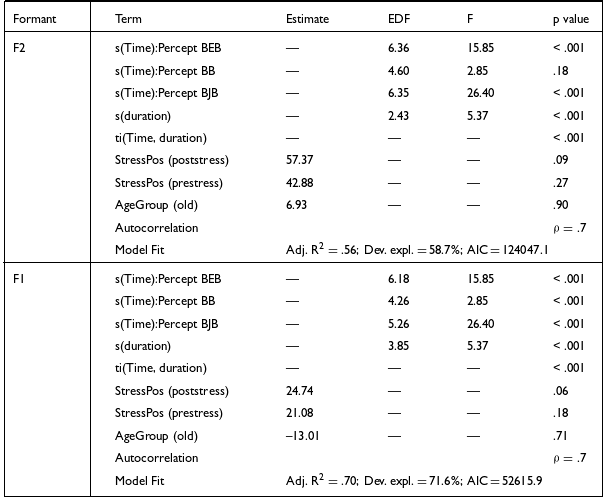
To evaluate how vowel formants change over time across different vocoid sequences, GAMMs were fitted with a single model including the three percept types (palatal glide between back vowels, evanescent glide between back vowels, and a sequence of two back vowels). Each model included duration (as a smooth predictor of overall formant variation and as part of a tensor interaction with Time), stress position and age group, along with smooth terms for speaker and word over time. Duration had a significant effect on both F1 and F2 trajectories. By contrast, neither stress position nor age group significantly affected F1 or F2, suggesting that formant dynamics were comparable across speaker cohorts and across stress positions. Smooth terms over time by percept were significant for percepts of a palatal glide between back vowels and an evanescent glide between back vowels, in both F1 and F2, while percepts of a sequence of two back vowels were less consistently significant, particularly in F2. Table 1 summarizes these model diagnostics and performance metrics, including effective degrees of freedom, adjusted R2, deviance explained, and AIC.
Formant ∼ s(Time, by = Context, k = 8) + StressPos + s(duration, k = 8) + ti(Time, duration, k = c(8, 5)) + AgeGroup + s(speaker, Time, bs = "fs", m = 1) + s(word, Time, bs = "fs", m = 1)

Table 1 Long description
The table presents model diagnostics and performance metrics for formant analysis, focusing on F2 and F1. It includes columns for Term, Estimate, EDF, F, and p value. The table has two main sections: F2 and F1, each with multiple rows detailing different terms and their corresponding values. For F2, terms include s(Time):Percept BEB, s(Time):Percept BB, s(Time):Percept BJB, s(duration), ti(Time, duration), StressPos (poststress), StressPos (prestress), and AgeGroup (old), along with model fit metrics. Similarly, F1 includes the same terms with their respective values. Notable trends include significant p values for certain terms and varying EDF and F values across different terms. The model fit metrics show adjusted R squared values and deviance explained percentages for both F2 and F1.
Percept levels: BEB – evanescent glide between two back vowels; BJB – palatal glide between two back vowels; BB – sequence of two back vowels.
Significance codes: *** p < .001, ** p < .01, * p < .050, . p < .1.
3.1.1. The evanescent glide and deletion
To investigate the phonetic substance of the evanescent glide, percepts with an evanescent glide (i.e., vocalization) between back vowels were compared to percepts with deletion in the same context. GAMM revealed that compared to deletion tokens, vocalized percepts exhibited greater temporal variation—i.e., were ‘wigglier’—as indicated by higher estimated degrees of freedom (edf) for both F1 and F2 (see Table 1). The plot_diff() function also showed that the F1 and F2 trajectories differed significantly between vocalized percepts and those with deletion.
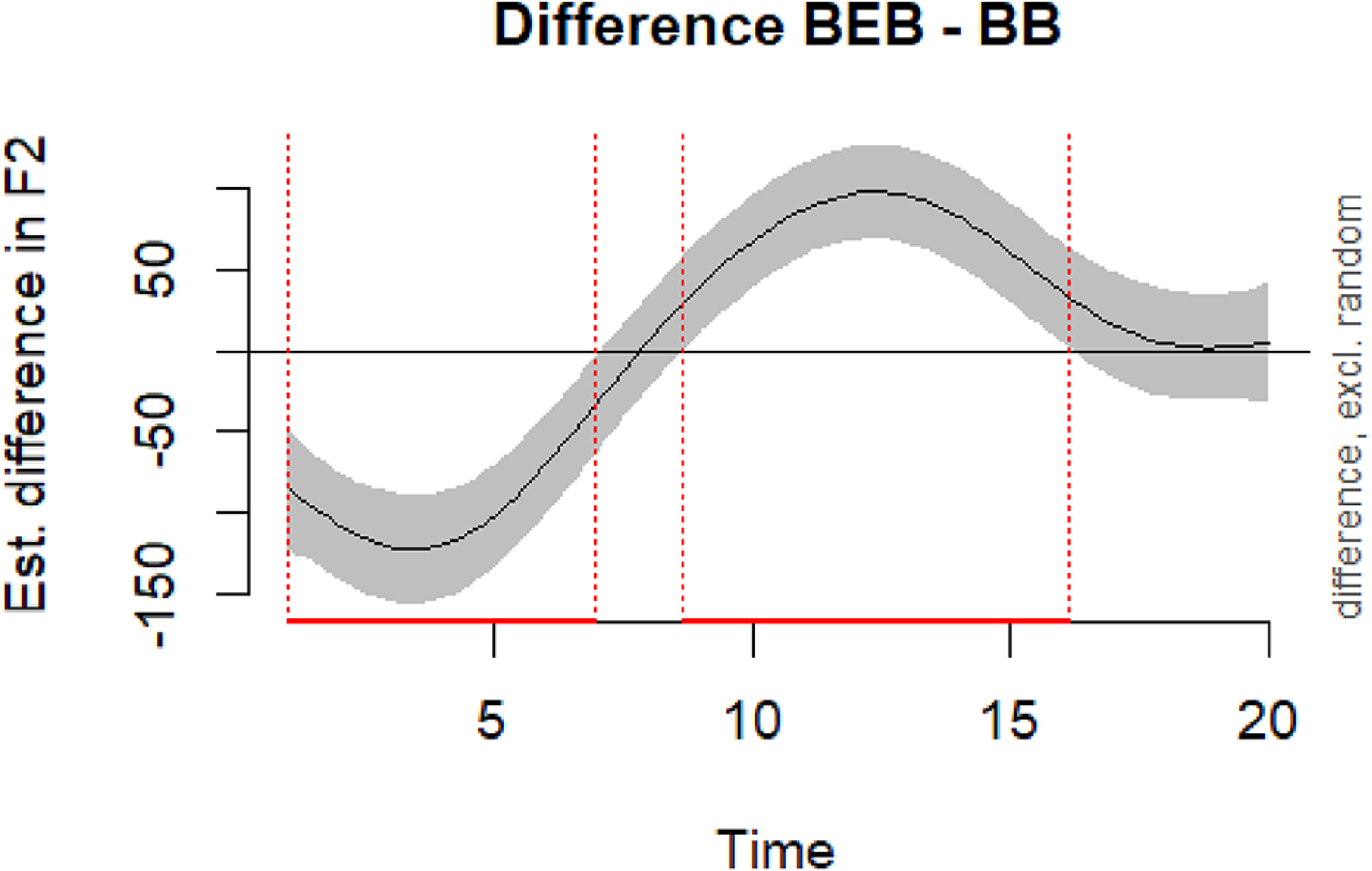
Figure 2 shows the overlaid second formant trajectories for percepts of an evanescent glide between back vowels and a sequence of two back vowels where an F2 rise between the two back vowels in the vocalized condition is clearly visible. Figure 3 presents the difference curve between conditions across time: the shaded portions of the x-axis highlight intervals where the trajectories differ significantly, approximately between timepoints 0–7 and 8–16. Since percepts with vocalization and deletion share the same phonetic context (back vowels), the early significance interval may reflect dissimilation effects in vocoid sequences.Footnote 2 The later interval, located mid-trajectory, shows a positive difference, indicating a significant rise in F2 values for the vocalized percept relative to the one with deletion. This pattern is consistent with the hypothesized fronting gesture of [e̯].
Overlaid F2 trajectories for BEB and BB (BEB signifies percepts of an evanescent glide between back vowels; BB signifies percepts of a sequence of two back vowels).

F2 difference curve across time, BEB – BB (BEB signifies percepts of an evanescent glide between back vowels; BB signifies percepts of a sequence of two back vowels).

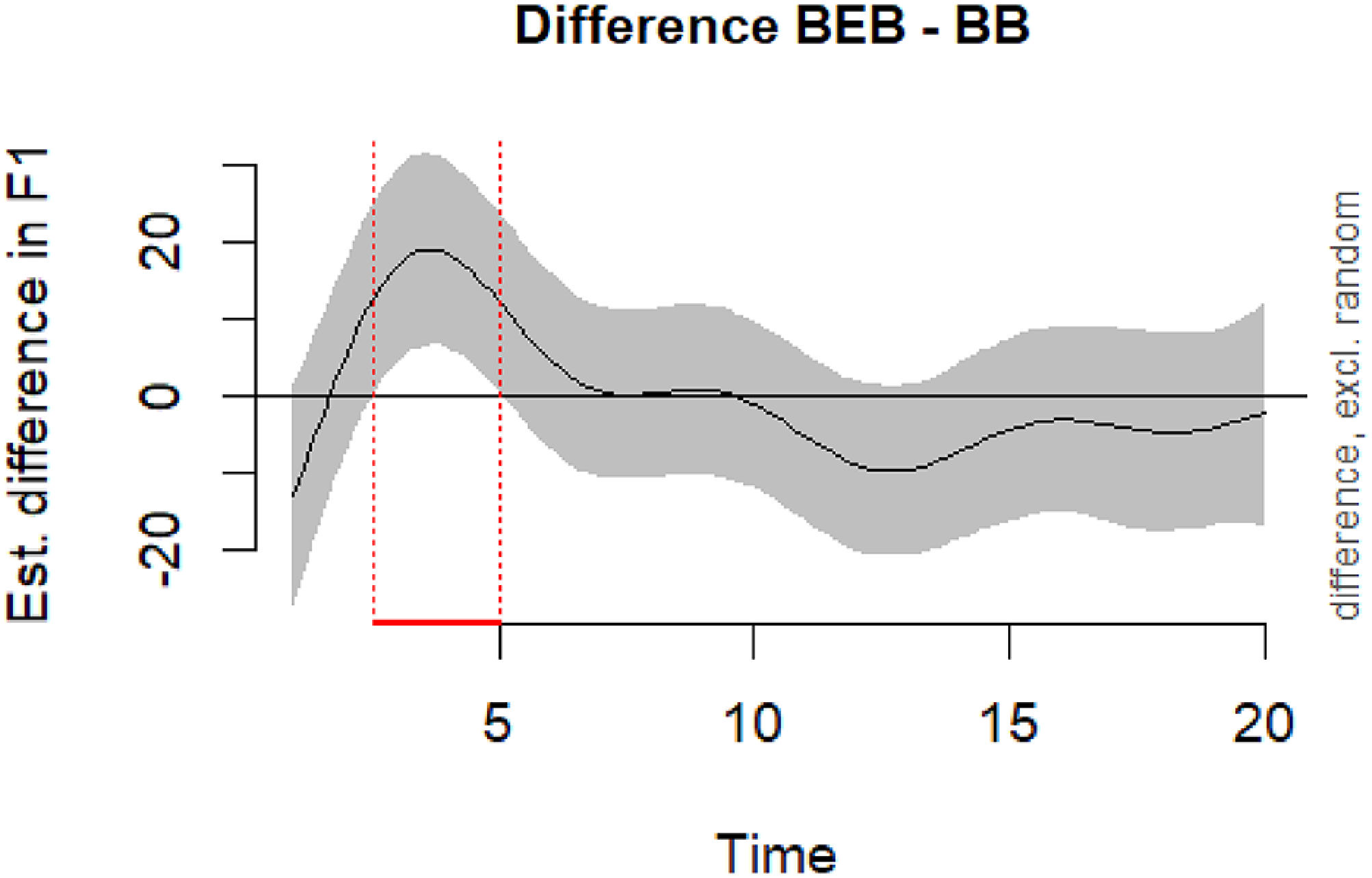
Figure 4 displays the estimated F1 trajectories for percepts of an evanescent glide between back vowels and a sequence of two back vowels. Although the two curves largely overlap, the difference smooth (Figure 5) reveals statistically significant differences at one brief interval (between timepoints 2–5). This difference, however, is visually subtle—amounting to minor fluctuations in the vocalized curve—and does not indicate a meaningful divergence in the overall shape of the trajectory. The slightly wigglier vocalized curve may reflect the articulatory presence of an intervening segment. Given that most back vowel contexts in this data set involved low, low-mid, or mid vowels, the glide height can be inferred to fall within a similar height range, once more in accordance with the hypothesized mid-height of [e̯].
Overlaid F1 trajectory for BEB (n=216) and BB (n=194) (BEB signifies percepts of an evanescent glide between back vowels; BB signifies percepts of a sequence of two back vowels).

F1 difference curve across time, BEB – BB (BEB signifies percepts of an evanescent glide between back vowels; BB signifies percepts of a sequence of two back vowels).

3.1.2. The evanescent glide and the palatal glide
Additionally, in order to compare whether the evanescent glide [e̯] is phonetically different from the canonical palatal glide [j], trajectories of percepts of an evanescent glide between back vowels were compared to those of a palatal glide between back vowels (e.g., zalo [ˈzae̯o] ‘yellow’ vs. fòja [ˈfɔja] ‘leaf’).
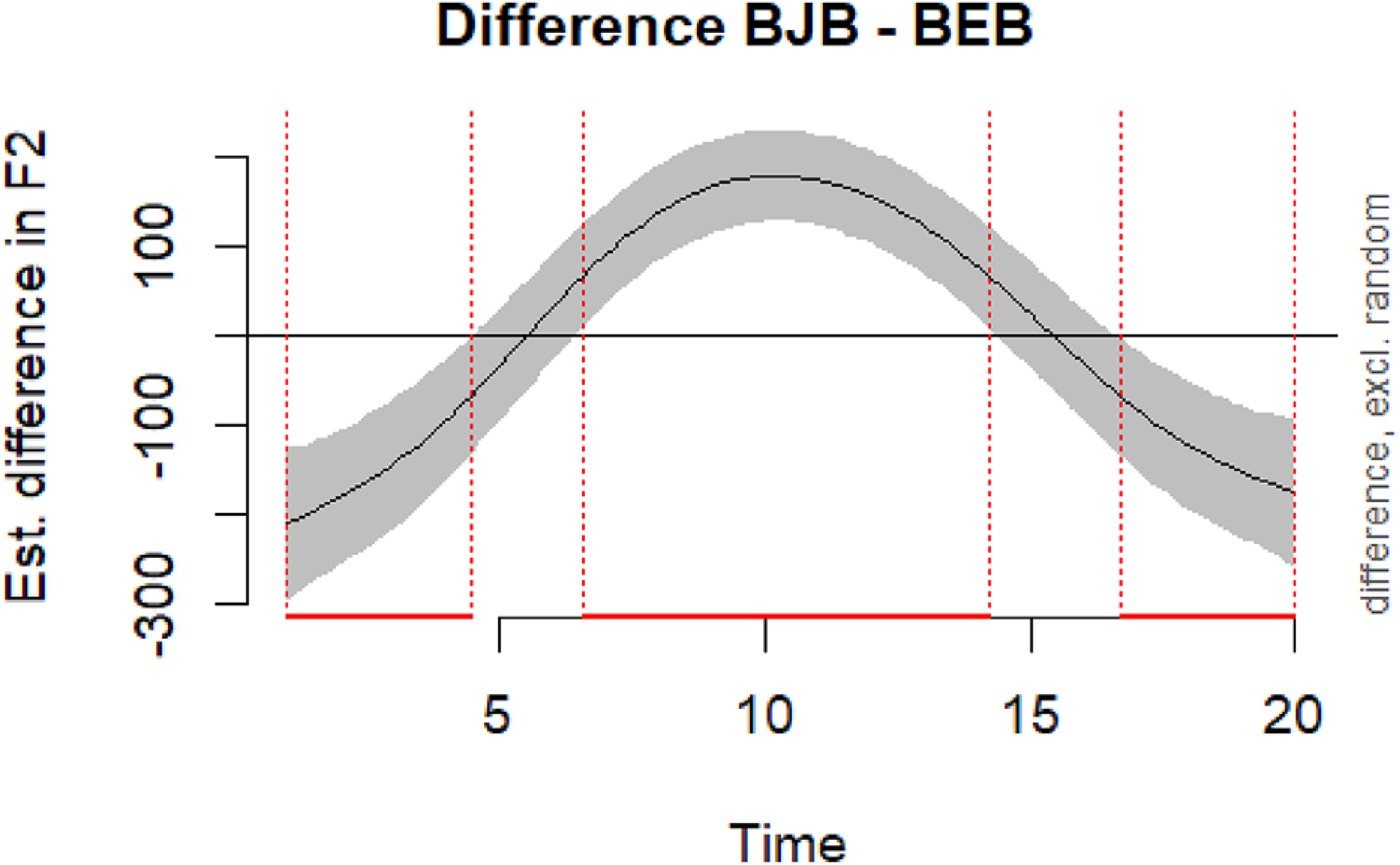
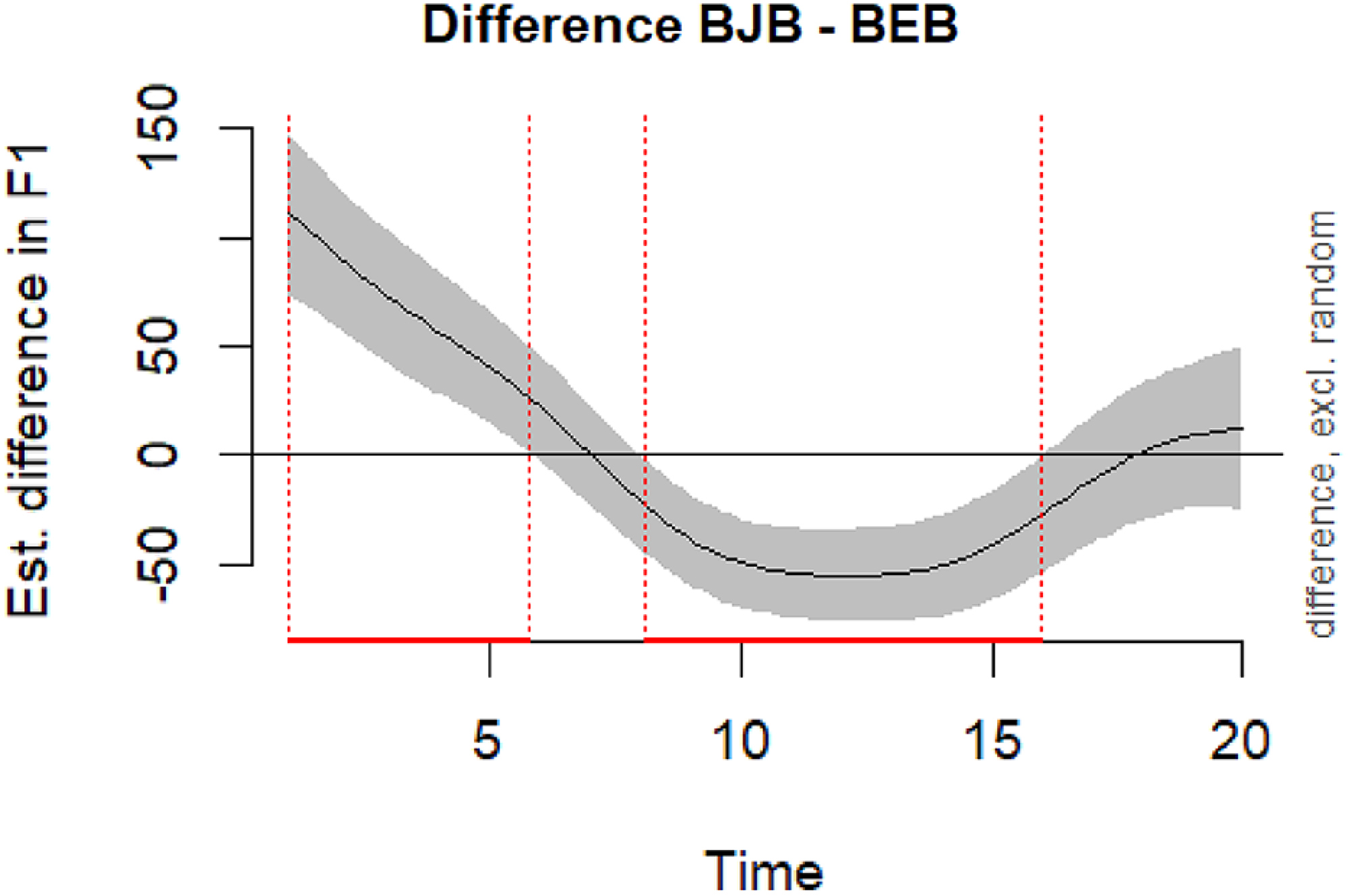
Figures 6 and 7 illustrate formant trajectories for sequences with a palatal glide between two back vowels and sequences with an evanescent glide between two back vowels. The second formant trajectories (Figure 7) reveal significant differences between the two percept types across three time windows: at both endpoints (approximately time points 0–4 and 16–20), where the difference is negative, and in a central window (roughly 7–14), where the difference is positive. The positive difference in the central portion of the trajectory suggests that the palatal glide [j] is produced with greater fronting than [e̯] (see also Figure 6). The negative differences at the endpoints may reflect increased dissimilatory effects in the vocoid sequence due to the greater articulatory extent of [j]. While percepts sequences with the evanescent glide exhibit more endpoint overshoot than percepts with deletion (cf. Figures 2 and 3), they still show less overshoot than those with a palatal glide.
Overlaid F2 trajectories for BJB (n=77) and BEB (n=216) (BEB signifies percepts of an evanescent glide between back vowels; BJB signifies percepts of a palatal glide between back vowels).

F2 difference curve across time, BJB – BEB (BEB signifies percepts of an evanescent glide between back vowels; BJB signifies percepts of a palatal glide between back vowels).

Figures 8 and 9 illustrate the F1 trajectories for percepts of an evanescent glide between back vowels and those of sequences with a palatal glide between back vowels, which also differed significantly in two time windows: an initial window (approximately time points 0–6) and a central window (roughly 8–16) (Figure 9). The positive difference in the initial portion likely reflects greater articulatory overshoot at the onset of the glide [j], consistent with the pattern observed in F2. In contrast, the negative difference in the central window suggests that the evanescent glide [e̯] is produced lower in the vowel space than the palatal glide [j], as indicated by its higher F1 values (Figure 8).
Overlaid F1 trajectories for BJB (n=77) and BEB (n=216) (BEB signifies percepts of an evanescent glide between back vowels; BJB signifies percepts of a palatal glide between back vowels).

F1 difference curve across time, BJB – BEB (BEB signifies percepts of an evanescent glide between back vowels; BJB signifies percepts of a palatal glide between back vowels).

In sum, the GAMM analysis shows that the evanescent glide [e̯] is phonetically distinct from the palatal glide [j], being lower and less fronted in articulation, supporting its characterization in previous literature as a mid-front rather than high glide.
Finally, examining the raw data for the evanescent glide [e̯] in comparison to other vowels (segmented between consonants, as in p[i]no ‘pine’), we find that the glide space is characterized by high F2 values, consistent with other front vowels (Figure 10). However, its F1 range is unexpectedly wide, spanning values as high as [i] to as low as [a].
Vowel chart with tokens from 2 speakers showing vowel spaces for the 7 vowels ([i, e, ɛ, a, ɔ, o, u]) and the glide space for [e̯]. Vowel points correspond to the midpoint of each vowel and the glide points correspond to the max-F2 value and corresponding F1 value within the trajectory of vocalized percepts.

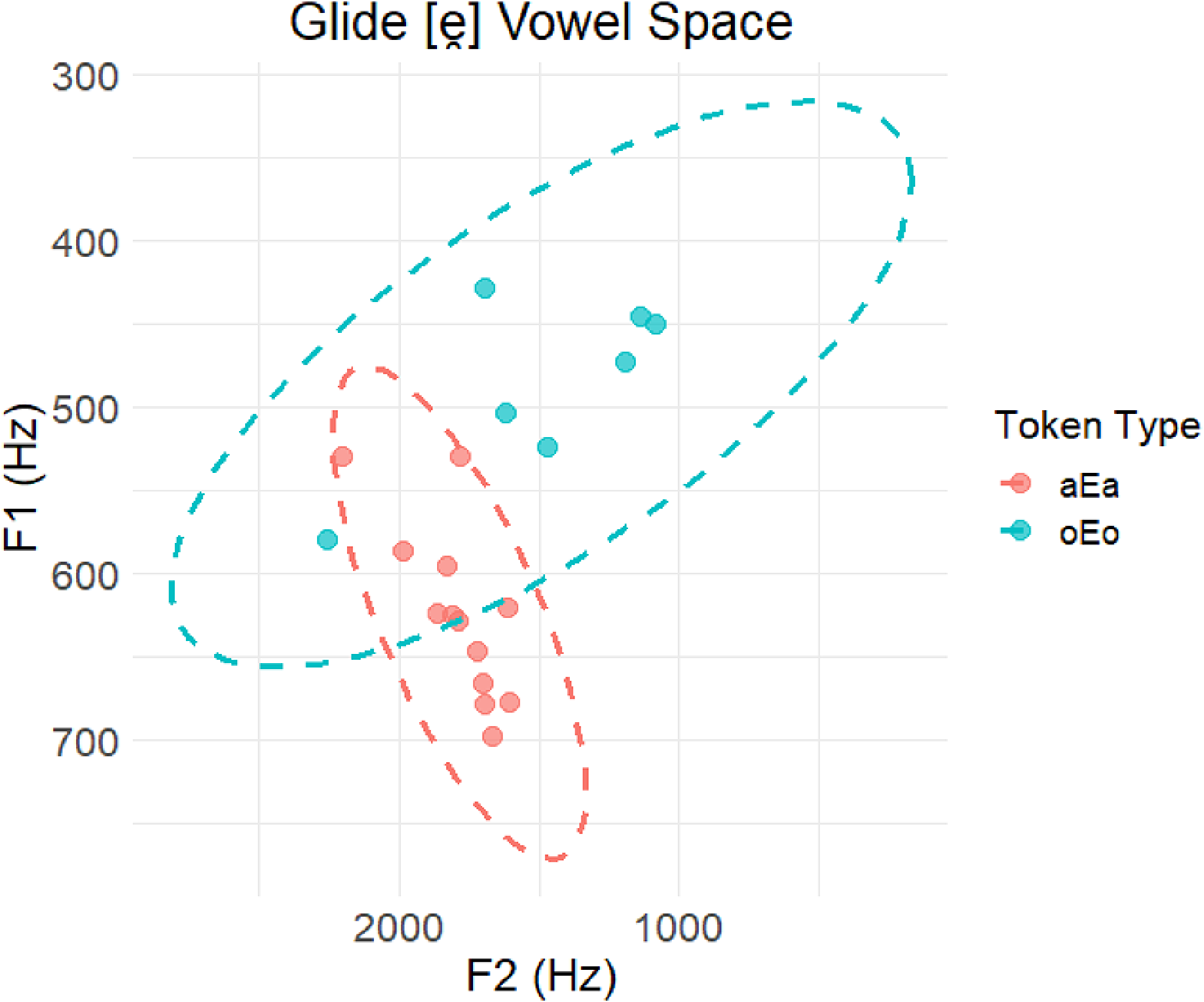
It is important to note that the glides in this dataset represent only surface instances, that is, cases in which the glide is realized. In our data, these occur almost exclusively between back vowels, most of which are low, low-mid, or mid. Consequently, these glides are subject to coarticulatory backing and lowering effects. Indeed, this effect is apparent in Figure 11, which shows that glides in context [oˍo] surface as higher and more back compared to glides in context [aˍa], which are lower and more fronted. This, in addition to the fact that the glide categorically deletes next to [i], but not so next to [a] (despite having similar degrees of acoustic overlap with both vowels in Figure 10), suggests that, underlyingly, absent such surface coarticulation, the glide may in fact be higher, closer to [i] than to [a]. It thus roughly corresponds to a front-mid segment, similar to [e] (that is, it is best transcribed as [e̯], as Zamboni (Reference Zamboni and Cortelazzo1974a) originally suggested). This conclusion contrasts with Dian & Burroni’s (Reference Dian, Burroni, Haro, Repede and Naciri-Azzouz2026: 187) characterization of the evanescent glide as ‘a low-mid front or a mid-central non-syllabic semivowel [ɛ̯] or [ə̯]’.
Vowel chart with tokens from 2 speakers showing the glide spaces for [e̯], in contexts [aˍa] (above: aEa) and [oˍo] (above: oEo). Glide points correspond to the max-F2 value and corresponding F1 value within the trajectory of vocalized percepts.

3.2. Cluster analysis of F2 trajectories
To complement the GAMM results, which captured time-varying formant trajectories, longitudinal k-means clustering was applied to F2 trajectories of sequences containing /l/-mutation between back vowels. This approach allowed us to test whether naturally occurring patterns in the trajectories correspond to perceptual categories (/l/-vocalization vs /l/-deletion).
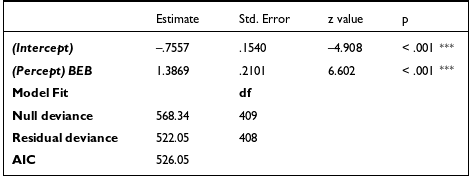
The clustering analysis revealed two distinct groups, one characterized by higher F2 values than the other. To examine whether token condition predicted cluster membership, a logistic regression was conducted with Cluster (A versus B) as the outcome and percept (evanescent glide between back vowels and deletion between back vowels) as the predictor. Cluster A (n = 207) contained mostly /l/-deletion percepts and lower F2 values, whereas Cluster B (n = 203) contained mostly /l/-vocalization percepts and higher F2 values (see Figure 12). The model revealed a significant effect of percept (β = 1.387 for /l/-vocalization), and while the cluster assignment did not always align with the manual classification (vocalization versus deletion) described in section 4, vocalized percepts were roughly four times more likely than percepts with deletion to belong to the cluster with higher F2 (exp(1.387)
 $\approx$
4.0) (see Table A3). In other words, F2 trajectories naturally segregate into two distinct clusters, corresponding to the presence or absence of the glide.
The red line corresponds to cluster A (n=207). The blue line corresponds to cluster B (n=203). Here, BEB signifies percepts of an evanescent glide between back vowels, while BB signifies percepts of a sequence of two back vowels.

3.3. Duration correlates
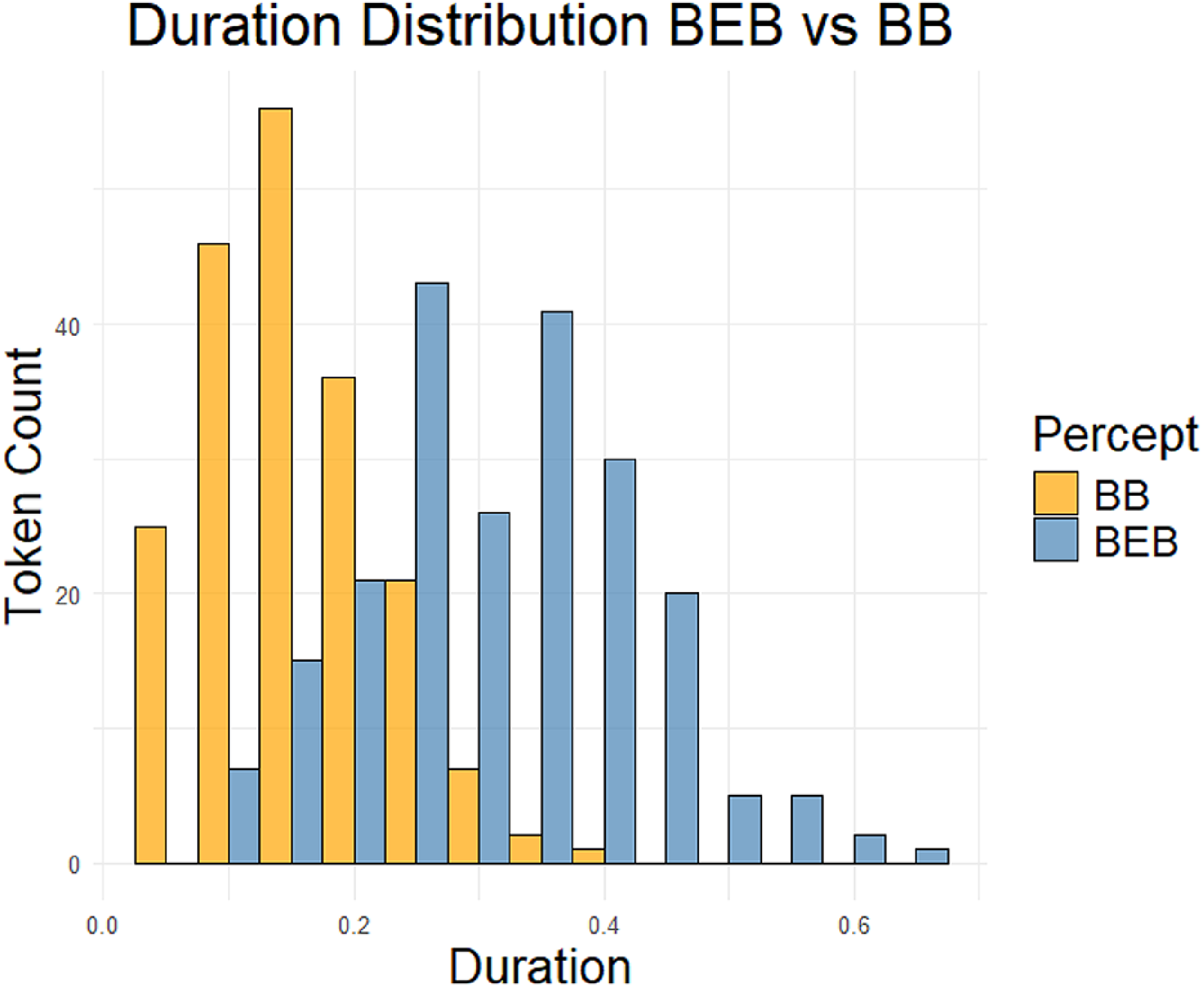
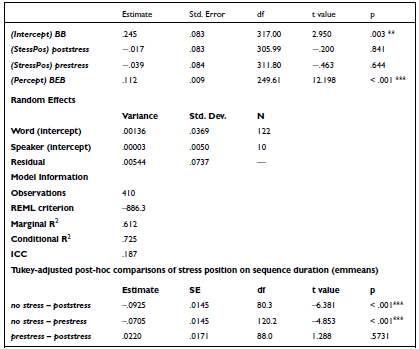
Building on the phonetic distinctions revealed in the GAMM and cluster analyses, we next examined whether these differences are reflected in scalar temporal measures. An LMM was conducted to examine the effects of stress and percept type on sequence duration. Duration was entered as the dependent variable, with percept type (/l/-vocalization and /l/-deletion) and Stress position (no stress, prestress, poststress) as fixed effects, and random intercepts for speaker and word: duration ∼ StressPos + Percept + (1 | speaker) + (1 | word). The overall LMM did not reveal a robust main effect of stress on duration (results reported in Table A1). However, post-hoc pairwise comparisons using Tukey-adjusted estimated marginal means (see Table A1) revealed that no-stress sequences were significantly shorter than both prestress (β = –.071, SE = .015, p < .001) and poststress sequences (β = –.093, SE = .015, p < .001), whereas pre- and poststress durations did not differ (β = .022, SE = .017, p = .573). These results indicate that stress has a modest effect on duration, primarily distinguishing stress-adjacent from stress non-adjacent syllables, but does not differentiate pre- and post-stress sequences. Percept type, by contrast, had a strong and significant effect in the overall LMM: vocalized percepts were longer than percepts with deletion (β = .112, SE = .009, p < .001). This duration difference supports the phonetic reality of glide realization: the presence of a glide adds measurable acoustic material, indicating an intermediate articulatory target between the two vowels. When the data are separated by percept type, an emerging bimodality becomes apparent (Figure 13), with vocalized percepts consistently shifted toward longer durations relative to percepts with deletion. This separation supports an emerging categorical distinction between vocalization and deletion.
Histogram showing duration distributions of BEB (n=216) and BB (n=194) (BEB signifies percepts of an evanescent glide between back vowels; BB signifies percepts of a sequence of two back vowels).

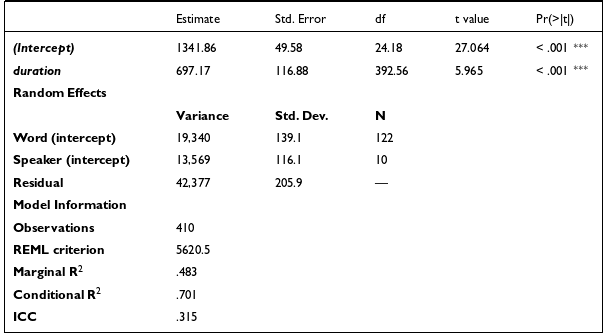
To further examine how temporal differences relate to spectral properties, we assessed the relationship between maximum second formant height and duration. Figure 14 presents the results of the LMM testing whether token duration predicts maximum F2, with random intercepts for speaker and word: maxF2 ∼ duration + (1 | speaker) + (1 | word). The model reveals a strong positive effect of duration: for each unit increase, max F2 rises by about 697 Hz (p < .001), with an estimated intercept of 1342 Hz (see Table A2). In other words, longer durations systematically co-occur with higher F2 maxima. This pattern is consistent with an articulatory interpretation in which longer temporal windows allow the tongue body to more fully approach a fronted target, whereas shorter durations may truncate the gesture, resulting in reduced fronting or apparent deletion. Even with partial overlap, the combined effects of duration and F2 provide reliable acoustic cues for distinguishing glide-retaining vocalized sequences from glide-deleting ones between back vowels.
Max F2 for BEB and BB tokens by duration (total n=410) (BEB signifies percepts of an evanescent glide between back vowels; BB signifies percepts of a sequence of two back vowels).

4. Discussion
4.1. The phonetic profile of the evanescent glide
This section recapitulates the phonetic profile of the evanescent glide [e̯]. Comparisons across back vowel environments further show that [e̯] is acoustically distinct from both deletion percepts and the canonical palatal glide [j]. The most consistent correlate of [e̯] was a rise in F2 in the central portion of the vowel-glide-vowel trajectory, a pattern absent in sequences with deletion, indicating an independent articulatory gesture involving tongue dorsum fronting. The glide’s relatively small effect on F1 reflects a front-mid, vowel-like articulation, roughly consistent with findings in other recent studies (Pecoraro Reference Pecoraro2022; Dian & Burroni Reference Dian, Burroni, Haro, Repede and Naciri-Azzouz2026).
Direct comparison shows that [e̯] differs systematically from [j], exhibiting higher F1 and lower F2 values throughout the trajectory, consistent with a lower and less front articulation. The reduced magnitude of formant movement and more centralized trajectory further suggest that [e̯] is a phonetically weaker and less discrete segment than [j]. Substantial variation in height and extensive overlap with neighboring vowels [i, e, ɛ, a] in the vowel space likely contribute to its gradient realization and susceptibility to reduction or assimilation, which accounts for its frequent weakening and deletion across back vowel contexts.
Furthermore, these percepts pattern non-randomly in the acoustic space. Cluster analysis of F2 trajectories reveals two naturally emerging clusters (Figure 12). Duration measures likewise show evidence of emerging bimodality, with longer durations observed in tokens with glide realization (Figure 13). Higher maximum F2 values co-occur with longer durations, reflecting greater articulatory fronting. This suggests that glide realization varies in articulatory strength, with glide productions characterized by more extensive fronting gestures and resulting in longer temporal intervals.
4.2. Gestural accounts of vocalization and deletion
The following section situates /l/-mutation within the framework of Articulatory Phonology (AP) (Browman & Goldstein Reference Browman and Goldstein1986; Reference Browman and Goldstein1989; Reference Browman, Goldstein, Mattingly and Studdert-Kennedy1991; among other works), in which segments are represented as constellations of overlapping gestures. In adopting this framework, the discussion uses AP as an explanatory model for the observed patterns, and the proposals advanced should be understood as theoretical interpretations rather than direct empirical observations. A growing body of articulatory work converges on the view that laterals are intrinsically bi-gestural, involving both a tongue-tip (TTIP) gesture and a tongue-body (TBODY) gesture (Proctor Reference Proctor2009; Reference Proctor2011; Gick et al. Reference Gick, Campbell, Oh and Tamburri-Watt2006;Footnote 3 Strycharczuk, Derrick & Shaw Reference Strycharczuk, Derrick and Shaw2020; Strycharczuk & Scobbie Reference Strycharczuk, Scobbie, Przewozny, Viollain and Navarro2020; among others). Proctor’s (Reference Proctor2011) ultrasound study on Spanish and Russian liquids showed that the TBODY specification differs cross-linguistically: in Russian, which exhibits ‘dark’ laterals, the TBODY gesture approximates the articulation of a back-mid vowel, whereas in Spanish, which exhibits ‘light’ laterals, the TBODY gesture approximates a front-mid vowel. Similar differences are reported by Ladefoged & Maddieson (Reference Ladefoged and Maddieson1986: 96, 102) for German ‘clear’ /l/ versus Russian ‘dark’ /l/. Since Veneto /l/ also patterns with the ‘light’ type, and the acoustic properties of the evanescent glide—specifically its higher F1 and lower F2 relative to [j]—closely match a mid-front dorsal target, the Estense Veneto lateral can be modeled as a complex of two gestures, with the tongue-body (TBODY) gesture corresponding to the evanescent glide [e̯].
-
TTIP: alveolar lateral constriction
-
TBODY: mid-front tongue-body constriction (
$\approx$
[e̯])

Under conditions of articulatory weakening, the separate parts of this gestural complex may surface independently (cf. Strycharczuk & Scobbie Reference Strycharczuk, Scobbie, Przewozny, Viollain and Navarro2020; Strycharczuk et al. Reference Strycharczuk, Derrick and Shaw2020), as illustrated in the gestural schematic shown in Figure 15.Footnote 4 EMA data from Dian & Burroni (Reference Dian, Burroni, Haro, Repede and Naciri-Azzouz2026: 187) show that intervocalic /l/ consistently lacks TTIP gesture across all vocalic contexts, and that is fully elided in /eˍV/, /ɛˍV/, and /iˍV/ contexts, yielding direct vowel-to-vowel transitions, or static tongue postures in /iˍi/. The fact that the alveolar gesture fails to surface in all intervocalic environments, suggests that TTIP suppression is a universal first step across all intervocalic contexts, as a result of gestural undershoot (i.e., TTIP weakening) in this position. What varies is whether the TBODY gesture survives. If it does, the output is a gesturally and acoustically distinct glide [e̯]; if not, the entire segment is deleted.
Hypothesized stages in the lenition of intervocalic /l/.

When /l/ occurs between back vowels, coarticulatory retraction of the tongue body weakens the alveolar TTIP gesture. However, the dorsal TBODY gesture is typically retained and surfaces as a fronted glide [e̯], despite the articulatory pressures that would favor a more retracted gesture like [ʊ̯]. This suggests that the output is shaped not solely by articulatory efficiency but also by the specification of a fronted articulatory target for ‘light’ /l/. In cases where [e̯] fails to surface, however, further coarticulatory retraction suppresses the TBODY gesture below a certain articulatory threshold, so that the glide gesture is no longer recoverable as distinct from the flanking back segments.
In a similar manner, the deletion of the TBODY gesture next to front vowels, results from the low articulatory distinctiveness of the front glide when adjacent to front vowels. Notably, it is interesting that deletion should occur so readily when at least one flanking vowel is front, whereas vocalization—a precursor to the optional deletion between back vowels—requires both adjacent vowels to be back. In other words, front vowels appear to ‘overpower’ back vowels. This asymmetry further supports the characterization of the evanescent glide as phonologically front (roughly equivalent to a front-mid vocalic segment), since the TBODY gesture is almost never preserved in front-vowel contexts, but is more consistently retained between back vowels. This may be because the glide is already inherently less distinct when adjacent to front vowels, while between back vowels, deletion only occurs when additional coarticulatory retraction suppresses the TBODY gesture below a recoverable threshold. In cases where an articulatorily salient glide is possible (i.e., between back vowels), duration becomes a decisive factor (Section 3.3). Shorter temporal windows limit the tongue body’s ability to reach its fronted target, increasing the likelihood of gestural undershoot and apparent deletion. This pattern aligns with duration-based accounts of lenition (Katz Reference Katz2021; among others), in which constrained articulatory intervals favor weaker or deleted realizations. That is, deletion reflects not categorical segment loss, but rather the interaction of prosodically limited duration with the articulatory demands of the glide gesture.
The behavior of the evanescent glide in Estense Veneto finds strong support in prior articulatory research on lateral consonants. Proctor (Reference Proctor2011: 476) shows that in Spanish, when the tongue-tip gesture of a lateral is weakened or lost, the intrinsic tongue-body gesture can still surface acoustically, yielding a palatal or mid-front vowel-like quality—as in /algo/ → [ai̭.Ɣo]. This supports the idea that vocalized laterals may retain a fronted quality not from coarticulation alone, but due to residual articulatory identity.Footnote 5 Bavarian German provides additional support for this notion: coda /l/ vocalizes to a high front vocoid [ɪ̯], as in [ʃpuɪ̯n] ∼ [ʃpi.lɐ] spielen ∼ Spieler ‘to play’ ∼ ‘player’ or [ʃpuɪ̯] ∼ [ʃpi.lə] Spiel ∼ Spiele ‘game’ ∼ ‘games’ (Noelliste Reference Noelliste2017: 131). In these cases, the glide preserves the tongue-body configuration of the lateral while eliminating the apical constriction, indicating that lenition is governed by surviving gestural structure rather than by categorical segmental substitution (cf. Noelliste Reference Noelliste2017: 141). Similarly, Hardcastle & Barry (Reference Hardcastle and Barry1985) find that English /l/ is more prone to vocalization before [–front] consonants, where alveolar contact is articulatorily costly. Perceptually, this vocalization occurs more often after front vowels, which enhance contrast with the back vowel-like quality of the vocalized [ɫ], making the alveolar gesture less necessary for identification. In Estense Veneto, the evanescent glide behaves in a parallel way: its vocalization survives between back vowels, where coronal contact is weakened, but is typically lost when adjacent to front vowels, where its fronted quality becomes redundant or more difficult to recover.
In sum, modeling /l/-mutation in Estense Veneto within the framework of Articulatory Phonology provides an explanatory account of the continuum /l/ → [e̯] ∼
 $\emptyset$
and captures both its phonetic variation and underlying phonological structure. TTIP suppression occurs universally, while TBODY retention depends on its gestural distinctiveness compared to the flanking vowels. In other words, deletion is gradient and phonetically motivated. The fact that the glide [e̯] surfaces between back vowels but is typically lost near front vowels supports its status as a front segment.
A brief note is warranted regarding the considerably greater phonetic variation in height of [e̯] compared to /j/, as well as its higher susceptibility to deletion. Specifically, [e̯] is more prone to coarticulation than intervocalic /j/ because it occupies the central region of the front-vowel space (Figure 10), making it less distinctive and more easily influenced by surrounding vowels. Furthermore, /j/ is a primary gesture with a well-defined palatal target from the outset. Its anti-phase timing with the following vowel in intervocalic, syllable-onset position ensures minimal overlap, conferring greater stability and resistance to contextual effects. In contrast, [e̯] emerges as a secondary gesture—a byproduct of /l/ weakening—and thus likely inherits substantial articulatory variability. This pattern is consistent with constraint-based models of coarticulation, such as the Degree of Articulatory Constraint (DAC) model (Recasens, Pallarès & Fontdevila Reference Recasens, Pallarès and Fontdevila1997; Recasens & Pallarès Reference Recasens and Pallarès1999; Recasens & Rodríguez Reference Recasens and Rodríguez2017), in which gestures with lower articulatory constraint (i.e., less precisely specified articulatory targets) exhibit greater contextual susceptibility and reduced acoustic stability. Also, because [e̯] derives from a secondary gesture, its gestural planning may not be strictly anti-phase; some degree of in-phase overlap with the following vowel may occur, increasing susceptibility to coarticulation. Finally, [e̯] exhibits greater variability than full vowels such as /e/ because it is non-syllabic and thus articulatorily less stable than syllabic vowels.
4.3. From gradient phonetics to language-specific targets
As discussed in Section 4.2, [e̯] and
 $\emptyset$
remain in a gradient phonetic relationship. The question remains whether this reflects purely ‘universal phonetics’ or ‘language-specific phonetics’ (Hyman Reference Hyman and Yu2013). The bimodal clustering of F2 trajectories (Figure 12) and the emerging bimodal durational distribution of vocalized percepts and those with deletion (Figure 13) suggest an incipient shift toward a categorical distinction between vocalization and deletion. This pattern parallels Shaw and Kawahara’s (Reference Shaw and Kawahara2018a; Reference Shaw and Kawahara2018b) findings for Tokyo Japanese, where devoiced /u/ presents a bimodal distribution reflecting optional full articulation or deletion. Although the bimodality in Estense Veneto is less categorical than the Japanese data, it suggests a shift away from a purely phonetically motivated continuum toward a two-way distinction, wherein words may be optionally realized as [kaˈvae̯o] or [kaˈvao], with intermediate forms becoming less frequent. This suggests that in Estense Veneto, glide realization and deletion between back vowels are shifting from being governed by universal phonetic pressures to being reanalyzed as two ‘conventionalized’ targets (cf. Hualde Reference Hualde, van Oostendorp, Ewen, Hume and Rice2011; Hualde, Simonet & Nadeu Reference Hualde, Simonet and Nadeu2011; Simonet, Ramírez & Torres-Tamarit Reference Simonet, Martínez and Torres-Tamarit2025 on conventionalization).
5. Conclusion
In sum, this study has examined the acoustic properties of the so-called ‘evanescent’ /l/ in Estense Veneto, a phenomenon that, until now, has received limited attention beyond dialectological and impressionistic accounts. In contrast, the present analysis offers fine-grained phonetic data from a specific locality, contributing empirical evidence to ongoing discussions of lateral weakening. The acoustic results confirm that, between back vowels, the glide [e̯] is realized with a marked F2 rise, indicating that [e̯] is phonologically a front-mid segment, though it may vary phonetically, particularly in height. The findings also shed light on the articulatory behavior of ‘light’ laterals, aligning with previous research showing that laterals involve an intrinsic dorsal gesture (Proctor Reference Proctor2011), in this case comparable to a mid-front vowel. In the case of Estense Veneto, [e̯] appears to result from the loss of the TTIP gesture while retaining the TBODY gesture, yielding an output acoustically similar to a mid-front vocoid. This study has shown that in Estense Veneto, glide deletion is phonetically conditioned by the articulatory salience of the surrounding vocalic environment. More broadly, this study refines our understanding of Veneto /l/-weakening, highlights the value of empirical phonetic data beyond traditional descriptive work, and contributes to our broader understanding of sound change.
Acknowledgements
I would like to express my sincere gratitude to the anonymous participants who generously contributed their time to this study, and to the Compagnia Teatro Veneto ‘Città di Este’ for their invaluable support and for kindly providing a space for the recordings. I am also deeply grateful to my advisor, José Ignacio Hualde, for his guidance and insight throughout the planning, execution, and writing of the project. Finally, I thank the two anonymous reviewers for their constructive suggestions, which substantially improved the presentation of this work.
Appendix
Linear mixed-effects model predicting duration from stress position and precept duration ∼ StressPos + Percept + (1 | speaker) + (1 | word)

Table A1 Long description
The table presents a linear mixed-effects model predicting duration from stress position and precept duration. It includes fixed effects for stress position and percept type, with random intercepts for speaker and word. The table is divided into several sections: Fixed Effects, Random Effects, Model Information, and Tukey-adjusted post-hoc comparisons. The Fixed Effects section lists estimates, standard errors, degrees of freedom, t-values, and p-values for the intercept, stress position (poststress and prestress), and percept type. The Random Effects section provides variance, standard deviation, and the number of items for word intercept, speaker intercept, and residual. The Model Information section includes the number of observations, REML criterion, marginal R-squared, conditional R-squared, and ICC. The Tukey-adjusted post-hoc comparisons section shows estimates, standard errors, degrees of freedom, t-values, and p-values for comparisons between no stress, poststress, and prestress conditions.
Percept levels: BEB – evanescent glide between two back vowels; BB – sequence of two back vowels.
Signif. codes *** p < .001, ** p < .01, * p < .05.
Linear mixed-effects model predicting max_F2 from duration max_F2 ∼ duration + (1 | speaker) + (1 | word)

Table A2 Long description
The table presents the results of a linear mixed-effects model predicting max F2 from duration. It includes fixed effects, random effects, and model information. The fixed effects section lists the estimate, standard error, degrees of freedom, t value, and p-value for the intercept and duration. The random effects section provides the variance and standard deviation for word intercept, speaker intercept, and residual. The model information section includes the number of observations, REML criterion, marginal R squared, conditional R squared, and ICC. Row 1: Intercept, Estimate 1341.86, Std. Error 49.58, df 24.18, t value 27.064, Pr(>|t|) < .001. Row 2: duration, Estimate 697.17, Std. Error 116.88, df 392.56, t value 5.965, Pr(>|t|) < .001. Random Effects: Word intercept, Variance 19340, Std. Dev. 139.1, N 122. Speaker intercept, Variance 13569, Std. Dev. 116.1, N 10. Residual, Variance 42377, Std. Dev. 205.9. Model Information: Observations 410, REML criterion 5620.5, Marginal R2 0.483, Conditional R2 0.701, ICC 0.315.
Signif. codes *** p < .001, ** p < .01, * p < .05.
Logistic regression model predicting cluster membership by percept. cluster ∼ Percept

Table A3 Long description
A table with logistic regression model results predicting cluster membership by percept. The table has 7 rows and 5 columns. Column headers are Estimate, Std. Error, z value, and p. Row labels are Intercept, Percept BEB, Model Fit, Null deviance, Residual deviance, and AIC. Row 1: Estimate, -0.7557; Std. Error, 0.1540; z value, -4.908; p, < .001 ***. Row 2: Estimate, 1.3869; Std. Error, 0.2101; z value, 6.602; p, < .001 ***. Row 3: Model Fit, df. Row 4: Null deviance, 568.34, 409. Row 5: Residual deviance, 522.05, 408. Row 6: AIC, 526.05.
Percept levels: BEB – evanescent glide between two back vowels; BB – sequence of two back vowels.
Signif. codes *** p < .001, ** p < .01, * p < .05.










 Open access

