Introduction
Adelges tsugae (Annand) (Hemiptera: Adelgidae) was introduced to the eastern United States of America from southern Japan sometime prior to its discovery in Virginia in the 1950s (Stoetzel Reference Stoetzel, Onken, Reardon and Lashomb2002; Havill et al. Reference Havill, Montgomery, Yu, Shiyake and Caccone2006, Reference Havill, Shiyake, Lamb, Foottit, Yu and Paradis2016a). It is now found from Georgia, United States of America to Nova Scotia, Canada and is causing high levels of mortality to eastern and Carolina hemlocks (Tsuga canadensis (Linnaeus) Carrière and Tsuga caroliniana Engelmann; Pinaceae) throughout this region (Havill et al. Reference Havill, Vieira and Salom2016b). In the Pacific Northwest, there is a cluster of native A. tsugae clones, closely related to the Japanese clone that was introduced to the eastern United States of America (Havill et al. Reference Havill, Montgomery, Yu, Shiyake and Caccone2006, Reference Havill, Shiyake, Lamb, Foottit, Yu and Paradis2016a). Where A. tsugae is native in the Pacific Northwest of North America, it does not cause any noticeable damage or mortality to western hemlock, Tsuga heterophylla (Rafinesque) Sargent (Pinaceae), even though it occasionally reaches very high densities (Kohler et al. Reference Kohler, Stiefel, Wallin and Ross2008). It has been suggested that coevolved host tree resistance and/or native natural enemies keep A. tsugae from causing any significant damage to western hemlock.
Three adelgid-specific predators have been found to be frequent and abundant associates of A. tsugae in the Pacific Northwest (Kohler et al. Reference Kohler, Stiefel, Wallin and Ross2008). Laricobius nigrinus Fender (Coleoptera: Deridontidae) was the first of these predators to be studied and released in the eastern United States of America. Despite releasing several hundred thousand Laricobius nigrinus adults and eggs, and its establishment at over 100 locations, there is currently no evidence that the beetle is reducing A. tsugae populations or hemlock mortality in eastern North America (Mausel et al. Reference Mausel, Davis, Lamb, Zilahi-Balogh, Kok, Salom, Onken and Reardon2011; Mayfield et al. Reference Mayfield, Reynolds, Coots, Havill, Brownie and Tait2015). The other two predators are species of silver flies, Leucopis argenticollis (Zetterstedt) and Leucopis piniperda (Malloch) (Diptera: Chamaemyiidae). Populations of both species appear to be restricted to A. tsugae in the Pacific Northwest, although populations in other parts of the world have been collected in association with other adelgid species (Ross et al. Reference Ross, Gaimari, Kohler, Wallin, Grubin, Onken and Reardon2011, Reference Ross, Kohler and Wallin2017; Havill et al. Reference Havill, Gaimari and Caccone2018). Both Leucopis argenticollis and Leucopis piniperda from the Pacific Northwest are able to feed and complete their development on the Japanese clone of A. tsugae that occurs in eastern North America (Motley et al. Reference Motley, Havill, Arsenault-Benoit, Mayfield, Ott and Ross2017), and small-scale operational releases have occurred in the last few years. Although several studies have compared species level resistance of western hemlock and several other Tsuga (Endlicher) Carrière to A. tsugae (Lagalante and Montgomery Reference Lagalante and Montgomery2003; Evans Reference Evans2008; Jetton et al. Reference Jetton, Hain, Dvorak and Frampton2008; Weston and Harper Reference Weston and Harper2009; Oten et al. Reference Oten, Bauchan, Frampton and Hain2012), no studies have considered potential intraspecific variation in western hemlock resistance. In this study, western hemlock clones growing in an operational seed orchard were evaluated for A. tsugae infestation to identify possible genetic differences in susceptibility.
Materials and methods
This study was conducted in a commercial seed orchard owned by Sierra Pacific Industries on Whidbey Island, Washington, United States of America. Trees were approximately 8–12 m in height with live branches extending to the ground. Trees used in the study were present in two blocks, a northern and a southern block, separated by an open, grassy area about 50 m wide. The northern block was approximately 1.1 ha and the southern block was approximately 1.2 ha.
The trees were rooted cuttings from 133 unrelated parent trees (hereafter, genets). Since the orchard is for production of reforestation seed for Sierra Pacific Industries, it was adapted to their ownership. The parent trees came from elevations of 105–860 m in Whatcom, Skagit, and Snohomish counties, Washington, that is, the west slope of the Washington Cascades. Proprietary genet numbers have been changed for publication. All cuttings were rooted between 1984 and 1988. Past management included irrigation, fertilisation, pesticide applications, and stress treatments to induce flowering. All of these treatments occurred prior to 2010 and all trees were subjected to the same treatments. Numbers of replicates (i.e., clones or, hereafter, ramets) of different genets ranged from one to seven individual trees. Ramets were randomly located within each block. The trees selected to be represented in the seed orchard were included due to their desirable silvicultural characteristics, that is, rapid growth rate and good form.
On 5 July 2016, 452 trees were assessed for their A. tsugae abundance by categorising infestation levels as absent (no A. tsugae flocculence observed), low, or high. Trees categorised with a low infestation had visible A. tsugae flocculence on less than 50 % of the branches in the lower 3 m of the crown and those categorised with a high infestation had visible A. tsugae flocculence on greater than 50 % of the branches. The subjectivity of this assessment was reduced by verbal consensus between two experienced observers looking at each tree from opposite sides.
There are no published data documenting the population dynamics of A. tsugae in western North America. However, two of the authors (D.W.R. and K.F.W.) have followed populations at a number of different locations in western Oregon and Washington for 10–15 years as part of various research projects. Our observations indicate that A. tsugae populations remain at high levels (similar to those found in eastern North America on eastern hemlock) on trees at a given location for no more than one to a few years before declining to undetectable or nearly undetectable levels, that is, no ovisacs or only a few scattered ovisacs. Populations remain at low levels for one to a few years before again reaching high densities. We have watched this change in population density through as many as 3–4 cycles at some locations. Consequently, the best time to assess possible resistance or tolerance to A. tsugae on individual trees at a given site to document differences in infestation levels is during a year when populations are at high levels in that area. At the time that we evaluated the trees in this study, A. tsugae infestation in the seed orchard was obvious on well over 25% of the trees in the orchard and many of those supported high populations. In contrast, by spring 2019, there were only a few scattered ovisacs among all the trees in the seed orchard. We did not make any effort to identify the adelgid species through morphological or genetic methods, because there is only one species (including six geographically distinct lineages) of woolly adelgid associated with hemlocks throughout the world (Havill et al. Reference Havill, Montgomery, Keena, Onken and Reardon2011). For this same reason, we did not deposit voucher specimens into a collection.
Data analyses
Join-count statistics were used to test for spatial autocorrelation among the nominal A. tsugae data. The A. tsugae abundance level data were consolidated into presence/absence. These tests were run separately for the two blocks because the blocks were composed of exclusively different hemlock genets. The Z-distribution was used for reference and this theoretical distribution was considered dependent instead of independent. That is, a distribution assuming nonfree sampling without replacement was used instead of one assuming free sampling with replacement; the probability of occurrence for this distribution was determined from the sample area, which was not assumed to represent a larger area; and this probability was not known a priori independent of sampling. In the calculations for the join-count statistics, the numbers of neighbours with different categorical attributes were counted for each sampling unit quadrat in space. In this case, sampling quadrats were trees and the categorical attribute was presence/absence (occurrence) of A. tsugae. The “queen” neighbouring scheme was used, meaning that neighbours of a focal tree were quadrats containing trees potentially in eight directions from the quadrat representing the focal tree. These eight directions were those diagonally neighbouring the quadrat to the northwest, northeast, southeast, and southwest, as well as those neighbouring straight-on to the west, north, east, and south. A bilateral Z-test was used with an alpha value of P = 0.05 for the number of joins of presence and absence quadrats.
Chi-square analysis was used to assess the significance of differences in frequency of A. tsugae levels on different genets of hemlock. For the χ 2 analysis, hemlock genets with four or more ramets in the orchard were used. The two blocks were not separated in this analysis because the hypothesis being addressed was not spatial. To reduce the risk of type I error stemming from multiple comparisons, the Bonferroni correction was used for adjusting the alpha value for evaluating the P-values from these χ 2 tests. Since five tests were conducted, a standard alpha value of P = 0.05 was adjusted to 0.01, which was considered significant. All statistical analyses were performed using the R-3.3.2 for Windows (32/64 bit) statistical package (Hornik Reference Hornik2018).
Results
A clumped spatial distribution of A. tsugae on the hemlock clones was not supported. Z-tests of the two join-count statistics for both the northern and southern blocks were nonsignificant (Z observed < Z critical). Thus, the observed distribution was not significantly different from random.
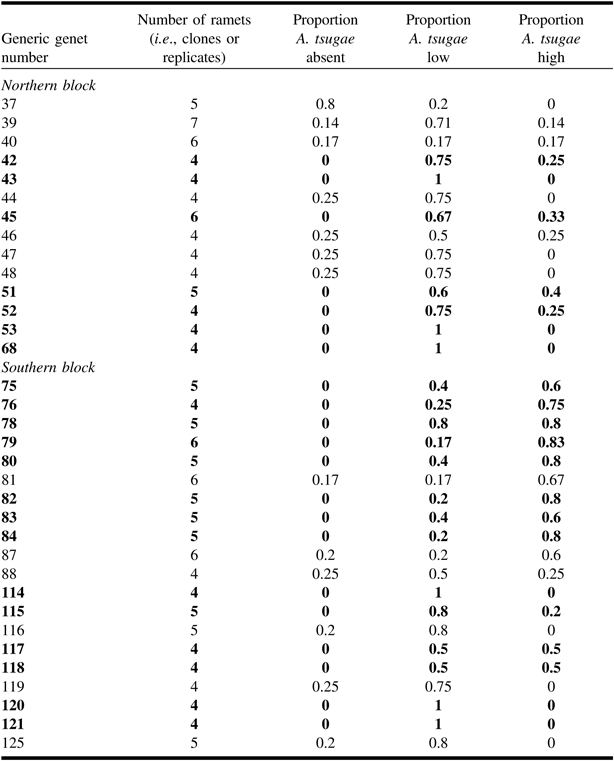
The proportions of ramets with A. tsugae levels of absent, low, and high for genets represented by four or more ramets were determined (Table 1). Most of the genets with four or more ramets had no ramets free of A. tsugae infestation (21 out of 34 in total; Table 1). None of the remaining 13 genets with four or more ramets, some of which were free of A. tsugae infestation, were exclusively A. tsugae free. In summary, all genets with four or more ramets had some ramets infested by A. tsugae.
The proportions of ramets with Adelges tsugae absent, low, and high are displayed for genets represented by four or more ramets. Those genets that had no ramets free of A. tsugae are bolded.

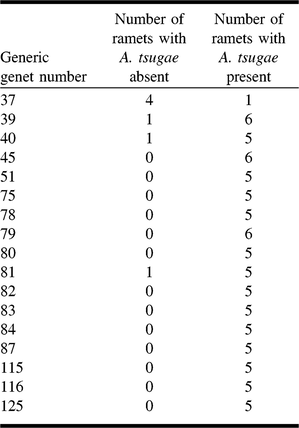
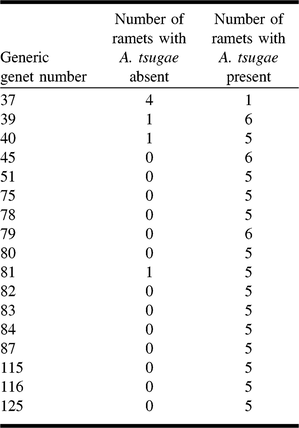
The first Pearson’s χ 2 test used genets with four or more ramets each and A. tsugae levels of absent, low, and high. The frequencies of these levels varied significantly by genet (χ 2 = 107.3; df = 66; P < 0.001). The second test again used genets with four or more ramets each, but A. tsugae levels were absent and present (combined low and high). The frequencies of A. tsugae presence/absence did not vary significantly by genet (χ 2 = 48.7; df = 33; P = 0.04). The third test used genets with five or more ramets only and A. tsugae levels of absent, low, and high. The frequencies of these levels varied significantly by genet (χ 2 = 61.7; df = 32; P < 0.01). The fourth test also used genets with five or more ramets, but A. tsugae levels of absent and present. The frequencies of A. tsugae presence/absence varied significantly by genet (χ 2 = 35.8; df = 16; P < 0.01) (Table 2). Finally, the fifth test used only genets with six or more ramets and A. tsugae levels of absent and present. The frequencies of A. tsugae presence/absence did not vary significantly by genet (χ 2 = 2.1; df = 4; P = 0.71).
The numbers of ramets with Adelges tsugae absent and present for genets represented by five or more ramets. These are the data that were used for the fourth χ 2 test (χ 2 = 35.8; df = 16; P ≤ 0.01).
Discussion
There was no evidence that Adelges tsugae distribution among the hemlock trees in the seed orchard was significantly different from random. The hypothesis of spatial clumping of A. tsugae in the seed orchard could be rejected based on the nonsignificant Z-tests of the join-count statistics. This helped to justify pooling all of the genets across the two blocks for the χ 2 analysis because spatial configuration could be eliminated as an explanatory variable for A. tsugae infestation levels on the different trees. There was no apparent local uniqueness in space experienced by the hemlock trees that would affect the spatial distribution of A. tsugae.
The χ 2 analysis suggests that there is a genetic basis for different levels of A. tsugae on western hemlock trees in the seed orchard, but the results are equivocal. All of the tests using A. tsugae levels of absent, low, and high were significant, meaning that frequencies of ramets with different A. tsugae levels varied by genet. The fact that the vast majority of genets with four or more ramets had no trees lacking A. tsugae (21 out of 34 in total; Table 1) and none of these genets was exclusively A. tsugae-free (Table 1) indicates there is no complete resistance to A. tsugae among the clones represented in the seed orchard. This is supported by the nonsignificant result of the χ 2 test of A. tsugae presence/absence frequencies among genets with four or more ramets. However, there may be genetic variation in A. tsugae susceptibility or tolerance because some genets tended to host more A. tsugae than others.
The small numbers of ramets in the different genets reduced the degrees of freedom for the χ 2 tests and thus the ability to infer genetic differences in frequencies of A. tsugae levels. If more of the genets had been represented by a larger number of ramets, then more of the data could have been used. However, there was significant variation by genet in presence/absence of A. tsugae for genets with five or more ramets. The genets used for this test are worth examining more closely for possible resistance to A. tsugae (Table 2). The genet with the generic number 37 uniquely had A. tsugae absent on four out of five ramets, whereas all of the other genets had A. tsugae present on the majority of ramets and most of these genets had no ramets lacking A. tsugae.
Acknowledgements
We thank Doug Sand and Sierra Pacific Industries for providing access to the field site. Dan Cress helped facilitate this access and we thank him as well. We gratefully acknowledge the role of Ariel Muldoon in the Department of Forest Ecosystems and Society, College of Forestry, Oregon State University (Corvallis, Oregon, United States of America) for her advice to the lead author on statistical design and computing. Thanks also to the United States Department of Agriculture Forest Service Hemlock Woolly Adelgid Initiative for funding this work.