Introduction
Outpatient Parenteral Antimicrobial Therapy (OPAT) is a common and safe method to administer intravenous antimicrobials for medically stable patients still requiring treatment after hospital discharge. While OPAT is traditionally administered with assistance from trained healthcare personnel (H-OPAT) via home health services, infusion/hemodialysis centers, or skilled nursing facilities, patients without health insurance often cannot afford H-OPAT services leading to longer hospital stays and avoidable healthcare costs. Reference Bhavan, Brown and Haley1,Reference Williams, Baker, Kind and Sannes2 Self-administered OPAT (S-OPAT) involves outpatient antimicrobial administration without assistance from home health services. Therefore, patients can continue intravenous medications at home while attending weekly clinic visits for line care, lab monitoring, and medication supply. S-OPAT has been described as a safe, economic alternative to H-OPAT since the 1970s, but it has yet to be adopted as common practice in the United States. Reference Bhavan, Brown and Haley1,Reference Antoniskis, Anderson, Van Volkinburg, Jackson and Gilbert3,Reference Bhavan, Agrawal and Cerise4 Prior cohorts reviewing S-OPAT clinical and safety outcomes typically included fewer than 1,100 episodes. Reference Bodycot, Mashonganyika, Kucziw, Ingham, Bhukera and White5–Reference Keller, Dzintars, Gorski, Williams and Cosgrove7 This cohort size remains true for S-OPAT studies focused on uninsured patients in the United States; however, reviews for this subset also commonly have less than 1–5 years of data. Reference Bhavan, Brown and Haley1
Bloodstream infections (BSI) and hospital readmissions are commonly measured safety outcomes of OPAT programs, regardless of administration setting. Reference Kaul, Haller and Yang8 However, safety metrics are extremely limited for S-OPAT episodes. This data is necessary to ensure the clinical effectiveness, safety, and sustainability of S-OPAT programs.
At Parkland Health, a safety-net hospital in Dallas, TX, we established an S-OPAT program for uninsured patients in 2009. Patients are eligible if they have stable housing, running water, reliable transportation, and no history of intravenous drug use at enrollment. While healthcare personnel are not required for antimicrobial administration, patients must come to Parkland for nursing services/line care, phlebotomy, and pharmacy services.
The first four years of this program demonstrated a decreased risk of 30-day readmission among S-OPAT compared to H-OPAT with no significant difference in 1-year mortality. Reference Bhavan, Brown and Haley1 The objective of this study is to assess BSI rates for H-OPAT episodes compared to S-OPAT episodes, using line-related BSI as a safety marker.
Methods
A retrospective chart review of all OPAT episodes between October 2012 and December 2023 was performed identifying patients through an OPAT registry at Parkland Health. Medical records were used to collect demographic information and identify patients with BSIs, defined in the CDC’s patient safety manual, with microbiologically confirmed BSIs diagnosed within 90 days of hospital discharge for H-OPAT patients or BSIs diagnosed before the end of the treatment period for S-OPAT patients. 9 To capture BSIs outside the CDC’s CLABSI definition but still representing S-OPAT–related harm, we applied CLABSI criteria to peripheral catheters as well, identifying BSI requiring peripherally inserted central catheter or midline removal that fall beyond standard CLABSI surveillance. All identified BSI cases were reviewed by two reviewers with further adjudication, when necessary, to determine if the infectious source was secondary to the patient’s intravenous access.
Demographics and outcomes were evaluated with the χ2 test for categorical data and t-test for continuous data. For skewed data, the Mann-Whitney test was utilized. Results were considered significant at a P value < .05. All statistical analysis was performed with Python 3.11 (Python Software Foundation). This study was approved by the University of Texas Southwestern Institutional Review Board.
Results
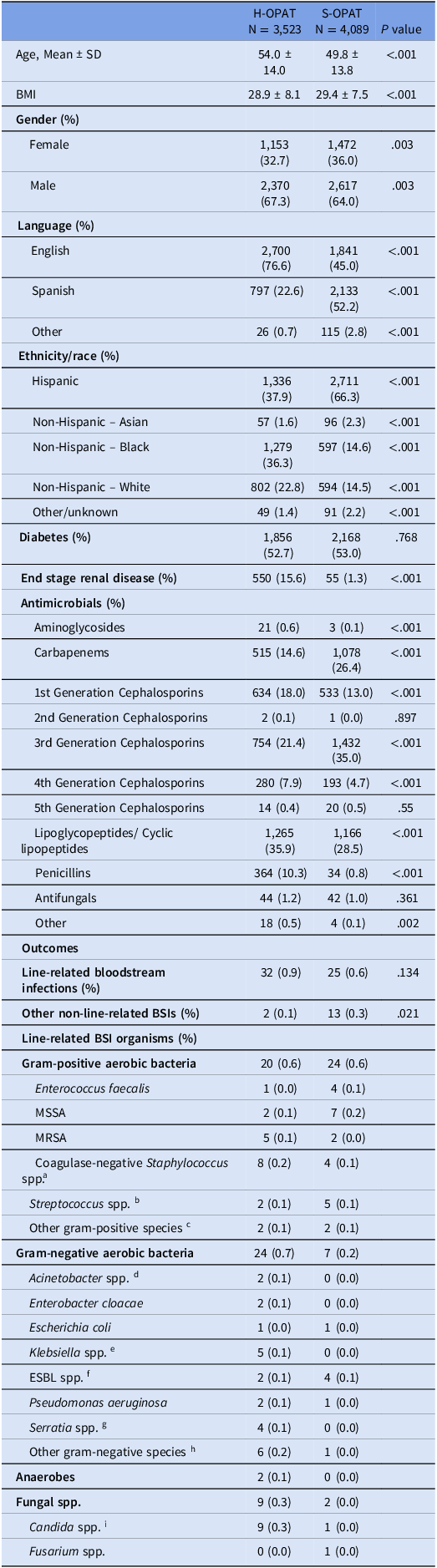
Of 7,612 OPAT episodes from 2012 to 2023, 3,523/7,612 (46.3%) were H-OPAT episodes and 4,089/7,612 (53.7%) were S-OPAT episodes. The H-OPAT population was comprised of older patients (54.0 vs. 49.8, P < .001), a higher proportion of men (2,370/3,523 (67.3%) vs. 2,617/4,089 (64.0%), P = .003), and a smaller proportion of Spanish speaking patients (797/3,523 (22.6%) vs. 2,133/4,089 (52.2%), P < .001). Comorbid diabetes was similar (H-OPAT: 1,856/3,523 (52.7%) vs. S-OPAT: 2,168/4,089 (53.0%), P = .768), but the H-OPAT population included significantly more patients with end stage renal disease (550/3,523 (15.6%) vs. 55/4,089 (1.3%), P < .001). The H-OPAT population also had more methicillin-resistant Staphylococcus aureus (5/3,523 vs. 2/4,089) and fewer extended spectrum beta-lactamase species (2/3,523 vs. 4/4,089) BSIs compared to S-OPAT (Table 1).
Demographics and outcomes of patients within the OPAT registry per OPAT case

H-OPAT, Healthcare-administered outpatient parenteral antimicrobial therapy; S-OPAT, Self-administered outpatient parenteral antimicrobial therapy; SD, Standard Deviation; BMI, Body mass index; BSI, Bloodstream Infection; MSSA, Methicillin-susceptible Staphylococcus aureus; MRSA, Methicillin-resistant Staphylococcus aureus; spp., species; ESBL, Extended Spectrum Beta-Lactamase.
a Staphylococcus capitis, Staphylococcus epidermidis, Staphylococcus warneri.
b Streptococcus pneumoniae, non-Streptococcus pneumoniae alpha-hemolytic Streptococcus species, Streptococcus agalactiae, Streptococcus anginosus.
c Aerococcus viridans, Vancomycin-resistant Enterococcus faecium.
d Acinetobacter baumanii, Acinetobacter lwoffi.
e Klebsiella pneumoniae, Klebsiella oxytoca, Klebsiella variicola.
f Escherichia coli, Klebsiella pneumoniae, Klebsiella oxytoca.
g Serratia marcescens, Serratia odorifera.
h Citrobacter freundii, Elizabethkingia species, Ochrobactrum species, Stenotrophomonas maltophilia, non-fermenting gram-negative rods.
i Candida auris, Candida albicans, Candida glabrata, Candida tropicalis, Candida parapsilosis, Candida guilliermondii.
There was no statistically significant difference between the number of BSIs secondary to intravenous access among H-OPAT episodes compared to S-OPAT episodes identified (32/3,523 (0.9%) vs. 25/4,089 (0.6%), P = .134). A multivariable analysis for BSIs controlling for age, gender, English/non-English speaking, end stage renal disease, and diabetes also showed a non-significant adjusted odds ratio for S-OPAT patients of 0.68 [95% CI: 0.32–1.44, P = .31].
Discussion
S-OPAT was designed as an alternative to prolonged hospital stays for uninsured patients requiring long-term intravenous antimicrobials. Reference Bhavan, Brown and Haley1 When reviewing BSIs caused by methicillin-resistant Staphylococcus aureus and extended-spectrum beta-lactamase species, increased lipoglycopeptide usage for H-OPAT patients and carbapenem use for S-OPAT patients aligns with antimicrobial stewardship practices. Reference Timsit, Ruppé, Barbier, Tabah and Bassetti10 However, there is a concern about the safety of discharging patients with vascular access and limited healthcare access. Our data demonstrates that S-OPAT shows comparable safety to H-OPAT services, the current standard of care, when measured by BSI rates. S-OPAT provides patients autonomy to receive care in their homes while saving healthcare-associated costs. This data also represents the largest S-OPAT episode cohort published to date.
This report’s primary limitation was selection bias from the screening eligibility applied to S-OPAT patients, but a multivariable analysis was performed to minimize its impact. Patients might have also received a diagnosis/treatment at another facility; however, this limitation is minimized as most of our patients are uninsured/underinsured. Further investigation is needed into factors that predict clinical success in S-OPAT episodes to better individualize care. This data continues to support that S-OPAT is a safe alternative to H-OPAT for our safety net population.
Acknowledgements
We would like to acknowledge the hard work and dedication of the OPAT Clinic Staff and the pharmacy infectious diseases specialists for their care of this patient population: Brenton Hall, Norman Mang, Jessica Ortwine, and Wenjing Wei. We would also like to thank the Hirsch Family Foundation for supporting the Center of Innovation and Value at Parkland and this work.
Financial support
None reported.
Competing interests
All authors report no conflicts of interest relevant to this article.