Is it known what adventurous printer, and what date, first disused the long s?
(Warwick Reference Warwick1855: 49)
1 Introduction
In 1855, the British journal Notes & Queries published the above-cited request by a man named Eden Warwick for information on the use of long-s. Warwick continued his question with: ‘Probably some of your correspondents remember noticing the innovation, which seems to have taken place soon after 1800’ (Warwick Reference Warwick1855: 49). More than half a century later, between 1907 and 1913, the same journal published several notes it had meanwhile received on the topic. Under the headings ‘S, Its Long and Short Forms’ and ‘Long “S”, Date of Disappearance’, readers discussed the disappearance of long-s from printed works, while giving instances of its continued, although rare, use from books dated as late as 1881. Remarkably, however, not one of these comments included observations about handwritten material. As the present article will show, in letters the use of long-s, hereafter also referred to as <ſ>, lingered just as long but seems to have been not nearly as rare.
In this article, we will first discuss what literature is available on the use of long-s in printed works in English in the eighteenth and nineteenth centuries. We will then review what, if anything, Late Modern English grammars and dictionaries had to say about the subject. As the next step, we will look at eighteenth- and nineteenth-century manuscripts and analyse the usage of <ſ> in the letters of two renowned grammarians: Joseph Priestley (1733–1804) and Lindley Murray (1745–1826).Footnote 1 Before concluding, we will briefly discuss the use of long-s by a few other letter writers from the period, who persisted in using it well after it had been discarded in print.
2 Long-s in the printed word
Considering the fact that long-s is a very noticeable orthographic feature – a present-day reader could easily confuse <ſ> with <f> and might even wonder whether two separate characters for <s> were necessary at all – it was surprising how little scholarly discussion of its use can be found. We found nothing, for instance, on long-s in Scragg's A History of English Spelling (Reference Scragg1974), and when Upward & Davidson discuss <s> in several entries for separate periods (Reference Upward and Davidson2011: 53–6, 152–7, 188, 212, 275–78) in The History of English Spelling, their focus is on the relation between spelling and pronunciation, and they do not mention long-s. There is also no mention of long-s in the chapter on orthography in the third volume of the Cambridge History of the English Language (Salmon Reference Salmon and Lass1999); and although Görlach mentions in his handbook on eighteenth-century English that two allographs for long-s co-existed in eighteenth-century English typefaces, and observes that they appear to have fallen out of use at the beginning of the nineteenth century (Görlach Reference Görlach2001: 79, 81), he does not discuss their usage. More recently, Tieken-Boon van Ostade (Reference Tieken-Boon van Ostade2009: 40) touches upon the long-s in her chapter on spelling and very briefly illustrates its practice.
According to Nash (Reference Nash2001: 3), ‘the only fundamental change in the range of textual characters used by printers has been the abandoning of the “long s”’. Palaeographers and historians of typography have established that the use of the allograph <ſ>, with its italic variant <ʃ>, dated back as far as the first century AD, when it occurred in the Old Roman Cursive script (see West Reference West2006, Reference West2008; Mosley Reference Mosley and Tuohy1995, Reference Mosley2008). The long-s arrived in England via the Carolingian and Gothic scripts, from which it was carried over into print with the introduction of the modern printing press in England in the late fifteenth century by William Caxton (1415/24–92).
2.1 The eighteenth century
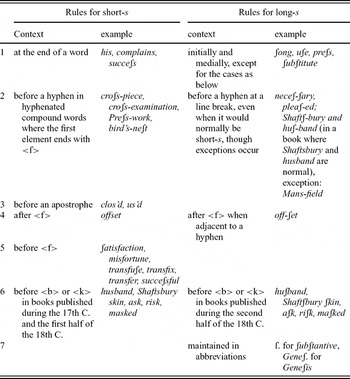
West (Reference West2008) has examined the use of short-s and long-s in texts printed in several languages in the seventeenth and eighteenth centuries. In table 1 below, we have summarised the rules West formulated for English,Footnote 2 and we have numbered them for ease of reference in the discussions that follow. Where possible, we have grouped them in pairs of complementary rules, starting with the general rule as it was also found in eighteenth-century grammars and dictionaries.
Rules for long-s and short-s (summarised from West Reference West2008)

It seems that some of these rules, such as the requirement to use short-s before the character <f>, mainly existed to avoid possible confusion, in both printing and reading, of <ſ> with the similarly shaped <f>. As illustrated in table 1, West (Reference West2008) deduced no rule for the use of double-s in printed works.
Nash (Reference Nash2001), tracing the disappearance of <ſ> from British printing, observes that ‘[i]n some circumstances, and in some languages more than others, double s was rendered with the first long and the second short’ (Nash Reference Nash2001: 3). Nash also notes that some variation occurred in double-s contexts:
[I]n eighteenth-century printing, one would normally find the phrase ‘sausages satisfy grossness’ set in lower-case roman type as ‘ſauſages ſatisfy groſſnes.’ One might also find ‘groſsneſs,’ but ‘groſſneſſ’ or ‘ſauſageſ’ are rare, and are perhaps most likely to signify a shortage of the short s in a printer's cases. (Nash Reference Nash2001: 4–5)
2.2 The nineteenth century
It seems safe to assume that printing practices will have had some influence on the disappearance of long-s from handwritten documents and therefore we continue our discussion of printing practices into the nineteenth century. It was almost at the end of the eighteenth century, in 1798, that Stephen Jones (Reference Jones1798) noted a new development in the printing world under the entry ‘S’ in his pronouncing dictionary, as follows:
In printing, the long ʃ is generally uſed at the beginning and in the middle of words, but the ſhort s always at the end. [A new mode of printing entirely without the long ʃ has lately been brought into partial uſe.] (Jones Reference Jones1798: S)
Within a very brief period, the development described here would have all but eradicated the use of <ſ> from the printed word. The year 1800 is generally considered as the year in which this allograph disappeared from printed works; in fact, the turn of the century is seen as such a clear demarcation point that book antiquarians use the presence or absence of <ſ> to date books to either pre- or post-1800. Nash (Reference Nash2001: 13) argues that ‘[i]n retrospect it seems curious that so few printers cast off the long s before 1800’ when ‘[t]here was no logical reason to continue with such a convention’. He further notes that ‘by the end of the century, it appears that the long s was perceived . . .as a confusing and old-fashioned character’ (Nash Reference Nash2001: 13) and that printing practices lagged behind due to the conservatism of the printers.
The abandonment of <ſ> in British printing had been preceded by a similar development on the European continent several decades earlier. The first modern typefaces are usually taken to be those cast by the French typefounder Didot and the Italian Bodoni in the early 1780s, neither of whom included <ſ>. Nash (Reference Nash2001: 6) assumes that ‘these typographers may have been influenced by changes that had occurred in Spanish printing’, in which the absence of <ſ> was already common by the 1770s. According to Nash, in Britain, ‘the earliest work to be printed without the long s was probably the first edition of Joseph Ames's Typographical antiquities’ in 1749, which was done intentionally in order to ‘distance the bibliographical descriptions from the “antient” books described, and signal this as a “modern” publication, by the typography of the text’ (Nash Reference Nash2001: 4). The argument of modernity, besides that of readability, is given implicitly as a reason for the discontinuation of <ſ> in other works, too; as Nash argues, ‘[t]he dropping of the long s was therefore partly a gimmick, a way for printers and publishers to signal their modernity’ (Nash Reference Nash2001: 14). In Britain, the first modern typeface was cast by the typefounder and bookseller John Bell (1745–1831) in 1787, although before that year, Bell ‘had already dropped the long s from several publications, including his newspaper The world’ (Nash Reference Nash2001: 7).
According to West (Reference West2008), the general demise of <ſ> happened just after the turn of the century. As he puts it, ‘[t]he death knell for long s was finally sounded on September 10th 1803 when . . . The Times newspaper quietly switched to a modern typeface with no long s or old-fashioned ligatures’ (West Reference West2008). Mosley (Reference Mosley2008) additionally argues that the discontinuation of <ſ> in some typefaces from the mid eighteenth century onwards happened for practical reasons:
It seems likely that these eighteenth-century examples in Britain and Spain represent the beginning of a revolt against the irrational use of two different forms of one letter, which meant that as well as the long s itself the printer had to find room in the case for its many ligatured sorts as well as the inevitable five for f. (Mosley Reference Mosley2008)
This argument is corroborated by at least one contemporary account. The English printer John Bell explains his decision to discontinue the use of long-s in the ‘Advertisement’ prefixed to Bell's Edition of Shakspere (1788) as follows:
In the mode of printing too, he hath ventured to depart from the common mode, by rejecting the long ſ in favour of the round one, as being less liable to error from the frequent imperfections of the letter f; the regularity of the print is by that means very much promoted, the lines being more open, without really being at any additional distance. (Bell Reference Bell1788: 2)
Nash (Reference Nash2001) provides us with another reason why Bell may have decided to discontinue using <ſ>:
Bell's willingness to sweep the long s from his cases was therefore partly an attempt to improve the accuracy (and thereby the speed and cost) of composition and proof-correction, and partly a genuine attempt to make his text clearer for the reader. (Nash Reference Nash2001: 8–9)
According to Nash (Reference Nash2001: 3), the tipping point between the use and disuse of long-s in printing in Britain literally was the turn of the century: ‘remarkably, the majority of British printers ceased to use the long s in the same year, 1800’. In a sample of books published in London at the very start of the nineteenth century, the use of <ſ> dropped from 90 per cent in 1800 to less than 25 per cent in 1801 (Nash Reference Nash2001: 9–10). In addition, Nash found two works in which <ſ> disappeared at some point in the middle of the book, simply because these works were begun by one typesetter, who used <ſ>, and finished by another, who did not (Nash Reference Nash2001: 11–13).
Since in section 4.2 we will analyse long-s usage in manuscript letters written by Lindley Murray, it is interesting to also briefly consider printing practices in several editions of his English Grammar, the first edition of which appeared in 1795, so just before the watershed.Footnote 3 Murray's printers initially tried to follow the rules as described above in table 1, although typesetting errors in this respect occasionally occurred. To give an example, in the chapter on orthography (Murray Reference Murray1795: 1–19), Murray clarified the ‘maxim’ that words ending with a double letter in some cases will preserve this letter double when ‘taking neʃs, leʃs, ly, or ful after them’, while examples are printed as ‘harmleſſneſs, careleſſneſs, careleſsly . . . distreſsful, &c’ (Murray Reference Murray1795: 18; our emphasis).Footnote 4 According to West (Reference West2006), the combination <ſſ>, frequently found throughout this first edition of the English Grammar, was not among the correct options, and therefore <ſs> would have been called for in all these instances.
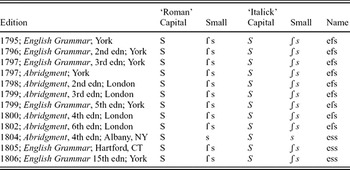
Within a few years, Murray's printers, both in America and in England, for subsequent editions completely abandoned the use of <ſ>, which would end this kind of typesetting mistake. Whereas the 1799 edition of the English Grammar, printed in York, still shows <ſ> throughout, by the time the first Connecticut edition appeared in 1805 and the sixteenth English edition was printed in 1806 all instances of long-s were replaced by modernised short ones. By then only Murray's list of characters in the chapter on orthography in the various editions still indicated that <ſ> had once been in use, either in roman or italic, in his earlier editions. Table 2 illustrates this process of disappearance from Murray's English Grammar as well as from his Abridgment, first published in 1797; it shows the allograph <ſ> as it occurs in Murray's orthographic overview in the editions mentioned, with under ‘Name’ the notations for the ‘sound’ that the character s signified (Murray Reference Murray1795: 3).
Use of <ʃs> versus <ss> in a selection of editions and reprints of Murray's grammar
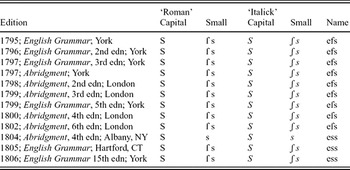
Nash (Reference Nash2001: 15) finds that the printers of York ‘appear to have been particularly slow to adopt the new typographical style of the capital’, and in this respect he specifically mentions Murray's printing house Wilson & Spence. As the final column in table 2 shows, it was some time between 1802 and 1806 that the allograph <ſ> disappeared from the English editions of Murray's grammars, while in America, a fourth edition printed in Albany, NY, lost <ſ> by 1804; we can see that this edition no longer even included it in the overview of characters in his section on orthography. An earlier American edition of Murray's English Exercises (Reference Murray1797), printed in Newark in 1802, already had short-s throughout.
Williams (Reference Williams1979: 98) concludes that long-s ‘was almost eradicated from English printing by the end of the first quarter of the nineteenth century’, although the use of the allograph <ſ> ‘was revived for a time for the sake of its antiquarian flavour . . . towards the middle of the nineteenth century’ (Mosley Reference Mosley2008). Before we come to our analysis of the use of long-s in the manuscript letters from Priestley and Murray, in section 3 we will consider what contemporary grammarians and dictionary writers had to say on the subject.
3 Long-s according to LModE grammars and dictionaries
Somewhat surprisingly, Smith's Printer's Grammar (1755), available in Eighteenth Century Collections Online (ECCO), has no mention of rules for the use of <ſ> (cf. West Reference West2008), with the exception of the observation that due to technical considerations in setting type, it was allowed for printers and typesetters to use short-s, also called round s, after the grapheme <g>, counter to the general rules concerning the use of <ſ>:
[I]n some Italics the lower-case g will not admit of another g to stand after it . . . neither will it give way to ʃ, and the ligature ʃt; and therefore a round st is cast to some Italic Fount, to be used after the letter g; but where the round st is wanting, an st in two pieces might be used with out discredit to the word, rather than to suffer the long ʃt to cause a gap between the g and the said ligature. (Smith Reference Smith1755: 16–17)
As pointed out in West (Reference West2008), the use of <ſ> is discussed in later editions of Thomas Dyche's Guide to the English Tongue (Reference Dyche1707) and Nathan Bailey's Universal Etymological English Dictionary (1727), published in 1785 and 1756 respectively. We found that in the 1710 edition of Dyche's Guide to the English Tongue (which is the earliest edition in ECCO) it reads that ‘[t]he long ʃ muſt never be us'd at the End of a Word, nor immediately after the ſhort s’ (Dyche Reference Dyche1710: 103). And in the 1727 edition of the Universal Etymological English Dictionary, Bailey wrote that ‘[a] long ʃ muſt never be placed at the End of a Word, as maintainʃ, nor a ſhort s in the Middle of a Word, as conspires’ (Bailey Reference Bailey1727, s.v. ‘S’).
Samuel Johnson (1749–84), too, mentioned <ſ> in his Dictionary of the English Language (1755), but provided only a very brief description of its usage:
None of the ſmall conʃonants have a double form, except ʃ, s; of which ʃ is used in the beginning and middle, and s at the end. (Johnson Reference Johnson1755, vol. 1: sig a1r)
We expected to find that spelling dictionaries contained rules for the use of <ſ> in either printed works and/or handwritten texts. To test this, three eighteenth-century spelling dictionaries were investigated, one from the beginning, one from the middle, and one from the end of the century: the second edition of Dyche's Spelling Dictionary (1725), which is the earliest edition available in ECCO, and two editions of Entick's New Spelling Dictionary (Entick Reference Entick1766; Crakelt & Entick 1800), published almost thirty-five years apart.
The preface to Dyche's Spelling Dictionary (1725) contains guidelines for spelling but does not include any rules for the use of long-s. The dictionary itself only contains lists of words provided with accents to indicate their pronunciation, which seems curious in light of the fact that it is called a spelling dictionary. It should be noted, however, that the first edition of this work was published under a different title, which did make clear its emphasis on pronunciation (Emsley Reference Emsley1940: 57).Footnote 5 The grammar included in Entick's New Spelling Dictionary (Entick Reference Entick1766), where the vowels and consonants are described, does not contain any explicit rules for the use of <ſ> either. As with Dyche's Spelling Dictionary (1725), this particular section gives guidelines only on the pronunciation of s, but not on its actual usage:
S has two ſounds; its natural ſound is ſharp and hiſſing: but at the end of words, and ſometimes between two vowels in the middle of a word it ſounds obſcurely like z. (Entick Reference Entick1766: xiv)
The 1800 edition of Entick's New Spelling Dictionary (Crakelt & Entick 1800), which was published posthumously, also includes a grammar, but for the letter <s> it only describes its allophonic variants, not its spelling. The dictionary itself, too, is silent when it comes to rules for the use of <ſ>. Also in another specialised dictionary of the period, the first edition of John Walker's Critical Pronouncing Dictionary (Reference Walker1791), no mention was found of whether to spell words either with a long-s or a short-s.
Watts's rule on the use of long-s in the Art of Reading and Writing English (1722) is especially interesting as this seems to be one of the few guidebooks on the English language that actually takes explicit notice of a possible distinction between print and handwriting – though this particular rule is the same for both – as can be seen in the following passage: ‘A long ſ is never uſed at the end of a Word, nor just after a short s in Writing or Printing’ (Watts Reference Watts1722: 89).
We have already mentioned in section 2.2 that neither Priestley's nor Murray's grammar gives any rules on the use of long-s, and also about nineteenth-century grammars and dictionaries we can be brief. Several of the nineteenth-century editions of the books examined above in this section are available via Google Books. A later edition of Entick's Spelling Dictionary of the English Language (Browne & Entick Reference Browne and Entick1831) no longer contains any entries starting with <ſ>, and unsurprisingly therefore it gives no comments on its use in printed or handwritten texts either. Nor does it mention the fact that <ſ> had been used for <s> in former times. We also inspected an edition from 1820 of Jones's Sheridan Improved (first published 1798). This revised edition, however, does not remark on the use of long-s in the ‘Prosodial Grammar’, while the allograph <ſ> is not used in the dictionary proper either. Finally, and not surprisingly, in the 1809 edition of Walker's Critical Pronouncing Dictionary (Reference Walker1791), and just like in his first edition, no rules on the use of long-s are mentioned. However, unlike in its eighteenth-century counterpart, the allograph <ſ>is no longer found as a character in the printed text of this sixth edition.
4 Long-s in manuscript letters
As recently as 2008, Dury stated that he was unable to find answers to the following questions about the use of long-s in manuscripts:
How frequent is long-s in handwriting in 1600, 1700, 1800? How does it correlate with social categories and with text-types? When was it first used in England, or in Scotland? (Dury Reference Dury, Dossena and van Ostade2008: 128)
As it is, some of Dury's questions may have to wait; a diachronic linguistic corpus with the help of which all the answers can be found is not yet available. In this section, however, we aim to make a small start by answering some of them, and we will do so by investigating the use of long-s by the two English-language grammarians Joseph Priestley and Lindley Murray in a single handwritten text type, namely private letters. This category of letters forms a good source for vernacular usage data, as discussed, for instance, by Tieken-Boon van Ostade (Reference Tieken-Boon van Ostade2005) and Kytö & Romaine (Reference Kytö, Romaine, Kytö, Rydén and Smitterberg2006: 205). Consequently, we expect that the ‘out-letters’ (Baker Reference Baker1980: 29) of these two grammarians should provide us with relevant data.
4.1 The Joseph Priestley Letter Corpus (JPLC)
That Priestley did not discuss long-s in his grammar is not entirely surprising, as he had explicitly mentioned in the first edition of the Rudiments of English Grammar that he would not bother himself with orthography:
For Orthography, though properly a part of Grammar, I refer to books written upon that ſubject; such as Dr. Watts's Art of reading and writing Engliʃh, which I mention as being a proper introduction to this Grammar. (Priestley Reference Priestley1761: 1)
In this section we will attempt to define some of the constraints on the use of long-s in Priestley's private letters. The Joseph Priestley Letter Corpus (JPLC) contains 433 out-letters, spanning the period 1762–1804.Footnote 6 These letters contain 245 different words written with the allograph <ſ>, not including words denoting a place name, such as Eʃsex, or abbreviations, such as Meʃsr for Messieurs.
We have seen that in printed works <ſ> often appears in word-initial position, as for example in the word ʃpeak. In Priestley's letters, <ſ> never appears there; initial position is therefore a very strong constraint on the use of this allograph for him. In his letters, <ſ> is used almost exclusively as the first part of double-s in word-medial or word-final position, as in the words profeʃsor and busineʃs in (1) and (2), respectively:
(1) You now tell me that, as the different profeſsors of Oxford and Cambridge will have the naming of the person, and they are all clergymen. (Priestley to Joseph Banks, 18 December 1771; State Library of New South Wales: Series 06.189)
(2) But still my distance from the center of philosophical intelligence and busineſs is very disadvantageous to me and I am willing to hope that I might, in some way or other; be serviceable with respect to rational Xty in France. (Priestley to Theophilus Lindsey, 8 March 1798; Dr Williams's Centre for Dissenting Studies: Letters of Joseph Priestley)
The near-exclusive occurrence of long-s as the first part of double-s is a very strong constraint on its use. Only in a single instance in the entire corpus does <ſ> occur by itself, without being followed by a short-s. This is in one of the earlier letters in the JPLC, and is shown in (3):
(3) I am making use of it at present to aſcertain the specific gravity of different kinds of air. (Priestley to Richard Price, 27 September 1772; Bodleian Library: MS Eng. Misc. c.132)
The JPLC contains several other instances of the word ascertain, occurring both at earlier and later dates than the instance in (3), but none of them is written with <ſ>. We could not find an explanation for why it occurs in this particular passage; it appears to be something of an anomaly in the corpus. In all other cases, the use of the allograph <ſ> in Priestley's handwriting obeys very clearly defined and very strong constraints.
Comparing Priestley's usage to the rules for printed works as deduced by West (Reference West2008) and illustrated in table 1 above, it is noticeable that the fact that in Priestley's letters <ſ> only occurs in the combination <ſs> has the consequence that his usage conforms to many of these rules. It only partially conforms to rule 1, however, since long-s only occurs medially and short-s everywhere else, but long-s does not occur in word-initial position. We cannot say whether or not Priestley's use of long-s conforms to rules 2, 3, 4 and 7, since the contexts to which these rules apply do not occur in the JPLC. The only rule that Priestley's usage appears to defy is rule 6; but since it pertains specifically to books it is not applicable to Priestley's letters. There are also no instances of s + apostrophe in his letters, and the only instance of double short-s occurs in the abbreviations for manuscripts, which are always written in the fully capitalised form MSS.
Overall, therefore, usage of <ſ> in Priestley's letters is very straightforward: it always occurs as part of double-s and double-s is always realised as <ſs>. As with most other linguistic features in his letters, Priestley was consistent in his usage, and we did not find any diachronic or stylistic variation in the use of long-s.
No clear standard for hyphenation in printing seems to have existed at the time (see Smith Reference Smith1755: 96–8), and manuals on writing such as Dyche (Reference Dyche1725) and the Compleat Letter-writer (Anon. 1756) give no rules for hyphenation at all. With regard to the hyphenation of words with <ſ> at line breaks, the occurrence of such words in the JPLC may provide some tentative insight into Priestley's usage. There are not many relevant instances, but in one instance a word containing <ſ> was hyphenated in an unexpected place, due to a line break on the page: profeʃs-ion. The most obvious observation is that hyphenation never occurred in the middle of <ſs> as it would with regular double-s. It is possible that this is a coincidence, due to the very small number of instances of hyphenation of these kinds of words. It is also possible that Priestley never hyphenated within <ſs> because he was not certain of the rules for doing so. A third possibility, and perhaps the most likely one, is that Priestley conceptualised the <ſs> combination as a single character. This seems to be confirmed by the way he wrote the combination in his manuscripts, with the <ſ> always closely joined to the following short-s, something that he did not consistently do with other letter sequences. It is therefore possible that Priestley viewed and wrote the long-s–short-s combination in a manner similar to that of the German Eszett digraph, which originated as a ligature of <ſ> and <z> (cf. Nash Reference Nash2001: 3). If Priestley's usage reflects general practice at the time, it seems that by the LModE period <ſs> had come to be considered as a character with a similar kind of conceptual unity.
To find out how Priestley's usage compares to the rules for <ſ> as they were formulated in the LModE period, we compared the spelling of words with <ſ> in the JPLC with the spelling prescribed in two spelling dictionaries from the early and late eighteenth century: the 1725 edition of Dyche's Spelling Dictionary (Reference Dyche1723), which is the earliest edition in ECCO, and Crakelt's 1800 edition of Entick's New Spelling Dictionary (1766), both discussed in section 3. Of the words with <ſ> occurring in the JPLC, Dyche (Reference Dyche1725) shows an <ſſ> spelling more often than Crakelt (Reference Crakelt and Entick1800). In addition, Crakelt (Reference Crakelt and Entick1800) occasionally shows the rather irregular <sſ> spelling. Out of the 245 words in Priestley's letters written with <ſ>, as many as forty-four are spelled differently from the two spelling dictionaries. This suggests that, if we take these dictionaries to exemplify standard spelling at the time – in so far as a standard existed for the use of long-s – the spelling of 18 per cent of Priestley's words with <ſ> can be considered idiosyncratic.
4.2 The Corpus of Lindley Murray Letters (CLML)
The Corpus of Lindley Murray Letters (CLML) contains 262 manuscript out-letters, spanning the period 1767–1825.Footnote 7 We examined them to see what Murray's practice was concerning the long-s, whether in initial or medial position, and if we could establish a date for the disappearance of long-s in favour of short-s. The results were striking, to say the least: 215 of his letters contained some 2,000 words that were spelled with either the combination <ſs> or <ss>.Footnote 8 Insofar as the dates of these 215 letters could be established, their date range is between 1773 and 1825. (4) is taken from a letter to his close friend Henry Tuke and shows three instances of <ſs>:
(4) As therefore more may / be made of thy conceſsion, than thou wouldst be willing to admit, / I think it would be best not to insert this paſsage. It is well / to remember that ‘Nescit vox miſsa reverti’. (Murray to Henry Tuke, 7 July 1800; Borthwick, Tuke Papers)
As can be seen in (4) above, the quotation in Latin – very rare in Murray's letters – also contains <ſs>.
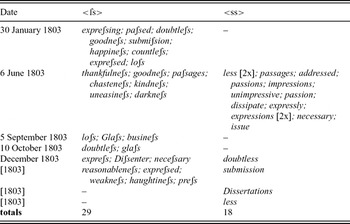
With one exceptional letter, the last occurrence of <ſs> is in a letter from 1803, while the earliest occurrence of modern <ss> appears in that very same year. Curiously, this transition largely coincides with the disappearance of long-s from The Times (see section 2.2). Table 3 lists all tokens of <ſs> and <ss> found in Murray's letters from 1803 to show what happened with these two character combinations in that particular year, which is the only year in which they appear to have co-existed. The dates that are given between square brackets had to be deduced from the contents of the letters.
Use of <ʃs> versus <ss> in Murray's out-letters

Table 3 illustrates how during the course of 1803 Murray decided to replace <ſs> by <ss>. The table further shows that variation was found in only three of the eight letters written in 1803. As mentioned above, and apart from the one exceptional instance, from then on Murray stuck to this decision. Although self-corrections are quite common in his letters, <ſ> was not among them.
Unlike Priestley's letters, which only produced long-s in <ſs> combinations, Murray's letters also contain instances of words that begin with a single <ſ>, such as ʃeems, ʃome, ʃtrengthened, ʃelfish and ʃlave, although altogether only twenty-two instances, against as many as 7,404 words beginning with single <s>. The passage in (5) from a letter to Dr Thomas Parke shows two instances of initial <ʃ>, i.e. ʃhort and ʃo, as well as one instance of the combination <ſs>:
(5) In ſhort I meet / with ſo many elegant and high Wrought Encomiums / upon my Friends amiable Accomplishments, that / I forbear my Sentiments, lest the Plainneſs of my / Approbation shou'd Diminish the Splentdor of his [i.e. Dr Parke's] / Reputation. (Murray to Dr Thomas Parke, 16 November 1773; Haverford: The Quaker Collection, MS 851)
To further illustrate Murray's rare use of initial long-s, there is only one instance of ʃeems in what the contents suggest must have been an early, undated, letter, against sixty-seven instances of seems in the whole period of writing. Additionally, the entire corpus contains a mere four words that were written with single medial <ſ>: retroʃpect, Hartʃhore, Harriʃon and Yorkʃhire. Single <ſ>, either initial or medial, completely disappeared from Murray's letters a few years earlier than the combination <ſs> did, namely in 1794, with, however, again that all too familiar exception to the rule that we shall now discuss.
It was quite unexpected to find that after four years of having exclusively used the modern combination <ss>, in one letter dating from July 1807 Murray reverted to the use of <ſs>, with five instances, as well as to single <ſ> at the beginning of a word, with three instances. In this particular letter no instances of modern <ss> are found. The letter in question was addressed to Thomas Clarkson (1760–1848), who was a slavery abolitionist for whom Murray had a high regard. It is the only letter in the CLML to Clarkson, and it deals with a book that Clarkson had written on the abolition of the slave trade, an accomplishment which Murray greatly admired. As the following passage from this letter illustrates, the content is of a particularly elevated and religious nature:
(6) to say that I have read it with pleasure, would / but faintly expreſs my feelings of approbation . . . Very gratifying to rational curiosity it must / be, to have the rise and progreſs of events [e overwrites E] which / bear upon the great question . . . Every attentive [-ve overwrites ?] rea- / der will perceive, it in the commencemeent, the / progreſs, and the consummation of the great work of / the abolition, the hand of divine providence– (Murray to Clarkson, 8 July 1807; Friends’ Library: Portfolio 8/160)
(6) shows three instances of <ſs>. The combination of addressee and nature of the subject matter may offer an explanation for Murray's abrupt but temporary fall back, in the sense that traditional topics would have required a more formal style of writing (cf. Tieken-Boon van Ostade Reference Tieken-Boon van Ostade2002: 464). Alternatively, this may have been a draft letter, because it contains several self-corrections, although these were found in final versions, too. Whatever Murray's reason for temporarily reverting to the use of long-s, this letter remains a curious exception in an otherwise very straightforward transformation from long-s to short-s.
4.3 Some additional eighteenth- and nineteenth-century letter writers
We have seen that Priestley's usage of <ſ> was restricted to a very specific graphological environment, while Murray's usage changed in the course of his life. In order to get some idea of how the usage of these two grammarians relates to that of writers who were not involved with grammar writing and who may therefore have been less linguistically aware than Priestley and Murray, we also looked at a few other letters from the middle and late eighteenth century, as well as from the beginning of the nineteenth century.
One set of letters we analysed for the occurrence of <ſ> were those written by two correspondents of the eighteenth-century author, politician and inveterate letter writer Horace Walpole (1717–97),Footnote 9 the manuscripts of which are in the British Library and the Lewis Walpole Library at Yale University. We looked at five letters written by Henry Seymour Conway (1719–95), an army officer and later politician, and two letters written by the diplomatist Horace Mann (bap.1706–86). Conway's letters to Walpole, written in 1756, 1759, 1767 and 1790, show the same pattern as that found in the letters of Priestley: <ſ> is always part of double-s and does not occur in word-initial position anywhere. Some examples from a letter from 1759 are given in (7):
(7) We walk & play a little at Cards & do our busineſs & in that way our time paſses much better than I would have suspected. (Conway to Horace Walpole, 29 January 1759; The Lewis Walpole Library: folder 1759)
Mann's letters from around the middle of the eighteenth century, on the other hand, show a use of <ſ> that was both expected and not. In his letters, too, double-s is realised exclusively as a long-s–short-s digraph. In contrast to the letters of Priestley and Conway, however, Mann did occasionally use <ſ> when it is not a part of double-s, though never in word-initial position; examples are conʃent, conʃul, Corʃica(n)(s), deʃtination, falʃe, Genoveʃe, Spaniʃh, thouʃand and Tuʃcany. An instance of <ſ> and one of <ſs> are included in (8):
(8) I would not omit acquainting you by this first opportunity with the alarm this Country has been put in by the report of the Master of a Genoveſe Veſsel. (Mann to Mr Robinson, 14 November 1741; The Lewis Walpole Library: microfilmed copies of BL 230109)
Dyche's Spelling Dictionary (1725) gives a <ſ> spelling for the following of these words: conʃent, conʃul, falʃe, Spaniʃh, thouʃand and Tuʃcany. The words Corʃica(n)(s), deʃtination and Genoveʃe do not appear in the dictionary, while deʃtiny does, suggesting that deʃtination was the preferred spelling. Interestingly, in Entick's New Spelling Dictionary (Crakelt & Entick 1800), published three-quarters of a century later, when <ſ> began to disappear from printed texts, we still find conʃent, conʃul, deʃtination, falʃe, and Spaniʃh, though we also find thousand. Without a larger and more representative corpus of manuscript letters, it is hard to say whether Mann's usage is idiosyncratic, or whether these kinds of uses are common and widespread. A relevant factor may also be that Mann had been an expatriate since 1738 (ODNB, s.v. ‘Mann, Sir Horatio’).Footnote 10
Another set of letters, which provide data from the early nineteenth century, were those written by the third president of America, Thomas Jefferson (1743–1826), to Joseph Priestley. In Jefferson's letters, which date from 1800–2, we see that when <ſ> occurs, it is always as part of double-s, represented by a <ſs> digraph. However, not all instances of double-s are written this way. About half the time Jefferson used double short-s, even varying with the same word, happiness, as can be seen in (9) and (10):
(9) Wishing you that pure happiness which your pursuits and circumstances offer . . . and with every sentiment of affectionate esteem & respect, I am, dear Sir, your most humble, and most obedient servant. (Letter to Joseph Priestley, 18 January 1800)
(10) I am almost persuaded that were you to try the difference between 41° and 38° of latitude you would find the genial effects of the latter towards that happineſs which arises from sensation. (Letter to Joseph Priestley, 24 April 1803)
Jefferson's letters appear to be evidence of a transition phase from <ſ> to <s> in double-s context. It should be noted that the letters examined do not having folding lines and are therefore probably not the originally sent letters but copies made later by him, probably for his own reference, which may complicate the notion of what was Jefferson's ‘actual’ usage.
5 The persistence of long-s in handwriting
While the year 1800 is usually taken as the year in which long-s disappeared from printed works, we found that the practice of using the allograph <ſ> in handwritten documents appears to have continued for a considerable time, at least well into the nineteenth century. Many examples of long-lingering use of <ſ> were also found in another letter corpus in the making. This corpus contains nineteenth-century letters, spanning the period 1812–95, which were almost exclusively written by lower- to middle-class inhabitants of New England.Footnote 11
Mosley (Reference Mosley2008) likewise notes that ‘Long into the 19th century it was still common practice in English handwriting to use long and short s for double s, notably in “Miss” in the address on letters’. Nash (Reference Nash2001: 18), too, observes that long after it had disappeared from print, the use of long-s in manuscripts continued by writers of advanced age who were born in the previous century – providing evidence of usage from as late as the twentieth century. What is more, at the onset of the nineteenth century the use of long-s in handwritten documents was still very widespread, and <ſ> was used by writers of various ages and consequently unlikely to be considered old-fashioned. Long after the turn of the century, many schoolchildren when learning to read and write were still confronted with eighteenth-century spelling books containing the long-s, because schoolbooks were expensive and scarce. It should not be surprising, therefore, that many of them will have long continued to use long-s, and that some may even never have turned to modern short-s.
6 Concluding remarks
While the use of long-s in printed works continued only briefly after the publication of Bell's Shakspere (1788), Priestley's last letters are from early 1804, written a few weeks before his death, so we simply cannot say whether his use of <ſ> might have changed under the influence of print. Having said that, we also did not expect to see a sudden and radical decline of the use of <ſ> in the letters of a man who was already fairly advanced in life – Priestley was 67 years old – at the turn of the century. We have illustrated how Murray's usage, on the other hand, radically changed in 1803, when he reached the respectable age of 58. Murray revised his textbooks on a continuous basis, and we can only conclude that this ensured that he was keenly aware of his printers’ practices in this respect; more particularly, he may have been a regular reader of The Times, because the disappearance of <ſ> from this newspaper coincides to a large extent with its disappearance from Murray's letters (see section 4.2).
The analysis presented here has furthermore demonstrated that usage of the graphemic variant <ſ> in LModE letters deviates from the rules for the use of long-s that were laid down in contemporary printed guidebooks, as well as from the printers’ practices for grammars and dictionaries. How far this last discrepancy was caused by printers’ errors will remain uncertain. It appears, moreover, that already in the second half of the eighteenth century word-initial use of <ſ> was becoming less frequent, both in printed and in handwritten texts.
In the majority of the eighteenth- and nineteenth-century letters studied, the last vestige of the formal pattern of usage of long-s was in double-s context, where ss was realised exclusively as an <ſs> combination. It is possible that this practice was initially the result of the rule to use long-s in word-internal position. Based on Priestley's apparent resistance to hyphenating the <ſs> combination for double-s in his manuscripts, we have suggested that this particular combination would have formed a conceptually single character, and was thus represented by a digraph in writing. It is likewise possible that this conceptual unity of long-s–short-s caused long-s to be resistant to elimination from handwritten texts, allowing <ſs> to endure long after its disappearance from printed texts.
Finally, we have demonstrated that there is a fair amount of variation in the use of long-s in eighteenth-century manuscripts. At the same time, it has become clear that much remains to be learned about its continued use throughout the nineteenth century (and perhaps even beyond), after <ſ> had been discontinued in print. Diachronic LModE letter corpora will prove valuable tools for contributing to our knowledge of this and many other aspects of usage.