Introduction
Birth weight steadily increased worldwide throughout the late 20th century, with a resulting increase in the prevalence of babies born large-for-gestational-age (LGA, generally defined as birth weight >90th centile).Reference Oken1 Being born either too small [small-for-gestational-age (SGA) – birth weight <10th centile], LGA, or with macrosomia (birth weight ≥4.0 kg) is associated with adverse long-term health outcomes.Reference Chiavaroli, Derraik, Hofman and Cutfield2 Even though the evidence for long-term health outcomes in those born LGA is not always consistent,Reference Chiavaroli, Derraik, Hofman and Cutfield2 the association between birth weight and risk of adulthood disease appears to be U-shaped.Reference Wei, Sung and Li3 Nonetheless, adults born LGA have an increased risk of obesity,Reference Skilton, Siitonen and Wurtz4 cardiovascular disease,Reference Skilton, Siitonen and Wurtz4 diabetesReference Johnsson, Haglund, Ahlsson and Gustafsson5 and breast cancer.Reference Innes, Byers and Schymura6
Greater maternal body mass index (BMI) is associated with an increased risk of delivering an LGA infant.Reference Chiavaroli, Derraik, Hofman and Cutfield2, Reference Kramer, Morin and Yang7 In addition, intergenerational studies have shown that women who were born LGA themselves are at increased risk of giving birth to LGA infants.Reference Ahlsson, Gustafsson, Tuvemo and Lundgren8 There is also some evidence of a paternal effect, with father’s birth weight reported in a number of studies as an independent predictor of offspring birth weight,Reference Magnus, Gjessing, Skrondal and Skjærven9–Reference Klebanoff, Mednick, Schulsinger, Secher and Shiono11 including a large population study in Sweden.Reference Mattsson and Rylander12 Although a positive association between paternal height and offspring birth weight has been consistently shown,Reference Magnus, Gjessing, Skrondal and Skjærven9, Reference Pomeroy, Wells, Cole, O’Callaghan and Stock13–Reference Nahum and Stanislaw17 the evidence for paternal BMI is conflicting. Studies have reported that greater paternal BMI was associated with increased offspring weight.Reference L’Abee, Vrieze and Kluck10, Reference Klebanoff, Mednick, Schulsinger, Secher and Shiono11, Reference Leary, Fall and Osmond15 One investigation observed a J-shaped curve, where greater paternal BMI was associated with both low and high birth weight in the offspring.Reference Myklestad, Vatten and Magnussen14 However, the evidence is inconclusive as a number of studies have reported no relationship between paternal BMI and offspring birth weight.Reference Magnus, Gjessing, Skrondal and Skjærven9, Reference Pomeroy, Wells, Cole, O’Callaghan and Stock13, Reference Sletner, Nakstad and Yajnik16–Reference Morrison, Williams, Najman and Andersen18 The conflicting reports may be explained (at least in part) by sex-specific effects on the offspring. For example, Chen et al. showed that paternal BMI was positively associated with birth weight, abdominal circumference and other anthropometric parameters in male offspring, but there were no observed associations among females.Reference Chen, Xiao and Li19
In addition, there is evidence that the father’s metabolic health may affect the offspring. Notably, while maternal diabetes is associated with an increased risk of delivering an LGA baby, there is a consistent reduction in offspring birth weight with paternal type 2 diabetes,Reference Tyrrell, Yaghootkar, Freathy, Hattersley and Frayling20–Reference Wannamethee, Lawlor and Whincup23 as well as paternal insulin resistanceReference Wannamethee, Lawlor and Whincup23, Reference Hillman, Peebles and Williams24 or increased glucose levels.Reference Myklestad, Vatten and Magnussen14
Most studies to date have focused on the associations between paternal birth weight or BMI and low birth weight in the offspring, with fewer studies investigating paternal factors associated with the likelihood of having an LGA infant. Thus, we aimed to examine the associations between paternal factors (including anthropometry and metabolic parameters) and the likelihood of having an infant born LGA, while accounting for important maternal confounders.
Methods
Study participants
Participants were healthy nulliparous women with singleton pregnancies recruited in 2004–2011 to the Screening for Pregnancy Endpoints (SCOPE) study across four countries: Australia (Adelaide), Ireland (Cork), New Zealand (Auckland) and United Kingdom (Manchester, Leeds and London).Reference McCowan, Thompson and Taylor 25 Ethics approval was provided by the relevant institutional ethic committees.Reference McCowan, Thompson and Taylor25 All women provided written informed consent. If a participant was certain of the identity of the infant’s father and she consented, the father was invited to participate and included in this study if he also provided written informed consent.
Study parameters
Paternal characteristics were recorded by 20 weeks of gestation. Paternal height, weight, abdominal circumference and blood pressure were measured by a research midwife. Data collected included age, race/ethnicity, socioeconomic index,Reference Galbraith, Jenkin, Davis and Coope26 birth weight, as well as previous diagnosis of diabetes, hypertension or heart disease. Birth weight for mothers and fathers was self-reported, but they were asked to confirm the weight from their health records whenever possible. Maternal height and weight were similarly recorded at 14–16 weeks of gestation.
The child’s gestational age was determined based on the date of the last menstrual period. However, gestational age was adjusted if one of the following discrepancies between the age from the scan and that calculated by the last menstrual period was observed:
a) ⩾7 days based on a scan performed before 16 weeks of gestation; or
b) ⩾10 days based on the 20-week scan.
If either condition was met, the scan dates were used to determine the estimated date of delivery.
Maternal smoking status and physical activity levels were recorded, with the latter dichotomously divided into whether or not the mother exercised at least moderately (defined as recreational walking ⩾4 times per week). Infant anthropometric measurements were made soon after birth, usually within 72 h.
Birth weight centiles were obtained as per INTERGROWTH 21st standards,Reference Villar, Ismail and Victora 27 and LGA was defined as birth weight >90th centile. Macrosomia was defined as a birth weight ⩾4.0 kg, and it was only adopted as a predictor due to the absence of gestational age data on the fathers. LGA is a more robust indicator of oversize at birth as it takes into account the infant’s gestational age at birth, so that the LGA classification can be applied across the gestational age spectrum. Overweight/obesity was defined as BMI ⩾25 kg/m2, obesity as BMI ⩾30 kg/m2 and central adiposity as waist circumference >102 cm for fathers and >88 cm for mothers.Reference Lean, Han and Morrison 28 Paternal hypertension was defined as systolic blood pressure ⩾140 mmHg and/or diastolic blood pressure ⩾90 mmHg.
Statistical analyses
Paternal and maternal characteristics in LGA and non-LGA infants were compared using one-way analysis of variance (ANOVA), χ2 tests or Fisher’s exact tests, as appropriate. Univariable logistic regressions were performed to examine associations between paternal factors and the risk of fathering an LGA infant. Continuous predictors were paternal age, socioeconomic status, birth weight, height, weight, BMI, abdominal circumference, systolic and diastolic blood pressures; categorical predictors were race/ethnicity, macrosomia obesity, central adiposity, hypertension at study visit, pre-diagnosed hypertension and diabetes, as well as fetal sex. The continuous factors significantly associated with LGA birth (at P < 0.05) were compared with pairwise linear correlations. A conservative approach was adopted to avoid issues with multicollinearity, and potential predictors were excluded if |r| > 0.25 as suggested by Vatcheva et al.Reference Vatcheva, Lee, McCormick and Rahbar 29 Where two parameters were highly correlated, the most clinically logical parameter was selected; where both the continuous parameter and the equivalent categorical variable were found to be significantly associated with the likelihood of having a LGA infant (e.g., birth weight v. macrosomia), the continuous parameter was chosen for inclusion. All selected paternal parameters were included in a generalized linear regression model.
The above-mentioned process was repeated for the corresponding maternal predictors, with the addition of pre-eclampsia, maternal smoking and moderate-to-vigorous exercise during pregnancy. The final maternal parameters selected were added into a generalized linear regression model, including the selected paternal factors. The above procedures were repeated separately for male and female infants.
Each final model discrimination was estimated using the area under the receiver operating characteristic curve (AUROC). Model calibration (i.e., the extent to which the model correctly estimated the absolute risk) was determined using the Hosmer–Lemeshow test,Reference Hosmer and Lemeshow 30 with satisfactory calibration determined by P > 0.05. Lastly, standardized coefficients were obtained for multivariable models as per King (2007).Reference King 31
Statistical analyses were carried out in Minitab v16 (Pennsylvania State University, State College, PA, USA) and SPSS v25 (IBM Corp, Armonk, NY, USA). All statistical tests were two-tailed, and a significance level of 5% was maintained. No adjustments were made for multiple comparisons, and there was no imputation of missing values.
Results
A total of 5628 pregnant women were recruited into SCOPE; 491 of whom were excluded due to fetal loss at < 20 weeks of gestation, perinatal death, major congenital abnormalities, preterm birth, or use of donor sperm or oocyte. A further 13 pregnancies were excluded as the biological father was unknown (Supplementary Fig. S1). Of the remaining 5124 pregnancies, 1113 biological fathers (21.7%) declined to be in the study, and 352 pregnancies were excluded as paternal birth weight data could not be supplied (Supplementary Fig. S1). As a result, we examined the data on 3659 fathers, mothers and newborns, including 342 infants who were born LGA (18.1%) (Supplementary Fig. S1). Rates of LGA birth among the offspring of included and excluded fathers were similar (17.2 v. 18.1%, respectively; P=0.41).
LGA
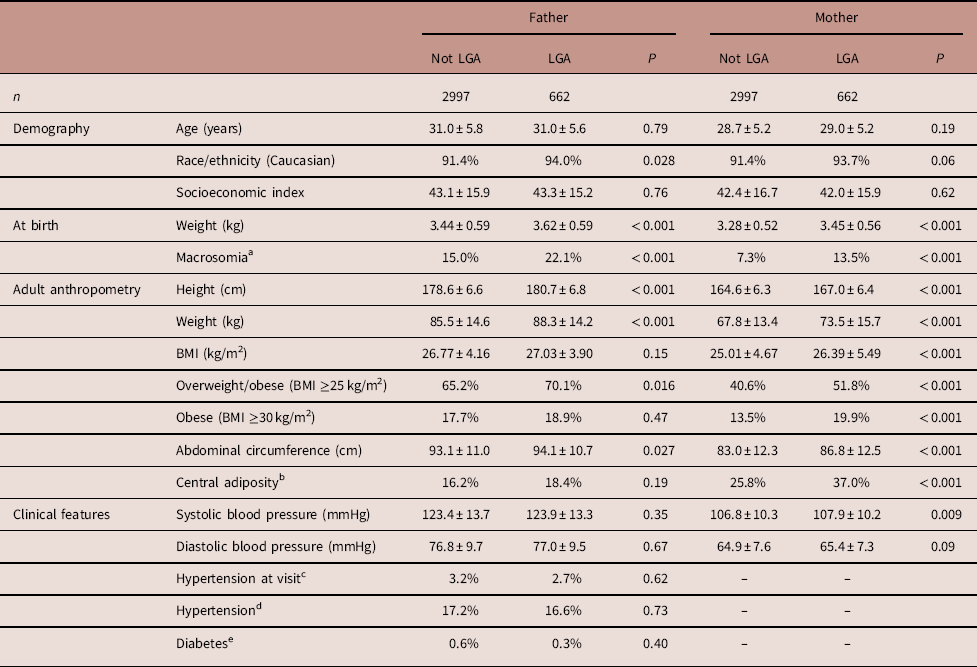
Fathers of LGA infants were demographically similar to those of infants who were not born LGA, as were their respective clinical characteristics (Table 1). However, men who fathered LGA babies were 180 g heavier at birth (P < 0.001) and were more likely to have been born macrosomic (Table 1). On average, the fathers of LGA infants were 2.1 cm taller (P < 0.001), 2.8 kg heavier (P < 0.001) but had similar BMI (Table 1). Although the rate of overweight/obesity was 4.9 percentage points greater among fathers of LGA babies, obesity rates were similar in the two groups (Table 1). The observed differences in paternal characteristics were largely mirrored by maternal characteristics, except that mothers of LGA infants displayed a more marked increased in measures of adiposity compared to those giving birth to non-LGA infants (Table 1).
Demographic, anthropometric and clinical characteristics of fathers and mothers of infants who were born large-for-gestational-age (LGA) or not

Where appropriate, data are means±SD. P-values are from one-way ANOVA or χ2 tests.
a Defined as birth weight ⩾4.0 kg.
b Abdominal circumference > 102 cm for fathers and > 88 cm for mothers.
c Systolic blood pressure ⩾140 mmHg and/or diastolic blood pressure ⩾90 mmHg at the study’s partner assessment. Note that presence of essential hypertension was an exclusion criterion for mothers.
d This was defined as a history of hypertension diagnosed by a health practitioner and use of antihypertensive treatment now or in the past. Note that presence of essential hypertension was an exclusion criterion for mothers.
e Pre-existing diabetes was an exclusion criterion for mothers.
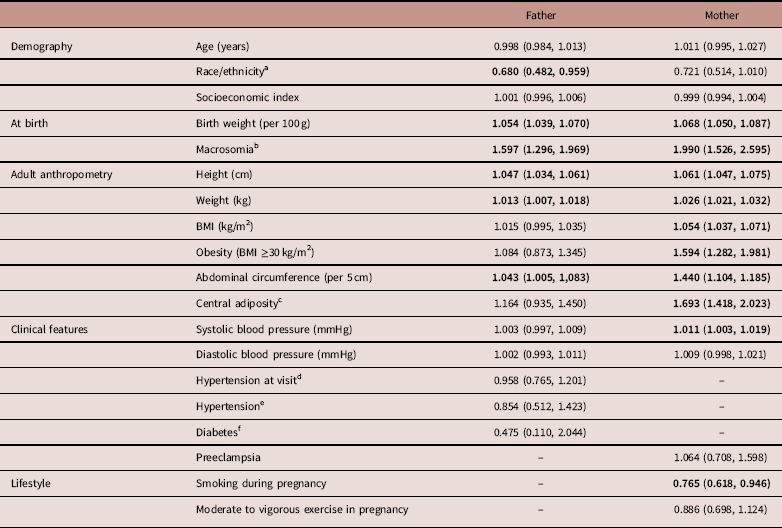
When individually assessed, demographic and clinical characteristics of the father were not associated with the odds of having a child born LGA, except the odds of the latter were lower among non-Caucasian fathers (Table 2). In contrast, increasing paternal birth weight and paternal macrosomia at birth, as well as greater adult height and weight were associated with greater odds of having an LGA infant (Table 2). Further, every 5-cm increase in abdominal circumference was associated with a 4.3% increase in the odds of LGA, but no association was observed with paternal BMI (Table 2).
Parental demographic, anthropometric and clinical characteristics and their associated odds ratios (95% confidence intervals) of having a child born large-for-gestational-age (LGA). Statistically significant associations (at P < 0.05) are shown in bold

a Non-Caucasian v. Caucasian.
b Defined as birth weight ⩾4.0 kg.
c Abdominal circumference > 102 cm for fathers and > 88 cm for mothers.
d Systolic blood pressure ⩾140 mmHg and/or diastolic blood pressure ⩾90 mmHg at the study’s partner assessment. Note that presence of essential hypertension was an exclusion criterion for mothers.
e This was defined as a history of hypertension diagnosed by a health practitioner and use of antihypertensive treatment now or in the past. Note that presence of essential hypertension was an exclusion criterion for mothers.
f Pre-existing diabetes was an exclusion criterion for mothers.
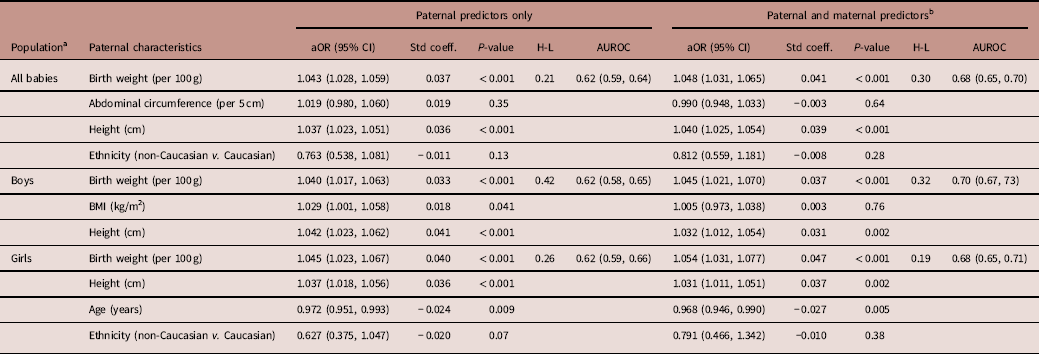
When paternal factors were considered together, only increasing paternal birth weight and height remained associated with greater odds of fathering a LGA infant across the whole cohort (Table 3). These associations persisted following the inclusion of maternal predictors (Table 3).
Paternal characteristics and the respective adjusted odds ratio (aOR) of fathering a large-for-gestational-age (LGA) baby

Data were analyzed using multivariable binary logistic regression models.
AUROC, area under the receiver operating characteristic curve; BMI, body mass index; H-L, Hosmer and Lemeshow test; Std coeff., standardized logistic regression coefficient.
a For all babies n=3659 (342 LGA), for boys n=1832 (170 LGA), and for girls n=1827 (172 LGA).
b The following maternal predictors were included in the respective models:
All babies: birth weight, BMI, random glucose at first visit, random glucose at second visit, smoking during pregnancy.
For boys: age, birth weight, BMI, height, random glucose at first visit, and smoking during pregnancy.
For girls: birth weight, BMI, and height.
A nearly identical pattern was observed among baby girls, with persistent associations between increasing paternal birth weight and height and the odds of LGA (Table 3). Further, increasing paternal age was associated with lower odds of a LGA girl irrespective of maternal predictors, but standardized coefficients indicated it was a comparatively weaker predictor (Table 3).
Among boys, paternal birth weight and height were also positively associated with the odds of LGA, irrespective of the inclusion of maternal parameters (Table 3). Notably, increasing paternal BMI was associated with greater odds of LGA boys (+2.9% for every 1 kg/m2 increment), but this association disappeared when maternal parameters were accounted for (Table 3).
Discussion
We observed that increasing paternal birth weight and adult height were the primary paternal predictors of an increased risk of LGA in the offspring, irrespective of adjustment for maternal factors or the baby’s sex. In spite of using the INTERGROWTH 21st standard (which has high rates of LGA when applied to Western settingsReference Liu, Metcalfe and Leon 32 ), our findings corroborate previous observations that paternal birth weight is an important independent predictor of offspring birth weight.Reference Magnus, Gjessing, Skrondal and Skjærven 9 – Reference Klebanoff, Mednick, Schulsinger, Secher and Shiono 11
Increasing paternal BMI was associated with greater odds of having an LGA infant, which is in line with other studies showing an association with offspring birth weight.Reference L’Abee, Vrieze and Kluck 10 , Reference Klebanoff, Mednick, Schulsinger, Secher and Shiono 11 , Reference Leary, Fall and Osmond 15 However, this association was confined to boys, and the positive association between paternal BMI and LGA was no longer significant after adjustment for maternal BMI. Thus, paternal BMI was not an independent predictor of offspring birth weight as suggested previously.Reference Pomeroy, Wells, Cole, O’Callaghan and Stock 13 , Reference Sletner, Nakstad and Yajnik 16 , Reference Nahum and Stanislaw 17 In addition, other paternal factors related to metabolism (blood pressure, diabetes and heart disease), body composition (waist circumference) and environment (socioeconomic status) were not associated with the likelihood of fathering an LGA baby. The absence of any associations between these parameters recorded at mid pregnancy indicate that the most important paternal factors influencing offspring birth weight are likely to be of genetic origin, as previously suggested.Reference Pomeroy, Wells, Cole, O’Callaghan and Stock 13 As a large proportion of an individual’s height is genetic,Reference Wood, Esko and Yang 33 our findings are not surprising as greater paternal stature is associated with faster limb growth in the fetus, resulting in longer and heavier infants more likely to be LGA.Reference Pomeroy, Wells, Cole, O’Callaghan and Stock 13 Importantly, the genetic paternal contribution contrasts to the maternal influences on offspring size at birth, which are not only genetically driven but also affected by the intrauterine environment,Reference Derraik, Ahlsson, Diderholm and Lundgren 34 as observed among infants born to mothers with gestational diabetes or who are obese.Reference Olmos, Borzone and Olmos 35 – Reference Catalano and Shankar 37
Previous studies have described an association between paternal hypertension and offspring low birth weight.Reference Myklestad, Vatten and Magnussen 14 , Reference Hillman, Peebles and Williams 24 It has been suggested that the underpinning mechanisms were related to, for example, maternal passive smoking.Reference Suter, Abramovici and Showalter 38 However, there is a paucity of data regarding offspring born at the upper end of the birth weight spectrum. Here, we observed no association between offspring birth weight (or the likelihood of being born LGA) with paternal blood pressure or central adiposity, irrespective of maternal factors (including smoking during pregnancy).
The limitations of our study include the potential imprecision of maternal and paternal birth weight data, which in many cases could not be verified and relied on recollection. Paternal blood pressure was based on measurement from a single clinic and thus potentially unreliable, but due to the size of the cohort it was not possible to perform repeated measurements over time. As the vast majority of study participants were Caucasian and all infants were born to nulliparous mothers, our findings may not be readily extrapolated to other populations. Further, infants may be LGA by weight and/or length. The paternal influences, such as greater height, are more likely to be associated with a longer rather than a fatter baby, so that the long-term health risks are likely to be greater in the former. Thus, the paternal influences on long-term risk of obesity and related comorbidities in LGA babies are probably minor. The strengths of our study include a large sample size and the robust parental anthropometric data that were measured by a research midwife rather than estimated or recalled by participants.
In conclusion, fathers who were taller as adults and were heavier at birth were more likely to have LGA infants. However, paternal BMI was not found to be an independent predictor of offspring birth weight, suggesting that fathers who are overweight and/or obese do not seem more likely to have an LGA baby when maternal factors are accounted for. Studies in larger cohorts are necessary to define more accurately the association of paternal clinical factors and offspring birth weight.
Supplementary material
To view supplementary material for this article, please visit https://doi.org/10.1017/S2040174419000035
Acknowledgments
The authors would like to thank the pregnant women who participated in the SCOPE Study, the SCOPE Country Project Managers Mrs D Healy, University of Adelaide, Dr A Briley, Kings College London, and Mrs N Murphy and Mrs E Snapes, University College Cork, Miss Eliza Chan for development of the databases, Dr Mik Black for creating the training and validation databases.
Financial support
This work was supported by the following funders: New Zealand: New Enterprise Research Fund, Foundation for Research Science and Technology (EM 04–05/03); Health Research Council (04/198); Evelyn Bond Fund, Auckland District Health Board Charitable Trust; Australia: Premier’s Science and Research Fund, South Australian Government; London: Guy’s and St Thomas’ Charity, United Kingdom, Tommy’s the Baby Charity; Manchester: UK Biotechnology and Biological Sciences Research Council, UK National Health Services NEAT Grant, University of Manchester Proof of Concept Funding, Tommy’s the Baby Charity, NIHR; Leeds: Cerebra, UK; and Cork, Ireland: Health Research Board, Ireland; Sweden: the Gillberg Foundation (Uppsala), and Her Royal Highness the Crown Princess Lovisas Society for Child Health Care (Stockholm).
Conflicts of interest
The funders had no role in study design, data collection and analysis, decision to publish or preparation of this manuscript. The authors have no financial conflicts of interest to disclose that may be relevant to this work.