INTRODUCTION
Post-traumatic amnesia (PTA) is a transient period of early recovery following traumatic brain injury (TBI), characterised by altered consciousness, disorientation, and amnesia. Attentional, physiological and behavioural disturbances are also common during this stage (Sherer, Nakase-Thompson, Yablon, & Gontkovsky, Reference Sherer, Nakase-Thompson, Yablon and Gontkovsky2005). The duration of PTA is an established indicator of injury severity and predictor of patient outcome (Bishara, Partridge, Godfrey, & Knight, Reference Bishara, Partridge, Godfrey and Knight1992; Ponsford, Hill, Karamitsios, & Bahar-Fuchs, Reference Ponsford, Hill, Karamitsios and Bahar-Fuchs2008). Considering the widespread disturbances observed during PTA, this phase has also been described as a post-traumatic confusional state (PTCS) and likened to the confusional state often observed in delirium (Nakase-Thompson, Sherer, Yablon, Nick, & Trzepacz, Reference Nakase-Thompson, Sherer, Yablon, Nick and Trzepacz2004; Sherer et al., Reference Sherer, Katz, Bodien, Arciniegas, Block, Blum and Yablon2020; Sherer, Yablon, & Nakase-Richardson, Reference Sherer, Yablon and Nakase-Richardson2009; Stuss et al., Reference Stuss, Binns, Carruth, Levine, Brandys, Moulton and Schwartz1999). In the current paper, the term PTA will be used as it remains the most commonly adopted within the literature and clinically (Ponsford, Carrier, Hicks & McKay, Reference Ponsford, Carrier, Hicks and McKay2020).
Despite the heterogeneity of neuropathology following injury, PTA is almost invariably observed in patients following moderate to severe TBI (Ponsford, Sloan, & Snow, Reference Ponsford, Sloan and Snow2012). The transient nature of this stage is thought to reflect temporary functional and structural disruption to connectivity between critical brain regions, including the posterior cingulate cortex, default mode network, frontoparietal, and executive control networks which are involved in supporting memory and other cognitive functions (De Simoni et al., Reference De Simoni, Grover, Jenkins, Honeyfield, Quest, Ross and Sharp2016). The extent of this disruption is reportedly associated with cognitive performance, including episodic memory and processing speed (De Simoni et al., Reference De Simoni, Grover, Jenkins, Honeyfield, Quest, Ross and Sharp2016). Functional connectivity between key brain regions has been shown to improve with the recovery of cognitive ability (De Simoni et al., Reference De Simoni, Grover, Jenkins, Honeyfield, Quest, Ross and Sharp2016). This suggests that diffuse connectivity deficits likely contribute to the broad range of cognitive disturbances experienced during this phase.
In addition to cognitive dysfunction, agitation is a characteristic feature of PTA (Bogner & Corrigan, Reference Bogner and Corrigan1995; Bogner, Corrigan, Fugate, Mysiw, & Clinchot, Reference Bogner, Corrigan, Fugate, Mysiw and Clinchot2001; Kadyan et al., Reference Kadyan, Mysiw, Bogner, Corrigan, Fugate and Clinchot2004; Wolffbrandt, Poulsen, Engberg, & Hornnes, Reference Wolffbrandt, Poulsen, Engberg and Hornnes2013) and presents as a significant complicating factor for patient management, rehabilitation, and outcome (Bogner et al., Reference Bogner, Corrigan, Fugate, Mysiw and Clinchot2001; Lequerica et al., Reference Lequerica, Rapport, Loeher, Axelrod, Vangel and Hanks2007; Montgomery, Kitten, & Niemiec, Reference Montgomery, Kitten and Niemiec1997; Sandel & Mysiw, Reference Sandel and Mysiw1996). Agitation encompasses a range of behaviours, including restlessness, distractibility, emotional lability, aggression, and violence, and presents in varying degrees of severity (Corrigan, Reference Corrigan1989). Agitated behaviour has been found to be more prevalent during PTA than following emergence (Brooke, Questad, Patterson, & Bashak, Reference Brooke, Questad, Patterson and Bashak1992; Kadyan et al., Reference Kadyan, Mysiw, Bogner, Corrigan, Fugate and Clinchot2004; McKay, Love, Trevena-Peters, Gracey, & Ponsford, Reference McKay, Love, Trevena-Peters, Gracey and Ponsford2018; Nott, Chapparo, Heard, & Baguley, Reference Nott, Chapparo, Heard and Baguley2010; Van Der Naalt, van Zomeren, Sluiter, & Minderhoud, Reference Van Der Naalt, van Zomeren, Sluiter and Minderhoud2000). A number of studies investigating agitation have attempted to identify the mechanisms underpinning it. Injury characteristics, such as damage to specific neuroanatomical areas including frontotemporal, frontoparietal, subcortical, and brainstem regions (Riggio, Reference Riggio2011; Singh, Venkateshwara, Nair, Khan, & Saad, Reference Singh, Venkateshwara, Nair, Khan and Saad2014; Van Der Naalt et al., Reference Van Der Naalt, van Zomeren, Sluiter and Minderhoud2000), have been associated with increased agitation. Additional factors found to be related to higher levels of agitation include the presence of certain environmental stimuli, such as noise or overstimulation (Nott et al., Reference Nott, Chapparo, Heard and Baguley2010), internal confusion (Bogner et al., Reference Bogner, Corrigan, Fugate, Mysiw and Clinchot2001; Eisenberg, Im, Swift, & Flanagan, Reference Eisenberg, Im, Swift and Flanagan2009), infection (Bogner et al., Reference Bogner, Barrett, Hammond, Horn, Corrigan, Rosenthal and Garmoe2015), and the use of antipsychotic medication (McKay et al., Reference McKay, Love, Trevena-Peters, Gracey and Ponsford2018).
A relationship has been identified between cognition and agitation after TBI, with behavioural disturbances more likely to occur in patients who exhibit more severe cognitive impairment (CI) (Bogner et al., Reference Bogner, Barrett, Hammond, Horn, Corrigan, Rosenthal and Garmoe2015; Bogner et al., Reference Bogner, Corrigan, Fugate, Mysiw and Clinchot2001; Corrigan, Reference Corrigan1989; Fugate et al., Reference Fugate, Spacek, Kresty, Levy, Johnson and Mysiw1997; Kadyan et al., Reference Kadyan, Mysiw, Bogner, Corrigan, Fugate and Clinchot2004; McKay et al., Reference McKay, Love, Trevena-Peters, Gracey and Ponsford2018; Noe, Ferri, Trenor, & Chirivella, Reference Noe, Ferri, Trenor and Chirivella2007; Nott et al., Reference Nott, Chapparo, Heard and Baguley2010). Corrigan and Mysiw (Reference Corrigan and Mysiw1988) were among the first to explore this relationship, documenting that improvements in cognition were associated with decreased levels of agitation, a finding that has been replicated (Bogner et al., Reference Bogner, Barrett, Hammond, Horn, Corrigan, Rosenthal and Garmoe2015; Corrigan, Mysiw, Gribble, & Chock, Reference Corrigan, Mysiw, Gribble and Chock1992; McKay et al., Reference McKay, Love, Trevena-Peters, Gracey and Ponsford2018). Extending these findings, Corrigan et al. (Reference Corrigan, Mysiw, Gribble and Chock1992) examined the relationship between agitation, attention (using simple reaction time), and functional cognitive ability (using the Orientation Group Monitoring System, OGMS). Results demonstrated a relationship between agitation and attention beyond functional cognitive ability. More recently, in a large sample of acute TBI patients, Bogner et al. (Reference Bogner, Barrett, Hammond, Horn, Corrigan, Rosenthal and Garmoe2015) reported that among medical and injury characteristics, greater CI, measured using the Functional Independence Measure Cognitive Score (FIM-C), (Heinemann, Linacre, Wright, Hamilton, & Granger, Reference Heinemann, Linacre, Wright, Hamilton and Granger1993) was one of the only consistent predictors of increased agitation during inpatient rehabilitation. In support of this premise, in a longitudinal study of acute TBI patients within a rehabilitation setting, McKay et al. (Reference McKay, Love, Trevena-Peters, Gracey and Ponsford2018) found that orientation and memory assessed using the Westmead Post-Traumatic Amnesia Scale (WPTAS) (Shores, Marosszeky, Sandanam, & Batchelor, Reference Shores, Marosszeky, Sandanam and Batchelor1986) total score significantly predicted agitation scores as measured on the Agitated Behaviour Scale (ABS) (Corrigan, Reference Corrigan1989) such that poorer cognitive performance was associated with increased agitation.
These findings are consistent with the view that agitation is in part an internally generated state, in which cognitive disturbance restricts the patient’s ability to understand and interact with the environment, resulting in inappropriate or excessive behaviours (Fugate et al., Reference Fugate, Spacek, Kresty, Levy, Johnson and Mysiw1997; Harmsen, Geurts, Fasotti, & Bevaart, Reference Harmsen, Geurts, Fasotti and Bevaart2004; Noe et al., Reference Noe, Ferri, Trenor and Chirivella2007; Nott et al., Reference Nott, Chapparo, Heard and Baguley2010). It is currently unclear whether specific cognitive domains are more or less important in the occurrence of agitated behavior as to date the relationship between cognition and agitation has been largely explored from a global perspective (Bogner et al., Reference Bogner, Barrett, Hammond, Horn, Corrigan, Rosenthal and Garmoe2015) or focused on single cognitive domains such as memory (McKay et al., Reference McKay, Love, Trevena-Peters, Gracey and Ponsford2018) or attention (Corrigan et al., Reference Corrigan, Mysiw, Gribble and Chock1992). By exploring the relationship between agitation and multiple aspects of cognition concurrently, it may be possible to identify which are more associated with the presence of agitation during PTA.
Examining which aspects of cognition are most closely associated with agitation is also of value given the temporal resolution of cognitive functions during PTA. This has been shown to be a gradual process reflecting a sequence of recovery from basic to complex functions (Geffen, Encel, & Forrester, Reference Geffen, Encel and Forrester1991; Stuss et al., Reference Stuss, Binns, Carruth, Levine, Brandys, Moulton and Schwartz1999; Tate et al., Reference Tate, Pfaff, Baguley, Marosszeky, Gurka, Hodgkinson and Hanna2006; Tittle & Burgess, Reference Tittle and Burgess2011; Wilson, Baddeley, Shiel, & Patton, Reference Wilson, Baddeley, Shiel and Patton1992; Wilson et al., Reference Wilson, Evans, Emslie, Balleny, Watson and Baddeley1999), perhaps, in turn, signalling the extent of disconnection. In one study characterizing the cognitive profile of PTA within a sample of TBI patients, Stuss et al. (Reference Stuss, Binns, Carruth, Levine, Brandys, Moulton and Schwartz1999) reported that the ability to perform simple attention and memory recognition tasks recovered prior to more demanding tasks, with memory free recall being the last to resolve. Similarly, Wilson et al. (Reference Wilson, Evans, Emslie, Balleny, Watson and Baddeley1999) documented that patients who remained in PTA exhibited the greatest degree of cognitive improvement on tasks of simple reaction time and working memory. The resolution of these functions preceded the return of more complex processes, including memory recall (Wilson et al., Reference Wilson, Evans, Emslie, Balleny, Watson and Baddeley1999). This highlights a consistent pattern of cognitive recovery from simpler to more complex functions, or more automatic functions to those requiring conscious control (Roberts, Spitz, & Ponsford, Reference Roberts, Spitz and Ponsford2015). It may be then, that patients are at greater risk of agitation when more basic levels of cognitive function are disrupted possibly due to greater neuronal disconnection early in PTA (De Simoni et al., Reference De Simoni, Grover, Jenkins, Honeyfield, Quest, Ross and Sharp2016).
With the goal of providing further insight into the cognitive components associated with agitated behaviour, this study aimed to examine the relationship between agitation and cognitive functions, including mental control, orientation, sustained attention, memory recall, memory recognition, and auditory comprehension. It was hypothesized, firstly, that agitation would be significantly associated with CI, such that improvements in cognitive performance would be associated with reduced levels of agitation. Secondly, although there was limited research to guide hypotheses, it was predicted that performance on simpler cognitive tasks (i.e., mental control, orientation) would be more strongly associated with agitation than complex cognitive functions (i.e., memory recall).
METHODS
Recruitment
Ethics approval was granted from relevant Human Ethics Research Committees. Participants aged over 16 years old were recruited via consecutive admissions to a brain injury rehabilitation unit from March 2017 to January 2019. Data were collected prospectively from all patients following admission as part of routine clinical practice. Consent to use data was obtained from the patient following emergence from PTA or from the next of kin, if the patient was unable to provide informed consent. Eligible participants were those with clinically documented moderate to severe TBI, who were in PTA on admission to the rehabilitation unit with no history of previous head injury, developmental or neurological disorder. Participants who were not administered the Confusion Assessment Protocol (CAP) (Sherer et al., Reference Sherer, Nakase-Thompson, Yablon and Gontkovsky2005) on at least one occasion during PTA were excluded. No incentive or reward was provided for participation.
Measures
Agitation was measured using the ABS, (Corrigan, Reference Corrigan1989) a 14-item clinical scale that objectively assesses the occurrence and extent of different behaviours. Behaviours are scored on a scale of 1 (absent) to 4 (present to an extreme degree). Total scores range from 14 to 56, with higher scores representing higher levels of agitation (Bogner et al., Reference Bogner, Corrigan, Fugate, Mysiw and Clinchot2001; Corrigan, Reference Corrigan1989; Corrigan & Bogner, Reference Corrigan and Bogner1994). Scores above 21 are considered clinically agitated (Bogner, Corrigan, Bode, & Heinemann, Reference Bogner, Corrigan, Bode and Heinemann2000). The ABS comprises the three subscales of Disinhibition, Aggression, and Lability; however, agitation is best conceptualised as a single construct based on the total score (Corrigan, Reference Corrigan1989; Corrigan & Bogner, Reference Corrigan and Bogner1994). The ABS has documented good internal consistency, interrater reliability, and construct validity (Bogner, Corrigan, Stange, & Rabold, Reference Bogner, Corrigan, Stange and Rabold1999; Corrigan, Reference Corrigan1989; Corrigan & Bogner, Reference Corrigan and Bogner1994). The average daily score and peak agitation score were used to characterise the sample’s agitated behaviour.
Administering cognitive tests to patients in PTA is challenging, as they are likely to be confused and distractible and exhibit poor concentration (Wilson et al., Reference Wilson, Baddeley, Shiel and Patton1992). Selected tasks had to be quick, easy to administer, and simple to prevent floor effects for TBI patients. The WPTAS (Shores et al., Reference Shores, Marosszeky, Sandanam and Batchelor1986) is a 12-item clinical test of orientation and the ability to lay down new memories. Items are scored as incorrect (0 points) or correct (1 point). To enable the assessment of orientation and memory individually, the WPTAS was divided into orientation (item 1–7) and new memory (item 8–12) (Tate, Pfaff, & Jurjevic, Reference Tate and Pfaff2000). Orientation items assess orientation to person (i.e., date of birth and age), time (i.e., day of the week, month, and year), and place (i.e. name of hospital). Ranging from 0 to 7, lower scores represented poorer orientation. Memory items test the recall of an examiner’s face and name and recall of three pictures of common objects presented on the previous day. The three target pictures are changed following correct recall on all 12 WTPAS items, and a new set of three pictures is presented on the subsequent day. Scores on the memory items range from 0 to 5, with lower scores indicating poorer memory functioning. The WPTAS has demonstrated good concurrent and construct validity and excellent interrater reliability (Geffen, Bishop, Connell, & Hopkins, Reference Geffen, Bishop, Connell and Hopkins1994; Shores et al., Reference Shores, Marosszeky, Sandanam and Batchelor1986).
Additional cognitive tasks were drawn from the CAP (Sherer et al., Reference Sherer, Nakase-Thompson, Yablon and Gontkovsky2005), a battery comprising seven domains used to assess the duration of PTCS. Tasks within the CAP were largely derived from existing measures of delirium (Delirium Rating Scale; Trzepacz et al., Reference Trzepacz, Mittal, Torres, Kanary, Norton and Jimerson2001), disorientation (Galveston Orientation and Amnesia Test, GOAT; Levin, O’Donnell, & Grossman, Reference Levin, O’Donnell and Grossman1979), cognition (Toronto Test of Acute Recovery After TBI, Stuss et al., Reference Stuss, Binns, Carruth, Levine, Brandys, Moulton and Schwartz1999 and the Cognitive Test for Delirium (CTD); Hart et al., Reference Hart, Levenson, Sessler, Best, Schwartz and Rutherford1996), and agitation (ABS, Corrigan, Reference Corrigan1989). PTCS is diagnosed if four or more factors are present (or three if one factor is disorientation) (Sherer et al., Reference Sherer, Nakase-Thompson, Yablon and Gontkovsky2005). For the purpose of this study, all subtests from the the CI factor were utilised. Subtests included mental control (counting from 1 to 20, counting backwards from 20 to 1, reciting the months of the year, and reciting the months of the year backwards), auditory vigilance (responding when a target letter is presented in a series of spoken letters), visual recognition memory (identifying five target pictures presented 1 min earlier from five distractors), and auditory comprehension (answering yes or no to simple questions, i.e., “will a stone float on water?”). Raw scores based on accuracy of performance from each CI subtest were included in analyses. Total possible scores on CI factor range from 0 to 28, with scores less than 18 indicating substantial impairment and count as one factor towards PTCS (see Sherer et al., Reference Sherer, Nakase-Thompson, Yablon and Gontkovsky2005; for full scoring protocol). The CTD Visual Picture Memory Test (Hart et al., Reference Hart, Levenson, Sessler, Best, Schwartz and Rutherford1996) and the WPTAS picture memory items incorporate two of the same picture item stimuli. Two pictures used in the CTD were substituted (i.e., fork was substituted for spoon and toothbrush for hairbrush) to avoid interference.
Procedure
Daily PTA monitoring was conducted for all patients admitted in PTA using the WPTAS (Shores et al., Reference Shores, Marosszeky, Sandanam and Batchelor1986) and daily agitation measured with ABS, (Corrigan, Reference Corrigan1989) until the patient was deemed out of PTA by three consecutive scores of 12/12 on the WPTAS. The CI tasks were administered as part of the entire CAP. Due to the longer administration time, the CAP was administered approximately two to three times per week. Assessment continued until the patient passed the CAP criterion obtaining two consecutive scores of less than 4 out of 7 symptoms, or less than 3 out of 7 symptoms if one of the factors was orientation, or the patient was called out of PTA on the WPTAS. Demographic, injury severity data, and medical information were obtained through review of medical records.
Data Analysis
All data handling was conducted using Stata Version 15. Alpha level was set at .05 for all analysis and outliers were not adjusted or removed, as such data points were clinically valid and met the inclusion criteria. Complete observations were used for data analysis in which all measures had been collected. Descriptive data for demographic variables (age, sex, and education), injury severity (Glasgow Coma Scale, GCS; acute and rehabilitation length of stay, LOS; and PTA duration), medication (antipsychotic use and dose), and agitation data (average daily score and peak agitation score) were summarised as means and standard deviations for continuous variables and frequencies for categorical variables (Table 1).
Demographic and injury-related characteristics for participants with TBI (n = 82)

NOTE: Data are shown as mean (SD), n (%), or as otherwise indicated. Abbreviations: GCS, Glasgow Coma Scale; NESB, non-English speaking background; LOS, length of stay (days); PTA, post-traumatic amnesia; CAP; Confusion Assessment Protocol; TBI, traumatic brain injury; MVA/MBA, Motor Vechicle Accident/Motorbike Accident; CT Findings, Computerized Tomography findings.
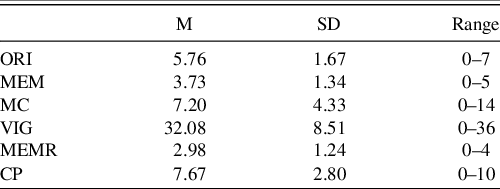
Multilevel mixed effects regression modelling was used to investigate the cognitive predictors of the outcome variable, agitation scores, with repeated observations nested within participants. All cognitive constructs (mental control, orientation, sustained attention, memory free recall, memory recognition, and auditory comprehension) were included in the model. Demographics (age, sex, and education) and previously identified factors associated with agitation and cognition, including time since injury (days), injury severity (PTA duration in days), and daily antipsychotic dosage, were included as covariates and participant was included as a random intercept within the model. Significant correlations were observed between most cognitive measures (Table 2), ranging from weak to moderate correlations. Table 3 depicts summary data of cognitive performance across all assessment tasks. Collinearity between predictors was examined with the variance inflation factors (VIFs). VIF values <5 were considered acceptable, with no identified violations of collinearity.
Correlations among cognitive constructs

NOTE: ***p < .001; **p < .01; *p < .05. Abbreviations: ORI, WPTAS orientation items; MEM, WPTAS memory Items; MC, Confusion Assessment Protocol (CAP) Mental Control Tasks; VIG, CAP Vigilance Task; MEMR, CAP Memory Recognition; CP, CAP Auditory Comprehension.
Summary of cognitive task performance during PTA

NOTE: Abbreviations: PTA, post-traumatic amnesia; ORI, WPTAS orientation items; MEM, WPTAS memory items; MC, Confusion Assessment Protocol (CAP) Mental Control Tasks; VIG, CAP Vigilance Task; MEMR, CAP Memory Recognition; CP, CAP Auditory Comprehension.
RESULTS
Participants
Of the 110 eligible patients, 28 were excluded as the CAP had not been administered on at least one occasion due to clinician availability or English as a second language. Included and excluded participants did not differ in demographic characteristics (i.e., age, gender, and pre-morbid occupation), cause of injury, injury severity, or hospital LOS (p > .05). The final sample included 82 participants (Table 1), 75.61% were male with a mean age of 43.79 years at injury (SD = 19.97; range 16–86). All participants were deemed to have moderate to extremely severe TBI based on duration of PTA (days) using the WPTAS and Mississippi PTA classification system (Nakase-Richardson et al., Reference Nakase-Richardson, Sherer, Seel, Hart, Hanks, Arango-Lasprilla and Hammond2011) (M = 42.30, SD = 35.10).
Agitation
Mean ABS score was 17.88 (SD = 4.19), mean peak ABS score was 22.93 (SD = 8.81, range 14–49), and the mean number of days of ABS evaluations was 15.78 (SD = 17.25). In total, 31 participants (37.80%) were clinically agitated (score of ≥ 21) on at least two occasions, while 41 participants (50.00%) were clinically agitated on at least one occasion. Of the participants deemed clinically agitated, using peak ABS score, 58.54% were classified as mild (score = 22–28), 24.39% were as moderate (score = 29–35), and 17.07% were deemed severely agitated (score > 36).
Predictors of Agitation
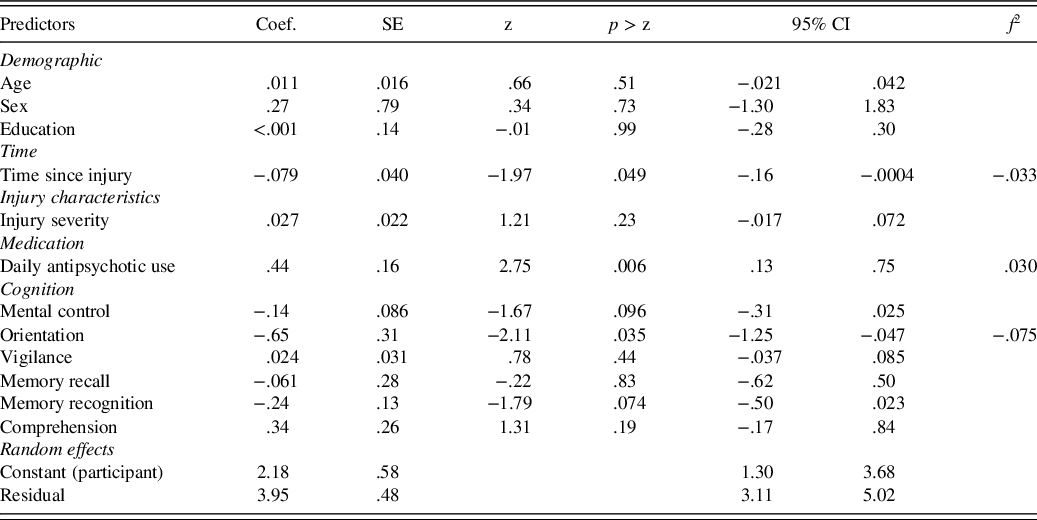
Multilevel mixed effects regression was used to investigate the cognitive predictors of agitation. Overall model results are shown in Table 4. Orientation was found to be significantly associated with agitated behaviour over time (z = −2.11, p = .035), such that improvement in performance on orientation items significantly predicted lower levels of agitation. A trend towards improved performance on tasks of memory recognition and lower agitation was observed; however, this was nonsignificant (z = −1.79, p = .074). Mental control, sustained attention, memory free recall, and auditory comprehension were not significantly associated with agitation scores over time.
Results of multilevel mixed effects regression predicting daily agitation scores

Of the covariates examined, time since injury significantly predicted ABS scores, demonstrating that agitation tended to resolve over time. Furthermore, antipsychotic medication dose predicted agitation, with higher dosages being associated with increased levels of agitated behaviour. Demographic factors and injury severity were not significantly associated with agitation scores within the model.
DISCUSSION
The aim of the present study was to investigate the association between agitated behaviour and various cognitive functions in a sample of acute TBI patients during PTA. The impact of time since injury, injury severity, and antipsychotic medication effects were also examined. In keeping with previous findings (Kadyan et al., Reference Kadyan, Mysiw, Bogner, Corrigan, Fugate and Clinchot2004), agitated behaviour was prevalent among participants in PTA, with 50% experiencing clinical levels of agitation on at least one occasion. Among the cognitive constructs explored, orientation was significantly associated with the occurrence of agitated behaviour, with the resolution of disorientation predicting lower levels of agitation. The association between improved performance on tasks of memory recognition and lower levels of agitation also approached significance. Performance on other cognitive tasks, including mental control, vigilance, free memory recall, and auditory comprehension were not significantly associated with agitation scores over time. Consistent with the view that agitated behaviour typically ceases prior to PTA emergence, agitation was also found to resolve over time (Harmsen et al., Reference Harmsen, Geurts, Fasotti and Bevaart2004; Shores et al., Reference Shores, Marosszeky, Sandanam and Batchelor1986). Additionally, higher antipsychotic medication dose was associated with higher levels of agitated behaviour.
The presence of disorientation is a key feature of PTA, reflecting the inability to orient oneself to person, place, or time (Levin, O’Donnell, & Grossman, Reference Levin, O’Donnell and Grossman1979; Shores et al., Reference Shores, Marosszeky, Sandanam and Batchelor1986). Current findings have been interpreted within the framework of PTA, however, are also consistent with a PTCS, which consider disorientation to be a key neurobehavioural feature and agitation as an associated feature (Sherer et al., Reference Sherer, Katz, Bodien, Arciniegas, Block, Blum and Yablon2020). Considering the gradual recovery of cognitive function during PTA, orientation has been found to return at the same time or following the return of mental control operations, but prior to return of complex functions such as continuous memory (Geffen et al., Reference Geffen, Encel and Forrester1991; Leach, Kinsella, Jackson, & Matyas, Reference Leach, Kinsella, Jackson and Matyas2006; Roberts et al., Reference Roberts, Spitz and Ponsford2015; Saneda & Corrigan, Reference Saneda and Corrigan1992; Stuss et al., Reference Stuss, Binns, Carruth, Levine, Brandys, Moulton and Schwartz1999; Tate & Pfaff, Reference Tate, Pfaff and Jurjevic2000). It is therefore conceivable that agitation is evident when more basic levels of cognitive functioning such as disorientation are impaired, possibly reflecting a greater degree of network disconnection between critical brain regions early within PTA (De Simoni et al., Reference De Simoni, Grover, Jenkins, Honeyfield, Quest, Ross and Sharp2016). This is reflective of past research investigating agitation and cognitive function more broadly, as greater levels of agitated behaviour were consistently associated with more severe CI (Bogner et al., Reference Bogner, Barrett, Hammond, Horn, Corrigan, Rosenthal and Garmoe2015; Corrigan & Mysiw, Reference Corrigan and Mysiw1988; McKay et al., Reference McKay, Love, Trevena-Peters, Gracey and Ponsford2018). Current findings are also in line with findings from Corrigan et al. (Reference Corrigan, Mysiw, Gribble and Chock1992) who reported that the majority of the relationship between agitation and functional cognitive ability, including memory, was accounted for by simple information processing capacity. The presence of disorientation may similarly be a marker of this early phase of network disconnection in which patients are more susceptible to agitated behaviour.
Additionally, a minor trend toward improved performance on memory recognition was observed. Memory recognition is thought to rely less on synchronized and integrated diffuse network connectivity (Kopelman, Reference Kopelman, Aminoff, Boller, Swaab, Goldenberg and Miller2008; Kopelman, Stanhope, & Kingsley, Reference Kopelman, Stanhope and Kingsley1999), which is in keeping with the notion that basic levels of cognitive functioning are associated with agitation. Further, altered consciousness and reduced arousal, which are also commonly observed in the early stages of recovery following TBI (Ponsford et al., Reference Ponsford, Sloan and Snow2012), most probably underpin the impaired information processing capacity of patients in PTA. This, in turn, could contribute to the distractible and restless behaviour often observed in agitated patients (Corrigan, Reference Corrigan1989; Kadyan et al., Reference Kadyan, Mysiw, Bogner, Corrigan, Fugate and Clinchot2004; Trevena-Peters, Ponsford, & McKay, Reference Trevena-Peters, Ponsford and McKay2018). These interpretations are, however, somewhat speculative as the timing and sequence of cognitive recovery were not explicitly explored in this study and requires further exploration and validation.
When considering the presence of agitation within an acute rehabilitation setting, it is possible that greater levels of disconnection impede an individual’s ability to understand their current circumstances or reliably process information from the environment, resulting in fear and confusion (Ponsford et al., Reference Ponsford, Sloan and Snow2012). The internalization of confusion and fear may trigger the occurrence of agitated behaviour including increased restlessness, frustration, aggression, and violence. From a clinical perspective, this is consistent with management recommendations that patients with TBI who remain in PTA be kept in a low stimulation and familiar environment, with consistent staff and provision of regular reassurance regarding circumstances in an attempt to maximize orientation (Ponsford et al., Reference Ponsford, Janzen, McIntyre, Bayley, Velikonja, Tate and Panel2014).
Recommendations also suggest avoiding interventions that may compromise basic cognitive functioning such as heavily sedating medications (Ponsford et al., Reference Ponsford, Janzen, McIntyre, Bayley, Velikonja, Tate and Panel2014). As the use of antipsychotic medication has been found to be associated with higher levels of agitation in this and other studies (Bogner et al., Reference Bogner, Barrett, Hammond, Horn, Corrigan, Rosenthal and Garmoe2015; McKay et al., Reference McKay, Love, Trevena-Peters, Gracey and Ponsford2018), several authors having raised the possibility that the use of antipsychotic medication during PTA could paradoxically increase agitation by suppressing arousal and cognitive function (Flanagan, Elovic, & Sandel, Reference Flanagan, Elovic and Sandel2009; Folweiler et al., Reference Folweiler, Bondi, Ogunsanya, LaPorte, Leary, Radabaugh and Kline2017; Harmsen et al., Reference Harmsen, Geurts, Fasotti and Bevaart2004; Hoffman, Cheng, Zafonte, & Kline, Reference Hoffman, Cheng, Zafonte and Kline2008). It must also be acknowledged that patients who are more agitated are more likely to be prescribed antipsychotic medication.
From a clinical perspective, current findings highlight the utility of using an assessment measure of PTA (i.e., WPTAS or GOAT) that incorporates orientation as a way to identify patients who may be at greater risk of agitation. The association between disorientation and agitation can also be used to guide staff education when managing patients in PTA, particularly considering reported misconceptions regarding the underlying cause and motivation for behavioural problems in PTA (Mortimer & Berg, 2017; Searby & Maude, 2014). Interventions designed to improve arousal and orientation may also potentially minimize agitation.
The current study is not without limitations. Firstly, findings may not generalise to individuals with TBI outside of an acute rehabilitation setting. In addition, while the study adopted a prospective design, only the days with complete data observations were used. While this may limit the interpretation of how daily fluctuations in agitation relate to cognitive functioning, the current study allowed for this relationship to be prospectively modelled over time. Only a select number of demographic factors were controlled for within the current study, and it is noted that other demographic or premorbid conditions such as socioeconomic status and mental health disorders may be associated with the occurrence of agitation or impact the relationship between cognitive function and agitation during PTA. Additionally, while CAP administration rates were based on previous studies (Sherer et al., Reference Sherer, Nakase-Thompson, Yablon and Gontkovsky2005; Sherer, Yablon & Nakase-Richardson, Reference Sherer, Yablon and Nakase-Richardson2009) and clinician availability, there was an association between higher levels of agitation and lower CAP administration. As such, current findings may not generalise to individuals exhibiting more severe levels of agitation. Interrater reliability was not formally measured in the current study; however, the same trained neuropsychologist administered all measures (i.e., CAP, WPTAS, and ABS) at any given time point. All assessment measures have demonstrated high interrater reliability (Bogner, Corrigan, Stange, & Rabold, Reference Bogner, Corrigan, Stange and Rabold1999; Geffen, Bishop, Connell, & Hopkins, Reference Geffen, Bishop, Connell and Hopkins1994; Sherer, Nakase-Thompson, Yablon, & Gontkovsky, Reference Sherer, Nakase-Thompson, Yablon and Gontkovsky2005; Shores, Marosszeky, Sandanam, & Batchelor, Reference Shores, Marosszeky, Sandanam and Batchelor1986).
Further, the current study dataset is mainly limited to the earlier stages of PTA when CAP data were available. In this sample, CAP administration was discontinued after the CAP was passed, which typically occurred on the same day or prior to emergence from PTA (based on the WPTAS pass criteria). This limited the ability to investigate the association between agitation and cognitive functions that may have recovered later on items of the WPTAS, such as memory recall. Lastly, a specific battery of cognitive tasks was selected based on accessibility, ease of administration, and suitability to patients’ cognitive state in PTA. The inclusion of more complex tasks may have proven too difficult for patients to complete (Corrigan et al., Reference Corrigan, Mysiw, Gribble and Chock1992; Stuss et al., Reference Stuss, Binns, Carruth, Levine, Brandys, Moulton and Schwartz1999). However, it is acknowledged that other cognitive domains not assessed in this study may contribute to agitated behaviour. Future studies should explore whether measures assessing different cognitive domains (i.e., processing speed, impulse control, and inhibition) show variance in performance during PTA and possibly underpin agitated behaviour. Extending this knowledge may influence planning of assessment and treatment during PTA.
The present study prospectively examined the occurrence of agitated behaviour and cognitive performance across multiple domains, within an acute TBI sample during PTA. Current findings confirm the presence of a significant relationship between cognition and agitation, particularly the presence of disorientation. This serves as an important reminder that PTA is a unique construct and not simply reflective of more severe neuropsychological dysfunction. Further research is required to obtain a more complete understanding of the impact of CI on agitation; however, the emergence of orientation as a significant predictor has significant clinical value. This may inform efforts to minimise agitation in this vulnerable group of patients by exploring interventions aimed at maximising orientation in this early stage of recovery.
ACKNOWLEDGEMENTS
The authors would like to gratefully acknowledge the neuropsychology staff at Epworth Healthcare Acute Brain Injury Ward for their assistance with data collection.
FINANCIAL SUPPORT
This research was funded by Monash University Research Grant.
CONFLICT OF INTEREST
The authors have no financial, consultant, institutional, or other conflicts to declare.
ETHICAL STANDARDS
Participating institutional boards approved this study, and informed consent was obtained after details of the study were explained to the participant following emergence from Post Traumatic Amnesia or from the next of kin, if the participant could not provide consent.