The pom pom anemone Liponema multicornis (Verrill, 1880) is a deepwater actinostolid found at depths from 80–872 m at high latitudes across the North Atlantic, occurring as far south as Cape Cod in the north-west Atlantic region (Carlgren, Reference Carlgren1921; Sebens, Reference Sebens1998). Verrill originally placed this species in the genus Bolocera but through a series of revisions it was erected to the genus Liponema (Sebens, Reference Sebens1998). Species in the genus Liponema have been observed on a variety of substratum, attached to rock surfaces or on sand and mud where individuals live unattached (Dunn & Bakus Reference Dunn and Bakus1977; Sebens Reference Sebens1998). Liponema multicornis is morphologically distinct from all other anemones in the Gulf of Maine region of the north-west Atlantic, with several hundred and up to 900 short papilliform tentacles that are easily detached (Sebens, Reference Sebens1998), making visual identification relatively straightforward.
Evidence that this species even occurs in the Gulf of Maine comes from a very limited number of specimens collected in historic dredge and net surveys. Even in the current era, it is extremely rare in the spatially extensive annual research trawl and dredge surveys conducted for fisheries assessments. A search of museum collections with verifiable specimens for this region revealed the United States Fish Commission Steamer ‘Fish Hawk’ collected a single specimen 7 miles south of Cape Cod at 80 m depth on 3 August 1882 (YPM 8872). Eight specimens collected by the United States Fish Commission Steamers ‘Speedwell’ and ‘Albatross’, from 185 m depth off of Nova Scotia in 1877 as well as from 368 m off Newfoundland and from 410 m in Cabot Strait in 1885, make up the remaining historic samples (YPM 8871, YPM 8869 and USNM 11734 respectively). More recent collections documented in the United States National Marine Fisheries Service data set for invertebrate collections (unpublished; for the years 1955–2006) lists a single record of a single specimen from the catch of an otter trawl from the NOAA Ship ‘Albatross IV’ on 23 July 1963 at 263 m depth in the Northeast Channel, a deep channel separating north-east Georges Bank and Browns Bank (specimen USNM 1046245).
It is possible that the dearth of L. multicornis specimens from net and dredge collections is because these anemones are fragile, become unrecognizable during the capture process, and are easily overlooked in catches. However, despite hundreds of hours of direct underwater observations using occupied submersibles and remotely operated vehicles for multiple projects across the depth-range of this species in the Gulf of Maine region over the past 30 years, observations of this species by the authors and their colleagues have been exceedingly rare. One of the authors (P.J.A.) briefly observed a single specimen of L. multicornis east of Stellwagen Bank on fine grained gravelly-sand with sparse emergent and attached fauna during a remotely operated vehicle (ROV) transect at 42°31.7′N 70°02.9′W in 132 m depth on 23 May 1996. Another single specimen was observed (by L.W.) in Wilkinson Basin during the deep submergence vehicle ‘Clelia’ dive 337 at 42°50.94′N 68°58.75′W in 127 m depth on 4 July 1995, amongst a dense patch of cerianthid anemones in sand substratum. A multi-year study of deepwater megafauna based on photographic transects over the seafloor in the central and eastern Gulf of Maine (Langton & Uzmann, Reference Langton and Uzmann1989) did not identify the presence of L. multicornis, nor did time-series photographic surveys of megafauna at the heads of five Georges Bank submarine canyons (Cooper et al., Reference Cooper, Shepard, Valentine, Uzmann and Hulbert1987).
Finally, while large anthozoans were regularly collected intact in grab samples, L. multicornis does not appear (nor any species in the genus Bolocera, allowing for errors in identification) in the extensive list of north-east shelf fauna published by Theroux & Wigley (Reference Theroux and Wigley1998). This work was based on 1076 quantitative grab samples collected across the continental shelf and down the continental margin to a depth of 4000 m during 22 cruises between 1956 and 1965. Five other actinids were collected so the collection gear clearly retains this component of the seafloor fauna.
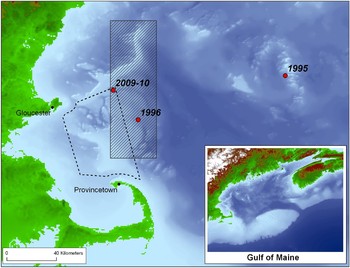
Here we report for the first time, as far as we can discern, direct underwater observations of three specimens of L. multicornis and their associates, from a marine protected area in the Gulf of Maine. Observations were made on 18 August 2009 and 5 August 2010, all at a deepwater station in the Stellwagen Bank National Marine Sanctuary that is protected from fishing using mobile bottom-contact fishing gear (approximately centred at 44.50′N 70°13.00′W; Figure 1).
Location of recent observations and collection of Liponema multicornis in the Gulf of Maine (north-west Atlantic) region. The dashed line indicates the boundary of Stellwagen Bank National Marine Sanctuary. The cross-hash area indicates the region of the western Gulf of Marine fishery closure.

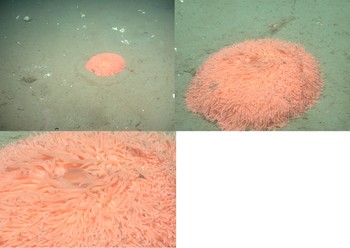
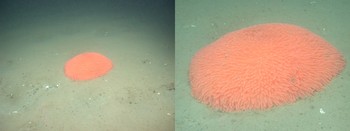
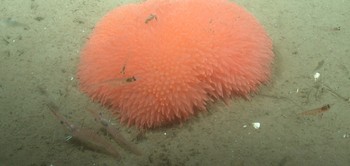
Each L. multicornis specimen was observed on fine grained gravelly-sand substratum with distal tentacles in contact with the sediment surface (Figures 2–4). Pandalid shrimp Pandalus borealis (Krøyer, 1838) were observed along the periphery of all specimens. A halo of disturbed sediment along the periphery of one specimen (Figure 2) suggests that shrimp are sometimes associated with anemones for some extended period of time, although temporal period and the potential for sequential occupation by multiple shrimp to produce the sedimentary pattern remain unknown.
Specimen A in habitat setting (upper left) and close-up images of associated pandalid shrimp and amphipods (observed at 42°44.55′N 70°13.91′W in 129 m depth). Note the halo of smoothed sediment around the periphery of the anemone, indicative of continued use of the anemone for food or shelter (or both) by the associated shrimp.

Specimen B in habitat setting (left) and close-up with associates (observed at 42°44.56′N 70°13.73′W in 131 m depth).

Specimen C and associates observed at 42°44.54′N 70°13.86′W (134 m depth). Note the krill on tentacles. These individuals were not captured by the anemone and their behaviour suggests predation on associated amphipods.

All of the anemones we observed hosted an aggregation of amphipods. The number of amphipods on specimen A, based on counts of visible amphipods in oblique digital still images was 82, 35 for specimen B, and specimen C had five. Specimen A was collected using the ROV manipulator, placed in an insulated box and returned to the surface where amphipods were collected for identification. Tentacles were extremely ‘sticky’ and continued to adhere to the ROV manipulator even in air after the vehicle was recovered to the deck. Separated tentacles and the intact specimen both produced excessive mucous material that actually encased associated amphipods. Scintigest Tissue Solubilizer was used to dissolve organic material in order to recover many of the specimens. We have tentatively identified the amphipod as Stenothoe brevicornis Sars. A total of 236 amphipods were recovered from specimen A, where only 82 were present based on a visual count, indicating the largest number in the remaining specimens were likely concealed behind and amongst the base of tentacles. Mean total length of a subsample of 50 amphipods from the collection was 1.89 mm (based on measurements using digital video calipers accurate to 0.01 mm).
We suspect amphipods were feeding on particulate matter trapped in the mucous material produced by the anemones. In European waters S. brevicornis Sars 1883 is found only in a commensal association with the sea anemone Actinostola callosa (Verrill, 1882), which is also common in this region of the North Atlantic (Vader & Krapp-Schickel, Reference Vader and Krapp-Schickel1996). Shrimp may be using the anemones as physical shelter as well as a source of food. We observed shrimp using chelae to pick along the edges of the anemone and subsequently move them towards their mandibles but were unable to discern any larger food items, suggesting small bits of the mucous material were being handled. Observations of krill Meganyctiphanes norvegica (M. Sars, 1857) apparently attacking amphipods on the tentacles of L. multicornis suggest that the anemone can serve as both refuge and prey patch (Figure 4).
The rarity of L. multicornis in collections and published accounts from direct observations, from the historic past to the present time, suggest that this species is very low in abundance across the Gulf of Maine region. The lack of high density patches and catches anywhere samples have been collected or direct observations have been made indicates that this species is low in abundance at the local scale as well. That is, L. multicornis is widely distributed but is rare everywhere, making an assessment of the population and conservation status of this species difficult. This pattern is in contrast to a limited set of observations during 1976 from the Bering Sea of the related species L. brevicornis, documenting small high density patches from 4.2–7.4 individuals m−2 (Dunn & Backus, Reference Dunn and Bakus1977). Given loss of tentacles when disturbed, high fishing pressure using bottom-contact nets and dredges characteristic of the Gulf of Maine region during the 1970s through to the late 1990s (Murawski et al., Reference Murawski, Wigley, Fogarty, Rago and Mountain2005) may have reduced population numbers, regardless of small scale distribution patterns. However, occurrence of multiple specimens in the protected region of the Stellwagen Bank National Marine Sanctuary (closed to bottom trawling for 11 years at the time of our first observation) perhaps indicates an area of ongoing recovery. If high density patches develop over time in this area, such observations may suggest a strategy for the conservation and recovery of L. multicornis for other areas in the region as well.
ACKNOWLEDGEMENTS
The authors thank the captain and crew of the RV ‘Connecticut’, as well as the pilots and technicians of the ‘Kraken 2’ ROV operated by the Northeast Underwater Research Technology & Education Center at the University of Connecticut, for exceptional support in the field. We also thank Traudl Krapp-Schickel for examining images of the appendages of the amphipod to confirm identification. The funding for the Seafloor Habitat Recovery Monitoring Program provided by the United States National Oceanic and Atmospheric Administration's Stellwagen Bank National Marine Sanctuary allowed us to conduct this work. The opinions expressed herein are those of the authors and do not necessarily reflect the opinions of the United States National Oceanic and Atmospheric Administration or its sub-agencies.