INTRODUCTION
Litter decomposition is a key process for terrestrial ecosystems; up to 99% of the above-ground net primary production enters the decomposer subsystem as plant litter (McNaughton et al. Reference MCNAUGHTON, OESTERHELD, FRANK and WILLIAMS1989). Litter quality, macro- and microclimatic conditions and the structure of the decomposer community influence the rate of litter decomposition (Swift et al. Reference SWIFT, HEAL and ANDERSON1979). Generally, decomposition processes in the humid tropics are faster than in temperate regions (Heneghan et al. Reference HENEGHAN, COLEMAN, ZOU, CROSSLEY and HAINES1999). Most of the litter in moist and wet tropical lowland forests decays within 1 y (Sampaio et al. Reference SAMPAIO, DALL'OLIO, NUNES and DELEMOS1993). However, little is known on decomposition processes in tropical montane rain forests (Weerakkody & Parkinson Reference WEERAKKODY and PARKINSON2006). Decomposition of leaf litter of 15 tree species in Jamaican montane rain forests at 1550 m ranged between 27% and 96% in 1 y (Tanner Reference TANNER1981). Litter turnover rates in tropical montane forests therefore are similar to those in temperate forests (Anderson & Swift Reference ANDERSON, SWIFT, Sutton, Whitmore and Chadwick1983).
Differences in litter decomposition are due to differences in density and composition of the animal and microbial decomposer communities, the physical environment, e.g. temperature, moisture and pH, and the quality of the litter itself. Separating the influence of these factors is essential for understanding decomposition processes. In a montane rain forest in southern Ecuador, Wilcke et al. (Reference WILCKE, YASIN, ABRAMOWSKI, VALAREZO and ZECH2002) assumed that waterlogging as well as lower temperatures inhibit the decomposition of organic matter, in particular at higher altitudes. Vitousek et al. (Reference VITOUSEK, TURNER, PARTON and SANFORD1994) found a strong negative relationship between decomposition rates and elevation (and hence mean annual temperature) on the slopes of Mauna Loa volcano, Hawaii.
The influence of external and internal factors on decomposition processes has been intensively studied (Heneghan et al. Reference HENEGHAN, COLEMAN, ZOU, CROSSLEY and HAINES1999, Taylor et al. Reference TAYLOR, PARKINSON and PARSONS1989). Recent studies investigated to what extent litter decomposition is affected by interactions between litter of different plant species (Albers et al. Reference ALBERS, MIGGE, SCHAEFER and SCHEU2004, Hansen & Coleman Reference HANSEN and COLEMAN1998, Wardle et al. Reference WARDLE, YEATES, BARKER and BONNER2006). Mixture effects can be synergistic, additive or antagonistic. Often decomposition rates are accelerated by mixing of different plant species. A number of factors may contribute to mixture effects including higher humidity in mixed litter (Wardle et al. Reference WARDLE, NILSSON, ZACKRISSON and GALLET2003) and the translocation of nutrients from high-quality to low-quality litter (Smith & Bradford Reference SMITH and BRADFORD2003). Further, Schädler & Brandl (Reference SCHÄDLER and BRANDL2005) concluded that non-additive effects may also be due to the activity of soil fauna.
By consuming plant residues, decomposer animals mobilize nutrients and enhance soil fertility and plant performance (Swift et al. Reference SWIFT, HEAL and ANDERSON1979, Wardle Reference WARDLE2002). The soil microbial community is structured and its activity influenced by soil invertebrates which are extraordinarily numerous and exceptionally diverse (Bardgett Reference BARDGETT2002). Micro-arthropods affect the biomass, activity and diversity of bacteria and fungi directly by feeding, or indirectly by comminution of plant debris, dissemination of microbial propagules and changes in nutrient availability (Cragg & Bardgett Reference CRAGG and BARDGETT2001, Scheu et al. Reference SCHEU, RUESS, BONKOWSKI, Buscot and Varma2005).
In a tropical montane rain forest in southern Ecuador we investigated (1) the decomposition of litter materials from dominant tree species at different altitudes, (2) the effect of mixing of different litter types on decomposition processes, and (3) the colonization of different litter materials by micro-arthropods and their effect on decomposition rates. To investigate changes with time, we followed the decomposition process over 1 y. We hypothesized that, due to higher temperature and lower precipitation (no waterlogging), decomposition rates in tropical montane rain forests are faster at lower altitudes.
Graffenrieda emarginata Triana (Melastomataceae) and Purdiaea nutans Planch. (Cyrillaceae) represent the most abundant tree species at the study area (Homeier et al. Reference HOMEIER, DALITZ and BRECKLE2002). Purdiaea nutans flourishes at higher elevation (> 2200 m) whereas G. emarginata is most abundant at intermediate altitudes (< 2200 m). Compared to G. emarginata, P. nutans produces foliage with a higher degree of sclerophylly. Since litter quality strongly influences decomposition processes (Loranger et al. Reference LORANGER, PONGE, IMBERT and LAVELLE2002) we expected the decomposition of P. nutans to be slower than that of G. emarginata with decomposition rates of mixed litter being intermediate.
It is generally agreed that the biomass of soil macro-invertebrates in temperate deciduous forests exceeds that in tropical rain forests (Anderson & Swift Reference ANDERSON, SWIFT, Sutton, Whitmore and Chadwick1983, Petersen & Luxton Reference PETERSEN and LUXTON1982). Indeed, at our study site in southern Ecuador the density of soil macrofauna, such as earthworms, millipedes and woodlice, is low (Maraun et al. Reference MARAUN, ILLIG, SANDMANN, KRASHEVSKA, NORTON, SCHEU, Beck, Bendix, Kottke, Makeschin and Mosandl2008). Therefore, we expected soil micro-arthropods to be the main drivers of decomposition processes. The most abundant and diverse soil micro-arthropods in tropical forests are oribatid mites (Franklin et al. Reference FRANKLIN, HAYEK, FAGUNDES and SILVA2004, Heneghan et al. Reference HENEGHAN, COLEMAN, ZOU, CROSSLEY and HAINES1999).
Declines in invertebrate species richness and abundance at high elevations in the tropics have been documented (Olson Reference OLSON1994) suggesting that physical parameters that vary continuously with altitude are important determinants. Therefore, we expected the micro-arthropod community to differ between altitudes.
METHODS
Study sites
The study area is located in southern Ecuador within the Eastern Cordillera of the Andes in the province of Zamora–Chinchipe. The experiment was conducted in the area of the Reserva Biológica San Francisco (RBSF) (3°58′S, 79°5′W) at the border of the Podocarpus National Park. The study site is a biological reserve, covering about 1000 ha, on the steeply sloping (30°–50°), north-facing flank of the valley of the Rio San Francisco which drains in the Amazon basin. The altitude ranges from 1800 m to 3200 m asl and the climate is semi-humid with 8–10 humid mo. The average annual precipitation at 2000 m is 2031 mm and the average annual temperature is 15.7 °C (Emck Reference EMCK2006). The bedrock consists mainly of weakly metamorphosed Palaeozoic schists and sandstones with some quartz veins. Dominant soil types are Eutric, Dystric and Humic Cambisols (Wilcke et al. Reference WILCKE, YASIN, VALAREZO and ZECH2001). The organic soil layer is thick and increases with elevation, the pH ranges between 3.0 and 5.5 (Wilcke et al. Reference WILCKE, YASIN, ABRAMOWSKI, VALAREZO and ZECH2002) and decreases with altitude (Soethe et al. Reference SOETHE, LEHMANN and ENGELS2006). The site is covered with mostly undisturbed montane rain forest (Homeier et al. Reference HOMEIER, DALITZ and BRECKLE2002).
Experimental design
Litter from G. emarginata and P. nutans was sampled in February 2004 at 1850 and 2280 m, respectively. After drying at 65 °C for 72 h, 10 g dry weight (5 g of each litter type in the bags with mixed litter) of the litter was filled in litterbags (20 × 20 cm) of different mesh-size (48 μm and 1 mm); the finer mesh-size prevents immigration of soil micro-arthropods. A total of 144 litterbags (three litter types, three sampling dates, two altitudes, two litterbag types, four replicates) with litter from G. emarginata, P. nutans and the one to one hand-mixture of both were sealed by sewing and exposed in the field at 1850 m (S 03°58′38″, W 79°04′66″) and 2280 m (S 03°58′96″, W 79°04′41″). Litterbags were fixed with tent pegs to ensure contact to the soil.
Micro-arthropods, microbial and chemical parameters
After 2, 6 and 12 mo, litterbags were removed and transferred to the laboratory. Mesofauna from half of the wide-meshed litterbag material were extracted with a modified heat-extractor (Kempson et al. Reference KEMPSON, LLOYD and GHELARDI1963) and micro-arthropods were identified (after 2 and 12 mo only). The remaining material was used for measuring microbial biomass (after 2 and 12 mo only) using the substrate-induced respiration method (Anderson & Domsch Reference ANDERSON and DOMSCH1978, Scheu Reference SCHEU1992). The temperature coefficient (Q 10) for the two altitudes (a = 1850 m and b = 2280 m) was calculated using the exponential function (Q 10) = (k b/k a)10(Tb-Ta), where k a and k b are the reaction rates (= remaining dry weights) at temperatures T a and T b. Yearly decomposition rates, k (y−1), were calculated by fitting the amount of remaining litter to the simple exponential decay model, x(t)/x(o) = e−k(t) (Olson Reference OLSON1963). The samples collected after 12 mo and also the initial litter materials were analysed for C and N concentration. The material was dried (65 °C, 72 h) and milled, and concentrations of C and N were determined by dry combustion with a C-N analyser (Carlo Erba EA 1108, Milano, Italy).
Statistical analysis
The remaining litter dry weight, microbial biomass, C and N concentration, C:N ratio and the response of the micro-arthropod groups (Oribatida, Uropodina, Gamasina, Prostigmata + Astigmata (all Acari) and Collembola (Insecta)) to altitude, litter type and time of exposure was analysed by analysis of variance (ANOVA, GLM). Means were compared by Tukey's honestly significant difference test (HSD). STATISTICA 6.0 (Statsoft, Tulsa, USA) and SAS 9.13 (Statistical Analysis System, SAS Institute Inc., Cary, USA) software packages were used for statistical analyses. To analyse the response of subgroups of oribatid mites to litter decomposition principal components analysis (PCA) was carried out. Time of exposure (2 and 12 mo) was coded as a supplementary variable and included in the PCA using the passive analysis procedure (i.e. the variables did not contribute to the ordination; Jongman et al. Reference JONGMAN, BRAAK and VAN TONGEREN1995) in CANOCO 5.0 (Microcomputer Power, Ithaca, USA). Taxa which occurred in total less than five times were not considered.
RESULTS
Mass loss, C and N concentration
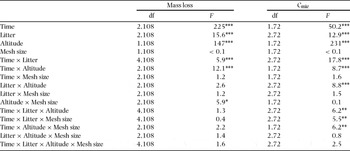
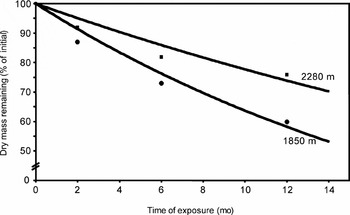
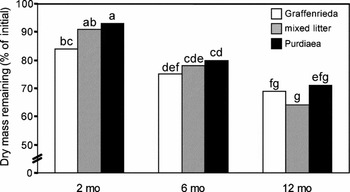
Overall, 90, 78 and 68% of the initial dry mass of the litter remained after 2, 6 and 12 mo, respectively. Litter at 1850 m decomposed faster (decay constant k = 0.48) than at 2280 m (k = 0.27; Table 1, Figure 1). Further, litter of P. nutans decomposed slower than that of G. emarginata and mixed litter (k = 0.27, 0.38 and 0.40, respectively). After 2 and 6 mo G. emarginata litter had decomposed faster than the other two litter types but after 12 mo the mixed litter had decomposed faster than both single litter species (Time × Litter interaction; Table 1, Figure 2). Generally, litter decomposition was faster at the beginning of the exposure and slowed down at later stages. This decline in decomposition rates was more pronounced at 2280 m than at 1850 m (Time × Altitude interaction; Table 1, Figure 1). At 1850 m litter in fine mesh-bags decomposed slightly but not significantly faster than that in coarse mesh-bags (72.9% and 74.7% dry mass remaining, respectively), whereas at 2280 m the opposite was true (84.9% vs. 82.7%; Altitude × Mesh-size interaction; Table 1).
Four-factor ANOVA table of F-values on the effect of time of exposure, litter type (Graffenrieda emarginata, Purdiaea nutans and mixture), altitude (1850 m and 2280 m) and mesh size (48 μm and 1 mm) on mass loss and microbial biomass (Cmic). For mass loss three sampling dates (2, 6, 12 mo) were considered whereas microbial biomass was only analysed at two sampling dates (2, 12 mo) (***P < 0.001; **P < 0.01;*P < 0.05).

Litter decomposition (Graffenrieda emarginata, Purdiaea nutans and a mixture of both litter types) in a tropical montane rain forest in Ecuador. The graph indicates the dry mass remaining (% of initial) of litter materials in litterbags exposed for 12 mo at 1850 and 2280 m (data are pooled for litter type and mesh size). Lines represent exponential regressions.

Dry mass remaining (% of initial) of litter materials exposed in litterbags with different litter types (Graffenrieda emarginata, mixed litter and Purdiaea nutans) after 2, 6 and 12 mo in a tropical montane rain forest in Ecuador (data are pooled for altitude and mesh size). Different letters indicate significant differences between means at P < 0.05 (Tukey's HSD).

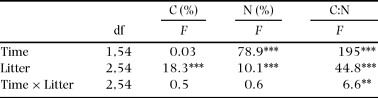
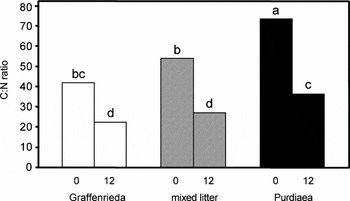
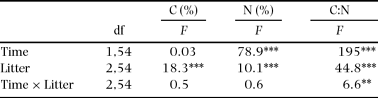
Carbon and nitrogen concentrations of the initial litter materials differed significantly (1.2%, 1.0% and 0.7% nitrogen and 50.5%, 52.1% and 53.7% carbon for G. emarginata, mixed and P. nutans litter material, respectively). Nitrogen concentrations increased until the end of the experiment for G. emarginata from 1.2% to 2.3%, mixed from 1.0% to 2.0% and P. nutans litter from 0.7% to 1.6% (Table 2). Since the carbon concentration of the litter materials changed little, C:N ratios followed the changes in N concentrations. The increase in nitrogen concentrations with time was strongest in P. nutans litter resulting in a stronger decrease in the C:N ratio compared to the other two litter materials (Time × Litter interaction; Table 2, Figure 3).
Two-factor GLM table of F-values on the effect of time of exposure (0 and 12 mo) and litter type (Graffenrieda emarginata, Purdiaea nutans and mixture) on C concentration (%), N concentration (%) and C:N ratio of the litter material exposed (***P < 0.001; **P < 0.01).
C:N ratio of litter of Graffenrieda emarginata, mixed litter and litter of Purdiaea nutans prior to exposure (indicated by 0 in the figure) and after 12 mo (indicated by 12) of exposure in litterbags in a tropical montane rain forest in Ecuador. Different letters indicate significant differences between means at P < 0.05 (Tukey's HSD).

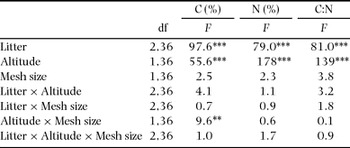
Overall, carbon concentrations in the litter materials after 12 mo were higher at 2280 m compared to 1850 m (53.0% vs. 51.1%), nitrogen concentrations were higher at 1850 m compared to 2280 m (2.3% vs. 1.6%), resulting in higher C:N ratios at 2280 m (33.9) compared to 1850 m (23.2; Table 3). Carbon concentrations of litter did not differ significantly in fine and coarse mesh-bags at 2280 m (52.8 ± 1.8 and 53.2 ± 1.7, respectively) but were lower in coarse mesh-bags than in fine mesh-bags at 1850 m (51.7 ± 2.5 and 50.5 ± 2.1, respectively; Altitude × Mesh-size interaction; Table 3).
Three-factor ANOVA table of F-values on the effect of litter type (Graffenrieda emarginata, Purdiaea nutans and mixture), altitude (1850 m and 2280 m) and mesh size (48 μm and 1 mm) on C concentration (%), N concentration (%) and C:N ratio after 12 mo of exposure (***P < 0.001; **P < 0.01).

Microbial biomass
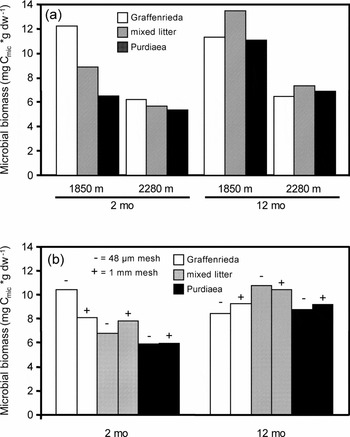
Microbial biomass (Cmic) increased from 2 mo of exposure to the end of the experiment from an average of 7.5 to 9.5 mg Cmic g−1 dry weight. Microbial biomass was significantly higher at 1850 m than at 2280 m (10.6 vs. 6.3 mg Cmic g−1 dry weight; Table 1) with the difference being more pronounced after 12 than after 2 mo of exposure (Time × Altitude interaction; Table 1). Microbial biomass in G. emarginata and mixed litter significantly exceeded that in P. nutans litter after 2 mo of exposure (9.2, 7.3 and 5.9 mg Cmic g−1 dry weight in G. emarginata, mixed and P. nutans litter, respectively), whereas microbial biomass was highest in mixed litter at the end of the experiment (10.6 compared to 8.9 and 9.0 mg Cmic g−1 dry weight in mixed, G. emarginata and P. nutans litter, respectively; Time × Litter interaction; Table 1). Microbial biomass in mixed and P. nutans litter was higher at the second sampling date but only at 1850 m; at 2280 m microbial biomass in each of the litter materials was similar at both sampling dates (Time × Litter × Altitude interaction; Table 1, Figure 4a). Microbial biomass in G. emarginata litter enclosed in coarse mesh-bags was lower than that in fine mesh-bags, whereas microbial biomass in mixed litter enclosed in coarse mesh-bags exceeded that in fine mesh-bags, but only after 2 mo of exposure (Time × Litter × Mesh-size interaction; Table 1, Figure 4b).
Effects of altitude (1850 and 2280 m) and time of exposure (2 and 12 mo) on microbial biomass in litter of Graffenrieda emarginata, mixed litter and litter of Purdiaea nutans (a), and effects of mesh-size (48 μm and 1 mm) and time of exposure (2 and 12 mo) on microbial biomass in litter of Graffenrieda emarginata, mixed litter and litter of Purdiaea nutans (b) in a tropical montane rain forest in Ecuador.

Colonization of litterbags by micro-arthropods
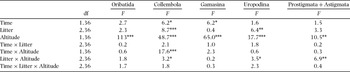
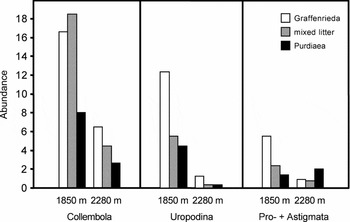
Micro-arthropods were more abundant at 1850 m than at 2280 m (Oribatida (49.5 ± 17.9 ind.) vs. (10.6 ± 6.3), Gamasina (15.0 ± 7.7) vs. (2.5 ± 2.2), Uropodina (7.5 ± 6.4) vs. (0.5 ± 1.6), Prostigmata + Astigmata (3.1 ± 3.0) vs. (1.2 ± 1.1), Collembola (14.4 ± 9.0) vs. (4.5 ± 3.7)). The number of Gamasina and Collembola declined from the first sampling date (2 mo) to the end of the exposure (12 mo) with 10.7 ± 9.9 and 11.2 ± 10.3 vs. 6.8 ± 6.2 and 7.7 ± 5.8 individuals, respectively (Table 4). Uropodina colonized G. emarginata litter at higher densities than P. nutans or mixed litter (6.8 ± 7.8, 2.3 ± 4.3 and 2.9 ± 3.6 individuals, respectively); Collembola were more abundant in litter of G. emarginata and mixed litter than in litter of P. nutans (11.6 ± 8.3, 11.5 ± 10.5 and 5.3 ± 3.9 individuals, respectively). The density of Collembola was higher at 1850 m at the first sampling date (19.1 ± 9.1 individuals) than at the second sampling date (9.7 ± 6.2 individuals), but at 2280 m the density of Collembola was higher at the second sampling date (5.8 ± 4.8 individuals) compared with the first sampling date (3.3 ± 1.7 individuals; Time × Altitude interaction; Table 4). The density of Collembola at 1850 m was highest in mixed, intermediate in G. emarginata and lowest in P. nutans litter; at 2280 m the density of Collembola was generally lower than at 1850 m, and highest in G. emarginata, intermediate in mixed and lowest in P. nutans litter. At 1850 m densities of Uropodina and Prostigmata + Astigmata were higher in G. emarginata litter, intermediate in mixed litter and lowest in P. nutans litter, whereas at 2280 m density of these taxa was similar in each of the litter materials (Litter × Altitude interaction; Table 4, Figure 5).
Three-factor ANOVA table of F-values on the effect of time of exposure (2 and 12 mo), litter type (Graffenrieda emarginata, Purdiaea nutans and mixture) and altitude (1850 m and 2280 m) on densities of Oribatida, Collembola, Gamasina, Prostigmata + Astigmata and Uropodina (***P < 0.001; **P < 0.01; *P < 0.05).

Effects of litter of Graffenrieda emarginata, mixed litter and litter of Purdiaea nutans at 1850 m and 2280 m on abundance of Collembola, Uropodina and Prostigmata + Astigmata in the litterbags exposed in a tropical montane rain forest in Ecuador (abundance of micro-arthropods extracted from half of the wide-meshed litterbag material).

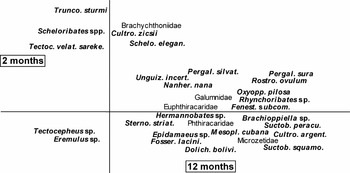
In total, 37 species of oribatid mite were found. Among adults Poronota were most abundant followed by Gymnonota, Enarthronota, Mixonomata and Desmonomata with 13.3 ± 12.5, 6.7 ± 9.4, 1.8 ± 2.8, 1.1 ± 2.0 and 0.5 ± 1.1 individuals, respectively. The oribatid mite community was dominated by Scheloribates spp. (2 species), Pergalumna sura, Scheloribates elegans and Truncozetes sturmi (16.8%, 6.7%, 6.3% and 6.0% of total, respectively). Seventeen taxa only occurred at 1850 m. In general, the density of oribatid mite subgroups did not vary between litter materials, with the exception of Enarthronota (Brachychthonioidea spp., Mesoplophora cubana) which preferentially colonized mixed litter (F2,36 = 12.6, P < 0.0001). In litterbags exposed for 2 mo in the field few oribatid mite species occurred, whereas in more-decomposed litter materials most oribatid mite taxa were found (Figure 6). Juvenile oribatid mites represented 22% of total and were more abundant after 12 mo (F1,36 = 19.3, P < 0.0001).
Oribatid mite community structure analysed by principal components analysis (PCA) in the litterbags after 2 and 12 mo of exposure in a tropical montane rain forest in Ecuador. Eigenvalues of Axis 1 and Axis 2 are 0.28 and 0.26, respectively. After 12 mo of exposure more species occurred in the litterbags than after 2 mo of exposure in the field (data are pooled for litter type and altitude) (Cultro. argent. = Cultroribula argentinensis Balogh & Csiszar, 1963; Cultro. zicsii = Cultroribula zicsii Balogh & Mahunka, 1981; Dolich. bolivi. = Dolicheremaeus bolivianus Balogh & Mahunka, 1969; Fenest. subcom. = Fenestrobelba subcomplexa (Balogh & Mahunka, 1968); Fosser. lacini. = Fosseremus laciniatus (Berlese, 1905); Mesopl. cubana = Mesoplophora cubana Calugar & Vasiliu, 1977; Nanher. nana = Nanhermannia nana (Nicolet, 1855); Oxyopp. pilosa = Oxyoppia pilosa Balogh & Mahunka, 1981; Pergal. silvat. = Pergalumna silvatica Hammer, 1961; Pergal. sura = Pergalumna sura Balogh, 1987; Rostro. ovulum = Rostrozetes ovulum (Berlese, 1908), Schelo. elegan. = Scheloribates elegans Hammer, 1958; Sterno. striata = Sternoppia striata Mahunka, 1983; Suctob. peracu. = Suctobelbella peracuta (Balogh & Mahunka, 1980); Suctob. squamo. = Suctobelbila squamosa (Hammer, 1961); Tectoc. velat. sareke. = Tectocepheus velatus sarekensis Trägardh, 1910; Trunco. sturmi = Truncozetes sturmi Balogh, 1984; Unguiz. incert. = Unguizetes incertus (Balogh & Mahunka, 1969).

DISCUSSION
Litter decomposition
Decomposition rates at the studied tropical montane rain forest were generally low (average of 32% y−1) but resemble those observed by Tanner (Reference TANNER1981) in similar environments. Decomposition rates at tropical lowland sites usually are higher (Heneghan et al. Reference HENEGHAN, COLEMAN, ZOU, CROSSLEY and HAINES1999). Most of the litter in tropical lowland forests decays within 1 y (Sampaio et al. Reference SAMPAIO, DALL'OLIO, NUNES and DELEMOS1993), resulting in rapid nutrient cycling. The slow decomposition rates in the studied tropical montane rain forest may be due to low litter quality (e.g. high C:N ratios) but also to low temperatures. The slow litter decomposition rate at the study site is similar to beech (Fagus sylvatica) litter decomposition in temperate forests which is around 30% y−1 (Albers et al. Reference ALBERS, MIGGE, SCHAEFER and SCHEU2004, Anderson & Swift Reference ANDERSON, SWIFT, Sutton, Whitmore and Chadwick1983, Wise & Schaefer Reference WISE and SCHAEFER1994). However, temperatures in tropical montane rain forests in southern Ecuador (16.2 °C and 13.7 °C at 1850 and at 2280 m, respectively) and temperate forests (7.7 °C at a beech forest near Göttingen in Germany) differ. Presumably, similar low decomposition rates are caused by functionally similar decomposer communities developing on lower-quality litters of varying chemical composition.
Variation with altitude
Litter generally decomposed slower at higher elevation supporting our assumption that temperature is driving litter decomposition and indicating that organic matter accumulates at high altitudes. However, compared with other studies (Vitousek et al. Reference VITOUSEK, TURNER, PARTON and SANFORD1994) the temperature coefficient (Q 10) at our study site is rather low indicating that the temperature is only of moderate importance for decomposition processes. High humidity at high altitudes (waterlogging and higher precipitation) may also have contributed to slowing down decomposition processes. Decomposition rates of leaves in Hawaiian montane forests also declined with increasing precipitation (Schuur Reference SCHUUR2001). Wilcke et al. (Reference WILCKE, YASIN, ABRAMOWSKI, VALAREZO and ZECH2002) also assumed that increased precipitation and waterlogging together with lower temperatures are responsible for the formation of thick organic layers at the studied montane rain forests.
Variation with litter type
Decomposition of P. nutans litter was generally slower than that of G. emarginata. Presumably, this was due to the low nitrogen concentration of P. nutans litter. Litter with low nitrogen concentration generally decomposes slower than litter with higher nitrogen concentration (Taylor et al. Reference TAYLOR, PARKINSON and PARSONS1989). C:N ratios of P. nutans and G. emarginata litter at the beginning of the experiment were rather high (73.6 and 41.9, respectively) suggesting that both decompose slowly (Swift et al. Reference SWIFT, HEAL and ANDERSON1979). Since G. emarginata litter decomposed faster (significantly after 2 and 6 mo) litter quality is an important factor for litter decomposition. In tropical rain forests where moisture is unlikely to limit decomposition processes (rather the opposite) the quality of decomposing resources is likely to be of major importance for decomposition processes (Loranger et al. Reference LORANGER, PONGE, IMBERT and LAVELLE2002).
After 12 mo the mixture of G. emarginata and P. nutans had decomposed faster than the monospecific litter of G. emarginata or P. nutans indicating a non-additive positive effect of litter mixture. Non-additive effects have been observed in 67% of litter-mixture experiments (Gartner & Cardon Reference GARTNER and CARDON2004). However, rather than being predictable, effects of litter mixing on decomposition processes appear to be idiosyncratic (Wardle et al. Reference WARDLE, BONNER and NICHOLSON1997). Faster decomposition of mixed litter was likely to be due to mixing litter species differing in nutrient concentrations. It is known that litter low in nitrogen may decompose faster when litter with high nitrogen concentration is in close vicinity allowing fungi to translocate nitrogen from high- to low-nitrogen litter (Schimel & Hättenschwiler Reference SCHIMEL and HÄTTENSCHWILER2007, Smith & Bradford Reference SMITH and BRADFORD2003).
Variation with mesh-size
Variation in decomposition with mesh-size of litterbags was generally low. This suggests that micro-arthropods only marginally affected decomposition rates. Unexpectedly, our data suggest that micro-arthropods reduced litter decomposition at 1850 m where their densities were higher than at 2280 m. Possibly, micro-arthropods at 1850 m reduced fungal biomass thereby slowing down litter decomposition.
Micro-arthropods reduced microbial biomass in G. emarginata litter and increased it in mixed litter at the beginning of the experiment but not at the end. Since collembolan densities were highest at the beginning of the experiment, they likely were responsible for reducing microbial biomass. In contrast to G. emarginata litter, micro-arthropods appeared to have increased microbial biomass in mixed litter, possibly by distribution of microbial propagules (Renker et al. Reference RENKER, OTTO, SCHNEIDER, ZIMDARS, MARAUN and BUSCOT2005). Overall, effects of micro-arthropods on litter decomposition were limited which is in contrast to studies in other tropical forests (Gonzalez & Seastedt Reference GONZALEZ and SEASTEDT2001, Heneghan et al. Reference HENEGHAN, COLEMAN, ZOU, CROSSLEY and HAINES1999). However, the accelerating effects of micro-arthropods on litter decomposition in those studies only became apparent after about 50% of the initial litter mass had decomposed. Presumably, the present study did not last long enough for effects of micro-arthropods to occur. Additionally, small effects presumably are related to overall low densities of micro-arthropods in tropical forests as compared with temperate and in particular boreal forests (Maraun et al. Reference MARAUN, ILLIG, SANDMANN, KRASHEVSKA, NORTON, SCHEU, Beck, Bendix, Kottke, Makeschin and Mosandl2008).
Colonization by biota
Micro-organisms
Microbial biomass in each of the litter types was higher at lower altitudes indicating that conditions for microbial growth decline with altitude. Presumably, this is related to lower temperatures and the dominance of low-quality litter at higher altitudes. After 2 mo of exposure microbial biomass in G. emarginata litter exceeded that in mixed and P. nutans litter, whereas after 12 mo microbial biomass was highest in mixed litter. Higher microbial biomass in mixed litter may explain why it had decomposed faster than the monospecific litter by the end of the experiment.
C:N ratios were generally high in all litter types at the beginning of the experiment and decreased with time. This was probably due to fungal colonization and associated nitrogen transfer into the litter necessary for the exploitation of complex carbon resources but also for the production of fruiting bodies (Berg & Staaf Reference BERG and STAAF1981). Interestingly, the C:N ratio of P. nutans litter decreased faster than that of G. emarginata and mixed litter suggesting that the translocation of nitrogen into the nitrogen-poor litter of P. nutans was faster than into G. emarginata litter. In general, the C:N ratios of litter materials increase with altitude (Leuschner et al. Reference LEUSCHNER, MOSER, BERTSCH, RÖDERSTEIN and HERTEL2007). However, it is not known if the low nitrogen concentration at high altitudes is a consequence of the adaptation of the trees to high altitude (high level of nitrogen withdrawal into the tree before litterfall) or if it is a consequence of the plant life style (presence of thick and sclerophyllic leaves and more carbon-rich secondary metabolites at high altitudes).
Micro-arthropods
Compared with temperate forest litter the densities of micro-arthropod taxa in the litterbags in our study were low indicating that the amount and/or quality of resources for micro-arthropods in tropical montane rain forests are low. Micro-arthropods in the litterbags were more abundant at 1850 than at 2280 m which probably was influenced by low temperatures and/or higher temperature fluctuations at higher altitude. Previous studies also found low densities of invertebrates in tropical forests at higher elevations (Olson Reference OLSON1994, Richardson et al. Reference RICHARDSON, RICHARDSON and SOTO-ADAMES2005). Differences in micro-arthropod densities may also be explained by the contribution of the chemical and physical nature of litter and habitat heterogeneity in the forest (Richardson et al. Reference RICHARDSON, RICHARDSON and SOTO-ADAMES2005).
The densitiy of Collembola and predatory Gamasida declined during litter decomposition indicating that both preferentially colonize fresh litter material; the decline in density at later stages suggests that these micro-arthropods are becoming increasingly limited by resources at later stages of decay (Hagvar & Kjondal Reference HAGVAR and KJONDAL1981). Generally, the density of micro-arthropods did not differ significantly between litter types indicating that they do not prefer certain litter types as resource or habitat. Feeding experiments by Schneider & Maraun (Reference SCHNEIDER and MARAUN2005) also suggest low trophic specialization of soil micro-arthropod species.
Collembolan density was highest in G. emarginata and mixed litter at 1850 m altitude indicating that, compared with P. nutans, G. emarginata is the superior food resource. At 2280 m differences in densities between the three litter materials were less pronounced indicating that at high altitudes abiotic factors overwhelmed the effect of litter type. Densities of Uropodina and Prostigmata+Astigmata at 1850 m decreased from G. emarginata and mixed to P. nutans litter but were similar in each of the litter types at 2280 m. Low densities of micro-arthropods at high elevation suggest that they suffer from harsh environmental conditions and/or are limited by resources of low quality.
Results of the principal components analysis showed that Tectocepheus velatus sarekensis, Truncozetes sturmi and species of the genus Scheloribates quickly colonized the fresh litter material. Tectocepheus spp. have been suggested to be fast colonizers which may be related to their parthenogenetic mode of reproduction (Domes et al. Reference DOMES, SCHEU and MARAUN2007, Maraun & Scheu Reference MARAUN and SCHEU2000, Norton Reference NORTON and Hank1994). Cultroribula zicsii also preferentially colonized fresh litter material whereas Cultroribula argentinensis predominantly colonized more decomposed litter after 12 mo. This indicates that niche requirements can differ between closely related species (Schneider et al. Reference SCHNEIDER, MIGGE, NORTON, SCHEU, LANGEL, REINEKING and MARAUN2004). Most of the oribatid mite taxa and also juveniles colonized the 12-mo-old litter supporting the view that oribatid mites usually exhibit K-selected life history traits (Norton Reference NORTON and Hank1994). Oribatid mite communities were generally dominated by Poronota and Gymnonota, evolutionary younger and more derived taxa. Stable isotope data (δ15N) indicate that derived taxa of oribatid mites are fungal feeders or predators (Illig et al. Reference ILLIG, LANGEL, NORTON, SCHEU and MARAUN2005). Our results support the conclusion of Illig et al. (Reference ILLIG, LANGEL, NORTON, SCHEU and MARAUN2005) that in tropical montane rain forests litter-feeding micro-arthropod taxa are rare.
In our study mixing of litter of different tree species did not result in a significant increase in the diversity of soil micro-arthropods which is in contrast to the results of Anderson (Reference ANDERSON1978) and Hansen & Coleman (Reference HANSEN and COLEMAN1998). It has been assumed that litter diversity reflects microhabitat diversity and is correlated with soil animal diversity. However, this is not necessarily true since the generalist life history tactics of soil animals prevent close correlation between habitat diversity and species diversity (Maraun et al. Reference MARAUN, ILLIG, SANDMANN, KRASHEVSKA, NORTON, SCHEU, Beck, Bendix, Kottke, Makeschin and Mosandl2008). Wardle et al. (Reference WARDLE, YEATES, BARKER and BONNER2006) also concluded that soil animal species predominantly are generalist feeders colonizing a wide habitat spectrum and may therefore be rather unresponsive to litter mixing.
ACKNOWLEDGEMENTS
Financial support by the German Science Foundation (DFG) is gratefully acknowledged (FOR 402; MA 2461/2-1).