Introduction
Mass, durability, and performance are three critical factors in the design of aerospace vehicles and missions. These factors can affect the operational efficiency of an aircraft or spacecraft, the safety of a vehicle or mission, and the success of a space exploration mission.
Reductions in vehicle mass can have a broad impact on aircraft, spacecraft, and future space missions. For aircraft, reductions in vehicle mass translate into reduced fuel consumption and emissions and, in the case of supersonic aircraft, noise pollution. Reductions in vehicle mass can also lead to increased payload capacity. Current costs for launching satellites into orbit or bringing supplies to the International Space Station are in excess of USD$22,000 US/kg.1 Increases in the ability of a launch vehicle or spacecraft to carry more supplies, materials, or instrumentation will have a positive impact on the success and productivity of human and robotic space exploration missions.
Durability is important because it impacts the safety of a spacecraft or aircraft. Failure of a critical component could sacrifice an aerospace mission and lead to loss of a spacecraft or aircraft and passengers or crew. Every hour that a commercial aircraft is grounded due to premature failure of a component or system costs an airline about USD$10,000.Reference Pohl2 Concerns about the durability and reliability of vehicle structures can lead to overdesign, resulting in added and potentially unnecessary vehicle mass (see the article by Siochi and Harrison in this issue).
Improved vehicle and system performance can enable reductions in power and fuel consumption, as well as increased mission success and output. Multifunctional materials and structures, such as a load-bearing material that also provides radiation protection, not only can have an impact on improving vehicle performance, but can also lead to reduced vehicle mass by reducing or eliminating parasitic weight.
Nanotechnology has the capacity to positively impact each of these factors by enabling the development of lighter-weight materials with better strength, stiffness, and/or toughness than today’s materials, inherently radiation- and fault-tolerant electronic devices that have lower power requirements than conventional complementary metal oxide semiconductor (CMOS) devices, and sensors for the detection of chemical and biological species that are more compact, require less power, and have better sensitivity than conventional sensor systems (see the article by Meyyappan et al. in this issue). This article highlights examples of nanoscale materials and devices that have been used in aerospace missions and discusses recent advances in nanotechnology research and development (R&D) that could be utilized in future aerospace vehicles and systems, as well as challenges to the broader application of nanotechnology in future vehicles and missions.
Current and past applications of nanotechnology in aerospace
While nanotechnology has become pervasive in applications such as consumer products, electronics, and health care, the number of examples in which it has been applied for aerospace purposes is somewhat limited. This is due, in part, to the general reluctance of spacecraft and aircraft designers to accept the risks involved in the use of new materials and devices in their designs.
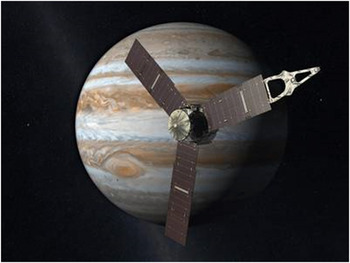
Mission acceptance of a new material or device can often be achieved by first utilizing it in a noncritical component. A good example of this in nanotechnology is the use of carbon nanotube (CNT) sheet composites to control electrostatic charge buildup on the Juno spacecraft (Figure 1). These composite sheets were used as the outer ply in composite engine struts and an engine cover in this spacecraft, providing a lighter-weight alternative to metallic struts or conventional electrostatic discharge coatings.Reference Rawal, Brantely and Karabudak3
Carbon nanotube-reinforced composites were used for electrostatic charge dissipation on the Juno spacecraft. Courtesy of the US National Aeronautics and Space Administration.

Aerogels are attractive alternatives to foam or multilayer insulation because of their low densities and their exceptional thermal insulation capacities. Thermal transport in these materials by means of conduction is very low due to their high porosity (typically above 95%) and small pore sizes. Aerogel blankets have been used to insulate cryogenic propellant transfer lines and other systems at launch sites. In addition, silica aerogels were used as thermal insulation for the batteries on the Mars rovers (Figure 2).Reference Jones4 Silica aerogels were also used as a medium to capture dust particles from a comet’s tail in the Stardust mission.Reference Tsou5 Stardust mission scientists were interested in studying the chemical composition and morphology of these dust particles, and the aerogels, because of their poor mechanical durability, provided an effective medium to capture dust particles without distorting or altering their shape.
Silica aerogel insulation has been used on all of the Mars rovers to maintain the operating temperatures of their batteries. Courtesy of the US National Aeronautics and Space Administration.

Scientists at the NASA Ames Research Center have utilized CNTs in the development of trace-gas sensors. These sensors were first successfully flown on a US Naval Academy satellite in 2003.Reference Li and Lu6 A modified version of these sensors was incorporated into an “electronic nose” that was flight-tested on the International Space Station in 2007.7
Researchers at the Georgia Institute of Technology utilized a vertically aligned array of CNTs deposited on a silicon substrate as a miniature field-emission thruster and demonstrated its use on a cube satellite under the Air Force Institute of Technology’s (AFIT) low-Earth-orbit (LEO) integrated miniaturized electrostatic analyzer (iMESA) CNT experiment (or ALICE) mission.8 ALICE was successfully launched on an ATLAS-5 rocket on December 6, 2013. One of the objectives of the ALICE mission was to demonstrate that these CNT thrusters could function properly and survive exposure to the space environment in LEO. The iMESA instrument, developed by AFIT engineers, was used to measure the flux and speed of electrons produced by the CNT thruster array (see the other space mission applications covered in the sidebar article).
Nanostructured materials have also found some limited applications in aircraft. For example, nanotextured coatings, developed by General Electric, have been demonstrated to be effective in reducing the buildup of ice on aircraft engine and airframe structures.Reference Alizadeh, Bahadur, Kulkarni, Yamada and Ruud9
Examples of promising nanotechnology for future use in aerospace
Ultralightweight structural materials
CNTs have been shown to have outstanding mechanical properties (strength, modulus, elongation at break) and high electrical and thermal conductivities. Use of CNTs as additives to polymers to improve their properties has been explored extensively since the late 1990s.Reference Spitalsky, Tasis, Papagelis and Galiotsis10 While this approach has been successful in producing nanocomposites with better strength and stiffness and enhanced electrical conductivity, it does have its limitations. Agglomeration of CNTs occurs at loading levels above a few weight percent, leading to nanocomposites with reduced mechanical properties. The addition of CNTs, as with any additive, increases the viscosity of the host polymer, which can adversely affect processability. Processing can also be a challenge if the nanotubes are used as a secondary reinforcement together with more conventional fiber or fabric reinforcements. For example, if melt infiltration processes, such as resin transfer molding or vacuum-assisted resin transfer molding, are used in nanocomposite fabrication, the nanotubes can become trapped or filtered off by the fiber preform or fabric, leading to an inhomogeneous distribution of the nanotubes throughout the composite and variations in properties.Reference Miller, Micham, Copa, Criss and Mintz11
A more promising approach that has begun to receive considerable attention is to incorporate CNTs directly into the primary fiber reinforcement, which can then be used in composites as a “drop-in” replacement for conventional fiber reinforcements.Reference Liu and Kumar12 This approach allows for higher CNT loading levels: Typical composites have fiber volume fractions on the order of 50% or higher. Current methods for composite fabrication allow for the fairly precise placement of fiber reinforcements within a composite. These same methods could be employed to produce composites with well-controlled placement of CNT-based fibers that would maximize the properties of components built with them. Importantly, this approach would require little or no change in the processing methods and machinery that are used to produce components with conventional fiber-reinforced composites, which should facilitate the acceptance and use of CNT-fiber-reinforced composites by the aerospace composites community.
Several methods have been developed for the production of CNT fibers, including dry spinning from either vertically aligned CNT arraysReference Zhang, Atkinson and Baughman13 or CNT aerogelsReference Koziol, Vilatela, Moisala, Motta, Cunniff, Sennett and Windle14 and gel spinning from liquid-crystalline solutions of CNTs in strong acids (e.g., chlorosulfonic acidReference Behabtu, Young, Tsentalovitch, Kleinerman, Wang, Ma, Bengio, ter Waarbeek, de Jong, Hoogerwerf, Fairchild, Ferguson, Muruyama, Kono, Talmon, Cohen, Otto and Pasquali15 [lyotropic behavior]) and, more recently, polyelectrolytes.Reference Jiang, Saha, Young, Hashim, Ramirez, Ajayan, Pasquali and Marti16 These methods have been scaled up and are in various stages of commercialization.
While significant progress has been made in the development of high-strength CNT fibers, the highest reported fiber strengthsReference Zhang, Atkinson and Baughman13 are on the order of 8.8 GPa, significantly lower than the measured strengths of individual CNTs (on the order of 50 GPaReference Yu, Lourie, Dyer, Moloni, Kelly and Ruoff17). A report18 identifying technical barriers for producing CNT yarns with mechanical and electrical properties that more closely match those of individual CNTs indicated the need for better understanding and control of CNT growth processes to maximize CNT length and minimize the formation of defects and impurities. It also called for more effective use of simulation and modeling tools to guide CNT synthesis and fiber processing and better predict properties, as well as the development of improved processing methods to optimize yarn and composite properties.
A recent study by Espinosa and co-workersReference Beese, Wei, Sarkar, Ramachandramoorthy, Roenbeck, Moravsky, Ford, Yavari, Keane, Loutfy, Nguyen and Espinosa19 employed a combination of experimental techniques and Monte Carlo simulation methods to understand the effects of post-processing treatments on CNT yarn morphology and properties and to predict the upper limits on strength and modulus for yarns produced by these methods. This study also compared the properties of CNT yarns produced by dry spinning from CNT aerogels with those produced by gel spinning from lyotropic solutions of CNTs in chlorosulfonic acid. The authors concluded that optimized properties will require the development of more effective methods to enhance CNT–CNT interactions within yarns and sheets thorough a combination of introducing chemical bonds (cross-links) between nanotubes and the development of in situ functionalization techniques to increase interfacial interactions between nanotubes. The authors also recommended the development of fabrication methods to align straight (fully extended and not wavy) CNTs and CNT bundles and effective techniques to compact CNT yarns to reduce porosity and enhance CNT–CNT contact and interactions.
CNTs have also been used in the production of carbon fibers. Precursor fibers have been produced by gel spinning mixtures of CNTs in various polymers,Reference Liu and Kumar12 such as poly(acrylonitrile), and poly(vinyl alcohol), which are then taken through stabilization and pyrolysis processes typically employed in the production of carbon fibers. While CNT loading levels in these fibers are typically on the order of a few weight percent, the CNTs act as nucleating agents, yielding fibers with a high degree of crystallinity, which gives rise to fairly good mechanical properties. Kumar and co-workersReference Șahin, Fasanella, Chasiotis, Lyons, Newcomb, Kamath, Chae and Kumar20 reported the preparation of carbon fibers from the bicomponent gel spinning of poly(acrylonitrile) nanocomposites containing 1 wt% of a mixture of single-, double-, and multiwalled CNTs with a characteristic tensile strength of 6.2 GPa.
CNT-based materials have also been used in cabling for data transmission.Reference Jarosz, Schauerman, Alvarenga, Moses, Mastrangelo, Raffaelle, Ridgley and Landi21 Reducing the mass and improving the durability of data and power distribution systems in aircraft and spacecraft can have a significant impact on reducing vehicle mass and improving safety and reliability. These distribution systems can account for a significant amount of weight in aerospace vehicles. For example, there is about 1800 kg of wiring in a Boeing 777 and almost 3600 kg in a Boeing 787, with most of this mass attributed to avionics and other data distribution systems. Replacement of metallic conductors in coaxial data cables with CNT yarns and sheets has been shown to reduce cable mass by between 30% and 70%, depending on design.Reference Jarosz, Schauerman, Alvarenga, Moses, Mastrangelo, Raffaelle, Ridgley and Landi21 In addition, CNT cables are more durable than conventional cables, because CNT fibers and yarns are not as susceptible to mechanical and thermal fatigue as metallic wires.
Recently, efforts have focused on improving the electrical characteristics (conductivity and ampacity) of CNT yarns and fibers to enable their use in power distribution. For example, Kono and co-workersReference Wang, Behabtu, Young, Tsentalovich, Pasquali and Kono22 reported the development of acid-doped CNT fibers with electrical resistivities as low as 2.5 × 10⁻⁷ Ω, about 10 times higher than that of copper (1.7 × 10⁻⁸ Ω). The authors also reported that the current-carrying capacity or ampacity of these fibers is higher than that of copper.
Nanoporous materials
Nanoporous materials can have broad applications in aerospace ranging from lightweight thermal insulation, to dielectric materials, to membranes for water and air purification.
As discussed earlier, silica aerogels have found applications in NASA missions primarily as insulation materials. However, their poor mechanical properties and low moisture resistance have limited their broader use in aerospace. Researchers at the NASA Glenn Research Center have addressed this deficiency by utilizing the functionality available on the surface of the silica nanoscale network as sites for reaction with conventional organic monomers to produce a conformal polymer coating on the aerogels. This approach is quite versatile because there are a variety of substituted trialkoxysilanes that can be used to prepare silica aerogels with functionality ranging from hydroxyl, to amine, to vinyl groups. This allows for reaction with a diverse array of monomers to produce polyimide-, polyurethane-, and polystyrene-coated aerogels. Polymer-reinforced aerogels produced by this approach have compressive strengths more than 100 times that of the underlying silica aerogel backbone, while still retaining their nanoporous structure and low thermal conductivity (as low as 20 mW/mK).Reference Randal, Meador and Jana23
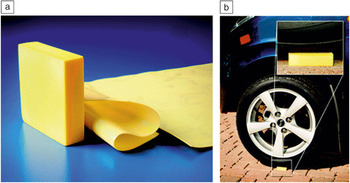
More recently, a family of aerogels based on high-performance polymers, such as polyimidesReference Meador, Malow, Silva, Wright, Quade, Vivod, Guo and Cakmak24 and polyamides,Reference Williams, Meador, McCorkle, Meuller and Wilmoth25 has been developed. Like silica and polymer-reinforced silica aerogels, these polymer aerogels have low densities and thermal conductivities. However, they have significantly higher compressive properties and can be cast as thin films that are flexible and creasable (Figure 3). Polyimide aerogels have been evaluated for use as replacements for silica aerogel blankets in inflatable aerodynamic decelerators (i.e., inflatable aeroshell structures used to reduce the velocity of a spacecraft when it enters a planet’s atmosphere prior to landing).Reference DelCorso, Cheatwood, Bruce, Hughes and Calomino26 Rigid aeroshells, composed of ablative materials such as carbon/phenolic composites, are often used in these applications. While this approach has worked well for small probes, larger payloads (probes, rovers, supplies, and even humans) will require aeroshells that are on the order of 40 m in diameter. Rigid aeroshells of this size would be too large and heavy to be practicable.
(a) Polyimide aerogel thin films are flexible, while (b) thicker aerogel monoliths are rigid and have high compressive strengths.Reference Meador, Malow, Silva, Wright, Quade, Vivod, Guo and Cakmak24

Inflatable aeroshells are attractive for these applications, because they can be folded and stored in compact volumes prior to launch and then deployed as the spacecraft enters the planet’s atmosphere. These aeroshells are multilayered structures consisting of a ceramic fabric outer layer and a Kapton bladder with several layers of insulation, typically silica aerogel blankets, between them.Reference DelCorso, Cheatwood, Bruce, Hughes and Calomino26 Arc-jet testing under conditions that simulate the heat and mechanical loads experienced during atmospheric reentry showed that the aerogel blankets were effective in reducing the heat loads on these structures. However, their poor mechanical durability has raised concerns about the viability of silica aerogel blankets under long-term storage during typical space missions. Inflatable structures in which the silica aerogel blankets were replaced with polyimide aerogels showed comparable thermal performance under arc-jet testing, but were more mechanically robust.Reference DelCorso, Cheatwood, Bruce, Hughes and Calomino26
Because of their low dielectric constants, polyimide aerogels have also been evaluated for use as substrates for patch antennas (rectangular microstrip antenna). Typically, aircraft can have about 100 of these antennas for use in navigation and communications. Simple patch antennas made with these aerogels had 67% higher bandwidth than those fabricated on conventional (Duroid, a perfluorinated poly[alkane]) substrates and were significantly lighter (polyimide aerogels have densities one-tenth that of Duroid).Reference Meador, Wright, Sandberg, Nguyen, VanKeuls, Mueller, Rodriguez-Solis and Miranda27 Replacement of conventional patch antennas with those prepared on polyimide aerogel substrates could reduce not only the aircraft weight, but also the number of antennas used because of their higher bandwidth capability.
Long-duration human space exploration missions require air-remediation and water-purification systems that are compact and efficient and have low energy demands. A considerable amount of research activity has focused on the development of nanoporous membranes for airReference Kim and Nair28 and waterReference Jackson and Hillmyer29 purification for terrestrial applications. Some of these technologies could be adapted for use in space exploration. For both applications, a major challenge has been to produce membranes with high-throughput capability without sacrificing the ability of the membrane to effectively remove impurities and contaminants. Toward that end, Yao et al.Reference Yao, Guo, Chen, Huang, Steinhart and Wang30 recently reported the development of micelle-derived composite membranes consisting of nanoporous block copolymer separation layers on a macroporous poly(ether sulfone) microfiltration membrane. These new membranes had a pure water flux (PWF) that was 5–10 times higher than that of commercial ultrafiltration membranes. They also exhibited no reduction in PWF even after 90 min of continuous operation.
Metal–organic frameworks
Metal–organic frameworks (MOFs) have also received considerable attention for use in air purification because their chemical structure can be tailored to interact and capture a wide variety of gaseous contaminants, some of which can be challenging to capture by other means. MOFs are cage-like structures consisting of metal centers coordinated with polyfunctional organic linking ligands that can be functionalized to interact with specific gases. Jasuja et al. Reference Jasuja, Peterson, Decoste, Browne and Walton31 reported that amine- and hydroxyl-modified UiO-66, a zirconium-based MOF, show high capacity for the removal of ammonia from air. MOFs have also been prepared with high capacity and selectivity for CO2.Reference Venna and Carreon32 While significant advances have been made in the design and synthesis of MOFs, more work is needed to improve the reproducibility of their performance, enhance their long-term and chemical stability, and improve their selectivity.
Nanostructured and nanocomposite coatings
Nanostructured coatings hold promise for a variety of aerospace applications ranging from ice mitigation to optical blacks (surfaces that completely absorb all incident light). Considerable research activity has focused on developing such coatings, often drawing upon structures seen in biological systems, such as the lotus leaf or butterfly wing, for inspiration.Reference Nishimoto and Bushan33
Schaaf et al. reported the development of a multifunctional coating based on ceramic nanoparticles embedded in a metal matrix for use in high-temperature applications such as turbine blades for aircraft engines.Reference Schaaf, Gunschmann, Hopfeld, Wilden, Drescher, Boirshcel and Ronning34 At high temperatures, these coatings deform to produce a “shark skin” texture that improves aerodynamic efficiency by reducing drag. At low temperatures (engine idle), the thermal deformation process is reversed, and these coatings become self-cleaning surfaces.
The introduction of nanoscale pillars or spikes onto the surface of a substrate can impart superhydrophobic or superoleophobic properties to the surface and lead to self-cleaning. For example, Gao et al. reported the fabrication of dust-repellant coatings based on arrays of SiO2-coated ZnO nanorods for use on solar cells.Reference Gao, Gereige, El Labban, Cha, Isimjan and Beaujuge35 These coatings were found to have high optical transmissions between 93% and 95% and, thus, little or no detrimental impact on solar cell performance. Dust-repellant surfaces would have broad applications in future space missions not only for photovoltaics but also for radiators, actuators, and space suits.
Arrays of nanotubes, nanopillars, and nanocones have been employed in a variety of optical applications, including antireflective coatings, light-harvesting layers for solar cells, and optical blacks. Chang et al. fabricated gradient-index refractive surfaces consisting of arrays of high-aspect-ratio silicon nanocones using a combination of interference photolithography, etching, and contact lithography.Reference Chang, Dominguez-Caballero, Choi and Barbastathis36 These surfaces suppress all reflected orders of light by two orders of magnitude for light with wavelengths from 351 nm to 633 nm and incident angles from –60° to +60°. Such surfaces could be used to improve the performance of Fresnel lenses, holographic elements, and integrated optical systems.
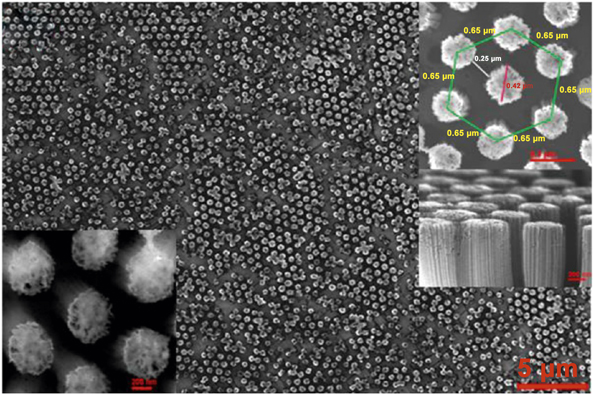
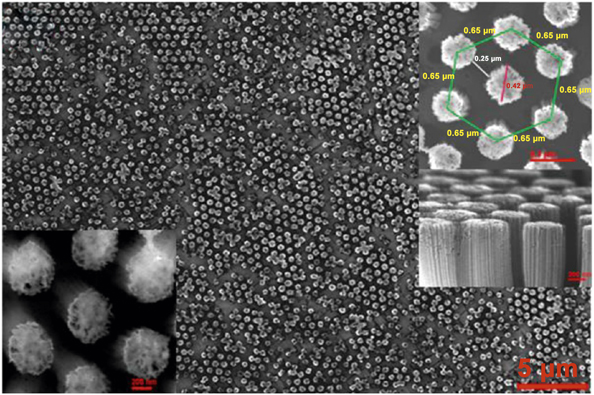
The absorption efficiency of solar cells can be enhanced through the use of arrays of nanopillars that more effectively capture incident light by scattering and trapping and minimizing the amount of light lost through reflection from the surface of the solar cell. Le reported a 40% improvement in the absorption efficiency of an organic solar cell (poly(3-hexylthiophene-2,5-diyl):[6,6]-phenyl-C61-butyric acid methyl ester; P3HT:PCBM) through the use of an array of silver nanopillars.Reference Le37 Pudasaini et al. reported silicon-nanopillar-coated poly(3,4-ethylenedioxythiophene) poly(styrenesulfonate) (PEDOT:PSS) hybrid solar cells with a maximum power conversion efficiency of 9.65%, compared to 7% for conventional PEDOT:PSS solar cells (Figure 4).Reference Pudasaini, Ruiz-Zepeda, Sharma, Elam, Ponce and Ayon38
Silicon nanoparticle array patterned silicon surfaces were fabricated by metal-assisted electroless chemical etching. These arrays were used in the fabrication of hybrid organic/inorganic solar cells with efficiencies as high as 9.65%.Reference Pudasaini, Ruiz-Zepeda, Sharma, Elam, Ponce and Ayon38
Optical blacks have been prepared using vertically aligned arrays of CNTs. For example, Ajayan and co-workers demonstrated CNT arrays with a reflectance of 0.03%.Reference Yang, Hsieh, Bur, Ci, Hanssen, Wilthan, Ajayan and Lin39 Other researchers have utilized vertically aligned CNT arrays grown by atomic layer deposition for use in stray-light suppression for optical instrumentation on earth-observing satellites.Reference Hagopian, Getty, Quijada, Tveekrem, Shiri, Roman, Butler, Georgiev, Livas, Hunt, Maldonado, Talapatra, Zhang, Papadakis, Monica and Deglau40 These arrays, which are 10 times blacker than paints typically used by NASA for stray-light suppression, are now being evaluated for use on the Ocean Radiometer for Carbon Assessment (ORCA), an instrument being designed to measure marine photosynthesis.
Manufacturing
Advanced manufacturing, such as additive manufacturing,Reference Diegel and Hashmi41 is attracting considerable attention within the aerospace community because it offers new possibilities for producing aerospace components at lower cost and with better performance than those made with more conventional manufacturing processes. In collaboration with NASA, Boeing Rocketdyne has fabricated and tested a rocket engine injector using selective laser melting that is 70% less expensive to produce than injectors made by more conventional processes.Reference Haynes42 GE Aviation has announced that it will use additive manufacturing to produce a metallic fuel nozzle for the LEAP (“Leading Edge Aviation Propulsion”) jet engine that is 25% lighter and more complex than conventional nozzles and produced as a single piece rather than assembled from multiple components, as has been done in the past. NASA has demonstrated the use of 3D printing to produce tools on the International Space Station.Reference Johnston, Werkheiser, Snyder and Edmunson43
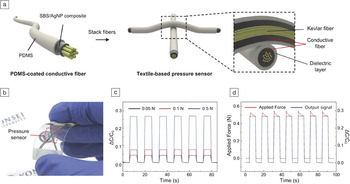
The marriage of advanced manufacturing with nanomaterials and nanomanufacturing holds promise for the fabrication of new structures with properties and performance that are vastly different from those of structures fabricated either from conventional materials or by conventional manufacturing processes. Considerable work has recently focused on the additive manufacturing of devices from nanocomposites. Beaulieu et al. demonstrated the fabrication of a ZrO2 nanocomposite-based flexible organic field-effect transistor using a contact-film-transfer technique.Reference Beaulieu, Baral, Hendricks, Tan, Briseno and Watkins44 In addition, Zhu et al. reported the fabrication of graphene-based aerogels by direct ink writing of a suspension of an aqueous suspension of graphene oxide and a silica filler.Reference Zhu, Han, Duoss, Golobic, Kuntz, Spadaccini and Worsley45 The authors claim that these aerogels could have broad applications, including electrodes for energy storage devices. Lee et al. described the fabrication of conductive fibers for use in wearable sensors based on silver nanoparticle/styrene–butadiene–styrene-rubber-coated KevlarReference Lee, Kwon, Seo, Shin, Koo, Pang, Son, Kim, Jang, Kim and Lee46 (see Figure 5). Such sensors could have applications in astronaut health and performance monitoring, extravehicular activity suit gloves, and in robotics.
Conductive fibers produced from silver nanoparticle/styrene–butadiene–styrene nanocomposite-coated Kevlar fibers (a) can be used in the fabrication of flexible pressure sensors (b) and other electronic devices. Flexible electronics made from these fibers could find applications in astronaut health and performance monitoring, robotics, and vehicle health management. Note: PDMS, poly(dimethylsiloxane); SBS, styrene–butadiene–styrene. The voltage response of the sensor in cyclic loading and unloading under various applied loads is shown in (c) together with a comparison of the sensor’s response (output signal) with the measured applied force (d).

Hierarchical manufacturing involves the assembly of individual nano- or microscale elements to produce periodic structures with novel properties. Meza and Greer reported the fabrication of TiN nanolattices using a combination of two-photon lithography, direct laser writing, and atomic layer deposition.Reference Meza and Greer47 These ultralightweight structures have a density 1.6% that of bulk TiN and a tensile yield strength one to two orders of magnitude higher than those of bulk TiN and other ceramics. While bulk TiN is brittle, the TiN nanolattices exhibited hyperelastic behavior under cyclic compressive loading. This approach has the potential to produce multifunctional structures from a variety of different materials with properties that are radically different from those of the materials from which they are produced. Such techniques significantly expand the toolkit available to design and produce novel aerospace structures and vehicles that could revolutionize the industry.
Summary
Significant advances have been made in nanotechnology R&D over the past two decades. Nanotechnology is becoming pervasive in our daily lives and can be found in products such as antimicrobial fabrics for sportswear, sunscreens, automobile tires, and consumer electronics, including televisions and smart phones. While the acceptance of nanotechnology-based products has been somewhat slower in aerospace, there are several nanotechnology R&D and demonstration projects in progress that will lay the groundwork for broader acceptance and use of nanotechnology.
Several challenges need to be addressed to make the widespread use of nanoscale materials and devices in aircraft and space vehicles a reality. Scale-up of nanomaterials still remains an issue, especially the ability to consistently produce materials of high quality in large quantities. In some cases, such as carbon-nanotube-based materials, this can be addressed by more research focused on understanding the fundamental mechanisms of nanomaterial growth and synthesis and better ways to control these processes.
In almost every case, nanoscale materials are integrated into higher-level systems, such as fibers, composites, and devices. At present, processes and methods to perform this integration do not always yield bulk materials and devices with optimized properties and performance. More work is needed on the optimization of these integration processes to enable the reliable production of nanotechnology-based systems with properties and performance more closely aligned with what would be anticipated for these systems based on the properties of their nanoscale constituents.
Many of the technologies discussed earlier in this article have been or are being developed for terrestrial applications. In those cases, work is needed to verify that they will perform reliably, with long-term durability and performance in the harsh environment of space or under repeated use in commercial aviation. Qualification of materials and devices for aerospace applications is a lengthy and expensive process. New approaches are needed that can reduce the time and cost of these qualification processes. More effective use of modeling and simulation in collaboration with experimental testing and characterization methods can help to shorten development and qualification time and costs. This approach is currently being explored under the US federal government’s Materials Genome Initiative.
Finally, aerospace has had a rich tradition of being a pioneer in fostering the development of technologies, with applications extending to other industrial sectors. The development of public–private partnerships that leverage investments from the government with those from multiple industry sectors will aid in accelerating technology development and commercialization into products that have broad benefit to society.