Introduction
First aid and bystander cardiopulmonary resuscitation (CPR) are considered cornerstones in emergency care. Much has been published about the frequency of bystander CPR and the patient characteristics that influence bystander CPR rates,Reference Jackson and Swor1–Reference Sasson, Keirns and Smith8 but less attention has been paid to the prevalence of broader first aid training among lay people and the personal characteristics that pre-dispose an individual to undertake first aid and/or CPR training. This study used the annual, state-wide survey of residents in Queensland, Australia to determine the prevalence of first aid/CPR training, the frequency of first aid/CPR skill use, and how regularly first aid/CPR skills are updated among the general population. Additional associations were explored between demographic variables and these first aid/CPR endpoints in an effort to identify potential high-yield target audiences for first aid/CPR training.
The aims of this study were to: (1) determine the prevalence of people (>18 years of age) who have undertaken first aid/CPR training; (2) explore the demographic factors associated with undertaking first aid/CPR training; (3) investigate the length of time since first aid training was last updated; and (4) explore how many people have used their first aid/CPR skills.
Methods
Data for this study were collected as part of the Queensland Social Survey (QSS) 2011. The QSS is an annual, state-wide survey conducted by the Population Research Laboratory (PRL) in Central Queensland University Australia’s (Rockhampton, Queensland, Australia) Institute for Health and Social Science Research. Through a cost-sharing arrangement, the QSS enables researchers and policy makers to incorporate questions into the survey.
Queensland is the second largest Australian state by land area, and the third most populous state. The QSS uses a computer-assisted telephone interviewing (CATI) system and trained interviewers to randomly sample households across Queensland, including metropolitan Brisbane (South East Queensland [SE QLD]) and the rest of the state (Other Queensland). To ensure equal representation of males and females, households are randomly pre-determined to provide a male or female respondent; if a person of that gender is not available, then the household is not included in the survey.
The QSS 2011 consisted of a standardized introduction, specific questions incorporated by researchers and the University, and 37 demographic questions. The questions were pilot tested by trained interviewers in 71 randomly-selected households, with modifications to the questions guided by both responses from the pilot study participants and feedback from the interviewers. Final interviewing was conducted between July 19, 2011 and August 22, 2011, between the hours of 10:30am to 2:30pm and 4:30pm to 8:30pm on weekdays, and between the hours of 12:00pm and 4:00pm on weekends.
Three questions related to respondents’ experience with first aid or CPR training were incorporated into the QSS 2011, and these formed the three outcome variables under investigation in this study. The three questions were:
1. Have you ever received first aid/CPR training? (yes/no);
2. When was the last time you updated your first aid/CPR training? (This was asked only of those participants who answered “yes” to the first question. There were seven possible responses ranging from “within the last month,” to “more than three years ago,” and an option for never. This variable was dichotomized as “three years or less” and “greater than three years.”); and
3. Have you ever used any first aid/CPR skills on a person prior to them being seen by an ambulance officer or going to hospital? (This was asked only of respondents who answered “yes” to the first question; responses were yes/no).
The data were provided in, and statistical analysis was undertaken using SPSS Statistics Version 20.0.0 (IBM Corporation, Armonk, New York USA). Bivariate associations between relevant demographic variables and having undertaken first aid/CPR training or having used first aid/CPR were analyzed using chi-square or Fisher’s exact test. Where demographic variables were recorded as ordinal data, analyses utilizing chi-square for linear-by-linear association were conducted to identify any significant trend effects.
To estimate the association between the predictor variables and the three outcome variables, three separate multivariate logistic regression analyses were conducted. This also allowed identification of covariates and interaction effects, and adjustment for confounding. Each demographic variable from Table 1 was entered into or removed from the logistic regression model using both forward and backward methods to identify significant covariates. The significant covariates were then retained in the model, with each of the remaining variables then individually entered into the model to identify potential confounders. The final models included only the significant covariates, potential confounders, and significant interaction effects.
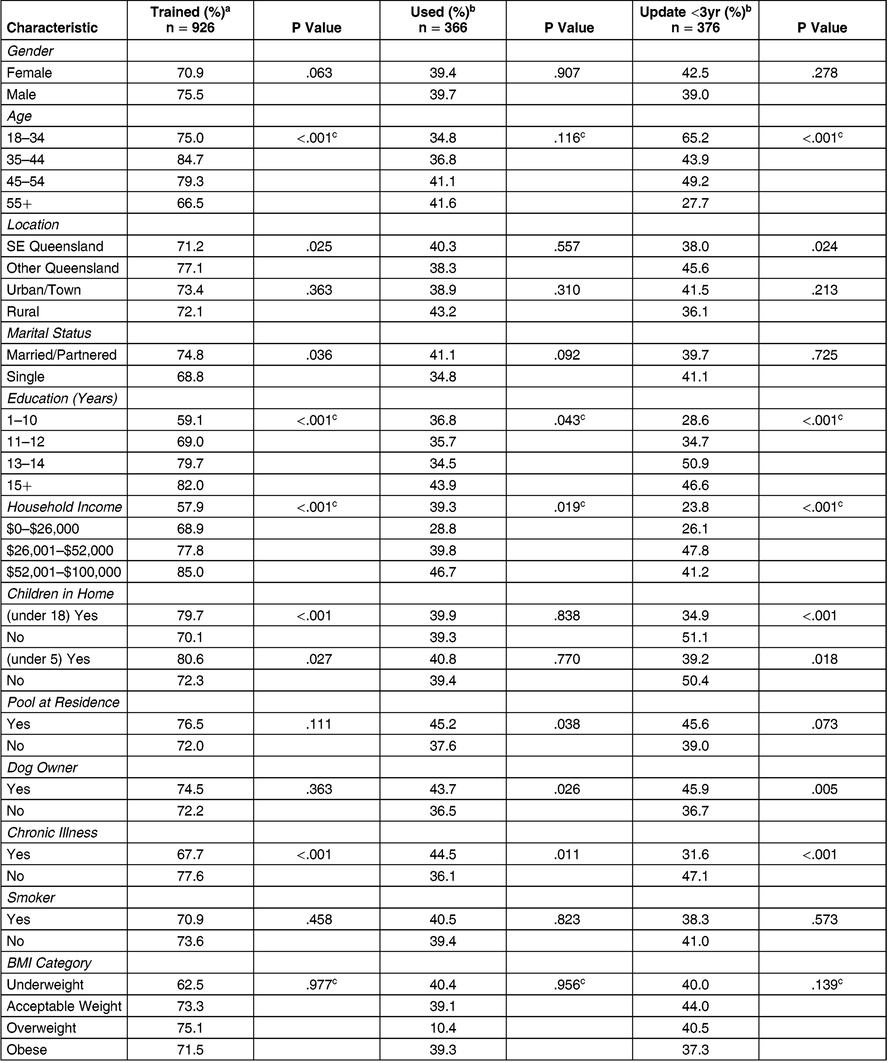
Demographic Variables Associated with First Aid/CPR Training, Refresher Training, and Use

Abbreviations: BMI, body mass index; CPR, cardiopulmonary resuscitation.
a Percent of total respondents (n=1265); row percents are presented (eg, of female respondents, 70.9% reported first aid training).
b Percent of respondents who were trained; row percents are presented (eg, of female respondents who reported first aid training, 39.4% reported using skills). c Chi square for trend.
For all analyses, P <.05 was used to establish statistical significance. Adjusted odds ratios and 95% confidence intervals (CI) are reported for the multivariate logistic regression models.
Population estimates were obtained from the Australian Bureau of Statistics (Canberra, ACT, Australia) publication 3101.0 – Australian Demographic Statistics, June 2011.9 Population data were used to extrapolate the findings of the survey to the population of Queensland, specifically to estimate the proportion of Queensland residents who have ever received first aid training.
The QSS 2011 was approved by the Human Ethics Review Panel at Central Queensland University (H10/06-121), and the incorporation of the first aid questions was approved by the Human Research Ethics Committee at James Cook University (H4229; Townsville, Queensland, Australia).
Results
During the QSS 2011, contact with 4,009 households was attempted, of which 2,309 refused participation, 279 could not be contacted, and 147 were otherwise ineligible (eg, no adult at home). Of the remaining 1,277 respondents, 12 participants completed only part of the survey. Thus, the final sample for the QSS comprised 1,265 participants, which was an overall response rate of 31.6%. Two-thirds of the participants were from SE QLD (n = 837) and one-third (n = 428) were from other areas of the state. The sample was equally divided between males and females (males: n = 633; females: n = 632). Younger people (aged <45 years) were under-represented in the sample (n = 378; 30.1%); older people (aged >55 years) were over-represented in the sample (n = 636; 50.7%); otherwise the participant demographics recorded by the QSS reasonably approximated that of the Queensland population.9 Based on the sample size, the estimated sampling error (SE) at the 95% confidence level is SE = 2.7% overall, SE = 3.4% for the SE QLD sub-sample, and SE = 4.7% for the Other Queensland sub-sample.
Responses to the three questions concerning first aid/CPR training are shown in Table 1. Nearly three-quarters of respondents (n = 926) reported having undertaken some first aid/CPR training and 39.6% (n = 366) of those respondents had used their first aid/CPR skills. The majority of respondents (n = 525; 56.8%) had not updated their first aid/CPR skills in the past three years, and an additional 2.5% (n = 23) had never updated their skills.
Extrapolating from these data, approximately 2.6 million Queensland adults have received some form of first aid/CPR training in their lifetime. This number was derived by applying the age and gender-specific proportion of participants in the sample who identified that they had previously received training to the respective age and gender population sub-groups for Queensland.
Bivariate associations between demographic variables and the three outcome variables are shown in Table 1. Education and income were significantly associated with having undertaken first aid/CPR training, updating first aid training, and use of first aid. Specifically, increasing education was associated with higher levels of first aid/CPR training (P <.001) and first aid/CPR use (P = .043), with respondents having 13–14 years of education undertaking refresher training more recently than other respondents (P <.001). Similarly, increasing income was associated with higher levels of first aid/CPR training (P <.001) and first aid/CPR use (P = .019), with respondents earning more than $52,000 annually undertaking refresher training more recently than other respondents (P < .001). Age was significantly associated with having undertaken first aid training (P <.001) and updating training (P <.001), but not use of first aid (P = .116). The presence of children in the household was also associated with undertaking first aid/CPR training (P <.001) and refresher training (P <.001), but not use of first aid (P = .838). There was also an association between households with swimming pools (P = .038) and dogs (P = .026) and use of first aid/CPR skills. Significantly more participants who lived outside of SE QLD reported having undertaken first aid training (P = .025) and having undertaken refresher training in the last three years (P = .024). Finally, there was an inverse association between respondents who reported having a chronic illness and having undertaken first aid/CPR training (P <.001) as well as refresher training (P <.001), and a positive association between these participants and use of first aid training (P = .011).
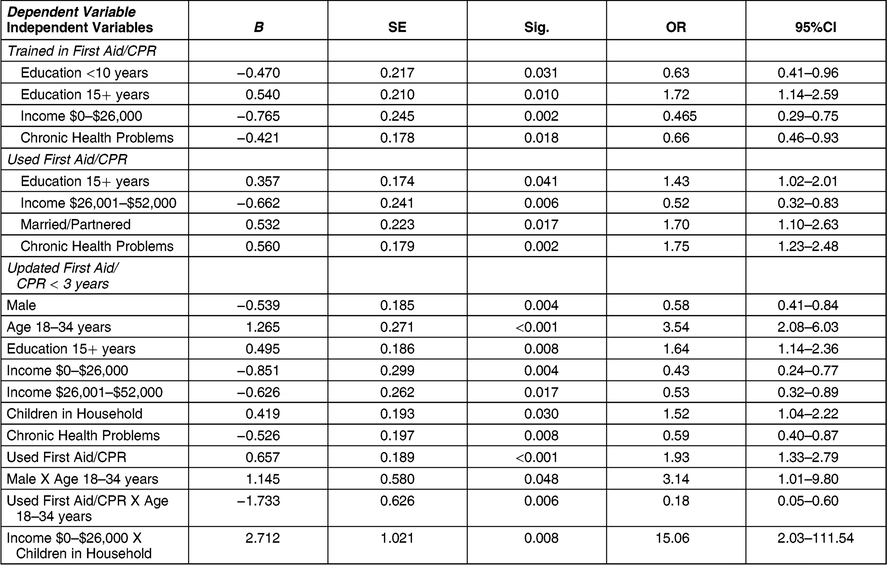
Many of these associations were sustained in the multivariate analysis. Independent predictors of undertaking first aid training, undertaking refresher training, and use of first aid are shown in Table 2. After adjusting for relevant confounders, variables independently associated with ever undertaking first aid/CPR training were: low-level of education (<10 years; OR = 0.63; 95% CI, 0.41–0.96); lower income ($0-$26,000; OR = 0.46; 95% CI, 0.29–0.75); and chronic health problems (OR = 0.66; 95% CI, 0.46–0.93). After adjusting for relevant confounders, variables independently associated with use of first aid/CPR skills were: higher level of education (15+ years; OR = 1.43; 95% CI, 1.02–2.01); being married or partnered (OR = 1.70; 95% CI, 1.10–2.63); and chronic health problems (OR = 1.75; 95% CI, 1.23–2.49). There were no significant interaction effects between the demographic variables in either the first aid/CPR training analysis or the first aid/CPR use analysis.
Independent Predictors of First Aid Training, Refresher Training, and Use

Abbreviation: CPR, cardiopulmonary resuscitation.
Note: B = coefficient; SE = standard error; Sig. = significance; AOR = adjusted odds ratio; 95% CI = 95% confidence interval. Odds ratios are adjusted for all relevant confounders.
After adjusting for relevant confounding variables, recent participation in first aid/CPR refresher training (within three years) was independently associated with being 18–34 years old (OR = 3.54; 95% CI, 2.08–6.03); high-level of education (15+ years; OR = 1.64; 95% CI, 1.14–2.36); presence of children in the household (OR = 1.52; 95% CI, 1.04–2.22); and use of first aid/CPR skills (OR = 1.93; 95% CI, 1.33–2.79). Variables that were independently inversely associated with recent participation in first aid/CPR refresher training were being male (OR = 0.58; 95% CI, 0.41–0.84); lower income ($0-$26,000: OR = 0.43; 95% CI, 0.24–0.77; $26,001-$52,000: OR = 0.54; 95% CI, 0.32–0.89); and chronic illness (OR = 0.59; 95% CI, 0.40–0.87). As shown in Table 2, there were three significant interaction terms in multivariable logistic regression model for first aid/CPR refresher training. The effect of being male and use of first aid/CPR skills on recent participation in refresher training was modified by age. Additional effect modification analysis was not possible due to small sample size.
Discussion
Organized, formal first aid training for the lay public began in the late 1800s, with the initial American Red Cross (Washington, DC USA) first aid manual being published in 1903.Reference Donelan10 Current layperson CPR training practice emerged in the 1960s and 1970s, after the technique was first described by Kouwenhoven in 1960.Reference Eisenberg and Psaty11 Since then, considerable research has been conducted exploring the factors that contribute to, or detract from, bystander decisions to perform CPR. Most of that work has focused on the influence of patient characteristics—for example, patients of lower socioeconomic status or of certain ethnicities are less likely to receive bystander CPR.Reference Vadeboncoeur, Richman, Darkoh, Chikani, Clark and Bobrow4, Reference Mitchell, Stubbs and Eisenberg6
In this study, exploration was undertaken of the demographic characteristics of potential bystanders in a large Australian state, and evaluated whether those characteristics are associated with having undertaken first aid/CPR training, having performed first aid/CPR, and having recently updated first aid/CPR skills. A number of characteristics that might be useful for targeting first aid/CPR training initiatives have been identified.
First Aid/CPR Training
Nearly three-quarters (73.2%) of the sample, which extrapolates to approximately 2.6 million adults in Queensland, have received some form of first aid/CPR training. This is higher than a decade ago where 55.2% of Queenslanders were reported to have participated in a CPR training course.Reference Clark, Enraght-Moony, Balanda, Lynch, Tighe and FitzGerald12
These data indicate that people with 10 or less years of schooling were less likely to have undertaken first aid/CPR training. In this sample, 24% of the participants reported completing 10 or less years of schooling. This is higher than the proportion of Queensland residents who have completed 10 or less years of school.13 However, incorporating first aid/CPR training into school curricula in years eight or nine could be one strategy for increasing the prevalence of emergency care skills among potential bystanders. Alternatively, making first aid/CPR training a compulsory part of obtaining a driver’s license is another strategy.
Participants who were in the lowest income category (ie, $0-$26,000) were less likely than others to have undertaken first aid/CPR training. Thus, targeting training programs to part-time/casual workers or those who receive income assistance might also be a strategy for increasing the prevalence of first aid/CPR skills among community members. Supporting charities to deliver training programs specifically targeting this population is also another strategy.
Use of First Aid/CPR Skills
In this study, 40% of those who had undertaken first aid/CPR training had used these skills. This highlights the need to undertake training and to maintain these skills. These data do not provide any indication of when these skills were applied, how frequently, or in what context.
The results also identified certain demographic characteristics that were associated with an increased likelihood of having performed first aid/CPR among those participants who had received some training. People with 15 or more years of education, married or partnered people, and people with chronic health problems were more likely to have ever performed first aid or CPR. It cannot be determined from the data whether these demographic groups are more likely to encounter situations requiring first aid/CPR, or whether they are simply more likely to act when faced with such situations. Further investigation is required to elucidate these associations.
In this study, age, gender, and location of residence (urban versus rural) were not associated with the likelihood of performing first aid/CPR, which is contrary to previous Australian and international research on willingness to perform CPR. Previous research in Queensland indicated that male Queenslanders were more likely than females (OR = 1.32; 95% CI, 1.11–1.57) to be extremely likely to perform CPR on average community members.Reference Johnston, Clark, Dingle and FitzGerald14 Johnston and colleagues also reported that retired people were less likely than others (OR = 0.76; 95% CI, 0.60–0.96) to be extremely likely to perform CPR.Reference Johnston, Clark, Dingle and FitzGerald14 Similar findings were observed in a Western Australian study.Reference Jelinek, Gennat, Celenza, O’Brien, Jacobs and Lynch15 The findings of this study may reflect some success of either general or targeted first aid/CPR training initiatives implemented in Queensland or Australia since those earlier studies were conducted.
First Aid/CPR Update
In this study, several demographic variables were associated with undertaking refresher first aid/CPR training in the past three years. Males, people in lower income groups, and those with chronic health problems were less likely to have updated their skills in the last three years. These data identify populations that should be targeted after their initial first aid/CPR training in order to encourage them to refresh those skills in a timelier manner. Lay people who undertake CPR refresher training have been reported to be more confident about attempting CPR than those who have not updated their skills.Reference Lester, Donelly and Assar16
The updating of skills is a key challenge, particularly following changes to first aid and CPR protocols. These results demonstrate that even at a three-year interval, most people who have participated in first aid/CPR training have not undertaken refresher training (59.3%). When other issues are taken into account (eg, time taken for organizations to update materials), there is a significant delay in transfer of new skills to the community. Future research is required to explore the barriers and motivators to updating CPR skills and public perception regarding optimum interval between training.
Chronic Health Problems
Of particular interest are the findings related to chronic health problems and first aid/CPR training and use. People with chronic health problems were less likely to have undertaken first aid/CPR training, and to have updated their skills, but they were more likely to have administered first aid/CPR. “Chronic health problem” was not further defined in the QSS questionnaire, but presumably these 563 (44.5%) respondents have regular contact with a physician or other health care provider. Perhaps those chronically ill patients who are physically able should be encouraged by primary health providers to pursue first aid/CPR training. These data indicate that those with chronic health problems were nearly twice as likely to have used first aid/CPR skills compared with those respondents without chronic health problems. Bystander CPR rates are lower when cardiac arrest occurs at home versus a public place.Reference Jackson and Swor1, Reference Swor, Jackson and Compton17 Therefore, targeting this group and their significant others for training—which might include the development of courses specifically designed for participants with chronic illnessReference Thorén, Axelsson and Herlitz18—is a potential strategy for improving bystander CPR rates when cardiac arrest occurs in the home.
Limitations
The response rate for this survey was 31.5%. Hence, there is the potential for response bias. However, the sample was approximately representative of the general Queensland population, and the overall survey was not specific to first aid/CPR. That is, there is no reason to suspect that any potential respondent’s decision about whether to participate in the survey would be related to their first aid/CPR experiences. It is possible that volunteer bias was present – such that respondents who agreed to participate in this study may have demographic or other characteristics (eg, willingness to offer assistance) that are associated with the outcome variables under investigation (first aid training/use). This study was also limited due to the method of data collection (CATI); CATI surveys do not include participants from households where there is no fixed landline. It has been estimated that 14% of Australian households do not have access to a fixed landline, and that 25% of 18–24-year-olds do not have a fixed line, increasing to 40% among 18–24-year-olds who have moved out of the family home.19 Hence, there are potential issues with the representativeness of the sample and the subsequent generalizability of the findings of this research. However, this methodology has been in place for several years and has been successfully used to address a number of questions. A more important limitation of the study is the potential measurement bias due to the method of data collection (self-report), particularly in relation to the measurement of the outcome variables. The concepts of first aid/CPR training and use were not specifically defined in the survey. Future studies should clarify perceptions of what this entails. This may have resulted in inaccurate reporting of these outcome variables.
Conclusion
Nearly two-thirds of Queenslanders have undertaken a form of first aid/CPR training at some point, but only 41% of those people have updated or refreshed those skills within the past three years. Approximately 40% of those who have undertaken first aid/CPR training have used those skills. Potential target groups for increasing the prevalence of first aid/CPR training in the community include those who don’t progress beyond year 10 in school and those in lower income groups. Potential target groups for improving refresher training rates include males and people in lower income groups. In this study, people with chronic health problems were less likely to have undertaken first aid/CPR training, but more likely to have administered first aid/CPR. Training initiatives that target this group may be an important strategy for improving bystander CPR rates when cardiac arrest occurs in the home.