Introduction
Satimolite was discovered at the Satimola salt dome in the North Caspian Region, Western Kazakhstan. This mineral was first found by one of the authors of this paper (V.M.B.) in 1964 in cores of boreholes drilled for boron prospecting. For the holotype satimolite, quantitaive chemical analysis, powder X-ray diffraction (XRD) pattern, infrared (IR) spectrum, thermogravimetric data, measured density and optical characteristics were obtained. These data unequivocally demonstrate individuality of the mineral, the first aluminium borate found in sedimentary rocks (Bocharov et al., Reference Bocharov, Khalturina, Avrova and Shipovalov1969; Ostrovskaya, Reference Ostrovskaya1969).
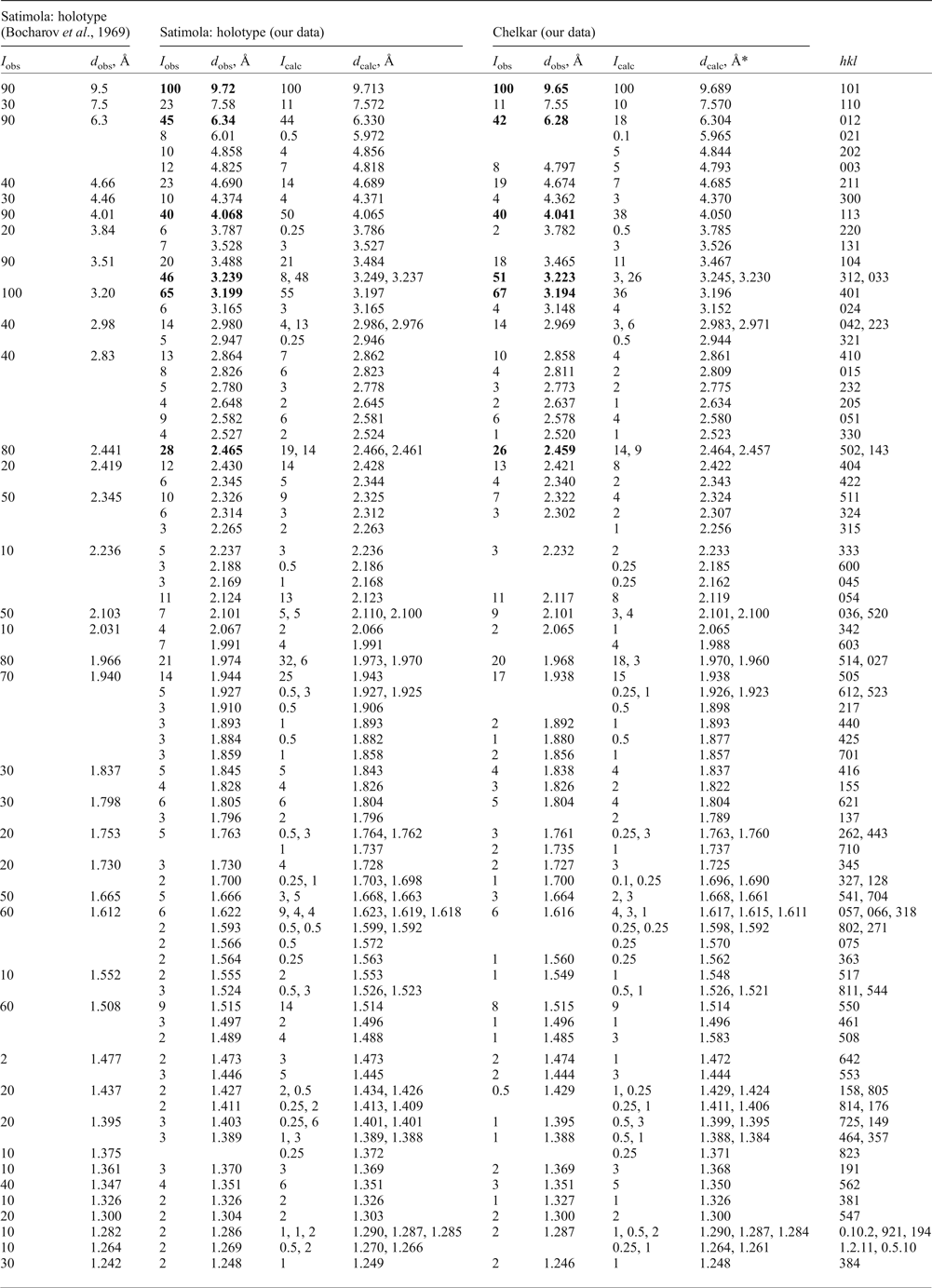
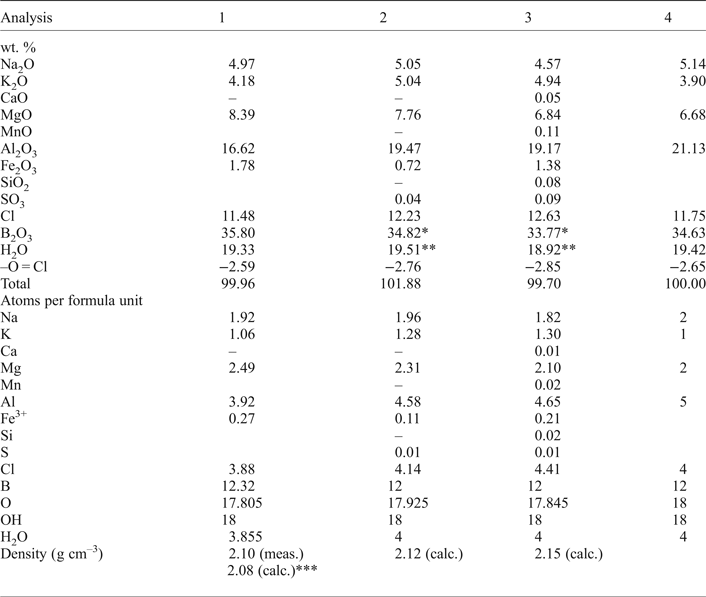
The fine-grained character of satimolite aggregates made single-crystal XRD impossible, and the absence of related minerals or synthetic compounds prevented acquisition of reliable crystal information even by analogy. Based upon only the powder XRD data (Table 1, # 1), the following orthorhombic unit cell was obtained: a = 12.62, b = 18.64, c = 6.97 Å and V = 1639.6 Å3 (Bocharov et al., Reference Bocharov, Khalturina, Avrova and Shipovalov1969). Wet chemical analysis (Table 2, # 1) was performed from a 100 mg sample. Ostrovskaya (Reference Ostrovskaya1969) supposed that the analysed material was polluted by Fe-bearing boracite, (Mg,Fe)3B7O13Cl, and subtracted Mg, Fe and corresponding amounts of B, O and Cl from the analytical data. After the re-calculation of the result for 100 wt.%, the following composition was obtained: Na2O 7.21, K2O 6.06, Al2O3 24.10, B2O3 24.76, H2O 28.03, Cl 12.70, –O = Cl –2.86, total 100.00 wt.%. This corresponds to the following empirical formula calculated on the basis of 6 Cl apfu: H52.10K2.15Na3.90Al7.92B11.91O55.82Cl6. Based on these data, the simplified formula KNa2Al4B6O15Cl3·13H2O (Z = 2) was suggested for satimolite. The discrepancy between measured and calculated density values, 2.10 and 1.70 g cm–3, respectively, was explained by the possible presence of admixed boracite, a mineral with density of 2.7–3.0 g cm–3 (Bocharov et al., Reference Bocharov, Khalturina, Avrova and Shipovalov1969; Ostrovskaya, Reference Ostrovskaya1969). However this would require the presence of at least 30% of boracite impurity in the satimolite sample studied that is in contradiction with microscopic observations reported in the above-cited publications, as well as with our new data showing that the holotype sample of satimolite is almost pure.
Powder X-ray diffraction data for satimolite.

The strongest reflections for both samples studied by us are highlighted in boldtype. *Calculated for unit-cell parameters obtained from single-crystal data.
Chemical composition and density of satimolite.

1 – Satimola, holotype, wet chemical data (Ostrovskaya, Reference Ostrovskaya1969); 2 – Satimola, holotype, our electron microprobe data; 3 – Chelkar, our electron microprobe data; 4 – composition calculated for the idealized formula KNa2(Al5Mg2)[B12O18(OH)12](OH)6Cl4·4H2O.
*calculated for 12 B apfu; **calculated for (OH)18(H2O)4 pfu; ***calculated using unit-cell parameters obtained by us. For analysis 1, with measured contents of all constituents, the formula is calculated on the basis of B + Al + Fe + Mg = 19 apfu, while for analyses 2 and 3, with calculated contents of B and H2O, the formulae are calculated on the basis of Al + Fe + Mg + Mn + Si = 7 apfu. In all cases the amount of OH groups is fixed as 18 pfu and amount of O atoms is formally calculated from charge balance.
‘–’ = below detection limit.
No other original data on satimolite were published after 1969 until 2016, when this mineral was identified by the authors of the present paper (O.V.K. and I.I.C.) in a drillcore from the Chelkar salt dome in the same North Caspian Region, Western Kazakhstan (Korotchenkova and Chaikovskiy, Reference Korotchenkova and Chaikovskiy2016). Satimolite crystals suitable for the single-crystal XRD study and the crystal-structure determination were extracted from this sample. Along with the Chelkar satimolite, we have re-investigated the holotype material from Satimola. Characteristics of both samples turned out to be very similar, which allowed us to redefine satimolite, with the incorporation of the new crystallographic data, crystal structure and chemical formula.
Occurrence and general appearance
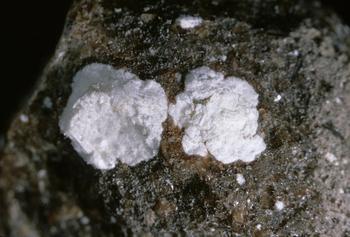
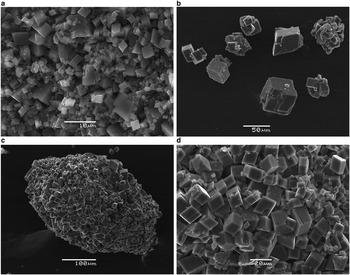
At Satimola, satimolite typically occurs as nodules (Fig. 1) up to 8 mm across included in clay–polyhalite–halite, clay–boracite–polyhalite and, rarer, clay–kiserite–polyhalite or clay–halite–kaliborite–polyhalite rocks. The mineral is mainly concentrated in clay-enriched areas of the rocks. It also fills, together with halite and boracite, cracks in clay–polyhalite–halite and polyhalite–magnesite rocks. In all cases satimolite forms fine-crystalline, chalk-like snow-white aggregates (Bocharov et al., Reference Bocharov, Khalturina, Avrova and Shipovalov1969). They consist of well-shaped rhombohedral crystals up to 10 µm across (Fig. 2a). The content of mineral impurities in the satimolite aggregates studied does not exceed 1–3 vol.%. They are represented mainly by tiny halite and clay particles.
The holotype material from Satimola showing white nodules of satimolite in a brown-grey clay–polyhalite–halite rock. Field of view: 2.5 cm wide. Photo: N.A. Pekova.

Scanning electron image showing the morphology of satimolite crystals and aggregates from Satimola (a) and Chelkar (b–d).

At Chelkar, satimolite was found in halite and sylvite–halite rocks with anhydrite and boracite (Korotchenkova and Chaikovskiy, Reference Korotchenkova and Chaikovskiy2016). It occurs as isolated, perfect in shape or blocky rhombohedral crystals up to 0.1 mm across, their clusters and nodules up to 0.5 mm, rarely up to 1.5 mm in diameter (Figs 2b–d). Separate crystals are colourless and transparent, with strong vitreous lustre, while nodules are white and translucent.
Chemical composition
The chemical composition of satimolite from both localities was studied using a JEOL JSM-6480LV scanning electron microscope equipped with an INCA-Wave 500 wavelength-dispersive spectrometer (Laboratory of Analytical Techniques of High Spatial Resolution, Dept. of Petrology, Moscow State University). The wavelength dispersive spectrometer mode was used, with an acceleration voltage of 20 kV and a beam current of 10 nA; the electron beam was rastered to 5 µm x 5 µm area to minimize sample damage. The standards used are as follows: microcline (K), NaCl (Na and Cl), wollastonite (Ca and Si), MgO (Mg), Mn (Mn), Al2O3 (Al), Fe (Fe) and FeS2 (S). Contents of other elements with atomic numbers higher than oxygen are below detection limits. The presence of a significant amount of chlorine in satimolite prevents the quantitative determination of boron by electron microprobe due to the overlap of X-ray emission lines of the K series of B with L lines of Cl. It was not possible to determine H2O because of the paucity of pure material.
Electron microprobe data for the samples studied by us are given in Table 2 in comparison with original, wet chemical data for the holotype satimolite. We have calculated the empirical formulae of our samples (No.s 2 and 3 in Table 2) on the basis of Al + Fe + Mg + Mn + Si = 7 apfu because these constituents: (1) are reliably determined by electron microprobe; and (2) fully occupy the Al sites in the crystal structure of satimolite (see below). Contents of B and H2O for these samples were calculated by stoichiometry, based on the structure data: for 12 B apfu and (OH)18(H2O)4 pfu. For the original wet chemical analysis, with measured contents of all constituents, the formula was calculated on the basis of B + Al + Fe + Mg = 19 apfu (No. 1 in Table 2), i.e. for the sum of all constituents that fully occupy the B and Al sites. Iron is considered in our samples as Fe3+ by analogy with the original satimolite in which the trivalent state of Fe was determined directly by wet chemical analysis (Ostrovskaya, Reference Ostrovskaya1969).
Data reported in Table 2 show that in terms of chemistry, satimolite samples from Satimola (both original and new analyses) and Chelkar are close to each other and to the composition corresponding to the idealized formula KNa2(Al5Mg2)[B12O18(OH)12](OH)6Cl4·4H2O (Z = 3) derived from the structure refinement data.
IR spectroscopy
In order to obtain IR absorption spectra, powdered samples were mixed with anhydrous KBr, pelletized, and analysed using an ALPHA FTIR spectrometer (Bruker Optics) with a resolution of 4 cm–1; 16 scans were obtained. The IR spectrum of analogous pellet of pure KBr was used as a reference.
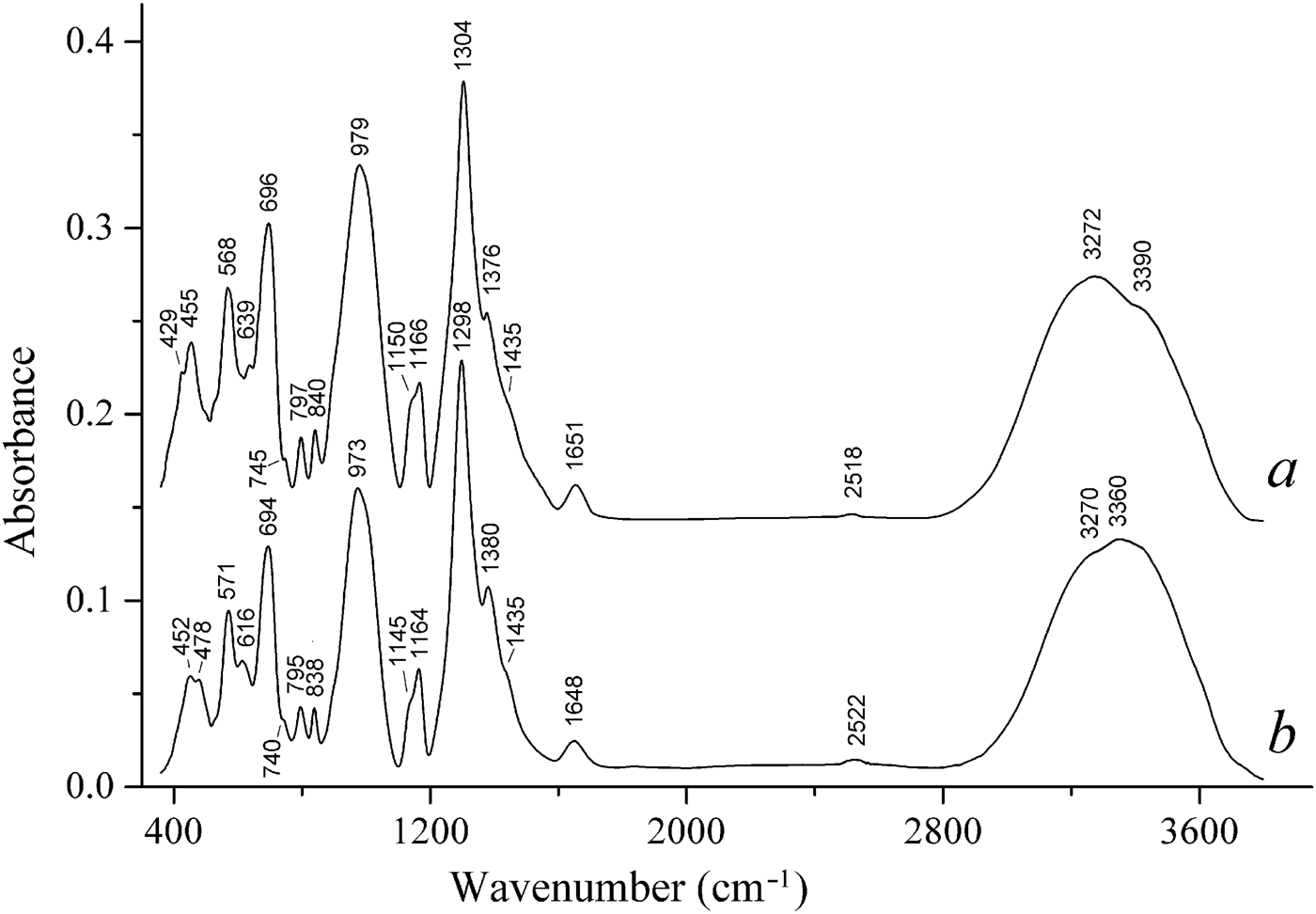
The IR spectra of satimolite samples from Chelkar and Satimola (Fig. 3) are close to each other and to the spectrum published by Ostrovskaya (Reference Ostrovskaya1969). They contain bands in the regions 3000–3500 cm–1 (O–H-stretching vibrations), 1640–1660 cm–1 (bending vibrations of H2O molecules), 1290–1450 cm–1 (asymmetric stretching vibrations of BO3 triangles), 900–1200 cm–1 (stretching vibrations of BO4 tetrahedra), 790–840 cm–1 (Al···O–H bending vibrations) and 694–696 cm–1 (bending vibrations of BO3 triangles). Assignment of the bands with frequencies below 650 cm–1 is ambiguous: these absorptions are due to mixed lattice modes involving bending vibrations of BO4 tetrahedra and Al···O-stretching vibrations, as well as librational vibrations of H2O molecules. The observed splitting of the bands of B–O-stretching vibrations reflects the distortion of BO3 triangles and BO4 tetrahedra.
Powder IR absorption spectra of satimolite from Chelkar (a) and Satimola (b).

X-ray crystallography and crystal-structure determination data
Powder X-ray diffraction data for satimolite from Chelkar (Table 1) were obtained with a Rigaku R-AXIS Rapid II single-crystal diffractometer equipped with cylindrical image plate detector using Debye-Scherrer geometry (CoKα radiation, d = 127.4 mm).
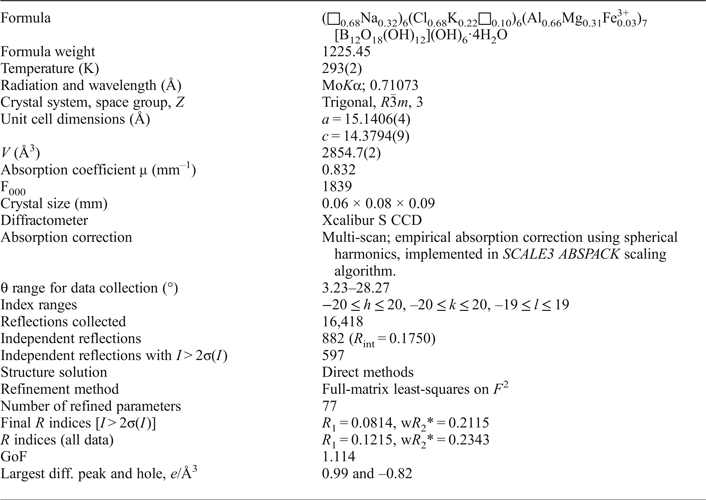
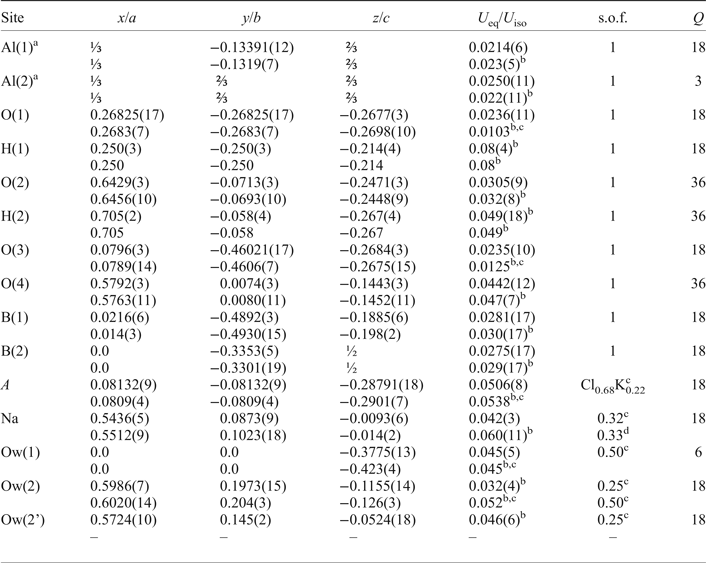
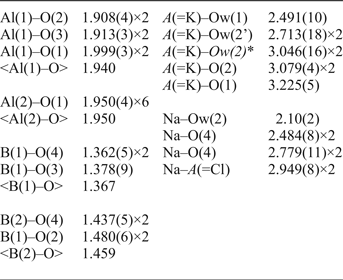
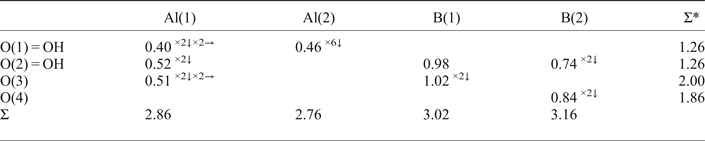
Single-crystal XRD studies of the Chelkar satimolite were carried out using an Xcalibur S diffractometer equipped with a CCD detector. A full sphere of three-dimensional data was collected. Data reduction was performed using CrysAlisPro, version 1.171.37.34 (Agilent, 2014). The data were corrected for Lorentz factor and polarization effects. The mineral is trigonal, with the following unit-cell parameters: a = 15.1406(4), c = 14.3794(9) Å and V = 2854.7(2) Å3. The crystal structure was solved by direct methods and refined in the space group R  $\bar{3}$m using the SHELX-97 software package (Sheldrick, Reference Sheldrick2008) to R = 0.0814 for 597 unique reflections with I > 2σ(I). Hydrogen atoms of OH groups were found in a difference-Fourier map and refined with O–H distances constrained to 0.90(1) Å. The crystal data and the experimental details for single-crystal experiment are presented in Table 3, atom coordinates, thermal displacement parameters and site occupancies in Table 4 (first line of each row), selected interatomic distances in Table 5 and H-bond geometry in Table 6. Bond-valence calculations for fully occupied sites are given in Table 7. The crystallographic information file has been deposited with the Principal Editor of Mineralogical Magazine and is available as Supplementary material (see below).
Crystal data, single-crystal data collection information and structure refinement details for satimolite from Chelkar.

*w = 1/[σ2(F o2) + (0.1408P)2 + 0.00P]; P = ([max of (0 or F o2)] + 2F c2)/3
Atom coordinates and thermal displacement parameters (U eq/U iso, in Å2), site occupancy factors (s.o.f.) and site multiplicities (Q) for satimolite. Single-crystal data for the Chelkar sample are given in the first line of each row and data for the holotype sample from Satimola (Rietveld refinement data) in the second line of each row.

a Al(1) and Al(2) sites are considered as Al0.66Mg0.31Fe0.03 taking into account electron microprobe data. The refined number of electrons in both sites is 13.08. b U iso. c Fixed during the refinement. d Calculated from electron microprobe data, without taking into account the possible occurrence of a minor amount of H2O.
Selected interatomic distances (Å) in the structure of satimolite from Chelkar.

* Two A(=K)–Ow(2) bonds are present only in the case when A–Ow(1) and A–Ow(2’) bonds are absent.
Hydrogen-bond geometry (Å,°) in the structure of satimolite from Chelkar.

Bond-valence calculations for fully occupied sites in the structure of satimolite from Chelkar.

* The bond-valence sum for O(1) and O(2) presenting OH groups could be decreased if the hydrogen bonds with Cl– as an acceptor are realized (Table 6) or insignificantly increased when K+ occupies the A site. The bond-valence sum for O(4) should be increased to 1.93 due to its participation in Na-centred polyhedron (Table 5). Bond-valence parameters were taken from Brese and O'Keeffe (Reference Brese and O`Keeffe1991).
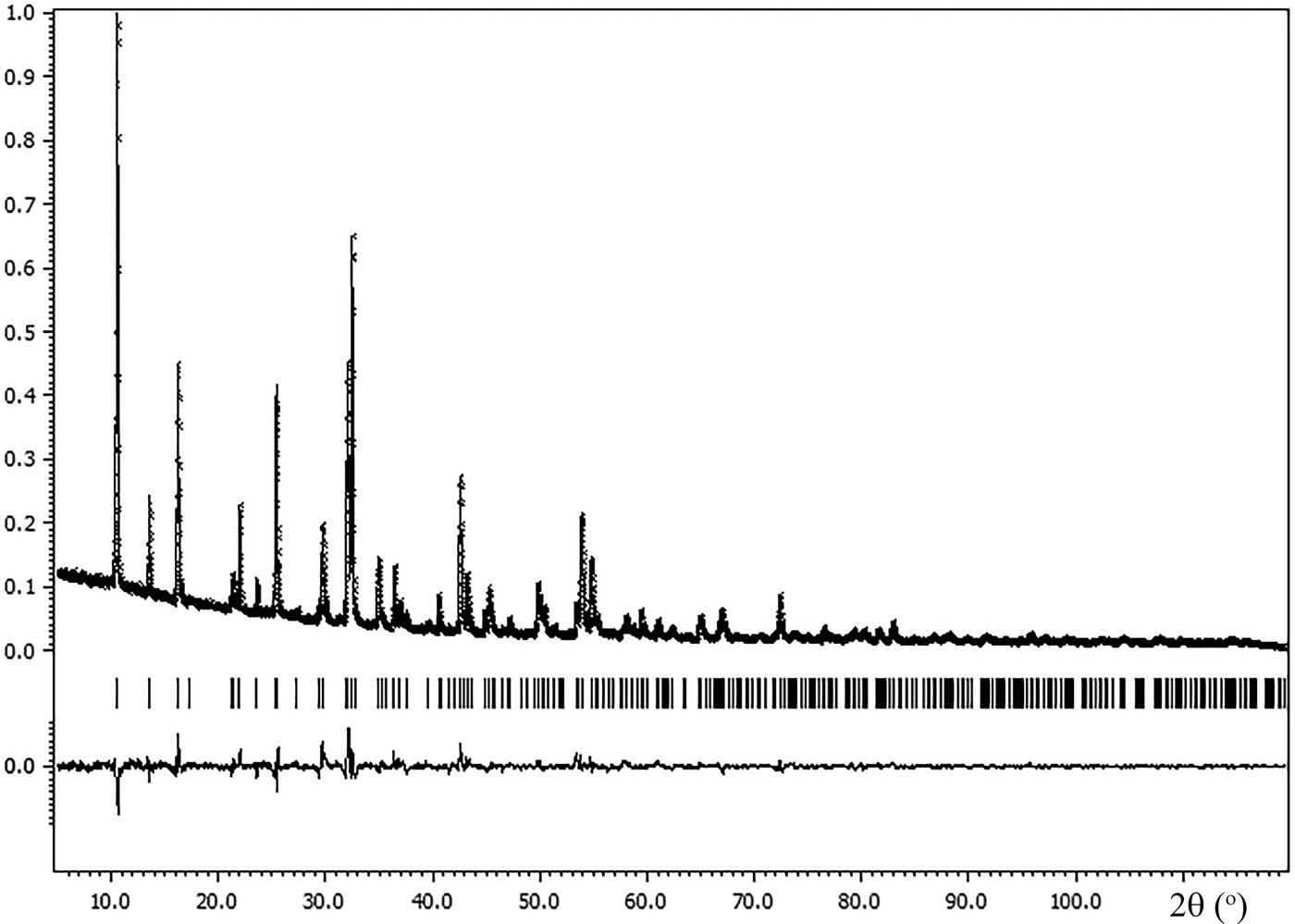
The crystal structure of satimolite from Satimola (the holotype specimen) was refined on a powder sample by the Rietveld method, based on the structure model obtained from single-crystal XRD data for our sample from Chelkar. Powder X-ray diffraction data for the Satimola sample (Table 1) were collected using a computer-controlled STOE STADI MP powder diffractometer (CoKα1 radiation, λ = 1.788965 Å). A scan range of 5.00 ≤ 2θ ≤ 119.48° was measured using a STOE linear position sensitive detector with exposure time of 500 s per 5o(2θ). Data treatment and the Rietveld structure analysis were carried out using the JANA2006 program package (Petříček et al., Reference Petříček, Dušek and Palatinus2006). The profiles were modelled using a pseudo-Voigt function. The structure was refined in isotropic approximation of atomic thermal displacements. The refined unit-cell parameters of the sample from Satimola, a = 15.1431(8), c = 14.4558(14) Å and V = 2870.8(4) Å3, are close to those obtained for the Chelkar satimolite (Table 3). Coordinates and thermal parameters of H atoms were not refined, thermal parameters of O(1), O(3), Ow(1) and Ow(2) and of mixed K and Cl sites were refined and fixed on the last stages of the refinement. Final agreement factors are: R p = 0.0563, R wp = 0.0761 and R all = 0.0667. The observed and calculated powder XRD diagrams for satimolite from Satimola are shown in Fig. 4. Atom coordinates, thermal displacement parameters and site occupancies obtained for this sample are given in Table 4 (second line of each row).
Observed and calculated powder XRD patterns of satimolite from Satimola. The solid line corresponds to calculated data, the crosses correspond to the observed pattern and vertical bars mark all possible Bragg reflections. The difference between the observed and calculated patterns is shown at the bottom.

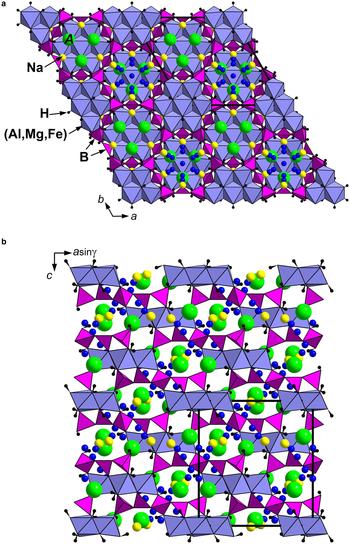
All figures showing the satimolite structure are given according to single-crystal data for the Chelkar sample (Figs 5 and 6); the Satimola sample has, in general, the same structure.
The crystal structure of satimolite projected along c (a) and b (b) axes. Dark blue circles mark the positions of O atoms of H2O molecules. The unit cell is outlined.

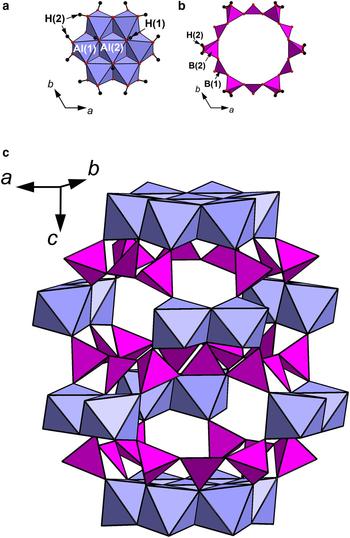
Octahedral clusters (a); twelve-membered borate rings (b); and ellipsoidal cage (c) in the structure of satimolite.

Discussion
The crystal structure of satimolite (Fig. 5) is based on a three-dimensional heteropolyhedral framework built by 12-membered borate rings [B12O18(OH)12] and octahedral clusters [M 7O6(OH)18] where M = Al + Mg + Fe. Topologically the same framework was recently found in the crystal structure of synthetic borate PKU-8 with the formula written as (H18Al7B12O36)Cl3(NaCl)2.4·6.5H2O (Gao et al., Reference Gao, Wang, Li, Liao, You and Lin2008). This compound is trigonal, with space group R3 and unit-cell dimensions a = 15.0613(1) and c = 14.0134(2) Å, that is very close to values found by us for satimolite. In the structure of the mineral there are two crystallographically non-equivalent octahedrally coordinated M sites labelled Al(1) and Al(2) (Table 4), and both sites are assumed to have an identical Al to Mg ratio close to 2:1 (with a small Fe admixture). This is in a good agreement with electron microprobe data (see Table 2 and footnote to Table 4). Six Al(1)O2(OH)4 octahedra encircle an Al(2)(OH)6 octahedron sharing edges to form clusters (Fig. 6a) which could be considered as fragments of brucite-like layers. Two crystallographically non-equivalent B atoms are triangularly [B(1)] and tetrahedrally [B(2)] coordinated. B(1)O3 triangles alternate with B(2)O2(OH)2 tetrahedra sharing common vertices and forming twelve-membered borate rings (Fig. 6b). Each ring is connected with six octahedral clusters: three under the ring and three over the ring. Like PKU-8 (Gao et al., Reference Gao, Wang, Li, Liao, You and Lin2008), the framework of satimolite contains three-membered [2B + Al] rings. These units are known as a preferred geometry for the porous aluminoborate frameworks being crucial to stabilizing them (Gao et al., Reference Gao, Wang, Li, Liao, You and Lin2008; Ju et al., Reference Ju, Yang, Li, Liao, Wang, You and Lin2004 and references therein; Yang et al., Reference Yang, Ju, Li, Liao, Zou, Deng, Chen, Su, Wang and Lin2007). In satimolite and PKU-8 these fundamental building units consist of one M-centred octahedron, one BO3 triangle and one BO4 tetrahedron. The same configuration was described recently in the structure of another synthetic borate PKU-3 (Chen et al., Reference Chen, Ju, Meng, Su, Lin, Zhou, Li, Wang, Gao, Zeng, Tang, Lin, Yang and Sun2015). The remarkable feature of the aluminoborate frameworks of satimolite and PKU-8 is the presence of large ellipsoidal cages with an approximate size of 12 Å x 8.6 Å (Fig. 6c). In PKU-8 only two Cl sites matching with A site in the satimolite structure (A = Cl + K) and H2O molecules were localized inside the cage whereas in satimolite Na cations are also located inside the cages. The Na site in satimolite with partial occupancy [32% for sample from Chelkar and 33% for sample from Satimola] corresponds to one of the H2O positions (Ow2) in PKU-8. If the A site in satimolite is occupied by Cl anions then this site could be included in the coordination sphere of Na cations with Na–Cl distance 2.949(8) Å. Moreover, Cl anions in the A site are involved in the formation of hydrogen bonds with H atoms of both crystallographically non-equivalent OH groups (Table 6): the Cl atom is bound with one H(1) cation and with two H(2) cations with Cl–H distances of 2.43(6) and 2.23(2) Å, respectively (according to the single-crystal data for the Chelkar sample). The framework in PKU-8 is cationic, positively charged: [H18Al7B12O36]3+ (Gao et al., Reference Gao, Wang, Li, Liao, You and Lin2008), while the presence of Mg2+ replacing Al3+ in M sites in satimolite leads to significant decrease of the framework charge: ca. +0.7.
Structural data obtained by the Rietveld method for the holotype sample of satimolite from Satimola are very close to those found from single-crystal data for the Chelkar sample. The insignificant difference is in the content of ellipsoidal cages; in the holotype sample no splitting of Ow2 site was observed and some H2O can occur in the Na site.
According to the classification of fundamental building blocks (FBB) in borates (Burns et al., Reference Burns, Grice and Hawthorne1995; Grice et al., Reference Grice, Burns and Hawthorne1999), satimolite is a neso-dodecaborate with the FBB 6Δ6□ = <Δ□Δ□Δ□Δ□Δ□Δ□>. This FBB indicates that 12 boron polyhedra are involved in the formation of a 12-membered ring with alternating tetrahedra and triangles. Among minerals, 12-membered borate rings consisting of alternating tetrahedra and triangles were previously found in brianroulstonite, Ca3[B5O6(OH)6](OH)Cl2·8H2O (Grice et al., Reference Grice, Burns and Hawthorne1997), where each ring shares three borate polyhedra with adjacent rings to form layers. In pringleite and ruitenbergite, two polymorphs of Ca9[B26O34(OH)24]Cl4·13H2O (Grice et al., Reference Grice, Burns and Hawthorne1994), and in penobsquisite, Ca2Fe[B9O13(OH)6]Cl·4H2O (Grice et al., Reference Grice, Gault and Van Velthuizen1996), the dodecaborate rings are linked to form frameworks. Thus, satimolite is the first mineral with isolated 12-membered rings with alternating boron tetrahedra and triangles. It is interesting that all natural borates with such rings contain chlorine.
The structural formula obtained for the Chelkar sample is (□0.68Na0.32)6(Cl0.68K0.22□0.10)6(Al0.66Mg0.31 $\hbox{Fe}_{{\rm 0}{\rm. 03}}^{{\rm 3 +}} $)7[B12O18(OH)12](OH)6·4H2O (Table 3), or K1.32Na1.92(Al4.62Mg2.17
 $\hbox{Fe}_{{\rm 0}{\rm. 21}}^{{\rm 3 +}} $)Σ7[B12O18(OH)12](OH)6Cl4.08·4H2O. Though Mg2+ is not a predominant constituent in the Al sites it is an important charge-compensating cation that makes it necessary to include Mg in the idealized formula of satimolite, which can be written as follows: KNa2(Al5Mg2)[B12O18(OH)12](OH)6Cl4·4H2O (Z = 3). It corresponds to the chemical data for all the samples studied (Table 2).
By analogy with the mineral, the formula of a K- and Mg-free satimolite-related synthetic compound PKU-8, originally presented as (H18Al7B12O36)Cl3(NaCl)2.4·6.5H2O (Gao et al., Reference Gao, Wang, Li, Liao, You and Lin2008), can also be written as Na2.4Al7[B12O18(OH)12](OH)6Cl5.4·6.5H2O.
Note that the initial chemical analysis of the holotype sample of satimolite from Satimola (No. 1 in Table 2: Ostrovskaya, Reference Ostrovskaya1969) corresponds well to the structural data obtained by us. It is also confirmed by good agreement between measured and calculated density values (Table 2) and by our calculations of the Gladstone-Dale compatibility index. Bocharov et al. (Reference Bocharov, Khalturina, Avrova and Shipovalov1969) reported that satimolite is optically biaxial, negative, with very small 2V value and the following refractive indexes: α = 1.535(2) and β = γ = 1.552(2). We used these optical data for the compatibility index calculation for the Satimola sample and found the following values of 1 – (K P/K C): –0.058 for the initial, wet chemical data and D meas; –0.047 for the initial, wet chemical data and D calc; –0.051 for our electron microprobe data and D meas; and –0.041 for our electron microprobe data and D calc. All these values correspond to the category ‘good’ (Mandarino, Reference Mandarino1981). Optical data also confirm trigonal rather than orthorhombic symmetry of satimolite: it is probably a uniaxial mineral with a weak anomalous biaxiality.
Thus, the assumption by Ostrovskaya (Reference Ostrovskaya1969) that the sample analysed was strongly polluted by boracite is definitely erroneous, as well as the formula based on this assumption, KNa2Al4B6O15Cl3·13H2O, that was accepted for satimolite before the present work.
Powder X-ray diffraction data for satimolite from Satimola and Chelkar are close to each other and to the original powder XRD pattern of the mineral reported by Bocharov et al. (Reference Bocharov, Khalturina, Avrova and Shipovalov1969). Good agreement between measured and calculated powder XRD data allows us to give correct hkl indices (Table 1) that, consequently, differ from initially reported values based on a wrong unit cell.
Conclusion
The data obtained in this work for satimolite samples from two localities, including the holotype, permit the present redefinition of satimolite. Its basic characteristics, namely chemical formula and crystal system have been significantly revised, the crystal structure was first solved and the powder XRD diagram has been refined and re-indexed. The novel results are in good agreement with all analytical data (wet chemical analysis, powder XRD pattern, measured density and optical characteristics) reported in original publications (Bocharov et al., Reference Bocharov, Khalturina, Avrova and Shipovalov1969; Ostrovskaya, Reference Ostrovskaya1969).
Thus, satimolite is a trigonal (space group R  $\bar{3}$m, a = 15.14 and c = 14.38–14.46 Å) hydrous chloroborate with the idealized formula KNa2(Al5Mg2)[B12O18(OH)12](OH)6Cl4·4H2O (Z = 3). In terms of crystal structure it has no analogues among minerals but is close to the synthetic borate PKU-8 Na2.4Al7[B12O18(OH)12](OH)6Cl5.4·6.5H2O reported by Gao et al. (Reference Gao, Wang, Li, Liao, You and Lin2008). The structure of satimolite contains a three-dimensional heteropolyhedral framework built by 12-membered borate rings [B12O18(OH)12] in which BO3 triangles alternate with BO2(OH)2 tetrahedra sharing common vertices and octahedral clusters [M 7O6(OH)18] with M = Al5Mg2 in the ideal case. Each borate ring is connected with six octahedral clusters: three under the ring and three over the ring. Large ellipsoidal cages in the framework host Na and K cations, Cl anions and H2O molecules.
Acknowledgements
We thank Peter Leverett and two anonymous referees for valuable comments. This study was supported by the Russian Foundation for Basic Research, grant 15-05-02051-a. The technical support by the SPbSU X-Ray Diffraction Resource Center in the powder XRD study of the sample from Chelkar is acknowledged.
Supplementary material
To view supplementary material for this article, please visit https://doi.org/10.1180/minmag.2017.081.081