

Deterrence has always played an important part in court decisions pertaining to tax offenses. In this respect, many decisions suggest that tax offenders should be penalized severely by means of including, but not limited to, imprisonment and significant fines. Economic theory, in turn, suggests that the probability of being caught and the severity of punishment are the main variables affecting tax evasion rates (Filippin et al., Reference Filippin, Fiorio and Viviano2013).
Some have also argued that the aggravation of punishment for tax offenses would lead to social aversion (Weiss Ernst Ltd. et al. v. State of Israel, 1980).
However, it seems that the aggravation of punishment did not give rise to social aversion in fact. Moreover, the aggravation of penalties against certain tax offenders and the mitigation of penalties for others within the framework of alternative proceedings has borne the opposite result: the public's social aversion to tax offenders has diminished and the public often justifies this in the way the authorities treat the citizen.
Measures that include the aggravation of penalties have also been taken by the Israeli Tax Authority but have not led to a reduction in tax offenses and an increase in the public willingness to pay taxes, among the public.
For example, the Money Laundering Law was amended to define some of the tax offenses as Specified Unlawful Activities (SUAs) (Anti-Money Laundering Law, 2016). Following the amendment, a letter was issued by the Supervisor of Banks at the Bank of Israel regarding ‘Preparations for managing compliance risks in light of the establishment of tax offenses as SUAs’ (Bank of Israel, 2016). Among other things, the letter presents a list of ‘red flags’ – patterns of action that may indicate the commission of tax offenses by customers that the bank is required to identify and ask for explanations. Examples include the establishment of another active company with a similar name in another country, multiple transfers of substantial sums to tax havens, the frequent movements of funds that are reinvested in other countries after being deposited in tax havens, unnamed numbered accounts, hiding dual citizenship, the use of post restante services, cases where the customer insists that the bank should not contact them directly, a customer expressing an unusual degree of interest in a tax issue, or customers being unable or unwilling to disclose the source(s) of their money.
Several measures taken by the Tax Authority since 2013 were also unsuccessful. One example would be the ‘Black People’ campaign, which aimed to influence public opinion in the fight against tax evasion. Furthermore, the establishment of a ‘Justice’ (whistleblower) Hotline, which aims to incentivize the public to announce tax evasion, also failed. The Israel Tax Authority itself has admitted that it possesses insufficient manpower to cope with the extensive Israeli ‘black economy’. An October 2017 State Comptroller Report has also pointed out the Tax Authority's inability to deal with the black economy in the real-estate industry as well as the obstacles and difficulties they face in collecting real-estate taxes. For example, Tax Authority employees concerned with real-estate taxation do not have the rights to access various sources of data and thus find it difficult to deal with taxpayers who submit false invoices, in order to reduce their Land Appreciation Tax liability. The State Comptroller's report also found that the Tax Authority does not fully collect value-added tax (VAT) from real-estate transactions (State Comptroller's report, 2017). Empirical studies conducted in this respect have also shown that a black economy thrives in countries where tax evasion is considered legitimate and acceptable. A study examining data from 48 countries, for example, shows that cultural and individual values should be borne in mind when designing policies meant for the improvement of tax compliance. In this respect, studies have found that societies whose members who have a greater degree of trust in their government also present a higher degree of tax compliance morale (Andriani et al., Reference Andriani, Bruno, Douarin and Stepien-Baig2021).
Finding an individual's internal motive for paying taxes is essential to a tax system since the basic assumption of any tax system is that most of the population pays tax voluntarily. A better understanding of taxpayer behaviour and the factors which affect tax law compliance would thus help tax authorities in designing better compliance strategies.
However, studies have shown that this issue has been relatively neglected and that tax authorities' main emphasis has been placed on effective enforcement as well as on resolving international tax vulnerabilities that were exposed during the 2008 global economic crisis (Public Consultation Document, 2019) (note that the State of Israel was not examined in this study). In this respect, a study conducted among 48 countries (mainly European countries in addition to the USA and Canada), shows that cultural perceptions affect tax compliance among individuals and that there is a positive relationship between individualism, femininity, and tax morals. The study also found that an unequal distribution of government power can undermine tax law compliance and that the complexity of a tax system and a lack of transparency in tax collection procedures can lead to tax evasion (Andriani et al., Reference Andriani, Bruno, Douarin and Stepien-Baig2021).
There have also been studies that have analysed the concept of stigma in the tax law context, and which have dealt with examining tax offenders' attitudes towards the existence of such stigmas (Murphy, Reference Murphy2008). A study conducted in 2010 also indicates several variables that affect tax law compliance, but notes that there are differences between countries that would affect the implementation of the study's recommendations in each country and state (Forum on Tax Administration: Small/Medium Enterprise [SME], 2010).
Due to cultural differences, the country's diverse population, the Israeli tax system (in which an employee is not required to submit an annual report as in about half of the Organization for Economic Co-operation and Development [OECD] countries), and the fact that the OECD report is concerned with differences in motives between different populations and does not include data from Israel, it is important to examine the issue tax law compliance among Israelis. A questionnaire prepared by the author of this paper was used as a source for the study in Israel among 189 participants and was aimed to examine the motives for paying taxes and specifically the effect exerted on the willingness to pay tax by social stigmas. More specifically, the questionnaire seeks to examine tax offense stigmas from a public perspective, as well as the prevailing public perceptions of variables which may affect tax law compliance.
The first part of the present article will discuss the uniqueness of tax offenses as a conceptual basis for distinguishing between tax offenses and other offenses and as a conceptual basis for the article's research hypotheses. The second part will deal with the meaning of social stigmas in the context of the attempt to reduce delinquency and with the absence of such stigmas with respect to tax offenders. The third part will then present the results of the quantitative study proposed for examining whether there is a degree of social aversion against tax offenders in practice, and, if so, to which extent. This section will also seek to map the variables that affect individuals with respect to tax law compliance and to the avoidance of tax evasion. The fourth part is a discussion of the questionnaire's findings and a summary of the article which will clarify the current situation and attempt to offer solutions for the reduction of tax evasion which arise from the study's findings.
Motives for paying tax
Human motivation
The term ‘motivation to pay tax’ in the present article refers to various variables that can affect an individual's willingness to comply with tax laws. While there are many variables that can affect the motivation to pay taxes, the article is mainly concerned with the question of the effect social stigmas exert on individuals' motivation to pay their taxes.
In this respect, utilitarian psychology perceives humans as passive creatures who will only act in response to positive or negative effects (Veblen, Reference Veblen1919).
Different tax regimes are thus, challenged to find ways in which they can motivate citizens to obey them. The absence of such motivation or overly forceful enforcement, for example, reduces tax compliance on the individual level (Greif and Mokyr, Reference Greif and Mokyr2016). According to North, the basic goal of government policies is to find ways to make an individual act that is less subjected to cost–benefit calculations alone (North, Reference North1981).
The past few years have shown that individuals are social beings that are motivated by more than pecuniary gain, which, in turn, suggests that economic policies should also take ethical factors into consideration (Zouboulakis, Reference Zouboulakis2015).
Motives associated with taxpayer behaviour
Research on tax law compliance has been conducted for about the past 40 years or so, at the time of writing (2022). At first, the research focused on trying to examine taxpayer behaviour in economic terms on examining costs versus benefits (Allingham and Sandmo, Reference Allingham and Sandmo1972; Kirchler, Reference Kirchler2007), while other studies have argued that social influence is another extrinsic motivation influencing behaviour (Allingham and Sandmo, Reference Allingham and Sandmo1972).
Recent studies, in turn, have examined sociological and psychological factors alongside personal and social norms and perceptions of justice and fairness (Tyler, Reference Tyler1990).
Individuals consider tax evasion more immoral in contexts with a stronger rather than a weaker rule of law and in both high- and in low-income countries (Andriani et al., Reference Andriani, Bruno, Douarin and Stepien-Baig2021). Studies have also indicated a connection between institutions and culture with respect to the commission of tax evasion (Richardson, Reference Richardson2008). There is also evidence that individualism and femininity are associated with higher levels of tax morale (Andriani et al., Reference Andriani, Bruno, Douarin and Stepien-Baig2021) and that institutional trust improves tax compliance (Kaasa and Andriani, Reference Kaasa and Andriani2021).
Additional studies have shown that third-party reporting and the reduction of opportunities for tax evasion also affect tax law compliance. A sense of moral duty and feelings of shame were also observed as influential factors (Braithwaite, Reference Braithwaite and Tonry2008). However, it is important to note in this context that deterrence can reinforce a moral obligation but can also lead to oppression, with both being determined by the deterrence's manner and extent of use (Braithwaite, Reference Braithwaite2009).
In this respect, studies have also found conflicting data regarding the effect exerted by actual deterrence on tax law compliance (Grasmick and Scott, Reference Grasmick and Scott1982; Wärneryd and Walerud, Reference Wärneryd and Walerud1982).
Recent studies have also made it clear that the effect of deterrence depends on the existence of social norms. When social norms encouraging tax law compliance are weak, the effect of deterrence is also weak, and when such norms are strong, deterrence exerts a greater impact (Wenzel, Reference Wenzel2004).
With this and other matters in mind, a 2010 OECD report attempted to understand taxpayer behaviour and the effects exerted by attempts to influence tax law compliance (Forum on Tax Administration: Small/Medium Enterprise [SME], 2010). Specifically, the report is based on data from 18 member countries and offers several findings divided into different categories.
First, Deterrence – a degree of deterrence is desirable such that it would provide certainty in enforcement on the one hand and not be too excessive on the other. According to the report, personal and social norms affect more than deterrence.
Second, Norms – taxpayers' personal and social norms (people may sometimes follow the law because they believed that this is the right thing to do [Hodgson, Reference Hodgson2015]). In this respect, the report recommends incorporating normative messages pertaining to fairness and public trust in the tax authorities' dealings with taxpayers.
Third, Opportunity – the report recommends simplifying tax forms and rephrasing them in plainer language to reduce the potential for technical offenses.
Fourth, Fairness – procedural fairness, fair procedures, respectful treatment, etc.
Fifth, Economic variables – factors that promote economic growth usually promote tax law compliance (at least in the long run). A liquidity problem, for example, can lead to tax evasion.
The report further notes that forced compliance through deterrence or evasion can lead to a reduction in the willingness to comply and render the entire system illegitimate (Forum on Tax Administration: Small/Medium Enterprise [SME], 2010).
While it is important to reinforce voluntary compliance with the law, it is no less important to ensure that effective enforcement mechanisms are available for handling repeated and blatant violations of the law, however marginal (Kuperan and Sutinen, Reference Kuperan and Sutinen1999).
Social stigma as a motive
‘Man is not what he thinks he is. Nor is he what others think he is. Man is what he thinks others think he is’ (Cooley, Reference Cooley1902).
As early as 1902, Charles Horton Coley developed the concept of the ‘self in the mirror’. According to this principle, our self-image is related to the way in which we perceive our reflection in the consciousness of others. People observe society and accordingly understand the behaviour expected of them. Furthermore, people constantly receive messages from society and act according to their understanding of those messages. According to this perception, therefore, individuals ascribe a great deal of importance to their social image.
Link and Phelan, in turn, argue that a social stigma is formed in four stages: the first among these is the labelling of human difference. The second is dominant cultural beliefs that link the person to an undesirable characteristic (a negative stereotype). The third is labelling the person into a separate category and the fourth exists when a tagged person experiences a loss of status and discrimination (Link and Phelan, Reference Link and Phelan2001). In other words, their argument proceeds from an assumption that people are social creatures by nature and therefore that social stigma exerts a considerable effect on them (Link and Phelan, Reference Link and Phelan2001).
The effectiveness of the stigma, however, depends on the tagged person's extent of norm internalization. An obedient person will perceive a stigma as a deterrent and as a threat that should be avoided. Alternatively, a person who strives to satisfy the expectations of others will be pushed into conformity due to a fear of rejection and a fear of being declared and labelled as a deviant.
Stigma and criminal law
When creating a stigma that accompanies a criminal norm, the labelling itself must be related to negative group characteristics. The language of criminal norms per se does not produce these characteristics and thus the intensity of the stigma does not necessarily depend on the severity of the criminal offense or its associated punishment (Hughes, Reference Hughes2017).
Stigmas have played an important role in criminal law over time and are a crucial factor in the interpretation of criminal offenses (and may also become a decisive factor in the interpretation of an offense's mens rea. Canadian courts, for example, have used stigmas to mark certain offenses, such as murder and theft, as more serious than others. Canadian law also perceives non-stigmatized offenses as possessing a purely regulatory character rather than being ‘real’ and serious crimes [Hughes, Reference Hughes2017]).
At the same time, however, there appears to be some inconsistency between the theory of social stigmas and the theory of criminal law. This is because the former is based on stereotypical judgements while the latter is based on a careful and rational process that considers such variables as offender circumstances of and penalization that are not necessarily relevant to social stigmas as a concept (Hughes, Reference Hughes2017).
With that said, many criminal justice scholars have proposed increasing the use of stigmas and, as a result, the use of shameful punishments that are affected by the existence of social stigmas. This has become popular in many American decisions, where in some cases many judges have chosen to impose a public punishment believing this would convey a more effective message than a fine and imprisonment alone (e.g. drunk drivers are forced to advertise their drunk driving by attaching stickers to their car and petty thieves are forced to hold a sign advertising their actions) (Netter, Reference Netter2005). As a result, many economists have sought to research the impact exerted by stigmas in reducing crime. One study, for example, presents a summary of pertinent research by legal economists (Harel and Klement, Reference Harel and Klement2007, note 3).
A deeper analysis of these studies reveals that criminal norms can be divided into three types: rational, mutual, and moral. Rational norms are simple: people perform a cost–benefit analysis and will obey the law where there is a fear that disobedience will lead to punishment. With conditional–mutual norms social pressure is important even if the punishment associated with the act is of negligible severity. In other words, compliance in these cases stems from social commitment. There are also cases where social norms are so grounded that they become part of a person's identity and are not merely social values. Sensible people seek to maximize expected benefits and thus perform cost–benefit calculations in which they consider the benefits of committing the crime, the probability of getting caught, and the embarrassment associated with punishment. The third type is moral norms, which are norms inherent in a person that are not affected by punishment when an offense is committed (Fehr and Gachter, Reference Fehr and Gachter1998).
In this respect, legal economists have demonstrated a negative correlation between increasing deterrence in punishment and the effectiveness of social stigmas by showing the stigmas are more effective the less they are used. There are several manners of attaining deterrence, for example, imprisonment, fines, and even negative treatment from society. At the same time, punishments are also intended to rehabilitate the offenders so that they can reintegrate into society. Increasing the use of stigmas as means of deterrence may thus lead to a reduction in the impact exerted by the aversion associated with punishments (Harel and Klement, Reference Harel and Klement2007). Some scholars have also argued that humiliating and exerting pressure on the offender through social stigmas may also lead to offenders identifying with deviant groups due to the low position they are placed in by society (Shoham, Reference Shoham1994).
The labelling theory holds that a negative social reaction towards offenders who are identified as criminals may lead to negative outcome and increase delinquency. Edwin Lemert, who laid the conceptual basis for the labelling theory, made it clear that the delinquency manifested primarily in boys' and girls' experience of engaging in illicit behaviour should not worry policymakers but rather the possibility that a social response may lead to secondary delinquency. Becker expanded Lemert's theory and argued that society creates offenses and even responses to offenders through stigmas. The tag attached to offenders thus affects their self-identity since the offenders internalize the label, are separated into a tagged group, and are then left in criminal circles (Larnau, Reference Larnau2016). It should, however, be noted that this approach lost its prestige after the 1970s and is presently far from being the prevailing theory in contemporary penology.
A study by Christina Murphy of 652 Australian tax offenders who were penalized by the Australian Taxation Office (ATO) found that taxpayers who felt tagged because of the experience they underwent for a previous tax offense were more likely to commit additional tax offenses in subsequent years. In addition, participants who felt labelled as a result of the ATO's enforcement measures were more likely to hold a grudge against it. It should, however, be noted that this study examined the effect of labelling on offenders but that the questionnaire used in the present article seeks to examine the effect exerted by stigmas on normative taxpayers' person with respect to their choice of continuing to pay taxes legally and to avoid committing tax offenses (Murphy, Reference Murphy2008).
Posner and Kahan, in turn, recommended reducing prison sentences while extending the shameful, stigma-creating sentences for white-collar offenses (Kahan and Posner, Reference Kahan and Posner1999; Owens, Reference Owens2000). Kahan himself, however, noted that further empirical research is required to examine the question of the use of shameful sentences alongside imprisonment or as an alternative to imprisonment for white-collar offenses. This is a position that Kahan renounced several years later, although neither because criminals are shameless such that shameful punishments have no effect, nor due to the fact that shameful punishments are stigmatizing in a way that does not accord with human dignity, but rather due to the fact that, in his opinion, the alternative of shameful punishments is not an absolute substitute for imprisonment since penal elements that exist in prison are absent (Kahan, Reference Kahan2006). It should also be noted that Kahan later proposes restorative justice that combines humiliation and rehabilitation.Footnote 1
In the context of tax law, there are several studies which examined the effect exerted by stigmas on compliance with tax laws. For example, Ahmed and Braithwaite (Reference Ahmed and Braithwaite2005) and Murphy and Harris (Reference Murphy and Harris2007) pointed out that shameful punishment and a sense of labelling led to a sense of resentment towards the system among tax offenders and reduced tax law compliance among this group. Another study has shown that tax evasion is considered less stigmatic than a similar crime such as embezzlement (Ekstrand, Reference Ekstrand1981).
The role played by social stigmas in tax offenses
Robinson and Darley argue that the impact of criminal law stems from a reciprocal relation between it being part of the social apparatus on the one hand and from the social perception of evil on the other (Robinson and Darley, Reference Robinson and Darley1997).
In the context of tax law, some argue that the failures of an aggravation of punishment and of the attempts to deter the public from committing similar offenses lie in the lack of social aversion towards tax offenders as well as a lack of public education pertaining to tax laws and tax compliance (Lin, Reference Lin1982). This concept is in line with the concept as education is the driver of moral perspectives and actions (and e.g. reduces corruption [Hugo et al., Reference Hugo, Savage, Schneider and Torgler2022]).
The way that states use the tax which they collected from the public also helps to blur boundaries and can cause offenders to experience a sense of self-justification because the tax does not return to the public (Amir, Reference Amir2008). Therefore, some argue that states will be more successful in tax collections if they change society's perception of the meaning of paying taxes rather than employ enforcement measures which incorporate punishments (Kahan, Reference Kahan2000; Lessing, Reference Lessing1995).Footnote 2
On the question of tax payment, the public is divided: mainstream taxpayers will pay their taxes even when the expected sanction for non-payment is lower than the tax amount due to their perception that the tax payment is a social signal. Specifically, if the government is perceived as good, the taxpayers will perceive the government as perceiving them as good people in turn (Posner, Reference Posner2000). When institutional trust decreases (in the presence of corrupt or unfair institutions), the social obligation to act in accordance with the rules decreases and the individual does not fear the sanctions for non-payment of taxes (Andriani and Sabatini, Reference Andriani and Sabatini2015).
Furthermore, Dan Arieli explained that a person's ability to cheat is influenced by several factors (Arieli, Reference Arieli2009): the first is the intensity of cheating (‘smaller’ scale cheating is more frequent). The second is that people tend to cheat less when they are reminded of their morals (such as in signing an ethical code or religious statement). The third is that people tend to cheat more when they move away from the object of cheating such as by exchanging money for a token which will then be converted into money. The fourth is that people are more motivated to cheat regardless of the change of being caught when people from their close social circles also cheat. This can be applied to tax evasion in that people will perceive tax evasion as more legitimate if other taxpayers do so, and especially if the extent of the evasion is relatively minor (as is often the case). Furthermore, people also tend to cheat more on their taxes as the means of tax payment are several steps removed from actual cash (e.g. annual reports, capital statements, deductions for recognized expenses, etc.).
Communities with many deviants and criminals do not perceive taxes as a signal and it may be the case that non-payment is a response to an inefficient government. In such communities, people will only pay their taxes if the expected sanction for non-payment exceeds the amount of taxes they are required to pay. In communities where tax compliance is marginal, tax payment is considered a weak signal and negative social attitudes towards offenders are accordingly too weak (Posner, Reference Posner2000). A similar division was made by representatives of the U.S. Internal Revenue Service with respect to companies that were divided into white-hat companies which from the mainstream, grey-hat companies which form the margins, and black-hat companies that form the tax offender group. The U.S. tax authorities have also expressed concern about the fact that tax compliance has diminished over time given that the public perceives that so many taxpayers commit tax offenses that the practice is imbued with ostensible legitimacy (Summers, Reference Summers2000).
The prevailing opinion is that tax laws do not in fact give rise to the social condemnation that should be evoked by offenses that harm the public coffers since no theft of material funds (bills and coins). This kind of indirect theft also makes deceit easier (Arieli, Reference Arieli2009). Arieli also notes that the distance from actual money leads to an increase in the percentage of people who would agree to cheat in such a case such as when an assistant files a business refund invoice when reporting dubious invoices.
Posner argues that the effect of punishment as well as the effect of stigma and exclusion depends on the type of the taxpayer. According to Posner, we can make a distinction between three groups: the taxpayer group, which is the largest group, the deviant group, and the marginalized group (Posner, Reference Posner2000). The punishment applied to the taxpayer group should be reduced while expanding the social stigma by publishing the names of tax offenders from this group. The punishment for the deviant group, in turn, should be aggravated. Regarding the marginalized group, Posner expresses concern that the aggravation of punishment may lead to a reduction in tax law compliance among its members. On the one hand, the aggravation of punishment can reduce the prevailing perception that tax offenses are not serious because ‘everyone does it’ even as it may reduce tax law compliance among taxpayers. In other words, the taxpayers pay their taxes in order to belong to a better kind of people than due to the penalty accompanying the offense.Footnote 3 The advantage of Posner's proposal, as presented by him, is to increase tax payments without increasing tax collection costs because, people obey the law to maintain their good reputation in the eyes of the society to which they belong when tax law compliance arises from social signals or social norms (Posner, Reference Posner2000).Footnote 4
Posner acknowledges the fact that part of the difficulty in increasing compliance with U.S. tax laws stems from the fact that the Internal Revenue Service (IRS) does not publish the names of tax offenders who reach an agreement with the service, and thus negating the stigma effect (Posner, Reference Posner2000). Several states have begun publishing lists of their worst tax offenders, with the idea that the fear of disclosure will reduce the commission of tax offenses given that it should lead potential offenders to consider the expected damage to their reputation as part of their cost–benefit considerations before they commit tax offenses (Netter, Reference Netter2005). However, the use of this measure is not part of criminal law, and the experience shows that many Americans, for example, renounced their U.S. citizenship in order to avoid paying tax and did not change this behaviour even after Congress published a list of Americans who renounced their citizenship for this reason (Netter, Reference Netter2005).
Tax offenses in Israel
Uniqueness of tax offenses
Tax legislation is often perceived as complicated and incomprehensible to the average reader. Even jurists know very little about tax laws since law schools only impart a very rudimentary knowledge of tax law (if any) (Raphael, Reference Raphael1998). In addition, most Israeli judges are not familiar with tax laws and therefore often seek to avoid making decisions in complicated cases.Footnote 5
Furthermore, most Israeli fiscal legislation is hastily adopted as part of the State Budget Law and specifically within the framework of the Arrangements Law and without the assistance of fiscal experts for the purposes of formulating a properly worded law. Furthermore, the fiscal domain requires frequent legislative changes that give rise to complicated transitional provisions (Raphael, Reference Raphael1998). Tax law precedents in case law are also relatively scarce since the Tax Authority usually refrains from appealing to the Supreme Court and usually seeks to close problematic cases as soon as possible by way of a settlement agreement with the taxpayers in question. Even when the Israel Tax Authority is concerned that it will not obtain a conviction in a particular case, it tends to compromise with the relevant Assessment Officer and/or taxpayer (Edrei, Reference Edrei1996) to prevent a decision which could act against the Authority in a sweeping manner.
Regular criminal law as enshrined in the penal code signals which actions are permitted and which are prohibited. In contrast, tax law prescribes a systematic course of conduct – an individual must follow it precisely since any deviation from it will be considered an offense (Amir, Reference Amir1992). Complying with tax laws which dictate rules of systematic and orderly conduct is thus difficult, and less natural for the public (Amir, Reference Amir2008). Submitting reports to the tax authorities is an action that many perform and one which is accompanied by ease of execution and by considerable financial temptation that leads to a significant increase in the commission of tax offenses (Gabay, Reference Gabay2003). In addition, tax law compliance decreases when the public or part of it does not agree with government actions as these dissenters do not agree with the justification for collecting tax and therefore does not perceive tax evasion as wrongful conduct (Shapira, Reference Shapira2002).
Moreover, tax law compliance is not ingrained in Israeli society. In fact, Israeli society does not condemn tax offenders as it does with respect to other criminal offenses (Amir, Reference Amir2008). In this respect, some have argued that tax law compliance does not have sufficient validity and does not contribute to social resilience and thus that tax offenses cannot be ascribed the same degree of aversion as other criminal offenses (Amir, Reference Amir1990). The Israeli public also perceives in many cases that the imposition of taxes is unjust and unequal and that refusing to pay taxes constitutes a public protest against the improper use of state funds (Pridex, Reference Pridex2002).
Tax compliance in Israel
Tax compliance culture varies between countries and may explain at least some of the questions about tax law compliance (Nerre, Reference Nerre2001). For example, a study examining tax disparities between Japan and Korea found that the taxpayers' attitudes towards the government led to a higher level of tax law compliance in Japan than in Korea despite the historical similarity and geographical proximity between countries (Kwon Hyun, Reference Kwon Hyun2006).
According to estimates by the Knesset's (the Israeli Parliament) Finance Committee, 20% of Israel's economy is a ‘black’ (underground and cash-based) economy, which places Israel in an unfavourable position compared to other OECD countries (Knesset, 2021).
The present article bases its claim of low compliance with tax laws on the extent of the Israeli ‘black’ economy. There has been, to the best of the author's knowledge, no quantitative study that has examined Israeli tax culture and Israeli taxpayers' motives for paying taxes. With that said, a 2012 survey found that 40% of respondents stated that they were involved in transactions that were not reported to the Israeli tax authorities. Given the sensitivity of the survey's subject matter, it is likely that the true percentage of unreported transactions is even higher than that (TheMarker, 2012).
As Justice Edmund Levy pointed out in Ronen Mann v. The State of Israel (2005):
‘…a phenomenon, which is probably very common among the public … the omission of reporting income to the tax authorities, is perceived as an act that is permissible since it is an unfortunate necessity’.
A similar position presented in the Late Haim Cohn's The Law, which presents a public misconception that does not perceive tax offenses as criminal offenses and does not condemn them. As such, tax evasion perceived as little more than a ‘malfunction’ (Cohen, Reference Cohen1996).
A successful 2007 petition by the Movement for the Freedom of Information in Israel means that the names of taxpayers who have paid a ransom to the Israel Tax Authority have been published before they are prosecuted from 2008 onwards. However, no research has thus far been conducted on behalf of the Israel Tax Authority or other entities that can provide quantitative information regarding whether this publication has in fact led to a reduction in tax offenses.
In this respect, the 2018 Ransom Committee decisions are a typical example of the normative nature of tax offenses in Israel. Specifically, the ransom for 25 criminals who failed to report the income they obtained from rents was only 3.2 million NIS.
The study
The study designed for the purposes of the present article was conducted among 185 participants. Specifically, a questionnaire was prepared using Google Forms and a link to it was sent to various groups by email, WhatsApp, and Facebook, and was also distributed among Israeli academic colleges after receiving the latter's approval to do so.
The questionnaire suffered from a comparatively low response rate which might be explained by the subject matter and by the reticence which is often associated with the disclosure of information on tax law compliance. As such, the present author halted the questionnaire's distribution when the number of new respondents became negligible.Footnote 6
It should be noted that the present study does not distinguish between different types of taxes, such as between direct and indirect taxes, and between progressive and proportional taxes, but rather examines the respondents' general position on tax compliance. Future research should examine positions on different types of taxes separately as it is possible that positions on tax law compliance differ between different types of questions.
The study questionnaire itself is designed to examine two main questions:
(1) Does the social aversion to tax offenders, the justifications for tax evasion, the payment of tax due to personal values, and the payment of tax on account of deterrence explain the intentions for tax law compliance or the lack thereof?
(2) Do the level of income and place of residence affect tax law compliance?
The study hypotheses
The present study seeks to examine the social aversion to tax offenses and to isolate the variables that affect tax law compliance.
The present study's first hypothesis is that the variables social aversion to tax offenders, justification for tax evasion, payment of tax due to personal values, and payment of tax on account of deterrence will exert an influence on an individual's willingness to pay tax.
The perception underlying this hypothesis is that some of the tax offenders do not feel like criminals since they justify their actions according to various pretexts (Feldman, Reference Feldman2018) such as the heavy tax burden or their disagreement with government actions. For example, a person who pays in cash to obtain a discount on the amount due as VAT is aware that there is a problem with doing so but occasionally justifies it by the extent of payment, by the fact that many do so or even by the pretext that it is justified as a form of protest against government policy. For example, Posner's aforementioned study supports the view that taxpayers will perceive their payment as justified if the government is perceived as good (Posner, Reference Posner2000).
This first broad hypothesis is then used to derive four more focused hypotheses:
(1) There is a positive relationship between the payment of tax due to personal values such as a person who understands the importance of paying taxes, who pays taxes because she or he was educated to do so, and who intends to pay her or his taxes regularly.
(2) There is a negative relationship between the justification of tax evasion and the intention to pay the tax.
(3) There is a positive relationship between the degree of social stigma ascribed to tax offenders and the intention to pay taxes.
(4) There is a positive relationship between the payment of tax on account of deterrence and the intention to pay taxes.
The present study's second broad hypothesis is that the level of income and place of residence affect the intention to pay taxes. In other words, the more people earn, the less likely they are to comply with tax laws (this is partly based on Posner's study which found that the extent of the tax burden affects tax law compliance). In a progressive tax regime (as is the case with the Income Tax Ordinance in Israel), the percentage of marginal tax increases with income. This hypothesis also suggests that a difference in tax law compliance will be found between those living in central Israel and those living in its geographical periphery as well as between those living in urban areas and those living in rural areas.
FindingsFootnote 7
A Pearson product–moment correlation coefficient test was used to examine the four research sub-hypotheses derived from the first research hypothesis. This test produces a value ranging from −1 to 1, with a negative value indicating a negative relationship between the variables.
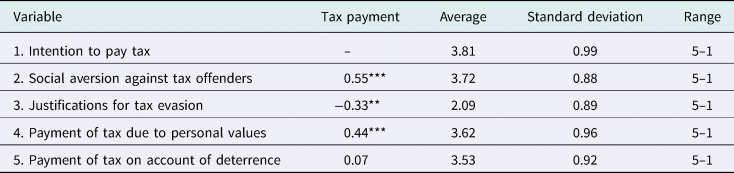
Table 1 shows that the study participants' intention to pay tax is high (M = 3.81, SD = 0.99). Similarly, they support social aversion against tax offenders (M = 3.71, SD = 0.88). In addition, in their opinion, tax payments are made mainly due to personal values (M = 3.62, SD = 0.96) and on account of deterrence (M = 3.53, SD = 0.92). In addition, the participants do not generally agree that tax evasion (M = 2.09, SD = 0.89) is justified. In other words, the study's participants believe that it is important to pay taxes due to personal values, because of a fear of social aversion and because of the use of deterrence by the tax authorities.
Averages, standard deviations, and Pearson coefficient values, between tax payment and social aversion to tax offenders, justifications for tax evasion, tax payment due to personal values, and tax payment on account of deterrence (N = 189)

*P < 0.05, **P < 0.01, ***P < 0.01.
The same Pearson product–moment correlation coefficient was used for the second stage of the data analysis. Table 1 shows that there is a statistically significant positive relationship between tax payment and the level of aversion to tax offenders (r = 0.55, P < 0.001). In addition, the table shows that there is a statistically significant negative relationship between the intention to pay taxes and justifications for tax evasion (r = −0.33, P < 0.01). That is, if a person addresses the importance of paying taxes and is aware of the consequences of not paying taxes, there is a willingness to pay taxes even in the absence of consent with the government. In addition, increasing the tax burden is not an incentive for these people to engage in tax evasion. Similarly, the table shows that there is a statistically significant positive relationship between the obligation to pay taxes and the payment of taxes due to personal values (r = 0.44, P < 0.001). Taxpayers will pay taxes even if the people closest to them such as neighbours and friends do not pay taxes. However, the table also shows that there is no statistically significant positive relationship between the payment of taxes and the payment of taxes on account of deterrence (r = 0.07, P > 0.05). That is, the respondents believe that increasing the use of deterrence methods against tax evasion does not lead to an increase in the willingness to pay taxes. In sum, the table shows that the first three hypotheses were confirmed but the fourth hypothesis was not.
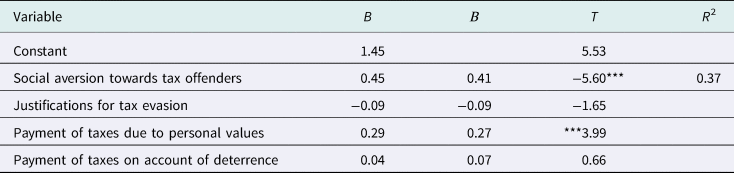
Multiple regression was used to examine the first research question, which is whether social aversion towards tax offenders, justifications for tax evasion, tax payment due to personal values, and tax payment on account of deterrence explain the motives for tax payments. The results of this multiple regression test are presented in Table 2.
Results of a multiple regression performed to explain the obligation to pay taxes through the variable justifications for tax payment, social aversion towards tax offenders, distance from members who are tax offenders, and personal values (N = 184)

***P < 0.001.
The table shows that the multiple regression model (i.e. the explanation of one variable, the intention to pay taxes, via a number of explanatory variables: social aversion towards tax offenders, justifications for tax evasion, tax payments due to personal values, and tax payments on account of deterrence) is significant (F(4, 180) = 26.14, P < 0.001), and was able to explain 37% of the variance associated with the motives for tax payment.
The revised regression values indicate that the variables, justifications for tax evasion and tax payment on account of deterrence, do not affect the variable of intention to pay taxes. In contrast, the variable aversion towards tax offenders was found as significantly affecting (β = 0.41, P < 0.001) the variable intention to pay taxes, and the variable paying taxes due to personal values was also found as significantly affecting the intention to pay taxes (β = 0.27, P < 0.001). That is, social aversion towards tax offenders and personal values regarding the obligation to pay taxes are the most influential factors affecting the intention to pay taxes.
Put differently, the data partially confirm the first research hypothesis, viz. that personal factors and social aversion towards tax offenders were found to be the factors influencing the intention to pay taxes while the variables deterrence and justifications for tax evasion do not affect the intention to pay taxes.
Both the Pearson tests performed above, which examined the relationship between the effect of social aversion towards tax offenders on the intention to pay taxes and Table 2 confirm that increasing social aversion towards tax offenders leads to an increased intention to pay taxes.
This finding, in turn, accords with the concept outlined in the literature above and, according to which, we as social creatures are influenced by society's behaviour. As explained by Dan Arieli's research cited above, cheating by a person close to us and cheating perceived by us as a matter of minor concern increases the likelihood of cheating among people belonging to the same group.
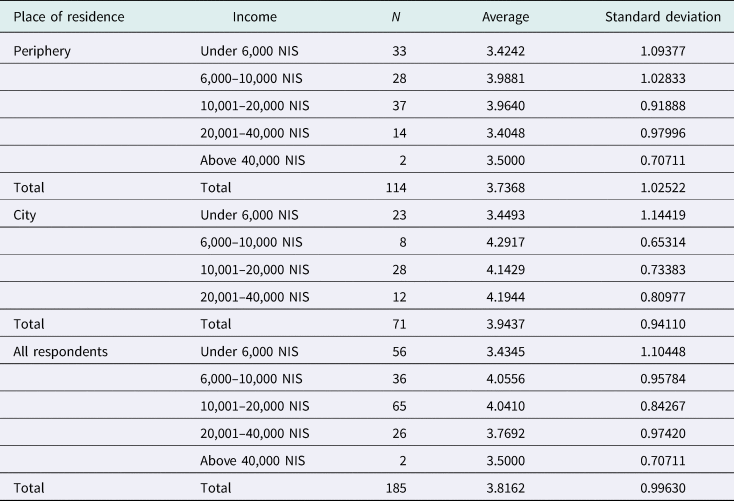
Two-way analysis of variance (ANOVA), in turn, was used to examine the second research question of whether the level of income and the place of residence affect the intention to pay taxes. The results of this analysis are presented in Table 3.
Examination of the effect of the variables level of income and the place of residence of the intention to pay taxes?

A main effect was found to be exerted, by the level of income and the place of residence on the intention to pay taxes in a two-way ANOVA test (F(4, 176) = 3.78, P < 0.01; F(1, 176) = 3.71, P < 0.05). As such, residents of urban areas are more likely to pay their taxes compared to respondents residing in the geographical periphery. It may be possible to explain this difference, in the latter group's sense of being neglected by the government in terms of resource allocation. With that said, the motives for non-payment of tax were not examined in such a way as to map the reasons for the non-payment of tax per se in the present study.
A Tukey's follow-up test found a significant difference in the intention to pay taxes between those who earn less than 6,000 NIS and those who earn between 6,000 NIS and 10,000 NIS per month. This can be explained by the existence of a progressive income tax regime in Israel such that a person who earns less than 6,000 NIS does not pay taxes at all and is thus not included in tax compliance considerations while the middle class bears the most significant tax burden (in the percentage of tax versus income per se).
In general, this means that the second research hypothesis was partially confirmed. Although respondents in urban areas are more likely to pay taxes than those living in the geographical periphery, there is no direct relationship between tax rate increases and the intention to pay taxes. The main difference in the intention to pay taxes is in fact between the low-income (working) class which does not pay taxes at all and members of the middle class who pay a low marginal tax (in absolute terms) but one that constitutes a relatively significant part of its income.
Summary and recommendations
A better understanding taxpayer behaviour and the factors affecting tax law compliance will help tax authorities design better compliance strategies.
With that said, the studies which were presented in this paper examined taxpayers' perceptions towards the respectable and fair enforcement of tax laws as opposed to enforcement based on discouragement and labelling. For example, Posner (Reference Posner2000: 1796–1797) has shown that the aggravation of punishment often leads to the opposite result, that is, increases tax law non-compliance. Studies have also shown that fair and respectful punishment increases the willingness to refrain from committing recurrent tax offenses, while the labelling of a rehabilitated tax offender leads to resentment towards tax authorities and an increasing willingness to commit recurrent tax offenses (Murphy, Reference Murphy2008: 126–127).Footnote 8 It is important to note, however, that these studies based their conclusions on the responses of tax offenders and did not examine the issue from the perspective of the general public and in relation to the influence of normative individual behaviour prior to the commission of tax offenses. Therefore, it is not possible to use them in drawing any conclusions with respect to the public's opinion on the enforcement of tax laws.
Some argue that cultural values influence individual's commitments to norms of governance and his attitude towards institutional compliance (Alesina and Giuliano, Reference Alesina and Giuliano2015; Andriani et al., Reference Andriani, Bruno, Douarin and Stepien-Baig2021).
The present study shows that the social response to tax evaders exerts a greater impact on increasing tax law compliance than the fear of punishment per se. Furthermore, a person who notes the importance of paying tax and the consequences of a lack of payment on the public coffers tends to pay taxes and even maintain negative positions on tax offenders. In addition, education from an early age and attempts to exert an influence on individual and social consciences also exerts implications on tax compliance (Schneider, Reference Schneider2011).Footnote 9
These results are consistent with the concept that morality has a great influence on compliance with the law (Hodgson, Reference Hodgson2015). The social condemnation gives the tax offense a moral element which increases compliance with the law.
Moreover, people who internalize the importance of paying taxes and the consequences of non-payment adopt a more negative approach towards tax evaders, and this, in turn, emphasizes the importance of education (Engel, Reference Engel2008) and the importance of a social aversion to tax offenders as tools for increasing tax law compliance among members of the public.
A survey conducted by the Dialogue Institute in this respect also reveals a worrying finding: among other things, it reveals that more than a third of young people in Israel do not perceive tax evasion as a form of theft (TheMarker, 2013). Therefore, internalizing the meaning of non-payment alongside the need for and the importance of paying taxes are the decisive factors to consider and can mostly, according to the research conducted in this article, lead to a negative perception towards tax evaders.
There are also studies that have shown that it is more difficult for people to cheat when they are required to sign at the top of each document and as the pace of execution of actions such as sitting in front of the tax clerk slows down and the document is signed before it is submitted (Arieli, Reference Arieli2009; Feldman, Reference Feldman2018). The rationale here seems to be the same: the understanding of the meaning of harm done to the public coffers in tax offenses, and the fear of social aversion affect the individual and it seems that the logic lies not in deterrence, but in an individual's ability to identify the victim or fraud.
The state should therefore invest in education for the payment of taxes which would clarify the importance of tax payments since this internalization constitutes an important basis for the institution of a social stigma towards tax evaders. This education can be implemented both within the framework of the education system itself as well as using the media for the purpose of imparting the relevant messages to the public and having it internalize them. As the present study clearly shows, the institution of a social stigma is crucial in the war against tax offenses because the lack of aversion and social condemnation signal that society considers tax offenses as marginal and there is no moral equivalence between tax evaders and thieves, or other offenders met with social disapproval. There are also other variables that influence tax law compliance, such as support of government policies, the tax burden in relation to the taxpayer's income, the taxpayer's social background, age, etc. (Posner, Reference Posner2000: 1811–1812). Posner also suggests that there are several variables that affect tax law compliance: a good government, a fair (progressive) tax base that applies to taxpayers according to their income, equality between taxpayer groups, and fair procedure. Furthermore, the tax authorities do not invest unnecessary funds when the public recognizes authorities' officials as fair and their procedures transparent. However, Posner also clarifies that the greater the number of tax evaders, the lower the effect of advertising as a stigma. In addition, Posner also believes that pardons and relief for certain tax offenders should be avoided as this would signal the absence of due process (Posner, Reference Posner2000: 1812–1814). However, the present study suggests that these variables are not significant, and that tax law compliance and an aversion towards tax evaders results when taxpayers are made aware of the importance of tax law compliance and of the detrimental effect of tax evasion on the public coffers.
Finally, the suggestion of reducing the tax burden to increase tax law compliance has not been further validated in this study. Although the study indicated a connection between the area of residence (urban centres or geographical periphery) and a willingness to pay tax, however, its causes have not been examined, and it is difficult to determine whether we are dealing with an accidental difference in this respect.
In this context, in accordance with the approach that individuals pay taxes in exchange for the services provided by the government (Luttmer and Singhal, Reference Luttmer and Singhal2014; Torgler, Reference Torgler2001, Reference Torgler2002; Torgler et al., Reference Torgler, Schneider and Schaltegger2007) we may explain the difference between tax compliance in geographical periphery areas which considered to receive fewer services than the urban centres.
Appendix A: The study
Methodology
The study designed to employ a quantitative methodology for examining the arguments that arose in its literature review, and to obtain evidence about the phenomenon under study and its extent. The present appendix will thus begin by presenting the segmentation of participants according to the individual variables described and will proceed by presenting the data collection process. It will then present the research tool (questionnaire) used for gathering data from the participants and will conclude by presenting the statistical methods used for analysing the quantitative research data thus obtained.
Method of analysis
The process of data analysis for the present study was carried out in several stages as follows:
Stage 1: production of descriptive statistics – the distributions, means, and standard deviations of the set of research variables (dependent and independent). These were produced for both the respondents as well as according to their applicable demographic variables (gender, marital status, income level, place of residence, education).
Stage 2: exploratory factor analysis (EFA) – this is a statistical method used for reducing the number of variables examined in a study by looking for common trends among them. These common trends are then represented by new variables called factors, which are linear variables based on a correlation between the weighted research variables attributed to the same factor.
Stage 3: the use of a Pearson product–moment correlation coefficient and linear regression to examine the relationship between the study variables.
Stage 4: two-way ANOVA given that one of the study's aims is to examine whether the demographic characteristics of the study participants exert any effect on their intention to pay taxes.
Ethics
The ethics of the present study were maintained in several ways. On the one hand, the confidentiality of the participants' identities was maintained by having them fill out the questionnaires anonymously and by emphasizing that the data would be used for research purposes only and without presenting data at the individual level. On the other, consent was assured by assuring the respondents that their participation was not mandatory and that they could withdraw at any time if they wished to do so.
Segmentation of participants according to individual variables
Gender: 84 participants were male and made up 45.4% of the study population. In total, 101 participants were women and made up 54.6% of the study population.
Level of education: 24 participants had a high school education and made up 13% of the study population. Eleven participants had some form of professional and/or vocational diploma and made up 6% of the study population. Seventy-six participants had an undergraduate degree and made up 41% of the total study population. Forty-five participants had a postgraduate degree and made up 24.3% of the total study population. Twenty-nine participants had a PhD and made up 15.7% of the total study population.
Source of income: the study involved 117 participants who were salaried employees and who made up 63.2% of the total study population. Twenty-six participants were self-employed and made up 14.1% of the total study population. Eighteen participants were the recipients of an annuity/benefit and made up 9.8% of the study population, and 24 participants were both salaried employees and self-employed professionals and made up 12.9% of the study population.
Data collection process
Research tools
The present study employed a dedicated questionnaire developed by the present author. The questionnaire was distributed randomly, and its data were collected using the Google Forms system. The study was also designed considering an extensive literature review conducted to identify the factors that can affect tax payment. The questionnaire design was also influenced to a great extent by Eisen's planned behaviour theory. Structurally speaking, the questionnaire is made up of three parts.
The first part of the questionnaire examined the respondents' demographic variables and encompassed six variables such as: age, place of residence, level of income, and level of marginal tax paid.
The second part of the questionnaire examined the respondents' moral and social attitudes towards tax law compliance and included 47 statements. The statements in this part were structure, and the respondents were asked to choose the appropriate level of agreement on a five-point Likert scale – between 1 (to a very minor extent) and 5 (to a very great extent).
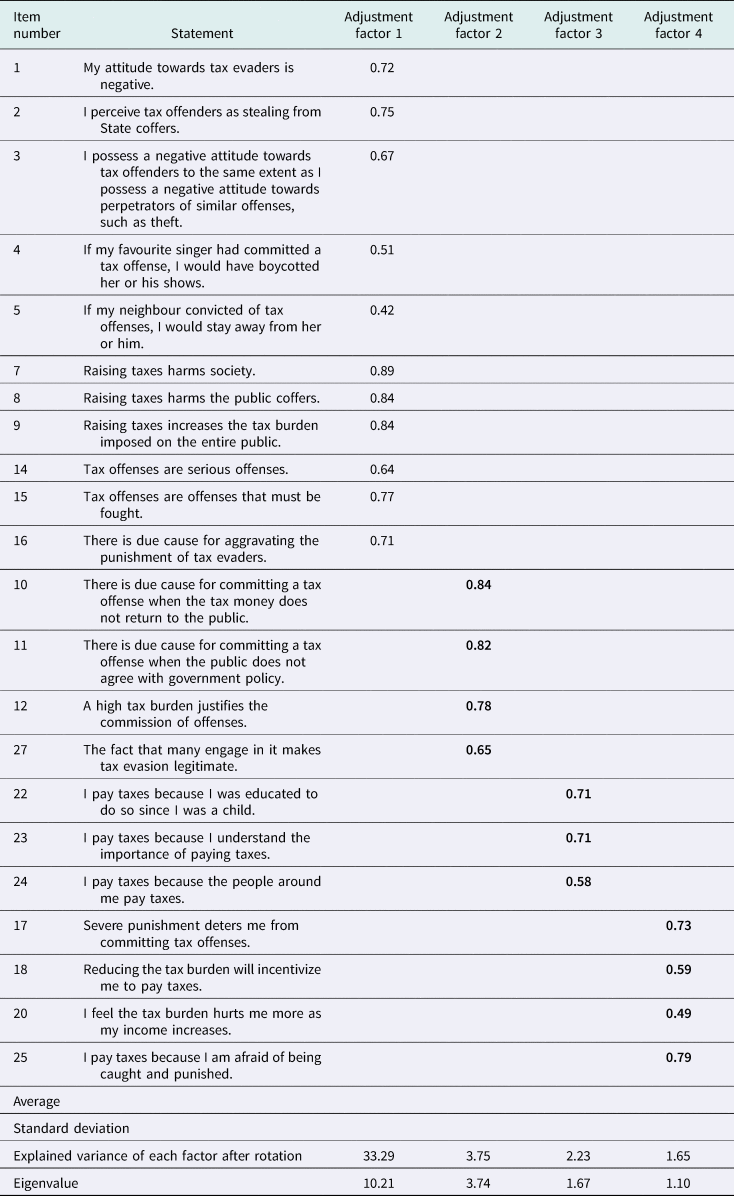
EFA was performed on all the statements to examine their validity. In this respect it should be noted that part of the EFA methodology requires statistical software (SPSS) to be given complete freedom of analysis regarding the breakdown of the questionnaire items into components since the result is not clear in advance. Furthermore, questionnaire factor analysis was performed using the principal axis factoring method (which assumes that there is a measurement error and refers to the common variance between the items and the factor) while performing a non-orthogonal rotation of the direct oblimin type, which assumes dependence between the factors. This analysis, in turn, indicated four distinct factors (eigenvalue >1): social aversion, justification for tax offenses, justification for paying taxes due to personal values, and paying taxes on account of punishment as can be seen in Table A1.
The distribution of the statements for Factors

Twelve items were omitted from the analysis (6, 7, 10, 12, 13, 19, 21, 25, 26, 28, 29, 30), because the level of change in each factor was lower than 40. Table 3 presents the results of the factor analysis, with the question numbers kept in questionnaire order.
The second part of the questionnaire's reliability was tested according to the internal consistency between the scores on the questionnaire statements and by way of the Cronbach's α test. The reliability values obtained for this component of the questionnaire presented in Table A2.
The reliability values of the Factors

As can be seen in Table A2, the reliability value obtained for the first factor (social aversion) was high (0.91 = α), and the reliability values obtained for each of the other three factors were moderate and ranged from 0.65 to 0.78.
The third part of the questionnaire measured the study's dependent variable, which is tax law compliance. This variable is measured using three statements that included statements such as: ‘I will not pay taxes’ (which was reverse-scored), ‘I would pay taxes even if most of the population did not pay taxes’, and ‘I will look for ways to evade paying my taxes’ (which were also reverse-scored prior to statistical analysis) and on a five-point Likert scale – ranging between 1 (to a very small extent) and 5 (to a very great extent).
The reliability of this part of the questionnaire was also tested for internal consistency using the Cronbach's α test. The reliability value obtained for this component of the questionnaire was high at α = 0.80.