Introduction
Embryo transfer to the uterus during an in vitro fertilization treatment is an important procedure in assisted reproductive technology (ART). Currently, day 3 (D3) cleavage embryo transfer (CET) is widely accepted by most centres. However, during the past 10 years, especially with improvements in embryo culture systems, an increasing number of centres have chosen blastocyst culture (Papanikolaou et al., Reference Papanikolaou, Kolibianakis, Tournaye, Venetis, Fatemi, Tarlatzis and Devroey2008; Kissin et al., Reference Kissin, Kulkarni, Mneimneh, Warner, Boulet, Crawford and Jamieson2015). Many studies have confirmed that blastocyst transfer can result in higher clinical pregnancy rates and live birth rates compared with CET (Glujovsky and Farquhar, Reference Glujovsky and Farquhar2016; Glujovsky et al., Reference Glujovsky, Farquhar, Quinteiro Retamar, Alvarez Sedo and Blake2016; Practice Committee of the American Society for Reproductive Medicine and the Practice Committee of the Society for Assisted Reproductive Technology, Reference Robinson2018). This has led physicians to consider using blastocysts for transfer. With the improvements in freezing technology, some centres recommend whole embryo freezing and suggest freeze–thawed blastocyst transfer (FBT) (Zhu et al., Reference Zhu, Chen, Wang, Lu, Lyu, Wang and Kuang2018; Bosdou et al., Reference Bosdou, Venetis, Tarlatzis, Grimbizis and Kolibianakis2019). However, a Cochrane review published in 2016 concluded that there was no evidence of any difference in the cumulative pregnancy rates after fresh-embryo transfer and frozen–thawed embryo transfer after one-oocyte retrieval [odds ratio (OR), 0.89; 95% confidence interval (CI), 0.64–1.22; very low-quality evidence] (Glujovsky et al., Reference Glujovsky, Farquhar, Quinteiro Retamar, Alvarez Sedo and Blake2016). More importantly, during the process of embryo self-selection, it is difficult for some embryos to form blastocysts. Therefore, if blastocyst transfer is planned, the possibility of cycle cancellation for many patients is greatly increased (Glujovsky and Farquhar, Reference Glujovsky and Farquhar2016; Practice Committee of the American Society for Reproductive Medicine and the Practice Committee of the Society for Assisted Reproductive Technology, Reference Robinson2018) because not all cycles are suitable for blastocyst culture, especially when patients have a poor ovarian response and fewer oocytes (Coates et al., Reference Coates, Kung, Mounts, Hesla, Bankowski, Barbieri, Ata, Cohen and Munné2017). Therefore, the suitability of blastocyst transplantation for older patients has been questioned. Most previous studies have been conducted in a younger population, and the optimal embryo transfer scheme for older women is controversial (Sfontouris et al., Reference Sfontouris, Martins, Nastri, Viana, Navarro, Raine-Fenning, van der Poel, Rienzi and Racowsky2016; Zhou et al., Reference Zhou, Jing, Xu, Guo, Lu, Gong, Lu, Lin and Gu2018; Liu et al., Reference Liu, Zheng, Lei and Wen2019). At present, many patients seeking ART treatment are in their late 30s or early 40s before they are diagnosed with infertility. Age is an important factor affecting the outcome of ART. The number and quality of oocytes decrease to varying degrees as age increases (Broekmans et al., Reference Broekmans, Knauff, te Velde, Macklon and Fauser2007). Studies have shown that the copy number of mitochondrial DNA in the oocytes of older patients is significantly lower than that in the oocytes of younger patients (Murakoshi et al., Reference Murakoshi, Sueoka, Takahashi, Sato, Sakurai, Tajima and Yoshimura2013). The incidence of aneuploidy in older patients is significantly higher than that in younger patients (Minasi et al., Reference Minasi, Colasante, Riccio, Ruberti, Casciani, Scarselli, Spinella, Fiorentino, Varricchio and Greco2016). Studies have shown that the cumulative live birth rate (LBR) resulting from ART significantly decreases after the age of 35 years (American College of Obstetricians and Gynecologists Committee on Gynecologic Practice and Practice Committee, 2014; Coticchio et al., Reference Coticchio, Behr, Campbell, Meseguer, Morbeck, Pisaturo, Plancha, Sakkas, Xu, D’Hooghe, Cottell and Lundin2021). Therefore, the embryo transfer strategy for older women is different from that for younger women.
The time required to achieve live birth has become an important factor in ART. It is necessary to help patients achieve live birth efficiently within the shortest time while avoiding complications, such as hyperstimulation syndrome and multiple births (Bosch et al., Reference Bosch, Bulletti, Copperman, Fanchin, Yarali, Petta, Polyzos, Shapiro, Ubaldi, Garcia Velasco, Longobardi, D’Hooghe and Humaidan2019; Coticchio et al., Reference Coticchio, Behr, Campbell, Meseguer, Morbeck, Pisaturo, Plancha, Sakkas, Xu, D’Hooghe, Cottell and Lundin2021). Studies have shown that the older the patient, the lower the pregnancy rate and LBR (Bortoletto et al., Reference Bortoletto, Willson, Romanski, Davis and Rosenwaks2021). Therefore, achieving live birth within a short time span is an urgent matter for elderly patients. The purpose of the study was to explore a more suitable transfer strategy for older patients to help them achieve live birth within the shortest possible time.
Materials and Methods
Study population and design
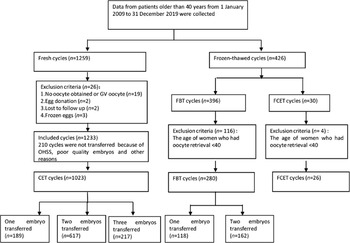
This study included data from patients older than 40 years who underwent ART treatment, including CET, frozen–thawed CET (FCET), and FBT at the Assisted Reproductive Center of Peking Union Medical College Hospital from 1 January 2009 to 31 December 2019. Patients with no retrieved oocytes, donated eggs, or frozen eggs, and patients who were lost to follow-up during this study were excluded. In total, 1233 CET cycles and 426 freeze–thaw cycles were included, making 396 FBT cycles and 30 FCET cycles. Patients who underwent FBT and FCET were further divided into two groups, respectively, according to their age at the time of oocyte retrieval (<40 and ≥40 years). Finally, 280 FBT and 26 FCET cycles were included. Figure 1 presents a flow chart of the process of enrolment of patients in this study. Requirement of patient consent was waived because of the retrospective nature of the study. This study was approved by the Ethics Committee of the Peking Union Medical College Hospital in China. All methods were performed according to the relevant guidelines and regulations.
Flow chart of the patient inclusion process during this study.

Treatment protocol and embryo evaluation
After pituitary suppression with gonadotropin-releasing hormone agonist and gonadotropin-releasing hormone antagonist, follicle-stimulating hormone (FSH; Gonal F; Merck Schlano, Switzerland) was used for ovarian stimulation. When three follicles with diameters of 18–20 mm were observed, 250 μg of human chorionic gonadotropin (HCG Merck Serono, Switzerland) was injected to reach final maturation. Then, oocytes were retrieved under transvaginal ultrasound guidance 38 h later. In vitro fertilization or intracytoplasmic sperm injection was administered based on the semen quality. The zygotes and embryos were cultured in an incubator at 37°C and in an atmosphere containing 6% CO2, 5% O2, and 89% N2. Embryos were evaluated on D3 after fertilization. We defined the high-quality cleavage-stage embryos as those with seven or eight blastomeres on D3 after fertilization with uniform cell size, no multinucleation, and less than 20% fragmentation. All others were not high-quality embryos. One or two embryos with the best quality were selected for transplantation. All embryo transfers were performed by senior embryologists with more than 5 years of experience working in the embryo laboratory. If the embryos could not be transplanted because the women were at risk for ovarian hyperstimulation or other reasons on the day of transplantation, the embryos were frozen or were cultured to the blastocyst stage. After informed consent was obtained from the patients, all remaining embryos were transferred to blastocyst culture medium and continuously cultured to day 5 (D5) or day (D6) in the same incubator to observe blastocyst formation. At our centre, the blastocysts were evaluated using the Gardner score (Gardner et al., Reference Gardner, Lane, Stevens, Schlenker and Schoolcraft2000), which is based on the degree of expansion of the blastocyst cavity, quality of the inner cell mass, and trophoblast cells. We defined blastocysts with an inner cell mass and trophoblast mass of A or B (grades: AA, AB, BA, and BB) as high-quality embryos; those with a grade of BC were defined as embryos that were not of high quality. Only blastocysts with an inner cell mass with grade A or grade B were selected for freezing. Grade C blastocysts were abandoned, but the quality of the trophoblast layer was not limiting.
Vitrification and warming of blastocysts
For vitrification, blastocysts were artificially shrunk before freezing. A mixture of 15% DMSO, 15% glycol, 0.65 mol/l sucrose, and 10 mg/ml Ficoll was used as a cryoprotectant solution. To warm the vitrified blastocysts, 0.33-M, 0.2-M, and 0-M sucrose solutions were used as a cryoprotectant diluent, and all steps were performed at 37°C. All vitrified and warmed blastocysts underwent laser-assisted hatching, and ∼25% of the zona pellucida was separated from the cell mass. Blastocysts were transferred to the blastocyst culture medium prepared in advance and placed in an incubator at 37°C with 6% CO2 and 5% O2. Cleavage embryos were cultured for 16 h, and blastocysts were cultured for 2 h. Embryo survival was evaluated before transplantation.
Endometrial preparation was performed according to the needs of the patient using either the natural cycle method or the artificial cycle method. The natural cycle method was used for patients with a regular menstrual cycle and normal ovulation. Before ovulation, 2000 IU HCG (Azer, Merck Serono, Switzerland) was injected, and luteal support (intramuscular injection of progesterone 20–40 mg/d) was provided after follicle rupture was detected by ultrasound. Embryo transplantation was performed on D6 after ovulation. The artificial cycle method included oral oestradiol valerate (Progynova, Schering, Germany) administered on days 2–4 of menstruation. Different starting doses (2–18 mg/day) were selected according to the previous endometrial conditions of patients. The thickness of the endometrium was monitored using ultrasound. When the thickness of the endometrium reached 8 mm, the blastocysts were thawed and transferred. After transplantation, luteal support was started using progesterone vaginal gel 8% (Crinone, Merck Serono, Feltham, UK) or progesterone injected intramuscularly.
Outcome measures
Clinical pregnancy was determined by an ultrasound examination indicating at least one foetus with a heartbeat at 6 to 7 weeks of gestation. Spontaneous abortion was defined as an intrauterine pregnancy loss. Live birth was defined as a viable infant born at more than 28 weeks of gestation after embryo transfer. The neonatal outcome was evaluated based on characteristics, such as gestational age at delivery, preterm birth (birth before 37 weeks of gestation), low birth weight (<2500 g at birth), and high birth weight (≥4000 g at birth).
Statistical analysis
SPSS 22.0 software (SPSS, IBM, Armonk, NY, USA) was used for statistical analyses. The main outcome measure was LBR. The secondary outcome measures were clinical pregnancy rate (CPR), spontaneous abortion rate, and neonatal outcome. Depending on the data distribution, a comparison of the means of the two groups was performed using either Student’s t-test or the Mann–Whitney U-test. A one-way analysis of variance was used to compare the means among the groups. The measurement data were evaluated using the chi-squared test or Fisher’s exact test. A multivariate logistic regression analysis was performed. Statistical significance was considered when P < 0.05.
Results
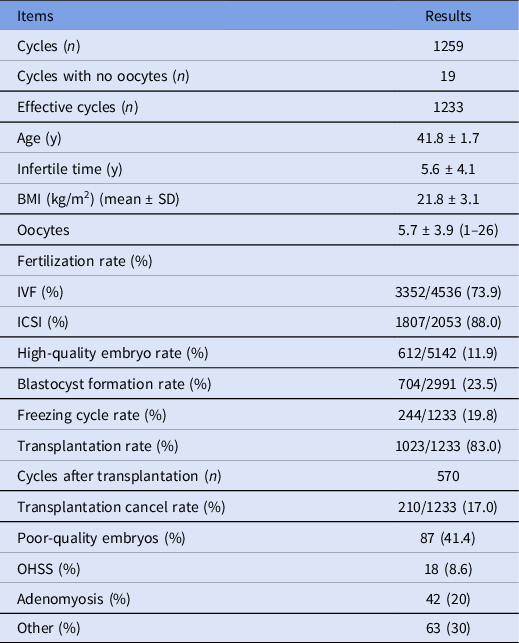
In total, 1259 fresh oocyte retrieval cycles were collected, and 1233 cycles were included after excluding invalid cycles. The average age of the patients was 41.8 ± 1.7 years. The average number of retrieved eggs was 5.7 ± 3.9. The blastocyst formation rate was 23.5%. The freezing cycle rate was 19.8%. Furthermore, 210 fresh-embryo transfer cycles were cancelled for various reasons, 41.4% of which were cancelled because of poor embryo quality. The number of fresh-embryo transfer cycles was 1023, and the transfer cycle rate was 83.0%. In total, 453 cycles had no remaining embryos after transplantation. In total, 570 cycles could progress to blastocyst cultures (Table 1).
Fresh cycle data of patients older than 40 years

BMI: body mass index; ICSI: intracytoplasmic sperm injection; IVF: in vitro fertilization, OHSS: ovarian hyperstimulation syndrome; SD: standard deviation.
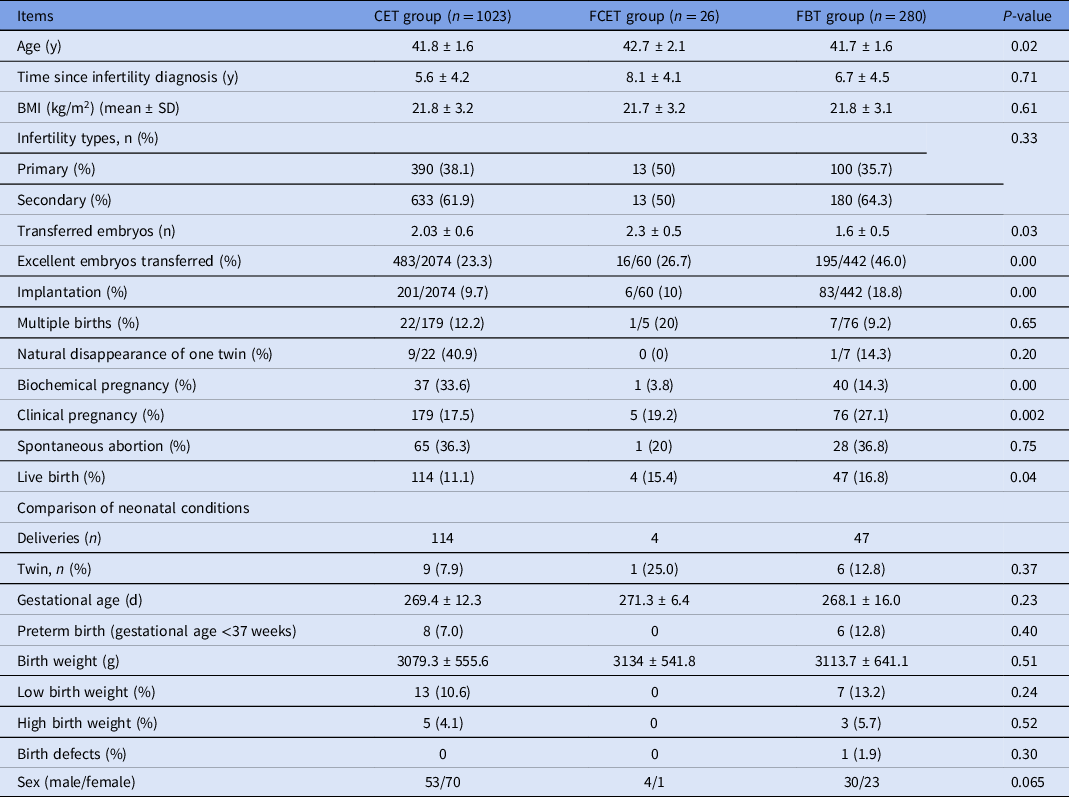
There were no significant differences in age, body mass index, duration of infertility, and type of infertility among the three groups. However, there were significant differences in the number of transferred embryos (P < 0.05) and the rate of transfer of high-quality embryos (P < 0.05). The number of embryos transferred in the FBT group (1.6 ± 0.5) was significantly lower than that in the CET and FCET groups (2.03 ± 0.6 vs. 2.3 ± 0.5, P = 0.03); however, the high-quality embryo rate in the FBT group (46.0%) was significantly higher than that in the CET and FCET groups (23.3 vs. 26.7; P = 0.00). Among the CET, FCET, and FBT groups, the implantation rates (9.7% vs. 10.0% vs. 18.8%; P = 0.00), biochemical pregnancy rates (33.6% vs. 3.8% vs. 14.3%; P = 0.00), clinical pregnancy rates (17.5% vs. 19.2% vs. 27.1%; P = 0.002), and LBRs (11.1% vs. 15.4% vs. 16.8%; P = 0.04) were significantly different.
There were no significant differences in multiple pregnancy rates and spontaneous abortion rates among the three groups. The incidence of spontaneous disappearance of twins in the CET group was higher than that in the two other groups, although the difference was not significant (P = 0.20). The twin birth rate in the CET group was lower than that in the FCET and FBT groups, although the difference was not significant (7.9% vs. 25.0% vs. 12.8%; P = 0.37). There were no significant differences in gestational age, birth weight, and body length among the three groups. There was no significant difference in the incidence of premature birth and low birth weight among the three groups. There was one case of neonatal malformation in the FBT group. Although the sex ratios (male:female) of the FCET and FBT groups were higher than those of the CET group, there was no significant difference among the three groups (Table 2).
General conditions, clinical outcomes, and neonatal outcomes of the CET, FCET, and FBT groups

P < 0.05 indicates statistical significance.
CET group, fresh cleavage embryo transfer; FBT, frozen–thawed blastocyst embryo transfer; FCET group, frozen–thawed cleavage embryo transfer.
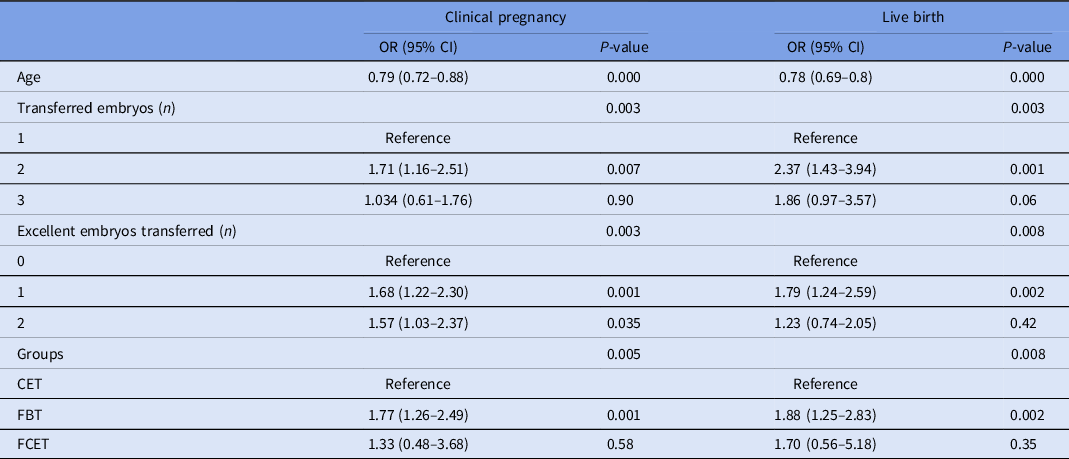
Logistic regression analysis showed that the older the patient, the lower the LBR (OR, 0.78; 95% CI, 0.69–0.88, P = 0.000) (Table 3). The number of transferred embryos and the number of transferred high-quality embryos were related to the LBR (P = 0.003 and P = 0.008, respectively). The LBR of two-embryo transplantation was 2.37-fold that of one-embryo transplantation. Although the LBR of three-embryo transplantations was 1.86-times higher, the difference was not significant (P = 0.06). The LBRs of transplantations involving one high-quality embryo and two high-quality embryos were 1.79-fold and 1.23-fold higher than that of no high-quality embryo transplantation, respectively. Compared with the CET group, the FCET group did not have an increased LBR (P = 0.35), but the FBT group had a significantly higher live birth rate (OR, 1.88; 95% CI, 1.25–2.83; P = 0.002).
Multiple logistic regression analysis of clinical pregnancy rates and live birth rates of older patients

P < 0.05 indicates statistical significance.
CET group, fresh cleavage embryo transfer; CI, confidence interval; FBT, frozen–thawed blastocyst embryo transfer; FCET, frozen–thawed cleavage embryo transfer; OR, odds ratio.
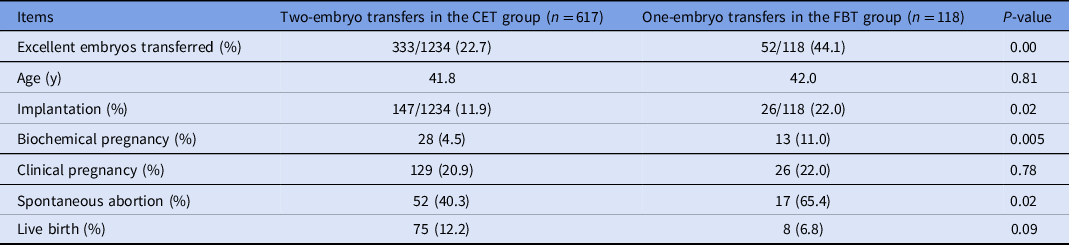
When comparing the pregnancy outcomes of two-embryo transfers in the CET group and one-embryo transfers in the FBT group, we found that the high-quality embryo rate of the FBT group was significantly higher than that of the two-embryo transfers in the CET group (44.1% vs 22.7%, P = 0.00), and that the biochemical pregnancy rate and implantation rate were significantly higher than those of the CET group (P = 0.005 and P = 0.02, respectively) (Table 4). The spontaneous abortion rate for one-embryo transfers in the FBT group was higher than that of the CET group (P = 0.02). Although the LBR of the two-embryo transfers in the CET group (12.2%) was slightly higher than that in the FBT group (6.8%), there was no significant difference between the groups (P = 0.09).
Clinical outcomes of two-embryo transfers and one-embryo transfers in the CET and FBT groups

P < 0.05 indicates statistical significance.
CET group, fresh cleavage embryo transfer; FBT, frozen–thawed blastocyst embryo transfer.
Discussion
During our study, the pregnancy outcomes of CET, FCET, and FBT were compared. The CPR and LBR of the FBT group were significantly higher than those of the CET and FCET groups, similar to the findings of previous studies (Papanikolaou et al., Reference Papanikolaou, Camus, Kolibianakis, Van Landuyt, Van Steirteghem and Devroey2006; Glujovsky and Farquhar, Reference Glujovsky and Farquhar2016; Glujovsky et al., Reference Glujovsky, Farquhar, Quinteiro Retamar, Alvarez Sedo and Blake2016; Robinson, Reference Robinson2018). According to a Cochrane review in 2016, the LBR after the fresh transfer was higher in the blastocyst transfer group than in the cleavage transfer group, which indicated that if the LBR of fresh cleaved embryo transfer was 29%, the blastocyst transfer rate could increase from 32% to 42% (Glujovsky et al., Reference Glujovsky, Farquhar, Quinteiro Retamar, Alvarez Sedo and Blake2016). This may be because prolonging embryo culture from the cleavage stage to the blastocyst stage can improve embryo self-selection, and it is good for us to select embryos with implantation potential (Glujovsky and Farquhar, Reference Glujovsky and Farquhar2016). Blastocyst transfer is better able to simulate the natural implantation time of embryos and results in better receptivity by the endometrium. Studies have shown that the endometrium after ovarian stimulation undergoes histological changes and gene expression changes and has structural abnormalities (Robinson, Reference Robinson2018). Therefore, frozen–thawed embryo transfer can prevent the possible abnormal effects of gonadotropin on the endometrium and improve the LBR. As a result, more centres have adopted whole embryo freezing strategies. Additionally, the number of high-quality embryos transferred in the FBT group was significantly higher than that transferred in the other two groups during this study, and the LBR of the FBT group was still significantly higher than that of the CET and FCET groups after multivariate regression analysis, which is different from the findings of previous studies (Li et al., Reference Li, Xue, Zhao, Ren, Zhuo and Shi2017; Levi-Setti et al., Reference Levi-Setti, Cirillo, Smeraldi, Morenghi, Mulazzani and Albani2018). Levi-Setti and colleagues included individuals younger than 39 years in their study and compared the clinical outcomes of fresh blastocysts and cleaved embryo transfer (Levi-Setti et al., Reference Levi-Setti, Cirillo, Smeraldi, Morenghi, Mulazzani and Albani2018). They found that blastocyst transfer did not significantly improve the pregnancy rate and LBR, although it increased the twin pregnancy rate, which may be related to the younger age and better embryo quality of the patients (Levi-Setti et al., Reference Levi-Setti, Cirillo, Smeraldi, Morenghi, Mulazzani and Albani2018).
Regarding multiple birth rates, this study suggested that there was no significant difference among the three groups, although multiple birth rates were slightly higher in the CET and FCET groups, which may have been related to our transplantation strategy. Compared with the number of embryos recommended by the American Society for Reproductive Medicine in 2013, for women 38 to 40 years of age, the recommended numbers of cleavage-stage embryos and blastocyst-stage embryos were three or four and two or three, respectively. For patients aged 41–42 years, no more than five cleavage-stage embryos or no more than three blastocysts should be transferred (Practice Committee of the American Society for Reproductive Medicine and the Practice Committee of the Society for Assisted Reproductive Technology, 2013). The number of transferred embryos was relatively conservative. According to the relevant regulations of China, two or three blastomeres or two blastocysts were transplanted to older patients. Because of the increasing attention focused on multiple pregnancies, our strategy was to reduce the number of embryos transferred; however, our criteria were more restrictive than those proposed by the American Society for Reproductive Medicine in 2017 (Practice Committee of the American Society for Reproductive Medicine and the Practice Committee of the Society for Assisted Reproductive Technology, Reference Rienzi, Gracia, Maggiulli, LaBarbera, Kaser, Ubaldi, Vanderpoel and Racowsky2017). After 2017, we began transferring two cleaved embryos and one or two blastocysts to patients older than 40 years. During the past 3 years, we have gradually moved to single-blastocyst transplantation. Using a multiple logistic regression analysis, we found that two-embryo transplantation can significantly improve the CPR and LBR, although three-embryo transplantation did not show significant improvements, which may have been the result of the poor embryo quality of older patients, especially in the cleavage stage. Embryo quality is often poor when three embryos are transferred. Increasing the number of transferred embryos cannot effectively improve the LBR. Additionally, this study suggested that, although the numbers of transferred embryos in the CET and FCET groups were significantly higher than those transferred in the FBT group, the LBR in the CET group was significantly lower than that of the FBT group, therefore demonstrating the advantages of blastocyst transplantation.
The neonatal outcomes after blastocyst transplantation have been controversial. Studies have found that there are some problematic neonatal outcomes of blastocyst transplantation. Blastocyst transplantation is believed to be more prone to premature birth than CET (Maheshwari et al., Reference Maheshwari, Kalampokas, Davidson and Bhattacharya2013; Dar et al., Reference Dar, Lazer, Shah and Librach2014; Wang et al., Reference Wang, Du, Guan, Wang, Zhang and Liu2017). A meta-analysis conducted by Maheshwari et al. (Reference Maheshwari, Kalampokas, Davidson and Bhattacharya2013) found that, compared with CET, the incidence of preterm birth before 37 weeks of gestation was higher in the blastocyst transfer group, and that the women in the blastocyst transfer group was more likely to have infants who were large for gestational age (Dar et al., Reference Dar, Lazer, Shah and Librach2014). Similarly, Zhou and colleagues found that, for patients younger than 35 years, the birth weight of the blastocyst transplantation group was significantly higher than that for the cleavage embryo transplantation group, which may have been caused by the effects of epigenetic alteration on the birth weight of newborns during blastocyst culture (Zhou et al., Reference Zhou, Jing, Xu, Guo, Lu, Gong, Lu, Lin and Gu2018). However, for older patients, there was no difference in birth weight between the two groups, which was consistent with our findings. We found no significant differences in neonatal outcomes among the three groups, which was consistent with the conclusions of other studies (Marconi et al., Reference Marconi, Raja, Bhattacharya and Maheshwari2019; De Vos et al., Reference De Vos, Dos Santos-Ribeiro, Tournaye and Verheyen2020). In another study, the neonatal outcomes of singleton birth after blastocyst transplantation and cleavage embryo transplantation were similar when a fresh transfer cycle was involved. Blastocyst transplantation did not affect preterm birth or birth weight, and it did not alter the probability of the newborns being healthy (Marconi et al., Reference Marconi, Raja, Bhattacharya and Maheshwari2019). A similar conclusion was reached during a study of the freeze–thaw cycle that aimed to determine whether the transfer of the frozen–thawed cleavage embryo or blastocyst affected neonatal weight. Additionally, during this study, we found that, although the sex ratios (male:female) in the FCET and FBT groups were higher than those in the CET group, there was no significant difference among them, similar to the findings of other studies (Li et al., Reference Li, Xue, Zhao, Ren, Zhuo and Shi2017; Fang et al., Reference Fang, Zhu, Li, Xu, Yan, Sun, Zhang and Chen2018; Levi-Setti et al., Reference Levi-Setti, Cirillo, Smeraldi, Morenghi, Mulazzani and Albani2018; Marconi et al., Reference Marconi, Raja, Bhattacharya and Maheshwari2019). Marconi and colleagues found that extended culture was associated with a marginal increase in the chance of male embryos (Marconi et al., Reference Marconi, Raja, Bhattacharya and Maheshwari2019). However, several studies have suggested that blastocyst transfer can increase the proportion of male embryos (Luna et al., Reference Luna, Duke, Copperman, Grunfeld, Sandler and Barritt2007; Maalouf et al., Reference Maalouf, Mincheva, Campbell and Hardy2014; Practice Committee of the American Society for Reproductive Medicine and the Practice Committee of the Society for Assisted Reproductive Technology, Reference Robinson2018). Because male embryos develop faster than female embryos and have better morphology, the faster-growing embryos are more likely to be male (Kawase et al., Reference Kawase, Tachibe, Kamada, Jishage, Watanabe and Suzuki2021). Additionally, studies have shown that, compared with female embryos developed during the same period, the morphological score of male embryos was better; for example, 72% of D5 or D6 blastocysts were male embryos, whereas 60% of D3 blastocysts were female embryos (Alfarawati et al., Reference Alfarawati, Fragouli, Colls, Stevens, Gutiérrez-Mateo, Schoolcraft, Katz-Jaffe and Wells2011). However, the specific mechanism of action remains unclear and requires further study.
Although blastocyst transplantation is efficient and can lead to a high LBR, blastocyst culture has some disadvantages. With in vitro culture, considerable numbers of embryos have low blastocyst formation rates because of poor embryo quality or atresia, especially for patients with a poor prognosis (Glujovsky and Farquhar, Reference Glujovsky and Farquhar2016; Glujovsky et al., Reference Glujovsky, Farquhar, Quinteiro Retamar, Alvarez Sedo and Blake2016). Some studies have shown that the blastocyst formation rate decreases with age (Alhelou et al., Reference Alhelou, Mat Adenan and Ali2018). If these patients choose blastocyst transfer, a large proportion of these patients may be left without available embryos. Compared with CET, the cycle cancellation rate will probably be greatly increased. During this study, the age of patients who underwent fresh cleaved embryo transfer ranged from 40 to 48.8 years, the number of fresh-embryo transfer cycles was 1023, the transfer rate was 83.0%, the blastocyst formation rate was 23.5%, and the freezing cycle rate was 19.8%. In total, 453 cycles had no remaining embryos after transplantation. This means that if these patients do not undergo fresh transplantation and all of them have blastocyst culture, more than half of them will not have the chance to undergo transplantation. Additionally, the outcomes of two-embryo transfers in the CET group and one-embryo transfers in the FBT group were compared. We found that, although the high-quality embryo rate of the one-embryo transfers in the FBT group was significantly higher than that of the two-embryo transfers in the CET group, there was no significant difference in the pregnancy rates of these two groups. In contrast, the spontaneous abortion rate of the one-embryo transfers in the FBT group was significantly higher than that of the two-embryo transfers in the CET group, and the LBR of the one-embryo transfers in the FBT group was slightly lower than that of the two-embryo transfers in the CET group, although the difference was not significant. For older patients, especially those with a small number of embryos, if they are allowed to extend blastocyst culture, even if they can develop blastocysts, their chances of achieving live birth may not be as high as that of patients with transferred cleavage embryos. Furthermore, some studies have suggested that some cleaved embryos cannot develop to the blastocyst stage in vitro; however, they may develop into viable embryos in vivo after D3 transplantation (Gleicher et al., Reference Gleicher, Kushnir and Barad2015). Therefore, early CET may be more effective in some cases. For older patients with a poor prognosis, careful decisions should be made to ensure that embryos of the best quality are transferred as soon as possible during the treatment process. The optimization of these processes will reduce the time to live birth by reducing the need for treatment cycles. A recent review of evidence-based medicine showed that the whole embryo cryopreservation strategy does not improve the cumulative LBR and continued pregnancy rate (OR, 1.08; 95% CI, 0.95–1.22; I2 = 0%; eight randomized, controlled trials; 4712 women; model-quality evidence), and the time to pregnancy was not determined according to the data of the included studies; however, they found that under the premise of similar LBRs, the time to pregnancy with the fresh-embryo transfer strategy seemed to be slightly less than that of the whole embryo freezing strategy (Zaat et al., Reference Zaat, Zagers, Mol, Goddijn, van Wely and Mastenbroek2021) because frozen–thawed embryo transplantation involves a longer waiting time than fresh transplantation. For older women, time is valuable because they hope to become pregnant sooner and have a live birth. It is recommended that they start the next cycle as soon as possible if pregnancy does not occur. Therefore, it is suggested that D3 CET should be performed instead of D5/D6 blastocyst transfer for older women with fewer oocytes retrieved to reduce the cancellation rate of the transfer cycle and make it easier for them to accept the risk of CET (Glujovsky and Farquhar, Reference Glujovsky and Farquhar2016). Based on the data from this study, in the elderly women, the blastocyst formation rate of the remaining embryos after transfer of two embryos was 23.5%, meaning that 4.25 cleavage embryos were required to form one blastocyst. If all the embryos are cultured without fresh-embryo transfer, the blastocyst formation rate may be even higher (>23.5%), which means that approximately four cleavage embryos are needed to obtain one blastocyst. This study also suggests that the LBR resulting from one blastocyst seems to be slightly lower than that resulting from two cleaved embryos. Therefore, to obtain a higher LBR, it is better to obtain two blastocysts, which requires more or less eight cleavage embryos. Therefore, for patients with more or less eight embryos after fertilization, blastocyst transfer can be considered if they are willing to accept the risk. Alternatively, CET can be performed first, and FBT can be performed if CET is not successful.
There were some limitations to this study. First, we compared the pregnancy outcomes of CET, FCET, and FBT cycles because no fresh blastocyst transfers were performed in our centre during this study. The reason for this comparison is that the cryopreservation of embryos can now be performed more safely with improvements in embryo freezing technology (Wong et al., Reference Wong, Mastenbroek and Repping2014; Rienzi et al., Reference Rienzi, Gracia, Maggiulli, LaBarbera, Kaser, Ubaldi, Vanderpoel and Racowsky2017). At our centre, since 2005, all blastocysts were cryopreserved using vitrification, and the survival rate after resuscitation reached 99% (Wang et al., Reference Wang, Zhen, Sun, Yu, Deng, Zhou, Wang and He2016). Additionally, studies have shown that the pregnancy rate after frozen–thawed blastocyst transplantation is similar to or even better than that after fresh blastocyst transplantation (Coates et al., Reference Coates, Kung, Mounts, Hesla, Bankowski, Barbieri, Ata, Cohen and Munné2017; Wei et al., Reference Wei, Liu, Sun, Shi, Zhang, Liu, Tan, Liang, Cao, Wang, Qin, Zhao, Zhou, Ren, Hao, Ling, Zhao, Zhang, Qi, Zhang, Deng, Chen, Zhu, Wang, Tian, Lv, Ma, Zhang, Legro and Chen2019). Similar to fresh blastocyst transplantation, frozen–thawed blastocysts can lead to live births efficiently and safely (Wei et al., Reference Wei, Liu, Sun, Shi, Zhang, Liu, Tan, Liang, Cao, Wang, Qin, Zhao, Zhou, Ren, Hao, Ling, Zhao, Zhang, Qi, Zhang, Deng, Chen, Zhu, Wang, Tian, Lv, Ma, Zhang, Legro and Chen2019). Therefore, the comparison can also provide a reference for the development of transplantation strategies for older patients. Second, the number of patients who had FCET cycles was relatively low, which may have affected the comparisons of the neonatal outcomes. In the future, a multicentre study with a large sample size should be conducted to address this issue. Finally, this study was retrospective, and the rate of excellent embryos transferred during FBT cycles was higher than that transferred during the CET cycles. In the future, studies involving blastocysts of balanced quality should be conducted to address this, which would enable us to analyze whether there is a difference between CET and FBT cycles.
In conclusion, the age of patients seeking ART is increasing (Coticchio et al., Reference Coticchio, Behr, Campbell, Meseguer, Morbeck, Pisaturo, Plancha, Sakkas, Xu, D’Hooghe, Cottell and Lundin2021), therefore it is important to help patients achieve live births as soon as possible. Although the efficiency of blastocyst transfer is high, not every cycle is suitable. If the cycle cancellation rate is too high, then many patients will not benefit from ART. Therefore, we should consider the transfer strategy based on the quantity and quality of embryos after fertilization. However, these results should be further confirmed by multicentre, randomized, controlled trials with large sample sizes in future.
Acknowledgements
The authors thank Editage (www.editage.cn) for English language editing.
Authors’ contributions
XW and ZYS contributed to the conception and design of the study. XW and YLX performed the literature search. JRZ and ZYS were involved in statistical analysis. XW, YLX, and QY contributed to the interpretation of the results. XW was responsible for manuscript drafting. All authors read and approved the final manuscript.
Funding
This study was funded by the Peking Union Medical College Hospital sedimentation fund (grant number: ZC201904363).
Conflict of interest
The authors declare none.
Ethics approval and consent to participate
This study was approved by the Ethics Committee of the Peking Union Medical College Hospital in China (zs-1214). The ethics committees waived the requirement for informed consent because of the retrospective nature of this study.
Consent for publication
Not applicable.
Availability of data and materials
All data generated or analyzed during this study are included in this published article.