Introduction
Clinical outcomes for CHD have significantly improved with both medical and surgical advancements. Despite these improvements, disparities in clinical outcomes among children with CHD prevail, and social determinants of health are recognised as significant contributors. Social determinants of health have been associated with unanticipated readmission, higher mortality, and longer hospitalisations in this population. Reference Bucholz, Sleeper and Newburger1–Reference Kucik, Nembhard and Donohue5 While the impact of social determinants of health on clinical outcomes during the perioperative period has been more widely examined, less information exists on the impact of social determinants of health on long-term paediatric cardiology follow-up and initial cardiology evaluation.
Outpatient cardiology follow-up is important for surveillance, management, and early detection of complications in CHD patients. For those with CHD, gaps in cardiology care appear to start in childhood and may increase into adolescence/adulthood. Reference Mackie, Ionescu-Ittu, Therrien, Pilote, Abrahamowicz and Marelli6 CHD patients with lapses in cardiology follow-up have been shown to be at higher risk for adverse outcomes, such as requiring an urgent cardiac intervention. Reference Yeung, Kay, Roosevelt, Brandon and Yetman7 In patients with CHD, minority status, public insurance, living in a high-poverty community, and farther distance needed to travel to a medical centre have all been associated with poor follow-up. Reference Davey, Sinha, Lee, Gauthier and Flores8–Reference Lu, Lowery, Yu, Ghadimi Mahani, Agarwal and Dorfman10
While cardiology follow-up for those with known CHD is vital, early detection of disease in the outpatient setting is also important. A study exploring failure to complete referrals to paediatric cardiology demonstrated that race, insurance type, neighbourhood deprivation, and time from referral date to appointment made were each associated with incomplete referrals. Reference Warren, Beck, Zang, Anderson and Statile11 Additionally, residing in an area of higher community deprivation has been linked to decreased likelihood of prenatal diagnosis of CHD. Reference Krishnan, Jacobs and Morris12 Both studies raise concern about equitable early diagnosis and early identification to avoid potential complications of delayed diagnosis.
Early detection and comprehensive outpatient management of CHD are critical to assuring optimal outcomes for children with CHD. Limited literature indicates that social determinants of health likely impact patients’ ability to present for cardiology evaluation and follow-up. Reference Demianczyk, Behere and Thacker9,Reference Jackson, Morack, Harris, DeSalvo, Daniels and Chisolm13 Our study aims to describe the population with lapses in care to outpatient, general paediatric cardiology from a social determinants of health standpoint and compare them to the primary service area, with the goal of utilising this data to inform future interventions to achieve equitable access to and retention in outpatient cardiology care.
Materials and methods
Study design and population
This is a retrospective chart review from Cincinnati Children’s Hospital Medical Center. Patients were included in the study if they had been identified as having a lapse in care from 07/01/2020 to 06/30/2022 for a general cardiology appointment and were 18 years or younger at the time of their appointment or at the beginning of the study period. Patients at both our main hospital location and satellite locations were included in the study. Lapses in care were defined as no-show to an appointment or lost-to-follow-up. No-show status was defined as a missed appointment that was not previously cancelled. If patients no-showed to more than one appointment, they would only be included in the no-show analysis once. Lost-to-follow-up was defined as patients with no scheduled appointment after three attempts to contact them to make an appointment. Patients may be included in both the lost-to-follow-up group and no-show group analysis. Figure 1 further illustrates the inclusion criteria for both no-show and lost-to-follow-up patients.
Patient selection algorithm.

Demographic information for both groups was compared to publicly available data on the population served by our hospital system, which will be referred to as the primary service area throughout the study. The study was reviewed and approved by the local institutional review board prior to collecting data (Cincinnati Children’s Hospital Medical Center: IRB 2022-0962). If a data point was missing (i.e. patient’s insurance status), the patient was not included in the subgroup analysis for that data point. However, missing data points did not exclude patients from other subgroup analyses.
Setting
Cincinnati Children’s Hospital Medical Center is a quaternary paediatric medical centre, whose cardiology division serves patients in both the outpatient and inpatient settings. The outpatient cardiology primary catchment area includes Southwest Ohio, Northern Kentucky, and Southeastern Indiana. These areas are made up of a mixture of urban, suburban, and rural communities. There are close to 30 outpatient cardiology locations, which are located throughout the above service area. The cardiology division has close to 26,000 visits per year for both general and subspeciality cardiology appointments.
Descriptors and measures
We obtained demographic information, primary cardiac diagnosis, and encounter information from the electronic medical record. The individual-level social determinants of health that we examined in this study were race, ethnicity, primary language spoken, and insurance status (private versus public versus both versus self-pay).
Community-level deprivation was approximated by deriving a deprivation index for each patient, which is a standardised marker of community-level disadvantage. It was derived from patients’ addresses using geocoding and information from the American Community Survey. The deprivation index incorporates census data regarding community median household income, educational attainment, individuals receiving public assistance, and vacant housing; it ranges from 0 to 1 (national median 0.33, IQR 0.24, 0.43) with higher indices indicating more disadvantage. 14,Reference Brokamp, Beck, Goyal, Ryan, Greenberg and Hall15 A deprivation index was not determined if the listed home address was that of Cincinnati Children’s Hospital Medical Center, Cincinnati’s Ronald McDonald House, a PO Box, or the County Department of Family Services.
Cardiac diagnosis was classified into two main categories: CHD and non-CHD. CHD was divided into simple, moderate, or severe based on the 2018 American College of Cardiology/American Heart Association guideline for the management of adults with CHD. Reference Stout, Daniels and Aboulhosn16 The most complex and/or primary diagnosis noted on the most recent cardiology appointment was used for patients with more than one cardiac diagnosis.
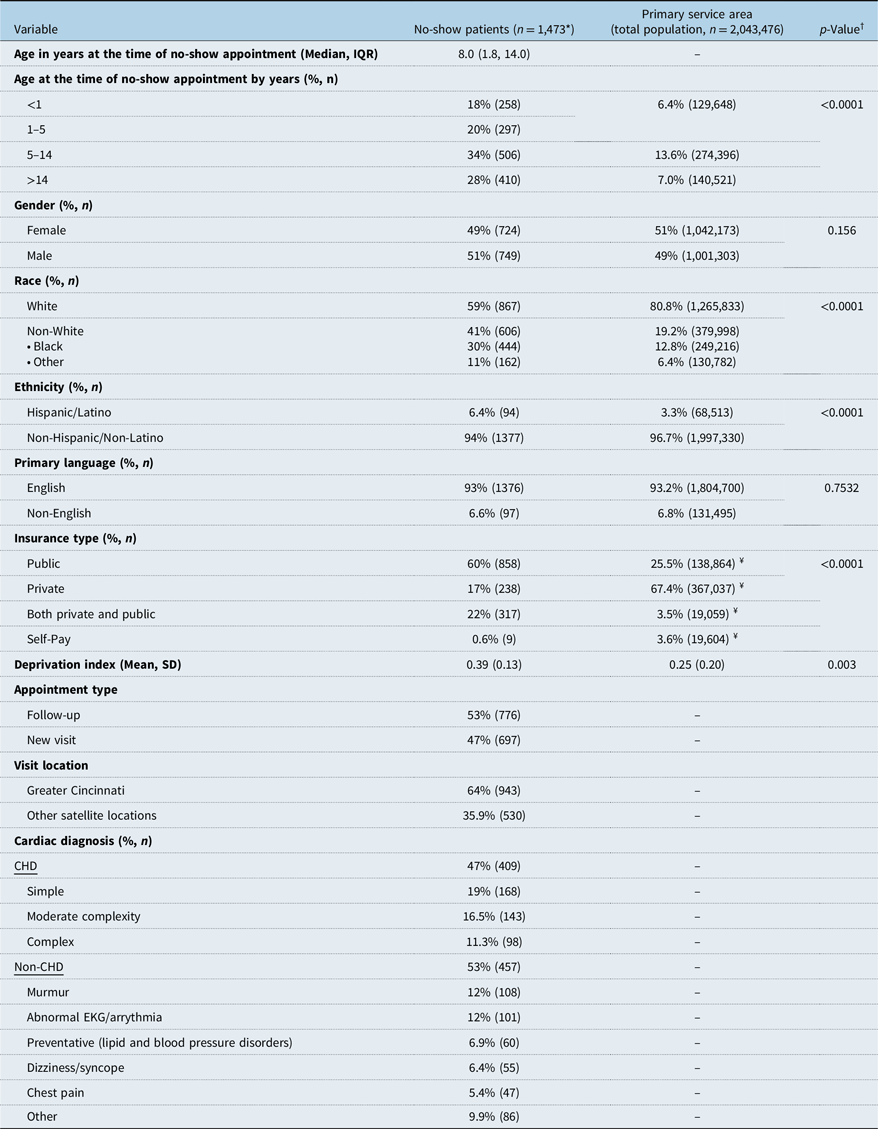
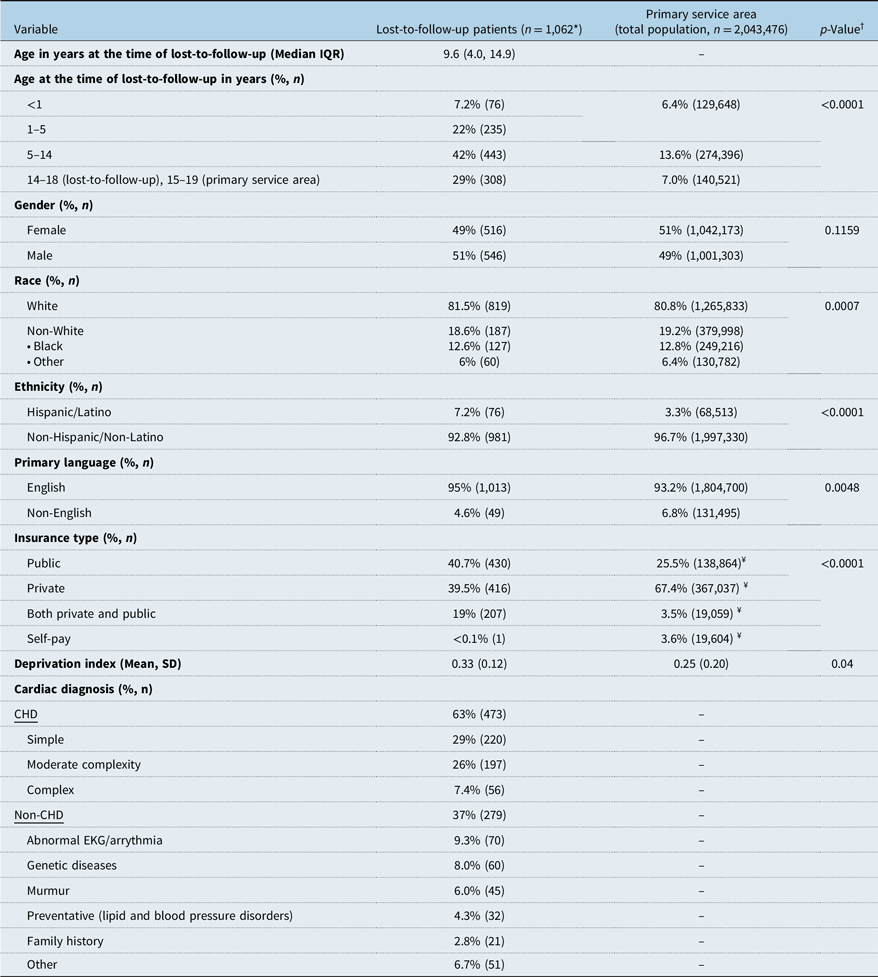
Encounters were conducted at both the main hospital and satellite locations, which follow similar practice protocols. The data obtained were compared to information available on Cincinnati Children’s Hospital Medical Center’s primary service area via the 2022 Community Health Needs Assessment, which is described in Tables 1 and 2. 17
Characteristics of no-show patients and primary service area population

* Total n for each sub-analysis may slightly differ due to availability of data for each patient.
† Based on chi-squared test.
¥ n = 544,565 (population <19 year old).
Characteristics of lost-to-follow-up patients and primary service area population

* Total n for each sub-analysis may slightly differ due to availability of data for each patient.
† Based on chi-squared test.
¥ n = 544,565 (population <19 years old).
Analysis
Demographic data were described using medians and ranges for continuous variables and counts and percentages for categorical variables. The deprivation index in the primary service area was compared to the deprivation index in lost-to-follow-up and no-show groups using an independent two-sample t test. All tests were two-tailed and performed at a significance level of 0.05. Analyses were conducted using R 4.4.0, RStudio, and the tidyverse package. Reference Hadley Wickham, Bryan and Chang18–20
Results
Comparisons of the demographic information for patients with lapses in care, both no-show and lost-to-follow-up patients, and our primary service area can be seen in Tables 1 and 2, respectively. A total of 1,473 patients identified as no-shows were included in the study. Among patients identified as no-shows, 74 of them (74/1473; 5%) were also identified as lost-to-follow-up. Two hundred and fifty-nine (17.5%) patients had two or more no-showed appointments. The majority of our patients identified as White (59%), non-Hispanic/Latino (94%), reported English as their primary language (93%), and utilised public insurance (82%). Compared to our primary service area, a higher proportion of no-show patients identified as non-White (41% versus 19.2%, p = < 0.0001), Hispanic/Latino (6.4% versus 3.3%, p = < 0.0001) and utilised some form of public insurance (82% versus 29%, p = <7 0.0001). Similar proportions reported a primary language other than English (6.6% versus 6.8%, p = 0.7532). The mean deprivation index was noted to be higher among our study population, as compared to our primary service area (0.39 versus 0.25, p = 0.003). Our lost-to-follow-up population included 1,062 patients. This group of patients had a lower proportion of patients who identified as non-White (18.6% versus 19.2%, p = 0.0007), but otherwise was noted to have characteristics similar to our no-show group (Table 2).
Discussion
As compared to our primary service area, our population with lapses in outpatient, general paediatric cardiology care had a higher proportion of patients who identified as Hispanic/Latino, utilised public insurance, and lived in communities with higher deprivation indices. Additionally, a larger proportion of patients who identified as non-White were identified as no-shows, but this was not seen in our lost-to-follow-up population. Lastly, we did not see higher proportions of patients with a primary language other than English in either the no-show or lost-to-follow-up population.
Prior studies exploring factors that impact cardiology follow-up have noted similar findings. Jackson et. al demonstrated that non-White patients and patients who utilise Medicaid had an increased risk of lapses in care. Reference Jackson, Morack, Harris, DeSalvo, Daniels and Chisolm13 Similarly, Demianczyk et. al noted that patients with two or more high-risk social factors were at higher risk for poor adherence to outpatient follow-up. Reference Demianczyk, Behere and Thacker9 These disparities in outpatient care may be observed for a variety of different reasons, including unequal access to care and biases within the patient–provider relationship. Reference Jackson, Morack, Harris, DeSalvo, Daniels and Chisolm13,Reference Penner, Blair, Albrecht and Dovidio21,Reference Lopez, Baker-Smith and Flores22 It has been well demonstrated that lapses in outpatient care among adults with CHD have been associated with increased morbidity. Reference Yeung, Kay, Roosevelt, Brandon and Yetman7 Therefore, gaps in outpatient care among paediatric CHD patients may contribute to the underlying disparities in clinical outcomes and is an important target for future research/interventions.
One limitation of our study is that it focuses on characterising patients with lapses in care, but it did not identify barriers to care or the impact of lapses of care on both short- and long-term health outcomes. We hope to utilise our study’s data to inform future studies exploring these topics and interventions to improve access to care. Another limitation is that our timeline included the COVID pandemic, which may have independently affected access to care. It is also possible that this may have had a larger effect on certain populations as compared to others, which may also have an impact on our findings. Additionally, we were unable to determine if patients that were identified as no-shows or lost-to-follow-up had received paediatric cardiology care at another institution. However, the majority of children in our catchment area have limited access to paediatric cardiology outside of our network. We also did not evaluate if patients were attending other, non-cardiology appointments within our hospital network. Lastly, our control group was representative of our hospital catchment area, but it was not specific to outpatient cardiology. We believe that there should be no significant difference between our hospital’s catchment area population and the paediatric outpatient cardiology population, but it is possible that these populations differ.
In the short term, our data highlight the importance of screening for social determinants of health and intervening on them. Screening for social determinants of health can help identify barriers to care, which can help inform hospital programming/policies, community partnerships aimed at improving access to care, and resources provided to patients (such as transportation/social work services/food/housing resources). Family focus groups, including families at high risk for lapses in care, may be another useful intervention to better identify barriers to care and improve access. Other interventions currently implemented by our team to improve care utilisation include reminder phone calls, establishing clinics closer to patients who live farther away from the main campus, and helping with transportation costs.
In the long term, utilising community-based participatory research may be a promising approach to further examine these disparities seen in outpatient cardiology care, as well as potential strategies to narrow this equity gap. Reference Lopez, Baker-Smith and Flores22 Community-based participatory research is a methodology where community members/stakeholders are actively involved in the research process, and it focuses on both knowledge gathering and action. Reference Vaughn, Crosh, Boyer and Jenkins23,Reference Harris, Pensa, Redlich, Pisani and Rosenthal24 This methodology may be helpful in actively engaging with the community to better understand the role of social determinants of health and develop effective interventions to mitigate its impact (such as incorporating paediatric cardiology into primary care visits, screening for social determinants of health both inpatient and outpatient, and the utilisation of parent–mentor groups to help families navigate paediatric CHD). Although the use of community-based participatory research is limited in paediatric cardiology literature, it has been utilised in other disciplines in paediatrics, such as paediatric asthma research. Reference Harris, Pensa, Redlich, Pisani and Rosenthal24 Community-based participatory research in asthma research has furthered understanding of the impact of social determinants of health on asthma control and aided in creating multiple, successful interventions to improve outcomes. Reference Harris, Pensa, Redlich, Pisani and Rosenthal24
Our research helped to better define our paediatric population with lapses in outpatient cardiology care, which can help inform future studies and interventions. This data may suggest that both individual- and community-level social determinants of health impact follow-up care and initial evaluation in paediatric cardiology clinic. Those who identify as a minority status (non-White or Hispanic/Latino), utilise public insurance, or live in a community with more social deprivation may be more likely to experience delayed diagnosis and lapses in outpatient cardiology care, potentially contributing to disparities in clinical outcomes among paediatric CHD patients. Future areas of work in this area could include utilising a community-based participatory research model to develop interventions to address this equity gap and further explore the association of social determinants of health with cardiology follow-up and long-term outcomes.
Acknowledgements
This work was conducted with support from the Heart Institute Research Core (HIRC) at Cincinnati Children’s Hospital Medical Center.
Financial support
None to report.
Competing interests
None to report.