Introduction
China has become an active player in the new wave of regionalism which has burgeoned since the end of the Cold War,Footnote 1 while it rarely cooperated with her neighbors or participated in regional institutions before that because of intrinsic hostility towards regional blocs. Just as Hu (Reference Hu1996: 45) argued, being forced to cooperate with neighbors to ‘stand up against western pressure’ after the Tiananmen incident was a turning point. However, this challenge–response mechanism could be triggered only after the leaders’ omni-directional reevaluation of the changing world/regional order.Footnote 2 From late 1988 to 1992, Deng Xiaoping iterated the fundamental judgment that a new world war was impossible, and pointed out that peace and development was the prevailing trend of the contemporary world. Since then, the basic principles guiding China's foreign policy were adjusted to be more economic oriented, and China began to recalibrate its attitude towards regional arrangements. Around that time, China began contact with ASEAN and became a member of APEC with Chinese Taipei and Hong Kong. China's acceptance of membership in APEC alongside Taiwan shows that China had a sharp epistemological adjustment towards regional organizations.
However, China was not as confident on regional cooperation as it looks to be today, and its active participation after the 1997 crisis was a response to the increasing importance of neighboring countries in its foreign relations (Chung, Reference Chung2010: 1–7). After years of regular involvement in the ‘10+1’ and ‘10+3’ forums, China initiated the China-ASEAN FTA in 2001, which triggered the competitive establishment of ‘10+1’ and provoked the concerns of regional countries. Since then, China has developed its FTA strategy by signing bilateral FTAs with more and more countries,Footnote 3 during which time China played an active role in the Chiang Mai initiative on financial cooperation and showed a preference for ‘10+3’ as the main channel for East Asian cooperation. After the outbreak of the 2008 crisis, China, together with Japan and Korea, re-launched the China–Japan–Korea FTA feasibility study.Footnote 4 Apart from economic cooperation, China is also a member of the ASEAN Regional Forum (ARF) and promoter of the Shanghai Cooperation Organization (SCO), both of which are organizations focused on security cooperation.
Till now, China's active participation in regional cooperation has stimulated a large and influential body of research on China's regionalism and its implications for regional integration. As a traditional power of East Asia, China developed the concept of the ‘All-under-heaven System’ (Zhao, Reference Zhao2008) and experienced the so-called China centralism of the Tribute System era (Hamashita, Reference Hamashita, Yuru and Hamashita2009) during its long history. Although these concepts are different from modern regionalism, the shadow they cast over the idea of regionalism that China may currently hold cannot be completely eliminated. Therefore, is China trying to return to historical relations by taking part in regional institutions? This question has invited more and more concern from the international community, with China rising as a leading economy. Acharya has suggested that China's regionalism should be defensive and focus more on its regime security (Acharya, Reference Acharya2002: 31–68), while Rozman (Reference Rozman2010), by introducing the Six-Party-Talks into China's regionalism, prefers a more aggressive explanation of China's regional thinking. Other researchers have argued that China is aiming at building a self-centered region in East Asia (Chung, Reference Chung2010). For instance, the China-ASEAN free trade agreement was thought to be a diplomatic coup in China's competition with Japan, but not in terms of economic gains (Ravenhill, Reference Ravenhill, Calder and Fukuyama2008). I do not want to deny the political concern embedded in China's regional thinking, but over-emphasizing the complicated political or security thinking may lead to biased understandings of China's regional strategy, for example the idea that China is trying to marginalize the US in East Asian regional architecture. Actually, a survey in the US has shown that the prevailing understanding of China's regional ambition in academic circles is parallel to the American public's understanding (Shambaugh, Reference Shambaugh and Dahui2010).
In this paper, I will try to help decipher China's regionalism by highlighting its economic concerns in regional cooperation and analyzing China's potential role in East Asian integration. The core argument is that an economic regionalism conception is indispensible to fully understand China's participation in regional cooperation. The logic behind economic regionalism is that economic relationships are the only effective way for China to communicate with the neighbors on the one hand, while on the other economic gains mean nearly everything for China since its opening up.
Economic regionalism: China's pragmatic choice
Regionalism and economic regionalism
Although regionalism is used regularly, scholars have ‘yet to generate a widely accepted definition of it’ (Mansfield and Milner, Reference Mansfield and Milner1999: 590). According to He (Reference He2004: 119), ‘Regionalism is a form of international organization that is needed to deal with regional problems that nation-states are unable or lack resources to solve.’ This is obviously more functional than Joseph Nye's definition of regionalism as ‘a half way house between the nation-state and a world that is not willing to become one’ (Nye, Reference Nye1968: vii). If we follow Pomfret (Reference Pomfret2011), whose definition highlights the intergovernmental character of regionalism, East Asian cooperation is a kind of economic regionalism, which is rooted in regional production networks and mainly driven by a series of abrupt financial crises. Its crisis driven character means that He's definition is closer to East Asian reality, because being crisis driven means East Asian countries are mainly cooperating in solving problems, which is far from evolving towards a super-national arrangement as suggested by Nye.
As a counterpart at the regional level to nationalism, regionalism was drawn from successful experiences, for example that of the EU, and is being applied to other regions in the belief that successful regionalism will be the end-point for all regions around the world. But the reality is the super-national EU has a long history during which there were different endeavors by various European countries in the incessant struggle to integrate the region (Hui, Reference Hui2008). To some observers, the strong nationalism of East Asian countries has prevented the forging of regionalism.Footnote 5 However, no matter what accusations go along with this, East Asian regionalism, just as He suggested, involves more nationalism than regionalism, and can be promoted only in the form of inter-governmental cooperation (He, Reference He2004). Thus, the variegated regionalisms in contemporary East Asia have been initiated as venues within which to foster regional identity, rather than being based on a shared identity that is already there. Clearly, with Japan still oscillating between Asian and European identities, to date East Asia can only be a geographic region integrated by economic linkages instead of a region combined by common identity. So East Asian regionalism, if we compare it to European regionalism, is still at the early stage of building mutual trust,Footnote 6 from which an East Asian identity may hopefully develop and pave the way for an East Asian Community.
This kind of understanding is strong in China, where the same nationality across the Taiwan Strait cannot reach conciliation after more than half a century. That is why the concept of regionalism is a frequent topic in China's academic circles, although the government is very cautious on any articulated regionalism (for most Chinese, the China-ASEAN FTA is a bilateral arrangement), except for its active involvement in the regional cooperation process. As some observers have correctly argued, China demonstrated its idea of regionalism in its preference for the ASEAN Plus Three (China, Japan, and Korea) over the ASEAN Plus Six (adding Australia, New Zealand, and India) as the framework for East Asian cooperation.Footnote 7 It seems now, however, that China's attitude is changing to welcome both while insisting on the ASEAN Plus Three as the main channel.
I aim to understand China's regionalism through the following aspects. Firstly, the international architecture of the world/region is changing quickly and China, as a rising power, has to recalibrate its relations with the rest of the world, which makes it impossible for China to form a practical version of Chinese regionalism; secondly, as a late comer to regional integration, China needs more time and experience to figure out its own understanding of regionalism. Actually, simply responding to the incessantly changing international environment and new initiatives and proposals has proven to be a tough challenge to the wisdom of China's leaders, who ‘have no choice other than develop a more sophisticated understanding of, and policies toward regional cooperation’ (Beeson and Li, Reference Beeson and Li2011: 2). For example, after the initiation of the East Asian Community proposal by Hatoyama in 2009, China postponed its reaction because it had no prepared policy with which to respond to the proposal. Thirdly, China focuses on the practice, that is the real process of regional cooperation in East Asia, especially economic cooperation.
Based on these observations, economic regionalism is used in the following sense to characterize China's idea of regionalism.Footnote 8 Firstly, economic cooperation was the main point, in most cases, of China's diplomatic relations with others. Secondly, economic gains, or more specifically, maintaining rapid GDP growth, is always the top target at which China's foreign economic cooperation is aimed. As the case study illustrates, by establishing FTAs or other arrangements, China seeks to develop or foster stable markets that can help to diversify its export destinations on the one hand, and exploit more material resources on the other; both of which are vital to its economic development in the post-crisis world. Thirdly, economic cooperation, especially by building economic interdependence, is believed to be an effective way to meet political or security challenges. This is especially true in relation to its cooperation with neighboring countries.
China's regional cooperation concerns
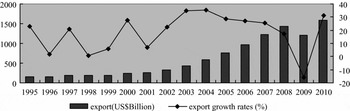
What does China want in promoting regional cooperation? First of all, maintaining economic growth, which in Chinese documents is referred to using the phrase economic construction is the center, should be the most direct concern of China's regional strategy. China has been involved in the Japanese-dominant ‘Flying Geese paradigm’ vertical production division through active foreign direct investment (FDI) and has gradually lost its economic independence since 1978. Although the open door policy was launched without setting targets in advance, which Deng Xiaoping called mozhe shitou guohe (crossing the river by feeling the stones), it proved to be a surprising success. For example, since its opening up China has experienced two five-year periods of more than 10% GDP growth, and exports have contributed a lot to this miracle. As shown in Figure 1, till 2008 China's exports maintained smooth growth even during the 1997–98 crisis and after September 11 2001, during which most East Asian economies suffered sharp declines in their exports. This export-driven development naturally led China's decision makers to focus on markets. As Zhang Yunling has argued, although China's opening up is to the world, the stagnation of World Trade Organization (WTO) negotiations and the burgeoning of regional arrangements pushed China to regional cooperation even after its WTO accession (Zhang Yunling, Reference Zhang2010).
China's export and its growth rates (1995–2010)

However, behind the miracle of China's export-oriented paradigm is the fact that China had become a ‘world factory’. The rapid inflow of FDI under the guidelines of ‘market for technology’ and ‘market for capital’ explained much of this. As a matter of fact, manufactured products dominate China's exports. According to the World Bank (2008), 92% of China's commodities in 2006 were manufactured products. Currently, China's textile and garment exports are about 30% of the world total, footwear 25%, and electronic data processing equipment 22%.Footnote 9
The problem with this industrial structure is as follows: on the one hand, China, as the ‘world factory’, is mainly a processing base concentrated on labor intensive manufacturing. Unlike high technology products, the lower value-added products that China exports to the advanced markets usually face competition from other developing countries, and are vulnerable to protectionism. As the 2008 crisis showed, this kind of export cannot serve as a reliable contributor to China's long-term economic growth.Footnote 10 On the other hand, during the last three decades, more and more rural labor has been absorbed by the FDI-based manufacturing, which has actually been fundamentally reshaping China's social structure. An important point is once social resources are mobilized for this process, there is no choice but to keep it going. During the crisis, about 20 million rural laborers working for the coastal manufacturing factories lost their jobs and had to go back home from the second half of 2008, which drew a lot of attention from the local and central governments because it relates not only to the economy, but also to social stability.
Facing these challenges, scholars and policy makers began to talk about economic transformation by encouraging internal consumption. But the economic structure formed over the past three decades cannot be changed over night; China will have to find ways to maintain acceptable GDP growth before people can consume more. ‘Regional cooperation’ had been written into the political documents of the 16th Party Congress, and to some scholars its meaning encompasses more than just the economy, for instance reducing trade frictions or even helping to establish China's central status in Asia (Qu, Reference Qu2009). The top concern for China's regional cooperation in the post-crisis era, however, is markets, and this is more understandable when the pressure from growing trade protectionism is also considered.Footnote 11
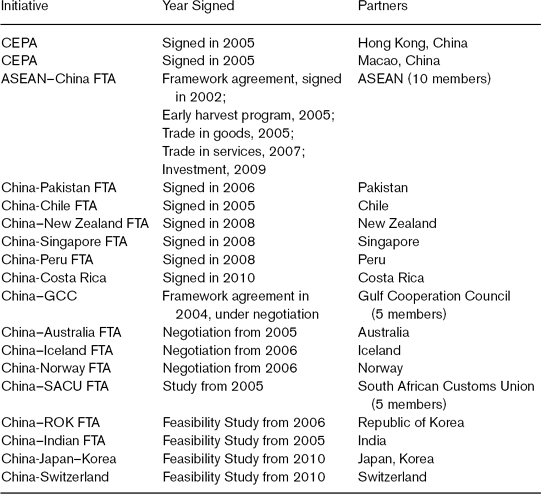
The market concern has another aspect, that is the import markets, which sometimes relate to so-called economic security. As a developing country that is the ‘world factory’, China is now consuming and in the future will consume more and more energy and resources. For example, in 2009 China imported more than $100 billion of oil and oil products and more than $50 billion of iron ore.Footnote 12 Building reliable suppliers of energy and resources is thus as important for China's economy as developing stable markets for its products. With regional arrangements such as an East Asian Free Trade Agreement (EAFTA) still far away, China has chosen to begin with bilateral arrangements and has also promoted regional cooperation at the same time. As a matter of fact, an FTA strategy had been emerging since 2007 to help fulfill economic targets (see Table 1 for China's FTA initiatives with its partners). Since the crisis broke in 2008, China has actively taken part in a China–Japan–Korea FTA, believing that conciliation among the Northeast Asian countries is the precondition for a whole East Asian regional arrangement, from which all the regional countries can maximize their economic welfare.
China's FTA initiatives with regional partners
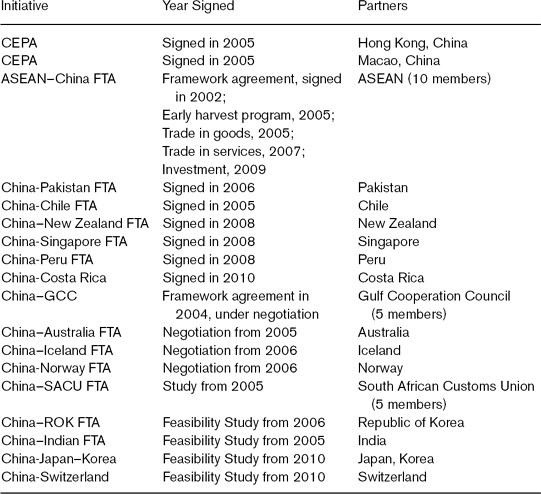
Source: Website of Ministry of Commerce of the People's Republic of China.
By highlighting economic concerns, I do not mean to deny that China's thinking on regional cooperation may include strategic elements, but rather try to emphasize the centrality of economic interests. This is why I use a redefined economic regionalism to characterize China's idea of regionalism, which is still in the process of evolving.
The political or security concerns of China's regionalism have been evolving along with its engagement with regional countries. At present, the most important aspect is building mutual trust. Since the 1997 crisis, during which China's reputation was believed to have greatly increased due to its pledge not to devalue the Chinese Yuan, China became more and more confident about using economic relations strategically, especially after the decision makers believed that the economic interdependence was the antidote to foreign concerns about a China threat. Economic cooperation is gradually being used to forge harmonious relations with its partners, which is why the security cooperation SCO (Shanghai Cooperation Organization) soon expanded to cover economic arrangements, because economic arrangements will lead to unbalanced interdependence towards China when China's huge potential market is considered.
Using the most cited China-ASEAN FTA (CAFTA) as a case study, in the next section I try to provide an illustration of economic regionalism.
China-ASEAN FTA: a case to understand China's economic regionalism
Due to the structural obstacles already discussed, China opened direct contact with ASEAN in 1991. One important reason for this change was the Tiananmen issue in 1989, which led to economic sanctions on China from the West and imperiled China's opening up policy. To break this diplomatic predicament, Vice-Premier Qian Qichen wrote to the secretary general of ASEAN proposing cooperation and received a positive response. But real positive relations between China and ASEAN started just after 1997 when the crisis-hit ASEAN countries decided to strengthen regional cooperation. The anti-crisis arrangement led to the ASEAN plus One (10+1) and ASEAN plus Three (10+3) cooperation frameworks, under which the leaders of China and ASEAN meet informally every year.
The China-ASEAN FTA was a political decision of this 10+1 framework in 2000. At that time, China's WTO access negotiations were nearly finished. ASEAN countries were worried about its impact on them and believed that the poor performance of their FDI inflows would suffer even more after China became a WTO member. Responding to ASEAN countries’ concerns over the possible adverse impact of China's WTO access, Premier Zhu Rongji proposed discussing a possible China-ASEAN FTA, which was accepted readily by ASEAN leaders. Feasibility studies were conducted after that by a joint expert group, which yielded a supportive result.
Economic centered proposal
China's initiation of the CAFTA ten years ago was obviously a political decision, and it is believable that China leaders had the intention to dispel the Western-rooted ‘China threat theory’ through this arrangement, because the ‘China threat theory’ was especially rampant among Southeast Asian countries, which were hit hard by the 1997 financial crisis and suffered drastic decline in their FDI inflows. It was natural for Chinese leaders to try to alleviate such anxiety through a free trade arrangement with ASEAN.
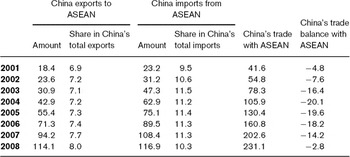
Although China survived the 1997 crisis, the affliction suffered by ASEAN countries showed that China also needed to diversify its export markets. Chinese leaders were fully aware that ASEAN, a large potential market with 500 million people and rich in various natural resources, could play a crucial role in China's long-run growth. Premier Zhu Rongji said that China should abide by the principles of duoyu shaoqu (give more and take less) and xianyu houqu (give first and take later) in the CAFTA, which showed that he had confidence both in bilateral relations and in the ASEAN market. As a matter of fact, following CAFTA initiation, bilateral trade quickly picked up speed (Table 2). Between 2001 and 2008, bilateral trade between China and ASEAN grew by about 28% a year in nominal terms, faster than that of China's total trade and far outpacing some estimates.Footnote 13
China-ASEAN trade, 2001–2008 (US$ billion and %)

Source: The Ministry of Commerce, P.R.C.
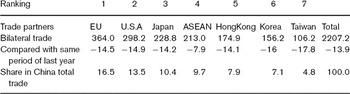
The importance of CAFTA has become more prominent with the outbreak of the 2008 crisis because, although CAFTA has proven to be an economic success in the sense of promoting trade and building mutual trust, the EU, US, and Japan remain China's top trading partners (as shown Table 3). The 2008 crisis was therefore more of a challenge than an opportunity for China.Footnote 14 In fact, global economic imbalances were highlighted as a cause of the crisis and export-oriented economies were accused of being responsible. In particular, China, due to its huge trade surplus with the United States, was under mounting pressure to help rebalance the world economy. At the same time, the sharp decline of the world economy and the resultant slow-down in China's economic growth served as an alarming reminder to the leadership. They realized that China cannot sustain smooth growth levels by being overly dependent on exporting to Western markets.
China's trade with its major trading partners, 2009 (billion US dollars and %)

Source: The Ministry of Commerce, P.R.C.
As a result, a shift in China's trade composition to diversify China's export markets has become even more pressing. Concerned about the low utilization rate of CAFTA's preferential arrangements, in 2009 the Chinese government tasked a research group to examine the reasons for this and to provide recommendations on how enterprises can benefit more from CAFTA. The objective is to further increase Sino-ASEAN trade. Generally speaking, the global economic crisis has led China to view CAFTA with more economic concern, considering its importance to the diversification of China's exports and countering its over-dependence on advanced economies.
Economic interdependence and strategic thinking
The surprising success of CAFTA and the subsequent attitude changes in ASEAN toward a rising ChinaFootnote 15 had improved China's confidence regarding economic engagement with others. With bilateral economic relations deepening, China has begun to adjust policies toward ASEAN, and the emphasis seems to have gradually changed to building economic interdependence. One sign of such change is that China's leaders began to set targets for China-ASEAN trade. Encouraged by favorable development and optimistic about CAFTA's future, Premier Wen Jiabao set $US100 billion and $US200 billion as the bilateral trade targets for 2005 and 2010, respectively. The strategic thinking was made clear in 2004 by Wang Yi, China's former Vice-Minister of Foreign Affairs, who said that Sino-ASEAN trade should eventually make up a quarter of China's total foreign trade.
Another aspect of this thinking can be seen in China's attitude to the Early Harvest Program (EHP).Footnote 16 The EHP was set up to let ASEAN countries benefit from CAFTA earlier, but some ASEAN countries witnessed a negative impact on certain sectors due to strong competition from Chinese products, and expressed their grave concerns. For example, the Philippines was hesitant to take part in the EHP due to internal pressure.Footnote 17 This reminded the Chinese leaders that more needed to be done to generate more concrete gains for ASEAN members. In the subsequent years, China's imports from ASEAN grew much faster than China's exports to ASEAN, and China's exports to ASEAN constituted about 7.2% of China's total exports, while around 11.2% of China's imports came from ASEAN in 2004, and trade deficits with ASEAN climbed from $4.8 billion in 2001 to more than $20 billion in 2004.
These facts show that Chinese leaders began to accept that deeper bilateral economic relations not only generate direct economic benefits to both sides, but more importantly will have a far-reaching positive impact on Sino-ASEAN relations. By encouraging more exports from ASEAN to China under the FTA, they believe that bilateral trade, and the trade imbalance that favors ASEAN, will reach a point where ASEAN's heavy dependence on the Chinese market might provide China with more leverage in the bilateral relationship. At the same time, Chinese leaders also hope the mutually beneficial cooperation will encourage a friendly atmosphere for both sides to discuss certain sensitive issues, such as the South China Sea and bilateral territorial disputes. Inspired by such thinking, the China-ASEAN expo was launched to provide an additional forum to further deepen the bilateral relationship.
Emerging strategy of suzao zhoubian (shaping neighboring relations)
After 20 years of cooperation, especially over the ten years of building the FTA, China's economic relationship with ASEAN has taken on two main characteristics: economic interdependence and the institutionalization of economic cooperation. It seems that bilateral relations should be very stable with the continual growth of shared interests, but in reality they are still fragile and conditional on stable Sino-US relations (Wang Yuzhu, Reference Wang2010a). The resurgence of the South China Sea issue recently showed that there is still long way to go before achieving a harmonious regional neighborhood, although China-ASEAN cooperation during the past 20 years has been highly praised by Chinese leaders.
Thus, apart from diversifying its trade relations in order to reduce its heavy dependency on Western markets, China is also trying to foster a positive reputation and influence among its close neighbors through mutually beneficial cooperation under CAFTA. The emerging strategy of shaping neighboring relations, which aims to improve China's soft power among neighboring countries, also highlights the importance of CAFTA because this strategy, like the heping jueqi (peaceful rise) pledge and goujian hexie shijie (building a harmonious world) idea, will most probably first be tested in Southeast Asia, in the hope that CAFTA can serve as a model for China's bilateral relations with other countries and regions. Toward this end, China is now actively promoting infrastructure building by establishing a $10 billion China-ASEAN foundation and another $15 billion in government loans aimed at completing land transport connections between China and ASEAN countries.
Generally speaking, CAFTA was initiated by Chinese leaders as a positive response to the challenges China faced. But the policy evolution during the ten years of building CAFTA has served to embody economic regionalism even though it is a bilateral agreement in nature. As we have discussed, China's concern in this arrangement is mainly to diversify its export markets and to develop a potential resource supplier. But with the deepening of interdependence, Chinese began to think about more than economic gains. China, as a communist country with many historical legacies, has always been burdened by issues like Taiwan, Tibet, human rights, and Falun Gong, etc. At the same time, China's rapid rise places it in a difficult position. On the one hand, the rise of China worries the world and leads to a worsening growth environment. For example, China's growing foreign exchange reserves invite increasing pressure on the appreciation of the Yuan, which would be a tough challenge for China's export sector and would threaten China's economic performance. While on the other hand, to tackle the problems accumulated since its opening up, China needs to keep a relatively high and smooth level of GDP growth. That is why President Hu Jintao called for goujian hexie shehui (building a harmonious society) internally and goujian hexie shijie externally. But he has only one economic card in his hands so, returning to the CAFTA case, China always needs support from ASEAN countries for its one China policy, human rights issues, etc., but when economic cooperation led to a degree of interdependence between the two sides, more strategic targets were added. This economic regionalism is a pragmatic choice by China to deal with the ‘rising dilemma’ (Men, Reference Men2007: 17). As I will discuss in the next section, China can contribute little to East Asian cooperation while its neighborhood maintains vigilance towards its rise.
China and East Asian integration
Since the establishment of APEC in 1988, China and other East Asian economies have been involved in this process of integration, during which a more exclusive concept of regionalism was initiated by the former Malaysian Prime Minister Mahathir. Surviving under the name of the East Asian Economic Caucus (EAEC), this East Asian Economic Group (EAEG) was thought to be anti-American,Footnote 18 however. The strong opposition from the US reminded East Asian countries that America is always a presence in the region. With its strategic interests locked into a series of hub and spoke alliances in the region, the US will respond to East Asian cooperation based on its interests, and push back against any exclusive arrangement (Zhang Xiaoming, Reference Zhang2010). In fact, as a global hegemonic power, the US has every reason to do so in order to try to keep its dominant status in this region (Xin, Reference Xin2009). This is an important precondition of analysis of East Asian regionalism.
Another factor is China. As a rising power, the role of China in East Asian cooperation has invited heated debate. China's engagement with regional arrangements has evolved along with the region. China joined APEC in 1991 and tried to establish close economic relationships from the same year. At that time, East Asian cooperation was pushed forward under the APEC framework, and China followed this ‘open regionalism’ process, slowly developing its relationship with ASEAN.
China's status in East Asian cooperation was shaped by the 1997 crisis from different directions. The most important factor is the rise of China. Although China experienced rapid GDP growth since the beginning of its opening up, and the China threat theory began to emerge in the mid-1990s, it was the 1997 crisis, which caused the contraction of most East Asian economies but affected China much less, that comparatively exaggerated China's rise. As we have touched upon, regional cooperation was thought to help diversify export markets and, more importantly at that time, to be the antidote to the prevailing ‘China threat’ that was undermining China's international reputation.
When all the changes were put together, regional countries found that rapidly rising China was actively promoting East Asian cooperation. What does China want? Many believe that China is thinking about the leadership position in East Asia, because ‘Beijing would gain political influence by being the center of regional cooperation that did not include the US and by helping to make rules for East Asia that non-member countries would have to adapt to’, and the way to be the center is insisting on the ASEAN plus Three framework, because ‘in a smaller setting, China would be relatively more influential’ (Wan, Reference Wan2010: 523–6). In order to obtain this leadership status, China will engage in rivalry with Japan and try to marginalize the US in East Asian regionalism.
Leadership issue
The major concern linked with a rising China is the leadership issue. Leadership is directly understood as authority, and in practice it means the ability to influence the process or the rule-making within a cooperation framework (Chen and Qi, Reference Chen and Jianhua2007: 234–5). For Chinese leaders, it is ideal to create a Sino-centered cooperation arrangement, and this contributed partly to China's ‘10+3’ preference. The worried attitude towards China's influence within the ‘10+3’ framework suggested that Japan shared this conception with China, and in practice it pushed Japan to neutralize Chinese power by inviting India, Australia, and New Zealand to join the East Asian Summit (EAS), which for Breslin ‘seems to represent an attempt to create an over-supply of region’ (Breslin, Reference Breslin2010: 727).
The damage of rivalry over the leadership of East Asian regionalism is obvious, because as Qin Yaqing put it after the leadership issue emerged, ‘it will stop the process of East Asian cooperation’ (Qin, Reference Qin and Dahui2010: 18). Worry about the formation of a Sino-centric East Asian regional organization has led to various initiatives being put forward, resulting in framework competition for East Asian cooperation (Wang Yuzhu, Reference Wang2010b). Trying to maintain regional cooperation, China chose to eschew this competition by emphasizing the leadership role of ASEAN. Promoting functional cooperation was thought to be one way partly to avoid the dilemma of leadership (Zhang Yunling, Reference Zhang2009). This means that China does not aim towards a self-centered East Asian regionalism, although giving up the leadership totally is also unacceptable.
Framework competition
The concern over regional leadership is translated into framework competition, that is regional players choose to fulfill their goals by proposing favorable cooperation frameworks. Behind the competitive frameworks we listed above, there are three main players: the US, Japan, and China. Rising China is a major concern of the other two.
For the United States, its deep involvement in East Asia compels it to try to keep the region under control. Although the security network weaved by its system of alliances has been powerful, its relations with East Asia in the economic realm changed a lot after the 1997 crisis. Since then, the attitude of the United States towards the resurgence of ASEAN plus Three cooperation and the proposal of an EAFTA had changed subtly (Wu, Reference Wu2007). As a result, the US turned to building a Free Trade Area of the Asia-Pacific (FTAAP) within the APEC framework first, and then tried to join the EAS by compromising and signing the Treaty of Amity and Cooperation in Southeast Asia (TAC). The most recent effort is strengthening the Trans-Pacific Partnership (TPP) within APEC. All these efforts suggest that the Unites States never abandoned the control of East Asia, although it has continually engaged in regional endeavors that support its interests in the region.
The analysis above shows that what the US is concerned about most is the formation of an exclusive regional arrangement in East Asia, especially an arrangement that is dominated by China. For that reason, the US has preferred open regionalism in East Asia, and has even achieved it by sitting in as a member of the EAS. As for the future of East Asian cooperation, the US does not care a lot, because it has its own arrangements, such as the TPP, in this region.
Within East Asia, Japan is engaged in rivalry with China for regional dominance, which has led to the competition between ‘10+6’ and ‘10+3’. As the economic leader of this region, Japan's economic interests had been embedded in the regional architecture with the success of the ‘Flying Geese Paradigm’. Being a populous island country, its markets and resources are both dependent on the external world, especially the East Asian region. It is reasonable that Japan promoted regional cooperation and tried to be the leader of East Asia. But the rise of China, along with hostile nationalism, greatly challenged Japan's ambition because the formation of a China-dominated regional organization will dilute Japan's regional influence. The proposal of ASEAN plus Six is thus an obvious ploy aimed at the East Asian leadership (Su, Reference Su2007), as Japan believed that China has more influence with the ‘10+3’ framework. Until now it seems that this tactic has worked only to hinder East Asian cooperation, which should not be what Japan wants. Logically, Japan needs a regional arrangement more than China does, considering its scarcity in resources and the demand for development of its multinational companies. But although a China-dominated regional process is not acceptable to Japan, this does not mean that Japan does not need to cooperate with China. In fact, as both sides understand, the future of East Asia is based on reconciliation between Japan and China. Maybe that is why Japan has been working with China on Northeast Asian cooperation.
Under these kinds of circumstances, China has become more cautious about its regional strategy. At first, as we argued in the CAFTA case, China focused on achieving regional economic cooperation; then the economic deals were used to tackle more challenging issues, such as constructing harmonious relations with neighboring countries through economic interdependence, although it is argued that ‘being a big power economically and politically, China should establish a self-centered regional integration process, for its global strategy or regional strategy’ (Qu, Reference Qu2009: 36).
The future of regional integration
Till now, it is ASEAN that is in the driving seat of East Asian cooperation, although regional players are all interested in the leadership. But ASEAN countries know how they have come to be there, and have been trying to invite more players into the ‘10+3’ framework. Actually, some ASEAN members are also supporters of the ‘10+6’ framework. Guided by the ‘balance of power or balancing policy’, these countries joined with Japan to invite India, Australia, and New Zealand to neutralize China's influence. Now their endeavor is leading to an emerging ‘10+8’ framework, with the US and Russia already sitting in on the EAS. But obviously, the more countries that are included the more difficult it becomes to reach any institutional arrangement.
The rapid expansion of East Asian Summit (EAS) members and the framework competition indicate a dim future for East Asian regionalism. But there is another fact, which is that China and Japan both need a regional arrangement, and this common interest was reinforced by the 2008 crisis. Following on from this point, Chinese scholar Men Honghua argued that China should try to construct East Asian order by widening its common interests with regional countries (Men, Reference Men and Dahui2010). But in practice China will initiate nothing for the time being. China has learned that if it makes any new proposal, it will generate diverse reactions from other countries. The wise strategy thus would be to pursue pragmatic economic regionalism and to fulfill economic goals by fortifying the FTA strategy. At present, China is negotiating with Norway and Australia on bilateral FTAs, and will launch negotiations with Korea on a bilateral FTA next year. While at the same time, as a long-term target, China is also trying to maintain the processes of regional cooperation. Based on this point of view, China has changed its attitude to support ‘10+6’ cooperation. Efforts are also being made to keep ‘10+3’ as the main channel of East Asian cooperation.
Generally speaking, although East Asian integration is trapped in framework competition, it seems that increasing common interests in the post-crisis era will lead to some kind of institutional arrangement. China will mainly focus on bilateral arrangements and maintain positive support for regional cooperation.
Conclusion
Based on culture, history, and international relations, different countries have their own understandings of regionalism. China, as argued in this paper, has no clear idea about regionalism. Although China has succeeded economically, it is still a latecomer to the world playground. It began to practice regional cooperation with more confidence in the last two decades but is still puzzled by the ‘–isms’. The documents of the central government show that the attitude to regional cooperation has been changing in China, with the words ‘regional cooperation’ frequently appearing in some very important documents, but economic interests are mainly emphasized. This paper has highlighted the special understanding of regional economic cooperation in China. The economic regionalism constitutes China's regional cooperation strategy. It was just self-interested concerns that led to framework competition in East Asia. This led to the study of Breslin (Reference Breslin2010), who suggested that a rising China provides more of a challenge to East Asia than a contribution.
This may be true, but the other side of the coin is that under the guidance of economic regionalism China is engaging actively with East Asian countries bilaterally and regionally, which is believed to be a useful way to cultivate the regional identity that East Asia has lacked. But generally speaking, the conservative, pragmatic economic regionalism of China can contribute little to East Asian regionalism because it has no clear concept of the regional architecture. This reminds us of the hindrance posed by nationalism to East Asian regionalism (He, Reference He2004), while the experiences of China suggest that structural elements should also be considered in taking the next steps to promote regional cooperation and regionalism.
About the author
Wang Yuzhu is an associate research fellow at the Institute of Asia-Pacific Studies, Chinese Academy of Social Sciences (IAPS-CASS), where he works on China-ASEAN relations and regional cooperation in the Asia-Pacific. He received his Ph.D. from the Graduate School of CASS. Before joining the regional cooperation division of IAPS, he was the executive Editor-in-Chief of the Journal of Contemporary Asia-Pacific Studies. His publications appear mainly in Chinese journals and focus on China-ASEAN relations, East Asian cooperation, and the strategic thinking behind China's regional cooperation. He is a member of the East Asian Cooperation Expert Group of the Ministry of Commerce of China.