Implications
This study investigated the effect of four perennial ryegrass cultivars on dairy cow milk yield and identified the cultivar characteristics responsible for variations in milk yield. The information generated by this study will be of significant use in pasture-based production systems. As the study identified the cultivar characteristics responsible for animal performance, it will allow grass breeders to increase their focus on such traits. Animal performance-orientated breeding programmes should result in grass cultivars becoming available to farmers that will increase animal performance from grazed grass, thereby further improving the economics of pastoral-based animal production systems.
Introduction
In recent years, a rejuvenated interest in pastoral dairy systems has taken place in Ireland and in many temperate and subtropical regions of the world (Dillon et al., Reference Dillon, Roche, Shalloo and Horan2005). Perennial ryegrass (Lolium perenne L.) is considered to be the most important grass species used in temperate pastoral dairy systems, dominating land area in such regions (Wilkins and Humphreys, Reference Wilkins and Humphreys2003). Although perennial ryegrass is regarded as a high-quality feed, genetic variations between cultivars has been shown to influence milk yield (Gowen et al., Reference Gowen, O'Donovan, Casey, Rath, Delaby and Stakelum2003). Nevertheless, very little information is provided on the potential of perennial ryegrass cultivars to influence animal performance. Therefore, it would be useful to identify the cultivar characteristics that influence animal performance in order to improve the information available to breeders and pastoral-based farmers.
Sward structural characteristics describe the proportion and relative vertical distribution of leaf, stem and dead material in the sward profile, as well as sward surface height, bulk density and tiller density. Sward structure influences grazing activity (Hodgson, Reference Hodgson1985), grass dry matter intake (GDMI) and milk yield (Parga et al., Reference Parga, Peyraud and Delagarde2000). In order to maximise GDMI, grazing animals need to be offered a sward with characteristics that allow rapid consumption (O'Donovan et al., Reference O'Donovan, Lewis, Boland and O'Kiely2010). Sward structural differences between cultivars have been shown to influence herbage intake (Gilliland et al., Reference Gilliland, Barrett, Mann, Agnew and Fearon2002; Smit et al., Reference Smit, Tas, Taweel and Elgersma2005a) and may be more important than organic matter digestibility (OMD) in determining GDMI and milk yield (O'Donovan and Delaby, Reference O'Donovan and Delaby2005). For example, the voluntary GDMI of the leaf fraction is 20% higher than that of the stem fraction (Laredo and Minson, Reference Laredo and Minson1975), suggesting that variations in cultivar leaf proportion will influence intake and animal performance (Gowen et al., Reference Gowen, O'Donovan, Casey, Rath, Delaby and Stakelum2003).
Grass chemical composition and in particular OMD varies among cultivars (O'Donovan and Delaby, Reference O'Donovan and Delaby2005) and is an important factor influencing animal performance (Stakelum and Dillon, Reference Stakelum and Dillon1990). Gately (Reference Gately1984) reported that grazing late heading grass cultivars had beneficial effects on the milk yield of dairy cows; which was attributed to their improved chemical composition. Water-soluble carbohydrate (WSC) content is a trait that varies between cultivars (Smit et al., Reference Smit, Tas, Taweel, Tamminga and Elgersma2005b) and is of interest to breeders selecting for improved animal performance (Wilkins and Humphreys, Reference Wilkins and Humphreys2003). Nevertheless, contrasting reports can be found in the literature regarding the benefits of grass cultivars with elevated levels of WSC. Tas et al. (Reference Tas, Taweel, Smit, Elgersma, Dijkstra and Tamminga2005) and Taweel et al. (Reference Taweel, Tas, Smit, Elgersma, Dijkstra and Tamminga2005) reported no improvement in animal performance by feeding grass cultivars with elevated levels of WSC to dairy cows. In contrast, increased intake by steers (Lee et al., Reference Lee, Harris, Moorby, Humphreys, Theodorou, MacRae and Scollan2002) and increased milk yield in dairy cows (Miller et al., Reference Miller, Moorby, Davies, Humphreys, Scollan, MacRae and Theodorou2001) has been observed when grazing perennial ryegrass cultivars with elevated levels of WSC.
Grass cultivar selection can potentially influence animal performance through variations in sward structure and chemical composition. If breeding of new grass cultivars is to be based on animal production responses (Wilkins and Humphreys, Reference Wilkins and Humphreys2003), it will be important to have a clear understanding of the cultivar characteristics that influence animal performance. The objective of this study was to examine the effect of four perennial ryegrass cultivars on the milk yield and composition of dairy cows and to identify the cultivar characteristics of influence.
Material and methods
A grazing experiment was set up to compare four perennial ryegrass cultivars. Two tetraploid cultivars, Bealey and Astonenergy with heading dates of 24 and 31 May, respectively, and two diploid cultivars, Spelga and AberMagic with heading dates of 22 and 28 May, respectively, were used. The experiment was conducted at the Teagasc Animal & Grassland Research and Innovation Centre, Moorepark, Fermoy, Co. Cork, Ireland (50° 09′N; 8°16′W) on a free draining acid brown earth soil of sandy loam-to-loam texture. In the year before the experiment, six paddocks (11.55 ha) were established with the four cultivars, in a randomised block design, with each cultivar having three replicates. Soils had a pH of 6.5 and were Index 3 (scale 1 to 4, 1 = deficient, 4 = no response to application of nutrient) for phosphorus (6.5 to 10 mg/l) and potassium (140 mg/l).
Experimental design
Cultivars were evaluated using a 4 × 4 latin square experimental design. Two experiments were executed to evaluate cultivars in both their reproductive (12 April to 20 June 2010) and vegetative (2 July to 6 September) growth phase. Each experiment lasted 68 days. Animals were assigned 17 days on each cultivar during both experiments. Animals moved between cultivars randomly to minimise carryover effects. The same latin square structure was maintained for both experiments to investigate interactions between growth phase and cultivar. During the first 10 days of each period, the cows acclimatised to the cultivar, and animal and sward measurements were taken during the remaining 7 days.
Pasture management
The entire experimental area was grazed once (8 March to 7 April) before the experiment. All cultivars were fertilised with 86 kg N/ha in two equal applications, 10 and 4 weeks before the commencement of the experiment. During the experimental period, all cultivars received 224 kg N/ha in seven equal applications. No phosphorus or potassium fertiliser was applied during the experimental period. A daily herbage allowance (DHA) of 17 kg dry matter (DM)/cow was offered throughout the experimental period with fresh herbage offered daily after morning milking. Such a herbage allowance is recommended for intensive pastoral dairy systems like those in Ireland (O'Donovan et al., Reference O'Donovan, Kennedy and Hennessy2011). The daily grazing area was modified according to the pre-grazing herbage mass (HM) in order to allocate the correct DHA. For the duration of the experimental period (12 April to 6 September), animals were fed and managed on a pasture-only diet and received no supplemental feed. A similar regrowth interval was maintained for each cultivar. HM and DHA were calculated above 4 cm.
Animal management
Thirty-two multiparous Holstein–Friesian cows, cared for in accordance with the European Community Directive, 80-609-EC (EC, 2002), were used. Before the experiment animals grazed as a single herd from calving and were offered a daily allocation of 14 kg DM of pasture and 3 kg of concentrate. The cows were divided into four homogeneous groups, on the basis of lactation number, days in milk, BW and pre-experimental milk production. The same animals were used for both latin square experiments. At the commencement of the first experiment, average lactation number was 3.6 (s.e.m. 0.17), cows were 60 (s.e.m. 2.5) days in milk, had a milk yield of 29.3 kg/day (s.e.m. 0.60), a BW of 562 kg (s.e.m. 8.8) and a body condition score of 2.96 (s.e.m. 0.04; based on scale of 1 to 5, 1 = emaciated, 5 = extremely fat). At the commencement of the second experiment, cows were 141 days in milk (s.e.m. 2.5), had a milk yield of 23.2 kg/day (s.e.m. 0.47), a BW of 560 kg (s.e.m. 7.1) and a body condition score of 2.80 (s.e.m. 0.04).
Sward measurements
Pre-grazing HM (>4 cm) was calculated by cutting two strips (1.2 m × 10 m) with a motor Agria (Etesia UK Ltd, Warwick, UK) twice per week from each cultivar. Ten grass height measurements were recorded before and after harvesting on each cut strip using a plate meter with a steel plate (diameter 355 mm and 3.2 kg/m2; Jenquip, Fielding, New Zealand). All mown herbage from each strip was collected, weighed and sub-sampled. A further sub-sample of 0.1 kg fresh weight was dried for 16 h at 90°C for DM determination. Post-grazing HM was calculated by cutting one strip (1.2 m × 20 m) twice per week from each cultivar directly after grazing as described above.
Pre-grazing sward height was measured daily throughout the experimental period by recording ∼30 heights per treatment across the two diagonals of each grazing area using a plate meter. Following grazing, 30 post-grazing sward heights were also recorded daily across the two diagonals of each grazing area.
Herbage representative of that available to the grazing animal was cut to ground level using a hand shears once during each measurement period. A 40 g sub-sample of the the upper sward layer (>4 cm) was manually separated into leaf blades, stem (true stem, pseudostem and flower heads if present) and dead material and dried for 16 h at 90°C for DM determination. This allowed the leaf, stem and dead proportions to be calculated.
Pre-grazing extended tiller height (ETH) and sheath height (SH) were measured on 100 tillers at random across one diagonal of the grazing area of each cultivar on 1 day of each measurement period using a graduated ruler. ETH was measured from ground level to the highest point of the extended tiller. SH was measured from ground level to the point of the highest ligula (longest leaf sheath). Free-leaf lamina (FLL) was calculated by subtracting the SH from the ETH. Post-grazing ETH, SH and FLL were measured directly after grazing as described above across the same area as the pre-grazing measurements.
Herbage representative of that grazed was manually collected using a Gardena hand shears (Accu 60, Gardena International GmbH, Ulm, Germany) for 5 consecutive days per treatment during each measurement period following close observation of the grazing animals previous days defoliation height. Samples were stored at −20°C before been freeze-dried and milled through a 1-mm sieve and bulked by treatment for each measurement period before conducting chemical analysis. The herbage samples were analysed for DM content (90°C oven for 16 h) and ash (500°C furnace for 12 h). The CP content was determined using the Dumas method (Leco FP-428; Australia Pty Ltd) based on the Association of Official Analytical Chemists (AOAC, 1990) official methods of analysis. Pasture digestibility (OMD) was determined using the method outlined by Morgan et al. (Reference Morgan, Stakelum and Dwyer1989) using the Fibertec™ System (FOSS, Ballymount, Dublin 12, Ireland). The ADF and NDF fractions (Van Soest et al., Reference Van Soest, Robertson and Lewis1991) were determined using an Ankom200 Fiber Analyser (ANKOM Technology, Macedon, NY, USA). To determine WSC content, herbage samples were collected as described above but dried within 1 hour of collection at 60°C for 48 h. The WSC concentration was determined using the anthrone technique described by Thomas (Reference Thomas1977).
Animal measurements
Milking took place at 0700 and 1600 h daily. Individual milk yields (kg) were recorded at each milking during each measurement period (Dairymaster, Causeway, Co. Kerry, Ireland). Milk fat, protein and lactose concentrations were calculated from six successive milking samples for each animal. A Milkoscan 203 (Foss Electric, DK 3400 Hillerød, Denmark) was used to determine the concentrations of these constituents in the milk.
Statistical analysis
All statistical analyses were carried out using PROC MIXED in SAS (SAS, 2005). All sward variables were analysed using a mixed model. Sward variables from each latin square were analysed separately using the following model:
 $$ Y = \mu + {{P}_i} + {{D}_k}\left( {{{P}_i}} \right) + {{C}_j} + {{e}_{ijk}} $$
where μ is the mean; Pi the period (i = 1…4); Dk (Pi) the day within period (k = 1…7); Cj the cultivar (j = 1…4); and eijk the residual error term.
Extended SH, OMD, leaf and stem proportions from both experiments were analysed together, to investigate interactions between growth phase and cultivar for these parameters, using the following model:
 $$ Y = \mu + {{L}_i} + {{D}_k}({{P}_i}) + {{C}_j} + \left( {{{L}_i}\times {{C}_j}} \right) + {{e}_{ijk}} $$
where μ is the mean; Li the latin square experiment (i = 1,2); Dk (Pi) the day within period (k = 1…7; i = 1…8); Cj the cultivar (j = 1…4); Li × Cj the interaction of cultivar and latin square experiment; and eijk the residual error term.
Animal variables were also analysed using a mixed model. Daily milk yield and milk composition for each period were analysed with the following model:
 $$ Y = \mu + {{P}_i} + {{A}_k} + {{C}_j} + {{e}_{ijk}} $$
where μ is the mean; Pi the period (i = 1…4); Ak the animal (k = 1…32); Cj the cultivar (j = 1…4); and eijk the residual error term. Animal was treated as a random effect.
Daily milk yield and daily milk solids yield from both experiments were analysed together, to investigate interactions between growth phase and cultivar for these parameters, using the following model:
 $$ Y = \mu + {{L}_i} + {{A}_k} + {{C}_j} + ({{L}_i}\times {{C}_j}) + {{e}_{ijk}} $$
where μ is the mean; Li the latin square (i = 1,2); Ak the animal (k = 1…32); Cj the cultivar (j = 1…4); Li × Cj the interaction of cultivar and latin square experiment; and eijk the residual error term. Animal was treated as a random effect.
Results
Reproductive growth phase
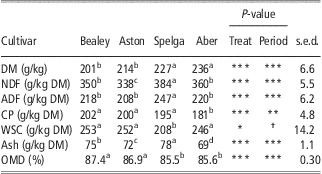
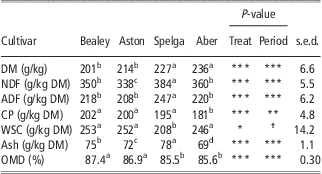
Table 1 presents the chemical composition of the consumed herbage during the reproductive growth phase. AberMagic and Spelga recorded a higher DM content (P < 0.001; +24 g/kg) compared with Bealey and Astonenergy (208 g/kg). Bealey and Astonenergy recorded a higher OMD value (P < 0.001; +1.6%) compared with AberMagic and Spelga (85.6%). Spelga recorded the highest level (P < 0.001) of ADF (247 g/kg DM) and NDF (384 g/kg DM). Spelga recorded a lower WSC content (P < 0.05; −42 g/kg DM) compared with the other cultivars (250 g/kg DM). AberMagic recorded a lower CP content (P < 0.001; −18 g/kg DM) compared with the other cultivars (199 g/kg DM).
The effect of perennial ryegrass cultivars on the chemical composition of the consumed herbage during the reproductive growth phase1
Aston = Astonenergy; Aber = AberMagic; DM = dry matter; WSC = water-soluble carbohydrate; OMD = organic matter digestibility.
112 April to 20 June.
a,b,c,dMeans within a row with different superscripts differ (P < 0.05).
***P < 0.001; **P < 0.01; *P < 0.05; †P < 0.1.
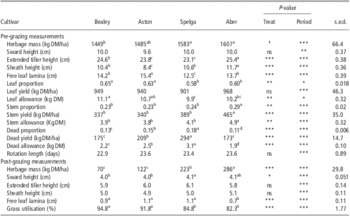
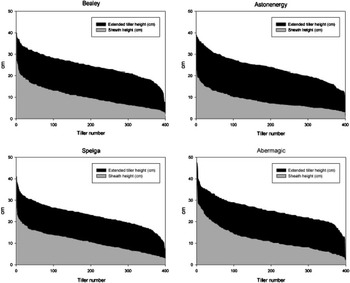
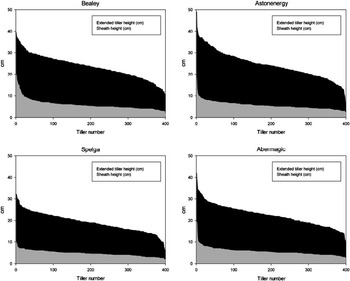
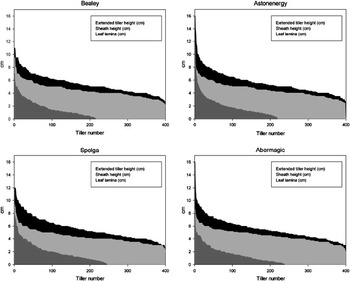
Table 2 presents the sward measurements taken during the reproductive growth phase. Pre-grazing ETH and SH were longer (P < 0.001) for AberMagic, whereas pre-grazing FLL was longest for (P < 0.001). Astonenergy (Figure 1). A higher leaf proportion (P < 0.01; +0.06) was recorded for Bealey and Astonenergy compared with AberMagic and Spelga (0.59). As a result, cows grazing Bealey and Astonenergy were offered a higher leaf allowance (P < 0.01; +0.85 kg DM/cow per day) compared with cows grazing Spelga and AberMagic (10.1 kg DM/cow per day). AberMagic recorded a higher stem proportion (P < 0.01; +0.06) and stem yield (P < 0.001; +110 kg DM/ha) compared with the other cultivars (0.23 and 355 kg DM/ha, respectively). This resulted in a higher stem allowance (P < 0.01; +1 kg DM/cow per day) for cows grazing AberMagic compared with cows grazing the other cultivars (3.9 kg DM/cow per day).
Effect of perennial ryegrass cultivar on pre- and post-grazing sward measurements during the reproductive growth phase1

Aston = Astonenergy; Aber = AberMagic; DM = dry matter.
112 April to 20 June.
a,b,c,dMeans within a row with different superscripts differ (P < 0.05).
***P < 0.001; **P < 0.01; *P < 0.05; †P < 0.1; ns = not significant.
Effect of perennial ryegrass cultivar on pre-grazing extended tiller height and extended sheath height during the reproductive growth phase (12 April to 20 June). Free leaf lamina = extended tiller height − sheath height.

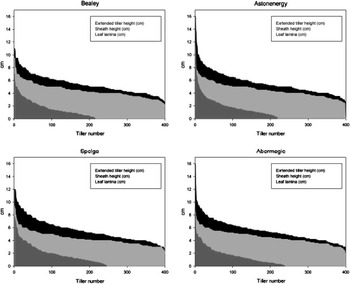
Post grazing, Spelga recorded a higher sward height (P < 0.05; +0.1 cm) compared with Bealey and Astonenergy (4.0 cm), but a similar post-grazing sward height compared with AberMagic. The highest post-grazing HM was recorded for AberMagic (P < 0.001; 286 kg DM/ha), +63 kg DM/ha compared with Spelga and +190 kg DM/ha compared with Bealey and Astonenergy. Consequently, lower levels of herbage utilisation (P < 0.001; −9.7%) were recorded for AberMagic and Spelga compared with Bealey and Astonenergy (93.3%). Post-grazing ETH and SH (Figure 2) was similar among the cultivars, whereas AberMagic recorded a shorter post-grazing FLL (P < 0.001; −0.3 cm) compared with the other cultivars (1.0 cm).
Effect of perennial ryegrass cultivar on post-grazing extended tiller height, extended sheath height and leaf lamina during the reproductive growth phase (12 April to 20 June).

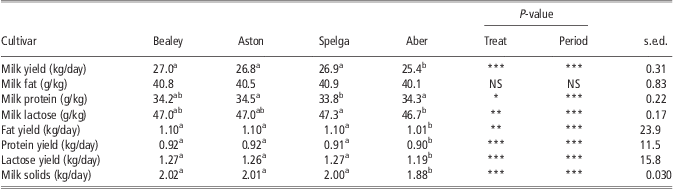
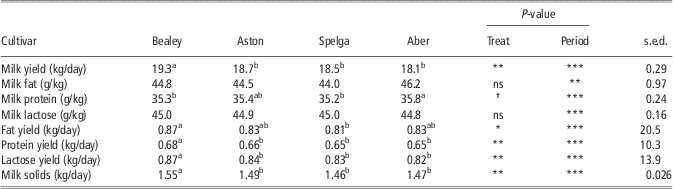
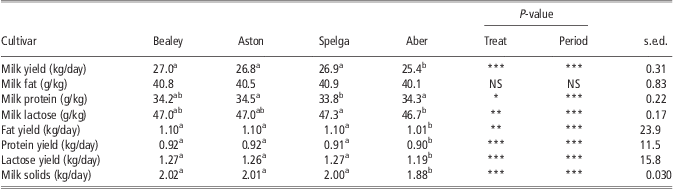
Table 3 presents the milk production results for the reproductive growth phase. Cows grazing AberMagic recorded a lower milk yield (P < 0.001; −1.5 kg/day) and a lower milk solids yield (P < 0.001; −0.13 kg/day) compared with cows grazing the other cultivars (26.9 and 2.0 kg/day, respectively). Milk fat yield, milk protein yield and milk lactose yield followed a similar trend; cows grazing AberMagic recorded the lowest yield (P < 0.01) for each constituent. Cows grazing Spelga recorded a lower milk protein content (P < 0.05; −0.6 g/kg) compared with cows grazing AberMagic and Astonenergy (34.4 g/kg) but a similar value compared with cows grazing Bealey.
The effect of perennial ryegrass cultivars on milk yield during the reproductive growth phase1
Aston = Astonenergy; Aber = AberMagic.
112 April to 20 June.
a,bMeans within a row with different superscripts differ (P < 0.05).
***P < 0.001; **P < 0.01; *P < 0.05, ns = not significant.
Vegetative growth phase
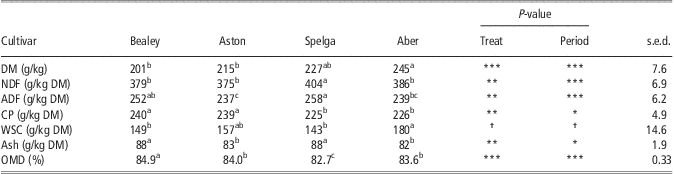
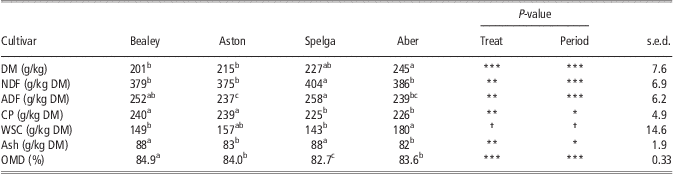
Table 4 presents the chemical composition of the consumed herbage during the vegetative growth phase. DM content was higher for AberMagic (P < 0.001; +37 g/kg) compared with Bealey and Astonenergy (208 g/kg). Bealey recorded the highest (P < 0.001) OMD value, which was +1.1% compared with Astonenergy and AberMagic (83.8%) and +2.2% compared with Spelga (82.7%). Spelga and Bealey recorded a higher ADF content (P < 0.01; +17 g/kg DM) compared with Astonenergy and AberMagic (238 g/kg DM). Spelga recorded a higher NDF content (P < 0.01; +24 g/kg DM) compared with the other cultivars (380 g/kg DM). Bealey and Astonenergy recorded a higher CP content (P < 0.01; +14 g/kg DM) compared with Spelga and AberMagic (226 g/kg DM).
The effect of perennial ryegrass cultivars on the chemical composition of the consumed herbage during the vegetative growth phase1
Aston = Astonenergy; Aber = AberMagic; DM = dry matter; WSC = water-soluble carbohydrate; OMD = organic matter digestibility.
12 July to 6 September.
a,b,cMeans within a row with different superscripts differ (P < 0.05).
***P < 0.001; **P < 0.01; *P < 0.05; †P < 0.1.
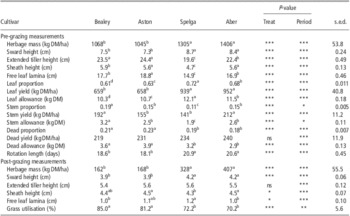
Table 5 presents the sward measurements taken during the vegetative growth phase. Pre-grazing HM and pre-grazing sward height were greater for Spelga and AberMagic (P < 0.001; +298 kg DM/ha and +1.2 cm, respectively) compared with Bealey and Astonenergy (1057 kg DM/ha and 7.4 cm, respectively). Pre-grazing ETH was higher (P < 0.001) for Bealey and Astonenergy (24.0) compared with Spelga (+4.4 cm) and AberMagic (+1.6 cm). Bealey recorded a higher SH (P < 0.001; 5.9 cm) compared with Astonenergy, AberMagic (+0.3 cm) and Spelga (+1.2 cm). Astonenergy recorded a longer FLL (P < 0.001; 18.8 cm) compared with Bealey, AberMagic (+1.5 cm) and Spelga (+3.9 cm; Figure 3). Spelga recorded a higher leaf proportion (P < 0.001; 0.72) compared with AberMagic (+0.04), Astonenergy (+0.09) and Bealey (+0.11). Although stem proportions were reduced compared with the reproductive growth phase, Bealey recorded a higher stem proportion (P < 0.001; +0.05) compared with the other cultivars (0.21). Grazing interval was on average 2.4 days longer (P < 0.001) for Spelga and AberMagic compared with Bealey and Astonenergy (18.4 days).
Effect of perennial ryegrass cultivar on pre and post grazing sward measurements during the vegetative growth phase1

Aston = Astonenergy; Aber = AberMagic; DM = dry matter.
12 July to 6 September.
a,b,c,dMeans within a row with different superscripts differ (P < 0.05).
***P < 0.001; **P < 0.01; *P < 0.05; ns = not significant.
Effect of perennial ryegrass cultivar on pre-grazing extended tiller height and extended sheath height during the vegetative growth phase (2 July to 6 September). Free leaf lamina = extended tiller height − sheath height.

Post grazing, Spelga and AberMagic recorded a higher sward height (P < 0.001; +0.3 cm) and a higher HM (P < 0.001; +203 kg DM/ha) compared with Bealey and Astonenergy (165 kg DM/ha and 3.9 cm, respectively). Similar to the reproductive growth phase, lower levels of herbage utilisation were recorded for AberMagic and Spelga (P < 0.001; −11.9%) compared with Bealey and Astonenergy (83.1%). Post-grazing ETH was similar between cultivars, whereas Spelga recorded the shortest post-grazing SH and the longest post-grazing FLL (P < 0.05; 4.3 and 1.2 cm, respectively; Figure 4).
Effect of perennial ryegrass cultivar on post-grazing extended tiller height, extended sheath height and leaf lamina during the vegetative growth phase (2 July to 6 September).

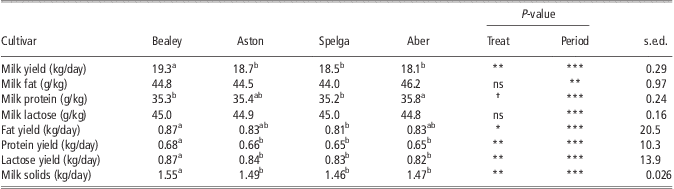
Table 6 presents the milk production results during the vegetative growth phase. Cows grazing Bealey recorded a higher milk yield (P < 0.001; +0.9 kg/day) compared with cows grazing the other cultivars (18.4 kg/day). Cows grazing Bealey also recorded a higher milk solids yield (P < 0.01; +0.08 kg/day) compared with cows grazing the other cultivars (1.5 kg). Cows grazing Bealey recorded a higher protein and lactose yield (P < 0.01; +0.03 and +0.04 kg/day, respectively).
The effect of perennial ryegrass cultivars on milk yield during the vegetative growth phase1
Aston = Astonenergy; Aber = AberMagic.
12 July to 6 September.
a,bMeans within a row with different superscripts differ (P < 0.05).
***P < 0.001; **P < 0.01; *P < 0.05; †P < 0.1; ns = not significant.
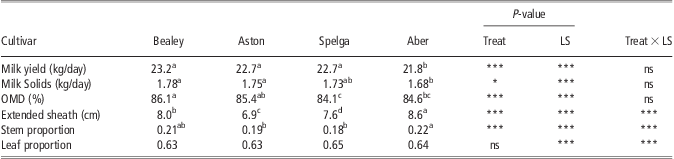
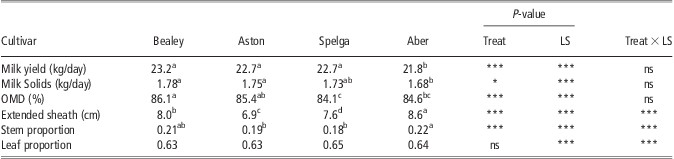
Table 7 demonstrates that there was no interaction between cultivar and growth phase for daily milk yield or daily milk solids yield indicating that milk yield was consistent between the cultivars during both growth phases. Similarly, there was no interaction between cultivar and growth phase for OMD. Cultivar did interact with growth phase for SH, leaf proportion and stem proportion, indicating that the cultivars had varying sward structural characteristics depending on the growth phase. AberMagic recorded the longest SH during the reproductive growth phase but during the vegetative growth phase recorded a similar SH to Astonenergy and a shorter SH (P < 0.001; −0.3 cm) compared with Bealey (5.9 cm). A similar trend was evident for stem proportion, AberMagic recorded the highest stem proportion during the reproductive growth phase but during the vegetative growth phase recorded a similar stem proportion to Astonenergy and a lower stem proportion (P < 0.001; −0.04) compared with Bealey (0.19). The tetraploid cultivars recorded a higher leaf proportion during the reproductive growth phase, whereas the diploid cultivars recorded a higher leaf proportion during the vegetative growth phase.
The effect of perennial ryegrass cultivars on milk yield and some sward characteristics over both the reproductive growth phase and vegetative growth phase1
Aston = Astonenergy; Aber = Abermagic; LS = latin square; OMD = organic matter digestibility.
1Reproductive growth phase – 12 April to 20 June; vegetative growth phase – 2 July to 6 September.
a,b,c,dMeans within a row with different superscripts differ (P < 0.05).
***P < 0.001; *P < 0.05; ns = not significant.
Discussion
This study investigated differences between four perennial ryegrass cultivars in terms of milk production performance and identified the cultivar characteristics responsible for variations in milk production performance throughout the grazing season. This study also explored any possible seasonal effects of the cultivars by investigating the cultivars in both their reproductive and vegetative states. Throughout the study, only small differences in regrowth interval and pre-grazing HM were recorded, and therefore differences in cow performance recorded in this study reflect differences between the cultivars.
Sward chemical composition
The OMD values recorded were high (85.1%), reflecting the fact that swards were in their 1st year post establishment and represent those selected by the animal. The values are comparable with those reported by Smit et al. (Reference Smit, Tas, Taweel, Tamminga and Elgersma2005b) (86.9%) and Gowen et al. (Reference Gowen, O'Donovan, Casey, Rath, Delaby and Stakelum2003) (84.7%). The OMD concentration of the leaf is higher than that of stem or dead material (Terry and Tilley, Reference Terry and Tilley1964; Hacker and Minson, Reference Hacker and Minson1981); a 5.5% change in leaf content is equal to a 1% change in digestibility (Stakelum and O'Donovan, Reference Stakelum and O'Donovan1998). During the reproductive growth phase of the current study, a 1% change in digestibility was brought about by a 3.1% change in leaf proportion. During the vegetative growth phase, there was no relationship between sward structure and chemical composition, as stem did not constitute a large proportion of the grazed horizon. Sward measurements show that stem extended only 1.4 cm into the grazed horizon during the vegetative growth phase compared with 5.5 cm during the reproductive growth phase, explaining the absence of a relationship between sward structure and chemical composition during the vegetative growth phase. Furthermore, a shortcoming of the current study was not to differentiate between pseudostem and true stem; both were classified as stem. The level of true stem or pseudostem present is very much dependant on the stage of growth with higher levels of true stem present during reproductive growth (Robson et al., Reference Robson, Ryle and Woledge1988). As pseudostem is a collection of leaf sheaths rolled together (Robson et al., Reference Robson, Ryle and Woledge1988), it is more digestible than true stem. Evidence suggests that during vegetative growth, the digestibility of pseudostem is not significantly reduced compared with the leaf blade (Terry and Tilley, Reference Terry and Tilley1964), offering further explanation for the absence of a relationship between sward structure and chemical composition during the vegetative growth phase.
Spelga recorded lower OMD values during both periods reflecting a higher fibre fraction, which indicates a higher ratio of cell walls to cell contents (McDonald et al., Reference McDonald, Edwards, Greenhalgh and Morgan2002). Wilkins and Humphreys (Reference Wilkins and Humphreys2003) suggested that cultivar digestibility can be improved by increasing the ratio of cell contents to cell walls and that fibre content is negatively related to digestibility. AberMagic recorded lower OMD values compared with Bealey and Astonenergy during both periods despite recording a similar fibre fraction, suggesting that AberMagic contained a less digestible fibre fraction than Bealey and Astonenergy. Indeed, Wilkins and Humphreys (Reference Wilkins and Humphreys2003) suggest that cultivar digestibility can be improved by increasing the digestibility of the fibre fraction. CP content ranged from 189 to 240 g/kg DM. The lowest CP content was recorded for AberMagic during the reproductive growth phase corresponding to the highest proportion of stem; CP content is negatively related to stem content (Stockdale et al., Reference Stockdale, Cohen and Doyle2001).
Herbage utilisation
Higher levels of herbage utilisation were achieved with animals grazing the tetraploid cultivars, which appears to be associated with their higher digestibility as compared with the diploid cultivars. Higher levels of herbage utilisation have previously been associated with improved sward nutritive value (O'Donovan et al., Reference O'Donovan, Delaby and Peyraud2004; Kennedy et al., Reference Kennedy, O'Donovan, Murphy, Delaby and O'Mara2007). However, in these studies, improved chemical composition and increased herbage utilisation were confounded with pre-grazing HM. There is limited information available in the literature regarding the effect of perennial ryegrass cultivars on sward utilisation. Smit et al. (Reference Smit, Tamminga and Elgersma2006) investigated dairy cattle grazing preference among six diploid cultivars of perennial ryegrass, measured as the relative amount of herbage removed from each cultivar and reported that preference among the cultivars was not related to morphological parameters but was positively related to digestibility and negatively related to fibre concentrations. In agreement with the current study, O'Riordan et al. (Reference O'Riordan, O'Kiely and Keane1998) reported increased preference for tetraploids, which have a greater proportion of cell contents compared with diploids.
Milk yield and composition
Perennial ryegrass cultivar influenced milk yield in the current study. In contrast, Tas et al. (Reference Tas, Taweel, Smit, Elgersma, Dijkstra and Tamminga2005) reported that perennial ryegrass cultivar did not influence milk yield, but in this study herbage was cut and transported to stall-tied cows, removing the animal sward interface. Smit et al. (Reference Smit, Tas, Taweel, Tamminga and Elgersma2005b) reported that the variation in nutritive value among four diploid cultivars was too small to influence herbage intake. However, in that experiment the reproductive growth phase was not studied and cows were offered an unrestrictive DHA of 25 kg DM/cow. Other authors identified that grass cultivar influenced milk yield through improved sward structure (decreased pseudostem in grazed horizon; Flores-Lesama et al., Reference Flores-Lesama, Hazard, Betin and Emile2006) and higher digestibility (Gately, Reference Gately1984), with increases in milk yield of 2% and 8%, respectively. This compares with a milk yield increase of 6% during the reproductive growth phase of the current study due to a favourable sward structure and an increase of 5% during the vegetative growth phase owing to improved chemical composition. There was greater variation in milk yield during the reproductive growth phase, cows grazing AberMagic had the lowest milk yield, attributed to an unfavourable sward structure rather than to chemical composition. Animal performance depends on numerous factors including sward structure (Wade, Reference Wade1991). Strip-grazed cows defoliate the sward in successive layers from the top of the canopy (Wade, Reference Wade1991); in the upper layers, cows mainly select leaf (Chacon and Stobbs, Reference Chacon and Stobbs1976). However, herbage intake and subsequently animal performance is determined more by sward characteristics in the deeper layers. Parga et al. (Reference Parga, Peyraud and Delagarde2000) showed the positive effect of increasing the proportion of green leaf material in the deeper layers of the sward. The sward structure of AberMagic during the reproductive growth phase was different to that of the other cultivars; cows grazing AberMagic had to graze through 7.6 cm of stem (SH minus post-grazing height), which was almost 2 cm greater compared with the other cultivars (Figure 1) and were offered a sward with 6% more stem in the grazed horizon. As cows grazed into the sward horizon, it is likely that cows grazing AberMagic had to ingest more stem (true stem and pseudostem), this is further substantiated by the lower level of FLL recorded for AberMagic post grazing (Figure 2). Offering swards with higher proportions of stem reduces milk yield (Stakelum and O'Donovan, Reference Stakelum and O'Donovan1998) as stem (pseudostem and true stem) is a barrier to grazing, particularly when cows are forced to graze to low post-grazing sward heights (Wade, Reference Wade1991). During the reproductive growth phase, the level of stem in the AberMagic sward acted as a barrier to grazing and consequently reduced milk production. On first sight, it appears that the milk yield of cows grazing Spelga contradict this argument; Spelga contained a similar combined total of stem and dead material compared with AberMagic but a higher milk yield. However, the stem and dead material was located lower down in the sward canopy, as indicated by the lower SH compared with AberMagic. Thus, the level of stem and dead material did not become a barrier to milk production for cows grazing Spelga.
During the vegetative growth phase, differences in milk yield between the cultivars persisted. Although differences in sward structure also persisted during the vegetative growth phase, they were greatly reduced (Figures 3 and 4). Furthermore, as evident by the SH measurements, stem did not extend into the grazed horizon (1.4 cm – SH minus post-grazing height), indicating that sward structure had little impact on milk yield during the vegetative growth phase. During this period, milk yield can be related to sward chemical composition and in particular to OMD; Bealey recorded the highest OMD value and consequently cows grazing Bealey recorded the highest milk yield. Stakelum and O'Donovan (Reference Stakelum and O'Donovan1998) reported an experiment in which three swards were created with 76%, 73% and 71% OMD. Daily milk yields declined by 1.0 and 1.3 kg as digestibility decreased from 76% to 73% and from 73% to 71%, respectively. In agreement with the current study, a number of authors have reported increased milk yield by grazing cultivars with increased OMD (Gately, Reference Gately1984; O'Donovan and Delaby, Reference O'Donovan and Delaby2005).
The current study suggests that different plant characteristics influence milk yield depending on season or whether the plant is in its reproductive or vegetative growth phase. The relative milk production performance of cows grazing each cultivar was consistent between the growth phases as was the relative OMD of the cultivars. However, some of the sward structural measurements varied between the growth phases, namely SH, stem proportion and leaf proportion. No relationship between OMD and milk production performance was established during the reproductive growth phase. This indicates that sward structural characteristics are more influential than OMD during the periods of reproductive growth, which agrees with O'Donovan and Delaby (Reference O'Donovan and Delaby2005) who reported that sward structural differences between cultivars may be more important than OMD in determining GDMI and milk yield. Conversely, OMD was more influential on milk production performance during the vegetative growth phase.
WSC is a trait that varies between cultivars (Gilliland et al., Reference Gilliland, Barrett, Mann, Agnew and Fearon2002) and ranged from 143 to 253 g/kg DM in the current study. The levels peaked during the reproductive growth phase and declined as the season progressed, which is in agreement with Miller et al. (Reference Miller, Moorby, Davies, Humphreys, Scollan, MacRae and Theodorou2001). Tetraploid cultivars are associated with higher levels of WSC content (Hageman et al., Reference Hageman, Lantiga, Schlerpers and Neuteboom1993); however, AberMagic came through a breeding programme for increased WSC content and contained a similar or higher level of WSC content as compared with the tetraploid cultivars in the current study. Wilkins and Humphreys (Reference Wilkins and Humphreys2003) suggested that a high WSC content is a particularly useful selection criterion for feeding ruminants as it reduces fibre content and potentially can influence the efficiency with which animals use herbage protein. In the current study, no relationship between increased levels of WSC and increased milk yield could be established. In contrast, Miller et al. (Reference Miller, Moorby, Davies, Humphreys, Scollan, MacRae and Theodorou2001) reported an increase in milk yield for cows grazing a cultivar with increased levels of WSC through an increase in digestible DMI; however, the cultivars differed in their digestibility. Where other chemical components were similar or differed marginally and digestibility was similar, Taweel et al. (Reference Taweel, Tas, Smit, Elgersma, Dijkstra and Tamminga2005) reported no benefit in terms of milk yield or milk composition by feeding cultivars with elevated WSC levels. Nevertheless, in the current study milk protein content was associated with WSC supply during both periods; increasing WSC supply increased milk protein content. Offering cows a cultivar with elevated WSC levels improves nitrogen efficiency in the rumen, resulting in a greater portion of nitrogen being partitioned toward milk protein production (Miller et al., Reference Miller, Moorby, Davies, Humphreys, Scollan, MacRae and Theodorou2001). However, the evidence to support this in the current study is weak and beyond the scope of this discussion.
Conclusion
It can be concluded from this study that grass cultivar influences milk yield through variations in sward structure and sward chemical composition. However, large seasonal variations were evident, particularly in the case of sward structure with clear differences existing between the reproductive and vegetative growth phases. Sward structure influenced milk yield during the reproductive growth phase; AberMagic maintained larger stem proportions during this period, which led to reduced animal performance. As the season progressed and the cultivars returned to vegetative growth, sward chemical composition and in particular OMD became an important trait influencing milk yield. Results from this study indicate that while improving cultivar digestibility increases milk production, sward structural characteristics such as stem proportion and SH are also traits that potentially influence milk yield from perennial ryegrass cultivars, particularly during the reproductive growth period.
Acknowledgements
The authors wish to acknowledge M. Feeney, C. Flemming and N. Galvin for their technical assistance, as well as the Moorepark farm staff for their care of the experimental animals.