Introduction
Dementia is one of the most common and serious disorders of later life with a prevalence of 5% among the over 65s in Europe (Hoffman et al., Reference Hoffman, Rocca and Brayne1991). More than 12% of people over the age of 75 in the U.K. are visually impaired (Evans et al., Reference Evans2002) and evidence suggests higher rates of visual impairment among older people with dementia (Klaver et al., Reference Klaver, Ott, Hoffman, Assink, Breteler and Dejong1999). The numbers with this comorbidity can be expected to increase as the population ages. However, there is a dearth of research within this population.
Like dementia, visual impairment is considered to be an extraordinarily traumatic impairment (Berman and Brodaty, Reference Berman and Brodaty2006). It is possible that the increased disorientation, impaired learning and social isolation associated with visual impairment might amplify confusion in the person with dementia (Uhlmann et al., Reference Uhlmann, Laarson, Koepsell, Rees and Duckert1991). One of the few studies to be conducted in this area found that individuals with coexisting visual and cognitive impairment were at high risk of disability (Whitson et al., Reference Whitson, Cousins, Burchett, Hybels, Pieper and Cohen2007). Poor visual acuity and cataracts have also been associated with visual hallucinations in Alzheimer's disease (Chapman et al., Reference Chapman, Dickson, McKeith and Ballard1999). Impaired cognition is likely to restrict an individual's ability to use compensatory mechanisms to overcome visual deficits, while low vision may prohibit the use of visual prompts among people with dementia. Despite the high comorbidity, the likely magnitude of the needs created by concurrent visual impairment and dementia, and the challenges posed to health and social care professionals, little research has been conducted in this area on which to base good practice (Watson, Reference Watson2001). This study therefore aimed to investigate the experiences and needs of older adults with visual impairment and dementia.
Methods
In-depth individual interviews were conducted with people with dementia and serious visual impairment, their family caregiver and the care professionals with whom they have contact. Qualitative methods were considered appropriate given the stark lack of evidence in this area (Black and Rabins, Reference Black and Rabins2007).
Participants
Participants were drawn from four socially and ethnically diverse south London boroughs (Croydon, Lambeth, Lewisham and Southwark). They were recruited via services for older adults with dementia and services for older adults with low vision. These services included Community Mental Health Teams for Older Adults, voluntary organizations, and statuary health and social care services. Care professionals were enlisted to help identify suitable participants. An invitation letter, information sheet and reply slip were sent to the registered family caregiver, followed by a telephone call to provide further information and arrange interviews. Purposive sampling was used to select participants with a range of characteristics (Patton, Reference Patton1990) including levels of severity (of visual impairment and dementia), age of onset and living arrangements, as these characteristics could have influenced the participants' experience.
Individuals recruited via dementia services were screened for concurrent sight loss, and vice versa. The “MMBlind” (Reischies and Geiselmann, Reference Reischies and Geiselmann1997), the “Short Form of the Informant Questionnaire of Cognitive Decline in the Elderly” (Jorm, Reference Jorm1994) and the “Clinical Dementia Rating” (CDR) scale (Morris, Reference Morris1993) provided an indication of the level of cognitive impairment; the Snellen acuity and the “Seeing Severity Scale” (Martin et al., Reference Martin, Meltzer and Elliot1988) were used to assess visual impairment. Each person was asked to identify a family member or friend who represented their primary source of support, as well as a care professional whom they considered knew them well. Having three parallel data sets enabled us to examine the research question from various angles and gain a more comprehensive understanding of the participants' experience (Barbour, Reference Barbour2001). Recruitment and interviewing continued until theoretical saturation was reached, i.e. until no significant new themes emerged from the analyses of the interviews.
Data collection and analysis
The interview guide was generated from the literature on the subjective experience of older adults with dementia and the subjective experience of older adults with visual impairment, and in consultation with experts in the respective fields. Interviews explored the individual's daily life, changes in health in recent years, impact of changes, difficulties faced, support received and how things could be improved. In addition, family carers and care professionals were asked about their experience of supporting an older adult with concurrent sight loss and dementia. Questions were open-ended and revised iteratively, allowing further exploration of the issues raised. The interviewer (VL) was sensitive to the cognitive abilities of the participants with dementia and their insight into their condition. Questions were rephrased and abbreviated where necessary and the pace of the interview was adjusted to the needs of the individual. The information sheet was read aloud and verbal consent was recorded. In instances where participants were judged to lack capacity to consent, we sought the assent of their main carer and only proceeded if the older adult was happy to do so. Interviews were held with staff at their place of work or another agreed venue; older people and their supporters were seen in their own homes. Interviews took approximately one hour and were tape-recorded and transcribed verbatim.
Two of the authors (VL and JM) independently scrutinized and coded the initial transcripts; data were separated into meaningful fragments and emerging themes were labeled with codes. The constant comparison method (Glaser and Strauss, Reference Glaser and Strauss1967) was used to delineate similarities and differences between the emerging themes. The researchers compared their coding strategies and any discrepancies were discussed and resolved (Barbour, Reference Barbour2001). The qualitative data analysis software N-Vivo 2 (QSR International, 2002) was used to process the transcripts and enabled us to code and retrieve concepts systematically. An advisory panel was convened from local and national user and carer groups (both for visual impairment and dementia) and from leading academics in both fields. These meetings provided an opportunity to gain feedback on emerging findings and to discuss their implications. Pseudonyms have been used for the presentation of findings.
Results
We undertook 19 individual case studies comprising in-depth individual interviews with (a) 17 people with dementia and serious visual impairment; (b) 17 family caregivers; and (c) 18 care professionals. It was not always possible to obtain three perspectives on the same individual: on two occasions the severity of the older adult's cognitive impairment prevented them from participating on two occasions, while some older adults did not have a family caregiver or could not suggest a care professional who knew them well.
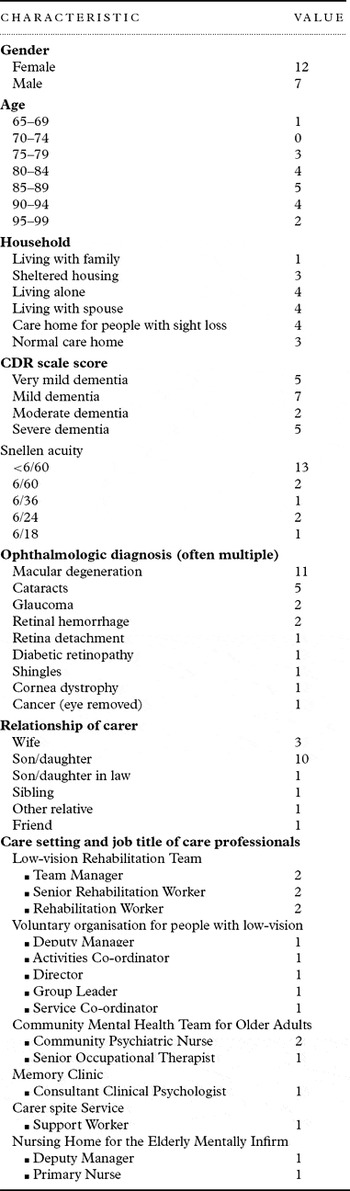
Table 1 shows the key sociodemographic characteristics, Snellen acuity, CDR scores and ophthalmologic diagnosis of the older adults, along with the relationship of the family caregiver, and job title and setting of care professionals. The CDR scores indicate a range of levels of dementia across the sample. Thirteen of the participants had a visual acuity <6/60, which classifies them as having severe vision impairment (World Health Organization, 1992), and the majority suffered from age-related visual impairment (e.g. macular degeneration). Participants lived in a number of different settings affording different levels of independence.
Key sociodemographic characteristics, Snellen acuity, CDR scores and ophthalmologic diagnosis of older adults and care setting and job title of care professionals

CDR = Clinical Dementia Rating.
Five core themes emerged during the course of the research that help to explain the complexity of the needs of older people with joint visual impairment and dementia: “safety v independence,” “heightened disorientation and distress”, “visual hallucinations”, “vulnerability to isolation”, and “difficulty in accepting multiple losses.”
Safety v independence
Informal caregivers identified loss of independence as the greatest threat to their relatives' emotional well-being. The combined inability to compensate for poor memory with visual cues, and to compensate for poor sight with cognitive strategies, profoundly impaired people's ability to manage everyday tasks. Denial or lack of insight into their difficulties amplified their vulnerability.
“The neighbors were worried about her because she was really an accident waiting to happen because she couldn't see properly, but was still insisting on going out, getting on the bus, doing all sorts of things”. (Teresa's daughter)
Concerns about safety often prompted family members to restrict their relatives' activities, which often led to conflict in the caregiving relationship. Particular difficulties arose if limitations were placed on valued activities and roles.
“I do get a lot of enjoyment from the workshop – it's more than enjoyment, I would be thoroughly miserable if I was kept out of it. Well, it would bust our marriage up I think if that happened”. (Robert)
Care professionals stated that their priorities were to promote their clients' independence and safety. However, they were mindful of the increased level of risk in this group and of the inherent conflict in these aims.
“It would be irresponsible, for example, if somebody has memory problems to do mobility training; it depends, obviously, but if someone is not going to remember that they have to stop at the edge of the road before they cross you're not going to continue with mobility training, you know why on earth would you do that, to put people more at risk to then go out and hurt themselves”. (Team Manager, Low-vision Rehabilitation Team)
However, there was also concern that services should not prevent individuals taking any risks at all. Care homes were criticized for seemingly adopting this approach.
“You see them being herded about, put in wheelchairs even though they can walk but it's safer for the nursing home to put them in a wheelchair and push them from a to b”. (Senior Occupational Therapist)
Some rehabilitation workers feared that they might assume an overcautious approach as they lacked the expertise to assess dementia-related risks. Community mental health staff demonstrated more confidence in undertaking a holistic risk assessment, yet acknowledged that this was a complex and time-consuming task.
There was little evidence of communication between mental health and low-vision rehabilitation teams; assessments were undertaken independently and information was rarely shared. Low-vision professionals often felt deskilled when confronted with clients with memory problems and limited in the options available to them. The majority of mental health staff did not access low-vision rehabilitation teams nor assume the responsibility of exploring how visual impairment might contribute to the client's needs. It was felt that increased contact between the teams would provide professionals with a more holistic understanding of the individual, which would help them to target support to maximize independence.
“My interpretation of what might be OK risk for someone with sight loss and memory problems is not going to be the same as another professional and, you know, I think by sharing that risk perhaps people might be more empowered rather than individual professionals saying actually I'm not willing to put my name to that, I'm not willing to say that that's a possibility. Whereas within a group decision it's the sharing of information and sharing of knowledge – you know, what level of cognitive function are we talking about, what are the possibilities? Very often we don't know, we sort of, our possibilities are can you make a cup of tea or not? Well you know there might be a better way round that, a skill that the psychiatric nurse has developed, a way of communicating that we aren't party to.” (Team Manager, Low-vision Rehabilitation Team)
Assistive technology (e.g. wandering alarms and memo reminders) was often cited as a valuable method of orienting the person and preserving their independence and safety.
Heightened disorientation and distress
Older adults occasionally described their frustration at being unable to locate themselves in their environment. However, it was predominantly carers who explained how sight loss and dementia contrived to disorientate the older adult. In the early stages of dementia, individuals' attempts to remain orientated to time were undermined by their inability to see the clock or read the date on the newspaper. Subsequently, many became unable to navigate their surroundings as they could neither observe nor recall the layout. Some could not remember where they were, and frustration was replaced by fear.
“I was with my cousin having lunch and he went off to go back home and I was in the garden and I just could not place myself. And I said to, in a loud voice, “I hope somebody will come and fetch me for tea this afternoon, I don't think I know where I am”. I just didn't know where I was and you know that was really frightening you know. I thought I could fall down and break a leg.” (Dorothy)
Professionals considered the disorientation in this group to be more immediate and pronounced than in individuals with dementia alone, as they lacked the visual cues to anchor them to the here and now. Many older adults were wholly dependent on their relative for orientation. Many caregivers were physically exhausted, but found it difficult to leave the older person for even brief periods of time. Formal carers recognized the magnitude and exceptional nature of these demands. One community psychiatric nurse asserted that extra resources should be committed to meeting them.
“The problems of orientation and the constant calling out and the demands on the carers and I think that if that can be recognized by social services and perhaps in those circumstances these people need more support because it's so constant, it's all the time, it's throughout the night, they are constantly, constantly called, they get tired and whereas night sitters are not normally put in at all, I mean it's way beyond the budget, but there are certain circumstances where that would help.” (Community Psychiatric Nurse)
Disorientation frequently led to distress, which was occasionally manifested in agitated and aggressive behavior. Family members and low-vision professionals stressed the value of clear verbal communication and a familiar environment. It was felt that attending to an individual's sensory needs could reduce feelings of disorientation, helplessness and restless or disruptive behavior.
“Her feelings of well-being need to be constant so that she is not agitated and she is not thrown in her mind that she would need to wander off . . . have the same group of people, even regardless who she thinks they are . . . for people to constantly reinforce the positive, to reinforce who they are, to say who they are, ‘Sarah, it's Michael’, in this way, ‘And I am taking you home and we are going on the mini bus with George and Vera’.” (Director, voluntary organization for people with sight loss).
Although mental health staff recognized the importance of a familiar environment, many acknowledged that staff within dementia services might fail to provide the reassurance that low vision demands. Indeed, few felt that visual impairment had a significant effect on the way that they worked with clients.
Visual hallucinations
Seven of the older people with dementia and sight loss had experienced visual hallucinations. Three participants discussed their content and how they made them feel. Despite insight into the hallucinations, it remained an ongoing challenge to differentiate between what was and was not real.
“Well, it is disorientating. I mean now you've hit on the key word I think that I'm suffering from. Because life can be very unsure, put it that way . . . See, when you have lived all your life with your sight you know that what you see is something definite or whatever the term is. But when it's an hallucination it's awfully difficult for you to say well that's silly, no it can't be”. (Donald)
Four individuals with more severe cognitive impairment appeared to lack insight into their hallucinations, and it was their caregivers who described their impact. Typically the hallucinations were identified as highly distressing, and they often took the form of strangers in the house. Family caregivers expressed uncertainty about how best to deal with hallucinations, although there appeared to be an initial inclination to challenge the older person's beliefs.
“Initially my brother and I tend to think that we ought not to acknowledge that she was talking about having visitors and we'd say, ‘well the door's locked, therefore nobody could have come in’ . . . and I suppose being confrontational really, although we would obviously try to do the best thing, but we didn't really know how to handle it. But since seeing the psychiatrist and the nurse and seeing how they ask more and more questions and ask how it distresses her and that's obviously the way to handle it. But it was quite difficult for us to know what to do.” (Florence's daughter)
Where older adults were able to comprehend that their visions were hallucinations, exploring them seemed to help them to make sense of their experience and attenuate its negative impact. However, the majority of older adults believed unequivocally in what they were seeing, and any suggestion that the visions were not real simply proved upsetting. Subsequently, relatives focused on comforting the individual. Continued distress often prompted a referral to a community mental health team or move into residential care.
Vulnerability to isolation
A large proportion of older adults experienced loneliness and isolation. They complained that sight loss prevented them from enjoying country walks, painting, knitting, reading, jigsaw puzzles, etc. Poor memory compounded their difficulties and often prevented the use of compensatory strategies such as “talking books”. This increased their emotional dependency on others and enhanced the burden on family members who often felt responsible for stimulating and entertaining the older person. Older adults benefited from attending day-centers or lunch clubs for people with dementia or sight loss. They and their relatives often praised the activities and opportunities for social interaction.
“I like that, they are nice people. They are in the same position as I am really I suppose, they can't see you know . . . you can laugh and talk about things and say ‘Oh, I didn't see that’ you know.” (Nell)
Despite the benefits of day-centers, it was evident that the majority of older adults found it easier to interact on a one-to-one basis. Visual impairment made it difficult for them to identify when conversation was directed at them, while dementia impaired their ability to follow the pace and complexities of the discussion around them.
“It's not so bad it it's one to one but if you've got a couple of people, and especially if we are there as well, say we have some family and we are all sitting round the table, he will tend to sit and not speak at all because he doesn't really know who is speaking to him. So I think he just shuts off completely and he will just sit there in silence and then get up.” (Donald's daughter)
Telephones represented a lifeline and high value was attached to regular contact with paid carers and volunteers. There were numerous examples where one-to-one interaction provided older adults with the necessary support to pursue valued hobbies and interests. However, participants agreed that limited resources restricted opportunities for one-to-one contact in care homes.
Difficulty in accepting multiple losses
Acceptance was an important coping strategy that influenced older adults' satisfaction with their lives, their willingness to relinquish particular activities and the ease with which they asked for and accepted help. However, dementia and visual impairment represented a substantial threat to the individual's identity, and older adults were likely to adopt self-protective strategies, such as denial.
“Every day really, there was another thing that he couldn't do any more and in the end he just was feeling totally useless. I mean he used to do all the garden and then you know he would still want to do that even though he couldn't see and he would like plant plants one day and the next day he thought they were weeds and was pulling them up and things like that you know, it's really sad. He was just so desperate to still lead as normal a life as possible.” (Donald's daughter)
The common view among family caregivers and professionals was that experiencing one form of loss increased the difficulty of accepting a second. Both informal and formal carers considered it likely that individuals with long-standing visual impairment would have benefited from having had the time to adapt practically and emotionally to their low vision before developing dementia.
“Mum has adapted so well, she really, really has and maybe the fact that she had the sight loss much earlier on, now of course it's just part of her life, it was part of her life before. So she copes remarkably well.” (Valerie's daughter)
Discussion
This research found a high level of unmet need in what is likely to be a growing population. The data substantiate suggestions that visual impairment exacerbates confusion in Alzheimer's disease (Uhlmann et al., Reference Uhlmann, Laarson, Koepsell, Rees and Duckert1991) and highlight the necessity for clear, regular communication that enhances the individual's orientation and confidence in the environment. Cognitive stimulation and reality-orientation approaches may also enhance older adults' knowledge of their surroundings (Spector et al., Reference Spector2003). Although sight loss may preclude the use of visual components (e.g. orientation boards), one-to-one conversations that raise awareness of time, place and person may be of even greater value in this population. Residents of care homes are among the most light deprived, and dim lighting and glare have been linked to challenging behaviors (Cormack et al., Reference Cormack, Tovee and Ballard2000). Low-vision professionals underlined the importance of optimizing visual input in this population through enhanced lighting and high contrast markers (Watson, Reference Watson2001).
Both conditions have been shown to restrict independence (Aggarwal et al., Reference Aggarwal, Vass, Minardi, Ward, Garfield and Cybuk2003; Berman and Brodaty, Reference Berman and Brodaty2006), and it was the opinion of the care professionals that concurrent visual impairment and dementia provoke challenges to independence at an earlier stage. U.K. guidelines for Older People's Mental Health Services (Care Services Improvement Partnership, 2007) and standards for low-vision services (NHS Eyecare Services Programme, 2007) highlight the necessity of a coordinated multi-agency approach in service delivery. However, we found little evidence of joint working between mental health and low-vision rehabilitation teams. Appropriate sharing of information and skills would facilitate a more accurate assessment of risk and promote clients' independence. Previous research suggests that unaddressed visual problems are common among people with dementia in nursing home populations (Koch et al., Reference Koch, Datta, Makhdoom and Grossberg2005). The present findings highlight the need to raise awareness of the prevalence of visual impairment in dementia services and to communicate that the needs created require extra time and attention if individuals are to be supported with eating, navigating their surroundings and personal care, in a way that promotes autonomy. Training for rehabilitation workers should include information on working with people with dementia. Family caregivers could serve a valuable role in educating professionals on the unique challenges posed by the co-existence of the two conditions.
Given the high prevalence of visual hallucinations in both conditions (Chapman et al., Reference Chapman, Dickson, McKeith and Ballard1999; Menon, Reference Menon2005), it is not surprising that these experiences were common and problematic in our sample. The optimal management of the symptom is unclear and requires further exploration. Management techniques, ranging from reassurance and non-confrontation to a full explanation and distraction, may depend on the cognitive abilities of the older adult. Family caregivers require ready access to advice on this and other aspects of the conditions. Care professionals recognized that the magnitude and exceptional nature of the demands placed on informal caregivers sometimes necessitated extra respite resources such as night carers and increased days at day-centers.
Visual impairment and dementia independently engender feelings of loneliness (Holmen et al., Reference Holmen, Ericsson and Winblad2000; Uhlmann et al., Reference Uhlmann, Laarson, Koepsell, Rees and Duckert1991). The older adults, informal carers and care professionals in this sample believed that the two conditions together compounded these effects. As in previous research, day-centers were widely praised for providing stimulation through word games and quizzes (Aggarwal et al., Reference Aggarwal, Vass, Minardi, Ward, Garfield and Cybuk2003) and for offering opportunities to interact with others with similar conditions (Preston et al., Reference Preston, Marshall and Bucks2007). However, combined visual impairment and dementia made it difficult to participate in groups and often necessitated one-to-one interaction. People with dementia and visual impairment would benefit from more individual contact with paid carers and volunteers. It is also important that staff in different care settings understand the value of one-to-one interaction in this client group. Both dementia and visual impairment can be conceptualized as a threat to the sense of self (Charmaz, Reference Charmaz1983), and the accounts of informal and formal carers imply that older adults were likely to adopt self-protective strategies such as denial (Steerman et al., Reference Steerman, Dierckx de Casterle, Godderis and Grypdonck2006) when confronted with both conditions. It is important that carers recognize the magnitude of the threats posed by concurrent visual impairment and dementia and look for ways to help individuals to continue with valued activities as fully as possible.
In the absence of epidemiological evidence it is difficult to determine how generalizable these findings are. However, it is likely that they are relevant beyond the research setting as participants were recruited from London boroughs with a broad range of socioeconomic characteristics and purposive sampling was used to select participants with a diversity of characteristics (Mays and Pope, Reference Mays and Pope2000). Research is needed to identify the prevalence of comorbid visual impairment in dementia in care homes and in the community. One of the major challenges was determining whether the difficulties stemmed from the combination of conditions rather than dementia or visual impairment alone. However, care professionals were able to make comparisons on the basis of their experience with individual conditions and data were compared with literature in the respective fields. Moreover, we were not aiming to measure the impact of the two conditions but to explore and describe the unique experience of a previously neglected population. This is an essential first step in building the knowledge base in this area.
In conclusion, the findings underline the importance of environmental approaches that optimize visual input, such as providing adequate eye care and lighting. They also suggest that joint working is necessary to maximize independence and that clear verbal communication and one-to-one contact may reduce disorientation, distress and agitated behavior. Ultimately, the research highlights that assessing and responding to the complex needs of this population requires extra time and resources if the quality of life of older people and their caregivers is to be maintained.
Conflict of interest
None.
Description of authors' roles
All the authors contributed to the concept and design, interpretation of results and manuscript preparation. In addition, J. Murray wrote the proposal, with input from the other authors, and V. Lawrence completed the interviews.
Acknowledgments
The authors are indebted to the research participants who generously shared their experiences and gave their time to the study. We are very grateful to the members of the Advisory Panel for their useful advice and interpretation.