1 Introduction
An aspect of the English language that has intrigued linguists for decades is its extensive use of adverbial ing-clauses. English frequently makes use of non-finite variants of the types illustrated in (1)–(4) (Kortmann Reference Kortmann, Haspelmath and König1995; Killie & Swan Reference Killie and Swan2009):
-
(1) And then, not hearing that there was any danger of a sudden change, I delayed going to him till the twentieth of July. (PPCEME, 1680)
-
(2) When lying unconscious from fever in Malta Hospital, some one hung a gold cross and chain round his neck. (PPCMBE, 1900)
-
(3) The publick Tranquillity being now settled, our Forces were remanded back to Nottingham. (PPCMBE, 1740)
-
(4) Mr Roker mounted another flight of stairs, with Mr Pickwick and Sam Weller following at his heels. (PPCMBE, 1837)
The constructions shown in (1)–(4) are participial clauses, commonly referred to as free adjuncts (FAs) and absolute constructions (ACs) (Kortmann Reference Kortmann1991, Reference Kortmann, Haspelmath and König1995). FAs, illustrated in examples (1) and (2), have no overt subject. The implied subject is often (1) but not necessarily (2) coreferential with the subject of the matrix clause. If FAs are augmented (i.e. introduced by a function word that makes the adverbial relation explicit), the augmentor is normally a conjunction (2). Syntactically, FAs function like subordinate or quasi-coordinate clauses. The most important difference between FAs and ACs, illustrated in (3) and (4), is that the latter always have an overt subject. This overt subject is typically non-coreferential with the subject of the matrix clause and can be expressed in the nominative or the oblique case, the former being the default option. The augmented AC is most commonly introduced by preposition-like items, such as with (4), or by augmentors which are ambiguous between a prepositional and a conjunctional interpretation (e.g. after) (Kortmann Reference Kortmann, Haspelmath and König1995; van de Pol & Cuyckens Reference van de Pol, Cuyckens, Ramat, Mauri and Molinelli2013). Like FAs, ACs function syntactically as subordinate or quasi-coordinate clauses.
English also exhibits a third type of adverbial ing-clause, namely the adverbial verbal gerund (henceforth AVG) (5)–(7). AVGs strongly resemble the adverbial clauses illustrated in (1)–(4), occurring either with (5) or without (6) overt subject. Still, AVGs are different in that they have a nominal rather than a participial origin. These nominal roots are still visible in that AVGs are augmented by prepositions instead of conjunctions or conjunctional prepositions, and in that their (optional) overt subject can occur in the genitive case (7):
-
(5) I am rather in hopes the magazine article has dropped through, either from my paper being thought bad, or Macmillan repudiating the thing. (PPCMBE, 187X)
-
(6) But in doing this there is danger of hurting the Scion. (PPCEME, 1696)
-
(7) . . . yet by its being ruined in the most needful, it is become impassable (PPCEME, 1672–81)
Because of their distinct origins, AVGs, FAs and ACs have mostly been studied in isolation (Comrie Reference Comrie1976; Kortmann Reference Kortmann1991, Reference Kortmann, Haspelmath and König1995; De Smet Reference De Smet2008), in spite of their striking functional and formal resemblances.Footnote 2 Nevertheless, many linguists have suggested that the increasing overlap between AVGs and participial constructions has reinforced the position of FAs and/or ACs in the English language, and vice versa (Fanego Reference Fanego2004; Killie Reference Killie, Elspass, Langer, Scharloth and Vandenbussche2007; Killie & Swan Reference Killie and Swan2009; Fonteyn & Cuyckens Reference Fonteyn, Cuyckens, Adams, Brinton and Fulk2014; van de Pol & Petré forthcoming). However, the details of this development, and the precise relations and dynamics between the three constructions remain little understood.
Our aim is to offer a corpus-based analysis of the (changing) variation between the adverbial ing-clauses in Modern English in which present-participial adverbial clauses and AVGs are treated as part of an adverbial ing-clause network that developed over time. Zooming in on the network's inner dynamics, we argue that language users have the basic choice of (i) including an augmentor to make the relation between matrix and adverbial clause explicit, and/or (ii) including an overt subject in the adverbial clause. It is argued that there are various factors at play in making these choices, which can be subsumed under the principles of iconicity and economy (Rohdenburg Reference Rohdenburg1996) to varying extents. By identifying and examining these different factors in relation to each other by means of a logistic regression analysis, we arrive at a clearer and broader picture of the usage profiles of the different constructions under investigation.
1.1 The gerund–participle divide
By assuming an inclusive perspective on the study of adverbial ing-clauses, this study joins a larger theoretical discussion regarding the status of grammatical categories. As pointed out by De Smet, ‘English ing-clauses pose two major descriptive issues: first, whether the two historically distinct clause-types of gerunds and participles can be collapsed into a single category, and second, whether ing-clauses still relate to their phrasal origins as (historical) noun phrases and adjectival/adverbial phrases’ (Reference De Smet2010: 1153). Traditionally, gerunds are classified as nominalizations, because, in terms of distribution, they pattern like noun phrases. As such, they are separated from participial ing-clauses, which distributionally pattern like adjectival or adverbial phrases.
Kortmann's study on adverbial ing-clauses implicitly takes the more traditional stance towards the gerund–participle divide, as he considers AVGs to be ‘related but different constructions’ from the participial clauses (Reference Kortmann1991: 13–14) and consequently excludes them from his study. However, Kortmann (Reference Kortmann, Haspelmath and König1995) does acknowledge that there are certain problems in distinguishing adverbial participles from AVGs, as both adverbial constructions are similarly detached from the matrix clause and receive their implied subject as well as their temporal grounding from their matrix clause. Hence, the sole reason for distinguishing between the non-finite adverbial clauses in (8), (9) and (10) is the syntactic status of their preceding linking element:
-
(8) This cannot be, if the pupils are thrust prematurely upon a foreign literature while mastering several new vocabularies. (PPCMBE, 1878)
-
(9) I will declare his Inconstancy in vttering this his Euidence. (PPCEME, 1554)
-
(10) Thus passed they this night, after having received from the slaves all imaginable respect and obedience. (PPCEME, 1688)
While Kortmann classifies ambiguous examples such as (10) as AVGs from a strictly syntactic point of view, he has grouped them with augmented adverbial participles as they ‘exhibit parallel semantic and pragmatic behaviour’ to adverbial participles (Kortmann Reference Kortmann, Haspelmath and König1995: 200). The question then arises as to why a study on the semantic and discourse-pragmatic behaviour of adverbial ing-clauses should not include unambiguous AVGs as instances of augmented ing-clauses.
Opposing the traditional view of gerunds and participles as separate categories, Huddleston & Pullum (Reference Huddleston and Pullum2002) argue that they can be conflated into a single category of ‘gerund participials’. In doing so, they take a radical stance, suggesting that distributional relations, or, in Kortmann's terms, ‘strictly syntactic’ evidence, does not justify the distinction between gerunds and participles. Their position is further strengthened by semantic evidence, which indicates that gerundive and participial ing-forms cannot be distinguished on semantic grounds (De Smet Reference De Smet2010: 1169–71; De Smet & Heyvaert Reference De Smet and Heyvaert2011), and historical evidence, as gerunds and participles engage in a diachronic trend of becoming less distinctive over time (De Smet Reference De Smet2010: 1171–82; see section 1.2).
Despite the evidence in favour of collapsing gerunds and participles into a single category, De Smet (Reference De Smet2010) points out that the data do not straightforwardly support a unified gerund participial. Based on the fact that in nonstandard varieties, language users distinguish between an /in/- and /iŋ/-realization of the (ING)-morpheme in a way that largely coincides with the gerund–participle divide and overt subjects in the possessive case clearly only associate with ing-clauses in nominal positions (De Smet Reference De Smet2010: 1181), one can only conclude that the behaviour of ing-clauses is essentially contradictory. Consequently, it seems that the categories gerund and participle should not be considered absolutely unified or separated, but rather that neither the traditional nor the unified account sufficiently characterizes the representations that speakers/writers actually use. To remedy this discrepancy, De Smet proposes an in-between solution, suggesting that language users can generalize over constructions and at the same time differentiate between them (Reference De Smet2010: 1187); the gerund can in fact partake of the formal and functional properties of the participial construction without being entirely absorbed by them, and vice versa.
In line with De Smet's (Reference De Smet2010) proposal, we will show that while gerunds and participles maintain syntactic/distributional ties to their phrasal origins, language users do recognize an (increasingly) strong association between AVGs and adverbial participles and conceptualize them as a semantically/pragmatically interconnected network of non-finite adverbial clauses that transcends the phrasal origins of the three constructions. By recognizing the existence of such a network, our study departs from traditional approaches to adverbial ing-clauses, which generally limit their scope to either gerunds or participles. In what follows, we will first provide a detailed description of the diachronic development of the different constructions, describing how the boundaries between the components have become increasingly vague over time. After establishing the (formal) structure of the network, we turn to the inner semantic/pragmatic dynamics of the network in section 2, where we will identify the relevant factors that influence (i) augmentation choice and (ii) subject inclusion within the network. The diachronic changes in the relative impact of these factors will be determined through two logistic regression analyses, which indicate that the variation within the ing-clause network came to adhere to the cognitive complexity principle (Rohdenburg Reference Rohdenburg1996) in various ways.
1.2 The formation of the adverbial ing-clause network
From a diachronic perspective, the proposed ing-clause network finds its origins in three constructions which were originally separate and unrelated. The functional and cognitive association between them is the result of a set of changes in Middle and Early Modern English (EModE), which led these three constructions to coincide, both formally and semantically.
In Old English, gerundive and participial constructions were entirely distinct (Kisbye Reference Kisbye1971: 51ff; Tajima Reference Tajima1985: 60ff; Kastovsky Reference Kastovsky and Fisiak1985: 241–3). The Old English ‘gerund’, illustrated in (11), was an abstract noun in -ing(g)(e) or -ung(g)(e), which in terms of its morphosyntactic form as well as its discursive function was entirely nominal (Fanego Reference Fanego2004: 7):
-
(11) ðurh ðæra sacerda blawunge toburston ða weallas (c.1000, Visser Reference Visser1963–73: 1165)
‘Through the blowing of the priests the walls burst’
The Old English participle, on the other hand, was formed with the -end(e) ending. The first ACs were formed with this typical participle ending, as in (12). These usually consisted just of a (pro)noun subject and its predicate without any additional complements and were most frequently used to express temporal relations of either simultaneity or anteriority (Timofeeva Reference Timofeeva2010).
-
(12) se Hælend, heom onlocigendum, upp to heofonum astah (YCOE, Late Old English)
‘The Saviour, while they were watching, rose up to heaven.’
At the same time, there were some subjectless adverbial-like participles (Callaway Reference Callaway1901), but these were not clausal in nature and usually expressed relations such as accompanying circumstance and state of mind (Killie & Swan Reference Killie and Swan2009: 338), as in (13):
-
(13) on þan twelften dæige eorneð mænn geond eall middeneard byfigende & drædende Cristes tocyme to demene cwican & deaden,. . .
‘On the twelfth day men will run through all the earth shivering and dreading Christ's coming to judge the living and the dead,. . .’ (Killie & Swan Reference Killie and Swan2009: 350)
In Middle English, then, the -ung ending of the gerunds was gradually replaced by -ing, which made -ing the sole gerundial ending (Kisbye Reference Kisbye1971: 54; Dalton-Puffer Reference Dalton-Puffer1996: 90–1). Moreover, as the case system disappeared, the genitive phrase that was previously used to express the object was replaced by a periphrastic of-phrase (Mustanoja Reference Mustanoja1960: 74–6; Tajima Reference Tajima1985: 60ff.), as in (14):
-
(14) Withouten doying of any harme (Tajima Reference Tajima1985: 62)
From 1300 onwards, gerunds became more verbal, taking true direct objects instead of periphrastically realized participants (Tajima Reference Tajima1985: 111–13; see (15)). Such verbal gerunds first emerged in adverbial function and often allowed for a controlled reading (Houston Reference Houston, Fasold and Schiffrin1989; De Smet Reference De Smet2008: 61):
-
(15) In yevyng wityngly noious medicyns to eny man (Jespersen Reference Jespersen1940, part V:116)
‘in knowingly giving harmful medicines to anyone’
At this point, some southern dialects of English started allowing -ing(e) as a present participle ending (Lass Reference Lass and Blake1992: 146), which became the standard form from the fifteenth century onwards.Footnote 3 During this transition period, FAs became more clausal, as in example (16), possibly due to Latin influence. These were predominantly quasi-coordinate clauses, but could sometimes take a more adverbial interpretation (Killie & Swan Reference Killie and Swan2009). ACs, as shown in (17), were also steadily becoming more diverse, as they started taking objects and adverbial complements of their own much more often. In addition, they started being used in quasi-coordinate contexts (paraphrasable by an and-coordinated clause with finite verb form), as in example (18) (van de Pol Reference van de Pol2014). As a result, the semantic features of the AC started to coincide with FAs.
-
(16) Therefor thei . . . spaken togidere, stondynge in the Temple . . . (Killie & Swan Reference Killie and Swan2009: 351)
-
(17) Mech joye was mad, euery man supposing þat þis mater schuld haue good ende . (PPCEME2, 1420–1500)
-
(18) And the Lorde Bonevyle was be-heddyd, the comyn sayynge that hys longage causyd hym to dye. (PPCEME2, 1420–1500)
FAs then spread to sentence-initial and medial position and acquired the ability to express more informative adverbial relations, like time and cause (Killie & Swan Reference Killie and Swan2009) (19). Early Modern ACs, as in (20), likewise continued to expand their functional abilities by spreading further to the domain of quasi-coordinate relations (van de Pol Reference van de Pol2014):
-
(19) So that I was fayne to flye to a lytle paryshe callyd Hemsted, thynkynge ther for to have had some reste (PPCEME, 1555)
-
(20) And rising from his seat, he went and led her into the bath; it being in vain for her to resist. (PPCEME, 1688)
From 1640 onwards, AVGs spread to other syntactic environments and started combining with a broader set of prepositions (after, upon, etc.). This greatly increased the semantic possibilities of AVGs, which could now easily express a wider set of temporal relations. Importantly, as some of these prepositions can also function as conjunctions (Quirk et al. Reference Quirk, Greenbaum, Leech and Svartvik1985: 196), the typical augmentors of FAs, these new AVGs further blurred the formal divide between subjectless AVGs and FAs. EModE likewise saw the gradual disappearance of the formal distinctions between AVGs with overt subject and ACs. The verbalization of the gerund had spread from bare environments to gerunds with a genitive subject(oid), as in my last kissing you, which then served as bridging contexts for reanalysis, actualized when verbal gerunds started occurring with oblique subjects, as in (21) (Fanego Reference Fanego2004: 8):Footnote 4
-
(21) It . . . could not immediately relinquish, the brass log, which, on the line being hauled in, was found to be a good deal injured. (PPCMBE, 1900)
In sum, the historical developments described above (summarized in figure 1) gradually formed a formal/functional continuum between gerunds without an explicit subject and FAs, between AVGs with explicit subject and ACs, and between ACs and FAs, together forming an overarching ing-clause network (see Kohnen Reference Kohnen2004: 10). As such, the adverbial ing-clause network can be considered a multiple source construction, as its historical development ‘entails blending of clearly distinct lineages’ (Van De Velde et al. Reference Van De Velde, De Smet and Ghesquière2013: 473).
Historical development of FAs and ACs vs AVGs

The examples in (22)–(25) illustrate the continuum between the FA and the AVG:
-
(22) By tapping the bell in various places with a hammer or mallet, . . . it was not difficult to detect 6 tones. (PPCMBE,1890)
-
(23) After being ready, we took coach. (PPCEME, 1666)
-
(24) . . . when seeing them, she would have run in again, but Trefry caught her by the hand (PPCEME, 1688)
-
(25) Then, crossing the Thames, he pacified the Eastern Counties. (PPCMBE, 1895)
The construction in (22) illustrates a AVG. Since the augmentor by is a preposition, the adverbial clause is still clearly recognizable as a gerund and can therefore unambiguously be categorized as one. In (23), by contrast, the adverbial augmented ing-clause is introduced by the structurally ambiguous augmentor after, which either functions as a preposition (e.g. After dinner, we left) or a conjunction (e.g. After we ate, we left), making the decision of assigning the example to the category of AVGs or that of FAs arbitrary. In (24), the augmentor is a straightforward conjunction, and therefore the adverbial ing-clause can be categorized as a FA. Finally, sentence (25) illustrates a prototypical unaugmented FA.
Ambiguity between verbal gerunds and ACs, as illustrated in (26)–(30), hinges on the case of the expressed subject.
-
(26) These three bourgeois elements will eliminate themselves without our having to lift a finger. (KU Leuven drama corpus, 1970s)
-
(27) Life was fraught enough for the Stevenses as it was, with the constant care of Jennifer, without her adding to their problems (BNC, 1990)
-
(28) Disks, no, Yeah, I know, but with them not knowing, friend's because there's so much disk swopping. (BNC, 1985–94)
-
(29) You are pointing the finger at him, them being involved in the murders. (BNC, 1990)
-
(30) But then I think of my big – fat – mother, going out there every morning and yelling at the Gardner and the postman, with this – this – poodle clutched in her arms. And she and this poodle yelling at everyone! (KU Leuven drama corpus, 1968)
In (26), the ing-clause is adverbial, but it is still clearly gerundial, as the subject our takes the genitive case. In (27), however, the subject of the ing-clause her is ambiguous between a genitive reading and an oblique reading, which makes an AC reading justifiable. In (28), then, the subject takes the oblique case, and, as a subject in the oblique case is possible for both ACs and AVGs, this example is highly ambiguous. In example (29), then, the ing-clause with oblique subject is unaugmented, making the ing-clause unarguably absolute. Finally, at the end of the AVG–AC continuum we find examples such as (30), in which an unaugmented AC takes a nominative subject.
Finally, overlap between ACs and FAs depends on the presence or absence of an overt subject and the overt subject's degree of coreferentiality with the subject of the matrix clause. Consider the continuum in (31)–(35):
-
(31) But my stay abroad proving much longer than I expected, when, being returned to London, I had occasion to make use of this Loadstone for an Experiment, I found it indeed where I left it. (PPCEME, 1685)
-
(32) Nothing remarkable happened till the 5th of August; we being still employed in repairing our Ships and Rigging, and . . . (PPCMBE, 1744)
-
(33) They finding her to drive and not go a-head, they sent our Lieutenant in our Cutter to desire more Assistance. (PPCMBE, 1744)
-
(34) Thanne we Descendyng the same way that ower lorde rode vpon palme Sonnday, And cam to the Place wher the Chyldern of Israell brake braunches of Olyff trees. (PPCEME, 1517)
-
(35) His sisters sent vnto him sayinge: ‘Lorde behold, he whom thou lovest, is sicke’. (PPCEME, 1534)
In (31), the ing-clause has an overt subject which is not coreferential with the subject of the matrix clause, and thus represents a prototypical AC. In (32), the overt subject of the ing-clause is a personal pronoun. While there is still no coreference with the subject of the matrix clause, there is some semantic identity with the story's narrator. In (33), the ing-clause still has AC-like qualities as it contains an overt subject, but this subject is fully coreferential with and formally identical to the subject of the matrix clause, which is more reminiscent of FAs. Example (34) contains an ing-clause subject that is again fully coreferential with the subject of the matrix clause, but in this case the construction is also formally ambiguous between an AC and a FA reading. If an ellipsis of the matrix clause subject is presupposed (i.e. if the underlying sentence is perceived to be: Then we descending, . . . we came. . .), an AC reading might be defended, because the ing-clause would be considered to have an overt subject. However, the ing-clause and the matrix clause do share the same subject and only one of those is formally expressed, which is typical of a FA. Finally, example (35) illustrates a typical FA with an implied subject which is fully coreferential with the subject of the matrix clause.
In sum, the diachronic evidence seems to suggest that the ing-clauses have always been connected through their function as adverbial clauses, and, more recently, through an increasingly prominent formal continuum. Arguably, both observations point in a similar direction, namely (i) that in a study of the semantic/pragmatic behaviour of adverbial ing-clauses, it seems reasonable to generalize over the phrasal origins of the ing-clauses, and (ii) that, on a functional as well as on a formal level, the phrasal origins of the different constructions play a decreasingly prominent role in distinguishing between them. Essentially, constructions in the adverbial ing-clause network can be distinguished based on (a) whether they take an augmentor in the form of a conjunction or preposition that makes the semantic relation with the matrix clause explicit (figure 2) and (b) whether the ing-clause contains its own expressed subject (figure 3).
Augmentation patterns in the ing-clause network

Subject inclusion in the ing-clause network

2 The adverbial ing-clause network: forms and functions
Now that we have established the formal make-up of the adverbial ing-clause network, the question remains how the constructions in the network can be characterized semantically and discourse-pragmatically. In this section, we wish to identify and describe the different factors that determine the variation in terms of augmentation and subject inclusion in the ing-clause network. The data for our study were taken from the Penn–Helsinki Parsed Corpus of Early Modern English (PPCEME) and the Penn Parsed Corpus of Modern British English (PPCMBE). In total, we coded 1,764 Early and 1,305 Late Modern ing-clauses for their specific semantics (section 2.1), position (section 2.2), coreference (section 2.3) and length (section 2.4).Footnote 5
2.1 Semantics
The first criterion according to which the ing-clauses in our data set were coded was adverbial semantics. In previous studies (Kortmann Reference Kortmann1991, Reference Kortmann, Haspelmath and König1995), it has been suggested that ing-clauses differ with regard to the amount of explicit coding they need in order to be interpreted semantically in the intended way. It is, for instance, easier to infer a temporal relation between two propositions without the aid of explicit coding than it is to infer a concessional one. Based on these differences in interpretational complexity, Kortmann (Reference Kortmann1991: 121) developed a scale of semantic relations from least to most informative which has an impact on the need for explicit linking by means of augmentation. Indeed, ‘the addition of a conjunction secures to a high degree that the adjunct in question receives the interpretation intended by the addresser . . . [and] the need for this addition . . . correlates with the degree of informativeness of the intended semantic relation’ (Kortmann Reference Kortmann1991: 198–9). As such, the expectation is that more informative adverbial relations will require explicit coding in the form of an augmentor more often than less informative, weakly adverbial relations (Kortmann Reference Kortmann1991: 197).
In addition, Kortmann (Reference Kortmann1991) stresses that the degree of semantic complexity also interacts with the in- or exclusion of an overt subject. Building on Levinson's (Reference Levinson1987) theory concerning the role of pragmatic inferences in identifying interpropositional relations, Kortmann argues that the subjectless FA is a minimized form, making it more appropriate to receive a more informative interpretation than the less minimized AC (Reference Kortmann1991: 208–11). In other words, concerning the link between subject inclusion and semantic relation, Kortmann suggests that the ‘tighter syntactic linkage (via argument sharing . . .) iconically reflects tighter interclausal semantic linkage’ (Reference Kortmann1991: 212).
From a diachronic perspective, Killie & Swan (Reference Killie and Swan2009) argue that FAs were initially restricted to expressing relations of elaboration and accompanying circumstance, but came to prefer strongly adverbial uses. ACs, on the other hand, appear to have undergone the opposite development from more strongly adverbial to less informative elaboration uses (van de Pol Reference van de Pol2014). In light of Kortmann's claims regarding the relation between syntactic and semantic linkage, these findings suggest that as the network of adverbial ing-clauses formed, these clauses came to be organized according to the iconicity principle, with subjectless ing-clauses expressing more informative relations, and constructions with overt subject being preferred for less informative uses.
For our analysis, we divided the ing-clauses into three large groups of semantic relations, i.e. CCC, temporal and elaboration clauses.Footnote 6 The category of CCC-clauses contains all ing-clauses that express ‘highly informative’ adverbial uses (Kortmann Reference Kortmann1991: 121). Ing-clauses within this category have a relation to their matrix clause that conveys meanings such as reason (36), condition (37), concession (38), manner (39), instrument (40) and purpose (41).
-
(36) I obtained my father's permission to give it up, seeing no reasonable prospect of success in that line. (PPCMBE, 1900)
-
(37) It is determyned that she shall remayne here Frydaie and Satyrdaye all daie, and vppon Sondaie, wynde and wether seruynge, take hir passage into Englande. (PPCEME, 1530–8)
-
(38) Instead of forcing his way home, at any cost, he retreated westward before Charles. (PPCMBE, 1895)
-
(39) The Lecturer here placed his foot on a loop of wire fastened to a support above, and swung with his whole weight resting upon it for some moments. (PPCMBE, 1859)
-
(40) Ermine thought it merciful to divert the attack by mentioning Mr. Clare's love of music. (PPCMBE, 1865)
-
(41) Others, for preventing any of them from reaching the Bees, direct the fixing of little Plates of Tin round the Entry. (PPCMBE, 1747)
The second category, that of temporal clauses, consists of somewhat more ‘weakly’ adverbial uses (Kortmann Reference Kortmann1991: 121), which express temporal anteriority (42)–(43) or accompanying circumstance (44)–(45).Footnote 7
-
(42) . . . after having first cleaned your brush well with the curry-comb, begin at the croup or rump. (PPCMBE, 184x)
-
(43) . . . her husband putting it up at the auction, our relative on the mother's side, Dr. Glossop, interested in the documents and particulars of the story as he was, had it knocked down to him . . . (PPCMBE, 1895)
-
(44) That poor child Carinthia Jane, when first she beheld Old England's shores, tossing in the packet-boat on a wild Channel sea, did say it and think it (PPCMBE, 1895)
-
(45) . . . so the combined forces threw themselves on the town and carried it by storm, the archbishop heading his own party and being wounded in the assault. (PPCMBE, 1905)
The final category is that of elaboration clauses, whose relationship to the matrix clause is the least informative. They differ from other ing-clauses in that they do not express an adverbial relation to their matrix clause, but simply give additional information. Elaboration uses may but need not be quasi-coordinate in nature, i.e. replaceable by an and-coordinated clause with a finite verb form as in (51) (Behrens & Fabricius-Hansen Reference Behrens and Fabricius-Hansen2005: 11).
-
(46) The condition of the food may likewise alter its facility of digestion and nutritive properties, this depending upon its mode of growth . . . and freedom from animal and vegetable parasites. (PPCMBE, 1886)
= ‘AND this depends upon its mode of growth . . .’
As stated by Halliday, elaboration clauses ‘elaborate on the meaning of another by further specifying or describing it’ (Reference Halliday2004: 396). In line with this definition, and in order to group together all non-adverbial uses of ing-clauses, we use the term ‘elaboration’ as subsuming exemplification (47), addition (48), specification (49) and elaboration (50):
-
(47) [He] continued to be an active parish priest, visiting regularly, preaching, and taking a share in the service, which he knew by heart . . . (PPCMBE, 1865)
-
(48) The grasses . . . are remarkably uniform in structure, the greatest diversity being in their height . . . (PPCMBE, 1886)
-
(49) And the Lord spake unto Moses, saying, Send thou men, that they may spy out the land of Canaan . . . (PPCMBE, 1885)
-
(50) And he goes on to tell us the origin of the Welsh oath, Cas Andra's . . . Andra`s or Andraste being the fury of the ancient Kymri, to whom they built temples and offered sacrifices out of fear. (PPCMBE, 1905)
2.2 Position
As positional preferences have been suggested to reflect different discourse-pragmatic behaviour (Kortmann Reference Kortmann1991, Reference Kortmann, Haspelmath and König1995; Killie & Swan Reference Killie and Swan2009), we also coded the data for position in the clause. ACs, for instance, have been claimed to ‘almost exclusively follow . . . their matrix clause’ (Kortmann Reference Kortmann, Haspelmath and König1995: 228), while FAs are much more likely to occur in sentence-initial position. These positional preferences supposedly follow directly from their distinct semantic profiles (Kortmann Reference Kortmann1991): preposed adverbial clauses serve a frame-setting function for the information provided by the matrix clause (Kortmann Reference Kortmann, Haspelmath and König1995; Chafe Reference Chafe1984; Thompson Reference Thompson and Klein-Andreu1983; Ramsay Reference Ramsay and Tomlin1987) and they have stronger referential and thematic links to the preceding discourse (Givón Reference Givón1990). By contrast, postponed adverbial clauses serve as afterthoughts on the preceding clause and provide additional or specifying information. It follows, then, that sentence-initial adverbial clauses will express those adverbial relations that serve as frame-setting background information, i.e. temporal and CCC-relations, while sentence-final adverbial clauses are more likely to express elaborative relations (Killie & Swan Reference Killie and Swan2009). It thus seems evident that ACs, which commonly express elaboration semantics, are better suited to function as postponed afterthoughts, whereas the semantically more diverse FA, which typically expresses more informative relations, is more likely to fulfill the preposed frame-setting function (Kortmann Reference Kortmann, Haspelmath and König1995: 229).
The relation between semantics and position might also play a role in augmentation choice. One and the same clause may thus invite a causal/instrument reading in initial position (51a), while taking an elaboration meaning in final position (51b):
-
(51)
-
(a) Neglecting his friends, John became increasingly lonely.
-
(b) John became increasingly lonely, neglecting his friends.
-
Since the sentence-final slot allows for a much wider range of interpretational possibilities (Kortmann Reference Kortmann1991, Reference Kortmann, Haspelmath and König1995; Verstraete Reference Verstraete2007; Killie & Swan Reference Killie and Swan2009), it seems plausible that sentence-final clauses with a more informative (temporal or CCC) meaning require augmentation to be interpreted correctly. In (52), for instance, the augmentor by is needed to successfully arrive at the cause/instrument reading:
-
(52) John became increasingly lonely by neglecting his friends.
However, other theories on the processing complexity of adverbial clauses seem to predict that it is not sentence-final, but sentence-initial ing-clauses that are more likely to take augmentation. In his ‘performance theory of order and constituency’, Hawkins (Reference Hawkins1992, Reference Hawkins1994) argues that in terms of processing, language users can only determine the status of a constituent once they have recognized the mother node of the entire phrase. Parsers prefer constituents with a short recognition domain, meaning that the sooner the mother node of the constituent is encountered, the more easily the utterance can be parsed. In the case of adverbial clauses, the mother node is typically a subordinate conjunction, which in turn also dominates the entire complex sentence (Diessel Reference Diessel2005: 455–6). However, if no conjunction is present, the parser cannot immediately recognize the mother node of the phrase, i.e. an initial constituent such as watching TV can only be identified as an adverbial clause ‘if the sentence continues with a (pro)noun (e.g. Watching TV, he fell asleep)’ but will be recognized as an NP ‘if the sentence continues with a verb (e.g. Watching TV makes me tired)’ (Diessel Reference Diessel2005: 456). As a result, conjunctionless (or unaugmented) adverbial clauses have a much longer recognition domain and are harder to parse than augmented ones, in which the parser immediately encounters the mother node in the form of a linking conjunction or preposition.
This difference in parsing complexity is particularly relevant for initial adverbial clauses (Hawkins Reference Hawkins1992, Reference Hawkins1994; Diessel Reference Diessel2005). Indeed, in a complex sentence, initial adverbial clauses indicate that the following sentence is biclausal, which means that the parser has to process the entire adverbial clause and keep it in working memory until the main clause can be accessed (Diessel Reference Diessel2005: 457). When the adverbial clause occurs sentence-finally, on the other hand, parsers only recognize the sentence as being biclausal when they already have access to the matrix clause. This difference in processing complexity leads to the hypothesis that language users will opt for augmented ing-clauses in initial position, as their recognition domain is shorter than that of unaugmented ones. As such, the available literature offers us two competing hypotheses: one claiming that initial ing-clauses will favour augmentation, as they require it to ensure ease of processing, and the other claiming that it is final ing-clauses which will favour augmentation more, since they have a wider semantic range and need augmentors to specify one of the possible interpretations.
In our own analysis, we examined to what extent and in what manner the position factor plays a role in the variation between ing-clauses with and without overt subject as well as in the variation between augmented and unaugmented constructions. Essentially, we distinguish three positional categories – initial, final and medial – which are illustrated in examples (53)–(55):
-
A. Initial position:Footnote 8
-
(53)
-
(a) The resistance of the air having been avoided, the glass bottle and gold leaf all fall exactly in the same time. (PPCMBE, 1859)
-
(b) I had bene drowned if the tide had come, and espyinge a man a good waye of, I cried as much as I could for helpe. (PPCEME, 1567–8)
-
-
-
B. Final position:Footnote 9
-
(54)
-
(a) . . . two or three Melters have helped her from off the weeds, by bearing her up on both sides, and guarding her into the deep. (PPCEME, 1676)
-
(b) . . . and so he had the abbay landes given onto hym, and then he made a monk prior ther, deviding the old possessions of the monastery with hym. (PPCEME, 1535–43))
-
-
-
C. Medial position:Footnote 10
-
(55)
-
(a) Jesus therefore, being wearied with his journey, sat thus by the well. (PPCMBE, 1881)
-
(b) Mr. Keith seconded her efforts, but the insect was both lively and cunning . . . until at last it kindly rested for a moment with its wooden peg of a body sloping, and most of its thread-like members prone upon a newspaper, where Rachel descended on it with her pocket-handkerchief, and Mr. Keith tried to inclose it with his hands at the same moment. (PPCMBE, 1865)
-
-
2.3 Coreference
The third criterion is degree of coreference, narrowly defined as the degree of semantic identity between the (implied) subject of the ing-clause and the subject of the matrix clause. Several authors have suggested that a link exists between a high degree of coreference and increased ease of processing (Berent Reference Berent, Grossman and San1975; Kortmann Reference Kortmann1991, Reference Kortmann, Haspelmath and König1995; van de Pol Reference van de Pol2011). Assuming that structures are determined by conflicting forces of economy and explicitness (Diessel Reference Diessel2005: 449), ing-clauses with a high degree of coreference (which presumably are easier to interpret) are hypothesized to be less in need of explicit coding (in the form of either an overt subject and/or an augmentor) than ing-clauses with a low degree of coreference. In the present study, we distinguished four different categories of coreference: subject coreference, object coreference, part–whole coreference and non-coreference.Footnote 11 The cline of degrees of coreference maps onto a cline from lowest to highest processing effort by the reader/hearer ([minimum effort] subject < object < part-whole < non-coreference [maximum effort]).
The category of subject coreference requires the least processing effort of the four categories. In this case, the (implied) subject of the ing-clause is semantically identical to the subject of the matrix clause (e.g. in (56) her refers forward to she).
-
(56) . . . besides her loosing my linnen and washing dirtily, she hath also grosly abused me (PPCEME, 1662)
The examples categorized under ‘object coreference’ are slightly less easily processable. In these cases, there is still full coreference between the (implied) subject of the ing-clause and an element in the matrix clause, but not its subject. An example is (57), where she refers back to the object of the matrix clause her.
-
(57) Here were several people come to see and take leave of her, she going tomorrow. (PPCEME, 1666–7)
In the category of part–whole coreference, there is only partial semantic identity between the (implied) subject of the ing-clause and an element of the matrix clause. The ing-clause subject either represents a subset of a larger group, as in (58), or stands in an inalienable possession relation to an element of the matrix clause, as in (59).
-
(58) . . . horses, like men, differ in their appetites, some being able to perform a certain amount of work on a smaller quantity of food than others. (PPCMBE, 1886)
-
(59) But see Camille Desmoulins, from the Café de Foy, rushing out, sibylline in face; his hair streaming, in each hand a pistol! (PPCMBE, 1837)
Finally, the category non-coreference indicates the category that requires the highest processing effort. In this case, there is no semantic identity at all between the (implied) subject of the ing-clause and an element of the matrix clause, as illustrated by example (60):
-
(60) Viewing one of these Creatures, after it had fasted two dayes, all the hinder part was lank and flaccid. (PPCEME, 1665)
2.4 Length
The choice between an unaugmented ing-clause and a more explicit variant with augmentation may also be influenced by the syntactic weight (or length) of the adverbial clause. Evidently, longer linguistic elements have a higher degree of processing complexity than shorter ones (Hawkins Reference Hawkins1992; Rohdenburg Reference Rohdenburg1996). In the case of the ing-clause network, the expectation is therefore that augmentation is favoured with long rather than short adverbial ing-clauses. In this study, we have considered length as a categorical variable, with ing-clauses containing up to five words being classified as short (61), and ing-clauses consisting of more than five words being classified as long (62):
-
(61) The rapid stream swept us off towards the sea, the night setting in, and we were soon out of sight of the steamer and the lights of the town. (PPCMBE, 1900)
-
(62) And now they are together – looking upon us poor mortals struggling on alone in a most imperfect and sad world. (PPCMBE, 186x)
2.5 Data and analysis
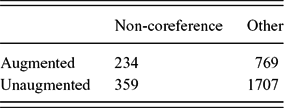
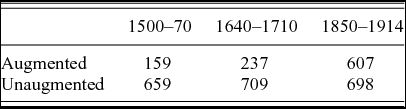
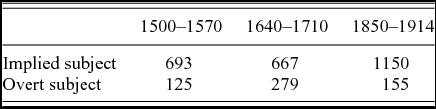
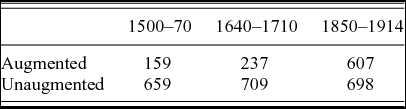
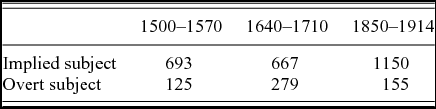
The best method to achieve an understanding of the inner dynamics of the ing-clause network, or, in other words, to investigate the multivariate and probabilistic nature of the choice between the different constructions, is to fit a regression model (Gries forthcoming). As we are addressing two separate issues, i.e. augmentation as well as subject inclusion, we built two different binary logistic regression models with mixed effects, one for each issue. In both models, author idiosyncrasies and genre are accounted for by means of random effects (Gries forthcoming). The absolute frequencies for each response variable in each period for the augmentation and subject inclusion model are presented in tables 1 and 2 respectively.
Augmented vs unaugmented ing-clauses
Subjectless ing-clauses vs ing-clauses with overt subject
2.5.1 Building the augmentation regression modelFootnote 12
The (supposedly) relevant predictors for this model and their levels are the following:
-
– Semantics: elaboration/temporal/CCC
-
– Position: initial/medial/final
-
– Coreference: subject/object/part–whole/non-coreference
-
– Subject inclusion: overt subject/implied subject
-
– Length: long/short
-
– Period: EModE/LModE
All variables have been set out in sections 2.1 to 2.4, except for the variable period and subject inclusion. In the regression model, the variable period has been used as a variable with two variants, namely ing-clauses found in the Early Modern data sets (EmodE, 1500–70 or 1640–1710), and ing-clauses from the Late Modern data set (LModE, 1850–1914). The most important function of this variable is to include it in interaction effects with the other variables to see how the influence of the predictors has shifted over time (as is, for example, done with regard to dative and genitive variability in Wolk et al. Reference Wolk, Bresnan, Rosenbach and Szmrecsanyi2013). The independent variable subject inclusion, which distinguishes between ing-clauses with and without overt subject, has been added to acquire a better picture of the relation between the different types of formal variation that we attested in the ing-clause network (see section 1.2).
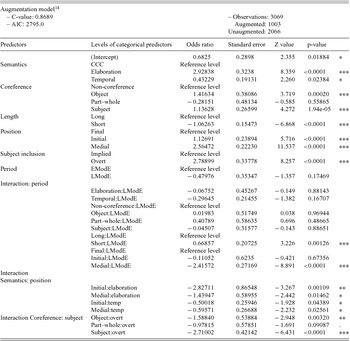
Table 3 presents the augmentation model,Footnote 13 with the binary response variable being the presence or absence of augmentation in ing-clauses. The odds ratios in the first column quantify the strength of the effect and the direction in which it deviates from the reference level (indicated by its being positive or negative). The p-values in the final column show which of the effects are significant. In addition to the fixed main effects, the model also contains interaction effects between the predictor ‘period’ and the other predictors to see which of the effects have shifted over time, between the predictors ‘position’ and ‘semantics’, and between ‘coreference’ and ‘subject inclusion’.
The augmentation model

14 A comparison between the mixed model presented in this article and a fixed-effects-only model shows that the random factors author and genre caused an increase in the c-value from 0.792 to 0.869 and a decrease in the AIC from 3127.4 to 2795.0. An Anova test indicated that both random effects made a significant contribution to the model.
(Significance codes: 0 ‘***’ / 0.001 ‘**’ / 0.01 ‘*’ / 0.05 ‘.’)
The figures in table 3 show a number of significant tendencies. First, there is a strong preference for expressing elaboration semantics by means of an unaugmented ing-clause (2.93). Ing-clauses with temporal semantics show a similar but weaker preference for unaugmented forms when compared to CCC-semantics (0.43).
These results, more or less in accordance with Kortmann's observations, suggest that the degree of interpretative complexity of the adverbial ing-clause indeed triggers the need for augmentation. As can be seen in figure 4, CCC- and temporal semantic relations – which have previously been established as ‘more informative’ and hence harder to process without additional explicit contextual cues than elaboration relations – are more likely to occur in the augmented form than ing-clauses with less informative elaboration relations.
Semantics (AUG)

In terms of position, it appears that, overall, the preference for unaugmented ing-clauses increases in sentence-initial position (1.13) and in medial position (2.56), with a strong decrease of unaugmented ing-clauses in medial position in LModE (-2.42) (see figure 5). This result goes against the hypothesis that was formulated in section 2.2, which predicted that initial ing-clauses would be more likely to take augmentation, as these require more processing effort.
Position (AUG)

Rather, it seems that augmentation is more common when a certain semantic relation does not occur in the position it is typically associated with. In the effect plot illustrated in figure 6, the adverbial ing-clauses are considered separately for each semantic class, showing how their position vis-à-vis the matrix clause has an impact on augmentation choice. While figure 6 does not show any valid effects for temporal and elaboration clauses, it does show that adverbial clauses with CCC-semantics are more likely to take augmentation in final position than in initial or medial position.Footnote 15
Interaction effect position – semantics (AUG)

The effect plot of the variable coreference is presented in figure 7. Observe that, while the p-values suggest that object and subject coreference are significantly more likely to be unaugmented than in the case of non-coreference, the large confidence intervals indicate that this might not be a valid effect.
Coreference (AUG)

Overall, it seems that the augmentation patterns in the different types of coreference in Early and LModE do not straightforwardly align to the cognitive complexity cline of coreference suggested in section 2.3 (subject < object < part-whole < non-coreference). In other words, while a bivariate analysis might yield a significant result,Footnote 16 a mixed effect regression model in fact indicates that there is a certain degree of caution required, as the degree of coreferential complexity possibly does not have a significant impact on augmentation choice in the ing-clause network.
However, the interaction effect between coreference and subject inclusion presented in figure 8 indicates that augmentation choice seems to behave quite differently in ing-clauses with an implied subject on the one hand, and ing-clauses with an overt subject on the other. With the group of ing-clauses with implied subject, the coreference complexity principle does hold, as cases where there is no or merely a part–whole relation between an element of the matrix clause and the implied subject of the ing-clause are more likely to take augmentation than those with subject or object coreference. Moreover, figure 8 shows that if there is no coreference relation between matrix and ing-clause, ing-clauses with implied subject require augmentation more often than those with overt subject. A possible explanation for this observation is that the presence of an overt subject in the ing-clause already serves to facilitate the processing of the non-coreferential ing-clause, which hence has a smaller need for additional elements that ease processing.
Interaction coreference – subject inclusion

These findings also shed new light on the function of augmentation in ing-clauses with implied subject. Concerning subjectless participial ing-clauses, Kortmann argues that ‘augmentation of FAs serves the primary function of signalling explicitly the circumstantial relation holding between the adjunct and the matrix clause’ (Reference Kortmann, Haspelmath and König1995: 227). Yet, by including AVGs into the multivariate analyses, we found that augmentation does serve the function of aiding processing of ing-clauses with low degrees of coreferentiality.
Finally, the model also indicates that the predictor length has a negative odds ratio, suggesting that short ing-clauses are more likely to be augmented than longer ones (-1.12). This is illustrated in figure 9.
Length (AUG)

From the perspective of cognitive complexity, this finding is quite unexpected, as greater syntactic weight is associated with greater processing complexity, which would lead to a preference for the more explicit (augmented) option (Rohdenburg Reference Rohdenburg1996). However, from a diachronic perspective the negative impact of length can be explained by the fact that the prepositionally augmented adverbial clause was still a very new construction at the time (De Smet Reference De Smet2008, Reference De Smet2013), while unaugmented participial ing-clauses were already much more common and well-established (Killie & Swan Reference Killie and Swan2009).Footnote 17 As the prepositionally augmented type became more frequent, the language user gradually allowed the construction to become more complex, resulting in a less pronounced impact of the factor length in LModE.
2.5.2 Building the subject inclusion model
To assess which predictors play a role in determining the likelihood of subject inclusion in adverbial ing-clauses, another regression model was built. The response variable again is binary, distinguishing between ing-clauses with an implied subject and ing-clauses with an overt subject. The relevant predictors are:Footnote 18
-
– Semantics: elaboration/temporal/CCC
-
– Coreference: subject/object/part–whole/non-coreference
-
– Position: initial/medial/final
-
– Augmentation: augmented/unaugmented
-
– Period: EModE/LModE
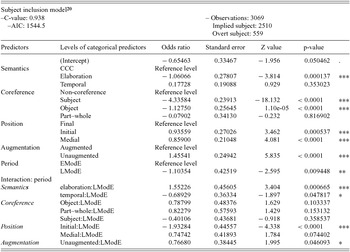
The results are presented in table 4.Footnote 19 The predicted odds in the first column are for ing-clauses with internal subject, which means that a positive value points to a preference for subject inclusion, while a negative value does the opposite. The model also includes interaction effects between the predictor period and the other predictors to see how the probabilistic effect of the various factors has changed from EModE to LModE.
The subject inclusion model

20 A comparison between the mixed model presented in this article and a fixed effects only model shows that the random factors author and genre raised the C-value from 0.9 to 0.94 and lowered the AIC from 1775.7 to 1544.5. An Anova test indicated that both random effects made a significant contribution to the model.
(Significance codes: 0 ‘***’ / 0.001 ‘**’ / 0.01 ‘*’ / 0.05 ‘.’)
Table 4 shows that elaboration semantics have a disfavouring effect on subject inclusion (−1.06), but, as the confidence intervals of CCC- and elaboration semantics overlap, the observed effect is not reliable. However, the interaction effect for semantics: period (illustrated in figure 10) shows that over time the proportions shift, adverbial clauses with an overt subject being the most likely to express elaboration semantics in LModE (1.55). Although the differences are only very subtle, it appears that the constructions in the ing-clause network over time have become more organized in accordance with the iconicity principle, as suggested by Kortmann (Reference Kortmann, Haspelmath and König1995), with syntactically less integrated adverbial clauses with an overt subject expressing the semantically less integrated elaboration relations.
Semantics (SUBJ)

Subject and object coreference have a disfavouring effect on subject inclusion which is the strongest in the case of subject coreference, i.e. when the subject of the ing-clause is identical to that of the matrix clause (-4.34).Footnote 21 This result is in line with Kortmann's observation on the distribution of the different coreference degrees in FAs and ACs, with subjectless FAs prototypically having subject coreference and ACs prototypically taking a subject that is not fully coreferential with the matrix clause subject:
the prototypical free adjunct (91.5 percent) is controlled by the matrix clause subject, and that the prototypical absolute has a subject which is not fully coreferential with the matrix clause subject. This division of labour between free adjuncts and absolutes in present-day English . . . can be seen as the result of a historical development which seems only natural from the point of communicational efficiency. (Kortmann Reference Kortmann, Haspelmath and König1995: 214)
Put differently, the ing-clause network over time organized itself in such a way that, when the notional subject of the ing-clause is fully coreferential with the subject of the matrix clause, speakers will opt for a subjectless ing-clause. Ing-clauses with an overt subject, on the other hand, become increasingly common when there is no full identity between the subject of the matrix clause and the subject of the ing-clause.Footnote 22 However, while this sounds like a plausible hypothesis, the actual diachronic development of the relation between subject inclusion and coreference seems less straightforward. The interaction effect coreference-period, illustrated in figure 11, does not provide any solid evidence to support the theory that the existing division of labour in terms of coreference is the result of a diachronic development. Rather, it seems that the observed contrast between ing-clauses with subject coreference and non-coreference becomes less pronounced over time, as it becomes more acceptable to use subjectless ing-clauses when there is no link between the matrix clause and the implied subject of the ing-clause.
Coreference (SUBJ)

Possibly, the growing number of subjectless non-coreference clauses can be explained by the relation between presence or absence of augmentation and subject inclusion. This is illustrated in the effect plot in figure 12.
Augmentation (SUBJ)

Figure 12 shows that augmentation is in fact more common with ing-clauses with an implied subject (1.46), and appears to become even more so over time (0.77). The growing number of augmented ing-clauses (especially AVGs) might help to explain why subjectless ing-clauses start occurring with low coreference relations more frequently, as the explicit linking element in subjectless ing-clauses has been shown to facilitate the processing of ing-clauses with low coreferentiality (see section 2.5.1).Footnote 23
Finally, the figures in table 4 seem to suggest that subject inclusion is more common in sentence-initial (0.94) and medial position (0.86), but the error lines in figure 13 indicate that this might not be a valid effect. Diachronically, we do find some significant changes between EModE and LModE, as adverbial ing-clauses with subject become increasingly uncommon in initial position (-1.93):
Position (SUBJ)

These shifts in positional patterning can be understood in light of Kortmann's (Reference Kortmann1991) theories on the relation between the function and discourse-pragmatic behaviour of the adverbial ing-clauses, as set out in section 2.2. The data suggest that, as ing-clauses with overt subject specialize to specificational or elaborative meanings, they come to serve as ‘afterthoughts’ rather than ‘signposts’ or ‘framesetters’, and hence decreasingly occur in sentence-initial position, which is reserved for frame-setting background information.
3 Summary and conclusion
In this article, we have offered a new approach to the study of non-finite adverbial ing-clauses by moving beyond the traditional boundaries of lexical categories and regarding FAs, ACs and AVGs as constituents of a higher-order generalization of adverbial ing-clauses that optionally take augmentation and/or an expressed subject.
With regard to augmentation, the degree of interpretative complexity of the adverbial ing-clause triggers the need for augmentation to varying extents. First, in line with the observations made by Kortmann (Reference Kortmann1991, Reference Kortmann, Haspelmath and König1995), results indicate that augmentation is more common when the adverbial clause expresses the more informative temporal and CCC-relations than in the case of elaboration semantics, and this effect appears to become stronger over time. Moreover, by including the interaction effect between position and semantics, we were able to determine that temporal and especially CCC-clauses have an additional preference for augmentation when they occur in sentence-final position, a slot which is typically associated with elaborative afterthoughts rather than frame-setting temporal or causal background information. By contrast, the results of the multivariate analysis suggested that the degree of processing complexity of the coreference relation between the matrix and subordinate clause subject only significantly impacted augmentation choice with ing-clauses with an implied (covert) subject.
Subject inclusion, in turn, is also determined by semantic iconicity factors, as the syntactically less integrated constructions with an overt subject specialize to express the less informative, less semantically integrated elaboration uses. These semantic developments are possibly linked to the observed shift in the discourse-pragmatic preferences of these overt subject constructions, since they decreasingly occur in sentence-initial position. The strongest effect in the subject inclusion model is – as was already stated for Present-day English FAs and ACs by Kortmann (Reference Kortmann1991, Reference Kortmann, Haspelmath and König1995) – the degree of coreference between the subject of the adverbial and the matrix clause, with fully coreferential subjects in the adverbial clause remaining unexpressed, and non-coreference leading to subject inclusion. However, a closer look at the interaction between period and coreference suggests that, over time, the ‘minimized’ subjectless constructions became much more dominant than those with an overt subject, leading them to become increasingly acceptable in non-coreferential contexts.Footnote 24
If we bring together the evidence on the conceptual status (see section 1.1), historical development (see section 1.2) and semantic and discourse-pragmatic features of adverbial ing-clauses (see sections 2.1–2.5), we can discern two different forces of change. First, the once clearly distinct categories of AVGs, FAs and ACs underwent a series of changes that increased the formal and functional similarities between the constructions, which in turn stimulated further attraction between them. As a result, in Modern English the three types of adverbial ing-clauses had become formally and functionally so alike that it is reasonable to say that they had become part of an overarching network in the language user's mind. Thus, in the spirit of De Smet (Reference De Smet2010), we argue that, while participial clauses and verbal gerunds cannot simply be collapsed into a single category, it does seem to be the case that FAs, ACs and AVGs are strongly interrelated, and over time came to be conceptually grouped as an adverbial ing-clause network. This network of adverbial ing-clauses and how it relates to other higher-order generalizations and its phrasal origins is illustrated in figure 14.
The adverbial ing-clause network

Second, our statistical analysis has shown that, after the different ing-clauses came to form a network as a result of the formal and functional expansion of and resulting overlap between all three members, new functional differences started to emerge. In other words, when the formal and functional ties between the three different sources became obvious enough to conceptually group them together as one type of adverbial ing-clause with optional subject and augmentor, the constructions were again reorganized in such a way that each subtype, i.e. (un)augmented or with(out) overt subject, filled its own particular niche of usage. The growing interaction between gerundive and participial clauses is reminiscent of Traugott & Trousdale's (Reference Traugott and Trousdale2013: 18) observation that there are basically two options when expansion and overlap create a possibility for competition in the ‘constructional space’: either one (or several) of the constructions involved decline (Leech et al. Reference Leech, Hundt, Mair and Smith2009) or competing constructions may come to be preferred in particular niches (Torres Cacoullos & Walker Reference Torres Cacoullos and Walker2009). It is a mechanism similar to the latter that we find with English ing-clauses, where blurred constructional boundaries have led to a network in which the internal variation is largely determined by principles of processing complexity.