


1. Introduction
The subprime financial crisis, which started in the US mortgage credit market in 2007 following a sudden decrease in house prices and finally propagated to the real sector, has revealed the strong linkages between the housing sector, the credit market, and the real sector. Therefore, it seems crucial to explain the dynamics of house prices to understand the credit and business cycles over the last decades. However, as for other assets, such as stocks, patterns of excess volatility in house prices relative to fundamentals have been apparent.Footnote 1
To address this puzzle, this paper presents a stylized small-scale dynamic stochastic general equilibrium (DSGE) model in the spirit of Iacoviello (Reference Iacoviello2005), in which non-rational expectations about future housing returns are introduced. This assumption is motivated by two distinct recent pieces of evidence. First, survey data about expected house price growth have recently developed (see the Michigan Survey of Consumers), thereby filling a gap in the understanding of the formation of house price expectations. Similar to what has been long established for macroeconomic variables and other assets, recent survey data reveal that US households make systematic forecast errors when predicting future house price growth and that these forecast errors are predictable. Second, the recent theoretical literature shows that modeling non-rational expectations about future house prices enables a better explanation of the empirical behavior of house prices (e.g., Granziera and Kozicki (Reference Granziera and Kozicki2015) and Glaeser and Nathanson (Reference Glaeser and Nathanson2017)).
In this paper, non-rational expectations about future house price growth relate to the assumption that agents do not understand how house prices form endogenously through market clearing. Agents, instead, believe that house price growth is exogenous and equals the sum of two components: a persistent time-varying component and a transitory component. Because agents cannot observe the two components separately, the agents learn over time the unobservable persistent component of house price growth, by using past data. To introduce the smallest degree of freedom into the model and the smallest deviation from the rational expectations assumption, I follow Winkler (Reference Winkler2020) in assuming that, conditional on house price expectations, expectations of all variables are rational. This assumption does not imply that expectations of other variables are fully rational, as errors in the estimation of house prices propagate to other variables, but they are however model-consistent. Under this assumption, the solving method is close to the standard perturbation method used for models with rational expectations.
In contrast to current literature on learning about future house prices, the learning mechanism is embedded into a production economy. Thus, both the asset price and the business cycles implications of the learning mechanism can be investigated. In addition to standard total factor productivity shocks, the model features shocks in the credit supply sector, namely, lenders’ intertemporal shocks that mimic sudden variations in the willingness to lend independently of borrowers’ ability to repay the debt. Indeed, as emphasized by Iacoviello (Reference Iacoviello2015), productivity shocks, which are the traditional drivers of business cycles in most DSGE models, are unlikely to fully explain the Great Moderation dynamics, the 2007−2008 financial crisis and its aftermath, when business cycles have been mainly financial.
Our approach yields the following main results. First, the learning model explains several puzzling features of housing market dynamics. The model is able to generate endogenously persistent booms in house prices in response to small macroeconomic and credit supply sector shocks. In addition, in contrast with the rational expectations version of the model, the learning model replicates the strong autocorrelation in house prices and the positive sign of the autocorrelation in housing returns observed in US data during 1985−2019. Second, the learning model generates an amplified response of credit and macroeconomic variables to shocks. This amplification is made apparent by the fact that the shocks variance that is required to simultaneously replicate the volatility in house prices and in additional variables observed during 1985−2019 in the USA is significantly smaller under learning. Third, the learning model replicates the predictability of forecast errors in both housing returns and macroeconomic variables, in accord with survey data.
Therefore, the present paper contributes to the recent literature that models the subjective law of motion of asset returns as an unobserved component model (Adam et al. (2012), Adam et al. (Reference Adam, Marcet and Nicolini2016), Adam et al. (2017), and Caines (Reference Caines2020). It shows that introducing this modeling assumption for housing returns beliefs in a macroeconomic model leads to predictions that are consistent with both macroeconomic evidence on the role of housing in the US business cycle and with micro-survey data on beliefs. Our results thus offer additional empirical support for the specific assumption made for asset returns beliefs, further justifying its use in earlier literature and arguing in favor of its use in larger macroeconomic models.
The remainder of the paper is organized as follows. Section 2 presents the related literature. Section 3 describes the baseline model with collateralized borrowing constraints, credit frictions, and capital adjustment costs. Section 4 explains the formation of beliefs about future house prices and describes the equilibrium under learning. Section 5 displays the simulated results obtained in the learning model, compares them to those of the rational expectations model, and discusses how they can help explain features of the joint dynamics of house prices, credit, real variables, and expectations since the mid-1980s in the USA. Finally, Section 6 concludes.
2. Related Literature
This paper is related to two strands of the literature that have for the most part remained separate. The first strand aims at modeling expectations that are more consistent with the results of survey data and at better replicating non-fundamental house price dynamics documented in the empirical literature. Thus, Gelain and Lansing (Reference Gelain and Lansing2014) and Granziera and Kozicki (Reference Granziera and Kozicki2015) explain house price volatility by introducing intuitive, but not microfounded, extrapolative models of house price expectations.
By contrast, I directly follow Adam et al. (2012), Adam et al. (Reference Adam, Marcet and Nicolini2016), Adam et al. (2017), and Caines (Reference Caines2020) in specifying the perceived law of motion of asset prices. Expectations of future house price growth are microfounded, relying on Bayesian updating of the perceived law of motion. These papers model exchange economies in which consumption and output streams are exogenous. Therefore, they cannot account for the impact of asset prices on the business cycle. An exception is the recent paper by Winkler (Reference Winkler2020). In contrast to this paper, the model developed in the present note focuses on house prices rather than on stock prices and includes shocks in the credit supply sector and household debt to account for the specificities of the last decades in the USA. Kuang (Reference Kuang2014) has developed a related small-scale macroeconomic model with learning about housing returns but has not investigated the implications for the production sector and for longer-term US business cycle statistics, and has not compared the model results with survey data. Even more recently, Adam et al. (Reference Adam, Pfauti and Reinelt2020) have developed a similar setting, but their model does not feature a financial sector and therefore cannot generate a financial accelerator mechanism and implications for the dynamics of credit. Pintus and Suda (Reference Pintus and Suda2019) also model non-rational expectations and learning about financial variables such as leverage, but they introduce house price shocks to replicate the boom–bust pattern of the 2000s. Pancrazi and Pietrunti (Reference Pancrazi and Pietrunti2019) assume that agents fail to forecast the long-run mean reverting behavior in house prices, but they abstract from learning and focus on consumption-saving decisions.
The literature on the role of the housing market in the business cycle is the second strand of literature this paper relates to. Several papers investigate the linkages between asset markets, the credit market, and the real sector in production economies with financial frictions, where consumption and production are endogenous, featuring a well-known financial accelerator mechanism (Kiyotaki and Moore (Reference Kiyotaki and Moore1997), Bernanke et al. (Reference Bernanke, Gertler and Gilchrist1999)).
However, in most of the papers that feature housing assets as collateral, at least part of the dynamics of house prices is driven by exogenous changes directly related to the housing sector. The most common approach consists in introducing housing price shocks, housing demand shocks, or housing technology shocks (Iacoviello (Reference Iacoviello2005), Iacoviello and Neri (Reference Iacoviello and Neri2010)). Such ingredients are not very helpful in understanding house price dynamics, as the latter thus remain largely exogenous. Other elements of explanations resort to monetary policy shocks and financial conditions shocks (Aoki et al. (Reference Aoki, Proudman and Vlieghe2004)), or to non-time separable preferences (Jaccard (Reference Jaccard2012)). In all cases, this set of explanations, based on standard rational expectations specifications, is difficult to reconcile with survey data about expected future house price growth.
By contrast, I only introduce discount factor shocks in the lending sector (in addition to standard productivity shocks), such that the dynamics of the housing market are initially driven by shocks in the credit supply sector and not directly by shocks related to the housing market. The response of house prices to exogenous shocks is thus more endogenous, less close to the shock, and more consistent with patterns observed during boom-and-bust episodes in the US housing market. Indeed, the steep increase in house prices that started in 2001 in the USA arose as a consequence of relaxed financial conditions and the fast development of mortgage credit (e.g., Mian and Sufi (Reference Mian and Sufi2009)). Therefore, by explaining house price dynamics more endogenously, it is possible to investigate the feedback transmission channels between the credit sector, the housing market, and the real sector. In addition, in contrast to the rational expectations literature on the role of house prices in the US business cycle, the present paper is able to explain several features of survey data and thus to explain the joint properties of house prices, survey forecasts, credit, and business cycle statistics.
3. The Baseline Model
The baseline model is close to the extended model presented in Iacoviello (Reference Iacoviello2005), except that it focuses on real and financial frictions. The model features a discrete-time, infinite horizon economy with three types of agents: lenders in the form of patient households and borrowers in the form of both entrepreneurs and impatient households. The housing stock in the economy is exogenous and normalized to 1. All variables are expressed in units of a single consumption good, which also serves as an investment good.
3.1. Lenders
It is assumed that a set of households displays a high discount factor relative to other households. Their preferences take the standard following form:
 \begin{equation} \max E_0^P \sum _{t=0}^{\infty } \beta _P^t d_t [\,\ln(C_{t,P})+j \ln(H_{t,P}) + \psi \ln(1-N_{t,P})]. \end{equation}
Patient households thus value consumption
 $C_{t,P}$
, housing services provided by real estate assets
 $H_{t,P}$
, and leisure hours equal to
 $1-N_{t,P}$
, where
 $N_{t,P}$
are working hours. Patient households discount future periods with the discount factor
 $\beta _P$
,
 $j$
is the weight allocated to housing services in the utility function, and
 $\psi$
is the weight allocated to leisure.
 $d_t$
follows an autoregressive process in the form of:
 \begin{equation} \ln(d_t)= \rho _d \ln(d_{t-1}) + \varepsilon _{d,t}, \end{equation}
where
 $\rho _d\lt 1$
, and
 $\varepsilon _{d,t}$
is the discount factor shock which follows a normal distribution with mean zero and variance
 $\sigma _d$
. The interpretation of this shock is that time preferences are time-varying: patient households can suddenly display more or less preference for current consumption, housing services, and leisure. This shock is introduced to mimic a context of higher willingness to lend, independently of borrowers’ net worth. An exogenous decrease in the current period discount factor of lenders thus increases the credit supply, independently of borrowers’ ability to pay back the debt. Expectations are evaluated under the probability measure
 $P$
and can differ from rational expectations.
The intertemporal flow of funds constraint of patient households writes as follows:
 \begin{equation} C_{t,P}+q_t H_{t,P} + B_t= w_{t} N_{t,P} + R_{t-1} B_{t-1} + q_t H_{t-1,P}, \end{equation}
where
 $q_t$
is the price of houses,
 $B_t$
is the debt held by patient households,
 $R_t$
is the (gross) interest rate on debt, and
 $w_t$
is the wage. Housing assets are traded in each period. The intertemporal first-order conditions with respect to housing, debt, and hours worked are standard, except that the time preference shock is included:
 \begin{equation} d_t \frac{1}{C_{t,P}} q_t= \beta _P E_t^P\left [\frac{1}{C_{t+1,P}} q_{t+1} d_{t+1} \right ] + j d_t \frac{1}{H_{t,P}}. \end{equation}
 \begin{equation} \frac{d_t}{C_{t,P}}= \beta _P E_t^P\left [\frac{d_{t+1}}{C_{t+1,P}} R_t \right ]. \end{equation}
 \begin{equation} \frac{w_t}{C_{t,P}}= \frac{\psi }{1-N_{t,P}}. \end{equation}
3.2. Entrepreneurs
Entrepreneurs own the capital stock and maximize the intertemporal utility of consumption streams:
 \begin{equation} \max E_0^P \sum _{t=0}^{\infty } \beta _F^t [\,\ln(C_{t,F})], \end{equation}
subject to the following flow of funds constraint:
 \begin{equation} C_{t,F}+ q_t H_{t,F} + R_{t-1} B_{t-1,F} + w_t N_t + I_t = Y_t + B_{t,F} + q_t H_{t-1,F}, \end{equation}
where
 $\beta _F$
is the entrepreneurs’ discount factor,
 $C_{t,F}$
is consumption,
 $H_{t,F}$
represents real estate holdings,
 $B_{t,F}$
is debt,
 $N_t$
is labor demand,
 $I_t$
is investment, and
 $Y_t$
is output, which is produced according to the following production function:
 \begin{equation} Y_t= A_t K_{t-1}^{\alpha } H_{t-1}^v N_t^{1-\alpha -v}. \end{equation}
Total factor productivity
 $A_t$
follows a standard
 $AR(1)$
process in the log:
 \begin{equation} \ln(A_t)= \rho _a \ln(A_{t-1})+ \varepsilon _{a,t}, \end{equation}
where
 $\varepsilon _{a,t}$
follows a normal distribution with mean zero and variance
 $\sigma _a$
. Adjusting capital too fast is assumed to be costly, and the capital accumulation equation takes the standard following form under capital adjustment costs (Hayashi (Reference Hayashi1982)):
 \begin{equation} K_t=I_t+(1-\delta )K_{t-1} - \frac{\phi }{2}\left (\frac{I_t}{K_{t-1}}-\delta \right )^2 K_{t-1}, \end{equation}
where
 $K_t$
is the capital stock,
 $\delta$
is the capital depreciation rate, and
 $\phi$
is a parameter governing the size of the capital adjustment cost. Entrepreneurs can borrow a limited amount of debt and face a collateralized borrowing constraint in which housing assets play the role of pledgeable assets:
 \begin{equation} B_{t,F} \leq m E_t^P \left [q_{t+1} \frac{H_{t,F}}{R_t}\right ], \end{equation}
where the term
 $E_t^P\big[q_{t+1} \frac{H_{t,F}}{R_t}\big]$
represents expected future asset value and
 $m$
is the loan-to-value ratio. The lender can recover only some fraction of the pledgeable assets in case of default due to asymmetry of information between lenders and borrowers, implying that
 $m\lt 1$
. The first-order conditions for firms with respect to labor, debt, and real estate assets write:
 \begin{eqnarray} w_t= \frac{(1-\alpha -v)Y_t}{N_t}, \end{eqnarray}
 \begin{equation} \frac{1}{C_{t,F}}= \beta _F E_t^P \left [\frac{1}{C_{t+1,F}}\right ] R_t + \mu _{F,t}, \end{equation}
and
 \begin{equation} \frac{q_t}{C_{t,F}}= \beta _F E_t^P \left [\frac{1}{C_{t+1,F}} \left (q_{t+1} + \frac{v Y_{t+1}}{H_{t,F} } \right ) \right ] +\mu _{F,t} m E_t^P\left [\frac{q_{t+1}}{R_t}\right ], \end{equation}
where
 $\mu _{F,t}\geq 0$
is the Lagrange multiplier associated with the borrowing constraint. The complementary slackness condition writes
 \begin{equation} \mu _{F,t} \left [B_{t,F} - m E_t^P \left [q_{t+1} \frac{H_{t,F}}{R_t}\right ] \right ]=0. \end{equation}
The first-order condition with respect to labor is standard, except that the share of labor in the production function depends not only on the share of capital but also on the share of real estate assets in the production function. The Lagrange multiplier
 $\mu _{F,t}$
associated with the borrowing constraint appears in the previous two equations, which shows that financial frictions act as an intertemporal wedge in the first-order conditions by comparison to standard first-order conditions. Note that in the non-stochastic steady state, the Lagrange multiplier associated with the borrowing constraint of firms
 $\mu _F$
is equal to
 $\big(\frac{\beta _P-\beta _F}{\beta _F}\big) \frac{1}{C_F}$
. Therefore, the discount factor of lenders must be strictly higher than the discount factor of borrowers (i.e.,
 $\beta _F\lt \beta _P$
) to ensure that the Lagrange multiplier associated with the borrowing constraint is strictly positive. The combination of the first-order conditions with respect to capital and to investment yields
 \begin{align} &\frac{1}{C_{t,F} \left (1-\phi \left(\frac{I_t}{K_{t-1}}-\delta \right)\right )} \nonumber \\ &\quad =E_t^P\left [\!\beta _F \frac{1}{C_{t+1,F}} \!\left (\!\frac{\alpha Y_{t+1}}{K_t}+ \frac{1}{1-\phi \left(\!\frac{I_{t+1}}{K_t}-\delta \!\right)}\left(\!1-\delta - \frac{\phi }{2}\left (\!\frac{I_{t+1}}{K_t}-\delta \right )^2 + \phi \!\left(\! \frac{I_{t+1}}{K_t}-\delta \!\right) \frac{I_{t+1}}{K_t} \!\right) \!\right ) \!\right ]\!. \end{align}
3.3. Impatient households
The preferences of impatient households are similar to those of patient households except that their time preference rate
 $\beta _I$
differs (
 $\beta _I\lt \beta _P$
). This assumption, which is standard in a borrower–saver model, makes impatient households willing to borrow rather than lend. The maximization program of impatient households is thus the following:
 \begin{equation}\max E_0^P \sum _{t=0}^{\infty } \beta _I^t [\,\ln\,(C_{t,I})+j \ln(H_{t,I}) + \psi \,\ln\,(1-N_{t,I})]\end{equation}
s.t.
 \begin{equation} C_{t,I}+R_{t-1}B_{t-1,I}+q_t H_{t,I}= w_t N_{t,I} + q_t H_{t-1,I} + B_{t,I} \end{equation}
 \begin{equation} B_{t,I} \leq m E_t^P\left [q_{t+1} \frac{H_{t,I}}{R_t}\right ]. \end{equation}
All variables indexed by
 $I$
for impatient households are equivalent to similar variables indexed by
 $P$
for patient households. Impatient households face a borrowing constraint similar to that of entrepreneurs. The first-order conditions with respect to housing, labor supply, and debt write
 \begin{equation} \frac{q_t}{C_{t,I}} = \beta _I E_t^P \left [\frac{q_{t+1}}{C_{t+1,I}} \right ] + j\frac{1}{H_{t,I}} + \mu _{I,t} m E_t^P\left [\frac{q_{t+1}}{R_t}\right ], \end{equation}
 \begin{equation} \frac{w_t}{C_{t,I}}= \frac{\psi }{1-N_{t,I}}, \end{equation}
 \begin{equation} \frac{1}{C_{t,I}}=\beta _I E_t^P\left [\frac{1}{C_{t+1,I}} R_t\right ] + \mu _{I,t}, \end{equation}
where
 $\mu _{I,t}\geq 0$
is the Lagrange multiplier associated with the borrowing constraint of the impatient households. The complementary slackness condition writes
 \begin{equation} \mu _{I,t} \left [B_{t,I} - m E_t^P \left [q_{t+1} \frac{H_{t,I}}{R_t}\right ] \right ]=0. \end{equation}
3.4. Market clearing
Finally, the model is closed by adding market clearing conditions and standard transversality conditions. The market clearing condition on the goods market is
 \begin{equation} Y_t= I_t + C_{t,P}+ C_{t,F} + C_{t,I}. \end{equation}
Bonds are assumed to be in zero-net supply:
 \begin{equation} B_t= B_{t,F} + B_{t,I}. \end{equation}
The equilibrium condition on the labor market is
 \begin{equation} N_t=N_{t,P}+N_{t,I}. \end{equation}
Finally, the market clearing condition on the housing market is
 \begin{equation} H_{P,t}+H_{F,t}+H_{I,t}=1. \end{equation}
The model is solved under the assumption that the borrowing constraint of both entrepreneurs and impatient households is binding (and thus that the associated Lagrange multipliers
 $\mu _{F,t}$
and
 $\mu _{I,t}$
are strictly positive). When numerically solving the model, I verify that this assumption holds true in all simulations.
4. The Learning Model
4.1. Perceived process for house price growth
Following a recent trend in the literature on learning regarding asset prices (Adam et al. (2012), Adam et al. (Reference Adam, Marcet and Nicolini2016), Adam et al. (2017), Winkler (Reference Winkler2020)), I now assume that agents in the economy do not understand the endogenous process through which house prices form. The actual equilibrium price results from the equalization of the demand for housing of the three sectors in the model to the exogenous supply of housing. Instead, in the learning model, agents observe house prices realizations and try to determine whether the actual evolution is permanent or temporary. They thus try to evaluate the persistence of the current variation in house prices based on their past experience. Therefore, instead of taking into account the housing market clearing condition, atomistic market participants believe that logged house prices follow an exogenous process which takes the following form:
 \begin{equation}\ln(q_{t})-\ln(q_{t-1})=\ln(\mu _{t})+\ln(\eta _{t}),\end{equation}
where
 $\eta _t$
is a temporary disturbance, and where the time-varying persistent component
 $\mu _t$
follows the process:
 \begin{equation}\ln(\mu _t)=\ln(\mu _{t-1})+ \ln(\nu _t),\end{equation}
where
 $\nu _t$
is an additional disturbance. Agents perceive the innovations
 $\eta _t$
and
 $\nu _t$
to be normally distributed according to the following joint distribution:
 \begin{equation}\begin{pmatrix} \ln(\eta _t)\\ \ln(\nu _t) \end{pmatrix} \sim N \begin{pmatrix} \begin{pmatrix} 0\\ 0 \end{pmatrix},\begin{pmatrix} \sigma _{\eta }^2 & 0\\ 0 & \sigma _{\nu }^2 \end{pmatrix} \end{pmatrix}.\end{equation}
Modeling perceived house price growth as an unobserved component model is grounded on several empirical elements. First, the implied learning mechanism not only gives rise to a neat optimal filter but is also very intuitive: when house prices grow, it is hard to disentangle whether the increase is persistent or only temporary. Observers thus try to evaluate the persistence of the increase based on their past experience. This is consistent with recent empirical evidence that shows that households extrapolate from recent changes in house prices to form expectations of future prices (Kuchler and Zafar (Reference Kuchler and Zafar2019)). Second, the perceived law of motion for house prices is consistent with the short-term empirical behavior of house prices. Indeed, US house prices present episodes of persistent increase followed by episodes of persistent decrease. Random walk specifications were thus a natural starting point in the literature for testing the behavior of house prices (Gau (Reference Gau1984), Case and Shiller (Reference Case and Shiller1989)) and are thus an intuitive device for modeling the unobserved component of perceived future house price growth. Third, Adam et al. (2012) and Caines (Reference Caines2020) show that this specification for perceived house price growth helps better understand the recent dynamics of house prices in G7 countries prior to the subprime financial crisis. Fourth, recent papers (Adam et al. (Reference Adam, Marcet and Nicolini2016), Adam et al. (2017), Winkler (Reference Winkler2020) and Adam et al. (Reference Adam, Pfauti and Reinelt2020)) emphasize that this specification is successful in explaining several features of survey data about future stock and housing returns.
4.2. Optimal Bayesian learning
Agents observe house price realizations
 $q_t$
without noise, but they are not able to separately observe the persistent component and the transitory component of what they believe to be the exogenous process driving house price dynamics. Therefore, they face an optimal filtering problem and come up with the best statistical estimate
 $\ln(\widehat{\mu _t})$
of the persistent component
 $\ln(\mu _t)$
in each period
 $t$
. Due to normality of residuals and the linearity of the process, Bayesian filtering amounts to standard Kalman filtering in the setup. Again following the related literature, the prior distribution of beliefs is assumed to be a normal distribution with mean parameter
 $\ln(\widehat{\mu _0})$
and dispersion parameter
 $\sigma _0$
. Because the deterministic steady state is the starting point in the simulations below, as is usual in DSGE models analysis, I set the prior mean and dispersion parameters at their steady state values. The prior mean belief about house price growth is thus set at
 $\ln(\widehat{\mu _0})=0$
, and prior uncertainty
 $\sigma _0^2$
is set at its Kalman filter steady state value
 $\sigma ^2$
:Footnote
2
 \begin{equation} \sigma ^2= \frac{-\sigma _{\nu }^2+\sqrt{(\sigma _{\nu }^2)^2+ 4 \sigma _{\nu }^2\sigma _{\eta }^2}}{2}. \end{equation}
Agents’ subjective probability measure
 $P$
is specified jointly by equations (29), (30), and (31), by prior beliefs and by knowledge of the productivity and lenders’ discount factor random processes. The posterior distribution of beliefs in time
 $t$
following some history up to period
 $t$
,
 $\omega _t$
, is
 $\ln(\mu _t)|\omega _t\sim N(\ln(\widehat{\mu _t}),\sigma ^2)$
, where
 $\ln(\widehat{\mu _t})$
is given by the following optimal updating rule:
 \begin{equation}\ln(\widehat{\mu _t})= \ln(\widehat{\mu _{t-1}})+g\left [\ln(q_t)-\ln(q_{t-1})-\ln(\widehat{\mu _{t-1}})\right ].\end{equation}
This unique recursive equation – in which
 $g$
is the Kalman filter gain, which optimal expression is
 $\tfrac{\sigma ^2}{\sigma ^2+\sigma _{\eta }^2}$
– fully characterizes agents’ beliefs about house price growth, which are summarized in each period
 $t$
by the state variable
 $\widehat{\mu _t}$
. The Kalman filter gain governs the size of the updating in the direction of the last forecast error.Footnote
3
Logically, the Kalman filter gain increases in the signal-to-noise ratio
 $\tfrac{\sigma _{\nu }^2}{\sigma _{\eta }^2}$
. A higher signal-to-noise ratio means that changes in house prices are driven to a higher extent by changes in the persistent component
 $\mu _t$
relative to changes in the transitory noise
 $\eta _t$
. Thus, the last forecast error is more informative for predicting future house prices. To solve the model under subjective expectations, I resort to lagged beliefs updating to avoid the simultaneous determination of beliefs and house prices. Indeed, according to equation (33), the mean belief about house price growth
 $\ln(\widehat{\mu _t})$
in period
 $t$
depends on current house prices
 $q_t$
. At the same time, house prices in period
 $t$
depend on the expectations of future house price growth and, thus, on the current mean belief
 $\ln(\widehat{\mu _t})$
. To avoid this issue, which is inherent in self-referential learning, lagged beliefs updating is assumed, that is, agents rely on lagged information when updating their beliefs. This assumption is common to all papers that model the same specification of asset prices and is also standard in the general self-referential learning literature. Adam et al. (2017) provide microfoundations for this updating rule with delayed information. Lagged beliefs updating consists in rewriting the beliefs updating equation rule (33) as:
 \begin{equation} \ln(\widehat{\mu _t})= \ln(\widehat{\mu _{t-1}})+g\left [\ln(q_{t-1})-\ln(q_{t-2})-\ln(\widehat{\mu _{t-2}})\right ]. \end{equation}
The slightly modified updating rule means that in period
 $t$
, agents update their mean belief in the direction of the forecast error of the previous period rather than of the current period. Consequently, the mean belief
 $\ln(\widehat{\mu _t})$
is now predetermined at time
 $t$
, and equilibrium house prices are determined by the housing market clearing condition. Lagged beliefs updating thus ensures that the equilibrium is unique. Given the perceived law of motion for house prices, agents believe that house prices in period
 $t$
are such that:
 \begin{equation} \ln(q_t)=\ln(q_{t-1})+ \ln(\widehat{\mu _{t}})+z_{1t}, \end{equation}
where
 $z_{1t}$
is seen by agents as an exogenous forecast error, normally distributed with mean 0 and variance
 $\sigma _z$
, whereas it is actually endogenous: it is equal to the difference between the expected growth rate of house prices and the actual growth rate formed endogenously on the housing market. Following Winkler (Reference Winkler2020), I treat the lagged forecast error
 $\ln(q_{t-1})-\ln(q_{t-2})-\ln(\widehat{\mu _{t-2}})$
as an exogenous disturbance
 $z_{2t}$
in the belief system of agents in period
 $t$
while ensuring that
 $z_{2t}$
is equal to the lagged forecast error. In the learning model, expected quarterly housing returns
 $E_t^P[\,\ln(q_{t+1})-\ln(q_t)]$
are given by
 $\ln(\widehat{\mu _t})$
. Thus, the perceived parameters of the unobserved component model
 $\sigma _\nu$
and
 $\sigma _{\eta }$
affect housing returns expectations through the Kalman filter gain
 $g$
. Therefore, these parameters affect the demand for housing and the related substitution effects.
4.3. Solving the model under imperfect market knowledge
The system of equations characterizing the subjective structural model includes the first-order conditions (4−
6), (13−
15), (17), and (21−
23), the flow of fund constraints (3), (8), and (19), the production function (9), the capital accumulation equation (11), the complementary slackness conditions (16−
24), market clearing conditions (26) and (27), random processes (2) and (10), and the beliefs’ updating equation (34).
 $P$
now represents the subjective probability measure. The market clearing condition on the housing market is not included in the perceived system of equations because agents do not understand how house prices form. Solving this subjective system of equations yields the subjective policy functions. However, subjective solution functions do not characterize the actual equilibrium house prices, which arise endogenously in the model through the market clearing condition.Footnote
4
Therefore, to solve the model under imperfect market knowledge, I rely on two steps, following the method proposed in Winkler (Reference Winkler2020). First, I numerically solve for the coefficients of the approximate subjective policy function of the above system of equations in the neighborhood of the deterministic steady state, relying on standard perturbation methods. Second, I solve for the approximate actual policy function, that is, the objective solution function, by deriving actual endogenous house prices from the subjective policy function, relying on chain rules derivation. I obtain the derivatives of the Taylor expansion of the actual policy function in the neighborhood of the deterministic steady state. This yields a numerical approximation for the objective policy function, which fully characterizes the numerical solution to the learning model.Footnote
5
5. Results: House Price Dynamics and Macro-Financial Linkages
The model is solved under both the assumptions of rational expectations and imperfect market knowledge, to assess the relevance of the model in explaining the US asset price, credit, and business cycles during 1985−2019.
5.1. Calibration strategy
The first set of parameters consists of static parameters
 $(\beta _P, \beta _I, \beta _F, \alpha, \psi, m_1, m_2, \delta, j)$
, which affect only the steady state. The discount factor of patient households
 $\beta _P$
is set at
 $0.9934$
so that the steady state mortgage rate
 $\bar{R}$
equals the mean of the average 1-year adjustable mortgage rate in the US over the period of interest. The discount factors of impatient households and firms
 $(\beta _I, \beta _F)$
are set at
 $0.94$
, following Iacoviello (Reference Iacoviello2015). The weight on leisure in the household utility function is set at
 $\psi =2$
, as in Iacoviello (Reference Iacoviello2015). The weight on housing in the household utility function is set at
 $j=0.075$
, whereas the share of housing in the consumption goods production function is set at
 $ v=0.05$
. These parameter values imply a steady state entrepreneurial share of housing of
 $24\%$
. Given the US average labor share to output during 1985−2019, we obtain
 $\alpha =0.34$
for the share of capital in the production function. The capital depreciation rate
 $\delta$
is set at the standard value of
 $0.025$
, corresponding to a
 $10\%$
annual depreciation. The loan-to-value ratio
 $m$
is set at
 $0.5$
to match the steady state debt-to-GDP ratio in the model with the average debt-to-GDP ratio in the data. This value is consistent with the values estimated in Iacoviello (Reference Iacoviello2005) and Kuang (Reference Kuang2014) for the household sector and is in the middle range of distinct values estimated for the entrepreneurial sector (Gerali et al. (Reference Gerali, Neri, Sessa and Signoretti2010)). It implies a significant degree of financial frictions and is such that the borrowing constraints are always binding throughout the simulations.
Regarding the dynamic parameters of the model, the persistence parameter of the productivity shock
 $\rho _a$
is estimated from the US data during 1985−2019 by using the perpetual inventory method. The linearly detrended Solow residual displays relatively strong persistence, with
 $\rho _a=0.93$
. For the persistence parameter of the lenders’ preference shock, I rely on the literature on intertemporal disturbances and set
 $\rho _d=0.83$
(Primiceri et al. (Reference Primiceri, Schaumburg and Tambalotti2006)). The remaining dynamic parameters
 $(g, \phi, \sigma _a, \sigma _d)$
are chosen to minimize the distance function between four second-order moments in the data (namely, the variances of production, investment, house prices, and consumption) and corresponding theoretical moments, both in the learning model and in the rational expectations model. Table 1 gathers the values of all parameters.
Calibration

The estimation yields a Kalman filter gain
 $g$
of
 $0.007$
, which is rather small but however consistent with the range of values estimated in learning models with a similar belief process (e.g., Winkler (Reference Winkler2020)). The estimated standard errors of the two shocks are higher in the rational expectations model than in the learning model. In particular, the standard error of the shock in the credit supply sector is more than four times larger. This result reveals the strong amplification in the responses to shocks generated by the learning mechanism.Footnote
6
Due to the high variance of the shock in the credit supply sector in the rational expectations model, the capital adjustment cost parameter is higher than in the learning model.
5.2. Business cycle, credit, and house price statistics
Table 2 compares the standard business cycle, credit, and house price moments in the data with those of the learning model. The table also reports the moments obtained in the rational expectations model for values of dynamic parameters that are identical to those estimated in the learning model (“RE model under learning calibration”) and for values of dynamic parameters specifically estimated for this version of the model (“RE model under RE calibration”). The use of the first calibration helps identify differences in the size of the propagation and amplification mechanisms between the rational expectations and the learning model, whereas the use of the second calibration enables the study of the version of the rational expectations model that best fits the targeted data. Table 2 presents both the moments that were directly targeted in the estimation strategy (output, house prices, investment, and consumption volatility), displayed with an asterisk, and a large set of standard moments that were not targeted.Footnote 7
Business cycles, credit, and house price moments

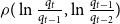
Despite the parsimony of the baseline model, both the learning and the rational expectations model replicate relatively well the volatility of production and the volatility of most other variables. However, both models tend to overpredict the volatility of debt, and they unsurprisingly have difficulties in replicating the volatility of hours due to the simplicity of labor market decisions in standard basic real business cycle models. When the rational expectations model is solved with the same parameter values as the learning model, the model cannot match the volatility of the distinct variables, thus revealing that strong amplification mechanisms arise under learning. In addition, the learning model replicates the high autocorrelations observed in the data, better than both versions of the rational expectations model. The learning mechanism indeed acts as an endogenous source of persistence without needing to resort to habit or other exogenous sources of persistence. The learning model also replicates the strong procyclicality in the model variables, even though the model tends to overpredict the correlation of debt and house prices with output. In addition, interestingly, the learning model predicts a positive autocorrelation in house price growth
 $\rho(\,\ln{\frac{q_t}{q_{t-1}}},\ln{\frac{q_{t-1}}{q_{t-2}}})$
, as observed in the data. The rational expectations model is unable to replicate this feature of the data. Indeed, unlike the learning model which generates extrapolation in house price beliefs and thus autocorrelation in housing returns, the rational expectations model generates a mean-reverting behavior in housing returns.
5.3. Impulse response functions analysis
To better understand the amplification mechanism in operation in the learning model, the impulse response functions to the two shocks under learning and under rational expectations are displayed below. The impulse response functions represent log-deviations from the steady state in response to a one-standard-deviation positive productivity shock and a one-standard-deviation negative lenders’ preference shock.Footnote 8
Following a productivity shock (Figure 1), entrepreneurs increase labor demand and investment, and output grows. Demand for housing grows, in particular in the borrowing sector, because holding housing assets relaxes the borrowing constraint. This growth in demand is reflected in higher house prices. Credit increases in equilibrium, in response to the relaxation of the borrowing constraint. Consumption increases due to a rise in wealth.
Impulse response functions following a positive productivity shock.

Despite this common mechanism, there are significant differences between the impulse response functions in the learning and rational expectations model. In the learning model, house prices are booming following the shock. Indeed, the initial effect of the shock is amplified over time; house prices display a persistent hump-shaped response due to the specific dynamics of housing returns expectations. Equations (15) and (21) show how changes in house prices that are expected to be persistent under learning have a multiplier effect on borrowers’ consumption. Similarly, response of credit to the shock is initially stronger and is amplified over time relative to the response in the rational expectations model. Hours worked also react more strongly in the learning model. The responses of aggregate output, consumption, and investment are also stronger and slightly hump-shaped compared to the same responses in the rational expectations model. However, consumption in the lending sector increases less under learning than under rational expectations because more money is transferred into the future through credit. Therefore, at the aggregate level, the higher increase in consumption in the borrowing sector under learning is partially offset.
A negative lenders’ preference shock (Figure 2) implies that patient households value the current period less and are, thus, more willing to transfer money into the future through lending. This shock thus mimics a context of higher willingness to lend and easier access to credit independent of borrowers’ net worth.
Impulse response functions following a negative lenders’ preference shock.

Following the shock, patient households increase the credit supply, because the marginal utility of current consumption becomes smaller. Borrowers increase investment in housing assets and credit is higher in equilibrium. Consumption increases, along with output. Once again, in the learning model, the shock generates an endogenous boom in house prices, whereas the response of house prices is much smaller and not persistent in the rational expectations model.
The differences between the learning model and the rational expectations model are stronger for the discount factor shock than for the productivity shock, because the former produces less offsetting effects between sectors. The responses of macroeconomic and credit variables are clearly amplified under learning, and the initial effect of the shock on these variables is propagated over time. Differences in the impulse response functions relate to differences in the evolution of expected housing returns and prices, which affects current housing demand in the three sectors of the economy and thus also affects intertemporal trade-offs and the financial accelerator mechanism. The actual law of motion under learning differs from the actual law of motion under rational expectations to the extent that two additional state variables appear in the model’s reduced form summarized by the policy function: the mean belief for house price growth
 $\ln(\hat{\mu _t})$
and the lagged forecast error, which are slow-moving variables. The fact that under learning current and expected variables depend on these state variables thus amplifies the effects of shock on house prices and the other model variables.
5.4. Explaining non-rational patterns in expectations: forecast errors predictability
I now investigate the ability of the learning model to explain some features of house price and macroeconomic expectations, as measured by survey data. In particular, the latter reveal that forecast errors are correlated with variables that were observable at the time of the forecast. By contrast, the rational expectations hypothesis implies that forecast errors are unpredictable because all information available at the time of the forecast is already incorporated into the forecast. Consequently, by nature, models that assume rational expectations fail to explain the data in what regards the formation of expectations. Table 3 presents evidence of forecast errors predictability in survey data about expected future macroeconomic variables and housing returns and compares this predictability to that obtained by the learning model and the rational expectation model with RE calibration. Correlations in both models are obtained from data simulations of length 50,000. Forecast errors for annual house price returns in period
 $t$
are defined as
 $\varepsilon _{R_{q_{t+4}}}=\ln(q_{t+4})-\ln(q_t)-E_t^P[\ln(q_{t+4})-\ln(q_t)]$
. In the learning model, they are equal to
 $\ln(q_{t+4})-\ln(q_t)-4 \ln(\hat{\mu _t})$
. In the data, forecast errors for annual house price returns are the difference between realized annual house price growth and 1-year-ahead household forecasts from the US Michigan Survey of Consumers available for 2007–2019. Forecast errors for output, investment, and consumption (
 $\varepsilon _Y$
,
 $\varepsilon _I$
and
 $\varepsilon _C$
) are retrieved from the Survey of Professional Forecasters and are computed for annualized quarter-on-quarter growth rates of the variables for 1985−2019. P-values are displayed in parentheses.
Forecast errors predictability

The results reveal that the learning model is able to replicate the sign, and, to some extent, the size, of the predictability of forecast errors, even though predictability was not targeted in the calibration method. Thus, the learning model predicts a strong positive correlation between housing returns forecast errors and house price growth at the time of the forecast. This feature emerges because agents tend to underpredict housing returns when house prices start to rise (i.e., when house price growth is high). In what regards the forecast errors of macroeconomic variables, the learning model succeeds in replicating the positive sign of the correlation of these errors with the observed house price growth at a short-term horizon. This positive correlation suggests that agents tend to underpredict future macroeconomic variables at the beginning of a housing boom.
6. Conclusion
The present note proposes an interpretation of the recent US macro-financial linkages based on imperfect knowledge regarding the formation of house prices and on learning about the perceived law of motion of housing returns. The model’s quantitative results suggest that learning about future house prices offers an intuitive mechanism for explaining the joint dynamics of macroeconomic variables, credit, and house prices in a simple and standard production economy, while considering that the empirical validity of the rational expectations assumption is called into question. Therefore, the results of the learning model offer additional empirical support for modeling the perceived process for asset price returns as an unobserved component model, as assumed in the recent literature. The promising results that are obtained despite the small scale of the model pave the way for several extensions in larger DSGE models, allowing to derive optimal policies when asset prices display expectations-driven excess volatility.
Acknowledgments
I am very grateful to Fabian Winkler for detailed explanation on the implementation of the approximation method for the learning equilibrium and for feedback. I also thank an anonymous referee and an anonymous associate editor, Zouhair Ait-Benhamou, Sophie Béreau, Camille Cornand, Frédéric Dufourt, Valérie Mignon, Fabien Tripier, Mirko Wiederholt, and participants at the 24th CEF Conference at Università Cattolica del Sacro Cuore, at the 32nd EEA Congress at the University of Lisbon, at the 34th Symposium on Money, Banking, and Finance at the Université Paris Nanterre, at the ADRES Doctoral Conference at the Toulouse School of Economics, at the 21st T2M Conference at the Lisbon Catolica University and at the EconomiX lunch seminar. Any remaining errors are my own.



