Introduction
Angiomyoma, also known as angioleiomyoma or vascular leiomyoma, is a benign, soft tissue neoplasm composed of encapsulated bundles of smooth muscle cells and prominent vascular channels. It usually develops in the lower extremities.Reference Enzinger, Weiss, Enzinger and Weiss1–Reference Hachisuga, Hashimoto and Enjoji3 Oral angiomyoma is considered rare. Among 12 cases of angiomyoma, the intraoral site distribution was as follows: lip, 49 per cent; palate, 21 per cent; buccal mucosa, 9.2 per cent; tongue, 9.2 per cent; and buccal sulcus, labial sulcus, floor of the mouth and gingiva, 0.9 per cent each.Reference Brook, Nikitakis, Goodman and Levy4 Lesions occurring in the submandibular area, submandibular salivary gland or inside the bony mandible have also been reported.Reference Wong, Ahuja, Chow and King5–Reference Bhatt and Brave7 Buccal vestibule angiomyoma is considered very rare.
There are no cytogenetic reports relating to oral angiomyoma. Karyotype evolution and chromosomal imbalances have been reported in cases of angiomyoma of the lower extremities and uterus.Reference Henning, Caselitz, Stern, Bartnitzke and Bullerdiek8, Reference Nishiho, Iwasaki, Ohjimi, Ishiguro, Kobayashi and Nabeshima9
The purpose of this report was to describe an unusual case of angiomyoma occuring in the buccal vestibule, with a normal karyotype.
Case report
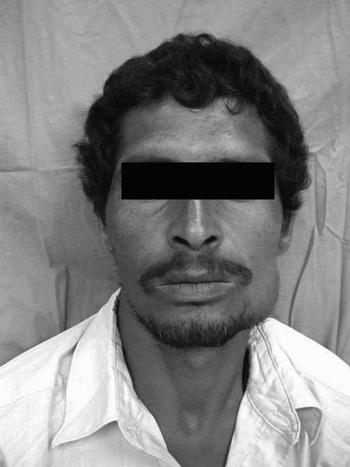
A 39-year-old man presented with a mass in the buccal vestibule of the left mandible, of several months' duration (Figure 1). The lesion was asymptomatic but had increased in size. There was no previous trauma or contributory medical history.
A 39-year-old man showing a mass in the left buccal area.

Physical examination revealed a well defined, submucosal mass involving the vestibule of the left mandible. There was no cervical lymphadenopathy, and the laboratory data were unremarkable.
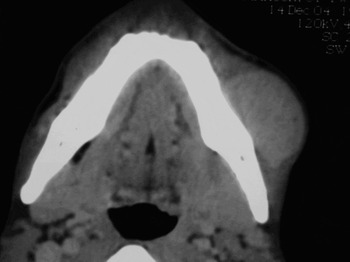
An axial computed tomography (CT) scan of the mandible revealed a somewhat hypervascular, 35 × 33 × 20 mm, soft tissue mass, with no invasion of the periosteum or bone (Figure 2).
Axial computed tomography scan of the mandible, showing a soft tissue mass lateral to the body of the mandible, with no invasion of the periosteum or bone.

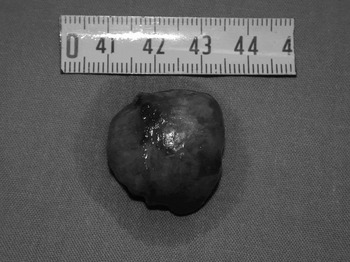
During the surgical procedure, which was via a submandibular approach, a well demarcated mass was found just under the platysma muscle. The surgical specimen was 35 × 33 mm in size (Figure 3).
The surgical specimen was a round, firm, 35 × 33 mm, soft tissue mass.

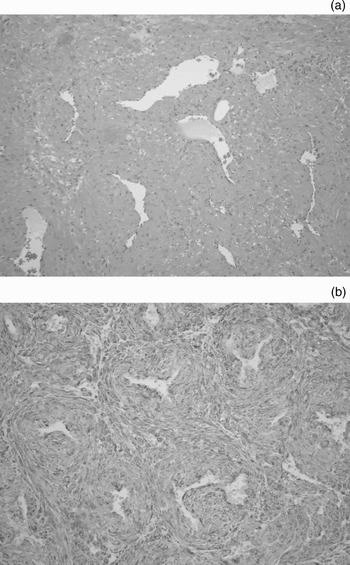
Microscopic examination of the soft tissue mass revealed a well circumscribed and encapsulated tumour, characterised by bands of smooth muscle cells surrounding multiple vascular spaces of varying size. The cells were positive for smooth muscle actin immunostain, which was consistent with angiomyoma (Figure 4a and b).
Photomicrograph of the angiomyoma, showing a whorled pattern of smooth muscle bundles with many vascular spaces. (a) H&E, ×40; (b) smooth muscle actin immunostain, ×40.

Cytogenetic analysis revealed a normal karyotype.
The patient's post-operative course was uneventful, and there was no evidence of recurrence after a follow-up period of 12 months.
Discussion
Leiomyomas comprise a group of benign tumours of smooth muscle origin. They are categorised into three subtypes: solid, vascular or epithelioid (leiomyoblastoma).
The solid leiomyoma is the typical form, occuring most commonly in the uterus and gastointestinal tract.Reference Farman10 The angiomyoma, also known as vascular leiomyoma or angioleiomyoma, is the second most common subtype, occurring mainly in the extremities. Leiomyomas of any type are very rare in the oral cavity, making up five cases in a series of 7748 cases involving all sites.Reference Farman10 A series dividing 142 oral leiomyomas into the classic three subtypes (solid leiomyoma, angiomyoma (i.e. angiomyoma and vascular leiomyoma) and epithelioid leiomyoma) clearly showed the predominance of angiomyoma, with 94 cases. Solid leiomyoma was next in frequency, with 45 cases, and there were only two cases of epithelioid leiomyoma.Reference Baden, Doyle and Lederman11
A recent review of oral angiomyoma reported that the lips were involved in 50 per cent of cases, the tongue in 9 per cent, and the buccal vestibule in less than 1 per cent.Reference Brook, Nikitakis, Goodman and Levy4
The reported age range for oral angiomyoma is from three to 85 years, with the mean in the fifth decade. Oral angiomyoma is most often a well defined, slow-growing and painless lesion.Reference Hachisuga, Hashimoto and Enjoji3, Reference Brook, Nikitakis, Goodman and Levy4 A single case of a painful angiomyoma has been reported.Reference Toida, Koizumi and Shimokawa12
Regardless of location, the treatment is usually surgical and recurrence is rare.
When a patient presents with a soft tissue mass in the buccal vestibule, the differential diagnosis should include haemangioma, lymphangioma, cystic hygroma, granular cell tumour, schwannoma, pleomorphic adenoma, fibroma, neurofibroma, solitary fibrous tumour and low-grade fibrosarcoma.
Radiological imaging plays an important role in the evaluation of the composition, extent and possible bone invasion of any mass in the oral region. In the present case, CT scans suggested that the mass was somewhat hypervascular, a fact not confirmed by magnetic resonance imaging (not shown).
The origin of oral angiomyoma is obscure. Due to the scarcity of smooth muscle in the oral region, leiomyomas are relatively uncommon. The possible sources of smooth muscle in the oral cavity include blood vessels, circumvallate papillae and heterotopic smooth muscle.Reference Cherrick, Dunlap and King13 It has been suggested that angiomyoma represents just one stage in a continuous process of pathological smooth muscle proliferation. The possible sequence of progression would be haemangioma, angioma, angiomyoma, leiomyoma and solid leiomyoma.Reference Miles and Waterhouse14
Microscopic diagnosis might occasionally be difficult, because the spindle cell proliferation has many similarities with neurofibroma, schwannoma and fibromatosis.
As seen in the present case, immunohistochemistry is a valuable, precise and reliable method of establishing a definitive diagnosis of oral angiomyoma, in particular for the differential diagnosis of spindle cell neoplasms arising in the oral cavity.
The microscopic differential diagnosis of angiomyoma involving the oral cavity includes a variety of lesions: haemangiopericytoma, solitary myofibroma, fibrous histiocytoma, desmoid tumour, spindle cell lipoma, myofibroma, peripheral nerve sheath tumour, leiomyosarcoma and fibrosarcoma.
• This paper describes a case of angioma of the buccal vestibule
• Most oral angiomatous lesions occur in the lips and tongue
• This is a rare case with a normal karyotype
In the present case of oral angiomyoma, cytogenetic analysis appeared to be normal. This is in contrast to the karyotype evolution and chromosomal aberrations (such as translocation) found in cases of angiomyoma of the lower extremities and uterus.Reference Henning, Caselitz, Stern, Bartnitzke and Bullerdiek8, Reference Nishiho, Iwasaki, Ohjimi, Ishiguro, Kobayashi and Nabeshima9 To our knowledge, the present case is the first to report cytogenetic findings in a case of oral angiomyoma. The reason for our patient's normal karyotype, as opposed to the reported karyotype abnormalities in cases of uterine and lower extremity angiomyoma, is unclear. It might be due to difference in tumour grade at the time of the analysis, or to some site-specific aetiology. Further cytogenetic studies may shed some light on this issue in the future.
Conclusion
We report an additional case of an angiomyoma affecting the buccal vestibule. The tumour showed the typical morphological and immunoreactive features of angiomyoma, but the patient exhibited a normal karyotype. There was no evidence of recurrent disease after a 12-month follow-up period. Although rare, angiomyoma should be included in the differential diagnosis of oral soft tissue tumours.