The concept of Black Power rests on a fundamental premise: Before a group can enter the open society, it must first close ranks. By this we mean that group solidarity is necessary before a group can operate effectively from a bargaining position of strength in a pluralistic society.
—Stokely Carmichael and Charles V. Hamilton, Black Power (Reference Carmichael and Hamilton1967, p. 44)
The basis for the claim that the United States is a “nation of immigrants” originates well before the country's founding, with settlers and slaves pouring into the colonies from England, continental Europe, and Africa, and pushed into an uneasy, often violent, coexistence with indigenous and sovereign tribal states already in the United States. Throughout the nation's history, there have been vigorous debates over whether the Republic would (and should) be defined by one or many national, ethnic, and cultural traditions; and, if many, whether that diversity would breed a factionalized politics around ascribed and agonistic identities or flourishing pluralist politics around countervailing and constitutive groups. In the eighteenth century, this debate was well represented by the contrast between Hector St. John de Crèvecoeur's optimism in 1782 about “a new race of man, whose labors and posterity will one day cause great changes in the world,” (Reference De Crèvecoeur1782[1981]) and Benjamin Franklin's surliness in 1751 about the “Palatine boors” who would turn his beloved Pennsylvania into a “colony of aliens” (Archdeacon Reference Archdeacon1983, p. 20).
Debates over the United States' pluralist foundations and their effect on our civic, social, economic, and political life have continued through each successive wave of immigration and throughout the long history of struggles for equality and freedom for indigenous, colonized, and enslaved peoples living under the control of the U.S. government. Today, the questions of whether and how diversity fits within the American liberal-democratic tradition come to a head with the unprecedented transformation of the U.S. population in recent decades. These sweeping demographic changes force a remaking of our conceptions of membership, identity, and belonging, and demand a reconsideration of our existing scholarly theories and frameworks for examining diversity and the varieties of politics it is likely to engender. A foundation stone in this matter is the expectation that individuals who share a demographic label—e.g., African American, Latino, Asian American, Arab American—will also share common political goals and interests and act in concert to pursue them. In the U.S. context, a common reference point for this expected “identity-to-politics” link is the case of African Americans in the civil rights era, as represented in the above epigraph by Stokely Carmichael (Kwame Touré) and Charles Hamilton. But does the case for African Americans in the post–civil rights era of U.S. politics also hold true for emerging immigrant-based ethnic communities in our contemporary multiracial, multicultural context?
In this essay, I look closely at this foundation stone, find some cracks in it, and attempt to cement these fissures by focusing on five key relationships, or constitutive processes, that link demographic identities to group politics. After a summary of the demographic changes we have witnessed and the implied link between demographic categories and changes in the nature and dynamics of group-based politics in the U.S. republic, I examine several assumptions that are built into empirical studies of this identity-to-politics link. Specifically, I argue that we need to separate out—both conceptually and empirically—at least five distinct processes: (1) definition, (2) identification, (3) consciousness, (4) venue selection, and (5) choice. The potential value of breaking down the conflation of demographic definition with collective choice, and the relationships in between, is demonstrated with a brief discussion of the potential gap between how racial/ethnic groups are categorized and classified/defined and how we measure “race” in scholarly research. The essay concludes by situating this proposed approach to the identity-to-politics link in current debates about scholarship on identity, with an eye to the potential value as well as the important limitations of this approach.
IMMIGRATION AND THE IDENTITY-TO-POLITICS LINK
On October 3, 1965, congressional leaders, governors, mayors, media personnel, and President Lyndon Baines Johnson gathered together in front of the Statue of Liberty for a bill-signing ceremony. Congress has passed the legislation with strong majorities: 76 to 18 in the Senate, and 326 to 69 in the House of Representatives. As President Johnson prepared to sign this piece of legislation, he remarked that “this bill we sign today is not a revolutionary bill. It does not affect the lives of millions. It will not reshape the structure of our daily lives, or really add importantly to either our wealth or our power” (Johnson Reference Johnson1965, p. 1038). The bill's main effect, as Johnson saw it, would be to end and amend older laws on this issue that “violate the basic principle of American democracy” (Johnson Reference Johnson1965, p. 1037).
The legislation being celebrated was an amendment to the Immigration and Nationality Act, popularly known as the “Hart-Cellar” Act. The actual terms of the bill were rather modest. U.S. immigration policy would no longer set quotas based on national origin; it would allow preferences for relatives of persons already in the United States, and for certain labor skills and professional training. As Johnson's remarks suggest, the Hart-Cellar Act was initially hailed not because anyone expected it to result in significant, sustained changes in immigration flows into the United States, but rather because of its symbolism in the context of the Cold War. Other leading political voices at the time shared this sentiment. Attorney General Robert F. Kennedy, in his 1964 testimony to Congress, remarked that “I would say for the Asia-Pacific Triangle … 5,000 immigrants would come the first year, but we do not expect that there would be any great influx after that” (from Reimers Reference Reimers1992, p. 74). Senator Edward Kennedy observed, in subcommittee hearings, that “the bill will not flood our cities with immigrants. It will not upset the ethnic mix of our society. It will not relax the standards of admission. It will not cause American workers to lose their jobs” (U.S. Senate 1965, p. 3).
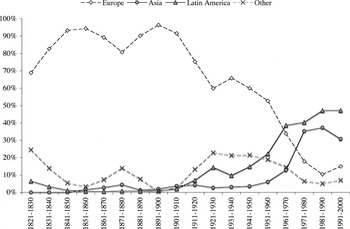
We now know, with the full benefit of hindsight, that Johnson and the Kennedy brothers could not have been more wrong. The Hart-Cellar Act sparked a profound demographic transformation. In sheer volume, we are witnessing the largest influx of immigrants since the early twentieth century. According to U.S. Bureau of the Census statistics, immigrants and their children comprise close to one in four Americans today, with more than 34 million foreign-born and more than 30 million second-generation immigrants in the United States in 2004 (U.S. Bureau of the Census 2004). These numbers compare to 9.6 million foreign-born residents and 24 million second-generation immigrants in 1970 (Gibson and Lennon, Reference Gibson and Lennon1999). In addition to the upsurge in the foreign-born, this wave of immigration has also produced a sea of change in the racial and ethnic composition of this nation. Contemporary immigrants come from different shores than the earlier immigrants from Europe, arriving instead from Asia, the Caribbean, and Latin America. As Figure 1 shows, up until the first decade of the twentieth century, about 90% of new migrants to the United States set sail from European shores. By the 1980s, this proportion had dwindled to about 12%, with about 80% of new migrants coming from Asia and the Americas (U.S. Department of Homeland Security 2006).
Immigration by Region, 1821–2000

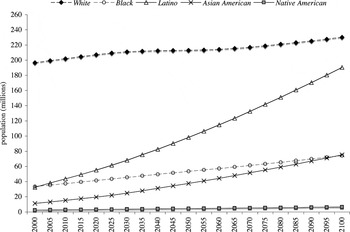
These immigrant-induced demographic changes are likely to continue in the foreseeable future. In the latest 2000 decennial census, Latinos emerged as the largest non-White minority in the United States. Moreover, according to U.S. Census Bureau projections, the Latino population will grow from 36 million today to more than 100 million by 2050; the Asian American population will grow from 11 million today to more than 33 million by 2050. Importantly, as Figure 2 shows, the United States will become a “majority-minority” nation sometime in the middle of this century, when White Americans are projected to fall below 50% of the U.S. adult population. This majority-minority status already describes the demographics of New Mexico, Hawaii, and California, as well as numerous cities throughout the nation.
Census Population Projections, 2000–2100

These sweeping demographic changes, moreover, are occurring in the midst of equally far-reaching changes in the way we categorize and classify people. Starting with the shift from enumerator observation in earlier censuses to respondent self-identification in the 1960 U.S. Census, we have seen a succession of dramatic changes in our system of ethnoracial classification, with the introduction of a separate Hispanic ethnic identifier in 1980; a proliferation of Asian, Pacific Islander, American Indian, Native Hawaiian, Alaska Native categories in 1980 and 1990; and, in the most recent decennial census, the option of choosing more than one among these categories. These changes both reflect and contribute to the multiplicity and hybridity of identities defined by race, ethnicity, and national origin, and are compounded by the critical intersections of these boundaries with other identities defined by gender, class, sexual orientation, religion, region, and the like (Omi Reference Omi, Smelser, Wilson and Mitchell2001). As political scientist and former director of the U.S. Census Bureau, Kenneth Prewitt explains, “The nation moved suddenly, and with only minimal public understanding of the consequences, from a limited and relatively closed racial taxonomy to one that has no limits” (Prewitt Reference Prewitt2001, p. 8). The United States, Prewitt declares, is now the most demographically complex nation in the world.
There has been no shortage of forecasts—both sunlit and somber—on where the prevailing winds of such demographic change will lead. A sampling of the wide range of considered opinions from scholars across varied disciplines includes:
ʼn Princeton sociologist Marta Tienda, who notes, “The diversification of the population warrants a realignment of democratic ideals with demographic realities” (Tienda Reference Tienda2002, p. 588).
ʼn Berkeley legal scholar Ian Haney-López, who claims, “A demographic revolution is underway…. This tectonic shift heralds more than a mere decline in relative numbers…. One thing is clear: the declining percentage of whites in America imperils continued white dominance” (Haney-López Reference Haney-López2005, pp. 42–43).
ʼn Stanford historian David Kennedy, referring specifically to immigration of Mexican origin, who predicts, “They could also eventually undertake to do what no previous immigrant group could have dreamed of doing: challenge the existing cultural, political, legal, commercial, and educational systems to change fundamentally … the very institutions in which they do business” (Kennedy Reference Kennedy1996, p. 67).
ʼn Harvard political scientist Samuel Huntington, who declares forebodingly that this new wave of migration threatens “the end of the America we have known for more than three centuries” (Huntington Reference Huntington2004, p. 43).Footnote 2
Such prognostications share, in varying degrees, a common yet unexamined expectation that the politics that accompanies pluralistic societies is based in identity claims and characterized by groupism, which Rogers Brubaker defines as the “tendency to take discrete, sharply differentiated, internally homogeneous and externally bounded groups as basic constituents of social life, chief protagonists of social conflicts, and fundamental units of social analysis” (Brubaker Reference Brubaker2002, p. 164). A widespread version of this assumption is to take the racial and ethnic identity categories that are common in practice and in research and infer that there is a group-based politics that will emerge out of these identity categories. For example, using the “ethnoracial pentagon” defined by the categories of the Office of Management and Budget Directive No. 15 (Hollinger Reference Hollinger1995), we typically talk in terms of an “African American politics,” an “Asian Pacific American politics,” a “Latino politics,” and so on.
A prevailing instance here is represented by multivariate regression equations in which some political variable of interest is explained by including a “dummy” variable for a given racial/ethnic category. For instance, in specifying the determinants of voter turnout using survey data, we might include a measure of whether respondents self-identify as Latino or Asian American. Or in explaining public support for affirmative action, we might include a variable for self-identification as African American. In the first example, the parameter estimates on the Latino and Asian American variables will be negative, statistically significant, and with a strong magnitude of effect; similarly, the parameter estimates on being African American will be positive, statistically significant, and large.
Importantly, if we hew narrowly to the assumptions built into regression analysis, a number of specific implications about the identity-to-politics link follow from these kinds of statistical analyses. Such models imply, to start, that Latino, Asian American, and African American are exogenously given categories vis-à-vis one's voting behavior and opinions on affirmative action. Second, they further imply that respondents who self-identify with these categories are observationally distinct vis-à-vis their voting behavior and opinions on affirmative action from those who do not so self-identity. Ceteris paribus, a third implication is that these respondents are observationally equal as Latinos, Asian Americans, and African Americans vis-à-vis other respondents who self-identify with these categories. Finally, the inclusion of these variables into the regression analysis implies some theoretically motivated expectation for a statistical relationship between a racial/ethnic category and the dependent variable of interest.
Each of these implications merits further scrutiny. As the voluminous literature on “new social movements” suggests, self-identification with a given identity category may not always be exogenous to a political phenomenon of interest. Second, the relationship between self-identification and the phenomenon of interest may not be as sharply demarcated as the unqualified difference between being assigned a value of 1 if a respondent self-identifies as Latino or Latina and 0 if otherwise. Third, if self-identification as Latino or Latina is taken as a valid and reliable measure of an underlying construct of interest (in the given example, a person's “race” or “ethnicity”), not everyone who is assigned the equivalent value of 1 is likely to be the same vis-à-vis their sense of racial/ethnic identity. Finally, in some cases, a compelling theoretical argument is given for the expectation that these categorical variables will be statistically significant. In other cases, however, the measures are simply included in the model specification as “control variables,” to take into account factors that are of secondary interest to the researcher (and, therefore, theoretically unspecified or underspecified) but are nonetheless likely to matter to the dependent variable in question. Given the insidious and invidious reach of race as an organizing principle in social, political, and economic life in the United States today, the latter case—of including “race” on the right-hand side of a regression model for no clear reason other than its likelihood of being a significant factor—is simply all too common.
Beyond these limitations specific to regression analysis is a more general problem in considering how the identity-to-politics link works given the context of the contemporary, post-1965 wave of immigration. Namely, we continue, for the most part, to examine a dynamic period of profound change, disruption, and disarticulation by applying the same, static research questions, conceptual frameworks, and methodological tools that were used in earlier periods. The fact of change is not, in and of itself, a reason to radically reconsider how we go about our work, since change is constant. Political parties realign, elites and mass publics polarize, political trust and efficacy levels rise and fall, and so on.
What motivates the concern about how we go about studying the identity-to-politics link, however, is that the concepts, categories, models, and methods we use all too often prefigure the conclusions we draw about a given phenomenon of interest. If we are motivated, then, to ask whether immigration will lead to a new politics of race—of the sort recapitulated by Tienda, Haney-López, Kennedy, Huntington, and others—it is apposite to reconsider our approach to that question. Put otherwise, if we, as social scientists, are in fact currently witnessing a transformation in race relations and racial politics, we may miss this change by adhering too closely to well-grooved concepts, categories, models, and methods.
One commonly remarked-upon anchor that moors our thinking is the unreconstructed translation of a Black-White “paradigm” to the study of the politics of Latinos, Asian Americans, Afro-Caribbeans, Arab Americans, and others (McClain and García, Reference McClain, García and Finifter1993; Dawson and Cohen, Reference Dawson, Cohen, Katznelson and Milner2002; Segura and Rodrigues, Reference Segura and Rodrigues2005; Lee Reference Lee, Kernell and Smith2006). While this approach to the study of the identity-to-politics link is not a paradigm per se, in a Kuhnian sense, there is, more specifically, an “African American politics” archetype that motivates much of our current work in this area. Archetype is used here because the identity-to-politics link for African Americans is demonstrably present and strong (Shingles Reference Shingles1981; Walton Reference Walton1985; Bobo and Gilliam, Reference Bobo and Gilliam1990; Tate Reference Tate1993; Dawson Reference Dawson1994; Barker et al., Reference Barker, Jones and Tate1999; Gay Reference Gay2001; Hutchings and Valentino, Reference Hutchings and Valentino2004; Shelby Reference Shelby2005). If the precepts of groupism that Brubaker and others identify—group differentiation, ingroup homogeneity, outgroup demarcation (essentially, the functional definition of social group identities, following Tajfel and Turner, Reference Tajfel, Turner, Worchel and Austin1986)—are to be found in any group, they are found among African Americans in the pre- and immediate post-civil rights era.
Not surprisingly, then, this African American politics archetype is often both implicitly and explicitly the point of reference for studies of whether ethnic or panethnic identity is a significant and independent determinant of the political behavior of Latinos and Asian Americans (Jones-Correa and Leal, Reference Jones-Correa and Leal1996; Leighley and Vedlitz, Reference Leighley and Vedlitz1999; Bobo and Johnson, Reference Bobo, Johnson, Bobo, Oliver, Johnson and Valenzuela2000; Lien Reference Lien2001; Lien et al., Reference Lien, Conway and Wong2004; Masuoka Reference Masuoka2006; Barreto Reference Barreto2007). In using African American politics as an archetype, however, there is a tacit implication that the identity-to-politics link is functionally isomorphic between African Americans and other comparison groups. Thus when scholars of Black politics find evidence for a strong role for group consciousness or a “linked fate heuristic,” or indigenous Black institutions in defining collective politics for African Americans, other scholars of the politics of Latinos, Asian Americans, Native Americans, and so on, see evidence of a similar role of these factors in defining the collective politics for these groups. This presumption of functional isomorphism, too, is a potential pitfall. Among other reasons, this is because the elements of “groupness” are likely to differ for emerging collectivities like Latinos, Asian Americans, and Arab Americans, and are defined not only, in the main, by the intersection of race and class, as in the case of African Americans, but also by nationality, panethnicity, language, religion, and so on.
LINKING IDENTITY TO POLITICS
We have reviewed a number of reasons to be cautious about assuming that because populations are defined by shared racial and ethnic labels, they will engage in collective politics based on those group definitions. To wit, these potential pitfalls beg for a clearer framework for specifying how the identity-to-politics link might differ across identity classes (e.g., race, gender, partisanship) and identity categories (e.g., Asian American, male, and Democrat). For the present purposes, I focus on identity categories. How, then, might we unpack the way in which specific racial/ethnic identity categories are linked to a group politics organized around these categories?
I contend that, in many of our existing analyses of the identity-to-politics link, there are five specific and distinct constitutive processes that are often bundled together in an unexamined and nonspecific manner. This bundling is most commonly found in individual-level, survey-based studies of political behavior. In what follows, I describe each of these processes in terms of questions that are typically assumed, not asked. I also briefly discuss why these questions are worth asking—that is, why the answers to these questions are likely to be variable and, in that variation across contexts, likely to give us a clearer and more precise understanding of how demographic categories arise and are linked to group politics.
Step 1: Definition
The first step in examining the identity-to-politics link is deciding how to define, categorize, and measure the concept. Are the identity categories we use to define and measure a population in racial/ethnic terms fixed and stable, or are they malleable and porous? As a philosophical matter, there are many possible analytical cuts we can take on the concept itself—starting with the questions “What is identity?” and “Which identities?”—most well beyond the scope of this paper and better left to other scholars (Du Bois Reference Du Bois1940[1983]; Hannaford Reference Hannaford1996; Hacking Reference Hacking1999; Shelby Reference Shelby2005; Bilgrami Reference Bilgrami2006; Sen Reference Sen2006). As a practical matter, we need to start somewhere, and a typical point of departure is from the allied identity dimensions of race and ethnicity.
Given this point of departure, the question of how to define categories and measure identities is often taken for granted (or, in the case of how identity is used as a variable in regression analysis, presumed to be exogenous). But there is now a wealth of studies that show the extent to which the categories that we use are not foreordained, but wrought through social and political processes. Perhaps most prominent among these are studies of the U.S. Census Bureau's evolving racial classification system (Lee Reference Lee1993; Anderson and Feinberg, Reference Anderson and Feinberg1999; Nobles Reference Nobles2000; Rodríguez Reference Rodríguez2000; Snipp Reference Snipp2003). Spurred by the U.S. Constitution's mandate in Article 1, Section 2 to apportion taxes and representation according to “the whole Number of free Persons … and excluding Indians not taxed, three-fifths of all other persons,” the United States has categorized and counted the nation's population since the U.S. marshals conducted the first decennial census in 1790. For our purposes, there are two important features of these decade-to-decade changes. First, with the exception of White, the categories used to define a given race have been quite variable across censuses. Second, the number of categories, in toto, has multiplied considerably over the long history of the census. In the most recent decades, this proliferation of categories has been especially notable in the case of Asian/Pacific Islander categories, in the separation of Hispanic as an “ethnic” category separate from all other “races,” and in the creation of a new multiracial “mark one or more” identifier. This contingency and changeability of “race” in bureaucratic and legal codes and rulings is taken as evidence, in some quarters, of the central role of elite dynamics, mass movements, and the modern nation-state in the political construction of our starting points (Omi and Winant, Reference Omi and Winant1994; Nobles Reference Nobles2000; Lie Reference Lie2004; Smith Reference Smith2003; Williams Reference Williams2006; DaCosta Reference DaCosta2007).
Step 2: Identification
Do the individuals who are defined by a given identity category identify themselves with that category? The mere existence of categories does not guarantee that the individuals to which they are meant to apply will identify with them. In part, this is the natural result of the distinction between identification, or how an individual thinks of herself, and ascription, or how that individual might be defined independent of how she views herself.Footnote 3 One powerful example of the importance of identification is in the varying responses of Latino and Latina Americans to the menu of “racial” categories in the census, with the modal response being Other Race, or what demographers might think of as a residual category (Rodríguez Reference Rodríguez2000; Haney-López Reference Haney-López2005; Lieberson and Waters, Reference Lieberson and Waters1993). Another example is the diversity of responses that populations defined, for sampling purposes, as Latinos and Asian Americans give to self-identification questions in opinion surveys. In the 2006 Latino National Survey, for instance, 62.6% of the sample identified “very strongly” as Hispanic or Latino; when asked whether they identified as Latino or Hispanic, American, or a national origin descriptor (e.g., Cuban), however, only 38.3% chose Latino or Hispanic.Footnote 4
In the case where scholars include a “dummy variable” for a racial or ethnic category of interest in a multivariate regression analysis, they either implicitly or explicitly assume that it is identification that links, causally, a demographic identity to a group-based politics. In light of the varying and contingent ways that individuals self-identify with such categories and, as we shall see, the multiple additional steps that link identity to politics but are ignored as a result, this is a dubious approach to making inferences. Importantly, by simply associating identification with identity per se, we are unable to distinguish whether identity or some other intervening variable is the basis for the association we see. Conversely, in cases where we fail to see any statistical association, we are also unable to distinguish whether it is because of the absence of a contributing role of identity or the effect of some confounding variable.
Step 3: Consciousness
Do individuals who self-identify with a given identity category also share common beliefs and interests? This is a decisive issue to examine because not all persons and groups who accept an ascribed identity label agree about what it means to be African American, Asian American, or Latino. These categories may, on the one hand, represent no more than a focal point for self-definition. On the other hand, they may also represent a basis for shared sentiments, beliefs, and interests. A long tradition of scholarship demonstrates that a sense of group consciousness is a key link between pooled demographic identification and collective political action. These studies were initially developed in the context of Black group consciousness as a key group-based resource that helps to explain African American political participation (Danigelis Reference Danigelis1978; Miller et al., Reference Miller, Gurin, Gurin and Malanchuk1981; Shingles Reference Shingles1981; Guterbock and London, Reference Guterbock and London1983; cf. Wolfinger Reference Wolfinger1965), but it has more recently also been applied to examine the participation of Latinos and Asian Americans, and to examine political outcomes beyond participation (Uhlaner et al., Reference Uhlaner, Cain and Kiewiet1989; Bobo and Gilliam, Reference Bobo and Gilliam1990; Dawson Reference Dawson1994; Lien Reference Lien1994; Marschall Reference Marschall2001; Stokes Reference Stokes2003; Chong and Rogers, Reference Chong, Rogers, Wolbrecht and Hero2004; Wong et al., Reference Wong, Lien and Conway2005; Chong and Rogers, Reference Chong and Rogers2005; Barreto Reference Barreto2007). When scholars go beyond merely adding a “race” variable to a statistical analysis, it is typically replaced by some measure of group consciousness.
There are, however, reasons to be cautious about this turn to group consciousness. Empirically, the evidence supporting the role of group consciousness in kindling collective political action appears somewhat mixed over time and across groups (Chong and Rogers, Reference Chong and Rogers2005; Junn Reference Junn, Lee, Ramakrishnan and Ramírez2006). With respect to temporal context, some research suggests that in the post–civil rights era, group consciousness is no longer as decisive a factor in explaining the political participation of African Americans (Bobo and Gilliam, Reference Bobo and Gilliam1990; Tate Reference Tate1993). With respect to group differences, the efforts to show evidence of a “group-consciousness effect” for non-Black minority groups such as Latinos and Asian Americans have been mixed at best (Uhlaner et al., Reference Uhlaner, Cain and Kiewiet1989; Lien Reference Lien1994; Verba et al., Reference Verba, Schlozman and Brady1995; Leighley and Vedlitz, Reference Leighley and Vedlitz1999; Marschall Reference Marschall2001). When a statistically significant effect is found, moreover, it is for group consciousness based in one's ethnic or national-origin attachments (e.g., as Chinese or Mexicans), not for one's panethnic attachments as Asian Americans or Latinos (Jones-Correa and Leal, Reference Jones-Correa and Leal1996; Bobo and Johnson, Reference Bobo, Johnson, Bobo, Oliver, Johnson and Valenzuela2000).
Beyond the empirical data, there is also a need for some conceptual brush clearing between group consciousness and kindred terms like group interests, solidarity, and linked fate. In particular, group consciousness, as it has been typically conceived, is measured by a battery of survey items: the belief in shared interests, ingroup favoritism, the sense of relative deprivation, and the systemic attribution of blame for unequal opportunities and outcomes (Olsen Reference Olsen1970; Verba and Nie, Reference Verba and Nie1972; Shingles Reference Shingles1981; Miller et al., Reference Miller, Gurin, Gurin and Malanchuk1981). Group interests per se, by contrast, can be either subjectively perceived or objectively defined (i.e., by one's “objective” position in the economy, polity, society). Similarly, racial solidarity is simultaneously both a descriptive and a normative concept (Shelby Reference Shelby2005). And in the case of “linked fate,” Dawson and his collaborators (Allen et al., Reference Allen, Dawson and Brown1989; Dawson Reference Dawson1994) make specific and deliberate commitments to the idea that “race” works in the human mind as a schema and that racial-group identity is sustained through a “linked-fate heuristic” in which individual judgments are made through the deployment of a racial-group utility calculus—what is best for me, individually, is determined by what I perceive to be in the best interests of my ingroup, collectively.
Step 4: Venue Selection
Do individuals who choose to act in pursuit of group-based interests coordinate and agree upon a common venue for their collective action? Or, put in less individualist terms, are the prevailing structures of economic, political, and social opportunity and mobility open or closed, vis-à-vis each other, to the pursuit of group-based interests? There are two relevant dimensions of venue to consider: whether the group ends should be pursued through political or nonpolitical means (i.e., economic, social, cultural means), and whether the appropriate political stage should be national, local, or transnational.
The importance of the first dimension is underscored by contrasting the defining efforts of African Americans across historical eras, in broad brushstrokes: economic self-empowerment in the late nineteenth century, and in the shift of the civil rights movement beyond the South; cultural self-definition during the Harlem Renaissance; political voice during and since the civil rights movement. It is also underscored by comparing the focus of African Americans in the political arena today with that of predominantly immigrant communities, such as many Asian American ethnic communities, where there is little evidence of collective investments in politics and far stronger evidence of collective investments, through ethnic entrepreneurialism and ethnic enclaves, in the economic and social realms (Light and Bonacich, Reference Light and Bonacich1988; Zhou and Logan, Reference Zhou and Logan1989; Portes and Zhou, Reference Portes and Zhou1992; Portes and Sensenbrenner, Reference Portes and Sensenbrenner1993; Sanders and Nee, Reference Sanders and Nee1996).Footnote 5 The importance of the second dimension—whether collective political interests are best pursued in the national, local, or transnational arena—is demonstrated by comparing the relatively circumscribed scope of understanding we draw from studies of immigrant political incorporation that focus on Latino and Asian American politics at the national level using “large-N” data sets (DeSipio Reference DeSipio1996; Lien Reference Lien2001; Ramakrishnan Reference Ramakrishnan2005; Lee et al., Reference Lee, Kernell and Smith2006) with the more nuanced and contingent story suggested by research at the local level (Padilla Reference Padilla1985; Jones-Correa Reference Jones-Correa1998; Saito Reference Saito1998; Kim Reference Kim2000; Kasinitz et al., Reference Kasinitz, Mollenkopf and Waters2004; García Bedolla Reference García Bedolla2005; Wong Reference Wong2006; Hajnal and Trounstine, Reference Hajnal and Trounstine2005) or in the transnational arena (Portes and Zhou, Reference Portes and Zhou1992; Portes and Sensenbrenner, Reference Portes and Sensenbrenner1993; Vertovec Reference Vertovec2001; Pantoja Reference Pantoja2005; Sawyer Reference Sawyer2005; DeSipio Reference DeSipio, Lee, Ramakrishnan and Ramírez2006). For example, the relative absence of Latinos and Asian Americans in nationally elected and appointed offices and the relative underparticipation of Latinos and Asian Americans in national elections may belie the presence of pivotal moments of panethnic politics beyond the national stage.
The process of venue selection is crucial because it forces us to examine how the will of the group (agency) works with, or in spite of, the forms of economic, political, and social organization (structure). It also forces us to consider how this negotiation varies between groups and across spatiotemporal and institutional contexts. For example, in the African American context, at the level of individual attitudes, the recognition of politics as a relevant venue for the pursuit of collective interests is deeply (perhaps inextricably) intertwined with collective economic aspirations and perceptions of intergroup competition (Bobo and Hutchings, Reference Bobo and Hutchings1996; Bobo and Tuan, Reference Bobo and Tuan2006; Dawson Reference Dawson1994, Reference Dawson2001; Lamont Reference Lamont2000). For emerging, immigration-based groups such as Asian Americans and Latinos (and their constituent ethnic groupings), there may be greater latitude for, and empirical evidence of, choice between economic, political, and social venues of collective pursuits, or so our working definitions of how ethnicity is differentiated from race would lead us to believe.
Step 5: Choice
Finally, do individuals agree, collectively, on the choice that best represents their group-based interests and ambitions? Individuals may have clearly defined group-based interests, but they may never act in pursuit of those interests in the political arena. In some cases, this is the result of a lack of group consciousness (Gaventa Reference Gaventa1980) or the adaptive shift to “everyday acts of resistance” beyond the realm of pluralist politics (Scott Reference Scott1987; Scott Reference Scott1992; Kelley Reference Kelley1994). In yet other cases, it may result from the logic of electoral competition (Przeworski and Sprague, Reference Przeworski and Sprague1986) or from the power of elite actors to keep issues and candidates of interest off the political agenda (Bachrach and Baratz, Reference Bachrach and Baratz1962). This key step of collective choice is often simply taken as a premise in the case of African American politics, where, for a given election, somewhere in the range of 80% to 90% of individuals falling within this demographic rubric identify, in chorus, with the Democratic Party, and vote, in lockstep, with its presidential candidate. It is, of course, precarious to cling too tightly even to this archetypal case of collective action, as the fiction of a durable African American political collective belies the rich diversity of political choices and the crosscutting claims on “groupness” facing this population (Cohen Reference Cohen1999; Dawson Reference Dawson2001; Berger Reference Berger2004; Harris-Lacewell Reference Harris-Lacewell2004).
In considering the range of outcomes where we might find evidence of identity politics specifically for newly emerging, immigration-based groups like Latinos and Asian Americans, we need to look beyond the conventional categories and boundaries of politics in the United States. That is, we need to look beyond the binary outcomes of voting or nonvoting, Democratic or Republican partisanship, and liberal or conservative ideological self-placement (Hajnal and Lee, Reference Hajnal, Lee, Lee, Ramakrishnan and Ramírez2006). In its place, we need to reconsider the boundaries of politics to include contentious politics—as manifested by the mobilization of protest marches in opposition to HR 4437 in the spring of 2006—as well as varieties of politics beyond voting, including engagement in civil society. We also need to move from synchronic measures of choice—voter turnout and choice in a given election—to the relational, processual, and dynamic study of choice, such as the acquisition of citizenship and partisanship, the mediation of cultural practices and ideological beliefs in the United States with those in one's home country, the building of indigenous institutions and multiracial coalitions, and the like (Guidry and Sawyer, Reference Guidry and Sawyer2003; Ramakrishnan Reference Ramakrishnan2005; Wong Reference Wong2006; García Bedolla Reference García Bedolla2005).
RACIAL CLASSIFICATION AND THE MEASUREMENT OF RACE
The above discussion of definition, identification, consciousness, venue selection, and choice invites us to think in terms of analytically separable and empirically distinct constitutive processes and relationships that bridge demographic categories to collective group politics. Ultimately, the proof of this pudding lies in having something to taste. In this section, I describe one example of the possible added value of thinking critically about constitutive processes, and consider the implications of taking seriously the processes of racial definition and identification for our current approaches to measuring race empirically.
To begin, the attention to definition and identification foregrounds the important point that if ethnoracial classification systems change over time and if our identification with a given set of categories shifts across groups and contexts, then we should approach the measurement of race and ethnicity in our empirical research in ways that allow us to capture important shifts in how individuals self-identify in ethnoracial terms as the demographic composition of a population changes and as the ethnoracial terms we use to describe that population change. To wit, while changes in the nation's population, our ethnoracial classification systems, and our understandings of race and ethnicity itself have been breathtaking, the methods and measures we use to study race and ethnicity have remained, for the most part, constant. For instance, for at least the past six decades, opinion surveys have asked its respondents some version of the question “What racial or ethnic group best describes you?” or “What is your race?” In this standard format, respondents are asked to choose from a typical menu of racial/ethnic categories—say, Black, Asian, Native American, Hispanic or Latino, White, or Other—and the given choices are assumed to describe who a person thinks she is, racially and ethnically, in a reliable and valid manner. The reliability and validity of this approach is dependent, among other things, on whether respondents can easily self-identify with one of these given racial/ethnic categories and whether the respondents' choices will be invariant across survey contexts. As noted above, we further assume that respondents who self-identify with these categories are observationally distinct from those who do not self-identity and that a respondent who self-identifies with a given category (e.g., as a “Latino”) is, ceteris paribus, observationally equivalent to other respondents who self-identify with that category.
These assumptions turn out to be problematic. In Lee (Reference Lee, Abdelal, Herrera, Johnston and McDermott2008b), for example, an alternative approach to measuring the process of identification is examined. Specifically, a question format is developed that allows for respondents to self-identify with multiple ethnoracial categories and weigh their intensity of identification between the categories. Operationally, respondents are given ten “identity points” to allocate, as they see fit, across a menu of racial/ethnic categories.Footnote 6 This modification measurably alters even our basic conclusions about the distribution of a population by race and ethnicity. There is substantial variation across individuals and across groups in the number of categories with which a respondent self-identifies, and in the strength of that self-identification. That is, even prior to a thick notion of collective group consciousness, there is considerable variation in the degree to which a population might be defined, objectively, as belonging to a specified racial category or, subjectively, as self-identifying with that category. The import here for the prevailing assumption that pooled demographic categories imply collective group politics is direct: all individuals who share a self-identification in the standard, categorical measurement approach (e.g., 1 if Latino and 0 if not) are not observationally equivalent; individuals who do not share such a self-identification in the standard, categorical approach (e.g., someone who self-identifies as Latino and someone else who self-identifies as Asian American) are not always observationally distinct.
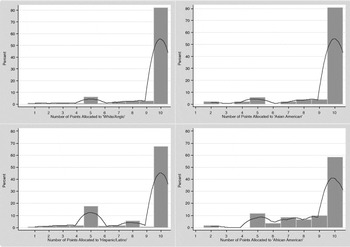
To make this point more vivid, Figure 3 shows how respondents who self-identify with a given ethnoracial category in the standard measure of race (e.g., in surveys) allocate their “identity points” to that category. Strictly speaking, if all individuals who self-identified as, say, African American were observationally equivalent, the allocation of identity points would be invariant and fixed at ten points (i.e., a monoracial allocation). While this assumption of observational equivalence holds true for a majority of respondents, Figure 3 also shows a meaningful degree of variation from this assumption. About 82% of those respondents who self-identify as White in the standard format allocate all their identity points to White/Anglo; the corresponding proportion for respondents who self-identify as Asian American is just above 80%; for Latino, it is 67%; for African American, which demonstrates the most graded distribution of identity points, it is 58%.Footnote 7
Distribution of Identity Points among Standard IdentifiersFootnote 8

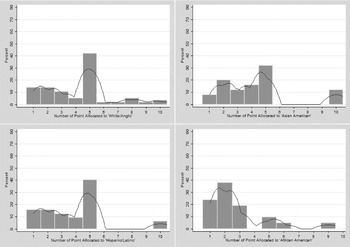
In measurement terms, those individuals who deviate from this assumption of observational equivalence represent lost information on the variation in the process of identification with ethnoracial categories. The varying degree to which individuals identify with a given category, however, is not the only kind of information that is lost by our standard approach to measuring identification. A nontrivial proportion of respondents who do not identify with a given category in the standard racial self-identification format will nonetheless describe themselves in terms of that same category through the use of identity points. The distribution of identity points among these “point allocators” is shown in Figure 4.Footnote 9 The prevalence of these point allocators and the dispersion of the identity points they allocate show that the validity of the assumption of observational distinctiveness—that someone who identifies with a given ethnoracial category is distinct from someone who identifies with a different ethnoracial category—also depends on the measurement approach that we take. Under the standard survey-based approach, a person who self-identifies as African American (i.e., assigns a value of 1 if African American) is treated, statistically, as distinct from another person who self-identifies as Hispanic/Latino. Under the alternative identity-point allocation approach discussed here, these two individuals may hold a significant degree of observational overlap, in cases where neither one self-identifies monoracially as African American or Hispanic/Latino, and each identifies, in some graded measure, with the other ethnoracial category.
Distribution of Identity Points Among Point AllocatorsFootnote 11

A different means of making the same point here is to compare our estimate of how multiracial a population is, using both the standard and alternate measurement approaches. If multiracial identification is defined as allocating at least one identity point to more than one ethnoracial category, our estimate of the multiracial population in California jumps from 4.7%, according to the 2000 U.S. Census, to about 26%, according to a 2003 telephone survey in which this alternative question format is used.Footnote 10 There are, interestingly, group differences in the degree to which our portrait of ethnoracial composition is altered. African Americans and Latinos are more apt to adopt a multiracial self-identification under this alternative format, while Whites are more likely to retain a monoracial self-definition.
The upshot of this example is that we may be missing potentially consequential variation in how racial categories are defined, how we identify with them, and what consequences this variation holds for our group consciousness, our ambitions to pursue collective interests through political means, and the specific choices we make in the political arena between candidates, parties, and policies. Note, for instance, that while most of the existing empirical research on the identity-to-politics link has focused on the cognitive basis of commonality (most often, in the language of group consciousness or linked fate), a background construct that is often assumed in these studies, ethnoracial identification, is highly contingent on our measurement approaches. One might imagine other potentially illuminating insights drawn from taking seriously the constitutive processes and relationships that link demographic identities to group politics. For instance, we might contrast the relative influence of identification, consciousness, and venue selection to the political choices that immigrant-based groups like Asian Americans and Latinos make. Given the tension between externally defined homogeneity and internally lived diversity that describes these “panethnic” groups, there are especially strong a priori reasons not to expect that individuals who fall under this panethnic definition will be spurred to collective political action (say, vis-á-vis the archetypical case of African Americans).
SUMMARY, IMPLICATIONS, AND LIMITATIONS
I have attempted to outline an approach to the question of whether or not the rapidly proliferating demographic diversity of America's population will lead to a resurgent and reconfigured identity politics. We began with a discussion of the potential pitfalls that arise in simply assuming that a demographic category—e.g., African American, Hispanic, Asian American—implies a group-based politics among the population of individuals defined by that demographic category. Five key relationships or processes that are bundled together when we consider identity politics have been articulated and differentiated: (1) the social and political construction of the categories and labels we use to divide polities into identity groups; (2) the processes by which individuals identify with these categories and labels; (3) the presence of shared beliefs and group consciousness that accompany this identification; (4) the coordination and agreement over the appropriate venue for a group's collective pursuits; and (5) the coordination and agreement over collective choice itself. The potential added value of this approach was then examined in the case of ethnoracial classification and the measurement of “race.”
This plea to be attentive to processes is especially timely given the context of immigration over the last four decades. Given the scale of this demographic transformation and the “heterogeneity, hybridity, and intersectionality” (Lowe Reference Lowe1996) that characterizes its resulting contemporaneous ethnoracial formations, it is especially important to be mindful of whether our existing concepts and frameworks can reasonably “travel” and “stretch” to new contexts (Sartori Reference Sartori1970, Reference Sartori1984; Collier and Mahon, Reference Collier and Mahon1993). In what we describe as the archetypic case of moving from shared demographic categories to common political destinies for African Americans, much is known about processes of definition, identification, consciousness, venue selection, and choice. With emerging groups like Latinos, Asian Americans, and multiracial Americans, much less is known.
The plea to unbundle the processes that link group definition to collective choice is also important given the soaring use of identity as a concept and key explanatory variable in the social sciences. Identity has come to serve as the “missing link” and right-hand side variable for phenomena as diverse and dispersed as class conflict, ethnonationalist violence, party identification, social movements, economic development, “democratic peace,” corporate culture, and the behavior of firms (Abdelal et al., Reference Abdelal, Herrera, Johnston and McDermott2008). While a rise in scholarly interest supports the view that identities are “among the most normatively significant and behaviorally consequential aspects of politics” (Smith Reference Smith2004, p. 302), such shifts also propel concerns about intellectual fashion and whether or not the stitching of disparate research threads into a single concept results in a richer, textured understanding of our complex social world.
Thus some critics declare that there is a “crisis of overproduction and consequent devaluation of meaning” (Brubaker and Cooper, Reference Brubaker and Cooper2000, p. 3). Other critics are vexed by the lack of “conceptual clarity of identity as a variable” and note the “worry that identity is so elusive, slippery, and amorphous that it will never prove to be a useful variable for the social sciences” (Abdelal et al., Reference Abdelal, Herrera, Johnston and McDermott2008, p. 21). For the first set of critics, the proposed alternative is to leave the overproduced and devalued use of identity to nonscholars and replace it with well-differentiated “categories of analysis” (the three that Brubaker and Cooper propose are “identification and categorization,” “self-understanding and social location,” and “commonality, connectedness, groupness”). The second set of critics favor, in the interest of building a cumulative research enterprise, greater coordination and consensus in how we conceptualize and measure identity as a variable.
The arguments in this essay complement the recent efforts to enjoin greater rigor and refinement in our scholarship on identity. They also echo Rogers Brubaker's argument that we should not take “as a basic analytical category … the ‘group’ as an entity, but groupness as a contextually fluctuating conceptual variable” (Brubaker Reference Brubaker2002, p. 11). The exhortation to treat the “group” gingerly, as a contingent and fluid relation and process, however, need not lead to a bog of meaning when we use identity. It also need not imply a radical renunciation from the search for macro- and microlevel processes and relationships that structure whether, when, and why groups move from objectively defined categories to subjectively motivated collective action. In thinking about the politics that immigrant-based groups such as Latinos and Asian Americans make or fail to make, this attention to processes has the potential to move us away from overly deterministic structural or overly static individualist explanations. For instance, rather than explaining the “underparticipation” of Latinos and Asian Americans (vis-à-vis the participation rates of Whites and African Americans) as a story about political apathy and ignorance or global capital and media-manufactured consent, we might look to the political processes that produce the ethnoracial categories we navigate, the ambivalence in racial self-identification, the incomplete formation of commonly held beliefs and interests, the structurally and historically defined opportunity structures that foreclose politics as an expedient venue for collective action, and so on.
There are, of course, some important limitations and provisos to the above arguments. First, I do not mean to imply, as the phrase “identity-to-politics link” may suggest, a strictly linear relation from demographic definition to collective choice. Nor do I mean to imply that it is both necessary and sufficient that each and every process is manifested in order for a group politics to emerge. The evidence from social science is simply too powerful to sustain such a tidy story. Sometimes, as the history of racial struggles tells us, the collective choice is not about whom a group votes for or which party a group identifies with, but, rather, the act of racial definition and identification itself. The political movements of the 1960s and 1970s over the use of terms like Black rather than Negro or colored, Asian American rather than Oriental or Asiatic, or Hispanic and Latino rather than Mexican or Puerto Rican (Martin Reference Martin1991; Espiritu Reference Espiritu1992; Rodríguez Reference Rodríguez2000); the dramatic resurgence and recovery of the memory of Native American backgrounds (Cornell Reference Cornell1988; Nagel Reference Nagel1996); and, more recently, the sustained political demands for the recognition of individuals of multiple racial backgrounds in our ethnoracial classification are obvious examples (Williams Reference Williams2006; DaCosta Reference DaCosta2007). Sometimes, the literature on social movements tells us, we are drawn—perhaps through the hypnotic influence of a crowd or the feverish spur of moral outrage or the embeddedness of social networks—to act collectively first, for reasons that may be related neither to a conscious choice about politics as a proper venue for the pursuit of collective interests, nor to the presence of collective interests or group identification itself. This fact of doing politics then impels and crystallizes a sense of who we are, collectively, and where our interests lie (Teske Reference Teske1997; Miller and Rahn, Reference Miller and Rahn2002). There is perhaps no better recent example of this than the outpouring of millions of protesters across dozens of towns and cities in the spring of 2006 in response to the feared passage of punitive and retrograde immigration reform policy in the U.S. Congress.
Several other important caveats are in order. First, for a given class of phenomena—e.g., race, gender, nationality, class, or religion, inter alia—identity formation, and its link to a group politics, does not occur in isolation. From Sojourner Truth's rhetorical battle cry, “Ain't I a Woman?” to contemporary scholarly rubrics of “multicultural feminism” and “postcolonial feminism,” to behavioralist empirical research into the “double bind” of race and gender, there is a now durable body of scholarship on the irreducibility and intersectionality of our primary social and political identities (hooks Reference hooks1989; Collins Reference Collins1990; Mohanty et al., Reference Mohanty, Russo and Torres1991; Mansbridge and Tate, Reference Mansbridge and Tate1992; Crenshaw Reference Crenshaw, Crenshaw, Gotanda, Peller and Thomas1995; Lowe Reference Lowe1996; Gay and Tate, Reference Gay and Tate1998; Alcoff Reference Alcoff2006). Rather than intending to obviate intersectionality by logical fiat, I hope that more care given to the identity-to-politics link will instead clarify how underspecified and oversimplified operationalization of component identities (e.g., in regression models that specify 1-0 dummy variables for respondents' gender and race, and an interactive term between the two dummy variables) may conceal the effects of intersectionality, properly understood. The complexity of our identity formations are key considerations for understanding the presence or the absence of each constitutive process in the identity-to-politics link.
The other important proviso is that I do not mean, in my example of ethnoracial classification and the survey measurement of race, to imply that a methodologically individualist approach to the study of identity is the only, or even the preferred, means of doing careful and deliberate empirical analysis. I am very mindful here of Rogers Smith's recent claim that “we cannot rely solely, or even predominantly, on efforts to identify abstract, ahistorical, and enduring regularities in political behavior…. Nor can we depend primarily on approaches … that enhance our formal grasp of instrumental rationality” (Smith Reference Smith2004, p. 301). Surely an account of the political processes of “people making” and racial domination will be incomplete if we simply abide by the prevailing modes of survey-based and game-theoretic social scientific inquiry. Yet it also goes too far to follow Smith's injunction to “study processes of political identity formation largely through interpretive, ethnographic, and historical methods” (Smith Reference Smith2004, p. 309) through to the exclusion of prevailing methodologies.
Rather than incant or sloganeer the virtues of methodological pluralism, I hope that one of the potential benefits here is greater precision in the match between the methods we use and the constitutive process of identity-making that we study. The process of definition—how the racial and ethnic identity categories and labels we use come into being, and how stable they are—is probably ill suited to survey-based methods and better suited to historical and organizational analysis. Or, to take another case, we might choose to study the process of venue selection by simply asking individuals whether they would rather privilege the attainment of economic success, political power, social ties, or some other common collective ends. Yet, we could push beyond the limits of this preference-based approach by examining the conditions under which “political opportunity structures” (Eisinger Reference Eisinger1973; McAdam Reference McAdam1982) and “windows of opportunity” for policy alternatives (Kingdon Reference Kingdon1984) open up to mass mobilization, or, better yet, by looking to the comparative and intersectional study of race from the analytic standpoints of history, culture, normative theory, and political economy (Kelley Reference Kelley1994; Cohen Reference Cohen1999; Lamont Reference Lamont2000; Winant Reference Winant2001; Harris-Lacewell Reference Harris-Lacewell2004; Singh Reference Singh2004; Shelby Reference Shelby2005; Hanchard Reference Hanchard2006). This attention to constitutive processes gives us a (hopefully) clearer yardstick with respect to Smith's concerns about the usefulness (or lack thereof) of survey-based and game-theoretic methods: when our primary research interest is in the processes of identification and consciousness, survey-based methods have a great deal to offer; if our primary research interests lie in explaining the process of collective choice itself, game-theoretic method, too, may be apposite, to the extent that “preference formation” might be prefigured by the prior processes in the identity-to-politics link. More ambitiously, in the field of scholarship on race relations and racial politics, this approach proposes a conditional defense of methodological pluralism as a means to what Ian Shapiro and his colleagues term “problem-driven” research (Shapiro et al., Reference Shapiro, Smith and Masoud2004; Shapiro Reference Shapiro2005).