Introduction
Globally, the probability of dying before reaching the age of five (the under-five mortality rate) is estimated to be 43 deaths per 1000 live births (UNICEF, 2015). This translates into approximately 5.9 million childhood deaths every year throughout the world (UNICEF, 2015). A large proportion of these childhood deaths (95%) occur in the African and Asian regions, specifically in sub-Saharan Africa and South Asia (Bryce et al., Reference Bryce, Black and Victora2013; United Nations Human Rights Council & WHO, 2013). In the sub-Saharan Africa region, 1 in 12 children aged below five years die every year compared with 1 in 147 in developed countries (UNICEF, 2015).
A considerable percentage of newborn babies, estimated to be 45%, die within the first month of being born as a result of infections, birth asphyxia, preterm birth complications or intrapartum-related complications (Black et al., Reference Black, Cousens, Johnson, Lawn, Rudan and Bassani2010; Bryce et al., Reference Bryce, Black and Victora2013; Liu et al., Reference Liu, Johnson, Cousens, Perin, Scott and Lawn2012; UNICEF, 2015). Pneumonia, undernutrition, diarrhoea and malaria account for over 50% of the deaths that occur after the first 30 days of life and before turning five years (Rudan et al., Reference Rudan, El Arifeen, Black and Campbell2007; Black et al., Reference Black, Victora, Walker, Bhutta, Christian and De Onis2013; Liu et al., Reference Liu, Johnson, Cousens, Perin, Scott and Lawn2012). All these causes of death can be prevented (You et al., Reference You, New and Wardlaw2012). Skilled care during pregnancy and delivery and after delivery (Bryce et al., Reference Bryce, Black and Victora2013; UNICEF, 2015), as well as proper care of newborn babies such as cleaning and drying the baby after birth, providing warmth through skin-to-skin contact, immediate and exclusive breast-feeding for 6 months (Arifeen et al., Reference Arifeen, Black, Antelman, Baqui, Caulfield and Becker2001; Lamberti et al., Reference Lamberti, Walker, Noiman, Victora and Black2011) and immunization (Fotso et al., Reference Fotso, Ezeh, Madise and Ciera2007) are all essential for preventing early childhood deaths. Studies have shown that proper sanitation, safe drinking water, vaccinations and exclusive breast-feeding can reduce childhood deaths caused by diarrhoea and pneumonia (Arifeen et al., Reference Arifeen, Black, Antelman, Baqui, Caulfield and Becker2001; Lamberti et al., Reference Lamberti, Walker, Noiman, Victora and Black2011; UNICEF, 2013).
Mothers are the primary care-givers of children under the age of five. Their health-seeking behaviour during and after pregnancy tends to influence the chances of child survival during the first five years of life. It is therefore the responsibility of mothers, where health facilities are available and accessible, to visit these to receive proper medical care during pregnancy, at delivery and after childbirth to promote good health and preserve the lives of herself and her child.
Existing studies have shown that maternal age, age at first marriage, mother’s level of education, sanitation, source of drinking water, wealth status, preceding birth interval, birth weight and birth order are significantly associated with the risk of dying during childhood (Mturi & Curtis, Reference Mturi and Curtis1995; Becher et al., Reference Becher, Müller, Jahn, Gbangou, Kynast-Wolf and Kouyaté2004; Fotso et al., Reference Fotso, Ezeh, Madise and Ciera2007; Titaley et al., Reference Titaley, Dibley, Agho, Roberts and Hall2008; Kembo & Van Ginneken, Reference Kembo and Van Ginneken2009; Kayode et al., Reference Kayode, Adekanmbi and Uthman2012). However, these studies concentrated more on examining the association between under-five mortality and maternal demographic and socioeconomic factors. Some studies have shown a strong association between maternal health-seeking behaviour and under-five mortality (Zahid, Reference Zahid1996; Howlader et al., Reference Howlader, Kabir and Bhuiyan1999; Rutstein, Reference Rutstein2000; Uchudi, Reference Uchudi2001; D’Souza, Reference D’Souza2003; Kayode et al., Reference Kayode, Adekanmbi and Uthman2012). Rutstein (Reference Rutstein2000) found that receiving proper antenatal care during pregnancy, skilled care at delivery and proper treatment for a sick child were important factors explaining the decline in under-five mortality in the 1990s in some developing countries.
Uchudi’s (Reference Uchudi2001) study in Mali showed that maternal health-seeking behaviour was a determinant of childhood mortality in the first 30 days of life, during infancy (1–11 months) and during childhood (12–48 months). Good maternal health-seeking behaviour (receiving antenatal care from a skilled provider, having at least four maternal tetanus injections and possessing a child health card) lowered the risk of a childhood death occurring in these three age groups (Uchudi, Reference Uchudi2001). D’Souza (Reference D’Souza2003), in Brazil, showed that poor and delayed health-seeking behaviour for a sick child accounted for 70% of childhood deaths. Kayode et al. (Reference Kayode, Adekanmbi and Uthman2012), in Nigeria, found that average maternal health-seeking behaviour reduced the risk of under-five mortality by 94% compared with poor maternal health seeking behaviour.
However, some of these studies – for example Uchudi (Reference Uchudi2001) and Kayode et al. (Reference Kayode, Adekanmbi and Uthman2012) – created a maternal health-seeking behaviour index using antenatal care provider, health card and maternal tetanus immunization variables, and did not look at the effects of each health-seeking behaviour variable independently as well as behaviour after childbirth. Also, some studies focused on the health-seeking behaviour for a sick child (D’Souza, Reference D’Souza2003). The study of maternal health-seeking behaviour during and after pregnancy is of particular importance in countries were mother-to-child HIV transmission prevalence is high because the necessary precautions to prevent the transmission can only be taken during antenatal care visits where mothers are screened for HIV.
Zimbabwe is one of the countries in the sub-Saharan Africa region where under-five mortality is still a major problem, with an under-five mortality rate of about 71 deaths per 1000 live births (UNICEF, 2015; Zimbabwe National Statistics (ZIMSTAT), 2014). The country is ranked among the top 50 countries with high under-five mortality in the world and it is one of the countries that failed to achieve the MDG-4 goal of reducing childhood deaths by two-thirds by 2015 (You et al., Reference You, New and Wardlaw2012; UNICEF, 2015). Prior to 2015, studies showed that Zimbabwe was not making progress towards reaching the goal of reducing childhood deaths by two-thirds by 2015 (Bhutta et al., Reference Bhutta, Chopra, Axelson, Berman, Boerma and Bryce2010; WHO & UNICEF, 2012). Under-five mortality is thought to have increased since the 1990s as a result of the high prevalence of HIV/AIDS among Zimbabwean adults (Adetunji, Reference Adetunji2000; Garenne & Gakusi, Reference Garenne and Gakusi2006; Zimbabwe Central Statistical Office, 2009). It has been shown that high HIV prevalence among Zimbabwean adults in 1994 accounted for the 61% increase in under-five mortality rate (Adetunji, Reference Adetunji2000). According to the National Child Survival Strategy for Zimbabwe 2010–2015 report, HIV/AIDS is one of the major causes of childhood deaths in Zimbabwe, accounting for 22% of childhood deaths. Diseases like pneumonia, diarrhoea, measles and malaria also contribute significantly to deaths that occur before a child reaches their fifth birthday (You et al., Reference You, New and Wardlaw2012; ZIMSTAT, 2014; UNICEF, 2015).
The Zimbabwe Demographic Health Survey (ZDHS) 2010/11 final report showed a 4% decline in the percentage of women receiving antenatal care from a skilled health provider, from 94% recorded in the 2005/06 ZDHS round to 90% in 2010/11 ZDHS (ZIMSTAT & ICF International, 2012). A continuous decline in birth deliveries in a health facility and skilled assistance during delivery has also been noted between the 1999 and the 2010/11 ZDHS rounds (ZIMSTAT & ICF International, 2012). According to the 1999 ZDHS, 72% of deliveries happened in a health facility, in the 2005/06 ZDHS 68% and in the 2010/11 ZDHS 65% (ZIMSTAT & ICF International, 2012). Skilled attendance at birth declined from 73% in the 1999 ZDHS to 69% in the 2005/06 ZDHS, then 66% in the 2010/11 ZDHS. In the 2010/11 ZDHS, 57% of the women reported that they did not receive any postnatal care after delivery (ZIMSTAT & ICF International, 2012). This is of concern because most maternal and neonatal deaths occur within the first week after delivery.
Given the observed declining trend in maternal health-seeking behaviour, it becomes expedient to examine the relationship between mother’s health-seeking behaviour and under-five survival among Zimbabwean children. The aim of this paper was therefore to investigate the effect of health-seeking behaviour of mothers on under-five mortality in Zimbabwe using the 2010/11 ZDHS.
Methods
Theoretical framework
This study was based on Mosley and Chen’s (Reference Mosley and Chen1984) theoretical framework for child mortality in developing countries. According to this framework, socioeconomic factors at community, household and individual level operate through proximate determinants of health such as maternal factors, personal illness control and injury to influence the levels of childhood mortality and morbidity in a society (Mosley & Chen, Reference Mosley and Chen1984). In this study, maternal health-seeking behaviour is treated as a variable falling in the ‘personal illness control’ category, and is treated as a factor that directly influences the prevention and treatment of child illness or death through certain practices and quality of care during pregnancy, delivery and the postnatal period.
Study design, sampling and data collection
This cross-sectional study was based on data from the 2010/11 ZDHS, which was chosen because it is nationally representative. The sample was selected using a stratified two-stage cluster design. In the first phase, 406 census enumeration areas (sampling clusters) were selected proportional to size. In the second phase, sample households were selected from a complete household listing for each cluster. A total of 10,828 households were then selected (ZIMSTAT & ICF International, 2012).
Three questionnaires (household, women’s and men’s) were used to collect information from eligible respondents through face-to-face interviews in the 2010/11 ZDHS. All women aged between 15 and 49 years and men aged between 15 and 54 years from the selected households were interviewed. The questionnaire of interest for this study was the women’s questionnaire, which was used to collect information on the background characteristics, birth history, childhood mortality, antenatal care, maternal tetanus immunization during pregnancy, place of delivery and postnatal care for women aged between 15 and 49 years.
The study sample was restricted to 5155 children who were single births and who were born five years preceding the 2010/11 ZDHS to a sample of 4128 women of reproductive age (15–49 years). Of the 5155 live births a total of 311 children died before reaching their fifth birthday. Of the 311 children who died, 118 died during the neonatal period (<1 month), 114 during infancy (1–11 months) and 79 during childhood (12–59 months).
Outcome variable
The outcome variable was the risk of a childhood death occurring between birth and 59 months. That is the risk of a child dying between birth and their fifth birthday. The outcome variable is thus a Hazard Ratio (HR) of dying within the first five years of life. A childhood death was considered to be the event (non-censored), whilst children who were alive at the time of the survey were right-censored.
Independent variables
The following independent variables were included in the study. Maternal variables included: mother’s current age (15–24 years, 25–34 years, 35+ years), educational level (none/primary, secondary/higher), current work status at the time of the survey (not working, currently working), place of residence (urban, rural), toilet facility (flush/ventilated improved pit latrine, other/none) and source of drinking water (safe water, unsafe water). Maternal health-seeking behaviour variables included: ever-use of contraceptives to prevent or delay pregnancy (never used, used contraceptives; ever-use of contraceptive was used rather than current use because previous use of contraceptives has the potential to have influenced childhood deaths that occurred in the five years prior to the survey compared with current use and it is also an indicator of health care); antenatal care provider (doctor/nurse/midwife, traditional/other), maternal immunization against tetanus (none/one injection, two injections or more, no response), place of delivery (health facility, elsewhere), birth delivery assistants (doctor, nurse/midwife, auxiliary midwife and trained birth attendant were merged into one group ‘skilled birth attendants’, while traditional birth attendant, relatives/friends, other and none were merged into one group ‘traditional/other’); postnatal check-up for the child within 2 months after birth from a skilled provider (no, yes). Child factors included: sex (male, female), perceived child size at birth as reported by the mother (large, average and small) and birth order (1, 2–3, 4+). Selection of these variables was directed by existing literature and this study’s research question on the role of maternal health-seeking behaviour.
Statistical analysis
Data were analysed using STATA Version 12.0 (StataCorporation, 2011). The SVY commands were also applied in the analysis to cater for the survey design effects. The analysis was done in three stages, namely descriptive (frequency tables), bivariate and multivariate analysis. The Cox Proportional Hazard model (survival analysis) was used to estimate (i) the association between each of the selected variables and the dependent variable at bivariate level and (ii) to estimate the net effects of maternal health-seeking behaviour on under-five mortality. The Cox Proportional Hazard regression model was used because it takes into consideration both the survival status of the child and time of death when creating the dependent variable (survival analysis).
Two Cox Proportional Hazard Regression models were fitted. In Model 1 only the maternal health-seeking behaviour variables were incorporated. Model 2 is the full model in which all the selected variables for this study were included.
The Cox Proportional Hazard regression model was estimated using the model:
 $$h_{i} (t)\,{\equals}\,h_{0} (t)\,\exp \,\beta _{1} x_{1} {\plus }\beta _{2} x_{2} \,\ldots\,{\plus}\beta _{k} x_{k} $$
where x i represents the selected maternal socioeconomic and demographic, health-seeking behaviour and child explanatory variables for the model, h 0(t) is the baseline hazard at time t and βi is the vector denoting the effect that each corresponding parameter coefficient from the selected vectors element has on the dependent under-five mortality vector (Cox, Reference Cox1972).
The test of the proportional-hazards assumption showed that none of the selected variables for this study violated the assumption as shown by a ρ of 0 and p-values≥0.05. The p-value for the global test was also ≥0.05.
Results
Characteristics of the study population
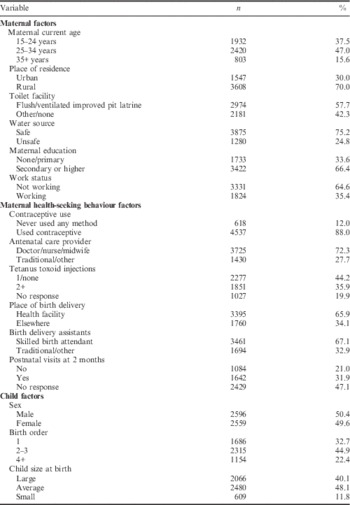
Table 1 shows the distribution of the sample by demographic, socioeconomic and maternal health-seeking variables. Of the 5155 single live births that were delivered five years before the 2010/11 ZDHS, 311 children died before reaching the age of five. Most of the childhood deaths (75%) occurred during the neonatal (118 deaths) and infancy (114 deaths) periods. Forty-seven per cent of the children were born to mothers aged between 25 and 34 years. Sixty-six per cent of the children had mothers with secondary or higher level of education and 65% of the children were born to mothers who were not currently working. Most of the children were rural residents (70%). Also, most resided in households with either a flush or a ventilated improved pit latrine toilet facility (58%) and had access to safe drinking water (75%).
Distribution of sample by demographic, socioeconomic and maternal health-seeking variables, ZDHS 2010/11, N=5155

A majority (88%) of the children had mothers who used contraceptive methods for family planning. During pregnancy, mothers of 72% of the children had received antenatal care from a skilled provider and 36% had received at least two tetanus injections during pregnancy. During delivery, mothers of 67% of the children were assisted by skilled birth attendants, whilst 33% were assisted by traditional/other unskilled birth attendants. About 35% of the children were delivered in a non-health facility. Thirty-two per cent of the babies received postnatal care within 2 months after birth, whilst 21% of the babies did not receive such care. Most of the children had a birth order of either second or third (45%) and their size at birth was average (48%).
Bivariate analysis
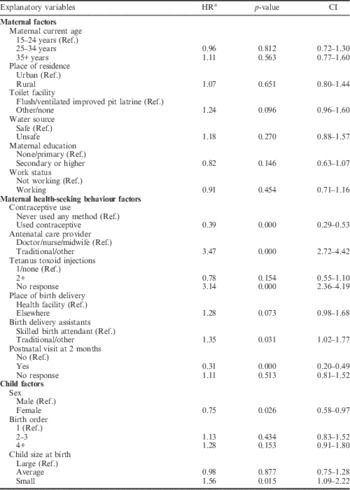
The bivariate analyses (unadjusted) results are shown in Table 2. Maternal health-seeking behaviour during and after pregnancy showed an influence on child survival. In the unadjusted analyses, the risk of dying during childhood among children born to mothers who had ever used contraceptives (HR: 0.39, CI 0.29–0.53) was lower compared with children born to mothers who had never used any form of contraception. Children whose mothers received antenatal care from an unskilled provider (HR: 3.47, CI 2.72–4.42) had a higher risk of dying before turning five compared with those children whose mothers received skilled ANC during pregnancy. Being a child of a mother who was attended by an unskilled birth attendant (traditional/other) during birth delivery (HR: 1.35, CI 1.02–1.77) was significantly associated with a higher risk of dying during childhood compared with those children whose mothers were attended by skilled birth attendants (doctor/nurse/midwife) during delivery. Children who received postnatal care within 2 months after birth delivery (HR: 0.31, CI 0.20–0.49) had a lower risk of dying before the age of five compared with those children who did not receive postnatal care within that period.
Results of Cox Proportional Hazard bivariate regression of under-five mortality and selected explanatory variables, ZDHS 2010/11

a HR: Hazard Ratio. Ref.: reference category.
The risk of dying before the age of five for female babies (HR: 0.75, CI 0.58–0.97) was significantly lower compared with that of male babies. Being born small at birth (HR: 1.56, CI 1.09–2.22) was associated with a higher risk of dying before reaching the age of five.
Multivariate analysis
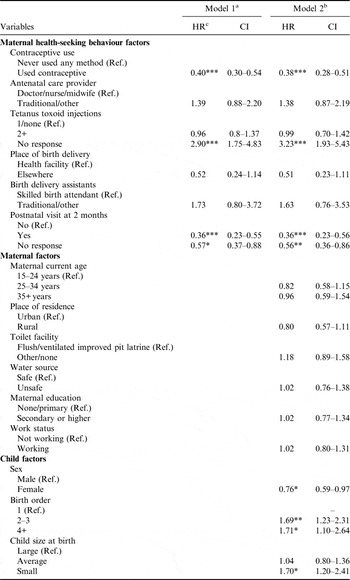
The results from Model 1 (Table 3), where only maternal health-seeking behaviour factors were incorporated, showed that contraceptive use and taking the baby for postnatal care within 2 months were significantly associated with the risk of dying before reaching the age of five. The results suggest that maternal use of contraceptives (HR: 0.40, CI 0.30–0.54) and taking the baby for postnatal care within 2 months after delivery (HR: 0.36, CI 0.23–0.55) lowered the risk of dying before reaching the age of five. The relationship between under-five mortality and other maternal health-seeking behaviours such as antenatal care provider and birth delivery assistants became insignificant after controlling for all the maternal health-seeking behaviour factors selected for this study.
Cox Proportional Hazard multivariate regression analysis of under-five mortality by selected maternal health-seeking behaviour variables, ZDHS 2010/11

a Model 1: maternal health-seeking behaviour variables only.
b Model 2: maternal health-seeking behaviour, maternal and child variables.
c HR: Hazard Ratio. Ref.: reference category.
*p<0.05; ***p<0.001; **p<0.01; *p<0.05.
The results from the full model in Table 3 (Model 2), which incorporated all the selected covariates, indicated that good maternal health-seeking behaviours remained significantly associated with a lower risk of an under-five death occurring. The risks of dying any time before reaching the age of five were significantly lower among children born to mothers who used contraceptives (HR: 0.38, CI 0.28–0.51) compared with those born to mothers who had never used any contraceptive method, and in children who received postnatal care from a skilled provider within 2 months after birth (HR: 0.36, CI 0.23–0.56) compared with those who did not receive postnatal care. Children whose birth size was small (HR: 1.70, CI 1.20–2.41) and higher order births had a higher risk of dying during childhood compared with reference categories. Female babies (HR: 0.76, CI 0.59–0.97) had a lower risk of dying during childhood compared with male babies.
Discussion
This study found that a larger proportion of the sample children in Zimbabwe were born to mothers who practised good maternal health-seeking behaviours such as use of contraceptives, receiving antenatal care from skilled providers, delivering in health facilities and being assisted by skilled birth attendants during birth delivery. However, a considerable percentage (34%) of all birth deliveries were delivered at home. Forty-four per cent of the sample children were born to mothers who received less than the required two tetanus injections during pregnancy and 21% of the children did not receive postnatal care within the required time, which is an indication of poor and risky maternal health-seeking behaviour.
The study further revealed that good maternal health-seeking behaviour indicators (contraceptive use and taking the baby for postnatal care within 2 months) were significantly associated with lower risks of childhood deaths, whilst poor maternal health-seeking behaviour indicators (receiving antenatal care from unskilled providers and being attended by an unskilled birth attendant during birth delivery) were significantly associated with higher risks of childhood deaths at bivariate level. Previous studies have made similar findings in different settings (Zahid, Reference Zahid1996; Howlader et al., Reference Howlader, Kabir and Bhuiyan1999). Also, small size at birth was significantly associated with a higher risk of under-five mortality, while being a female child was significantly associated with a lower risk of under-five mortality at the bivariate level.
Contraceptive use, postnatal check-up within 2 months, child size at birth, sex of the child and birth order emerged as the determinants of under-five mortality in Zimbabwe after controlling for potential confounders. The findings suggest that use of contraceptives for family planning has a protective effect on child survival. The risk of dying during childhood is lower among children born to mothers who used contraceptives compared with those born to mothers who have never used any method. This is consistent with findings by Kayode et al. (Reference Kayode, Adekanmbi and Uthman2012) in Nigeria and Palloni et al. (Reference Palloni, Pinto Aguirre and Lastiri1994) in Mexico. A study by Cleland et al. (Reference Cleland, Bernstein, Ezeh, Faundes, Glasier and Innis2006) showed that family planning can reduce childhood mortality by 10%.
Taking a baby for a check-up within 2 months decreases the risk of dying during childhood. It is within these two months after birth that the child receives essential vaccines thereby saving lives. In the case of Zimbabwe, a child will receive the Bacillus Calmette–Guerin (BCG) vaccine against tuberculosis at birth, and at 6 weeks, 10 weeks and 14 weeks the child will receive oral polio vaccines and pneumococcus vaccines, which protect against pneumonia and meningitis (UNICEF, 2012; Bangure et al., Reference Bangure, Chirundu, Gombe, Marufu, Mandozana, Tshimanga and Takundwa2015). Also, any emerging complications that arise after birth can be detected and treated during that period. This could be an explanation for why taking a baby for postnatal check-up within 2 months after birth reduces the chances of dying before the age of five.
This study also found that children who were born small at birth were more likely to die during childhood compared with those whose size at birth was large in Zimbabwe. This finding is well documented and is consistent with those of previous studies (Victora et al., Reference Victora, Barros, Huttly, Teixeira and Vaughan1992; Bhutta et al., Reference Bhutta, Chopra, Axelson, Berman, Boerma and Bryce2010). Deaths among small births are usually due to respiratory diseases, infections and sepsis.
Contrary to the findings of other studies (Zahid, Reference Zahid1996; Mahmood, Reference Mahmood2002; Ikamari, Reference Ikamari2013) this study found that antenatal care provider, tetanus injection during pregnancy, place of delivery and birth delivery assistants have no effect on under-five mortality in Zimbabwe in the multivariate level analysis. However, the direction of the relationship between antenatal care, birth delivery assistants and under-five mortality shows that use of an unskilled antenatal provider and the presence of an unskilled birth attendant during delivery increase the risk of a childhood death occurring. These findings, however, are consistent with a study done by Forste (Reference Forste1994) in Bolivia, which suggested that place of delivery and skilled attendance at delivery had no effect on child survival. This requires further investigation as it could be because of confounders that were not controlled for in this study considering the direction of the relationship.
The limitations of this study are linked to the nature of the data. The study was based on cross-sectional data collected at a certain point in time so it was not possible to establish a causal relationship between the dependent and independent variables. Also, the retrospective nature of the data could have resulted in bias, especially recall bias during the reporting of events that occurred five years prior to the survey. Studies of this nature are also affected by the under-reporting of deaths as these are sensitive events.
In conclusion, this study found that maternal health-seeking behaviour, as indicated by contraceptive use and taking the baby for a postnatal check-up within 2 months of delivery, is an important determinant of under-five mortality in Zimbabwe. Good maternal health-seeking behaviour reduces the risk of dying during childhood, whilst poor maternal health-seeking behaviour increases the risk. Child size at birth and higher birth order (2+) are also independently associated with under-five mortality in Zimbabwe. It is therefore essential for health programmes to focus on influencing maternal health-seeking behaviour as a way of improving child survival. The implementation of programmes to encourage use of health facilitates for skilled antenatal care, delivery and postnatal care and contraceptive use will go a long way in reducing under-five deaths in Zimbabwe. There is also a need to extend the provision of health facilities to eliminate barriers to accessing health care.
Acknowledgments
The authors are grateful to Measure DHS for granting them permission to use the Zimbabwe 2010/11 DHS data. This paper is based on a Master’s Research report from the University of the Witwatersrand, South Africa. The authors are grateful for the Department of Higher Education and Training grant from the Faculty of Humanities, University of the Witwatersrand, for financial support and for organizing a writing retreat at which this manuscript was prepared. Also, the support of the DST-NRF Centre of Excellence in Human Development is acknowledged. Opinions expressed and conclusions arrived at are those of the authors and not necessarily to be attributed to the Centre of Excellence in Human Development or the National Research Foundation. The authors declare that they have no competing interests.