INTRODUCTION
Fish faeces, especially of carnivorous species, are a rich and habitual food source for several fish species in the Pacific (Bailey & Robertson, Reference Bailey and Robertson1982; Robertson, Reference Robertson1982). Marine mammals are mostly carnivorous (Reeves et al., Reference Reeves, Stewart and Clapham2002) and their faeces also are a rich source of nutrients to reef fish (Sazima et al., Reference Sazima, Sazima and Silva2003, Reference Sazima, Sazima and Silva2006) and possibly other organisms as well. As most dolphins and pinipeds feed on open waters and rest and eliminate wastes (faeces and vomits) in inshore waters (Reeves et al., Reference Reeves, Stewart and Clapham2002), they may play a significant role in the transference of nutrients from open to coastal waters, by providing these as particulate food to reef fish. However, fish use of wastes released by marine mammals is recorded only for the spinner dolphin (Stenella longirostris) in the tropical Western Atlantic (Lodi, Reference Lodi1998; Sazima et al., Reference Sazima, Sazima and Silva2003, Reference Sazima, Sazima and Silva2006).
Here we record the purple or banded wrasse (Notolabrus fucicola) feeding on faeces and vomits of New Zealand fur seals (Arctocephalus forsteri) in the Tasman Peninsula, Australia. Based on this observation, we present further support to the idea that marine mammals transfer food from open waters to reef fish, and that this functional role is present both in tropical and temperate waters.
MATERIALS AND METHODS
Field observations were made at the Fortescue Bay (43°08′14″S 148°00′18′W) in the Tasman Peninsula, Australia, during a total of 2 hours 30 minutes while SCUBA diving on 23 and 25 March 2008. The bottom at the study site is composed of rocks and cobbles with kelp coverage. Depth ranged 8–15 m; underwater visibility was 15 m and water temperature 15°C. Sizes of seals and wrasses are estimates of total length (TL) in cm; and sizes of particles in faeces and vomit are actual measurements or estimates in mm. The behaviour of seals and fish was video-recorded and photographed. The four best photographs are filed at the Museu de Zoologia, Universidade Estadual de Campinas (ZUEC).
RESULTS
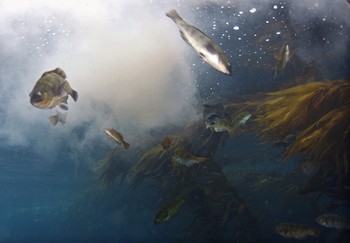
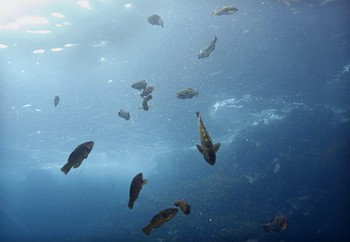
Two instances of fish feeding on faeces of seals and one instance of feeding on vomit were recorded. In one record of fish feeding on faeces, a seal about 120 cm TL rose in the water column, spread its hind fins and about three seconds later started to defaecate (Figure 1). While doing so it twisted its body sideways, and swam using mostly its fore fins. About 2–3 seconds after a cloud of liquid faeces and suspended particles (the largest ones about 3–10 mm) began to sink slowly, a group of about 15 wrasses (20–40 cm TL) rose from the rocky bottom and started to feed on the particles (Figure 2). The fish moved toward the particles when these were clearly visible and about 2 m below the water surface. After about 20 seconds, only a fine sediment cloud remained and the fish retreated to the bottom. The other record of fish feeding on faeces was very similar to the one described above, but the fur seal was about 140 cm TL. In the only record of fish feeding on a vomit, a seal regurgitated while gliding in the water column and a group of 27 wrasses (20–40 cm TL) immediately rose from the bottom and started to feed on the largest particles (about 3–8 mm) from the vomit (Figure 3). This particular seal was noticed about 2 seconds after it vomited, and thus we were unable to observe whether it displayed any behaviour which could be indicative that vomiting would follow, such as swallowing water—a behaviour that precedes vomiting in spinner dolphins, Stenella longirostris (Silva Jr et al., Reference Silva, Pandolfo and Sazima2004). Moreover, we were not able to observe whether the fish approached the seal before it started to vomit, as recorded for S. longirostris (Silva Jr et al., Reference Silva, Pandolfo and Sazima2004).
A New Zealand fur seal (Arctocephalus forsteri) defaecates and leaves a cloud of liquid faeces and particles in the water column at Fortescue Bay, Tasman Peninsula, Australia (Photograph: João Paulo Krajewski).

A group of purple wrasses (Notolabrus fucicola) forages on particles within a fur seal faeces' cloud in the water column near kelps at Fortescue Bay, Tasman Peninsula, Australia (Photograph: João Paulo Krajewski).

A group of purple wrasses (Notolabrus fucicola) forages on particles from a fur seal's vomit slowly sinking in the water column at Fortescue Bay, Tasman Peninsula, Australia (Photograph: João Paulo Krajewski).

DISCUSSION
Several species of fur seals (Otariidae) feed on fish and squids in the water column over deep waters, and forage mostly at twilight and night (Gentry, Reference Gentry, Perrin, Würsig and Thewissen2009). The New Zealand fur seal is no exception judging from its diet and diving behaviour (e.g. Carey, Reference Carey1992; Reeves et al., Reference Reeves, Stewart and Clapham2002; Page et al., Reference Page, McKenzie and Goldsworthy2005; Ling, Reference Ling, Perrin, Würsig and Thewissen2009). As New Zealand fur seals and spinner dolphins may gather in great numbers, sometimes thousands of individuals (Silva Jr et al., Reference Silva, Silva and Sazima2005; Ling, Reference Ling, Perrin, Würsig and Thewissen2009) at traditional coastal sites where they may eliminate wastes when back from feeding excursions (Reeves et al., Reference Reeves, Stewart and Clapham2002), their faeces and vomits may provide a predictable and abundant source of nutrients to the fish that dwell at these sites (Sazima et al., 2002, Reference Sazima, Sazima and Silva2006; Silva Jr et al., Reference Silva, Silva, Sazima and Sazima2007). Reef fish are usually strongly associated to the reef structure, and rarely forage in open waters (Choat & Bellwood, Reference Choat, Bellwood and Sale1991; Kuiter Reference Kuiter2000). Additionally, most reef fish recorded to feed on wastes of marine mammals are small to medium-sized (about 8–40 cm TL) planktivores, omnivores or benthic carnivores, that would not be able to feed on the same sources of nutrients used by fur seals and dolphins (fish and squids) even if those were available on coastal waters. As a consequence, some reef fish benefit directly from the excretory behaviour of marine mammals as they have access to nutrients that otherwise would be unavailable to them (Silva Jr et al., Reference Silva, Silva and Sazima2005; Sazima et al., Reference Sazima, Sazima and Silva2006). Similarly to the spinner dolphin, New Zealand fur seals are able to gather nutrients in open waters, process, and provide them as particulate food to reef fish in inshore waters (Silva Jr et al., Reference Silva, Silva and Sazima2005; Reference Silva, Silva, Sazima and Sazima2007). Spinner dolphins and New Zealand fur seals thus seem to play similar ecological roles, but in reefs in different latitudes (tropical and temperate).
The portions of wastes that are not promptly used by reef fish that swim in mid-water sink to the reef bottom and then become available to benthic fish and invertebrates. Thus, part of the nutrients brought in by fur seals from open waters may be used by several organisms that dwell in coastal reefs. Presently, a functional role similar to that here attributed to fur seals is played by spinner dolphins (Sazima et al., Reference Sazima, Sazima and Silva2003) and a few planktivorous reef fish species that feed away from the reef at night and return to the reef during the day, where they defaecate (Marnane & Bellwood, Reference Marnane and Bellwood2002).
The purple wrasse is a benthic carnivore that feeds mainly on crustaceans, molluscs and polychaetes (Denny & Schiel, Reference Denny and Schiel2001). Thus, it may come as a surprise that this wrasse picks particles in the water column and feeds on fur seals' wastes. The fish species recorded to feed on faeces and vomits of dolphins, for example, are planktivores or carnivores that forage both on the bottom and in the water column. Therefore, foraging on drifting particles in dolphins' wastes is a relatively short and simple behavioural switch for these fish (Sazima et al., Reference Sazima, Sazima and Silva2003). The case of the purple wrasse feeding in the water column may be considered as a more complex behavioural switch. However, several benthic species have the ability to change their usual feeding behaviour and pick particles in the water column when an ephemeral and rich feeding resource is available (Sazima & Sazima, Reference Sazima and Sazima2001; Krajewski & Bonaldo, Reference Krajewski and Bonaldo2006). Additionally, wrasses are renowned for their foraging plasticity (e.g. Sazima et al., Reference Sazima, Bonaldo, Krajewski and Sazima2005; Bellwood et al., Reference Bellwood, Wainwright, Fulton and Hoey2006; Cowman et al., Reference Cowman, Belwood and van Herwerden2009) and ability to detect feeding opportunities, since several species are recorded to temporarily associate with and follow other benthic disturbing species and feed on prey uncovered by them (Sazima et al., Reference Sazima, Bonaldo, Krajewski and Sazima2005, Reference Sazima, Krajewski, Bonaldo and Sazima2007; Shepherd, 2005; Krajewski, Reference Krajewski2009). Thus, both the ability to detect a feeding opportunity and the foraging plasticity of wrasses in general may have facilitated the switch from the usual foraging behaviour of the purple wrasse to particle-picking in the water column. This overall feeding versatility of reef fish facing a rich food resource indicates that several species and trophic groups may have the potential to feed on wastes of marine mammals.
Several species of pinnipeds and cetaceans feed in open water and eliminate their wastes in clear and shallow waters (Reeves et al., Reference Reeves, Stewart and Clapham2002; Sazima et al., Reference Sazima, Sazima and Silva2003), and some representative groups of reef fish contain versatile species able to take advantage of rich and ephemeral feeding resources available in the water column. Thus, our findings and the present knowledge on the behaviour of marine mammals and reef fish indicate that the former may have a more significant role as food providers to reef fish than previously suggested by the number of records of fish feeding on marine mammals' wastes. Mid and long-term studies that quantify the amount of faeces and vomits produced by marine mammals while in coastal waters and its use by reef organisms would be the next fundamental step to understand the role of marine mammals on the food chain of temperate and tropical reefs.
ACKNOWLEDGEMENTS
We thank Roberta M. Bonaldo for reviewing the manuscript and the CNPq for essential financial support. Two anonymous referees improved the manuscript.