Introduction
Metformin (1,1-dimethylbiguanide hydrochloride) is widely used in the treatment of diabetes mellitus type 2 (Matthaei et al., Reference Matthaei, Hamann, Klein, Benecke, Kreymann, Flier and Greten1991; Bailey, Reference Bailey1997; Hundal & Inzucchi, Reference Hundal and Inzucchi2003; Leverve et al., Reference Leverve, Guigas, Detaille, Batandier, Koceir, Chauvin, Fontaine and Wiernsperger2003) and is increasingly prescribed in polycystic ovary syndrome (Nardo & Rai, Reference Nardo and Rai2001; Lord et al., Reference Lord, Flight and Norman2003). The exact mechanism of action of metformin is uncertain. Its glucose- and insulin-lowering effects are mediated, at least in part, by the activation of AMPK through activation of the upstream kinase liver kinase B1 (LKB1) (Shaw et al., Reference Shaw, Lamia, Vasquez, Koo, Bardeesy, DePinho, Montminy and Cantley2005; Towler & Hardie, Reference Towler and Hardie2007). AMPK acts as a cellular energy sensor, responding to increases in the AMP/ATP ratio (Stapleton et al., Reference Stapleton, Mitchelhill, Gao, Widmer, Michell, Teh, House, Fernandez, Cox, Witters and Kemp1996). Metabolic stresses that either inhibit ATP production or accelerate ATP consumption activate AMPK, resulting in down-regulation of energy-consuming processes and up-regulation of energy-generating processes, in order to restore the ATP supply (Towler & Hardie, Reference Towler and Hardie2007; Luo et al., Reference Luo, Zang and Guo2010).
A major downstream target of AMPK is the mammalian target of rapamycin (mTOR) (Shackelford & Shaw, Reference Shackelford and Shaw2009). mTOR is a highly conserved serine/threonine kinase found in all eukaryotes (Wullschleger et al., Reference Wullschleger, Loewith and Hall2006) that acts as a catalytic subunit of two functionally and biochemically distinct complexes, namely mTORC1 and mTORC2. Both complexes are activated by growth factors through the PI3K pathway, while mTORC1 is additionally regulated by nutrient and energy signals (Manning & Cantley, Reference Manning and Cantley2003; Guertin & Sabatini, Reference Guertin and Sabatini2007; Sancak et al., Reference Sancak, Peterson, Shaul, Lindquist, Thoreen, Bar-Peled and Sabatini2008). Activation of mTORC1 results in phosphorylation of downstream effector systems and is associated with cell proliferation, survival and angiogenesis (Sabatini, Reference Sabatini2006; Meric-Bernstam & Gonzalez-Angulo, Reference Meric-Bernstam and Gonzalez-Angulo2009; Bai & Jiang, Reference Bai and Jiang2010).
The tuberous sclerosis complex 2 (TSC2) tumour suppressor has been identified as an upstream inhibitor of mTORC1 (Ito & Rubin, Reference Ito and Rubin1999; Gao & Pan, Reference Gao and Pan2001; Potter & Xu, Reference Potter and Xu2001; Tapon et al., Reference Tapon, Ito, Dickson, Treisman and Hariharan2001; Inoki et al., Reference Inoki, Zhu and Guan2003). Under energy starvation conditions, AMPK phosphorylates TSC2, which in turn inactivates Rheb, a direct activator of mTORC1 in vitro (Sancak et al., Reference Sancak, Thoreen, Peterson, Lindquist, Kang, Spooner, Carr and Sabatini2007). Moreover AMPK is able to directly phosphorylate raptor, a scaffold in the mTORC1 complex, causing inhibition of mTORC1 and cell cycle arrest (Gwinn et al., Reference Gwinn, Shackelford, Egan, Mihaylova, Mery, Vasquez, Turk and Shaw2008).
There is a limited number of studies concerning the result of AMPK activation in oocytes (Downs et al., Reference Downs, Hudson and Hardie2002; Bilodeau-Goeseels et al., Reference Bilodeau-Goeseels, Sasseville, Guillemette and Richard2007; Tosca et al., Reference Tosca, Uzbekova, Chabrolle and Dupont2007; Mayes et al., Reference Mayes, Laforest, Guillemette, Gilchrist and Richard2007). Studies on bovine oocytes have revealed that activation of AMPK by millimolar concentrations of metformin controls nuclear maturation by decreasing the number of cumulus–oocyte complexes (COC) reaching metaphase II stage (Bilodeau-Goeseels et al., Reference Bilodeau-Goeseels, Sasseville, Guillemette and Richard2007; Tosca et al., Reference Tosca, Uzbekova, Chabrolle and Dupont2007; Hong et al., Reference Hong, Jang, Oh, Koo, Park, Park, Kang and Lee2009). In order to provide further insight into the effects of metformin on embryos and the molecular pathways involved in these actions, we employed an in vitro protocol of bovine embryo production and investigated the effects of low pharmacologically relevant concentrations of metformin on the percentage of cultured COC giving embryos, early embryo development and AMPK-mediated TSC2 activation.
Materials and methods
All reagents for media preparation were purchased from Sigma-Aldrich Corp (Germany), unless otherwise indicated. Oocyte and embryo culturing were carried out according to previously published protocols (Adamiak et al., Reference Adamiak, Powell, Rooke, Webb and Sinclair2006; Kwong et al., Reference Kwong, Adamiak, Gwynn, Singh and Sinclair2010).
Oocyte collection and IVM
Ovaries were obtained from a local abattoir, immersed in physiological saline solution in a thermos flask at 38.8°C and transported to the laboratory. On arrival, they were washed briefly in 70% w/w ethanol and twice in warm sterile phosphate-buffered saline. Follicles, 2–8 mm in diameter, were aspirated and COC together with follicular fluid dispensed in 15 ml conical tubes containing medium M-199 with 26.2 mmol l−1 NaHCO3 and stable glutamine (Biochrom AG, Berlin, Germany) supplemented with 5% v/v foetal bovine serum (FBS) and 0.5% v/v penicillin/streptomycin solution. On the basis of criteria previously described (Hazeleger et al., Reference Hazeleger, Hill, Stubbings and Walton1995; Stojkovic et al., Reference Stojkovic, Machado, Stojkovic, Zakhartchenko, Hutzler, Goncalves and Eckhard2001) only oocytes surrounded by at least 4–5 layers of cumulus cells, with ungranulated, even cytoplasm and cumulus cells unexpanded, compact and even were considered to be suitable for IVM.
Between 30 and 50 COC were matured in 450 μl of M-199 medium (with 26.2 mmol l−1 NaHCO3 and stable glutamine; Biochrom AG, Berlin, Germany) supplemented with 10% v/v FBS, 20 U l−1 FSH, 20 U l−1 LH and 0.5% v/v penicillin/streptomycin solution. Maturation occurred at 38.8°C in a humidified atmosphere of 5% CO2 in air for 24 h.
Sperm preparation and IVF
Frozen ejaculate aliquots from the same bull stored in pellets were used throughout all laboratory experiments. Semen was thawed at 35°C for 30 s. The spermatozoa were subjected to a swim-up technique and capacitated for 1 h in a 3 ml medium that contained: 110.4 mmol l−1 NaCl, 2.7 mmol l−1 KCl, 25 mmol l−1 NaHCO3, 0.4 mmol l−1 NaH2PO4, 0.49 mmol l−1 MgCl2, 5 mmol l−1 HEPES, 1 mmol l−1 Na-pyruvate, 6.9 mmol l−1 glucose, 16 mmol l−1 Na-lactate, 0.6% w/v BSA and 0.5% v/v penicillin/streptomycin solution, and 0.00002% w/v phenol red. The pooled supernatant medium containing motile spermatozoa was centrifuged at 1500 g for 10 min. The sperm pellet was counted and resuspended in 46 μl microdrops of fertilization medium to which COC were transferred and overlaid with mineral oil, to give a concentration of 1 × 10⁶ sperm/ml. Prior to transfer to fertilization microdrops, COC were washed twice in oocyte washing medium (114 mmol l−1 NaCl, 3.2 mmol l−1 KCl, 2 mmol l−1 NaHCO3, 0.4 mmol l−1 NaH2PO4, 0.49 mmol l−1 MgCl2, 2 mmol l−1 CaCl2, 10 mmol l−1 HEPES, 0.5 mmol l−1 Na-pyruvate, 16 μmol l−1 Na-lactate, 0.3% w/v BSA, 0.5% v/v penicillin/streptomycin, and 0.0001% w/v phenol red). Following that, COC were washed twice in fertilization medium (93.1 mmol l−1 NaCl, 3.1 mmol l−1 KCl, 26.2 mmol l−1 NaHCO3, 1.4 mmol l−1 caffeine, 0.3 mmol l−1 Na2HPO4, 0.5 mmol l−1 MgCl2, 5.3 mmol l−1 CaCl2, 9.1 mmol l−1 Na-pyruvate, 10 μmol l−1 Na-lactate, 0.6% w/v BSA, 0.5% v/v penicillin/streptomycin, ≥1400 U l−1 heparin, 4.6 μmol l−1 hypotaurine, and 2.7 μmol l−1 epinephrine). In each microdrop a group of 20 oocytes was transferred. Fertilization occurred at 38.8°C in a humidified atmosphere of 5% CO2 in air for 24 h.
Culture of embryos
Presumptive zygotes were totally denuded from attached sperm and remaining cumulus cells by pipetting in HEPES SOF medium (107.6 mmol l−1 NaCl, 7.2 mmol l−1 KCl, 1.2 mmol l−1 KH2PO4, 1.5 mmol l−1 MgSO4, 7.3 mmol l−1 Na-pyruvate, 0.2 mmol l l-glutamine, 0.3 mmol l−1 tri-sodium citrate, 1.8 mmol l−1 CaCl2, 0.001% w/v phenol red, 4 μmol l−1 Na-lactate, 5 mmol l−1 NaHCO3, 2 mmol l−1 HEPES, 0.5% v/v MEM non-essential amino acids, and 0.3% w/v BSA). They were then washed twice in SOFaa BSA medium (107.6 mmol l−1 NaCl, 7.2 mmol l−1 KCl, 1.2 mmol l−1 KH2PO4, 1.5 mmol l−1 MgSO4, 7.3 mmol l−1 Na-pyruvate, 0.2 mmol l−1l-glutamine, 0.3 mmol l−1 tri-sodium citrate, 1.8 mmol l−1 CaCl2, 0.001% w/v phenol red, 4 μmol l−1 Na-lactate, 25 mmol l−1 NaHCO3, 2.8 mmol l−1 myo-inositol, 4.5% v/v BME amino acids, 0.5% v/v MEM non-essential amino acids, and 0.3% w/v BSA). Presumptive zygotes were cultured in groups of 20 in 50 μl microdrops of SOFaa BSA medium under mineral oil at 38.8°C in a humidified atmosphere of 5% CO2 in air for 48 h. Uncleaved zygotes were removed 24 h before the end of experiment.
Immunocytochemical studies
Immunofluorescence studies were performed as described previously (Vasilaki et al., Reference Vasilaki, Papadaki, Notas, Kolios, Mastrodimou, Hoyer, Tsilimbaris, Kouroumalis, Pallikaris and Thermos2004; Goossens et al., Reference Goossens, Vandaele, Wydooghe, Thys, Dewulf, Peelman and Soom2011). In brief, embryos were washed in PBS, fixed for 1 h at 4°C using 4% paraformaldehyde and permeabilized with 0.5% Triton X-100 in PBS for 30 min at room temperature (RT). Embryos were then washed in PBS and incubated for 30 min at room temperature (RT) in PBS that contained 10% FBS in order to block non-specific antibody tissue binding. Subsequently, samples were washed in PBS and incubated overnight at 4°C in PBS containing 0.5% FBS and rabbit polyclonal primary antibodies raised against: (i) a 14 amino acid peptide from near the N terminus of human TSC2 (anti-TSC2 antibody; 1/100; ab25884, Abcam plc, UK); or (ii) a synthetic phosphopeptide corresponding to residues surrounding Ser1387 of human TSC2 protein (anti-PhosphoS1387-TSC2 antibody; 1/100; #5584, Cell Signaling Technology, Inc., USA). Thereafter embryos were incubated for 1.5 h at room temperature with fluorescein isothiocyanate (FITC)-conjugated goat anti-rabbit IgG secondary antibody (1/200; Chemicon Int., USA), in PBS. Finally, embryos were mounted and counterstained with propidium iodide (PI) that contained mounting medium (Abcam plc, UK) and cover-slipped. For non-specific binding and auto-fluorescence negative control studies primary antibodies were omitted and normal rabbit serum was applied.
Microscopy and image analysis
Embryos were examined by light microscopy (Zeiss Axioskop with Plan-Neofluor 40/0.75 objectives; Oberkochen, Germany). Image analysis was conducted with the use of MacBiotronics Image J programme for Light Microscopy (Rasband, W.S., ImageJ, National Institutes of Health, Bethesda, Maryland, USA, http://rsb.info.nih.gov/ij/, 1997–2004), as described previously (Hatziefthimiou et al., Reference Hatziefthimiou, Kiritsi, Kiropoulou, Vasilaki, Sakellaridis and Molyvdas2009) with slight modifications. All images (RGB pictures) were similarly analysed. In order to minimise the effect of experimental inaccuracies, background (BG) was subtracted from the region of interest (ROI; embryo) in each image. BG (area of the slide next to the embryo) was selected with the ‘freehand selection’ tool and the command ‘Plugins/ROI/BG Subtraction from ROI’ was run. After background subtraction, the mean signal intensity of each whole embryo was recorded by employing the ‘Analyze/Histogram’ command. Results were expressed as intensity values (0–255 integers’ scale from minimum to maximum luminosity intensity).
Experimental design
Experiments employed a randomized design that allocated equivalent numbers of non-selected COC to each treatment group.
Experiment 1
In Experiment 1, increasing concentrations of metformin (0.1 nM, 0.1 μM, 1 μM, 10 μM) were supplemented throughout all stages of IVP (IVM, IVF and IVC). COC were matured in vitro, inseminated, and presumptive zygotes were cultured for a further 72 h post insemination before the percentage of cultured COC giving rise to embryos were assessed. Early embryo development within each experimental group was estimated based on advanced embryos (i.e. ≥8-cell) and arrested zygotes at the 2-cell stage. Five to nine repeats were conducted with a total of 83–183 oocytes per treatment.
Experiment 2
In Experiment 2, increasing concentrations of metformin (0.1 nM, 0.1 μM, 10 μM) were supplemented only during IVF stage. Culture conditions were the same as in Experiment 1. Six to twelve repeats were conducted with a total of 116–218 oocytes per treatment.
Experiment 3
Experiment 3, is an extension of Experiments 1 and 2 in that the effects of metformin were further investigated in respect to TSC2 regulation. Immunofluorescence staining was performed in order to investigate: (i) the presence of TSC2 in bovine embryos; and (ii) its possible AMPK-induced activation, in the presence or absence of 10 μM metformin (phosphorylation of TSC2 by AMPK at the conserved serine site 1387) (Corradetti et al., Reference Corradetti, Inoki, Bardeesy, DePinho and Guan2004; Shaw et al., Reference Shaw, Bardeesy, Manning, Lopez, Kosmatka, DePinho and Cantley2004) throughout IVP or during IVF only. Anti-human TSC2 antibodies were chosen based on protein sequence similarities between human and bovine TSC2 confirmed by the Universal Protein Resource database (UniProt; http://www.uniprot.org). Four repeats were conducted with a total of 55–58 oocytes per treatment.
In all experiments metformin (stock solution: 0.2 mM, in 20 μl dH2O) was consequently diluted in medium at the day of use. For the solvent control, the ratio of 1:20 H2O:medium corresponding to the dilution of 10 μM metformin was used.
Statistical analysis
All experimental data were expressed as means ± standard error of the mean (SEM). GraphPad Prism software (version 4.00 for Windows; GraphPad Software, San Diego California USA, www.graphpad.com) was employed for the statistical analysis of the data. For all comparisons, P-values < 0.05 were considered to be statistically significant.
In Experiments 1 and 2 statistical comparison between groups was performed using one-way analysis of variance (ANOVA) followed by: (i) the Dunnett's multiple comparison post test in order to compare metformin treated to control embryos; and (ii) the post hoc test for linear trends, in order to test whether there was a trend such that the percentage of cultured COC giving rise to embryos increased or decreased with metformin concentration.
TSC2 and PhosphoS1387-TSC2 expression levels were calculated after subtraction of non-specific/auto-fluorescence signal of embryos incubated in the absence of primary antibodies from TSC2 and PhosphoS1387-TSC2 luminosity intensity levels. The ratio of PhosphoS1387-TSC2 to total TSC2 luminosity intensity levels was calculated in all treatment groups. Data were analyzed using one-way ANOVA followed by: (i) the Dunnett's multiple comparison post hoc test in order to compare duration of metformin exposure to zero exposure (control); and (ii) the post test for linear trend in order to test whether there is a trend such that the values increase or decrease as the exposure to the metformin is increased.
Results
Effect of metformin on the percentage of COC giving rise to embryos
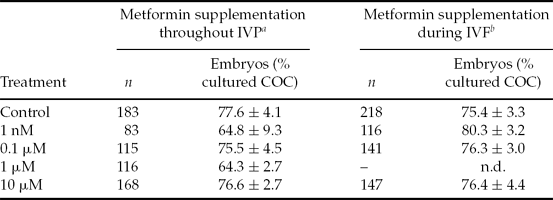
Supplementation of increasing concentrations of metformin throughout IVP or only at the IVF stage had no effect on the percentage of cultured COC giving rise to embryos. No statistically significant differences were observed between the metformin-treated and metformin-untreated groups (Table 1).
Effect of increasing concentrations of metformin on percentage of cultured COC giving rise to embryos

aValues represent means ± standard error of the mean (SEM) of 5–9 repeats. No statistically significant treatment effect was observed.
bValues represent means ± standard error of the mean (SEM) of 6–12 repeats. No statistically significant treatment effect was observed.
n.d., non determined. COC, cumulus–oocyte complexes; IVF, in vitro fertilization; IVP, in vitro embryo production.
Effect of metformin treatment on the early post-fertilisation development of embryos
One-way ANOVA followed by Dunnett's multiple comparison post-test indicated that the percentage of cleaved embryos reaching ≥8-cell stage 72 h post-insemination was significantly lower than control (38.4 ± 3.2%), when metformin was applied at 1 μM (24.2 ± 4.2%, P < 0.05) and 10 μM (17.8 ± 2.8%, P < 0.01; Fig. 1A). This decrease in the number of advanced ≥8-cell embryos was accompanied by an increase of arrested embryos at 2-cell stage. Metformin (10 μM) significantly increased the percentage of 2-cell embryos (27.8 ± 6.4%, P < 0.01) compared with control (10.7 ± 2.1%; Fig. 1B). Data analysis with one-way ANOVA followed by the post-test for linear trend depicted a significant trend of ≥8-cell embryos to decrease (P < 0.001) and 2-cell embryos to increase (P < 0.001) as metformin concentration was increased (Fig. 1).
Effect of increasing concentrations of metformin, supplemented throughout IVP, on the early post-fertilisation development at 72 h post-insemination. (A) Advanced embryos (≥8-cell). (B) Embryos arrested at the 2-cell stage. Values represent mean ± standard error of the mean (SEM) of 5–9 repeats, with a total of 83–183 oocytes per treatment. ###P < 0.001: statistically significant differences between groups using one-way ANOVA followed by the linear trend post-test. *P < 0.05, **P < 0.01: statistically significant difference from the control group using one-way analysis of variance (ANOVA) followed by the Dunnett's multiple comparison post-test.
The impact of metformin supplementation on the early post-fertilisation development of bovine embryos was further substantiated with another set of experiments in which metformin was supplied only during one of the stages of IVP (i.e. IVF). According to our results, the percentage of ≥8-cell embryos 72 h post insemination was significantly lower than the control (36.9 ± 4.6%) when metformin was applied at 10 μM (15.0 ± 2.1%, P < 0.01) and 0.1 μM (18.2 ± 4.6%, P < 0.01; Fig. 2A). The decrease of ≥8-cell embryos was accompanied by an increase of 2-cell embryos, as in the case of metformin supplementation throughout IVP. The percentage of 2-cell embryos was significantly increased by 10 μM metformin (29.2 ± 4.5%, P < 0.05) compared with control (15.1 ± 2.8%; Fig. 2B). The dose-dependent effect of IVF supplemented metformin on bovine embryo cleavage was further substantiated with one-way ANOVA followed by the post-test for linear trend (2-cell embryos: P < 0.01; ≥8-cell embryos: P < 0.001; Fig. 2).
Effect of increasing concentrations of metformin supplemented during IVF on the early post-fertilisation development at 72 h post-insemination. (A) Advanced embryos (≥8-cell). (B) Embryos arrested at the 2-cell stage. Values represent means ± standard error of the mean (SEM) of 6–12 repeats, with a total of 147–218 oocytes per treatment. ##P < 0.01, ###P < 0.001: statistically significant differences between groups using one-way ANOVA followed by the linear trend post-test. *P < 0.05, **P < 0.01: statistically significant difference from the control group using one-way analysis of variance (ANOVA) followed by the Dunnett's multiple comparison post-test.
Effect of metformin treatment on TSC2 expression in bovine embryos
TSC2 is expressed during the early developmental stages of bovine embryos (Fig. 3). No statistical difference was observed in TSC2 immunoreactivity of embryos in different cleavage stages (data not shown).
Expression of TSC2 in bovine embryos. (A, B) TSC2 immunoreactivity at different cleavage stages. (C) Negative control with omission of primary antibody. (A′–C′) nuclei counterstaining with propidium iodide (PI) of cells in photographs (A–C).
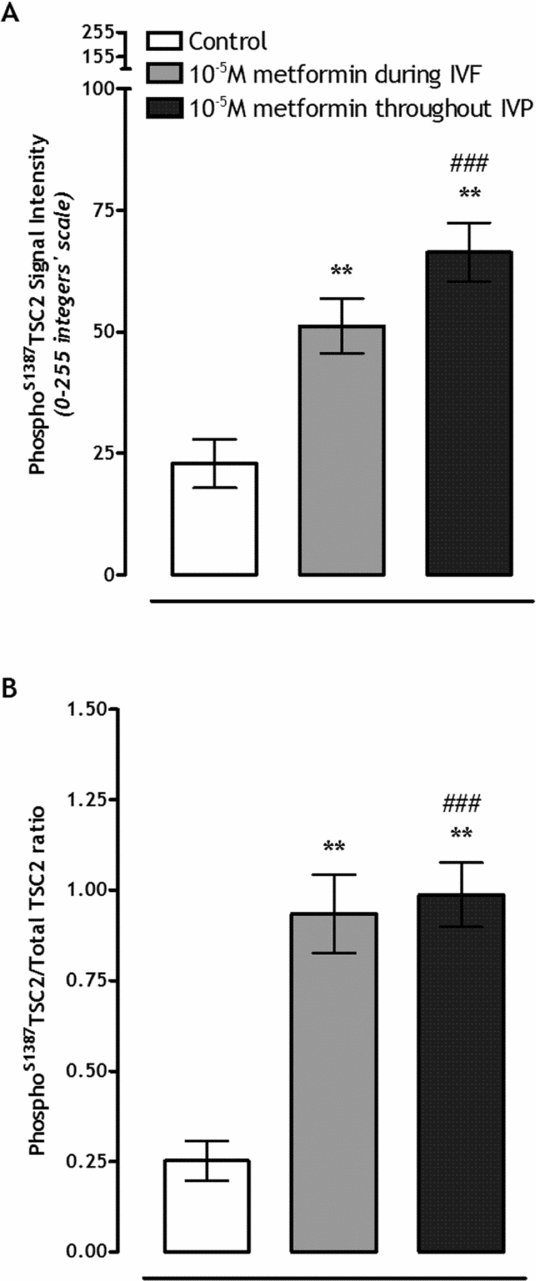
Low levels of PhosphoS1387-TSC2 immunoreactivity were also observed in early embryonic stages (Fig. 4). No statistical difference was observed in PhosphoS1387-TSC2 immunoreactivity of embryos in different cleavage stages (data not shown). Supplementation of metformin (10 μM) increased the levels of PhosphoS1387-TSC2 immunoreactivity in embryos (Figs. 4 and 5A). One-way ANOVA followed by the Dunnett's multiple comparison post-test designated that metformin significantly increased PhosphoS1387-TSC2 immunoreactivity up to 223.0 ± 24.5% (P < 0.01) and 289.1 ± 26.29% (P < 0.01) when applied during IVF or throughout IVP, respectively (Fig. 5A). This increase of PhosphoS1387-TSC2 immunoreactivity corresponded to an increase of PhosphoS1387-TSC2:Total-TSC2 ratio (Control: 0.25 ± 0.05, IVF: 0.94 ± 0.10, IVP: 0.99 ± 0.09; P < 0.01; Fig. 5B). Data analysis using one-way ANOVA followed by the post-test for linear trend indicated that the levels of PhosphoS1387-TSC2 immunoreactivity and PhosphoS1387-TSC2:Total-TSC2 ratio increased as exposure-time to the drug increased.
Immunofluorescence localization of PhosphoS1387-TSC2 in 2-cell (A–C) and ≥8-cell (D, E) bovine embryos in the absence (A, D) or presence of 10 μM metformin during IVF (B, E) or throughout IVP (C, F). (A′–F′) nuclei counterstaining with PI of cells in photos A–F.
Effect of metformin supplementation during IVF or throughout IVP on AMPK-mediated TSC2 activation in bovine embryos. (A) PhosphoS1387-TSC2 expression levels. (B) PhosphoS1387-TSC2:Total-TSC2 ratio in bovine embryos in the absence or presence of 10 μM metformin during IVF or throughout IVP. Values represent means ± standard error of the mean (SEM) of four repeats, with a total of 55–58 oocytes per treatment. ###P < 0.001: statistically significant differences between groups using one-way ANOVA followed by the linear trend post-test. **P < 0.01: statistically significant difference from the control group using one-way analysis of variance (ANOVA) followed by the Dunnett's multiple comparison post-test.
Discussion
Metformin is an activator of AMPK, a key regulatory enzyme well characterized in many tissues, including the liver, muscle, lung, heart, kidney, brain (Stapleton et al., Reference Stapleton, Mitchelhill, Gao, Widmer, Michell, Teh, House, Fernandez, Cox, Witters and Kemp1996) and ovary (Tosca et al., Reference Tosca, Froment, Solnais, Ferre, Foufelle and Dupont2005; Reference Tosca, Solnais, Ferre, Foufelle and Dupont2006a; Reference Tosca, Crochet, Ferre, Foufelle, Tesseraud and Dupont2006b). AMPK phosphorylates target proteins participating in a number of metabolic pathways (Hardie & Carling, Reference Hardie and Carling1997). As far as bovine oocytes are concerned, recent studies have revealed that activation of AMPK by millimolar concentrations of metformin controls nuclear maturation by decreasing the number of COC that reach metaphase II stage (Bilodeau-Goeseels et al., Reference Bilodeau-Goeseels, Sasseville, Guillemette and Richard2007; Tosca et al., Reference Tosca, Uzbekova, Chabrolle and Dupont2007; Hong et al., Reference Hong, Jang, Oh, Koo, Park, Park, Kang and Lee2009). In the present study, we investigated the effects of low metformin concentrations (1 nM to 10 μM) on the percentage of cultured COC giving rise to embryos and early embryo development. The highest concentration used (10 μM) is relevant to the reported steady state serum levels of metformin prescribed in women with PCOS, which range from 40 to 50 μM (Eng et al., Reference Eng, Sheridan, Wyman, Chi, Bibee, Jungheim and Moley2007; Karttunen et al., Reference Karttunen, Uusitupa and Lamminsivu1983).
According to our results, supplementation of increasing concentrations of metformin throughout IVP or only during IVF had no effect on the percentage of cultured COC giving rise to embryos. The lack of effect observed suggests that supplementation up to 10 μM of metformin does not affect the insemination of oocytes. Our observation that metformin had no effect on the percentage of cultured COC giving rise to embryos when added during both IVM and IVF reinforces the results of previous studies reporting that supplementation of 10 μM and 100 μM of metformin during IVM had no effect on nuclear maturation of bovine oocytes (Tosca et al., Reference Tosca, Uzbekova, Chabrolle and Dupont2007; Hong et al., Reference Hong, Jang, Oh, Koo, Park, Park, Kang and Lee2009). Nevertheless, it has been reported that metformin applied during IVM, when added at the millimolar range (2–10 mM) induces meiotic arrest of bovine oocytes by inhibiting germinal vesicle breakdown (Bilodeau-Goeseels et al., Reference Bilodeau-Goeseels, Sasseville, Guillemette and Richard2007; Tosca et al., Reference Tosca, Uzbekova, Chabrolle and Dupont2007). Our results in combination with previously published data suggest that metformin does not exert a negative effect on oocyte maturation at low concentrations.
Although metformin at concentrations between 1 nM and 10 μM had no effect on the percentage of COC giving rise to embryos, its supplementation throughout all IVP stages had a dose-dependent negative effect on early post-fertilisation development of bovine embryos. A similar negative effect of metformin (10 μM) was observed by Hong et al. (Reference Hong, Jang, Oh, Koo, Park, Park, Kang and Lee2009). This team reported an increase of arrested embryos at the 2-cell stage. However, in contrast with the data presented in this study, the increase was not correlated with a decrease of ≥8-cell embryos. Although one can argue that the lack of effect on ≥8-cell embryos is merely an effect related to the stage at which metformin was supplemented [Hong et al. (Reference Hong, Jang, Oh, Koo, Park, Park, Kang and Lee2009) added metformin only during the IVM] the most plausible reason of this discrepancy is that this group used a serum-, hormone-, and growth factor-free medium, which can negatively affect oocyte maturation and subsequent development.
The impact of metformin supplementation on the cleavage of bovine embryos was further substantiated with another set of experiments in which metformin was supplied only during one of the stages of IVP. We chose IVF given that there are no published data that concern the effect of metformin at this stage. According to our results, metformin supplementation during IVF had a dose-dependent negative effect on the early post-fertilisation development of bovine embryos, similar to that observed when the drug was applied throughout all IVP stages.
Several studies have shown that metformin can act through activation of AMPK both in vivo and in vitro (Zhou et al., Reference Zhou, Myers, Li, Chen, Shen, Fenyk-Melody, Wu, Ventre, Doebber, Fujii, Musi, Hirshman, Goodyear and Moller2001; Musi et al., Reference Musi, Hirshman, Nygren, Svanfeldt, Bavenholm, Rooyackers, Zhou, Williamson, Ljunqvist, Efendic, Moller, Thorell and Goodyear2002; Shaw et al., Reference Shaw, Lamia, Vasquez, Koo, Bardeesy, DePinho, Montminy and Cantley2005; Towler & Hardie, Reference Towler and Hardie2007). Metformin applied at the millimolar range during IVM activates AMPK which in turn affects bovine oocyte maturation (Bilodeau-Goeseels et al., Reference Bilodeau-Goeseels, Sasseville, Guillemette and Richard2007; Tosca et al., Reference Tosca, Uzbekova, Chabrolle and Dupont2007). Our results, in combination with the published data, suggest that metformin exerts a negative effect on oocyte maturation only when present at millimolar concentrations and not at physiologically relevant concentrations. Nevertheless with regard to embryos, early post-fertilisation development is affected even if low concentrations of metformin are used. This, in conjunction with the fact that metformin supplementation only during IVF has a similar effect as when applied throughout all IVP stages, could be an indication of AMPK activation by metformin being more important in embryo cell division than oocyte maturation processes.
There is a high energy demand for embryo development. AMPK activity during embryo development is probably related to its function as a sensor of cellular energy status (Stapleton et al., Reference Stapleton, Mitchelhill, Gao, Widmer, Michell, Teh, House, Fernandez, Cox, Witters and Kemp1996; Towler & Hardie, Reference Towler and Hardie2007; Luo et al., Reference Luo, Zang and Guo2010). It is known that under energy starvation conditions, AMPK phosphorylates TSC2 and enhances its activity (Inoki et al., Reference Inoki, Zhu and Guan2003). Recent genetic evidence showed that TSC2 is expressed in oocytes and functions to maintain the dormancy of primordial follicles through suppression of mTORC1 activity (Adhikari et al., Reference Adhikari, Flohr, Gorre, Shen, Yang, Lundin, Lan, Gambello and Liu2009). In an attempt to investigate the possible involvement of the AMPK-TSC2 pathway on the effects of metformin in early embryonic development, we examined the presence of TSC2 in bovine embryos and its possible AMPK-induced activation by metformin throughout IVP or IVF alone.
According to our results, TSC2 is expressed during the early developmental stages of bovine embryos. Phosphorylation of TSC2 by AMPK at the conserved serine site 1387 is known to lead to TSC2 activation (Corradetti et al., Reference Corradetti, Inoki, Bardeesy, DePinho and Guan2004; Shaw et al., Reference Shaw, Bardeesy, Manning, Lopez, Kosmatka, DePinho and Cantley2004). Supplementation of metformin, either throughout IVP or during IVF only, led to an AMPK-mediated TSC2 activation that corresponded to the total TSC2 protein levels expressed in the cells, as indicated by the increase of PhosphoS1387 TSC2 immunoreactivity and the PhosphoS1387-TSC2:Total-TSC2 ratio observed in our study. To our knowledge, this is the first report showing the presence of TSC2 immunoreactivity in bovine embryos and suggesting the possible involvement of TSC2 on AMPK-mediated metformin effects on early embryonic development.
In conclusion, our results in combination with previously published data suggest that metformin exerts a negative effect on oocyte maturation only when present at high concentrations. Metformin at low concentrations has a dose-dependent negative effect on the early post-fertilisation development of bovine embryos. This effect of metformin is the same whether the drug is supplied throughout IVP or only during IVF. Given that metformin is an AMPK activator, these results signify the importance of AMPK activity regulation and indicate that any change in the activity levels of this enzyme can have a negative result on embryo development. Furthermore, according to our results, one of the possible mechanisms involved in metformin-induced delay of early bovine embryo development is the AMPK-mediated activation of TSC2. Further studies are necessary in order to fully understand the molecular pathways involved in metformin-mediated effects on embryo development.
Acknowledgements
We thank Professor Kevin D. Sinclair, Dr Peter Marsters and Dr Wing Yee Kwong (University of Nottingham, UK) for valuable guidance with bovine oocyte and embryo culture methods and Professor Kyriaki Thermos (University of Crete, Greece) for reviewing the manuscript. We also thank Dr Begas Elias for technical assistance (University of Thessaly). This research did not receive any specific grant from any public-funding agency, or from commercial or the not-for-profit sector.