Introduction
Double outlet right ventricle accounts for approximately 1–1.5% of CHDs and encompasses a broad anatomical spectrum in which both great arteries arise predominantly from the right ventricle. The position of the ventricular septal defect, the risk of postoperative left ventricular outflow tract obstruction following biventricular repair, and coronary anatomy shape the physiological presentation and determine the surgical strategy. Because of this heterogeneity, no single operative technique is applicable to all patients.
Historically, the Rastelli procedure has been one of the most widely applied intraventricular rerouting strategies for biventricular repair in patients with double outlet right ventricle and right ventricular outflow tract obstruction, which directs left ventricular outflow through the ventricular septal defect to the aorta and reconstructs the right ventricular outflow tract with a conduit. Although effective, the Rastelli operation is limited by conduit degeneration and size mismatch during growth, often necessitating reoperation.Reference Hörer, Schreiber and Dworak1 To address these limitations, alternative techniques were developed. The Réparation à l’étage ventriculaire procedure combines conal septum resection with the Lecompte manoeuvre to reduce the risk of postoperative left ventricular outflow tract obstruction avoiding an extracardiac right ventricular outflow tract conduit,Reference Pontailler, Moiroux-Sahraoui and Bernheim2,Reference An, Li, Yan, Wang and Hua3 while the Nikaidoh and Bex modifications employ aortic root translocation to create a more anatomically aligned left ventricular outflow.Reference Yeh, Ramaciotti, Leonard, Roy and Nikaidoh4,Reference Raju, Myers and Quinonez5 The Bex modification further refines this concept by combining aortic and pulmonary root mobilisation.Reference Schulz, Buratto, Ishigami, Konstantinov, Cheung and Brizard6 Pulmonary root translocation and double-root translocation further refine right ventricular outflow tract geometry.Reference da Silva, da Fonseca da Silva and Lopes7,Reference Hu, Xie and Li8 In selected neonatal series reported within double outlet right ventricle cohorts, the Yasui operation has been used as a biventricular pathway in the presence of severe systemic outflow obstruction and aortic arch pathology.Reference Greene, Scully and Staffa9
Despite the proliferation of techniques, comparative outcomes in the paediatric population remain incompletely characterised. Most reports are single-centre, retrospective, and limited in size.Reference Hörer, Schreiber and Dworak1–Reference Greene, Scully and Staffa9 Furthermore, the relative advantages and trade-offs of each operation—early mortality, long-term survival, conduit durability, and right ventricular outflow tract reintervention—have not been systematically synthesised.Reference Aoki, Forbess, Jonas, Mayer and Castaneda10
This systematic review aims to evaluate early and long-term outcomes of contemporary surgical strategies for double outlet right ventricle in children and to define the anatomical and procedural factors that guide optimal operation selection.
Material and methods
Search strategy and study selection
This systematic review was conducted according to PRISMA 2020 guidelines. A comprehensive search of PubMed/MEDLINE, Embase, Scopus, the Cochrane Library, and medRxiv was performed for studies published from January 2000 through September 2025. Search terms included combinations of double outlet right ventricle, Rastelli, Réparation à l’étage ventriculaire, Nikaidoh, aortic root translocation, double-root translocation, pulmonary root translocation, and Yasui. Neonatal pathway procedures such as the Yasui operation were included for descriptive completeness and were not considered directly comparable to intraventricular or root-based biventricular repair strategies. Reference lists of included studies were screened to identify additional reports.
Studies were eligible if they:
-
1. included patients ≤18 years of age;
-
2. reported outcomes after biventricular repair of double outlet right ventricle using the Rastelli, Réparation à l’étage ventriculaire, Nikaidoh/Bex aortic root translocation and variants, double-root or pulmonary root translocation, or Yasui operation;
-
3. enrolled ≥10 patients; and
-
4. provided data on early mortality, survival, or reinterventions.
Exclusion criteria were isolated case reports, adult-only cohorts, technical descriptions without outcomes, studies not reporting biventricular repair, and duplicate publications from the same institution (the most complete dataset was retained). Two reviewers independently screened titles, abstracts, and full texts; disagreements were resolved by consensus.
Data extraction
Two reviewers independently extracted data using a standardised form. Variables included study design, sample size, age at repair, anatomic subtype, presence of left ventricular outflow tract obstruction, coronary anatomy when reported, specific operative technique, conduit type and size when applicable, early outcomes (mortality, complications, residual gradients), and late outcomes (survival, reinterventions, conduit replacement, arrhythmias, and follow-up duration).
Risk of bias assessment
Cohort studies were assessed using the ROBINS-I tool, and case series were evaluated using Joanna Briggs Institute criteria. Each domain was rated as low, moderate, serious, or critical risk of bias. Studies with critical bias were excluded from quantitative synthesis.
Statistical analysis
Early mortality and 10-year survival were pooled using random-effects models with logit transformation to stabilise variance for proportions close to 0 or 1. The DerSimonian–Laird estimator was used to compute between-study variance (τ2). When only one study contributed data for a particular outcome or procedure, results were presented using exact 95% confidence intervals. Heterogeneity was quantified using τ2 rather than I2 due to the small number of studies per comparison. Planned meta-regression could not be performed because no outcome included ≥10 studies.
Kaplan–Meier survival proportions were extracted directly when reported or digitised from published curves when necessary. Funnel plots were not generated due to the small number of included studies. All analyses were performed using Python (statsmodels) and R.
Given the marked anatomical heterogeneity of double outlet right ventricle, pooled outcome estimates are intended to provide a descriptive synthesis of contemporary results rather than direct comparative inference between surgical techniques.
Protocol and registration
The review protocol was not registered in PROSPERO.
Results
Study selection and characteristics
The search identified 231 records, of which 179 remained after removal of duplicates. After title and abstract screening, 33 full-text articles were reviewed, and 13 studies met inclusion criteria. All included studies were retrospective observational cohorts published between 2000 and 2025, enrolling a total of 413 children undergoing biventricular repair of double outlet right ventricle. Study characteristics are summarised in Supplemental Table 1.
Sample sizes ranged from 10 to 109 patients, with a median follow-up of approximately 7 years. Most cohorts evaluated subaortic double outlet right ventricle with associated right ventricular outflow tract obstruction, typically managed with the RastelliReference Hörer, Schreiber and Dworak1 or Réparation à l’étage ventriculaire procedures.Reference Pontailler, Moiroux-Sahraoui and Bernheim2,Reference An, Li, Yan, Wang and Hua3 Series labelled as double outlet right ventricle with subpulmonary or non-committed ventricular septal defects and right ventricular outflow tract obstruction reported the use of Nikaidoh or Bex aortic root translocation, while the Yasui operation was reported in neonatal cohorts with severe systemic outflow obstruction and aortic arch pathology.Reference da Silva, da Fonseca da Silva and Lopes7–Reference Greene, Scully and Staffa9 Additional contemporary and historical cohorts were used to contextualise outcomes.Reference Aoki, Forbess, Jonas, Mayer and Castaneda10–Reference Holten-Andersen, Lippert, Holmstrøm, Brun and Døhlen12 Right ventricular outflow tract conduits were employed in 10 of the 13 studies; conduit type and size were inconsistently reported.
Early outcomes
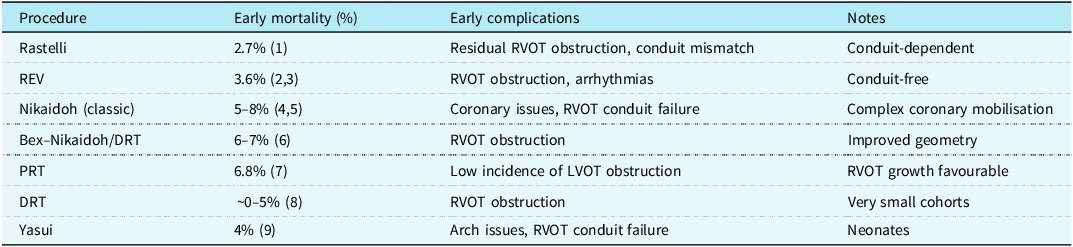
Early mortality ranged from 0 to 6.8% across studies. Pooled early mortality was 2.7% (95% CI 0.8–8.8%) for the Rastelli procedure,Reference Hörer, Schreiber and Dworak1 3.6% (1.4–8.7%) for Réparation à l’étage ventriculaire,Reference Pontailler, Moiroux-Sahraoui and Bernheim2,Reference An, Li, Yan, Wang and Hua3 and 5.8% (2.8–11.4%) for Nikaidoh/Bex operationsReference Yeh, Ramaciotti, Leonard, Roy and Nikaidoh4,Reference Schulz, Buratto, Ishigami, Konstantinov, Cheung and Brizard6 (Figure 1). One pulmonary root translocation series reported early mortality of 6.8%.Reference da Silva, da Fonseca da Silva and Lopes7 A Yasui cohort reported one early death among 25 patients (4%).Reference Greene, Scully and Staffa9 Other early complications included residual left ventricular outflow tract or right ventricular outflow tract obstruction, need for extracorporeal membrane oxygenation, and pacemaker implantation, though reporting was inconsistent. Early postoperative results for each technique are summarised in Table 1.
Forest plot showing early mortality across contemporary surgical techniques for double outlet right ventricle (DORV). Forest plot showing early mortality across contemporary surgical techniques for DORV. Individual study proportions and 95% confidence intervals are displayed for Rastelli, Réparation à l’étage ventriculaire (REV), Nikaidoh/Bex aortic root translocation and variants, pulmonary root translocation, and double-root translocation procedures. Pooled estimates were calculated using random-effects models with logit transformation and are shown as diamond markers; individual studies appear as circles. Because early mortality rates were uniformly low (<6% across techniques), the x-axis is displayed on a focused scale (0.00–0.25) to enhance visualisation of differences and confidence intervals. Variation reflects underlying anatomy, coronary patterns, and procedural complexity. Abbreviations: LVOTO = left ventricular outflow tract obstruction; RVOT = right ventricular outflow tract.

Early outcomes by procedure

This table summarises early postoperative outcomes for all major biventricular repair techniques used in double outlet right ventricle (DORV). Reported early mortality rates reflect pooled estimates from included studies. Early complications include residual right or left ventricular outflow tract obstruction, arrhythmias, coronary-related issues in root translocation procedures, and conduit-related dysfunction. Variation across cohorts reflects differences in anatomy, surgical strategy, and institutional experience.
DRT = Double-root translocation; LVOT = Left ventricular outflow tract; LVOTO = Left ventricular outflow tract obstruction; PRT = Pulmonary root translocation; PS = Pulmonary stenosis; REV = Réparation à l’étage ventriculaire; RVOT = Right ventricular outflow tract; TGA = Transposition of the great arteries; VSD = Ventricular septal defect.
Long-term survival
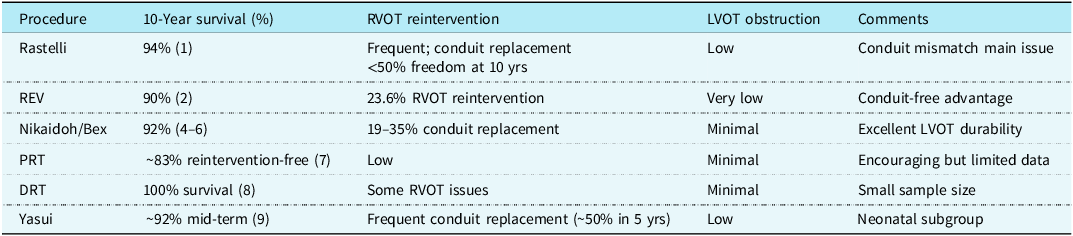
Ten-year survival exceeded 90% for all major procedures (Figure 2). Pooled estimates were 94.3% (87.7–97.5%) for Rastelli,Reference Hörer, Schreiber and Dworak1 89.8% (83.0–94.1%) for Réparation à l’étage ventriculaire,Reference Pontailler, Moiroux-Sahraoui and Bernheim2,Reference An, Li, Yan, Wang and Hua3 and 91.9% (85.7–95.5%) for Nikaidoh/Bex aortic root translocation.Reference Yeh, Ramaciotti, Leonard, Roy and Nikaidoh4–Reference Schulz, Buratto, Ishigami, Konstantinov, Cheung and Brizard6 The Yasui operation demonstrated approximately 92% survival at mid-term follow-up.Reference Greene, Scully and Staffa9 A small double-root translocation cohort reported 100% survival, although confidence intervals were wide due to limited sample size.Reference Hu, Xie and Li8 Historical benchmarks showed substantially lower survival (∼81% at 8 years),Reference Aoki, Forbess, Jonas, Mayer and Castaneda10 underscoring the improvement in contemporary care. A contemporary national cohort confirmed improved survival trends and heterogeneous anatomic distributions in real-world populations.Reference Holten-Andersen, Lippert, Holmstrøm, Brun and Døhlen12 Long-term outcomes and reintervention profiles are listed in Table 2.
Ten-year survival after double outlet right ventricle (DORV) repair. Forest plot showing 10-year survival following contemporary surgical repair strategies for DORV. Individual study proportions and 95% confidence intervals are displayed for Rastelli, Réparation à l’étage ventriculaire (REV), Nikaidoh/Bex aortic root translocation and variants, pulmonary root translocation, double-root translocation, and the Yasui operation. Pooled estimates for the major procedure categories were calculated using random-effects models with logit transformation and are shown as diamond markers; individual cohorts are shown as circles. Because long-term survival was uniformly high (>90% across techniques), the x-axis is restricted to 0.70–1.00 to improve visualisation of differences and confidence intervals. Abbreviations: LVOT = left ventricular outflow tract.

Long-term outcomes and reinterventions

This table presents long-term survival, right ventricular outflow tract (RVOT) and left ventricular outflow tract (LVOT) reintervention rates, and conduit durability across the major surgical techniques used for double outlet right ventricle (DORV). Differences in reintervention profiles reflect variations in anatomic suitability, conduit dependence, and the complexity of LVOT and RVOT reconstruction. Nikaidoh and Bex modifications provided excellent LVOT durability but were limited by conduit-related RVOT failure. REV demonstrated low LVOT obstruction rates despite notable RVOT reintervention. Yasui repairs achieved stable LVOT patency in neonates but required frequent conduit replacement.
DRT = Double-root translocation; DORV = Double outlet right ventricle; LVOT = Left ventricular outflow tract; LVOTO = Left ventricular outflow tract obstruction; PRT = Pulmonary root translocation; PS = Pulmonary stenosis; REV = Réparation à l’étage ventriculaire; RVOT = Right ventricular outflow tract; TGA = Transposition of the great arteries; VSD = Ventricular septal defect.
Reinterventions and conduit durability
Reintervention rates varied substantially. Conduit replacement was frequent after Rastelli repair, with one large series reporting 48.8% freedom from conduit replacement at 10 years.Reference Hörer, Schreiber and Dworak1 Nikaidoh/Bex procedures demonstrated excellent durability of the left ventricular outflow tract but required right ventricular outflow tract conduit replacement in 19–35% of patients.Reference Yeh, Ramaciotti, Leonard, Roy and Nikaidoh4–Reference Schulz, Buratto, Ishigami, Konstantinov, Cheung and Brizard6 In a large Réparation à l’étage ventriculaire cohort, 23.6% required right ventricular outflow tract reintervention and 2.5% required left ventricular outflow tract reoperation, with approximately 60% freedom from right ventricular outflow tract reintervention at 40 years.Reference Pontailler, Moiroux-Sahraoui and Bernheim2 Pulmonary root translocation demonstrated 82.9% reintervention-free survival at 12 years.Reference da Silva, da Fonseca da Silva and Lopes7 Neonatal Yasui repairs achieved stable left ventricular outflow tract patency but required frequent conduit replacement (≈50% by 5 years).Reference Greene, Scully and Staffa9
Subgroup analyses
Subgroup reporting was limited and heterogeneous across studies. Patients with subaortic ventricular septal defects and no significant left ventricular outflow tract obstruction predominantly underwent Rastelli or Réparation à l’étage ventriculaire repair. Both approaches achieved excellent long-term survival, although Rastelli was associated with more frequent conduit replacement. Some comparative data suggested lower right ventricular outflow tract reintervention rates with Réparation à l’étage ventriculaire, although findings were inconsistent.Reference Hörer, Schreiber and Dworak1–Reference An, Li, Yan, Wang and Hua3
Patients with Taussig–Bing physiology, noncommitted ventricular septal defects, or significant left ventricular outflow tract obstruction were typically managed with Nikaidoh/Bex procedures. These techniques provided durable left ventricular outflow tract reconstruction with minimal late left ventricular outflow tract obstruction or aortic insufficiency, but at the cost of higher early mortality and substantial right ventricular outflow tract conduit failure.Reference Yeh, Ramaciotti, Leonard, Roy and Nikaidoh4–Reference Schulz, Buratto, Ishigami, Konstantinov, Cheung and Brizard6
Neonates and infants with arch obstruction and severe left ventricular outflow tract obstruction underwent the Yasui operation, which demonstrated excellent early and mid-term survival but high conduit-related reintervention rates.Reference Greene, Scully and Staffa9
Abnormal coronary anatomy frequently influenced surgical selection. Several Nikaidoh/Bex series reported higher early mortality when coronary patterns limited safe root translocation. Earlier age at repair (<4 years) and smaller initial conduit size were associated with shorter conduit lifespan across Rastelli and Nikaidoh/Bex cohorts.Reference Yeh, Ramaciotti, Leonard, Roy and Nikaidoh4–Reference Schulz, Buratto, Ishigami, Konstantinov, Cheung and Brizard6
Formal subgroup meta-analysis was not feasible because only a minority of studies reported adequately disaggregated data.
Most studies were rated at moderate risk of bias, primarily due to retrospective design and incomplete reporting (Supplemental Table 2). Certainty of evidence for pooled outcomes was generally low because of study heterogeneity and imprecision (Supplemental Table 3).
Discussion
This systematic review synthesises contemporary outcomes of biventricular repair strategies for double outlet right ventricle in children. Across 13 retrospective studies involving 413 patients, early mortality was uniformly low, and long-term survival exceeded 90% for all major procedures. These findings highlight the substantial progress in perioperative care, anatomical assessment, and surgical technique over the past two decades.Reference Aoki, Forbess, Jonas, Mayer and Castaneda10 Owing to the diverse ventricular–arterial relationships encompassed by double outlet right ventricle, inter-procedural comparisons in this review should be interpreted as descriptive summaries within anatomically defined indications rather than evidence of procedural equivalence.
From a conceptual standpoint, contemporary biventricular double outlet right ventricle repair strategies may be broadly grouped into two operative categories. Intraventricular rerouting techniques, including the Rastelli and Réparation à l’étage ventriculaire procedures, are primarily applied in patients with subaortic ventricular septal defects and favourable LV outflow alignment. In contrast, root-based or outflow realignment strategies—such as Nikaidoh/Bex aortic root translocation, pulmonary root translocation, and double-root translocation—are employed in more complex anatomies to establish unobstructed LV outflow and optimise ventricular–arterial alignment.
Comparison of early outcomes across techniques
The Rastelli and Réparation à l’étage ventriculaire procedures demonstrated comparable early mortality, typically below 4%.Reference Hörer, Schreiber and Dworak1–Reference An, Li, Yan, Wang and Hua3 Rastelli remains a proven strategy for subaortic ventricular septal defects but is limited by conduit degeneration and growth mismatch. Réparation à l’étage ventriculaire, by contrast, avoids a right ventricular outflow tract conduit and reconstructs the outflow using the Lecompte manoeuvre, producing physiologic geometry that may reduce right ventricular outflow tract obstruction.Reference Pontailler, Moiroux-Sahraoui and Bernheim2,Reference An, Li, Yan, Wang and Hua3
Nikaidoh and Bex aortic root translocation procedures, applied in patients with complex ventricular–arterial relationships including remote or non-committed ventricular septal defects with right ventricular outflow tract obstruction, showed higher early mortality.Reference Yeh, Ramaciotti, Leonard, Roy and Nikaidoh4–Reference Schulz, Buratto, Ishigami, Konstantinov, Cheung and Brizard6 This reflects both anatomical complexity and the technical demands of coronary mobilisation. Nonetheless, contemporary series demonstrate markedly improved safety relative to early experiences.
Pulmonary root translocation and double-root translocation represent alternative realignment strategies in selected complex anatomies where standard intraventricular rerouting or single-root translocation is suboptimal.Reference da Silva, da Fonseca da Silva and Lopes7,Reference Hu, Xie and Li8 Early outcomes in these small cohorts were acceptable, although the evidence base remains limited. Yasui repairs in neonates with severe left ventricular outflow tract obstruction and arch obstruction achieved excellent early survival.Reference Greene, Scully and Staffa9
Durability and reinterventions
Although long-term survival was excellent, the durability of right ventricular outflow tract and left ventricular outflow tract reconstruction varied across procedures. Rastelli repair demonstrated reliable long-term survival, but conduit replacement was frequent. Freedom from conduit replacement at 10 years was below 50% in a major series.Reference Hörer, Schreiber and Dworak1 Younger age at repair and smaller initial conduit size predicted earlier reintervention. Réparation à l’étage ventriculaire avoided conduit-related complications but still showed substantial right ventricular outflow tract reintervention rates. Over long-term follow-up, 23.6% of patients required right ventricular outflow tract reintervention.Reference Pontailler, Moiroux-Sahraoui and Bernheim2 Freedom from right ventricular outflow tract reintervention at 40 years was approximately 60%, indicating that conduit avoidance does not eliminate right ventricular outflow tract dysfunction entirely. Nikaidoh and Bex modifications provided favourable left ventricular outflow tract alignment, with minimal late left ventricular outflow tract obstruction or aortic insufficiency.Reference Yeh, Ramaciotti, Leonard, Roy and Nikaidoh4–Reference Schulz, Buratto, Ishigami, Konstantinov, Cheung and Brizard6 However, right ventricular outflow tract conduit replacement remained frequent, occurring in 19–35% of patients. Double-root translocation may reduce right ventricular outflow tract reintervention by enabling a more anatomic pulmonary position,Reference Schulz, Buratto, Ishigami, Konstantinov, Cheung and Brizard6,Reference Hu, Xie and Li8 although long-term data are limited. Pulmonary root translocation demonstrated favourable right ventricular outflow tract growth and good durability, with 82.9% reintervention-free survival at 12 years.Reference da Silva, da Fonseca da Silva and Lopes7 Yasui repairs achieved excellent left ventricular outflow tract patency but required frequent conduit replacement, with approximately half of patients requiring reintervention within 5 years.Reference Greene, Scully and Staffa9 The Yasui operation represents a distinct neonatal strategy for patients with severe left ventricular outflow tract obstruction and aortic arch obstruction and is included in this review for descriptive completeness rather than procedural comparison.
Anatomic and physiologic considerations
Procedure selection in double outlet right ventricle is strongly determined by anatomical relationships. Subaortic ventricular septal defects in the presence of right ventricular outflow tract obstruction favour intraventricular rerouting strategies such as Rastelli or Réparation à l’étage ventriculaire repair.Reference Hörer, Schreiber and Dworak1–Reference An, Li, Yan, Wang and Hua3 Taussig–Bing physiology, non-committed or remote ventricular septal defects associated with right ventricular outflow tract obstruction may require root-based realignment strategies to achieve unobstructed postoperative left ventricular outflow tract continuity. Double-root or pulmonary root translocation can improve alignment.Reference da Silva, da Fonseca da Silva and Lopes7,Reference Hu, Xie and Li8 Coronary anatomy is a major determinant of feasibility: abnormal coronary courses can preclude root translocation and may increase surgical risk.Reference Yeh, Ramaciotti, Leonard, Roy and Nikaidoh4–Reference Schulz, Buratto, Ishigami, Konstantinov, Cheung and Brizard6 These anatomic determinants emphasise that no single repair is universally applicable.
Centre experience and technical evolution
Institutional experience played an important role in outcomes across several studies. Centres with large volumes of root translocation procedures reported lower operative mortality and fewer major complications. Technical refinement—including improved coronary mobilisation, tailored right ventricular outflow tract reconstruction, and systematic use of imaging for preoperative planning—likely contributed to improved outcomes over time.
Limitations
Most included studies were retrospective, single-centre cohorts with inherent selection bias. Reporting of anatomic subtypes, coronary patterns, and conduit characteristics was incomplete. Follow-up duration varied widely, and reintervention definitions were inconsistent. Few studies provided disaggregated subgroup data, limiting comparative statistical analysis. Certainty of evidence for pooled outcomes was generally low, as summarised in the GRADE assessment.
Implications and future directions
Despite heterogeneity in anatomy and technique, modern double outlet right ventricle repair in children yields excellent survival across procedures. Given the trade-offs between left ventricular outflow tract durability, right ventricular outflow tract conduit longevity, and operative complexity, individualised surgical planning remains essential. Prospective multicenter registries are needed to clarify comparative advantages of each technique and identify patient-specific predictors of durability. Future research should also explore bioengineered or growing conduits to reduce the burden of reoperation in young patients.
Conclusions
Modern surgical repair of double outlet right ventricle in children achieves excellent long-term survival, with early mortality consistently below 6% across contemporary techniques. Despite these favourable outcomes, important differences in durability and reintervention profiles persist, highlighting the need for individualised operative planning tailored to anatomic characteristics and patient-specific factors.
The Rastelli procedure remains a reliable option for patients with subaortic ventricular septal defects; however, conduit degeneration and limited growth potential lead to frequent reinterventions, with nearly half of patients requiring conduit replacement within 10 years. The Réparation à l’étage ventriculaire operation avoids an extracardiac conduit and provides survival comparable to Rastelli, yet right ventricular outflow tract reinterventions are still required in up to one quarter of patients over long-term follow-up. Nikaidoh and Bex aortic root translocation procedures provide excellent left ventricular outflow tract alignment in selected complex anatomies with right ventricular outflow tract obstruction, with minimal late left ventricular outflow tract obstruction or aortic insufficiency. These benefits come with increased operative complexity, higher early mortality, and significant right ventricular outflow tract conduit failure. Double-root translocation may offer improved right ventricular outflow tract geometry, though evidence is limited by small cohort sizes.
The Yasui operation enables stable biventricular circulation in neonates with severe left ventricular outflow tract obstruction and arch obstruction, achieving high early and mid-term survival. However, conduit replacement is frequent, necessitating structured long-term surveillance.
Overall, operative choice should incorporate ventricular septal defect position, left ventricular outflow tract obstruction severity, coronary anatomy, patient age and size, and institutional expertise. Continued refinement of root translocation techniques and development of tissue-engineered or growing conduits may improve durability. Prospective multicenter registries are needed to better define comparative performance across anatomic subgroups and to enhance long-term patient outcomes.
Perspectives
What is known?
Double outlet right ventricle represents a heterogeneous group of CHDs requiring individualised surgical strategies. Traditional approaches such as the Rastelli procedure achieve good survival but are limited by conduit degeneration. Alternative techniques—including the Réparation à l’étage ventriculaire, Nikaidoh/Bex aortic root translocation, and the Yasui operation—address specific anatomic challenges such as left ventricular outflow tract obstruction or Taussig–Bing physiology.
What is new?
This systematic review synthesises contemporary paediatric data across all major double outlet right ventricle repair strategies and demonstrates consistently low early mortality (<6%) and excellent long-term survival (>90%) for Rastelli, Réparation à l’étage ventriculaire, Nikaidoh/Bex, and Yasui operations. Important differences in durability were identified: Rastelli and Nikaidoh/Bex repairs are limited by right ventricular outflow tract conduit failure, whereas Réparation à l’étage ventriculaire avoids a conduit but still incurs notable right ventricular outflow tract reinterventions. Nikaidoh/Bex procedures provide durable left ventricular outflow tract reconstruction but have higher early mortality due to technical complexity.
What is next?
Future research should focus on multicenter prospective registries to compare techniques across standardised anatomic subgroups and to reduce selection bias inherent in single-centre retrospective studies. Advances in tissue-engineered or growing conduits may improve right ventricular outflow tract durability and reduce the long-term burden of reoperation. Longitudinal studies evaluating neurodevelopmental outcomes, exercise capacity, and quality of life are needed to guide patient-centred decision-making in this complex population.
Supplementary material
The supplementary material for this article can be found at https://doi.org/10.1017/S1047951126111287.
Acknowledgements
None.
Financial support
The authors report no external funding for this work.
Competing interests
The authors declare no conflicts of interest relevant to the content of this manuscript.
Ethical standard
This study is a systematic review of previously published data. No new patient data were collected, and no identifiable individual information was accessed. Therefore, ethical approval and informed consent were not required. Extracted datasets, analytic code, and digitised survival data are available from the corresponding author upon reasonable request.