


1. INTRODUCTION
Laser-plasma based accelerators have generated great interest recently due to the development of super intense laser pulses and a series of experimental achievements leading to the production of quasi-monoenergetic electron beams with energies in the range of 100 MeV to 1 GeV (Esarey et al., Reference Esarey, Sprangle, Krall and Ting1996; Modena et al., Reference Modena, Najmudin, Dangor, Clayton, Marsh, Joshi, Malka, Darrow, Danson, Neely and Walsh1995; Singh et al., Reference Singh, Sajal and Gupta2008; Leemans et al., Reference Leemans, Nagler, Gonsalves, Toth, Nakamura, Geddes, Esarey, Schroeder and Hooker2006). Particle accelerators find applications in X-ray lasers (Amendt et al., Reference Amendt, Eder and Wilks1991; Bessonov et al., Reference Bessonov, Gorbunkov, Ishkhanov, Kostryukov, Maslova, Shvedunov, Tunkin and Vinogradov2008; Wong et al., Reference Wong, Woo and Yap2007), laser-plasma based harmonic generation (Esarey et al., Reference Esarey, Ride and Sprangle1993), laser-driven inertial confinement fusion schemes (Tabak et al., Reference Tabak, Hammer, Glinsky, Kruer, Wilks, Woodworth, Campbell, Perry and Mason1994; Azizi et al., Reference Azizi, Hora and Miley2009), high-resolution radiography for nondestructive material inspection, comprehensive zero-jitter pump-probe analysis, radiotherapy, ultrafast chemistry, femtosecond-time-scale measurements, radiobiology, and material science.
In plasma-based acceleration, a plasma wave with a phase velocity close to the speed of light is excited in acceleration schemes such as laser wakefield acceleration (LWFA) (Tajima & Dawson, Reference Tajima and Dawson1979; Nakamura et al., Reference Nakamura, Nagler, Tóth, Geddes, Schroeder, Esarey, Leemans, Gonsalves and Hooker2007; Luttikhof et al., Reference Luttikhof, Khachatryan, Van Goor, Boller and Mora2009), plasma wakefield acceleration (PWFA) (Chen, Reference Chen1985; Huang et al., Reference Huang, Lu, Zhou, Clayton, Joshi, Mori, Muggli, Deng, Oz, Katsouleas, Hogan, Blumenfeld, Decker, Ischebeck, Iverson, Kirby and Walz2007; Hogan et al., Reference Hogan, Barnes, Clayton, Decker, Deng, Emma, Huang, Iverson, Johnson, Joshi, Katsouleas, Krejcik, Lu, Marsh, Mori, Muggli, O'Connell, Oz, Siemann and Walz2005; Dimitrov et al., Reference Dimitrov, Giacone, Bruhwiler, Busby, Cary, Geddes, Esarey and Leemans2007), plasma beat wave acceleration (PBWA) (Shvets et al., Reference Shvets, Fisch and Pukhov2002), self-modulated wakefield acceleration (SMWFA), (Najmudin et al., Reference Najmudin, Krushelnick, Clark, Mangles, Walton, Dangor, Fritzler, Malka, Lefebvre, Gordon, Tsung and Joshi2003), and resonant LWFA (Sprangle et al., Reference Sprangle, Hafizi, Peñano, Hubbard, Ting, Moore, Gordon, Zigler, Kaganovich and Antonsen2002). Relatively large laser spot size effectively increases the Rayleigh range of the laser beam, allowing propagation over distances on the order of the gas jet length resulting in the monoenergetic bunches (Mangles et al., Reference Mangles, Murphy, Najmudin, Thomas, Collier, Dangor, Divali, Foster, Gallacher, Hooker, Jaroszynski, Langley, Mori, Norreys, Tsung, Viskup, Walton and Krushelnick2004; Faure et al., Reference Faure, Glinec, Pukhov, Kiselev, Gordienko, Lefebvre, Rousseau, Burgy and Malka2004).
The direct electron acceleration by the lasers in vacuum has received attention in recent years. The problems inherent in laser-plasma interaction, such as wakefield generation and laser-plasma instabilities are absent in vacuum. When a powerful laser beam is focused onto a free electron in vacuum, the ponderomotive force of the laser light pushes electrons into the direction opposite to the gradient of the light intensity, and can accelerate them to relativistic energies. The amplitude of electron oscillations along the polarization direction (quiver motion) increases with the magnitude of the electric field. For a small focal spot size, the transverse amplitude can exceed the laser beam size, causing the electrons to escape in the transverse direction (Hartemann et al., Reference Hartemann, Van Meter, Troha, Landahl, Luhmann, Baldis, Gupta and Kerman1998; Xu et al., Reference Xu, Kong, Chen, Wang, Wang, Lin and Ho2007a, Reference Xu, Kong, Chen, Wang, Wang, Lin and Ho2007b; Gupta & Suk, Reference Gupta and Suk2007; Kawata et al., Reference Kawata, Kong, Miyazaki, Miyauchi, Sonobe, Sakai, Nakajima, Masuda, Ho, Miyanaga, Limpouch and Andreev2005). To correctly describe the electron acceleration, it is necessary to take into account the longitudinal components of the fields. The acceleration occurs almost symmetrically around the laser propagation direction (Mora & Quesnel, Reference Mora and Quesnel1998). High-energy-density attosecond electron beam production by intense short-pulse laser with a plasma separator has been studied previously by Sakai et al. (Reference Sakai, Miyazaki, Kawata, Hasumi and Kikuchi2006). And resonant acceleration of electrons by intense circularly polarized Gaussian laser pulses was investigated earlier by Niu et al. (Reference Niu, He, Qiao and Zhou2008).
Acceleration of free electrons in vacuum to MeV energies by a high-intensity subpicosecond laser pulse has been studied experimentally (Malka et al., Reference Malka, Lefebre and Miquel1997). The high-energy electrons ejected from a laser focus following the ionization of high-charge states of gases have been investigated experimentally. The method generated electron pulses with MeV energies and pulse widths substantially less than the laser pulse width (Moore et al., Reference Moore, Ting, McNaught, Qiu, Burris and Sprangle1999). Free electrons are rapidly accelerated by the leading edge of the pulse and then expelled from the pulse before being overtaken by the pulse, and never see the maximum temporal peak intensity of the intense laser pulse (Hu & Starace, Reference Hu and Starace2006). Generation of collimated quasi-monoenergetic electrons has been studied recently (Singh et al., Reference Singh, Sajal and Gupta2008; Karmakar & Pukhov, Reference Karmakar and Pukhov2007).
The laser field in previous studies was assumed as linearly polarized and the dependence on the initial phase has not been investigated carefully yet. The effect of other parameters on electron acceleration also needs to be investigated. We investigate the effect of laser pulse polarization and different parameters on electron acceleration in vacuum in this paper. We have found better acceleration effects by a circularly polarized laser pulse due to the axial symmetry of its electromagnetic fields. This paper is organized as follows: The electron dynamics in the presence of the linearly polarized and circularly polarized laser pulses are presented in the next section. The Section 3 is devoted to the results and discussion of the numerical simulations. Finally, conclusions are drawn in the Section 4.
2. ELECTRON DYNAMICS
Consider the propagation of a laser pulse with electric field

where

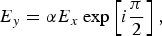

the phase of the laser is given by  is the Rayleigh length, τ is the pulse duration, r 2 = x 2 + y 2 and r 0 is the minimum spot size of the laser. The Rayleigh length is the distance along the propagation direction of the laser from the waist to the place where the area of the cross section is doubled. The α = 0 for the linearly polarized laser pulse and α = 1 for the circularly polarized laser pulse. The initial position of the pulse temporal peak is taken at the origin. If we put the initial coordinates of the electron in the phase of the laser then we get the value of the initial phase.
The magnetic field related to the laser pulse is given by Maxwell's equation ∇ × E = −∂B/∂t. A three-dimensional test-particle simulation code is utilized to study the dynamics of accelerated electrons. We solve the relativistic Newton-Lorentz equations of motion given by d P/dt = −e(E + v × B) using the fourth order Runge-Kutta method with variable time step size. The following relations have been used P x = γm 0v x, P y = γm 0v y, P z = γm 0v z and γ2 = 1 + (P x2 + P y2 + P z2)/m 02c 2. The kinetic energy of an electron associated is given by γm 0c 2 = 0.51(γ − 1)MeV.
Throughout this paper time, length, and velocity are normalized by 1/ω, 1/k, and c, respectively. We use the following normalized parameters a 0 = eE 0/m 0ωc and b 0eB 0/m 0ω, where e and m 0 are electron charge and rest mass, respectively.
3. RESULTS AND DISCUSSION
Acceleration of the electrons situated along the z-axis with initial positions from z 0 = 0 to z 0 = 400 has been studied for linearly polarized and circularly polarized laser pulses. The normalized pulse duration is taken as τ = 200. The initial transverse momentum is assumed to be zero. The results corresponding to zero initial energy are applicable for electrons that are generated during ionization processes of a gas or are situated ahead of the pulse. The electrons are generated during interaction of high intensity laser pulse with gas atoms through multiple ionizations. The electrons are removed from the outer shells of the atoms as the interaction begins, and then from the inner shells of the atoms. The electrons from the outer shells are generated close to the rising edge and the electrons from inner shells are generated close to the peak of the laser pulse. Plasma effects such as wakefield generation, magnetic field generation, plasma instabilities, space charge effect, modification of the laser envelope, etc. can be neglected and the calculation can be approximated by vacuum conditions for a low-density gas. The results with some finite initial energy are applicable when pre-accelerated electrons are injected into the laser focus. The results are presented in the form of normalized variables.
Figures 1a and 1b show the energy of electrons γ and the scattering angle θ (in degree), respectively, as a function of initial positions of the electrons z 0 for P z0 = 0, a 0 = 10, and r 0 = 70 for the linearly polarized and circularly polarized laser pulses. The electrons close to the temporal peak of the laser pulse show strong initial phase dependence for a linearly polarized laser pulse. The electrons with initial phases φ0 = (2n + 1)π/2, where n = 0, 1, 2, 3 … are scattered least and retain highest energy. The electrons with initial phases φ0 = nπ are scattered more and retain least energy. Bahari and Taranukhin (Reference Bahari and Taranukhin2004) reported that the electron acceleration is not dependent on the initial laser phase for a short laser pulse. This is true only for those electrons interacting with the leading edge of the pulse or for a circularly polarized laser pulse. The scattering and energy of the electrons depend strongly on the initial laser phase for the electrons close to the temporal peak of the pulse for a linearly polarized laser pulse. The electrons close to the temporal peak of the circularly polarized laser pulse do not show any initial phase dependence. The energy gain is highest for a circularly polarized laser pulse as compared to a linearly polarized laser pulse (for φ0 = (2n + 1)π/2). Singh (Reference Singh2004) has investigated the interaction between a high intensity electromagnetic wave and an electron on the basis of analytically derived expressions for the x- and z-coordinates and the electron energy. The dependence of electron energy on the initial phase for linearly polarized laser pulse has been found analytically in that study. When the initial phase is φ0 = (2n + 1)π/2, the magnitude of the electric field given by Eq. (1) is zero for a linearly polarized laser pulse. The electric field interacting with the electron starts increasing with time, which is an accelerating phase for the electron. When the initial phase is φ0 = nπ/2, the magnitude of electric field given by Eq. (1) is at its temporal peak for a linearly polarized laser pulse. The electric field interacting with electron starts decreasing with time, which is a decelerating phase for the electron. This is not the case with circularly polarized laser pulse. When the x-component of the electric field decreases, the y-component increases. The electron does not encounter the decelerating phase. The electrons close to the leading edge of the laser pulse do not show any initial phase dependence for either linearly polarized or circularly polarized laser pulse because the laser intensity is very low there. The energy decreases and the scattering angle increases with initial positions of the electrons from the temporal peak to the leading edge of the pulse. We are interested in a comparison of the highest energy (for φ0 = (2n + 1)π/2) for the linearly polarized and circularly polarized laser pulse, respectively. Acceleration of the electrons with initial phases φ0 = (2n + 1)π/2, where n = 0, 1, 2, 3 … are considered for the results of Figures 2 to 6.
(Color online) (a) The electron energy γ and (b) The scattering angle θ (in degree) as a function of z 0 for P z0 = 0, a 0 = 10, and r 0 = 70 for the linearly polarized and circularly polarized laser pulses.

(Color online) The electron energy γ as a function of (a) r 0 and (b) P z0 for z 0 = π/2, and a 0 = 10 for the linearly polarized and circularly polarized laser pulses.

(Color online) The electron energy γ as a function of z 0 for P z0 = 0 at (a) a 0 = 5, (b) a 0 = 10, and (c) a 0 = 20.

(Color online) The electron energy γ as a function of z 0 for a 0 = 5 at (a) P z0 = 1, (b) P z0 = 3, and (c) P z0 = 5.

(Color online) The electron energy γ as a function of (a) a 0 for P z0 = 0; and (b) P z0 for a 0 = 10 for z 0 = π/2.

(Color online) The temporal variation of (a) the y-component of the EM force F y, (b) The electron momentum Py, (c) the y-coordinate of the electron, and (d) The electron energy γ for z 0 = π/2, a 0 = 10, and P z0 = 0. Solid black line is for linearly polarized and dashed red line is for circularly polarized.

Figure 2a shows the electron energy given by the relativistic γ factor as a function of r 0 for z 0 = π/2, P z0 = 0 and a 0 = 10 for the linearly polarized and circularly polarized laser pulse. The energy of the electron increases rapidly with normalized laser spot size r 0 and then saturates. The electron energy is higher for the linearly polarized laser pulse than that for a circularly polarized laser pulse if the laser spot size is less than r 0 = 40. The energy of the electron is higher for circularly polarized laser pulse for higher values of r 0. The energy of the electron increases very slowly beyond r 0 = 20 for the linearly polarized laser pulse and beyond r 0 = 70 for the circularly polarized laser pulse. A large value of r 0 imply requirement of high laser energy. Our natural choice is the lowest value of the laser spot size for which the electron is able to gain most of the energy it can. We can say that this is the optimum value of laser spot size r 0m. The scattering of the electrons is associated with the transverse coordinate, which ultimately governs the optimum value of laser spot size. The x-coordinate (Singh, Reference Singh2004) and the optimum laser spot size in the present study are proportional to the laser intensity and inversely proportional to (γ0 – P z0. We can estimate the optimum value of minimum laser spot size to be r 0m ≅ 7a 0/(γ − P z0). Figure 2b shows the optimum value of minimum laser spot size r 0m as a function of initial momentum. The value of r 0m is too high for higher values of the laser intensity and the initial momentum. The lasers of that high energy may not be available to reach optimum r 0m and corresponding electron energy.
Figures 3a–3c show the electron energy γ as a function of z 0 at P z0 = 0 and r 0 = 7a 0 for a 0 = 5, a 0 = 10, and a 0 = 20, respectively. As expected, the energy of the electrons increases with laser intensity parameter a 0. The electrons gain higher energy for a circularly polarized laser pulse than for a linearly polarized laser pulse for all the three values of a 0. The energy of the electrons decreases with z 0 implying that the electrons close to temporal peak of the pulse gain higher energy and the electrons close to the leading edge of the laser pulse gain small energy for all the values of laser intensity. Here, it may be noted that the results of Figure 1 include all the values of initial electron positions while the results of Figure 3 are for z 0 = (2n + 1)π/2 only. The results of Figure 1 are for initial position z 0 up to 80π only and the results of Figure 3 are for z 0 up to 140π. The effect of laser intensity has been investigated in more detail in Figure 5a.
Figures 4a–4c show the electron energy γ as a function of z 0 at a 0 = 5 for P z0 = 1, P z0 = 3, and P z0 = 5, respectively. The energy of electrons increases with initial electron momentum P z0. The electrons gain higher energy for a circularly polarized laser pulse than for a linearly polarized laser pulse for all the three values of P z0. The energy trend with z 0 also remains the same for all three values of P z0. The effect of the initial electron energy has been investigated in more detail in Figure 5b.
Figure 5a shows the electron energy γ as a function of a 0 for z 0 = π/2 and P z0 = 0. It can be seen from the plots that the lines corresponding to relativistic factor γ coincides with the line corresponding to 0.7a 02 for the linearly polarized laser pulse and with the line 0.83a 02 for the circularly polarized laser pulse. The energy of the electrons is proportional to laser intensity. For the chosen parameters, the energy of electrons increases more rapidly with laser intensity for a circularly polarized laser pulse than that for a linearly polarized laser pulse. Figure 5b shows electron energy γ as a function of initial electron momentum P z0 for z 0 = π/2 and a 0 = 10. The energy of the electron is inversely proportional to (γ0 − P z0). It can be seen from the plots that the line corresponding to the relativistic factor γ coincides with the line corresponding to 70/(γ0 − P z0) for a linearly polarized laser pulse and with the line corresponding to 83/(γ0 − P z0) for a circularly polarized laser pulse. For the chosen parameters, the energy of the electrons increases more rapidly with initial energy for a circularly polarized than that for linearly polarized laser pulse. The energy gained by the electrons is found to be proportional to the laser intensity and inversely proportional to (γ0 − P z0) by Singh (Reference Singh2004), which is followed in the present study as well. The energy of the electrons with initial positions close to the temporal peak can be approximated by γR ≅ 0.7a 02/(γ0 − P z0) for a linearly polarized laser pulse and by γR ≅ 0.83a 02/(γ0 − P z0) for a circularly polarized laser pulse.
The parameters for Figure 6 are a 0 = 10, z 0 = π/2 and P z0 = 0. Figures 6a and 6b show temporal variation of y-component of the electromagnetic force F y and the electron momentum P y, respectively. A linearly polarized laser pulse does not have any y–component of electric field. The y-component of the electromagnetic force on the electron and electron momentum are negligible for a linearly polarized laser pulse as compared to that for a circularly polarized laser pulse. Figure 6c shows temporal variation of y-coordinate of the electron. The y-coordinate has a finite value for a circularly polarized laser pulse and is nearly zero for the linearly polarized laser pulse. Figure 6d shows temporal variation of electron energy γ. The electron energy γ is higher for a linearly polarized laser pulse in the beginning. The electron energy is higher for a circularly polarized laser pulse for higher values of normalized time. The y-component of the electric field of circularly polarized laser pulse contributes to the higher energy gained by the electrons.
Xu et al. (2007a, 2007b) have presented the characteristics of vacuum laser acceleration in a tightly focused circularly polarized laser pulse with the capture and acceleration scenario scheme. The main advantage for using a circularly polarized field was found that its acceleration channel occupies a relatively larger phase space, stemming from the distribution of the longitudinal electric component, the dependence on the laser initial phase and on the incident polarization azimuth angle, etc. It gives rise to greater acceleration efficiency. We have also studied (not shown) the role of longitudinal laser fields in the acceleration process. We found that if we exclude longitudinal laser fields, it results in higher values of electron energy and higher scattering angle of the electrons. The inclusion of longitudinal laser fields' results in suppression of the scattering but it does not contribute to the longitudinal electron acceleration for parameters chosen in this paper. Laser is not very tightly focused in our study and capture and acceleration scenario scheme is not playing a role in the acceleration process. The role of longitudinal laser fields may be different for a tightly focused laser pulse. The ponderomotive force v × B ∝ E × B of the laser light pushes electrons in the direction opposite to the gradient and is the main contributor to the longitudinal acceleration. Even though the electrons with initial position at origin interact with the falling edge of the pulse, the pondermotive force v × B ∝ E × B is always in the forward direction. This is because the direction of magnetic and electric fields remains the same irrespective of rising or trailing edge of the pulse. The electrons are always accelerated in the forward direction and donot slip back with respect to the pulse. In fact, the electrons close to the peak of the pulse satisfy the best injection condition as explained by Hu and Starace (Reference Hu and Starace2006).
The trapping and acceleration of an electron by forward ponderomotive force associated with intense short laser pulses, propagating in homogeneous rarefied plasmas have been analyzed by Sazegari et al. (Reference Sazegari, Mirzaie and Shokri2006) by solving energy conservation law and Lorentz transformation. One-dimensional plane wave laser pulse propagating in homogeneous plasma was considered. It was shown that the gain of acceleration increases linearly with the field strength of the laser and the relativistic factor of the group velocity of the laser in the plasma. The energy gain is proportional to laser intensity in our study and proportional to electric field in their study. This is because the study by Sazegari and Shokri was performed for low density plasma while our study is in vacuum.
4. CONCLUSIONS
Electron acceleration by the linearly and circularly polarized laser pulses has been investigated in this paper. The energy gained by the electrons close to the temporal peak shows strong initial phase dependence for a linearly polarized laser pulse. It has been found that the electrons close to the temporal peak of laser pulse gain maximum energy approximated by γR ≅ 0.7a 02/(γ0 − P z0) and γR ≅ 0.83a 02/(γ0 − P z0) for the linearly polarized and circularly polarized laser pulses, respectively. The energy peaks for an optimum laser spot size approximated by 7a 0/(γ0 − P z0). The y-component of the electric field of the circularly polarized laser pulse contributes to the higher energy.
ACKNOWLEDGEMENT
This work was supported by Department of Science and Technology, Government of India. The acceleration simulation code used in this work was developed by Singh Simutech Pvt. Ltd., Bharatpur, Rajasthan, India.



