INTRODUCTION
The freshwater protozoan parasite of fish, Ichthyophthirius multifiliis Fouquet 1876, also known as ‘fish whitespot’, continues to impact wild and cultured fish populations worldwide and places an economic burden on global freshwater finfish aquaculture.
The ciliate protozoan I. multifiliis is one of the most important freshwater pathogens affecting the aquaculture and ornamental fish industries. In part, its impact stems from its low host specificity, allowing it to infect a wide range of fish species, including commercially important species such as channel catfish (Ictalurus punctatus Rafinesque 1818) and rainbow trout (Oncorhynchus mykiss Walbaum 1792) (see Valtonen and Koskivaara, Reference Valtonen and Koskivaara1994; Noble and Summerfelt, Reference Noble and Summerfelt1996; Buchmann and Bresciani, Reference Buchmann and Bresciani1997; Rintamäki-Kinnunen and Valtonen, Reference Rintamäki-Kinnunen and Valtonen1997; Matthews, Reference Matthews2005; Jørgensen et al. Reference Jørgensen, Larsen and Buchmann2009). It has a direct life cycle, which is temperature dependent such that the warmer the water temperature the faster the life cycle completes. The life cycle involves 4 different stages: (1) the trophont, which resides within the surface epithelium of gills, fins and other body surfaces; (2) the protomont, a free-swimming stage that exits the fish and settles on the substrate to become the encysted tomocyst stage (3) which in turn repeatedly divides by binary fission to produce tomites which are released to the water column. Tomites differentiate into the infective stage (4) the theront, which needs to find a host within a short window to successfully complete the life cycle by penetrating the epidermis and developing into the trophont stage before it dies (Lom and Dyková, Reference Lom and Dyková1992; Matthews, Reference Matthews2005). Theronts can survive for up to 92 h at low water temperatures; their survival being inversely proportional to the ambient water temperature (Wagner, Reference Wagner1960; Aihua and Buchmann, Reference Aihua and Buchmann2001).
On farms, the most common approaches to treat this ciliate is through the use of either short (e.g. 30 min–4 h in tanks, raceways and flow-through systems) or long (e.g. 7–15 days in pond culture) duration in-bath treatments which target the free-swimming stages of the parasite (i.e. protomonts and theronts). Of the other two stages, the trophont is protected lying underneath the host surface epithelium (Post and Vesely, Reference Post and Vesely1983) whilst the tomocyst is protected by a resistant coat (Ewing et al. Reference Ewing, Kocan and Ewing1983) and as such, are rarely susceptible to treatment.
Historically, malachite green (MG) was commonly used for the control of I. multifiliis and a range of other fish diseases (Srivastava et al. Reference Srivastava, Sinha and Roy2004) due to its demonstrable efficacy, low cost, ready availability, high stability during storage and high solubility in water (Schnick, Reference Schnick1988; Henderson et al. Reference Henderson, Schmitt, Heinze and Cerniglia1997). This organic (triphenylmethane) dye was favoured for the control of I. multifiliis infections because of its high efficacy against both the free-swimming stages (protomonts and theronts) of the parasite and the feeding parasite stage (trophont) within the fish's epithelium (Wahli et al. Reference Wahli, Schmitt and Meier1993; Tieman and Goodwin, Reference Tieman and Goodwin2001; Buchmann et al. Reference Buchmann, Jensen and Kruse2003). MG and its derivatives (mainly leucomalachite) also display well-documented ecotoxicological effects including cytotoxicity, carcinogenicity, mutagenicity, induction of chromosomal fractures, teratogenicity and respiratory toxicity (Culp and Beland, Reference Culp and Beland1996; Srivastava et al. Reference Srivastava, Sinha and Roy2004). Malachite green and its derivatives are also known to be highly persistent in the environment, bio-accumulating in the ecosystem and fish tissues (Henderson et al. Reference Henderson, Schmitt, Heinze and Cerniglia1997). Although the use of MG has never been licensed by the US Food and Drug Administration (FDA), its use in food products was initially permitted under an ‘investigational new animal drug’ status (Alderman, Reference Alderman1985). This status was revoked in 1983 and MG was listed as a priority chemical for toxicity and carcinogenicity testing (Culp and Beland, Reference Culp and Beland1996; Culp, Reference Culp2004). Similarly, in Canada the use of MG and the presence of its derivatives in food animals are not permitted and its continued use was advised against in 1992 when MG was classified as a class II health hazard (Canadian Food Inspection Agency 2010). Its use within the European Union has been subsequently banned in 2000 under EC directive 90/676/EEC; article 14, regulation 2377/90/EEC.
As a consequence of the widespread ban, enforced restrictions imposed on the use of MG and the concerns regarding the presence of derivatives in food-products (Herber, Reference Herber, Shore and Pruden2009), there has been extensive research in the last few decades focusing on the provision of alternative, effective and environmentally friendly products and management techniques for controlling I. multifiliis infections. Despite the global effort, no clear alternative management strategies have yet emerged. There is a strong commercial and scientific need for providing a critical summary of tested candidate and applied drugs but also an assessment of the potential of other management strategies to prove efficacious against I. multifiliis infections. It has been nearly 30 years since the last major reviews were published examining the use of drugs for the control of I. multifiliis (Cross, Reference Cross1972; Hoffman and Meyer, Reference Hoffman and Meyer1974; Herwig, Reference Herwig1979) so that this review might be considered to be somewhat overdue.
This paper provides an overview and assessment of the current state of knowledge concerning drugs (compound, dose, duration and efficacy) and physical interventions employed or tested against I. multifiliis since the 3 earlier reviews were published. This review seeks to summarize the original research findings and to help identify the most suitable therapy against I. multifiliis while highlighting the most promising treatments for further research and application in farm systems.
ASSESSMENT OF CURRENTLY APPLIED CHEMOTHERAPIES
A large number of compounds have been tested for efficacy against I. multifiliis although relatively few of them have been widely deployed to provide effective control under field conditions. Table 1 provides a detailed list of 116 compounds used to control I. multifiliis under laboratory or field conditions from 1980 onwards. Of the compounds that are listed, all except quinine and some malachite green-based formulations have been tested against food fish species. These latter treatments, however, that have been evaluated for the ornamental trade, are included to provide a comprehensive overview of all compounds tested for the treatment of I. multifiliis. Of those given in Table 1, 18 entries listed by their commercial product name are cross-referenced, and details of their activity given, under their specific compound formulation. Sixteen of the compounds have been assessed by in vitro trials only, while of the remaining 81 compounds tested in vivo, 43 have been tested in-bath challenges and 51 by in-feed presentation. Of those used under field conditions, the most commonly used treatments are: formaldehyde, sodium chloride, copper sulphate, potassium permanganate, chloramine-T, hydrogen peroxide, metronidazole and toltrazuril (Dickerson, Reference Dickerson and Woo2006; Noga, Reference Noga2010). Whilst malachite green was previously the most extensively employed treatment, eliminating the protomont, theront and trophont stages, its use has been largely discontinued for food fish, particularly in the EU and the United States.
Chemical treatments tested against infections of Ichthyophthirius multifiliis Fouquet, 1876

Abbreviations: d: days; h: hours; inf.: infection; p.i.: post-infection; *authors use the term ‘throphont/trophozites’ for the free-swimming stage which exited the fish host; ** authors used the term ‘adults’ for the free-swimming stage which exited the fish host; †: toxic to fish; a carp/trout/eels/ornamental fish.
Some caution, however, should be taken with regard to the treatment efficacies provided in Table 1, in that these may be the result of how the study was conducted (i.e. natural, multi-age class infections compared to a standard, single age class infection) and/or evaluated (i.e. parasite numbers determined from skin scrapes as opposed to total parasite counts) and therefore the results may have been affected by the differential level of parasitaemia at the time of the treatment on the test and control fish. For efficacious compounds of interest, therefore, details on the treatment conditions used in the original work should be consulted. If the physiological trauma created by exiting trophonts is considered as the primary cause of mortality, then a compound that successfully kills trophonts in situ, thereby preventing exit, could be considered efficacious (i.e. a statistically lower number of parasites and host mortality when compared to an appropriate control group).
Formaldehyde
Formaldehyde has been proven to be very effective at eliminating the free-living stages of the parasite (i.e. protomonts, tomocysts and theronts) (Wahli et al. Reference Wahli, Schmitt and Meier1993; Shinn et al. Reference Shinn, Taylor and Wootten2005, Lahnsteiner and Weismann, Reference Lahnsteiner and Weismann2007; Heinecke and Buchmann, Reference Heinecke and Buchmann2009), however, when used for in vivo baths, fish survival can be compromised (Wahli et al. Reference Wahli, Schmitt and Meier1993; Tieman and Goodwin, Reference Tieman and Goodwin2001). Formaldehyde remains one of the most commonly used treatments to control I. multifiliis infections in aquaculture systems (Noga, Reference Noga2010). However, efficiency is achieved only at high concentrations, which are serially repeatedly applied (i.e. 100 mg l−1 for 30 min to 1 h over 10 consecutive days in salmonid farms), such that in flow-through systems with rapid water turn-over, as used for e.g. the intensive production of salmonids, high volumes are required. In addition, the use of formaldehyde has many reported side effects such as reducing the oxygen available in the water by 1 ppm for each 5 ppm of formaldehyde that is used (Cross, Reference Cross1972; Pillay and Kutty, Reference Pillay and Kutty2005). This can be particularly problematical in summer when increasing water temperatures both accelerate the life cycle of I. multifiliis and act to cause a concomitant reduction in the oxygen holding capacity of the water. Buchmann et al. (Reference Buchmann, Bresciani and Jappe2004) also demonstrated that O. mykiss exposed to formaldehyde at concentrations of 200–300 ppm for 1 h had a reduced mucus production and were thus more susceptible to secondary infections by water moulds and bacteria. Accordingly, when formaldehyde is applied in vivo in the form of baths, fish survival can be compromised (e.g. for O. mykiss exposed to 2 treatments of 25 and 100 mg l−1 of formaldehyde for 1 h on days 9 and 12 post-infection) (Wahli et al. Reference Wahli, Schmitt and Meier1993). Importantly, the effect of water quality parameters on the toxicity of formaldehyde to fish and to I. multifiliis remains poorly characterized (Meinelt et al. Reference Meinelt, Pietrock, Burnison and Steinberg2005). Although formaldehyde is an approved aquacultural therapeutic within the EU (Schlotfeld, Reference Schlotfeld1993, Reference Schlotfeld1998), in 2004 it was re-classified by the WHO International Agency for Research on Cancer as ‘carcinogenic to humans’ (WHO, 2006). Even though it is quickly metabolized by aquatic organisms and holds a low potential for bio-accumulation (Hohreiter and Rigg, Reference Hohreiter and Rigg2001; Duffort et al. Reference Duffort, Houeix, Manier and Troise2010), it might be envisaged that formaldehyde could soon be banned due to the hazard it poses to workers handling large volumes of the chemical (Wooster et al. Reference Wooster, Martinez and Bowser2005). Given the high volumes of formaldehyde required in a typical farm treatment and the potential toxic risks this chemical poses to both fish stock and the farm workers handling it, the future of formaldehyde as a long-term acceptable and sustainable drug seems unlikely.
Sodium chloride
Sodium chloride (salt) is the second most commonly used product for the treatment of I. multifiliis infections. The application of a minimum of 2·5 g l−1 has been proven to reduce protomont and theront survival (Aihua and Buchmann, Reference Aihua and Buchmann2001; Shinn et al. Reference Shinn, Taylor and Wootten2005; Lahnsteiner and Weismann, Reference Lahnsteiner and Weismann2007). A treatment regime of 1–5 g l−1 salt applied continuously for a minimum period of 7 to 32 days, for example, was able to reduce the number of trophonts establishing on fish (Selosse and Rowland, Reference Selosse and Rowland1990; Miron et al. Reference Miron, Silva, Golombieski and Baldisserotto2003; Lahnsteiner and Weismann, Reference Lahnsteiner and Weismann2007; Balta et al. Reference Balta, Kayis and Altinok2008; Mifsud and Rowland, Reference Mifsud and Rowland2008). The use of higher concentrations of salt (e.g. 15–20 g l−1) over short periods of exposure (e.g. 20–60 min), however, was not able to reduce the level of infection (Lahnsteiner and Weismann, Reference Lahnsteiner and Weismann2007; Balta et al. Reference Balta, Kayis and Altinok2008). Additionally, the bath application of salt may be beneficial, in helping the host recover the osmotic imbalance and loss of salts created by exiting trophonts. The incorporation of salt in fish feed has also been explored with contradictory results. Rahkonen and Koski (Reference Rahkonen and Koski2002) reported a reduction in infection levels in medicated fish when salt was incorporated at a level of 0·3–1·0% and fed for 3 to 11 days. Garcia et al. (Reference Garcia, Becker, Copatti and Baldisserotto2007), however, did not observe any significant reduction in parasite burdens when fish were fed a diet containing 1·2–6·0% salt for a period of 30 days. While the use of salt appears to represent an economically viable and safe treatment option for many farm and ornamental fish species, it should be used with caution in certain infected stenohaline freshwater fish species such as channel catfish (Noga, Reference Noga2010).
Copper sulphate
Copper sulphate has been shown to be effective at eliminating I. multifiliis in a range of fish species when used at low concentrations (Ling et al. Reference Ling, Sin and Lam1993; Schlenk et al. Reference Schlenk, Gollon and Griffin1998; Goodwin and Straus, Reference Goodwin and Straus2006; Straus, Reference Straus2008; Rowland et al. Reference Rowland, Misfud, Nixon, Read and Landos2009). However, long periods of exposure can lead to toxicity, gill damage and growth suppression (Cardeilhac and Whitaker, Reference Cardeilhac and Whitaker1988; Moore, Reference Moore2005; Rábago-Castro et al. Reference Rábago-Castro, Sanchez, Pérez-Castaneda and González-González2006). Copper has a very low therapeutic index (Boyd, Reference Boyd2005) and its toxicity to both fish host and I. multifiliis is known to vary widely with water chemistry parameters, particularly water alkalinity and hardness (Deilhac and Whitaker, Reference Deilhac and Whitaker1988; Straus, Reference Straus2008; Straus and Meinelt, Reference Straus and Meinelt2009). Copper sulphate is a recognized algaecide and is known to be toxic to a wide range of invertebrate organisms (Boyd, Reference Boyd1990). When added to pond systems, there is a risk of phytoplankton mortality which consequentially might result in lower oxygen levels at night, which in turn compromises the trophic chain on which the fish stock might rely (Noga, Reference Noga2010). It is vital therefore that its use on a small subsample of the fish stock in the local water is determined before it is applied on a large-scale basis. Particular care should be taken when using this compound in green water pond systems. Future research should be aimed at identifying the range of water quality parameters and concentrations within which this compound is effective against I. multifiliis infections and can be safely administered without risk to fish.
Potassium permanganate
Potassium permanganate (KMnO4) is also commonly used against I. multifiliis, mainly in farm pond systems (Brown and Gratzek, Reference Brown and Gratzek1980; Noga, Reference Noga2010). Low concentrations (e.g. 0·8–1·0 mg l−1) over short periods of exposure (30 min to 4 h) were able to eliminate the theront stage in the water column (Straus and Griffin, Reference Straus and Griffin2001). When tested in vivo, low concentrations (e.g. 0·25–2 mg l−1) require longer periods of exposure (continuously from 6 to 20 days) to significantly decrease the number of trophonts per fish (Tieman and Goodwin, Reference Tieman and Goodwin2001; Straus and Griffin, Reference Straus and Griffin2001, Reference Straus and Griffin2002). The application of higher concentrations (e.g. 10–20 mg l−1) for 30 min was found to be toxic to treated fish (Balta et al. Reference Balta, Kayis and Altinok2008). Potassium permanganate is an algaecide which oxidizes organic matter, reducing dissolved oxygen levels; its effects are notable when used in ponds. This compound has a low therapeutic index and can be very toxic when used in waters of a high pH when it can precipitate on gills leading to high mortalities (Tucker, Reference Tucker1987; Dolezelova et al. Reference Dolezelova, Macova, Plhalova, Pistekova, Svobodova, Bedanova and Voslarova2009; Noga, Reference Noga2010). Potassium permanganate treatment against I. multifiliis shows very low efficacy at concentrations that are not toxic to fish, if the organic loading of the aquatic system is not taken into account. Large quantities of this compound and its continuous application, therefore, are often required to manage infections.
Chloramine-T
Chloramine-T is an organic chlorine compound, specifically a sodium salt that when mixed with water is a very strong disinfectant (Treves-Brown, Reference Treves-Brown2000; Noga, Reference Noga2010). When used to treat I. multifiliis stages, chloramine-T has been found to be very effective in vitro for the treatment of both the protomont and theront stages (Shinn et al. Reference Shinn, Wootten, Sommerville and Conway2001). In vivo, however, chloramine-T was effective only when administered at high concentrations (e.g. 100 mg l−1 for 30 min given over a period of 10 days) (Shinn et al. Reference Shinn, Wootten, Sommerville and Conway2001; Tieman and Goodwin, Reference Tieman and Goodwin2001; Rahkonen and Koski, Reference Rahkonen and Koski2002; Shinn et al. Reference Shinn, Wootten and Sommerville2003a; Rintamäki-Kinnunen et al. Reference Rintamäki-Kinnunen, Rahkonen, Mannermaa-Keränen, Suomalainen, Mykrä and Valtonen2005a; Balta et al. Reference Balta, Kayis and Altinok2008). The administration of high doses of chloramine-T can inflict damage to the gill epithelia and has been reported to affect the development of the swim bladder in young fry (Sanabria et al. Reference Sanabria, Diamant and Zilberg2009). The average lethal time (LT50) for a dose of 50 mg l−1 chloramine-T was determined to be 166·8 min (Powell and Harris, Reference Powell and Harris2004). Although these latter authors suggested that freshwater stages of Atlantic salmon, Salmo salar L., were as sensitive to chloramine-T toxicity as O. mykiss, and more sensitive than I. punctatus, the latter showed histopathological changes when exposed daily to 80 mg l−1 in a static immersion bath for 3 h (Gaikowski et al. Reference Gaikowski, Densmore and Blazer2009). Future work, therefore, should explore the efficacy of using 30 min baths of chloramine-T ranging between 30 and 80 mg l−1 over a period of 10 days (e.g. treatments on days: 1, 4, 7 and 10) (or the full duration of the parasite life cycle as dictated by the ambient water temperature).
Hydrogen peroxide
Hydrogen peroxide is a powerful oxidizer that has been used under field conditions to control I. multifiliis. Results for its use in in vitro tests against free-living stages of I. multifiliis, however, were disappointing (Shinn et al. Reference Shinn, Taylor and Wootten2005; Lahnsteiner and Weismann, Reference Lahnsteiner and Weismann2007), with a 100 mg l−1 treatment for 1 h effecting only a 15% mortality of theronts (Shinn et al. unpublished observations). It is not surprising, therefore, that a 20-day regime of 25 mg l−1 hydrogen peroxide failed to bring about a reduction in the number of trophonts on stock, which consequentially resulted in high mortalities (Tieman and Goodwin, Reference Tieman and Goodwin2001). High doses, however, can cause gill damage leading to fish mortality (especially at high temperatures) (Schmidt et al. Reference Schmidt, Gaikowski and Gingerich2006; Noga, Reference Noga2010).
Metronidazole
Metronidazole has been shown to be very successful at reducing the number of trophonts on infected fish when incorporated into diets (Tojo-Rodriguez and Santamarina-Fernandez, Reference Tojo-Rodriguez and Santamarina-Fernandez2001; Tokşen and Nemli, Reference Tokşen and Nemli2010). This compound, which has been shown to be effective in the ornamental fish industry, is currently listed as being ‘possibly carcinogenic to humans’ by the World Health Organization and has been banned within the EU and USA for use in animal feed; in the US specifically for animals destined for human consumption. Its future use as a potential treatment in the fish food industry, therefore, is no longer considered.
Toltrazuril
The triazinetrione derivative coccidiostat toltrazuril has been shown to be effective against the protomont stage in in vitro trials (Schmahl et al. Reference Schmahl, Mehlhorn and Taraschewski1989; Tojo-Rodriguez et al. Reference Tojo, Santamarina, Ubeira, Leiro and Sanmartin1994). However, when administrated in vivo it is either ineffective (Schmahl et al. Reference Schmahl, Mehlhorn and Taraschewski1989; Tojo-Rodriguez et al. Reference Tojo, Santamarina, Ubeira, Leiro and Sanmartin1994) or toxic to the fish (From et al. Reference From, Karas and Vordermeier1992).
THE POTENTIAL OF ALTERNATIVE CHEMICAL COMPOUNDS
Despite recent extensive research to explore the utility of alternative, environmentally friendly chemical compounds, only a handful of compounds have been shown to display efficacy at reducing I. multifiliis infections in vivo (see Table 1).
In-bath treatments
Of the bath compounds that have been identified, acetic acid (4%), bronopol, peracetic acid-based products, combinations of peracetic acid and formaldehyde, humic acid (10%) and potassium ferrate (VI) displayed a good level of efficacy. Acetic/peracetic acid represents the cheapest treatment option, followed by, in rank order, formaldehyde, potassium ferrate (VI), and then significantly more expensive bronopol and humic acid, notably the latter. Of these compounds, acetic acid (4%) is widely used in Turkey to control protozoan infections (Kayis et al. Reference Kayis, Ozcelep, Capkin and Altinok2009). When tested in vivo against I. multifiliis, a single short dip bath of 10 ml l−1 for 3 min was able to reduce the trophont burden on treated fish (Balta et al. Reference Balta, Kayis and Altinok2008).
Bronopol, the active compound of a product already licensed for use as an aquacultural drug, when applied at low concentrations (e.g. 2 and 5 mg l−1) over a long period of exposure (e.g. 27 days) was demonstrated to be highly effective against the free-swimming stages of I. multifiliis, as well as reducing the number of trophonts subsequently establishing in successive waves of infection (Shinn et al. Reference Shinn, Wootten, Sommerville and Conway2011; Picón-Camacho et al. Reference Picón-Camacho, Taylor, Bron, Guo and Shinn2011a). Bronopol does not accumulate in fish tissues or in the environment and therefore no withdrawal period is required after its administration (Novartis, 2002). Bronopol presents no serious toxicological hazard to humans (Bryce et al. Reference Bryce, Croshaw, Hall, Holland and Lessel1978) or to fish (Pottinger and Day, Reference Pottinger and Day1999), and, it degrades very quickly, especially when exposed to high intensity UV light (Noga, Reference Noga2010). Bronopol-based products therefore show strong potential for the management of I. multifiliis infections in farm systems; however, timing of deployment with respect to parasite population dynamics and optimal treatment concentrations remain to be optimized for this product.
Formulations of peracetic acid (PAA), hydrogen peroxide and acetic acid have proven able to kill the protomont stage within 48 h of exposure at concentrations of 0·8–0·9 mg l−1. Importantly, tomocysts recently attached to the substrate were also killed following a 12 h exposure to 1–3 mg l−1 to PAA solutions (Meinelt et al. Reference Meinelt, Matzke, Stüber, Pietrock, Wienke, Mitchell and Straus2009). When used in vivo, formulations containing a high proportion of PAA were also able to reduce the number of trophonts on infected fish (Rintamäki-Kinnunen et al. Reference Rintamäki-Kinnunen, Rahkonen, Mannermaa-Keränen, Suomalainen, Mykrä and Valtonen2005a; Sudová et al. Reference Sudová, Straus, Wienke and Meinelt2010). Adding peroctanoic acid to a PAA formulation, further improved the anti-protozoal activity of the solution, such that tomocyst stages were killed after 60 min exposure (Bruzio and Buchmann, Reference Bruzio and Buchmann2010; Picón-Camacho et al. Reference Picón-Camacho, Marcos-Lopez, Beljean, Debeaume and Shinn2011b). PAA's stability, however, has been shown to be closely linked to a range of water quality parameters such as temperature, organic matter content and pH (Pedersen et al. Reference Pedersen, Pedersen, Nielsen and Nielsen2009) and therefore the degradation of PAA must be assessed over time and taken into account in establishing the most effective treatment regime to use on site. The efficacy of PAA, notably against the tomocyst and trophont stages, however, highlights the potential of this compound as a treatment against I. multifiliis.
Low concentrations of humic acid (10%) (100–150 μl l−1) were found to disrupt the development of protomonts; however, when the same concentrations were used in vivo, the results were inconsistent and appeared to be highly dependent on water temperature and the treatment regime used (Lahnsteiner and Weismann, Reference Lahnsteiner and Weismann2007).
Ling et al. (Reference Ling, Wang, Liu, Li, Ye and Gong2010) demonstrated that 4·8 mg l−1 potassium ferrate (VI) for 2 h was very effective in vitro, in killing theronts. When the same dose was used as an in vivo continuous bath treatment for 3 days, it resulted in an 80% reduction in the number of trophonts on the test fish. An increase in concentration to 19·2 mg l−1 applied for 3 days managed to completely eradicate the infection from the fish stock suggesting that potassium ferrate (VI) is very successful at disrupting trophont development. Potassium ferrate (VI) is an environmentally friendly, strong oxidizing agent (Ma and Liu, Reference Ma and Liu2002), that is less toxic to fish and humans than closely related potassium salts such as potassium permanganate (Ling et al. Reference Ling, Wang, Liu, Li, Ye and Gong2010). The effectiveness and degradation rate of potassium ferrate (VI) in the aquatic environment, however, is strongly linked to pH and water temperature (Johnson and Sharma, Reference Johnson and Sharma1999) and these must be considered when establishing a treatment regime based on its use.
Of the bath chemicals that have investigated in recent years, potassium ferrate (VI), bronopol and the peracetic acid-based products all possess potential as promising alternatives to current chemotherapies for the control of I. multifiliis infections.
In-feed treatments
Of the in-feed treatments described in Table 1, the compounds with the highest apparent efficacy in vivo in controlling I. multifiliis infections are amprolium hydrochloride, vitamin C, quinine, SalarBec, salinomycim sodium and secnidazole. Shinn et al. (Reference Shinn, Wootten, Côte and Sommerville2003b) demonstrated that the two anti-coccidiostats compounds, amprolium hydrochloride and salinomycin sodium, when incorporated into a commercial feed, were able to significantly reduce the number of trophonts establishing on fish. Treatment with 100 mg l−1 of amprolium hydrochloride (a thiamine, vitamin B1, analogue) for 1 h compromised the survival of the tomocyst stage in vitro, ultimately killing 85–90% of the tomocysts (Shinn et al. Reference Shinn, Wootten, Sommerville and Conway2001). Incorporation of 1 g kg−1 of feed given over 8 days post-infection did not manage to reduce the trophont burden on fish (Tojo-Rodriguez et al. Reference Tojo, Santamarina, Ubeira, Leiro and Sanmartin1994). A dose 63 mg kg−1 of feed of amprolium hydrochloride given 10 days prior the infection, however, reduced the number of trophonts subsequently establishing on fish by up to 78% when compared to the control groups (Shinn et al. Reference Shinn, Wootten, Côte and Sommerville2003b). Salinomycin sodium has only been tested in vivo, with promising results. Infected fish fed a diet containing 47–63 mg kg−1 of feed of salinomycin sodium for a period of 10 days were found to show a significant reduction (80–93%) in number of trophonts when compared to the control groups (Shinn et al. Reference Shinn, Wootten, Côte and Sommerville2003b). The same authors also tested SalarBec, a blend of Vitamin C, E and B group. When SalarBec was incorporated at a rate of 3·2 g kg−1 feed and given to fish for a period of 10 days prior to infection with I. multifiliis, a 65% reduction in the number of trophonts surviving on challenged fish was found (Shinn et al. Reference Shinn, Taylor and Wootten2005).
Vitamin C on its own or in combination with Vitamin E has also been tested with success in vivo (Wahli et al. Reference Wahli, Streiff and Meier1985, Reference Wahli, Frischknecht, Schmitt, Gabaudan, Verlhac and Meier1995, Reference Wahli, Verlhac, Gabaudan, Schüep and Meier1998). Quinine when incorporated into feed at a rate of 5 g kg−1 feed and given over a period of 7 to 10 days effected the complete elimination of I. multifiliis on medicated fish (Schmahl et al. Reference Schmahl, Schmidt and Ritter1996). Medicated fish using vitamin C and quinine, however, showed growth suppression as a result of decreased food intake.
Finally, secnidazole is an antibiotic which has been shown to reduce I. multifiliis infections when incorporated into feed and presented at 24–36 mg kg−1 of body weight (Tokşen and Nemli, Reference Tokşen and Nemli2010) or 40 g kg−1 of feed for 10 days (Tojo-Rodriguez and Santamarina-Fernandez, Reference Tojo-Rodriguez and Santamarina-Fernandez2001). While secnidazole appeared to be effective, the cost of using it on a large commercial scale would be prohibitive (Noga, Reference Noga2010).
Although the use of in-feed treatments appears to be an efficient, targeted strategy for reducing trophont burdens, the general inappetance displayed by heavily infected fish means that getting the target dose into infected fish in the later stages of an infection can be a challenge. This can, in part, be circumvented by top dressing unpalatable medicated diets (e.g. salinomycin sodium, see Shinn et al. Reference Shinn, Wootten, Côte and Sommerville2003b) with bait flavouring to mask bitter ingredients and/or by incorporating feed stimulants (e.g. garlic) into the diet (Shinn unpublished data).
NATURAL EXTRACTS
Some new treatments involve the use of plant extracts such as those from garlic, Allium sativum L., which showed promising results when tested in vitro (Buchmann et al. Reference Buchmann, Jensen and Kruse2003). However, when incorporated in-feed and tested in vivo this extract did not manage to significantly reduce infection levels when compared to control groups (Shinn et al. unpublished observations). Other natural products such as those from papaya Carica papaya L. and the velvet bean Mucuna pruriens L. were successful when tested in vitro and in vivo against protomonts and trophonts (Ekamen et al. Reference Ekamen, Obiekezie, Kloas and Knopf2004). Concentrations of 200 and 250 mg l−1 of C. papaya reduced the infection levels on treated fish by 89–92%. M. pruriens administered at 100, 150 and 200 mg l−1 also reduced the parasite burden on the treated fish by 59–92%. Recent research by Yao et al. (Reference Yao, Shen, Li, Xu, Hao, Pan, Wang and Yin2010) using the extract from Macleaya cordata Willd has shown high efficacy in in vitro trials against protomonts and an important trophont reduction (e.g. 75–97%) when administered in vivo at low concentrations (e.g. 0·6–0·9 mg l−1) for 48 h. The use of probiotics as an in-feed treatment (e.g. 108 cells of Aeromonas sobria g−1 feed for 14 days) has also proven to be very effective at reducing infections in medicated fish (Pieters et al. Reference Pieters, Brunt, Austin and Lyndon2008).
There may therefore be considerable potential for the use of such natural products to control I. multifiliis infections; however, in vivo trials carried out under field conditions are a critical requirement prior to wider deployment of such treatments.
NON-DRUG INTERVENTIONS
In the last few years, a wide range of non-drug interventions (see Table 2) have been tested against I. multifiliis.
Management strategies tested against infections of Ichthyophthirius multifiliis Fouquet, 1876
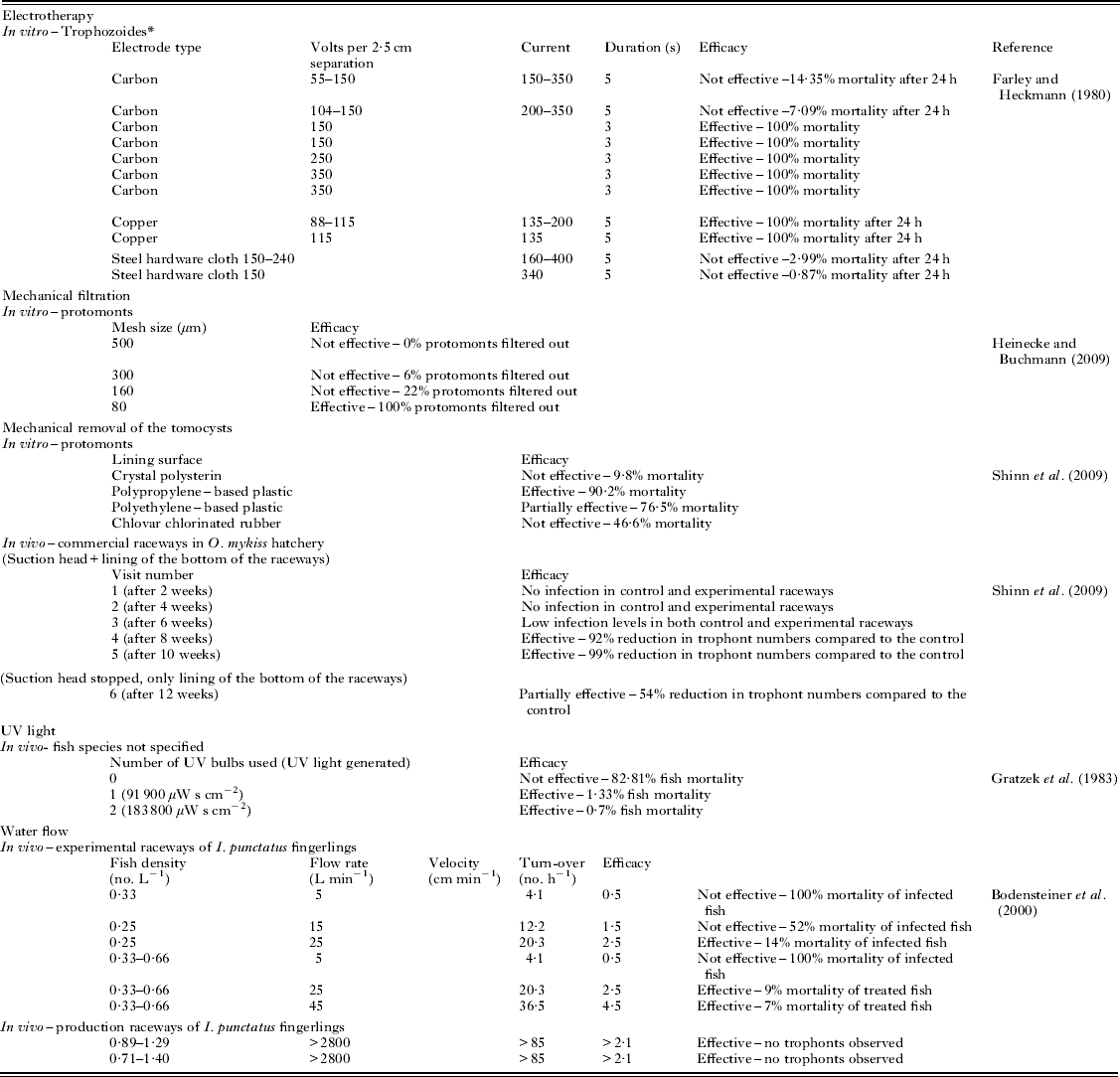
Abbreviations: s: seconds, *authors use the term ‘trophozites’ for the free-swimming stage which exited the fish host.
Farley and Heckmann (Reference Farley and Heckmann1980) used ‘electrotherapy’ as a possible treatment to control whitespot infections. Whilst there was some protomont mortality following exposure to short pulses of electricity (5 sec), it seems that this was probably due to water hydrolysis rather than lysis of the parasite. It was concluded that the amperage necessary to disrupt trophonts within the fish epidermis would be too high and lethal to the fish.
The utilization of a single UV lamp (91900 μW s−1 cm−2) has, in contrast, successfully managed to reduce the mortality of fish infected with I. multifiliis in a closed re-circulation system by controlling the spread of I. multifiliis stages between tanks (Gratzek et al. Reference Gratzek, Gilbert, Lohr, Shotts and Brown1983).
The mechanical filtration of inlet water, considering that the size of theronts ranges from 57·4×28·6 μm (at 5°C) and 28·6×20·0 μm (at 30°C), is not a feasible method to prevent the entry of the parasite to farm systems (Aihua and Buchmann, Reference Aihua and Buchmann2001). Nonetheless, a combination of an 80 μm mesh followed by a treatment of sodium percarbonate prevented protomonts from entering the system and killed theronts (Heinecke and Buchmann, Reference Heinecke and Buchmann2009).
Bodensteiner et al. (Reference Bodensteiner, Sheenan, Willis, Brandenburg and Lewis2000) demonstrated that increasing the flow rate and water turnover in fish farms above 85 cm min−1 and 2·1 l h−1 managed to reduce infection levels by flushing the free-swimming stages of the parasite out of the system. However, since water availability in farms can fluctuate greatly over the year, often reducing significantly over the summer months at the same time as water temperature increases exacerbate I. multifiliis infections, this cannot always provide a viable control solution.
Shinn et al. (Reference Shinn, Picón-Camacho, Bawden and Taylor2009) recently demonstrated that the combination of regular cleaning with a vacuum cleaning head and the use of a low adhesion polymer to line rainbow trout raceways is able to remove tomocysts and reduce infection levels by up to 99·55% when compared to control groups. Notwithstanding their apparent efficacy, none of the management strategies described above have been adopted so far in a commercial fish farm context.
Despite these non-drug interventions, fish that are exposed to a certain level of I. multifiliis infection are able to acquire a protective immunity which can last from several months to a year (Hines and Spira, Reference Hines and Spira1974; Burkart et al. Reference Burkart, Clark and Dickerson1990; Matthews, Reference Matthews, Pike and Lewis1994). This acquired immunity has stimulated efforts towards the development of a vaccine against I. multifiliis which is in progress (Matthews, Reference Matthews2005; Sommerset et al. Reference Sommerset, Krossøy, Biering and Frost2005; Dickerson, Reference Dickerson and Woo2006).
CONCLUSION
Currently, the most frequent method employed to control I. multifiliis infections in farm systems is the use of in-bath chemical treatments. Because of its asynchronous life cycle and continuous release into the water column of different stages (Lom and Dyková, Reference Lom and Dyková1992; Matthews, Reference Matthews2005), multiple applications are often required over long periods of time, notably during the summer months when water temperatures can rise rapidly. In addition, outbreaks can occur in the spring and autumn seasons during which sharp changes in water temperature can induce physiological stress, as seen in channel catfish pond culture (Noga, Reference Noga2010). Such treatment regimes involve the use of large quantities of chemicals when the infections levels are high (e.g. formaldehyde and sodium chloride), leading to high costs and potentially high environmental impacts. Repeated or prolonged use of a single drug without rotation of treatment types is also likely to increase the probability of development of drug resistance in the targeted pathogen, as documented for bacterial and copepod fish pathogens (Fallang et al. Reference Fallang, Ramsay, Sevatdal, Burka, Jewess, Hammell and Horsbergs2004; Lees et al. Reference Lees, Baillie, Gettinby and Revie2008; Heuer et al. Reference Heuer, Kruse, Grave, Collignon, Karunasagar and Angulo2009). While development of resistance by I. multifiliis has yet to be investigated, it is clear that drug resistance would act to increase the quantities of drug used and the environmental impacts of treatment.
In the present overview we have assessed the efficacy and practicality of a wide range of drug and non-drug strategies that are potentially available to be used in farm systems. However, there remain considerable difficulties in comparing efficacies between products, since no standardized methods are employed across the stakeholder community for culturing the parasite, assessing viability of the theront stage and infecting fish. The greatest current discrepancy in determining the efficacy of a treatment follows from the counting method employed for enumerating the trophont stage in in vivo studies. Some researchers only consider the trophonts present on skin scrapes or gills while others take into the account direct observations of the number of visible trophonts present in skin, fins and gills. In addition to these methodological variations, there is the fact that different strains/genotypes of I. multifiliis can behave very differently in terms of infectivity (Elsayed et al. Reference Elsayed, El Dien and Mahmoud2006; Swennes et al. Reference Swennes, Findly and Dickerson2007; Ling et al. Reference Ling, Luo, Wang, Wang, Wang and Gong2009), host specificity and susceptibility to treatment (Straus and Meinelt, Reference Straus and Meinelt2009; Straus et al. Reference Straus, Hossain and Clark2009). Hence, a chemical treatment demonstrated to successfully eliminate one strain might not exhibit the same efficacy when applied to treat a different one.
From this review, chemical treatments remain the principal method for controlling I. multifiliis infections in aquaculture, despite numerous attempts to develop and implement physical and farm management-based alternatives. With the introduction of a ban on the use of malachite green in food-fish and a likely future ban on the use of formaldehyde, options for effective drug treatment remain severely depleted. For these reasons, considerable research has been conducted to develop new drugs or screen existing compounds, both natural and synthesized, for efficaciousness against one or more stages of this parasite. New products, where deployed, will need to be derived from sustainable sources and of themselves be more environmentally friendly and more suitable for use in food-fish than previous compounds. As part of the attempt to reduce the use of drugs, new deployment strategies (e.g. extended low-dose treatments), management strategies helping to reduce initial infection levels (e.g. flow control), breeding fish for resistance and the development of DNA vaccines need to be considered.
FINANCIAL SUPPORT
Part of this study was supported by the British Federation of Women in Science (BFWS) awarded to Sara Picón Camacho to support her Ph.D. project.