INTRODUCTION
Swede oilseed rape (Brassica napus L. ssp. oleifera (DC.) Metzg.) is the most widely grown non-cereal arable crop in the UK. In 2003, it was estimated that 542 000 ha were planted (DEFRA 2004).
Historically, broad-leaved crops such as rape extended the opportunities for controlling grass weeds in cereal-dominated rotations. However, in England, controlling Lolium multiflorum Lam. (Italian ryegrass) and Alopecurus myosuroides Huds. (black-grass) has become difficult since the development of herbicide resistance (Weed Resistance Action Group 2003), such that on many farms rape is no longer considered a ‘cleaning crop’.
It is recognized that relatively ‘small biomass’ rape crops can yield as well as big ones and recent work has identified the optimum canopy size in relation to light interception and yield (Lunn et al. Reference Lunn, Spink, Stokes, Wade, Clare and Scott2001). The use of low seed rates with hybrid and lodging-prone conventional cultivars (NIAB 2001) could also reduce crop biomass. There is limited information on the impact of such practices on weed control.
Preventing or slowing down the development of herbicide resistance is considered beneficial. A good anti-resistance strategy would include cultural techniques that minimize herbicide dependence (Weed Resistance Action Group 2003), such as maximizing and fully utilizing crop competition. The inclusion of broad-leaved crops in mainly cereal rotations would extend herbicide choice over a complete rotation (Whitehead Reference Whitehead2002) and using herbicides with different modes of action will contribute to an anti-resistance strategy (Weed Resistance Action Group 2003).
Sansome (Reference Sansome1989, Reference Sansome1991) was able to improve herbicide efficacy by increasing rape seed rate. This was particularly evident with weeds that were ‘moderately resistant’ or ‘moderately susceptible’ rather than ‘susceptible’ to the applied herbicides. This could apply equally where herbicide efficacy has been compromised by partial resistance or, in the case of soil-applied herbicides, by edaphic factors (Riley & Morrod Reference Riley and Morrod1976).
In the UK, most winter rape/grass weed studies have involved Hordeum vulgare L. (volunteer barley) and, to a lesser extent, A. myosuroides (e.g. Lutman & Dixon Reference Lutman and Dixon1985, 1990). Information on L. multiflorum is limited. Moreover, the main concern of earlier work was the effect of weeds on the crop, rather than the effect of the crop on the weeds. Reducing weed seed return would contribute to the management of resistance weed populations and, in the case of non-resistant infestations, contribute to an anti-resistance strategy.
Four experiments were conducted over three seasons to investigate the effect of rape canopy size on crop competition in relation to grass weed growth and seed return. L. multiflorum (cultivar Fabio), Lolium×boucheanum Kunth. (‘Italian type’ hybrid ryegrasses; cultivars Polly and Aberecho) and A. myosuroides were sown to provide the ‘weed infestations’. Emphasis was placed on the effects of the crop on the weed.
Experiment 1 (2002/3) studied the effects of crop sowing date and seed rate along with the influence of autumn nitrogen. Experiment 2 (2003/4) again studied the effects of rape seed rate and provided an opportunity to measure the effect of grass weeds on the crop. Experiment 3 (2003/4) measured the effect of sowing date on grass seed production in the absence of rape and Experiment 4 (2004/5) provided additional data on the effect of sowing date.
MATERIALS AND METHODS
Site and husbandry details
The field experiments were conducted at the Crops Research Unit, University of Reading, UK on a fine sandy loam.
All plots were sown using a self-propelled ‘Hege 80’ plot drill to a depth of 20–30 mm with a row spacing of 125 mm. Rape and grass were sown separately, but always on the same day. Both crop and weeds were drilled parallel to the longitudinal axis of the plots and the rows were always within 40 mm (usually less) of each other. To maintain a common cultivation regime all plots had two passes of the drill, irrespective of whether one or both components were drilled.
All rape seed lots were screened using a 2·0 mm sieve and the large fraction sown. The seed was treated against seedling pests and diseases using iprodione, thiram, beta-cyfluthrin and imidacloprid (Whitehead Reference Whitehead2002).
Potassium fertilizer was applied to all experimental sites pre-drilling at 60–72 kg K2O/ha and, with the exception of the ‘no autumn N’ treatments in Expt 1, all treatments received 30 kg nitrogen (N)/ha immediately post drilling. In spring, Expts 1, 2, 3 and 4 received 197, 196, 131 and 151 kg N/ha, respectively. This was applied uniformly to all plots irrespective of autumn N treatment. Sulphur was applied with the nitrogen at rates between 117 and 132 kg SO3/ha.
Herbicide applications were confined to pre-drilling glyphosate and post emergence broad-leaved weed herbicides that had no recognized effect on grass species (i.e. benazolin (Galtak SC, 500 g/l; Anon. 2001) plus clopyralid (Dow Shield, 200 g/l; Anon. 2004)).
Broad-spectrum post-emergence disease control was based on autumn and spring applications of flusilazole and carbendazim (Whitehead Reference Whitehead2002). The rape was protected from Meligethes spp. (pollen beetle) in the spring using lambda-cyhalothrin (Whitehead Reference Whitehead2002). Protection from vertebrate pests was maintained throughout using fencing, screens and scaring devices.
Experiment 1 – 2002/3 season
The rape cultivar Apex was used throughout the experiment. The ‘grass weed’ L. multiflorum (cultivar Fabio) was sown on all plots at 500 seeds/m2.
The three husbandry factors investigated were sowing date (16 August (early), 2 September (mid) or 13 September (late)), rape seed rate (0 (zero), 25 (low), 110 (medium) or 180 (high) seeds/m2) and autumn nitrogen (N) (0 or 30 kg N/ha applied to seedbed at drilling in the form of ammonium nitrate).
The treatments were incorporated in a split-plot design with three blocks. Sowing date was allocated to the main plots and randomized within the block. Seed rate and autumn N levels were combined factorially and randomized to give eight subplot treatments within each main plot. Subplot size=20×2·1 m.
Experiment 2 – 2003/4 season
The experiment comprised a complete factorial combination of rape cultivar (Winner, Apex), rape seed rate (45 (low) or 90 (high) viable seeds/m2) and grass weeds (Two L.×boucheanum cultivars, Polly, Aberecho, A. myosuroides or ‘zero-grass’). The three grasses were sown at 500 viable seeds/m2.
The 16 treatments (10×2·1 m) were randomized in four blocks. The plots were sown on 26 August.
After plant emergence, it became apparent that three A. myosuroides plots had not been drilled. As the rape had been successfully established, a decision was taken to include the plots as additional ‘zero-grass’ treatments and to analyse the experiment as an unbalanced design.
The results presented in the present paper focus on the effects of rape seed rate. Detailed comparisons of the effects of rape cultivar and the interactions between rape cultivar and grass cultivar/species have been reported in Sim et al. (Reference Sim, Froud-Williams and Gooding2007).
Experiment 3 – 2003/4 season
Using a split plot design, three grass species/cultivars (subplots, 5×2·1 m) were sown (at 500 viable seeds/m2) in pure stands on three sowing dates (main-plots). The treatments were replicated in four randomized blocks.
The sowing dates were 20 August (early), 3 September (mid) or 16 September (late) and the grasses were the L.×boucheanum cultivars Polly or Aberecho, or A. myosuroides.
Experiment 4 – 2004/5 season
The rape cultivar Winner was sown at 130 seeds/m2 with the L. multiflorum cultivar Fabio at 500 seeds/m2 on two dates (21 August (early) or 15 September (late)).
Within each sowing date, canopy size was manipulated by hand thinning at different times throughout the autumn and winter. There were five such treatments and these were factorially arranged with sowing date giving a total of 10 treatments that were randomized and replicated four times (plot size 8×2·3 m). Canopy size manipulation effects were small and have not been reported here. There were no significant (P<0·05) interactions between sowing date and canopy size. Mean canopy treatment values were used to compare main sowing date effects.
Measurements and sampling
Crop and grass weed emergence was monitored every 2–4 days from drilling until plant densities started to decline. On each occasion, assessments were made on two blocks in each experiment using the same 2×2 m lengths of row in each plot.
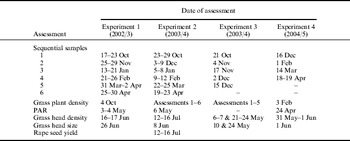
Destructive sequential samples (0·5 m2) were taken systematically from establishment to early spring in Expts 1, 2 and 4, starting 2 m in from the plot end. Initially, a gap of 0·5 m was left between sampling points but this was extended to 1 m in the spring. Sampling dates for each experiment are summarized in Table 1. Measurements included rape plant density, rape green area (assessments 1–5 in Expt 1 and assessments 2 and 4 in Expt 2) and rape and grass biomass. Samples were stored in sealed polythene bags and kept in a cold store prior to processing.
Experiments 1, 2, 3 and 4: Sampling dates for: destructive sequential assessments during autumn, winter and spring (Assessments 1–6), photosynthetically active radiation (PAR) interception by the rape floral layer, grass weed head density, grass weed head size and rape seed yield

Grass density was estimated in Expts 1 and 4 by sampling the ‘zero-rape’ treatments (5×0·5 m rows and 5×0·66 m rows/plot, respectively). In Expt 2, it was recorded during assessments 1–6 and in Expt 3 by estimating the mean of assessments 1–5 (2×0·3 m rows/plot; Table 1).
Green area of leaves and stems was estimated before flowering using a Delta – T image analysis system (Webb Reference Webb1991). The effective stem area was assumed to be a ‘half cylinder’ (Bilsborrow Reference Bilsborrow1985). Dry matter of rape and grass was assessed after soil removal by gentle washing and drying at 80°C for 48 h. During late March and early April, rapid rape stem extension increased the height differential between crop and grass weed. This provided an opportunity to measure photosynthetically active radiation (PAR) interception by the rape floral layer without interference from the grass. PAR was measured using a Delta – T Sunfleck Ceptometer (Decagon Devices, Inc. 1989).
Grass head density was assessed in June or July using quadrats (Expt 1, 3×0·25 m2/plot, Expts 2 and 3, 8×0·09 m2/plot and Expt 4, 1×0·5 m2/plot). Head size was estimated by assessing spikelet number/head in Lolium spp. (10 heads/plot) and head length in A. myosuroides (20 heads/plot).
In Expt 2, rape seed yield was estimated using 1·0 m2 quadrats. To minimize pod shatter and seed loss during sampling, plants were harvested 2–3 weeks prior to being ‘combine ripe’. Plants were stored in open paper sacks for 3–4 weeks to dry out before threshing. After cleaning the seed was dried at 80°C for 48 h prior to recording dry weight. Yields have been expressed on a 90 mg moisture/g basis.
Statistical analysis
Data were submitted to Genstat 6 for analysis (Payne et al. Reference Payne, Lane, Digby, Harding, Leech, Morgan, Todd, Thompson, Tunnicliffe, Welham and White1993). Tests of significance were based on a 5% probability level (P=0·05). With regression the ‘goodness of fit’ was estimated using the ‘adjusted R 2 statistic’(Payne et al. Reference Payne, Lane, Digby, Harding, Leech, Morgan, Todd, Thompson, Tunnicliffe, Welham and White1993). Prior to analysis, in Expts 1 and 4, individual rape plant size data sets were transformed (loge) to improve the homogeneity and normality of residuals.
RESULTS
The results presented in the present paper focus on the influence of canopy size of winter oilseed rape on the growth of grass weeds and the return of their seeds to the soil. Main conclusions are presented here with full data sets available in Sim (Reference Sim2005).
Crop and grass weed establishment
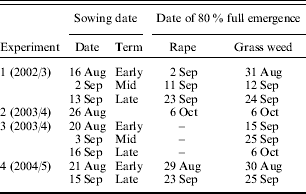
Emergence dates (i.e. date of 0·8 full emergence) of rape and grass over the four experiments have been summarized in Table 2. August and September 2003 were exceptionally dry and emergence of both rape and grass was protracted in Expts 2 and 3. The dry conditions not only led to direct plant loss, but slow growth exacerbated losses from pests and disease. Irrigation was applied from 19 September. In addition to L. multiflorum, Poa annua L. and a number of broad-leaved weeds were recorded, especially on the early sown plots. These rapidly declined as a result of frost, competition and herbicide applications and by February accounted for <0·02 of total biomass. In Expt 4, the early sown plots suffered from rabbit (Oryctolagus cuniculus L.) grazing on 6 September. Whilst most L. multiflorum plants recovered, there was a substantial loss of rape plants. Delia radium L. (cabbage root fly) also differentially attacked the early sown rape.
Experiments 1, 2, 3 and 4: Rape and grass weed sowing and emergence dates
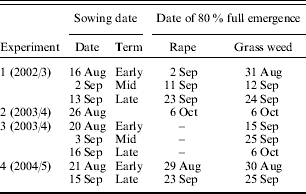
In Expts 2 and 3, rape cultivar and grass genotype had no effect on emergence dates. The influence of grass genotype on grass plant density has been reported in Sim et al. (Reference Sim, Froud-Williams and Gooding2007).
Rape seed rate
Experiment 1 (2002/3)
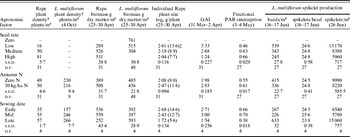
Increases in rape seed rate increased autumn crop density (Table 3) and consistently increased rape biomass. The medium and high seed rates significantly out-performed the low seed rate throughout the sampling period as exemplified by the April assessment (Table 3). Differences between high and mid seed rates were significant at the first four sampling dates.
Experiment 1: Main effect of rape seed rate, autumn nitrogen (N) and sowing date on rape and grass weed plant density, individual rape plant size (transformed loge and back-transformed), green area index (GAI), fractional interception of photosynthetically active radiation (PAR) by the rape floral layer and L. multiflorum head size, head density and spikelet density. ‘Zero-rape’ treatments omitted apart from grass weed plant density and biomass. Dates refer to time of sampling

* Mean of two sampling dates: 17–23 Oct and 25–29 Nov.
† ‘Zero-rape’ treatments only.
‡ Back-transformed data in parentheses (g dry matter/plant).
An increase in seed rate tended to reduce individual rape plant size, as shown by data taken at the end of April (Table 3). ‘Low seed rate’ plants were significantly larger than the ‘medium and high rate’ plants from November onwards and an increase in seed rate consistently and significantly increased GAI as demonstrated by the spring assessment (Table 3). Fractional PAR interception by the floral layer was also influenced by rape seed rate (Table 3). Interception by the high and medium seed rates was significantly greater than for the low rate.
Grass weed biomass was reduced by the presence of rape. In April the difference between the ‘zero-rape’ and ‘low seed rate’ biomasses was significant (Table 3), the trend having become evident in November. Increases in rape seed rate led to further weed biomass reductions. Differences between high and low seed rates were significant from January onwards.
The influence of rape seed rate on L. multiflorum head density, head size and spikelet density has been summarized in Table 3. An increase in seed rate significantly reduced head and spikelet density up to the highest rates tested, but there was no effect on spikelets/head. Severe lodging and secondary growth precluded measurements on the ‘zero rape’ treatments. Interactions were evident between rape seed rate and sowing date. These are discussed later.
Experiment 2 (2003/4)
An increase in rape seed rate again significantly increased autumn crop density (Table 4) and significantly increased rape biomass at all sampling dates, this being exemplified by the April assessment (Table 4). The effect on individual rape plant size was limited. The higher seed rate significantly increased GAI, PAR interception by the floral layer and rape seed yield (Table 4).
Experiment 2: Main effect of rape seed rate on rape and grass weed plant density, individual rape plant size, green area index (GAI), fractional interception of photosynthetically active radiation (PAR) by the rape floral layer, rape seed yield adjusted to 90 mg moisture/g (mc), mean grass head density, mean L. boucheanum head size and spikelet density and A. myosuroides head length. Dates refer to time of sampling. (Data are mean of two rape cultivars)

* Mean of two sampling dates – 23–29 Oct. and 3–9 Dec.
† Men of three grass genotypes ‘Zero-grass’ treatments omitted.
An increase in rape seed rate reduced grass weed biomass in April (Table 4), the trend having become evident from November. Spring grass plant density was also reduced (Table 4). The higher seed rate significantly reduced mean grass head density (Table 4) but had no effect on spikelets/head in L.×boucheanum. However, head length of A. myosuroides was slightly but significantly reduced by about 9%. Spikelet density in L.×boucheanum reflected head density and was reduced by an increase in seed rate.
The effect of rape plant density on grass biomass and head density was influenced by grass genotype and rape cultivar. Main effects and interactions have been reported in Sim et al. (Reference Sim, Froud-Williams and Gooding2007).
Autumn nitrogen
Experiment 1 (2002/3)
The addition of autumn nitrogen increased rape biomass, individual plant size and GAI. For all three measurements, the effects became statistically significant from November onwards. Data for GAI and biomass from March and April, respectively, are given in Table 3. Interactions between autumn N and sowing date involving rape biomass and GAI are discussed later. PAR interception by the rape floral layer was also significantly increased (Table 3).
The application of autumn nitrogen did not affect weed biomass until the spring, when a significant negative response was recorded (Table 3). Autumn N significantly reduced final L. multiflorum head and spikelet density, but had no appreciable effect on spikelets/head (Table 3). Interactions between autumn N and sowing date and between autumn N and seed rate involving head and spikelet density are discussed later.
Sowing date
Experiment 1 (2002/3)
A significant reduction in rape plant density was recorded at the early sowing date (Table 3) and this was attributed to dry soil conditions. Apart from the October assessment, when early sowing produced significantly more rape biomass than mid-sowing, dry matter production from the two sowing dates was either similar or mid-sowing produced significantly more (Table 3). Early and mid-sowing produced significantly more rape biomass and GAI than late sowing at all assessment dates. In general, delayed sowing reduced individual rape plant size, with late-sown plants always significantly smaller than those early or mid-sown. There were only small differences between early and mid-sown plants. The first two sowing dates gave similar levels of PAR interception by the rape floral layer, but late sowing intercepted significantly less (Table 3).
Autumn assessments of L. multiflorum plant density suggested that establishment had been significantly reduced at the first sowing date (Table 3). Spring weed biomass production was broadly similar for early and mid-sowing and significantly lower than for late sowing (Table 3). Late sowing also significantly increased head density over early and mid-sowing. The effect on head size was small. Late sowing significantly increased spikelet density (Table 3).
Experiment 3 (2003/4)
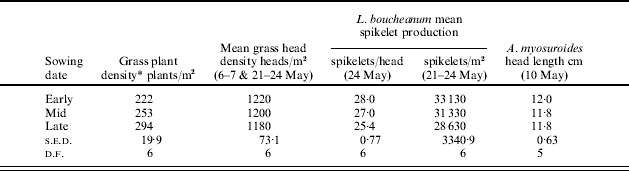
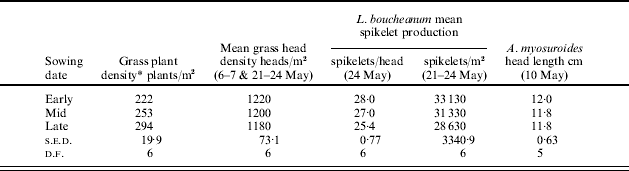
Mean grass plant density tended to increase as sowing date was delayed (Table 5). In the absence of rape, the sowing date effect on grass head density was limited (Table 5). There was a small non-significant, trend for head density (mean of three grasses) and spikelet density (mean of two L.×boucheanum cultivars) to decline as sowing date was delayed. A similar trend was recorded with spikelets/head (mean of two L.×boucheanum cultivars), the difference between early and late sowing reaching significance. No trends were evident with A. myosuroides head length. The effects of grass genotype on head density and size are discussed in Sim et al. (Reference Sim, Froud-Williams and Gooding2007). There were no interactions between sowing date and grass genotype.
Experiment 3: Effect of sowing date on mean grass plant density, mean grass head density, mean L. boucheanum head size and spikelet density and A. myosuroides head length when grown in the absence of rape. Dates refer to time of sampling
* Mean of assessments 1–5.
Experiment 4 (2004/5)
The significantly greater rape density recorded on the late sown treatments was attributed to less pest damage (Table 6). In December, early sown rape produced significantly more biomass than late sown, but by April the positions had been reversed with late sowing producing significantly more biomass than early sowing (Table 6). Early sowing consistently and significantly increased individual rape plant weight as shown by the April assessment. The late sown rape floral layer intercepted significantly more PAR than the early sown (Table 6).
Experiment 4: Main effect of sowing date on rape and grass weed plant density, rape and grass weed biomass, individual rape plant size (transformed loge and back-transformed), fractional interception of photosynthetically active radiation (PAR) by the rape floral layer and L. multiflorum head size, head density and spikelet density. Dates refer to time of sampling

* ‘Zero-rape’ treatments omitted.
† ‘Zero-rape’ treatments only.
‡ Back-transformed data in parentheses (g dry matter/plant).
February estimates suggested that sowing date had little effect on L. multiflorum plant establishment (Table 6). However, early sowing produced significantly more grass biomass throughout the sampling period (Table 6) and significantly higher head and spikelet densities. Head size was not affected by sowing date (Table 6). Full data sets covering rape canopy and grass weed measurements are presented in Sim (Reference Sim2005).
Sowing date and autumn nitrogen interactions on rape growth
Experiment 1 (2002/3)
With rape biomass there was a significant interaction between sowing date and autumn nitrogen, where the response to N occurred on the early and mid-sown treatments rather than on the late sown (Table 7a). The same pattern was apparent with rape GAI in early April (Table 7b). Individual rape plant size also followed a similar pattern but the interaction was not significant.
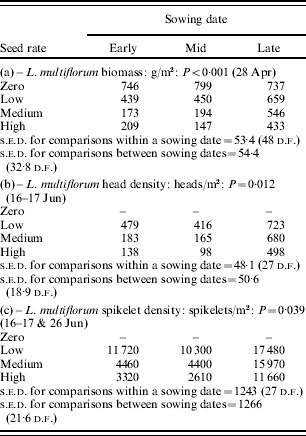
Experiment 1: Interactions between autumn nitrogen and sowing date and autumn nitrogen and seed rate. Autumn N×sowing date: (a) Rape biomass (Assessment 5). (b) Rape green area index (GAI) (Assessment 5). (c) L. multiflorum head density. Autumn N×seed rate: (d) L. multiflorum head density (e) L. multiflorum spikelet density. P values refer to significance of interaction. Dates refer to time of sampling

Sowing date, rape seed rate and nitrogen interactions on L. multiflorum
Experiment 1 (2002/3)
With grass weed biomass, there was a significant and consistent interaction between sowing date and seed rate during winter and spring. The reduction in biomass brought about by increasing rape seed rate was more evident on the early and mid-sown treatments than on the late sown. Data from the late April assessment has been presented in Table 8a. This interaction was mirrored by similar significant interactions with final ryegrass head and spikelet density (Tables 8b and 8c respectively). In the late sown situation, a higher rape seed rate was required to significantly reduce L. multiflorum seed production.
Experiment 1: Interactions between sowing date and rape seed rate: (a) L. multiflorum biomass (assessment 6) (b) L. multiflorum head density (c) L. multiflorum spikelet density. P values refer to significance of interaction. Dates refer to time of sampling

There was a significant interaction between sowing date and autumn N with L. multiflorum head density (Table 7c). Head density suppression from autumn N was more pronounced at the early sowing date. A similar pattern was noted with spikelet density but the interaction was not significant.
With L. multiflorum head and spikelet densities, there were significant interactions between autumn N and rape seed rate (Tables 7d and 7e respectively). The greatest reductions were recorded when autumn N was applied in combination with the low seed rate.
With L. multiflorum head density, a significant three-way interaction (P=0·039) between autumn N, sowing date and seed rate suggested that autumn N was most effective at minimizing seed return when used in combination with early sowing and low seed rates.
Relationships between rape growth and grass weed growth and head density
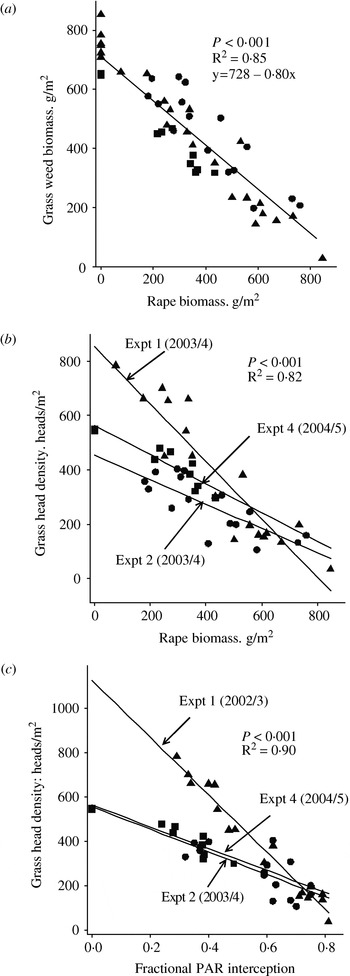
Combining all treatments from Expts 1 (2002/3), 2 (2003/4) and 4 (2004/5), there was a strong highly significant negative linear relationship between spring rape and grass biomass (Fig. 1a). There was also a fairly strong highly significant negative relationship between spring rape biomass and grass weed head density (Fig. 1b). However, there was evidence of variation between experiments. The Expt 1 intercept and regression parameters were significantly (P<0·001 and P<0·01, respectively) higher than the other two experiments. There were no significant differences between Expts 2 and 4. A similar relationship was found between PAR interception by the rape floral layer and grass weed head density (Fig. 1c). Again, the Expt 1 intercept and regression parameters were significantly higher (P<0·001) than the other two experiments.
(a) – Experiments 1 (2002/3), 2 (2003/4) and 4 (2004/5). Fitted trendline and observed treatment values for April grass weed biomass (dry matter g/m2) against April rape biomass (dry matter g/m2). Expt. 1 (▲), Expt. 2 (●) and Expt. 4 (■). (b) – Experiments 1 (2002/3), 2 (2003/4) and 4 (2004/5). Fitted trendline and observed treatment values for grass weed head density (heads/m2) against April rape biomass (dry matter g/m2). Expt. 1 (▲), Expt. 2 (●) and Expt. 4 (■). Treatments omitted where head density not measured. (c) – Experiments 1 (2002/3), 2 (2003/4) and 4 (2004/5). Fitted trendline and observed treatment values for grass weed head density (heads/m2) against fractional PAR interception by the floral layer. Expt.1 (▲), Expt. 2 (●) and Expt. 4 (■). Treatments omitted where head density not measured.

Overall effect of grass weeds on rape crop
Experiment 2 (2003/4)
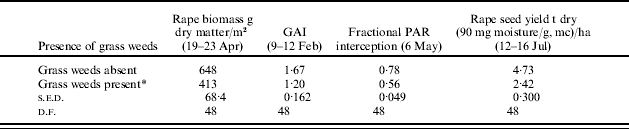
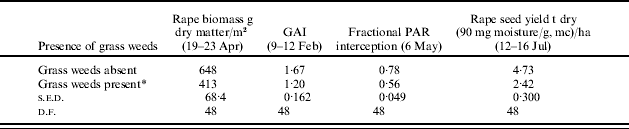
Grass weeds significantly reduced rape canopy size from February onwards, as shown by assessments of GAI (February), biomass (April), PAR interception by the floral layer and rape seed yield (Table 9). The weed free crop yielded in excess of 4·7 t/ha. The influence of individual grass genotypes has been reported in Sim et al. (Reference Sim, Froud-Williams and Gooding2007).
Experiment 2. Main effect of interspecific competition between rape and grass weeds on rape biomass, green area index (GAI), photosynthetically active radiation (PAR) interception by the rape floral layer and rape seed yield adjusted to 90 mg moisture/g (mc). Dates refer to time of sampling. (Data are means of two rape cultivars and two seed rates)
* Mean of three grass genotypes.
DISCUSSION
Rape canopy size and grass weed suppression
The yield of rape seed obtained in weed-free conditions in 2003/4 was comparable to the national mean yield for Winner recorded in cultivar evaluation experiments during that season (HGCA 2004). The reduction in rape canopy biomass and seed yield in the presence of grass weeds was consistent with earlier work involving H. vulgare and A. myosuroides (Lutman & Dixon Reference Lutman and Dixon1985, Reference Lutman and Dixon1990).
The pattern of rape growth was consistent with that described in earlier work (e.g. Jenkins & Leitch Reference Jenkins and Leitch1986), consisting essentially of a steady increase in biomass accumulation during autumn, a fairly static period during winter and then a period of rapid growth in the spring. The large autumn crops maintained their relative status during winter and went on to produce large spring canopies with large floral layers. Canopy size pre-flowering ranged from zero to GAI 5.1 (0–560 g dry matter/m2), the highest value having been recorded in Expt 1 with the agronomic combination of mid-sowing, high seed rate and autumn N. Lunn et al. (Reference Lunn, Spink, Stokes, Wade, Clare and Scott2001) suggested that rape seed yield was unlikely to benefit from canopies in excess of GAI 3.0 pre-flowering (c. 375 g dry matter/m2 in the current experiments). Reductions in grass weed growth and seed return from increased rape biomass were evident up to the largest canopies tested. Hence, for maximum weed suppression, canopy size would have to be in excess of that required for maximum yield.
Rape canopy size was measured by biomass, GAI and PAR interception by the floral layer. Although they referred to different aspects of size and structure they were strongly correlated. When correlating canopy size with weed seed return, the strongest relationship was obtained using rape PAR interception. Although PAR interception was well correlated with floral layer biomass (data not presented), it is also possible that the measure reflects structural differences that influence shading. Petals reflect and absorb a high proportion of total PAR, e.g. 0·78 (Fray et al. Reference Fray, Evans, Lydiate and Arther1996). Moreover, floral layer size reflects total crop biomass both before and during flowering (Mendham et al. Reference Mendham, Shipway and Scott1981a).
Seasonal effects, competitive differences between rape cultivars and differences between grass weed genotypes could explain the variation in crop/weed competitive balance between experiments (Figs 1b, c). Plot observations indicated that final grass weed head density was largely determined by mid-April. Late fertile tiller loss was minimal (typically 0·02–0·03 of total and never more than 0·05 of total) and there was little evidence of late fertile tiller production. The main influence was on tiller production sometime during autumn, winter and early spring rather than on late tiller survival.
Lutman et al. (Reference Lutman, Bowerman, Palmer, Andrews and Whytock1995) noted wide variation in growth and competitiveness between rape and weeds from year to year. The data suggested greater grass growth in 2002/3 than in 2004/5. Spring biomass production from the Fabio sown ‘zero-rape’ treatments was consistently higher in Expt 1 than in Expt 4 (Fig. 1a). Moreover, extrapolation (Fig. 1b) suggested that, in the absence of rape, Fabio head density was likely to have been higher in 2002/3 than that recorded in 2004/5. Both winters were mild, but 2002/3 was slightly warmer in the spring and also benefited from substantially more bright sunshine between January and late April (Met Office 2006).
Sim et al. (Reference Sim, Froud-Williams and Gooding2007) have demonstrated that rape cultivars and grass genotypes can vary in competitiveness and that interactions occur between the two. For example, when grown with rape (density of c. 50 plants/m2), Fabio produced 135 heads/m2 with Apex and 14 heads/m2 with Winner. This could, at least in part, explain the lower head densities recorded in Expts 2 and 4 (Fig 1b, c). Comparisons between Polly and Aberecho also demonstrated differential competitiveness that influenced final head density under rape. Fabio was not included in the comparison, but the possibility that it differs competitively from the two hybrids cannot be ignored. Interestingly, competitive differences were more evident under small rape canopies than under large ones, a pattern evident in Figs 1b and 1 c.
The regression coefficient from the correlation between rape and grass weed biomass in spring (Fig. 1a) approached unity, thus suggesting almost direct replacement between the two. With Lolium spp. the main effect of rape competition was to influence head density rather than head size. With A. myosuroides inter-specific competition influenced both head density and head size, but the main determinant of seed return was head density.
Rape seed rate
The increase in rape crop biomass and GAI from increased seed rates has been recorded previously (Lunn et al. Reference Lunn, Spink, Stokes, Wade, Clare and Scott2001, Reference Lunn, Spink, Wade and Clare2003; McWilliam et al. Reference McWilliam, Stafford, Scott, Norton, Stokes, Sylvester-Bradley and Murphy1995a, Reference McWilliam, Stokes, Scott, Norton, Sylvester-Bradley and Daviesb; Mendham et al. Reference Mendham, Shipway and Scott1981b; Scarisbrick et al. Reference Scarisbrick, Danials and Noor1982). The reduction in weed biomass from increased seed rates was also consistent with published data covering a number of crop/weed combinations (e.g. Champion et al. Reference Champion, Froud-Williams and Holland1998; Küst et al. Reference Küst, Heitefuss and Wahmhoff1988; Mohler Reference Mohler, Liebman, Mohler and Staver2001; Weiner et al. Reference Weiner, Griepentrog and Kristensen2001; Wilson et al. Reference Wilson, Wright, Brain, Clements and Stephens1995; Zaicou-Kunesch et al. Reference Zaicou-Kunesch, Zaheer and Eksteen2003).
Over the three seasons, spring rape plant density ranged from c. 16–80 plants/m2. For a number of years it was recommended that the spring target density should be about 70–80 plants/m2 (NIAB 2001). However, more recent work in weed-free conditions has suggested target densities of 20–30 plants/m2 (McWilliam et al. Reference McWilliam, Stokes, Scott, Norton, Sylvester-Bradley and Davies1995b) and 25–50 plants/m2 (HGCA 2000) as these are more likely to produce an optimum canopy size for seed yield.
Spring rape densities in Expt 2 were 21 and 36 plants/m2 for the low and high seed rates, respectively. Although both were within the latest recommended density range, rape seed yield was reduced at the low seed rate. Mohler (Reference Mohler, Liebman, Mohler and Staver2001) argued that, although a ‘weedy conditions’ yield would not match a ‘weed-free’ yield, the optimum crop density was higher in ‘weedy’ conditions than in ‘weed-free’ conditions. Yield could also have been affected by lodging, which, interestingly, was more evident at the low seed rate. This contrasts with earlier work where high plant densities increased lodging (Andersson & Bengtsson Reference Andersson and Bengtsson1989; NIAB 2001; Lunn et al. Reference Lunn, Spink, Wade and Clare2003). Lodging was minimal on the ‘zero-grass’ treatments indicating that the grass weeds lodged and then ‘brought the crop down’. The higher grass biomass at lower crop densities exacerbated the situation.
Autumn nitrogen
The increase in rape canopy size from autumn N was consistent with previous work (Darby & Yeoman Reference Darby and Yeoman1994; Mendham et al. Reference Mendham, Shipway and Scott1981b). However, the reduction in weed biomass was not consistent with earlier work, where both rape and weeds positively responded to the fertilizer N with little change in the competitive balance (Lutman Reference Lutman1989, Reference Lutman1991). A potential explanation for the differing results could lie in the behaviour of N in the soil. The experiment was conducted on a low organic matter, low nitrogen status fine sandy loam, where N could be readily leached (DEFRA 2000). It was possible that autumn-applied N leached down the soil profile beyond grass rooting depth, but remained within reach of the deeper rooting rape (Anon. 1962; Barraclough Reference Barraclough1989; Evans Reference Evans1978; Mendham Reference Mendham and Murphy1996). The time lag between the positive rape and negative grass weed biomass response would lend support to this argument. The increase in rape biomass and consequent shading would tip the competitive balance in favour of the crop, eventually resulting in reduced weed biomass and seed return.
Grass weed suppression from autumn N was greatest when used in combination with a low rape seed rate that gave incomplete autumn ground cover. The increase in individual rape plant size from the N could well have improved ground cover and crop competitiveness (Lutman Reference Lutman1991). Ground cover was more extensive at the higher seed rates and so the beneficial effects of increased plant size could have been more limited.
It was clearly demonstrated that autumn N can reduce grass weed seed return, but such benefits could be restricted to light low N status soils. There is no evidence to suggest that autumn N would have a detrimental effect on the crop/weed competitive balance. On farm, autumn N is likely to play a minor role in improving crop competitiveness.
Sowing date
For competitiveness, Lutman et al. (Reference Lutman, Bowerman, Palmer, Andrews and Whytock1995) emphasized the importance of crop vigour, this being a function of plant density and individual plant size. It was clear that early sowing increased ‘autumn growing time’ and produced relatively large plants prior to the onset of winter; a trend previously noted by Mendham et al. (Reference Mendham, Shipway and Scott1981a, Reference Mendham, Shipway and Scottb). Hence, where crop density remained fairly constant, early sowing increased canopy size and this was consistent with earlier work (Bilsborrow Reference Bilsborrow1985; Leach et al. Reference Leach, Darby, Williams, Fitt and Rawlinson1994; Lutman & Dixon Reference Lutman and Dixon1987).
Poor establishment was encountered at the earliest sowing dates in Expts 1 and 4. In Expt 1, the larger early sown plants compensated for the lower plant density such that canopy size remained similar to mid-sowing but larger than late sowing. In Expt 4, however, although the early sown large plants produced the largest canopy in December, by April it was the late sown higher density treatment that produced the greatest biomass. The early sown large plants were not able to fully compensate for the extremely low plant density.
In Expts 1 and 4, initial grass weed biomass benefited from early sowing. However, in Expt 1, the late sown treatments, once established, gave the highest biomass and the highest L. multiflorum seed return. The evidence suggested that late sown crops were less competitive. In contrast, the early sown higher grass weed biomass in Expt 4 was maintained throughout and eventually produced the highest seed return. In this case, the late sown crop was the most competitive because the much higher plant density had a greater impact than late sowing.
Earlier work investigating rape sowing date and weed suppression found that early sowing generally increased competitiveness, especially with grass weeds (Lutman Reference Lutman1989; Lutman et al. Reference Lutman, Bowerman, Palmer, Andrews and Whytock1995). However, there were some inconsistencies across sites and seasons and these were attributed to a number of factors including differential crop establishment and differential base temperatures between crop and weed. The current experiments confirm that differential crop establishment can override the effect of sowing date. As sowing date had a limited effect on grass seed return in the absence of rape, the sowing date effect with rape was attributed to differential inter-specific competition.
All three seasons, 2002/3 to 2004/5, were relatively mild. Cooler autumns could well exacerbate problems associated with late sowing or delayed emergence. If early crop growth were poor and autumn ground cover incomplete, a proportion of weeds would not be subject to inter-specific competition until spring. Cool conditions would affect both crop and weeds but some such as volunteer H. vulgare and A. myosuroides can grow at lower temperatures than rape, giving them an advantage in late-sown marginal conditions (Lutman et al. Reference Lutman, Bowerman, Palmer and Whytock2000; Mendham Reference Mendham and Murphy1996; Morrison et al. Reference Morrison, McVetty and Shaykewich1989; Storkey & Cussans Reference Storkey and Cussans2000). The base temperatures for H. vulgare, A. myosuroides and rape are about 0, 0 and 5°C, respectively. Lolium genotypes are less likely to benefit because base temperatures are similar to or just above that of rape. Estimates from work with L. multiflorum and Lolium spp. dominated pastures suggest thresholds in the order of 5·0–6·3°C (Anslow & Green Reference Anslow and Green1967; Spedding & Diekmahns Reference Spedding and Diekmahns1972; Weihing Reference Weihing1963).
In late sown situations, the use of high seed rates and autumn N will help increase canopy size but the benefits could be limited. High seed rates would still require sufficient ‘growing time’ before the onset of winter to fully express their potential. The failure of late sown crops to respond to autumn N has been attributed to low air temperatures (Mendham et al. Reference Mendham, Shipway and Scott1981b). Although crops are sown later, the recommended sowing period in England and Wales is from mid-August to the end of the first week in September (MAFF 1983).
Practical implications
It has been demonstrated that crop canopy manipulation can substantially reduce grass weed seed return. Within current agronomic guidelines, competitiveness can be maximized by planting early (from mid-August, provided conditions are suitable for good establishment) and (assuming a non-hybrid cultivar) by sowing about 120 seeds/m2 in anticipation of a spring plant density of about 70 plants/m2 (NIAB 2001). Timing and seed rate adjustments may be required in very fertile conditions to avoid excessively large canopies (Lunn et al. Reference Lunn, Spink, Stokes, Wade, Clare and Scott2001), but such risks are minimized when canopy size is reduced by the presence grass weeds. High biomass crops are prone to lodging, disease and higher production costs (Lunn et al. Reference Lunn, Spink, Stokes, Wade, Clare and Scott2001) and should only be considered in fields with dense ‘difficult to control’ grass weed infestations. Lodging and disease-resistant cultivars will reduce the risks and help maintain yield.
Data from Expts 1 and 2 indicate that an autumn GAI of 2–2·5 (180–225 g dry matter/m2) would be required to give complete ground cover and subject all grass weeds to inter-specific competition before the onset of winter. From a weed control perspective, a late March pre-flowering GAI of about 4·5 (560 g/m2 dry matter) would be beneficial.
As grass head density is determined by early to mid rape flowering, canopy size becomes less important thereafter and so management can then be geared to maximizing rape yield. The use of fungicides with growth regulatory properties and the manipulation of nitrogen rate and timing can restrict final canopy size (Lunn et al. Reference Lunn, Spink, Wade and Clare2003).
The present experiments demonstrate that rape competition is unlikely to give complete suppression of grass weeds and that herbicides would be required to maximize rape seed yield and minimize weed seed return. Good competition has been shown to improve the consistency and overall level of weed control from herbicides for a number of crop/weed combinations (Black & Dyson Reference Black and Dyson1993; Sansome Reference Sansome1989, 1991; Sharma & Vanden Born Reference Sharma and Vanden1983). Surviving weeds that had received sublethal doses of herbicide were less competitive than untreated ones. Hence, good competition could improve weed control from soil-applied residual herbicides where edaphic factors have reduced chemical uptake (Riley & Morrod Reference Riley and Morrod1976) and contact materials that are challenged by partial (enhanced metabolism) resistance (Weed Resistance Action Group 2003). Unless herbicide-resistant biotypes have other competitive advantages, weed suppression from direct crop competition should be similar for all weed plants irrespective of resistance status. Reduced seed production from the more resistant biotypes will help maintain low weed populations.
Good crop competition should help maintain the status of rape as a cleaning crop.
The authors would like to thank the staff of the Schools of Biological Sciences and Agriculture, Policy and Development at the University of Reading who provided assistance and support on numerous occasions. We are particularly indebted to the Crops Research Unit, University of Reading, for assistance with the experimentation. We are also grateful to Mrs M. M. Sim for her financial support and encouragement.