Introduction
The emerald ash borer (EAB), Agrilus planipennis Fairmaire (Coleoptera: Buprestidae), is an invasive species originally from Asia, first detected in North America in 2002. It has not been identified as a pest in its native range of China, Korea, Japan, Mongolia, and eastern Russia (EAB 2014). In the United States of America and Canada, however, it has caused extensive ash (Fraxinus Linnaeus, Oleaceae) mortality (Haack et al. Reference Haack, Jendek, Lui, Marchant, Petrice and Poland2002). At the time of its discovery in North America, nothing was known about the chemical ecology of this species, with respect to its host-finding and/or mate-finding behaviour. Indeed, there was a paucity of information on the chemical ecology of the entire Buprestidae. Evidence existed that adult beetles used visual cues in mate finding (Gwynne and Rentz Reference Gwynne and Rentz1983) and that male buprestids may be orienting to a volatile chemical cue from females (Dunn and Potter Reference Dunn and Potter1988). However, there was little other information on host and/or mate selection within this extremely large and diverse family of beetles.
The chemical ecology of EAB has been intensively studied since its detection in North America. The primary focus of this review is on the pheromone chemical ecology of EAB, due to the large increase in our knowledge regarding the natural history of this species in the last 10 years. This review builds on two earlier reviews on EAB by Crook and Mastro (Reference Crook and Mastro2010) and Domingue and Baker (Reference Domingue and Baker2012), with significant discoveries since these publications. Specifically, at the time of Crook and Mastro’s (Reference Crook and Mastro2010) review, evidence was beginning to emerge that EAB used volatile pheromones (Bartelt et al. Reference Bartelt, Cossé, Zilkowski and Fraser2007; Pureswaran and Poland Reference Pureswaran and Poland2009c). The more recent review by Domingue and Baker (Reference Domingue and Baker2012) focuses predominantly on visual cues used in mate finding in EAB and other buprestids. Here we focus on studies that have been conducted into two main aspects regarding the chemical ecology of EAB: (1) chemical cues used in ash tree host-finding behaviour and (2) chemical cues used in mate-finding behaviour. It is evident that the behaviour and ecology of EAB involves a complex pattern of sensory modalities that include host and conspecific interactions, both visual and olfactory, which blend to influence a variety of host- and mate-location behaviours that are very difficult to de-convolute. An understanding of the chemical ecology of this species is important in the development of early detection tools, such as baited traps. It is essential to develop effective procedures for detecting new incursions of buprestids before they become established so as to maximise the chances of control and/or eradication. This is important due to the subsequent detection of additional invasive buprestids in North America, including the European oak borer (Agrilus sulcicollis Lacordaire) (Haack et al. Reference Haack, Petrice and Zablotny2009; Jendek and Grebennikov Reference Jendek and Grebennikov2009), as well as the range expansion of the goldspotted oak borer (Agrilus coxalis Waterhouse) (Coleman and Seybold Reference Coleman and Seybold2008). This emphasises the importance of developing monitoring programmes using pheromones and/or host volatiles as trap-baits to develop early warning devices. In addition, information about host volatiles and/or pheromone components can be exploited in the development of management tactics, such as mating disruption, “push–pull” strategies (Cook et al. Reference Cook, Khan and Pickett2007), or development of processes to slow ash mortality (SLAM; McCullough and Mercader Reference McCullough and Mercader2012).
The many mysteries of buprestid chemical ecology, however, are complex and difficult to unravel. Given the huge impact of EAB alone in North America, the very limited knowledge of host- and mate-finding behaviour in buprestids and the potential impact of future buprestid invasives, we envision a “call to action” for continued research into buprestid chemical ecology, especially given the dearth of information in the literature.
Attraction to hosts: chemical cues
Since the discovery of EAB in North America, considerable research has been conducted into identifying host volatiles that are attractive to EAB and can thus be exploited in a trapping programme (Herms and McCullough Reference Herms and McCullough2014). Much of this research was reviewed earlier in Crook and Mastro (Reference Crook and Mastro2010), examining aspects of trap design and colour, as well as host volatiles that could be used as trap-lures. Although a detailed review of studies regarding trapping development using host volatiles is beyond the scope of our current review, briefly, two main types of host volatiles were identified as attractive to EAB: bark sesquiterpenes (Crook et al. Reference Crook, Khrimian, Francese, Fraser, Poland and Sawyer2008b; Crook and Mastro Reference Crook and Mastro2010 and references therein; Grant et al. Reference Grant, Ryall, Lyons and Abou-Zaid2010; Khrimian et al. Reference Khrimian, Cossé and Crook2011) and foliar volatiles (Crook and Mastro Reference Crook and Mastro2010 and references therein; Grant et al. Reference Grant, Ryall, Lyons and Abou-Zaid2010, Reference Grant, Poland, Ciaramitaro, Lyons and Jones2011; Silk et al. Reference Silk, Ryall, Mayo, Lemay, Grant and Crook2011; Crook et al. Reference Crook, Khrimian, Cossé, Fraser and Mastro2012).
Bark sesquiterpenes attractive to EAB
One approach to study attraction to hosts was to artificially stress or girdle ash trees to evaluate responses by adult beetles. In an earlier study on the two-lined chestnut borer, Agrilus bilineatus (Weber), it was reported that insects landed predominantly on host trees (white oak, Quercus alba Linnaeus (Fagaceae)) that had been girdled, but not on girdled nonhost tree genera (Dunn et al. Reference Dunn, Kimmerer and Nordin1986), suggesting the production of host-specific volatile cues. Several studies report increased captures of EAB adults on ash trees that had been stressed by girdling. McCullough et al. (Reference McCullough, Poland, Anulewicz and Cappaert2009a, Reference McCullough, Poland and Cappaert2009b) reported higher adult captures and larval densities on trees that had been girdled versus untreated trees or wounded trees, those treated with herbicide, and those exposed to methyl jasmonate. Tluczek et al. (Reference Tluczek, McCullough and Poland2011) reported that more adults were captured on sticky bands placed on girdled trees than on traps placed on untreated trees or those exposed to methyl jasmonate. To our knowledge, no studies have evaluated responses of EAB to girdled nonhost trees.
Increased captures of adults following girdling of host trees is hypothesised to be due to changes in volatile emissions, signalling stress or weakness in the trees. Such changes in ash host volatiles following girdling or stressing of trees have been quantified in several studies (Rodriguez-Saona et al. Reference Rodriguez-Saona, Poland, Miller, Stelinski, Grant and de Groot2006; Crook et al. Reference Crook, Khrimian, Francese, Fraser, Poland and Sawyer2008b; Crook and Mastro Reference Crook and Mastro2010), with several trapping studies showing increased captures of adults on girdled trees (McCullough et al. Reference McCullough, Poland, Anulewicz and Cappaert2009a, Reference McCullough, Poland and Cappaert2009b; Tluczek et al. Reference Tluczek, McCullough and Poland2011); a number of these volatiles were identified as antennally active sesquiterpenes (i.e., being detected by the antennae): α-cubebene, α-copaene, 7-epi-sesquithujene (7-EST), trans-β-caryophyllene, and α-humulene (Crook et al. Reference Crook, Khrimian, Francese, Fraser, Poland and Sawyer2008b). A sixth active compound was later identified by Cossé et al. (Reference Cossé, Bartelt, Zikowski and Fraser2008) as eremophilene. Blends of these sesquiterpenes, along with numerous other compounds, can be found in essential oil distillates, specifically Manuka oil (a steam distillate from Leptospernum scoparium Forst (Myrtaceae)) and Phoebe oil (an essential oil from Phoebe porosa (Nees and Martius) Mez (Lauraceae)), produced from these tree species (Crook et al. Reference Crook, Khrimian, Francese, Fraser, Poland and Sawyer2008b). One compound in particular, 7-EST, was highly antennally active and present in Phoebe but not Manuka oil (Crook et al. Reference Crook, Khrimian, Francese, Fraser, Poland and Sawyer2008b).
These sesquiterpenes are difficult and/or very costly to synthesise, thus results of these studies led to numerous field trials testing Manuka and/or Phoebe oil as surrogates for these antennally active EAB sesquiterpene components (Crook and Mastro Reference Crook and Mastro2010 and references therein; Grant et al. Reference Grant, Ryall, Lyons and Abou-Zaid2010, Reference Grant, Poland, Ciaramitaro, Lyons and Jones2011; Marshall et al. Reference Marshall, Storer, Fraser and Mastro2010; Silk et al. Reference Silk, Ryall, Mayo, Lemay, Grant and Crook2011). These data suggest that Manuka and/or Phoebe oil may function as effective lures to increase captures of EAB on sticky traps. Indeed, Marshall et al. (Reference Marshall, Storer, Fraser and Mastro2010) reported higher trap captures and detection rates on purple traps baited with Manuka or Phoebe oil and deployed at 6-m height versus girdled trees with sticky band traps at 1.5-m height. However, in the Pureswaran and Poland (Reference Pureswaran and Poland2009a) study, beetles were more attracted to live trees versus girdled trees with sticky band traps baited with Manuka oil, whether visible or hidden from view, indicating the importance of specific chemical cues being used in orientation to host ash trees in EAB. This also suggests that, whereas Manuka (and/or Phoebe oil) oil may contain a number of bark sesquiterpenes in common with ash trees, there are other additional compound(s) specific to host ash trees eliciting attraction by EAB that have not yet been identified. Moreover, these studies all focused on testing volatiles produced by the bark, following stressing or girdling of the host ash tree. Although EAB primarily attacks stressed or weakened trees in its native range in Asia, in North America it is attacking apparently healthy and vigorous trees. Healthy host ash trees may emit an entirely different array of volatile compounds. Therefore, additional research into volatile production in apparently healthy ash host trees and in those trees initially preferred by EAB for infestation is necessary to further elucidate specific compounds or blends of compounds being used to elicit primary attraction in this insect.
Foliar volatiles attractive to EAB
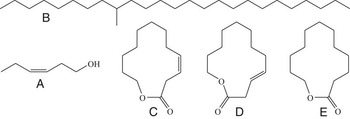
A number of studies have identified volatiles produced by ash foliage in response to stress and/or EAB feeding, and then elucidated responses of EAB to these foliar volatiles. In de Groot et al. (Reference de Groot, Grant, Poland, Scharbach, Buchan and Nott2008), volatiles produced by the foliage of white and green ash trees (Fraxinus americana Linnaeus and F. pennsylvanica Marshall, respectively) were reported; eight different host foliar volatiles were detected with (3Z)-hexenol (Fig. 1A) and (3Z)-hexenyl acetate represented more than 80% of the total foliar volatiles emitted by the two species. Using gas chromatography-electroantennographic detection analysis, de Groot et al. (Reference de Groot, Grant, Poland, Scharbach, Buchan and Nott2008) found male antennae to be highly responsive to (3Z)-hexenol, compared with any of the other seven green leaf volatile (GLV) compounds.
Chemical structures of emerald ash borer attractants/pheromones.

Relative differences in foliar volatiles among ash tree species may influence EAB preference and performance. Pureswaran and Poland (Reference Pureswaran and Poland2009b) reported that ash species differed in the relative composition of foliar volatile compounds, with green ash producing lower levels of volatiles compared with Manchurian ash (Fraxinus mandshurica Ruprecht). In their study, they identified compounds that differed among the six ash species and between girdled versus healthy host trees. When given a choice, adult EABs spent more time on, and consumed more foliage of, green, white, and black (Fraxinus nigra Marshall) ash respectively, compared with blue, European (Fraxinus quadrangulata Michaux, F. excelsior Linnaeus), and Manchurian ash (Pureswaran and Poland Reference Pureswaran and Poland2009b). Preferred hosts had lower levels of volatile emissions than less-preferred host species. This was hypothesised to indicate to EAB that the lower emission rates were associated with lower host resistance (Pureswaran and Poland Reference Pureswaran and Poland2009b), however, this hypothesis has not been tested.
Attraction to (3Z)-hexenol was subsequently demonstrated when it was deployed on light or dark green sticky traps (Grant et al. Reference Grant, Ryall, Lyons and Abou-Zaid2010; Silk et al. Reference Silk, Ryall, Mayo, Lemay, Grant and Crook2011; Ryall et al. Reference Ryall, Silk, Mayo, Crook, Khrimian and Cossé2012) or on purple sticky traps (de Groot et al. Reference de Groot, Grant, Poland, Scharbach, Buchan and Nott2008). Grant et al. (Reference Grant, Poland, Ciaramitaro, Lyons and Jones2011) demonstrated increased attraction of males to traps baited with (3Z)-hexenol, with increased captures compared with unbaited traps or those baited with blends of GLVs. Addition of other GLVs, specifically (2E)-hexenol, (2E)-hexenal and hexanal, to traps baited with (3Z)-hexenol actually reduced trap captures of males compared with those baited with (3Z)-hexenol alone (Grant et al. Reference Grant, Ryall, Lyons and Abou-Zaid2010, Reference Grant, Poland, Ciaramitaro, Lyons and Jones2011). Similarly, Crook et al. (Reference Crook, Khrimian, Francese, Fraser, Poland and Sawyer2008b) reported that a four-component blend of GLVs, (3Z)-hexenol, (2E)-hexenol, (2E)-hexenal, and hexanal, did not increase attraction of adults to traps versus unbaited controls. In other tests, (3Z)-hexenol increased captures, but not always significantly, on dark green traps (Crook et al. Reference Crook, Khrimian, Cossé, Fraser and Mastro2012).
Several studies have compared trap captures on traps baited with bark versus foliar volatiles. Grant et al. (Reference Grant, Ryall, Lyons and Abou-Zaid2010) reported that the addition of Manuka oil to traps baited with (3Z)-hexenol did not further enhance trap captures. Grant et al. (Reference Grant, Poland, Ciaramitaro, Lyons and Jones2011) demonstrated increased attraction of males to traps baited with (3Z)-hexenol, with increased captures compared with traps baited with bark sesquiterpenes (Phoebe oil). Crook et al. (Reference Crook, Khrimian, Cossé, Fraser and Mastro2012) reported that green traps baited with (3Z)-hexenol+Manuka oil caught more than those baited with Manuka oil alone, and that traps baited with just (3Z)-hexenol caught similar numbers as those baited with both (3Z)-hexenol and Manuka oil. Adult EAB are clearly attracted to (3Z)-hexenol, but this compound is produced by numerous tree species so it does not provide host specificity. Therefore, as with the bark sesquiterpenes, it is still not clear if this specific compound is eliciting primary attraction to the host ash trees. Further study is needed to determine the integrated role of visual and/or chemical cues in eliciting attraction of EAB to host ash trees.
Evidence suggests that age and reproductive maturity influence attraction of EAB to different host volatiles. For females, they may be attracted to the GLVs first in order to feed to promote maturation (Herms and McCullough Reference Herms and McCullough2014), then attracted to bark volatiles, which potentially indicate oviposition locations. Results of one study demonstrated that females caught on traps baited with (3Z)-hexenol are significantly less mature with respect to stage of egg development than females caught on traps baited with bark sesquiterpenes (Ryall et al. Reference Ryall, Dutkiewicz, Silk, Antunes and Ochoa2013a). Moreover, other results in that study suggest that traps baited with (3Z)-hexenol or bark sesquiterpenes do not attract females when they first emerge and are reproductively immature (Ryall et al. Reference Ryall, Dutkiewicz, Silk, Antunes and Ochoa2013a). It is not clear what compounds are attractive to immature newly emerged females; this represents a gap in the knowledge of the chemical ecology of this species. Thus, despite considerable research effort, specific host compounds eliciting primary attraction in adult EAB are still poorly understood.
Attraction to mates: visual and chemical cues
Visual cues used in mate finding
Visual cues have long been suspected to be important in mate finding in the Buprestidae (Gwynne and Rentz Reference Gwynne and Rentz1983); Domingue and Baker (Reference Domingue and Baker2012) provide a review of recent research into this aspect of mate finding in the buprestids. Briefly, several studies demonstrated that male EAB would land on, and attempt to mate with, dead EAB adults pinned to the foliage of host ash trees (Lelito et al. Reference Lelito, Fraser, Mastro, Tumlinson, Böröczky and Baker2007; Rodriguez-Saona et al. Reference Rodriguez-Saona, Miller, Poland, Kuhn, Otis and Turk2007; Silk et al. Reference Silk, Ryall, Lyons, Sweeney and Wu2009; Domingue et al. Reference Domingue, Lelito, Fraser, Mastro, Tumlinson and Baker2011b). Using dead or dummy females in any assay, of course, removes any possible role of the live female from the behavioural equation and may bias the results.
For other Agrilus Curtis species, a similar behaviour involving visual cues was reported (Lelito et al. Reference Lelito, Domingue, Fraser, Mastro, Tumlinson and Baker2011), whereby males of Agrilus subcinctus Gory or Agrilus cyanescens Ratzeburg would also land on, or next to, dead specimens pinned to foliage, and subsequently attempt to mate. In addition, these latter two insects would land on specimens of other insect species, similar in size and colour to their own species (Lelito et al. Reference Lelito, Domingue, Fraser, Mastro, Tumlinson and Baker2011). Similarly, in Domingue et al. (Reference Domingue, Csóka, Tóth, Vétek, Pénzes and Mastro2011a), males of Agrilus biguttatus (Fabricius), A. sulcicollis, and A. angustulus (Illiger) would land on or next to dead female models of their own, and of conspecific, species. Visual decoys also increased captures of other Agrilus species, particularly A. biguttatus, reported in a subsequent study (Domingue et al. Reference Domingue, Imrei, Lelito, Muskovits, Janik and Mastro2013). Thus, a visual cue is clearly being used by male Agrilus beetles, when attempting to find potential mates.
Multiple visual cues may also be integrated into the response by male beetles. Males were also captured on sticky traps made from ash leaves with a dead EAB pinned onto the leaves or on blue or yellow sticky cards, with dead EAB attached to them (Lelito et al. Reference Lelito, Fraser, Mastro, Tumlinson and Baker2008). In Lelito et al. (Reference Lelito, Fraser, Mastro, Tumlinson and Baker2008), an interaction between colour and presence of dummy beetles was evident in visual attraction by A. cyanescens. More males were captured on blue (versus yellow) sticky card traps, but only blue traps to which dead beetles had been affixed. EAB did not distinguish between the blue versus yellow traps, but were influenced by the presence of dead EAB attached to the traps (Lelito et al. Reference Lelito, Fraser, Mastro, Tumlinson and Baker2008). A visual decoy on a green trap enhanced trap captures in another study (Domingue et al. Reference Domingue, Imrei, Lelito, Muskovits, Janik and Mastro2013). No studies have attempted to determine the relative importance of various visual cues; for example, the requirements of males to first find a suitable host tree then to detect and orient towards a potential mate.
Chemical cues in mate finding
Research has demonstrated that there appear to be two distinct types of chemical cues used in mate finding in EAB: contact chemical cues used by males to identify mature females and volatile pheromones produced by females and detected by males. Whereas visual cues are used in the orientation of males to the dummy “mates”, a subsequent contact chemical cue appears to be necessary to stimulate copulation attempts in EAB and other Agrilus species. Indeed, this is supported by results of Crook et al. (Reference Crook, Kerr and Mastro2008a) who reported multiple contact chemoreceptors and sensillae on the antennae of EAB and concluded that chemoreception was likely important in this insect species.
Contact chemical cues
Three studies demonstrated the influence of contact pheromones in the female cuticle on male mating attempts. Attempts to copulate with dead females indicate the presence of a contact pheromone cue, stimulating male-mating behaviour in the absence of any volatile pheromone produced by the female. In these experiments, males spent more time on unwashed mature females versus females that had been rigorously washed in dichloromethane to remove the cuticular hydrocarbons (Lelito et al. Reference Lelito, Fraser, Mastro, Tumlinson, Böröczky and Baker2007, Reference Lelito, Böröczky, Jones, Frazer, Mastro and Tumlinson2009, Reference Lelito, Domingue, Fraser, Mastro, Tumlinson and Baker2011; Silk et al. Reference Silk, Ryall, Lyons, Sweeney and Wu2009). Different compounds were identified on the cuticle of mature EAB females versus immature females; addition of these compounds onto the cuticle of the dead washed females restored a certain degree of mating activity (time spent in contact with a female and/or time spent attempting to mate with a female). Silk et al. (Reference Silk, Ryall, Lyons, Sweeney and Wu2009) subsequently identified the contact pheromone as 9-methylpentacosane (Fig. 1B) (9Me-C25) active at female equivalent dosages, with 3-methyltricosane as only a trace component. In contrast, in another study, the contact pheromone was reported as 3-methyltricosane (Lelito et al. Reference Lelito, Böröczky, Jones, Frazer, Mastro and Tumlinson2009); application of this compound to a washed female only partially restored male-mating behaviour but at much higher than female dosages and it could not be detected in mature females (Ryall et al. Reference Ryall, Dutkiewicz, Silk, Antunes and Ochoa2013a). The contact pheromone, 9Me-C25 (Silk et al. Reference Silk, Ryall, Lyons, Sweeney and Wu2009), was only detected on females more than 12–14 days old versus those 2–4 days old, whereas 3-methyltricosane was not (Silk et al. Reference Silk, Ryall, Lyons, Sweeney and Wu2009; Ryall et al. Reference Ryall, Dutkiewicz, Silk, Antunes and Ochoa2013a). Subsequent studies demonstrate the first appearance of the contact pheromone at approximately 8 days of age on female EAB (Ryall et al. Reference Ryall, Dutkiewicz, Silk, Antunes and Ochoa2013a). Further study is also necessary to elucidate the potential stereochemistry of the contact pheromone; Silk et al. (Reference Silk, Ryall, Lyons, Sweeney and Wu2009) tested responses of males to racemic (synthetic) 9Me-C25; however, it is not clear whether the R- or S-9Me-C25 components (or a nonracemic blend) have biological activity and at what dose. Interestingly, there is some evidence that the solitary ground-nesting wasp Cerceris fumipennis (Hymenoptera: Crabronidae) uses buprestid cuticular hydrocarbons as contact chemo-recognition cues in prey recognition to provision brood. In the case of EAB, the synthetic contact pheromone, 9Me-C25, acts, in part, as a kairomone (eliciting an overt stinging response in >42% of the wasps) along with other cuticular hydrocarbons (Rutledge et al., In press).
Cuticular hydrocarbons play a critical role in preventing a lethal rate of desiccation in insects in general (Gibbs Reference Gibbs1998). The hydrocarbons on the cuticle of EAB likely play this role, but the contact sex pheromone, 9Me-C25, appears only on maturation of the female, with its presence possibly related to juvenile hormone production and oogenesis and its transport to the cuticle during maturation by the haemolymph protein, lipophorin (Schal et al. Reference Schal, Sevala, Capurro, Snyder, Blomquist and Bagnères2001). Biosynthesis of these hydrocarbons (Howard and Blomquist Reference Howard and Blomquist2005) likely occurs through fatty acid CoA elongation, with the methyl branch arising from methyl malonyl CoA in place of malonyl CoA at a specific point during chain elongation (Nelson and Blomquist Reference Nelson and Blomquist1995). Little is known, however, about the stereochemistry of methyl branches, and this requires investigation because contact chemoreception may have important chiral specificity.
Evidence for a volatile sex pheromone
Prior to the detection of EAB in North America, evidence for any volatile pheromones in the Buprestidae was extremely limited. Dunn and Potter (Reference Dunn and Potter1988) demonstrated that male two-lined chestnut borer, A. bilineatus, were more attracted to cages containing females plus host logs, than to cages with host logs alone, suggesting the presence of a female-produced attractive compound. However, no studies were conducted to isolate or identify any putative female-produced pheromone. At the time of detection of EAB in North America, this study was the only evidence for any pheromone in the Buprestidae. Several studies had stated that EAB do not use volatile pheromones in mate finding, however, this is now known to be inaccurate. An early study on EAB had suggested the lack of a volatile pheromone used in mate finding by EAB (Rodriguez-Saona et al. Reference Rodriguez-Saona, Poland, Miller, Stelinski, Grant and de Groot2006); however, this was based on one single olfactometer bioassay where 40 males were exposed to an unspecified number of females of unknown age. This lack of evidence was subsequently cited as evidence for the absence of a pheromone in this species, a premature and incorrect assumption. This type of negative result needs to be interpreted with caution, especially early on in the investigation of a new species. The paradigm was that pheromones do not exist in buprestids and numerous articles cited this initial but incomplete study as evidence that no pheromone was being used. Similarly, before the turn of the century, it was believed that longhorned beetles (Coleoptera: Cerambycidae) did not use volatile pheromones. Instead it was believed that they used only host-derived cues (kairomones), visual stimuli, and contact sex pheromones for host and mate location. This has turned out not to be the whole story either, and there is now strong evidence for not only visual, kairomonal, and contact phenomena but also for volatile pheromones in the Spondylidinae, Aseminae, Lamiinae, Lepturinae, Prioninae, and the Cerambycinae subfamilies of Cerambycidae. (Hanks et al. Reference Hanks, Millar, Moreira, Barbour, Lacey and McElfresh2007; Silk et al. Reference Silk, Sweeney, Wu, Price, Gutowski and Kettela2007; Nehme et al. Reference Nehme, Keena, Zhang, Baker, Xu and Hoover2010; Sweeney et al. Reference Sweeney, Silk, Gutowski, Wu, Lemay and Mayo2010; Mitchell et al. Reference Mitchell, Graham, Wong, Reagel, Striman and Hughes2011; Hanks and Millar Reference Hanks and Millar2013).
Evidence of a female-produced volatile pheromone has recently been reported for EAB. First, a volatile, antennally active macrocyclic lactone, (3Z)-dodecen-12-olide ((3Z)-lactone; Fig 1C) was identified as produced by both sexes of EAB by Bartelt et al. (Reference Bartelt, Cossé, Zilkowski and Fraser2007), but no behavioural evidence was reported. Second, Pureswaran and Poland (Reference Pureswaran and Poland2009c) provided evidence that EAB males were able to locate and identify females at close range using olfaction with an unidentified contact or volatile cue. Male EAB could discriminate between other males and mature females in small cages but only attempted to mate with females (Pureswaran and Poland Reference Pureswaran and Poland2009c). In a series of sensory deprivation experiments, Pureswaran and Poland (Reference Pureswaran and Poland2009c) demonstrated a reduction in mating (50% reduction in successful mounting and less time spent in copula) when the eyes of males were painted over. However, they also demonstrated that mating attempts were completely eliminated when male antennae were painted, thus preventing detection of necessary chemical cues. Pureswaran and Poland (Reference Pureswaran and Poland2009c) hypothesised that host volatiles are used as long-range cues, with the potential for a volatile pheromone as a “short-range” cue in mate finding. From their study, it was not possible to determine if the chemical cue is contact or volatile.
Evidence that (3Z)-lactone functions as a volatile pheromone in EAB now exists. Three field-based trapping studies demonstrated significant increases in trap captures of male EAB on traps baited with (3Z)-lactone pheromone (Silk et al. Reference Silk, Ryall, Mayo, Lemay, Grant and Crook2011; Ryall et al. Reference Ryall, Silk, Mayo, Crook, Khrimian and Cossé2012, Reference Ryall, Fidgen, Silk and Scarr2013b). Mean captures of male EAB significantly increased by 50–100% on traps baited with both (3Z)-lactone combined with the highly antennally active host volatile, (3Z)-hexenol (de Groot et al. Reference de Groot, Grant, Poland, Scharbach, Buchan and Nott2008; Grant et al. Reference Grant, Ryall, Lyons and Abou-Zaid2010, Reference Grant, Poland, Ciaramitaro, Lyons and Jones2011), compared with traps baited with (3Z)-hexenol alone (Silk et al. Reference Silk, Ryall, Mayo, Lemay, Grant and Crook2011). Low doses of (3Z)-lactone (0.1 mg; all source dosages on pre-extracted red rubber septa; Silk et al. Reference Silk, Ryall, Mayo, Lemay, Grant and Crook2011) tended to increase male trap captures more than moderate (1.0 mg; release rate is ~20 μg/day at 25 ºC) or higher doses (10 and 50 mg) (Ryall et al. Reference Ryall, Silk, Mayo, Crook, Khrimian and Cossé2012), when deployed as a single point-source lure at the top of the trap. To date, the release rates of the (3Z)-lactone have not influenced trap captures of females (just of males). Combining the (3Z)-lactone with Phoebe oil did not significantly increase trap captures, suggesting the importance of the appropriate combination of host volatiles with the pheromone to elicit attraction (Silk et al. Reference Silk, Ryall, Mayo, Lemay, Grant and Crook2011). Next, increases in male trap captures on traps baited with both the host kairomone and pheromone appear to be additive (Silk et al. Reference Silk, Ryall, Mayo, Lemay, Grant and Crook2011; Ryall et al. Reference Ryall, Silk, Mayo, Crook, Khrimian and Cossé2012), not synergistic as has been reported with other bark and wood-boring beetle species, such as the brown spruce longhorned beetle (BSLB) Tetropium fuscum (Fabricius) (Coleoptera: Cerambycidae) (Silk et al. Reference Silk, Sweeney, Wu, Price, Gutowski and Kettela2007; Sweeney et al. Reference Sweeney, Silk, Gutowski, Wu, Lemay and Mayo2010) and the Asian longhorned beetle, Anoplophora glabripennis (Motschuslky) (Nehme et al. Reference Nehme, Keena, Zhang, Baker, Xu and Hoover2010). In addition, in some field trials, (3Z)-lactone alone increased captures of males compared with unbaited control traps (Silk et al. Reference Silk, Ryall, Mayo, Lemay, Grant and Crook2011; Ryall et al. Reference Ryall, Silk, Mayo, Crook, Khrimian and Cossé2012). Further research also demonstrated that the increased attraction between the (3Z)-lactone and (3Z)-hexenol tended to occur only when traps were placed well within the middle of the ash canopy (Ryall et al. Reference Ryall, Silk, Mayo, Crook, Khrimian and Cossé2012). Indeed, traps in the mid-upper ash canopy have been shown to capture more adults than traps hung below the canopy in many studies (Francese et al. Reference Francese, Fraser, Lance and Mastro2007, Reference Francese, Crook, Fraser, Lance, Sawyer and Mastro2008; Lance et al. Reference Lance, Fraser and Mastro2007; Crook et al. Reference Crook, Khrimian, Francese, Fraser, Poland and Sawyer2008b, Reference Crook, Francese, Zylstra, Fraser, Sawyer and Bartells2009) and traps in locations exposed to direct sunlight (i.e., on the edge or near a gap) generally catch more adults than those in shaded locations (Poland et al. Reference Poland, McCullough, de Groot, Grant, MacDonald and Cappaert2005; McCullough et al. Reference McCullough, Poland and Cappaert2006, Reference McCullough, Poland, Anulewicz and Cappaert2009a, Reference McCullough, Poland and Cappaert2009b; Francese et al. Reference Francese, Crook, Fraser, Lance, Sawyer and Mastro2008; Lyons et al. Reference Lyons, de Groot, Jones and Scharbach2009).
Ongoing research demonstrated an inconsistent response by males to traps baited with 1.0 mg or less (3Z)-lactone (K.R., personal observation), suggesting lower limits on pheromone release rates. The optimum release rate of (3Z)-lactone for maximum attraction of male A. planipennis and its additive or synergistic interactions with the host volatile requires further investigation.
There are many gaps in our understanding of the function of (3Z)-lactone pheromone, despite recent advances in knowledge. Specifically, in Bartelt et al. (Reference Bartelt, Cossé, Zilkowski and Fraser2007), they detected low levels of (3Z)-lactone in approximately half the samples collected from male EABs, indicating that it is not produced solely by the females and thus may function differently from pheromones in other species. However, although Silk et al. (Reference Silk, Ryall, Mayo, Lemay, Grant and Crook2011) verified the production of (3Z)-lactone by female EAB, they could not detect it in males. Bartelt et al. (Reference Bartelt, Cossé, Zilkowski and Fraser2007) also demonstrated the highest emission rate from females was when they were sexually immature (<7–8 days old), with levels dropping considerably as females aged; this curiously occurs even though females are not reproductively mature until at least 8–10 days old (i.e., presence of contact pheromone is not detected until this age, Ryall et al. Reference Ryall, Dutkiewicz, Silk, Antunes and Ochoa2013a). Timing and rates of production of the pheromone by females, with respect to sexual maturity, require further investigation.
The apparent flexibility or “plasticity” in the stereochemistry of the lactone pheromone is an interesting discovery that also requires further study. Although the natural sex pheromone of EAB is the female-produced (3Z)-dodecen-12-olide, biological activity is also found in the (3E)-stereoisomer (Silk et al. Reference Silk, Ryall, Mayo, Lemay, Grant and Crook2011). (3E)-lactone (Fig. 1D) was highly antennally active and attractive to male EAB in an olfactometer bioassay (Silk et al. Reference Silk, Ryall, Mayo, Lemay, Grant and Crook2011). This isomer also increased captures of males in one field-trapping experiment in admixture with (3Z)-hexenol (Silk et al. Reference Silk, Ryall, Mayo, Lemay, Grant and Crook2011). However, the (3E)-lactone is not produced by females. One possibility is that orientation of male EAB to (3E)-lactone may have actually been in response to the 3–4% of (3Z)-lactone present in the samples/lures used in the olfactometer and trapping experiment (Silk et al. Reference Silk, Ryall, Mayo, Lemay, Grant and Crook2011).
One of the more important goals of developing an optimised trap and lure combination is to provide earlier detection of low-density A. planipennis infestation. Ryall et al. (Reference Ryall, Fidgen, Silk and Scarr2013b) demonstrated significant increases in both trap captures and detection rates (proportion of traps positive for A. planipennis) with the addition of a moderate dose of the volatile pheromone, (3Z)-lactone (3.0 mg/lure; ~40–50 μg/day at 25 ºC), to the host volatile, (3Z)-hexenol, in low-density populations. A subsequent study also showed a significant increase in trap captures, when traps were baited with (3Z)-lactone (3.0 mg) and (3Z)-hexenol, compared with those baited with (3Z)-hexenol alone (K.R., personal observation). Cumulative evidence now suggests that a moderate dose (3.0 mg) of pheromone may be required for detection of ultra-low density EAB populations. Optimum release rates of the (3Z)-lactone may further increase detection rates; this would increase the efficiency and efficacy of pheromone-baited traps for early detection of A. planipennis populations.
The lactone pheromone may provide a good option for early detection of EAB, when used in dark green traps baited with the host volatile, (3Z)-hexenol and deployed within the tree canopy. However, because of the high costs of synthesis of the (3Z)-lactone pheromone (Fig. 1C) and the (3E)-lactone isomer (Fig. 1D) (Silk et al. Reference Silk, Ryall, Mayo, Lemay, Grant and Crook2011; MaGee et al. Reference MaGee, Mayo, Silk and Beattie2013; Mayo et al. Reference Mayo, Silk, MaGee and McConaghy2014), a cheaper alternative for large-scale detection surveys deploying high numbers of traps would be desirable. Preliminary studies in Reference Scala, Allmann, Mirabella, Haring and Schuurink2013 tested attraction of males to a synthetic saturated analogue, dodecan-12-olide of the lactone (Fig. 1E; P.S. and K.R., personal observation) and found that traps baited with the synthetic analogue captured similar numbers of male EAB compared with those baited with the (3Z)-lactone (both in combination with the host volatile, (3Z)-hexenol, Fig. 1A). Although further studies to confirm its efficacy are necessary, the potential of the synthetic analogue to be substituted for the (3Z)-lactone pheromone could significantly increase the cost-effectiveness of this lure combination as an option for surveys or mitigation. It appears, therefore, that there is some interesting plasticity in the pheromone structure and behavioural activity requiring further study. This analogue has the distinct advantage of being very cheap to synthesise, made in one step via the classical Baeyer–Villiger (Taber and Qui Reference Taber and Qiu2013) oxidation with peracids of commercially available cyclododecanone, an inexpensive starting material (P.S., personal observation).
Visual, tactile, and chemical cues are all used in EAB host- and mate-finding behaviour. It is currently unknown how these various cues are integrated and prioritised. Multiple cues are obviously important: clearly, males use visual cues to locate potential females, given that they will land on, and attempt to mate with, dead females pinned to the foliage. This does not negate the evidence that males are also attracted to (3Z)-lactone, which is produced by females, functioning as an attractant pheromone. Males further assess female reproductive maturity through one or a combination of contact pheromones on the cuticle. Female behaviour with respect to mate choice has not been studied. With a greater parental investment than males, females may also be expected to be selective in their choice of partner and the overall quality of their mates (Lassance and Löfstedt Reference Lassance and Löfstedt2009), but whether this is important is not known. Female behaviour has not been studied to any extent, and their role in the mating process is unknown. Questions as to when and where they mate have yet to be addressed. Studies combining these various cues are needed to determine how EAB integrate and process information regarding host trees and mates.
Parasitoid chemical ecology
Numerous Hymenoptera parasitoids are known to attack immature stages of EAB (Duan et al. Reference Duan, Taylor, Fuester, Kula and Marsh2013 and references therein; Lyons Reference Lyons2015). The chemical ecology of one species, the exotic Spathius agrili Yang (Hymenoptera: Braconidae), which was released in the United States of America, has been studied. Seven male-specific volatile compounds have been identified, of which dodecanal, (4R, 11E)-tetradecen-4-olide and (Z)-10-heptadecen-2-one were the key behaviourally active components in flight tunnel assays (Cossé et al. Reference Cossé, Petroski, Zilkowski, Vermillion, Lelito and Cooperband2012). This information and technology might be very useful in determining parasitoid establishment through trapping procedures to supplement the tedious method of felling and peeling ash trees for recovery of S. agrili from infested EAB larvae.
Molecular biology
There has been some advance in identifying odour-processing genes in EAB, but little molecular knowledge exists. A recent report, however, undertook an antennae-specific transcriptomic study to identify odour-processing genes involved in EAB olfaction (Mamidala et al. Reference Mamidala, Wijeratne, Wijeratne, Poland, Qazi and Doucet2013). These data show that antennal expressed sequence tags derived from EAB are a rich resource for identifying these genes for a myriad of antennally active compounds including host odours and, potentially, the kairomone and pheromone components. The number of odour reception and odour degradation genes identified in this study provides valuable insights into the olfactory processes of EAB in detecting host and mate cues.
Conclusions
Considerable progress has been made in increasing our understanding of the chemical ecology of host and mate finding in EAB. A variety of host volatiles, produced by the bark and/or foliage, elicit attraction by adult beetles. Synthetic lures exploiting this information have been developed, although further progress in determining specific compounds produced by ash is still required. GLVs, including (3Z)-hexenol, are produced by wounded or stressed trees and/or are induced by EAB herbivory linked to the tree defence system, which may also provide foraging cues for parasitoids and predators. Many studies (Scala et al. Reference Scala, Allmann, Mirabella, Haring and Schuurink2013) reveal that GLVs play an important role for insects to make informed choices. However, GLVs are emitted by almost all green plants so they need to be emitted in defined compositions or ratios in order to provide host or nonhost specific information and to elicit specific responses from insects. More work in unravelling this kairomonal component of EAB herbivory and its link to GLV production and tree defenses is required as a vital contribution to EAB chemical ecology.
A variety of visual and chemical cues have been identified in mate-finding behaviour in this species. Males use visual cues in part to identify potential mates, followed by contact pheromone cues to determine reproductive maturity of females. Although these visual cues may be sufficient to elicit male mating attempts, a volatile pheromone produced by females has also been discovered that further increases attraction by males. It is unclear how these various sensory modalities are integrated and prioritised by male beetles.
In summary, the pheromone of EAB is a female-produced macrocyclic lactone ((3Z)-dodecen-12-olide, Fig. 1C), weakly attractive alone in green traps, but male trap capture is highly augmented by the co-addition of the antennally active GLV host volatile, (3Z)-hexenol (Fig. 1A) and when deployed in green traps in the ash canopy. Mate recognition occurs through contact chemoreception by male antennal contact with females that produce 9Me-C25 (Fig. 1B), the contact pheromone, at sexual maturity.
We are exploring the potential of the mating disruption technique using the sex pheromone for EAB to help slow its spread in Canada, particularly in the urban environment. It may prove useful in an IPM strategy in which detection, tree injection, sanitation (i.e., tree removal), and mating disruption would be employed. We think the strategy has potential, based on positive results with the BSLB, T. fuscum, in Nova Scotia, Canada using “Fuscumol” [(S)-(E)-6, 10-dimethyl-5, 9-undecadien-2-ol] the male-produced aggregation pheromone of BSLB (Silk et al. Reference Silk, Sweeney, Wu, Price, Gutowski and Kettela2007). Field trials from 2008 to 2012 have demonstrated that aerial application of fuscumol in Hercon® (Hercon Environmental, Emigsville, Pennsylvania, United States of America) flakes significantly reduced mating success of BSLB (P.S., personal observation). Another technique we are exploring that may aid in slowing the spread of EAB involves a “push–pull” strategy (Cook et al. Reference Cook, Khan and Pickett2007), whereby we “push” insects from ash trees using nonhost volatiles (e.g., conifer terpenes) and “pull” insects to a trap tree baited with pheromone and host volatiles and, perhaps, treating that tree with systemically injected Treeazin® (BioForest, Sault Ste. Marie, Ontario, Canada) (McKenzie et al. Reference McKenzie, Helson, Thompson, Otis, McFarlane and Buscarini2010) followed by tree removal. This work is presently underway.
A major hurdle to be overcome is a cheaper and higher-yielding synthesis of the pheromone for potential mating disruption. This will not come from the (3Z)- or the (3E)-lactone syntheses. The (3Z)-lactone is synthesised via Wittig olefination under cis-conditions with the final step being a Mitsunobu cyclisation (Silk et al. Reference Silk, Ryall, Mayo, Lemay, Grant and Crook2011), whereas the (3E)-lactone is produced via a Julia-Kociensky trans-olefination with the final step being a Mitsunobu cyclisation (Silk et al. Reference Silk, Ryall, Mayo, Lemay, Grant and Crook2011); they are multi-step, relatively low-yielding reactions and require high dilution in the final step to decrease dimerisation. The saturated analogue offers an exciting opportunity to produce a biologically active analogue in large amounts that is cheap and is made in a one-step process and in high yield via Baeyer–Villiger oxidation from commercially available cyclododecanone. This work will be published elsewhere.
Host-seeking and mate-seeking behaviour in many insect systems in particular, the Lepidoptera, is well described (e.g., The Pherobase; http://www.pherobase.com) and here, olfactory cues are paramount. In Coleoptera, a more complex pattern of visual and olfactory cues occurs in both host and conspecific interactions. A complex pattern of sensory modalities that involve host and conspecific interactions, both visual and olfactory, that blend to make up a display of host- and mate-location behaviours, are very difficult to unravel and decode. Overloading of one sensory input or the absence of one specific stimulus, may well obscure the effects of the other components.
Buprestidae may emerge as the new invasive insect family worldwide. The expected huge economic impact of EAB in North America, particularly in the urban environment, has prompted a vast amount of research into its basic natural history, ecology, and semiochemistry in the last 10 years, but little is known about buprestid chemical ecology in general and this area is a rich source of opportunities for chemical ecological research.
Acknowledgments
The authors acknowledge the contributions made by two anonymous reviewers to improving the quality of this review.