The business history literature generally considers sustained international retailing activity to be a feature of the globalization of markets at the end of the twentieth century.Footnote 1 Management literature encourages this perception, although the chain store firm of Woolworth, which entered Canada in 1897, the United Kingdom in 1909, and Germany in 1926, is acknowledged as the notable exception that proves a general rule.Footnote 2 The accepted narrative for the internationalization of American retailing on a large scale is one of a gradual increase in international retailing activity associated with food retailers and specialist retail firms from the 1960s onward.Footnote 3
However, this interpretation does not stand up to close scrutiny. American manufacturing firms were involved in retailing outside the United States from the late nineteenth century, while American retail firms established international buying networks from the mid-nineteenth century onward. Singer, the sewing machine manufacturer, developed an extensive network of agents and retail outlets in foreign markets in the last quarter of the nineteenth century.Footnote 4 Kodak, the photographic materials manufacturer, launched a chain of European stores in the 1890s; by 1900, its advertising in Europe claimed the firm had stores in London, Liverpool, Glasgow, Paris, Berlin, Brussels, Vienna, Saint Petersburg, and Moscow.Footnote 5 From a buying perspective, large American department store firms such as A. T. Stewart's, Marshall Field's, and Wanamaker's imported impressive volumes of goods.Footnote 6 In 1872, a congressional investigating committee heard that A. T. Stewart's was responsible for 10 percent of the imports coming through the port of New York.Footnote 7 By 1906, “Marshall Field and Company was paying three-fifths of all customs duties at the Port of Chicago and was the largest importer in the United States.”Footnote 8 The scale of their buying encouraged these firms to establish European buying offices.Footnote 9 This international sourcing was fundamental to how they marketed themselves to domestic consumers. However, American department stores did not internationalize in this period.
Given the contribution American chain store retailers such as Woolworth made to the internationalization of retailing in the twentieth century, consideration of nineteenth-century international retail activity provides an opportunity to explore those firm-level factors that precipitated the internationalization process—that is, how early international retailing activity grew out of the merchant activities of firms such as Tiffany of New York. Tiffany's transition from international merchant to international retailer provides a unique opportunity to investigate those factors that stimulated and supported early retail internationalization. By considering the development of this example of an international retailer over an extended period, it is possible to advance our theoretical understanding of the retail internationalization process. The research reported here addresses the following question: What firm-level factors were required to initiate and sustain international retail operations in the late nineteenth century?
Literature Review
The internationalization of retailing emerged as a distinct research theme in the management literature at the end of the twentieth century.Footnote 10 This literature defines the internationalization of retailing as the transfer of retail technology and concepts and international retailing as the operation of retail outlets in the domestic market and at least one foreign market; international retailing is a forward-facing consumer-oriented activity.Footnote 11 The literature contains three implicit assumptions about international retail firms. First, they are primarily engaged in the retail trade in their domestic and foreign markets. Second, they are large or very large corporations that are shareholder owned. Third, buying activity is not a distinguishing characteristic. These assumptions reflect international retailing activity in the later decades of the twentieth century and early decades of the twenty-first century. However, they are not entirely compatible with earlier examples of international retailing.Footnote 12
First, there is a long history of manufacturing firms with international retail operations. For example, Singer had developed an extensive international distribution system by 1914 that was fundamental to the firm's success.Footnote 13 It established an integrated network of international offices where wholesaling and retailing developed side by side. The firm's system of offices and suboffices protected the brand through sales and service support. Second, international retailing is not entirely the preserve of large publicly quoted companies. Research on British retail internationalization suggests smaller firms might prove a suitable subject for further historical research.Footnote 14 Initial research confirms that smaller firms do undertake international initiatives.Footnote 15 Third, the assumption in the management literature that international buying neither defines international retailing nor is a determinant of international retailing operations is not challenged by the business history literature. In part, this may be a consequence of business historians viewing international retailing as a support function for manufacturing operations.Footnote 16 That is, the manufacturing firm establishes international retail outlets to enhance and control the distribution, selling, and servicing of in-house products. Such a firm does not market products derived from buying operations. From a retail management perspective, lack of evidence to support the role of buying activity as a determinant of international retailing may be a consequence of the organizational structure of large retail enterprises.Footnote 17 That is, the separation of functions may preclude the transfer of international experience across a business.Footnote 18 In the management literature, the causes of international retailing are a mixture of exogenous and endogenous factors.Footnote 19 Exogenous push factors are associated with domestic market saturation and exogenous pull factors are associated with opportunities in host markets. The endogenous factors that motivate firms to internationalize are the strength of the retail brand and distinctiveness of operating format.Footnote 20 Depending on the mix of factors that cause international activity, retailers are categorized as reactive or proactive firms.Footnote 21 Limited opportunities in the home market push reactive firms toward internationalization. Opportunities in the host market pull proactive retailers into international markets. The process of retail internationalization is explained with reference to (1) drivers of change within the firm, (2) the firm's internal facilitating competencies, and (3) the firm's ability to assert control over firm assets within the changing dynamic of the external market environment.Footnote 22 Asset-based and transaction-based drivers of change correspond to John Dunning's ownership advantages.Footnote 23 Asset-based advantages derive from the intangible asset of the brand in which the retailer has proprietary rights along with the operating systems and formats used by the firm. The assets are exclusively in the possession of a firm. Asset-based advantages are the result of innovation within the retail firm and are context dependent; that is, they depend on characteristics of consumption within the home market. Firms develop these assets in the domestic market and exploit them in foreign markets. In contrast, firms derive transaction-based advantages from the experience of operating international outlets.Footnote 24 Internal facilitating competencies are the means by which the retail firm is able to transfer asset-based ownership advantages and capture transaction-based ownership advantages. Leadership, functional coordination, management experience, and the perceptions and attitudes within an organization determine the firm's ability to develop international operations.Footnote 25 In the early stages of international activity, a firm will be able to make semi-informed judgments regarding the best way to exploit asset-based advantages. Transaction-based ownership advantages will inform subsequent exploitation of international market opportunities.
This theoretical analysis accommodates twentieth-century and early twenty-first-century international retailing. However, the importance of manufacturers to the development of international retailing before the second half of the twentieth century has led some business historians to suggest that firms engaged in early international retailing did not possess retail-specific asset-based ownership advantages; that is, firms did not have “a strong retail brand or system.”Footnote 26 In order to address this question, and to determine what firm-level factors were required to initiate and sustain international retail operations in the late nineteenth century, it is necessary to consider the retail context in which firms such as Tiffany operated.
Retail Context
Other American firms provide an instructive benchmark for Tiffany's international retailing activities before 1914. In order to provide context and comparisons, we consider the development of the department store, the chain store, and the manufacturer with retail networks. Department stores, such as A. T. Stewart of New York, provide early examples of innovative retail development. The chain store Woolworth provides an example of a retail firm that developed international operations at an early date. The manufacturer Singer, with international retail networks, provides an example of a firm where the primary commercial interest was not retailing. Department stores provide a valuable comparison for the whole of this period. Chain store development is useful as a comparison for the end of the period. Unlike the department stores that began to develop in the middle decades of the nineteenth century, chain stores were a product of the 1890s onward. By the first decade of the twentieth century, department stores had a multidepartment structure and occupied large iconic buildings. In contrast, chain stores comprised single-unit operations replicated across a market. Operationally department stores combined the role of buyer and retail manager. Chain stores separated these functions, thereby facilitating the simplification of the store manager's role and the replication of units within the chain.
Innovation in retailing in the late nineteenth century is associated with large business organizations. The growth of the department store in Britain, France, and the United States has generated a wealth of published material.Footnote 27 In this way, and with the help of Émile Zola's literary representation of the French department store at its most dynamic, the department store has come to represent retailing's response to changing economic and social conditions.Footnote 28 Alfred Chandler places considerable emphasis on retailing when discussing the emergence of managerial capitalism. He asserts that the first “managerial hierarchies appeared during the 1850s and 1860s to coordinate the movements of trains and flow of goods over the new railroad networks . . . then quickly came into use to manage the new mass retailing establishments—the department stores, mail order houses, and chains or multiple shops.”Footnote 29 Chandler's interpretation places primary emphasis on organizational structure. He is interested in the scale of the organization and the scope of organizational activities. However, the department stores on which Chandler placed so much emphasis remained domestic operations. In this section, we consider key business characteristics that may have inhibited the internationalization of large retail firms in the late nineteenth century.
Partnerships characterized retail ownership arrangements in the nineteenth century. They were fluid and potentially unstable. A successful partnership could be terminated after an agreed period, usually three years. Partnerships were often based around familial-social relationships and were renegotiated at regular intervals.Footnote 30 Even where the same partners remained in place for some time, agreements were subject to periodic alterations in partner participation and financial investment. American department stores were no exception.Footnote 31 The demise of A. T. Stewart as an independent department store business illustrates the inherent instability of partnership arrangements and associated succession problems.Footnote 32 The history of large American department store firms is punctuated by the arrival and departure of partners. The tensions inherent in any partnership arrangement are illustrated by Gordon Selfridge's frustration with his position at Marshall Field's.Footnote 33 However, despite the limitations of this ownership structure, American department stores delayed incorporation. Marshall Field and Company did not incorporate until 1901, and R. H. Macy & Co. did not incorporate until 1919.Footnote 34 In the chain store sector, Woolworth was a syndicate of partner organizations. However, in 1905 following health problems and “concern as to what would happen to his business, and to the men and women of his syndicate, were he . . . to decease,” Frank Woolworth decided to transform “the structure of his syndicate from an unincorporated company.”Footnote 35 In a general letter to his employees in February 1905, Woolworth noted, because of incorporation, “no matter what happens to me as President, or to any of the other officers of the company, the business goes on just the same.”Footnote 36
In a retailing context, Mira Wilkins's analysis of the importance of intangible assets to international trade, of “brand names, trade names and company names,” provides a useful counterpoint to the emphasis on organizational structure provided by Chandler.Footnote 37 Whether it was international retailing associated with large manufacturing operations such as Singer or large chain store operations such as Woolworth, brand name, fascia name, and/or company name were important assets. They were important in the domestic market but especially important for the transference of innovation to international markets. In international markets, Singer generated increased sales through a distribution system designed to support and protect the brand.Footnote 38 In contrast, department stores did not achieve a clear brand identity across their domestic operation. Certainly, they developed strong company names, and the large fixed iconic store was an important marketing tool. For example, Macy's store in New York was the physical representation of the firm's marketing message, a tangible representation of consumer aspiration. However, this asset was neither fully leveraged nor fully appreciated within the firm. In the late 1870s following the death of the firm's founder, Rowland Macy, the remaining partners anticipated changing the firm's name to La Forge & Valentine from the beginning of January 1879. Only the sudden death of La Forge prevented this.Footnote 39 In the late nineteenth century, department store firms did not develop a single powerful product-based brand identity.Footnote 40 As Bill Lancaster notes, “despite the rise of registered trademarks, the [department] stores themselves created the ethos of the goods sold. The department store with its displays, services and, most important, tradition, functioned as the brand.”Footnote 41
For large nineteenth-century American retailers, international markets were less a retail opportunity and more a sourcing opportunity. From a very early date in their development, American department stores relied heavily on the marketing benefits derived from buying European products.Footnote 42 Alexander Stewart opened a buying office in Paris in 1845.Footnote 43 In 1871, Marshall Field's opened a buying office in Manchester, England, and a Paris office followed in 1872.Footnote 44 International sourcing met the needs of an emerging mass market for which country of origin was an important indicator of quality and sophistication. The department stores on both sides of the Atlantic responded to this need. As Miller notes, with reference to Zola's literary representation of department stores and their impact on the economy and society, “In Zola's vision there was an awareness that a way of life was passing, that with the department store was emerging a society more impersonal, more uniform, more machine-like, more mass-like.”Footnote 45 In this, there is a paradox: large American retail businesses were drawn to European markets because they offered sophistication by association for the growing market back home; however, the markets to which they traveled to source goods did not attract international investment until the twentieth century.
The chain store depended on the same factors that drove the development of the department store: higher “levels of capitalization, the volume and type of goods displayed, and the customer base.”Footnote 46 However, there was a fundamental difference between the department store and the chain store. By separating the role of retail store manager from retail buyer the chain store firm had an asset, in a replicable retail format, that the department store firm lacked.Footnote 47 The chain store operation was exclusively customer facing. It could be transferred domestically from one town to another and ultimately from one national market to another. Woolworth had “318 stores in the United States” when it entered the British market in 1909.Footnote 48 Nevertheless, as Chandler notes, chain stores “did not become a significant retail institution until the first decade of the twentieth century.”Footnote 49 Consequently, for large American retail businesses that conformed to Chandler's ideal of managerial capitalism expressed through scale and scope, internationalization did not occur until the years immediately before the outbreak of war in Europe in 1914.
Managerial capitalism and the achievement of scale and scope certainly drove major changes in fixed retailing, mail order, and wholesaling in the United States market during the late nineteenth century. However, it did not lead to the internationalization of those businesses that epitomized this system. In order to understand the factors that drove retail internationalization, this article moves the emphasis away from large retail formats to the specialist retailer and the role of the specialist retailer in the development of international retail activity during the second half of the nineteenth century. In this, the firm considered here is a precursor to the American chain stores that internationalized in the twentieth century. In addition, it provides a comparison with department stores that failed to internationalize in the nineteenth century. This article is concerned with an international specialist retailer that sustained operations in two foreign markets: Britain and France.Footnote 50 Tiffany of New York began operations in Europe in 1850. When Woolworth opened its first store in Britain, in 1909, Tiffany already had six decades of international business experience behind it.
Tiffany of New York
The sources available to the researcher interested in nineteenth-century history of international retailers are limited. However, Tiffany of New York is a retailer that provides firm-level data to support such a study. The firm has been in continuous existence since 1837, and some of its nineteenth-century internal business records have survived. Where firms have passed through disruptive ownership arrangements or have ceased trading, valuable documentation has often been lost. Tiffany & Co. maintains a professionally managed archive at its offices and operating facilities in Parsippany, New Jersey. The archive primarily serves the commercial requirements of the firm; consequently, access is restricted. Gaining access was an important stage in the research process. Internal business documents available at the archive provide an opportunity to consider firm structure and strategic decision-making processes.Footnote 51 In addition, we use documentation external to the firm: trade directories, tax records, and newspaper advertisements. These documents are valuable sources of data. Used in conjunction with internal archival documents, they provide data that firmly date and place events in a way that later commentary or internal business documents may not. Used in combination, these documents provide considerable operational, strategic, and marketing insights. Methodologically, using a range of internal and external sources demonstrates how research into early international retail firm activity can be achieved.
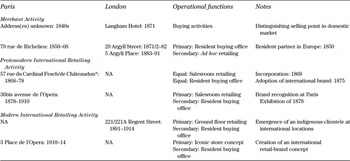
We discuss our findings thematically. That is, we consider those factors that enabled Tiffany to establish and sustain international retail operations during the nineteenth century. Analysis indicates the following themes: a centralized organizational structure, a stable ownership structure, existing international engagement, a strong brand identity, and a relevant international retail format in the context of an expanding consumer market. From our data collection, the following narrative emerged. The first Tiffany retail store opened in 1837 at 259 Broadway, New York. From inception, the store emphasized its international sourcing activities. Partners made buying trips to Europe, particularly Paris, in the 1840s. In 1850, the success of these buying visits led directly to the establishment of a buying office in Paris, at 79 rue de Richelieu, under the management of a new partner, Gideon Reed. By 1868, when the firm incorporated, the original buying office had outlived its usefulness and new premises were found at 57 rue du Cardinal Fesch.Footnote 52 Here a greater emphasis was placed on retailing activity. In 1878, following the firm's success at the Paris Exhibition of that year, Tiffany transferred its operation to a more central and fashionable location, at 36bis avenue de l'Opera. This location was superseded by much larger premises, at 3 Place de l'Opera, in 1910. Meanwhile, a buying office was opened in London in 1871 at 29 Argyll Street. Increased business led to the transfer to a new office, at 5 Argyll Place, in 1883. A dedicated retail store opened in 1891 at 221/221A Regent Street. This chronology is included in Table 2. The factors that contributed to this process and enabled Tiffany to succeed as a pioneering international retailer are discussed thematically below.
The firm's organizational structure was fundamental to its emergence as an early international retail operation. Tiffany maintained a centralized organizational structure throughout the period under consideration, due to two factors. First, the leadership structure and entrepreneurial nature of that leadership ensured tight control. One of the original founders of the business, Charles L. Tiffany, was involved in the running of the business until his death in 1902.Footnote 53 The business did not suffer from extended communication channels. The partnership structure provided direct communication between the New York and Paris operations. After incorporation, the board in New York continued to maintain a close relationship with the European operation. Second, the scale of the business was small and its scope was narrow. This was a business that neither required elaborate divisional structures nor extended over a wide range of product categories. Certainly, the first catalog issued by the firm, in 1845, shows an eclectic range of goods; however, in the context of the time, these were fancy goods and the firm specialized in them.Footnote 54 As the business developed, it increasingly emphasized precious stones, silverware, jewelry, and watches.Footnote 55 The firm focused primarily on items of high individual value.
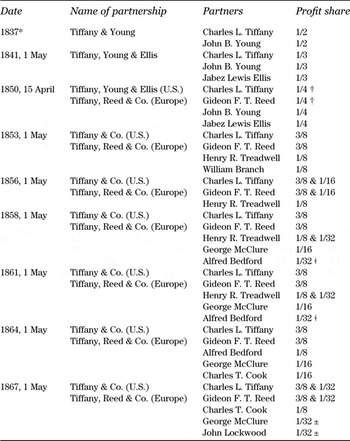
Tiffany Partnership Agreements, 1837–1867

Source: Co-partnership Agreements, Legal Department, Partnership Agreements, 1841–1867, Tiffany Archive, Parsippany, N.J.
Notes: * information regarding 1837 agreement derived from 1841 agreement, † plus salary of $2,000/year, ǂ as $2,000/year in lieu, ± $10,000/year guaranteed.
The firm's ownership structure supported internationalization as it developed with the changing needs of the business. Charles Tiffany and John B. Young, who had been friends since their youth, formed the first partnership in 1837.Footnote 56 A $1,000 loan from Charles Tiffany's father provided the capital required to establish the retail business.Footnote 57 The partners' social-familial connections strengthened in 1841 when Charles Tiffany married Young's sister.Footnote 58 However, as the enterprise developed, a series of partners joined and left the firm as business needs changed. Table 1 illustrates the temporary and shifting nature of the firm's partnership agreements between the founding of the original business in 1837 and incorporation of the firm in 1868. During this time, the firm had ten partners; only one, Charles Tiffany, was a partner for the full period of thirty-one years. Following the renegotiation of agreements, partners fulfilled distinct functions. Jabez Lewis Ellis joined the partnership in 1841 to facilitate John B. Young's traveling to Europe to source merchandise for the business.Footnote 59 In 1850, Gideon Reed joined the partnership to act as the resident partner in Europe, overseeing the development of the international operation.Footnote 60 This international partnership structure was fundamental to the first phase of European development. A resident American partner in Paris bridged the gap that might otherwise have existed between the firm in New York and its European operation. Reed's expectations were compatible with those of the remaining partners in New York. He was able to respond to European conditions and support the retailing of goods to expatriate Americans. As a resident partner in Paris, Reed reduced psychic distance for copartners and customers alike.Footnote 61
These partnerships were, by definition, not limited liability arrangements; thus, as the number of partners increased, the later agreements attempted to reduce the freedom of action of the junior partners. By the last ten years of the partnership structure, a managerial class had emerged, with junior partners’ remuneration becoming salaried in form. By the late 1860s, the firm had grown beyond a partnership structure. On the one hand, the firm needed to bind able managers into the business, and on the other, it needed to be able to control the liability associated with partnership agreements. Incorporation provided a framework within which more ambitious international operations could be considered. This was particularly important in a context where the resident partner in Paris had been in place for nearly two decades and the arrangement could not be maintained indefinitely. Continuation of the partnership structure would require an equally able, trustworthy, and committed replacement in the event of Reed's retirement.
The firm's resident international office was instrumental in the development of international retail activity. From 1850 to 1868 the office in Paris was located at 79 rue de Richelieu.Footnote 62 George Frederic Heydt in his brief history of the firm refers to it as “the first branch house” and implies its function was that of a buying office.Footnote 63 In the 1850s, the firm's listing in Paris trade directories confirms its role as “commissionaires” or merchants.Footnote 64 However, it is also clear that the office began to develop a retail function at an early stage. For example, advertising material published in 1863—as the “Courrier des hôtels et Guide du commerce réunis”—lists “Tiffany, Reed et comp., 79 r Richelieu, ont des demandes d'Amérique en divers art. De haute nouveauté. Vont en magasin.”Footnote 65 Aimed at visitors to Paris, this and other advertisements indicate that the rue de Richelieu facility was functioning as a rudimentary retail operation by the 1860s. Consequently, at the first board meeting of the newly incorporated firm, held on Monday, June 8, 1868, “it was deemed advisable, to secure another and more desirable location, as well as conveniences, for advancing the best interests of the Company” in Paris.Footnote 66 Importantly, “it was also proposed to have constantly on hand a suitable display of goods, adequate to meet the demands of our many friends and customers who may see fit at any time to call upon the Paris House.”Footnote 67 The new premises of “Tiffany, Reed & Co., Paris, rue du Cardinal Fesch, 57” were open for business by Christmas of 1868.Footnote 68 In Gambon's 1873 trade directory for Paris, the firm appears in a list of merchant buying offices as follows: “Tiffany, Reed et Cie, bronzes et bijouterie pour leur maison de New-York.”Footnote 69 At the rue du Cardinal Fesch, the business was still in transition from merchant to retail operation.
This transition, from buying office to retail outlet, also occurred in London. The firm was sourcing merchandise from London by the early 1870s. For example, Tiffany was agent in the United States for the British watch business of Frodsham.Footnote 70 However, unstable conditions in Paris following the outbreak of the Franco-Prussian War triggered the opening of a London office. Reed escaped from Paris to London in October 1870 and initially operated from hotel accommodation until late 1871, when an office described as Tiffany, Reed & Co. “merchants” opened at 29 Argyll Street.Footnote 71 The firm transferred to larger office space at 5 Argyll Place in 1883.Footnote 72 However, it was not until 1891 that the firm moved the short distance to 221/221A Regent Street in order to operate a dedicated retail outlet.Footnote 73
With the move to Regent Street, buying became a secondary function. A London trade magazine article of the time observes this transition. The article, noting the recent opening of Tiffany's new Regent Street store, emphasizes the impact this would have on nearby jewelers who had benefited from American visitors to London. The article observes that “a retail trade will be carried on” at the new address, whereas “practically no retail business was done” at the earlier address.Footnote 74 The trade journal continued, “Americans visiting this country often inquired after Tiffany's store,” yet the location of the Argyll Place office had meant “no one could direct them to it.”Footnote 75 Employment records confirm that retailing activity had been a business function at the Argyll Place address.Footnote 76 That is, the firm having established an office in London would serve loyal and favored customers despite retailing not being its main or initially intended function. Consumer demand existed in London, just as it had done in Paris, before dedicated retail facilities were available.
This has two important implications for understanding the development of international retail activity at this time. First, retail activity occurred because the firm had a resident international buying office. An office provided an opportunity for the firm to learn, in-market, what customers required of an international retail branch store. Second, a move from one location to another does not necessarily indicate a change in function; rather, it indicates the formal recognition within the firm of a changing balance of functions. Therefore, while it may be tempting to see the move to new premises at rue du Cardinal Fesch in Paris (1868) or at Regent Street in London (1891) as a definitive demarcation between buying office and retail store, such an interpretation would ignore the subtleties of the development process. Retailing activity preceded these moves and buying activity continued after them.
The firm's development of a strong brand was crucial to the retail internationalization process. Since its inception, Tiffany had emphasized the quality of its goods through its international sourcing activities. The first catalog, in 1845, explained that the merchandise was “of their [Tiffany's] own importation—made to order, or selected from the best sources, by one of their firm, resident in Europe.”Footnote 77 As the business developed, it placed a greater emphasis on the branding, rather than simply the selling, of merchandise. In the early 1870s, in order to ensure merchandise of the highest quality, the firm manufactured watches in Geneva, Switzerland. In 1873, the board decided “that all watches made by us be only marked Tiffany and Company Geneva, thus adopting the House name as a trade mark.”Footnote 78 Incorporation in 1868 was an important step both in the reorganization of the firm and in establishing a consistent identity. However, the European operation continued to trade as Tiffany, Reed & Co. until Reed's retirement in April 1875. Informed of his intended departure, the board had initially “determined to continue the business in Paris and London under the name of Tiffany Reed and Company, and Mr P.I. de Horrack, and Mr Charles A. Reed” were “appointed joint agents to transact” the firm's “European business.”Footnote 79 However, the firm ultimately decided to drop “Reed” from the name of the operation in Europe and adopt the name used in the United States: Tiffany & Co.Footnote 80 This act established a consistent brand identity across all markets.
Tiffany's brand positioning was enhanced further by endorsements. This took two forms: royal warrants and the prizes received at world's fairs. In the early 1880s, Tiffany actively sought endorsements from European royal patrons, while its representation at exhibitions enhanced a reputation for quality that communicated the values of the brand to a wider audience.Footnote 81 The success of the brand and its increasing market visibility led directly to the decision to improve retail facilities in Europe. As the firm's catalog of 1879–1880 notes,
Since the Exposition Universelle at Paris last year [1878], where MESSRS. TIFFANY & Co.’s goods won the Grand Prize, there has been a continual demand for their wares in Europe, and to facilitate the growing foreign business they have removed their Paris house to the more central and accessible location – Avenue de l'Opera 36bis, which is the only place besides the Union Square [New York] establishment where their goods can be purchased, as they are never sold to dealers.Footnote 82
This statement is significant for two reasons: it illustrates the prominence achieved by the Tiffany brand and it emphasizes the close relationship between brand as a product and brand as an in-house retail-service experience.
The firm's ability to respond to changing market conditions with format development and innovation was fundamental to establishing a sustainable international retail operation. The establishment of the London store in 1891 and the Paris store in 1910 illustrates the firm's response to changing market conditions and its recognition of the need for an international retail format. These two innovations are discussed below.
The first Tiffany store in London provided access and assortment not previously available to customers. A London-based trade journal, The Watchmaker, Jeweller and Silversmith, noted in its July 1, 1891, edition that “the American store is now located in Regent street.”Footnote 83 Before moving into the new premises, Tiffany combined two shops and, through its improvements, increased the gross estimated rental value of the property by 70 percent.Footnote 84 Heydt suggested that at the time he was writing (1893), “the London house occupies a handsome store at 221 and 221A Regent Street, where a large assortment of Tiffany & Co.’s products are always kept in stock.”Footnote 85 The store carried a specialist merchandise range. Store-window advertising describes a jeweler, selling precious stones.Footnote 86 Sales to customers show the store had a particularly strong trade in jewelry items, such as bracelets, brooches, necklaces, pendants, rings, and tiaras, along with purses and watches.Footnote 87 Advertising shows the firm specialized in jewelry, watches, silverware, and objects of art.Footnote 88 Photographs of the store from 1898 and 1910 depict a four-story building with a street-level store frontage.Footnote 89 Lettering on the fascia emphasizes the firm's international profile: New York and Paris. On the corner of Maddox Street and Regent Street, it occupied a prominent location on one of London's most prestigious retail thoroughfares and was opposite Liberty's main store, which was then on Regent Street.
The headquarters of the European business remained in Paris. However, the Paris operation at avenue de l'Opera was becoming inadequate for dealing with increasing consumer demand. Relocation to avenue de l'Opera in 1878 placed the Paris operation in a more central and fashionable position. However, the new location did not have facilities at ground level directly accessible from the street.Footnote 90 This became a major limitation of the business. The sales area was on the first upper story, providing a discrete selling space for loyal customers. It was in many respects appropriate for the sale of high-value items: diamonds, jewelry, watches, and American silverware.Footnote 91 However, as the firm's potential market grew, the limited retail sales space at avenue de l'Opera prompted the firm to obtain accommodation more accessible to passersby.Footnote 92 On October 4, 1905, the board sent a letter to Messrs. Tiffany & Co. Paris, indicating that
During his last visit to Paris, Mr Louis C. Tiffany was much impressed with the advantages the local jewelers there possess in having their salesrooms on the ground or street level. Everyone visiting Paris devotes more or less time to looking at the wares displayed in the shop windows, and the convenience and ease with which one can step into a shop on the street level to examine and price goods undoubtedly lead to many sales which are—through being located on an upper floor—lost.Footnote 93
The firm had been keen to respond to market needs for some time, and this was not the first time this development had been considered; however, “a suitable place has never been available.”Footnote 94 The Paris house was a complex operation by the beginning of the decade, with twenty-nine staff members in various roles.Footnote 95 Initially, Louis Comfort Tiffany suggested securing the shop on the ground floor of the building in which the firm already operated, at 36bis avenue de l'Opera. The Paris branch cabled the board in New York on November 20, 1905, to inform them, “Tourist shop control lease until July 1912, rental Frs 25000. per year.”Footnote 96 But it soon became evident to the board that merely expanding into the ground floor of the existing branch would be insufficient. By early 1906, the board's plans for the Paris store had become more ambitious. The Equitable Life Assurance Society of New York, Tiffany's landlord in Paris, was to offer the firm a more prestigious site with a larger sales area close by: that is, “the ground floor, entre-sol, first floor and basement of their building at rue de la Paix and Avenue de l'Opera.”Footnote 97 The lease was to be for twenty-four years commencing April 1, 1907, at an annual rental of 200,000 francs.Footnote 98 However, the rental cost was to increase further and substantially. Minutes of the board taken on January 15, 1907, indicate improvements by the Equitable would result in a more expensive lease, amounting to a higher rent of 325,000 francs per year.Footnote 99 The board was clearly prepared to countenance this higher cost, giving “Mr C.M.Moore, manager of the Paris House” negotiating power “to make the best arrangement possible for the changes in Contemplation.”Footnote 100 The new store was an ambitious undertaking, as reflected in contemporary accounts of its development.Footnote 101 The Daily Trade Record New York details the lengths to which the architects and designers were willing to go to ensure the most effective store possible. The newspaper notes that “before work on the store itself was begun a full-size model in plaster, showing a section of the store as it now appears, was set up in one of the suburbs of Paris.”Footnote 102
Tiffany's retail operation in Paris changed from being an upper-story salesroom to a new type of international store. The New York Herald, Paris edition, ran a long feature on it on Sunday, April 24, 1910: “The new shop is constructed on lines entirely different from those employed in the typical jewelry shop in European cities. Its novelty, its artistic beauty and its conveniences for customers set it apart from even the most famous places of its kind, and make it one of the show places of Paris.”Footnote 103 It had “360 square metres of floor space”; an extravagant use of empty space was expressed through “the broad transverse space running across from the boulevard to the rue de la Paix, and two broad aisles extending to the back.”Footnote 104 However, it was also a practical sales environment designed to engage the customer's attention, because “the most striking feature of Tiffany's, certainly the most novel to Parisians, is the system of show-cases.” Here greater customer access to merchandise replaced the secluded upper-story showroom. That is, “instead of articles of jewelry being brought out from safes and displayed one by one on a table before the prospective purchaser, all the articles for sale are exhibited in the familiar American way, in a series of glass and bronze show-cases.” There was enticement, encouragement to engage with the merchandise without the immediate and potentially discouraging interaction with employees, because “visitors may enter the store, wander from case to case at their leisure . . . or merely enjoy the splendid display.”Footnote 105 Here, the store is a tourist destination in its own right, a display case for the brand.
This iconic store was the firm's response to an expanding consumer market. For example, the pricing system at the Place de l'Opera store encouraged purchases at modest sums as well as extravagant prices: “any sum from 25 to 1,000,000fr.”Footnote 106 During the period under consideration, two changes occurred in the firm's customer base. First, the firm became less dependent on expatriate Americans. Second, a wider group of consumers was encouraged to patronize the international stores. Commentary on Tiffany's customer base has emphasized the expatriate American.Footnote 107 There appears little question that American visitors were encouraged to visit the firm's European operations. Paris was an important destination for Americans visiting Europe in the years following the Civil War.Footnote 108 Likewise, the London store sought to address the requirements of American customers. Advertisements from the late 1890s provide “dates for delivering Christmas Presents in the United States.”Footnote 109 However, internal firm records show that by the 1910s, English customers along with expatriate American customers were purchasing from the Regent Street store.Footnote 110 In Paris, the store established in 1910 on the Place de l'Opera was “not only for Americans but for Parisians themselves.”Footnote 111
Between 1850 and 1910, per capita gross domestic product (GDP) in France almost doubled.Footnote 112 Changes to Tiffany's operation in the Paris market reflect this increase in spending power. Initially, retailing had been an incidental outcome of Tiffany's buying office in Paris and a service provided for visiting Americans. By the 1910s, the firm had established an iconic retail store in a fashionable location designed to appeal to a new consumer base. Similarly, Tiffany's changing operation in London reflects the move away from a restricted group of American customers traveling in Europe to an emerging indigenous market and widening consumer base. When Tiffany started buying in Europe in the 1840s, Paris was the most attractive market for the firm's merchant activities. When the firm opened its Regent Street store in 1891, France's per capita GDP was only 60 percent of that of the United Kingdom.Footnote 113 Tiffany's ability to develop its retail format over this sixty-year period in two major European cities indicates a firm with the organizational capabilities to respond to changing consumer demand.
Discussion
This article addresses the following question: What firm-level factors were required to initiate and sustain international retail operations in the late nineteenth century? Tiffany's international retail operation developed as the result of a combination of factors that came together at a relatively early date: a centralized organizational structure, a stable ownership structure, existing international engagement, a strong brand identity, and a relevant international retail format. In the context of an expanding consumer market, these factors facilitated the initiation and development of sustainable international retailing activity.
Tiffany operated through a centralized organizational structure. The scale of the business was not large. The international business was a buying operation that developed a retail function; in time, the retail function became dominant. The firm's organizational structure provided a simple platform for the management of the retail operation. Had department stores tried to replicate their stores internationally, they would have been on a very different scale and required extensive integration with local distribution and supplier systems. In contrast, Tiffany's organizational structure facilitated the development of international stores.
Charles L. Tiffany and Gideon Reed provided continuity of leadership and strategic direction for a long and important period in the firm's development. In particular, Reed had a crucial role in the establishment of the international operation. Within the ownership structure provided by partnership agreements, Reed established a branch office in Paris that laid the foundation for future European development. However, the partnership structure inevitably led to shifting arrangements that could potentially destabilize the business. With incorporation, there was a fundamental change in the level of international engagement. The history of A. T. Stewart's department store is an example of what could happen to a business on the death of its key entrepreneurial innovator.Footnote 114 Lacking direction and appropriate ownership arrangements, that business went into terminal decline, indicating the instability associated with partnerships and unincorporated businesses. Partnerships remained a feature of large American department stores long after Tiffany incorporated. Incorporation balanced the value of strong individual leadership within the centralized organizational framework of the firm. Incorporation was clearly an important factor in Tiffany's willingness to engage with further international growth.
From its earliest years as a retailer in New York, international sourcing defined Tiffany's merchandise range. John B. Young's regular buying trips to Paris in the 1840s demonstrate partners’ commitment to this aspect of the firm's commercial identity. This merchant activity drew the firm into international markets and gave it an increasing knowledge of them. The establishment of an international resident buying office proved fundamental to Tiffany's recognition of the retail potential available in international markets. With this, the retail business could grow incrementally. A buying office provided local knowledge and market understanding. The existence of the office facilitated the development of transaction-based assets. Tiffany was not the only American retail firm that engaged in international sourcing in the second half of the nineteenth century. The department store sector actively and extensively sourced in European markets. However, the size of department store organizations may have inhibited knowledge transfer across business functions as strategic decision making became isolated from the knowledge accrued within the organization's functional units. In contrast, at Tiffany, buying and retailing were centralized, so knowledge derived from one activity could easily transfer to another.
From 1875, Tiffany had a consistent and clearly defined brand across its domestic and international markets. The firm took full advantage of this asset-based advantage. The ending of the partnership structure facilitated this, as did the development of retail formats suited to international markets. In this, Tiffany created a clear and consistent brand identity with regard to both the product and service environment. Exclusively selling products through its own retail outlets further enhanced this relationship. In contrast, department stores did not have their own clear and consistent brands; instead, they had a fragmented brand architecture spread across a wide range of product qualities and categories. Woolworth, as representative of chain stores, had a recognizable fascia and identity. However, the firm did not have a strong product-based own brand that built on its retail identity. In contrast, Singer, as representative of a manufacturer with a retail network, had a distinct, strong brand consistent with the identity of its retail system. From a branding perspective, Tiffany resembled the manufacturing firm of Singer more than it resembled other retailers. The creation of a distinct brand was fundamental to Tiffany's international development, whether from the perspective of American consumers wanting the security of buying from a familiar firm when traveling abroad or from the perspective of European consumers recognizing a desirable brand. As a retailer, Tiffany was innovative in its placement of a distinctive brand and coherent brand message at the center of its marketing activities.
For the process of retail internationalization in the late nineteenth century, scale could be an asset but scope was a liability. Trading name, fascia, and brand proved fundamental to firm success. Woolworth and Singer used their organizational capabilities and scale to establish their dominant presence in host markets. However, neither firm built their international operations on the scope of their activities. Certainly, Woolworth sold merchandise in different categories, but it did not do so to the same extent and on the same basis as the department stores. Likewise, Woolworth did not combine buying and selling functions in the same way as the department stores. Singer's distribution system emphasized a narrow product focus. Singer and Woolworth possessed a strong brand or company name and both developed a distribution system and retail format that facilitated replication. In contrast, the department stores were built on scale and scope but did not develop the same brand asset and a replicable retail format. Instead, they sold manufacturer brands and developed various captive brands—in contrast to Tiffany, which did possess a distinct brand. Tiffany's organizational structure and merchandise range facilitated this. The firm's development of a single brand strategy and the marketing of Tiffany goods exclusively through its own retail outlets domestically and internationally was a valuable commercial asset.
Evolution of Tiffany's International Operation, 1837–1914

Source: Authors' compilation of article's findings.
Note: * rue du Cardinal Fesch was renamed rue de Châteaudun after the Franco-Prussian War (1870–1871).
Tiffany's retail activities in Paris and London underwent considerable development between the 1850 arrival of a resident partner in Europe and the 1910 opening of the firm's iconic store format in Paris. In this, the firm's retail operations grew with the opportunities provided by the markets of London and Paris. The store development process indicates Tiffany went through three phases of international retail activity (see Table 2). Initially, retail activity was carried out through the international office, which was established for buying activity. This merchant phase was followed by a period of protomodern international retailing activity. In this phase, the firm's facilities retained some of the older characteristics of the merchant operation with new customer-facing activities: a buying office and discrete retail facilities designed to serve a narrow customer base. In this protomodern phase, the firm transitioned from a merchant operation to a fully developed retail operation. This transition culminated in a modern retail offering as represented by the 1891 London store and the 1910 Paris store. Modern retail facilities provided street-level open access and an internal open display of merchandise. For Tiffany, these facilities provided a showcase for a distinct and consistent brand identity. In this combination, a consistent brand identity and modern facilities represented a major development in the firm's retail provision and clearly acknowledged the changing needs of its widening customer base. This incremental development shows the firm acquired transaction-based assets during its time in international markets.
Conclusion
The process of retail internationalization in the late twentieth century and early twenty-first century is explained in the management literature by firm drivers of change, internal facilitating competencies and the assertion of control over firm assets. However, this literature has not shown how this process occurs over an extended period within a changing market context. The research presented here addresses this gap in the literature by considering the firm-level factors required to develop and sustain international retail operations during the late nineteenth century.
Tiffany's activities in European markets illustrate the firm's use of asset-based advantages derived from its brand, operating systems, and formats. Initially, these were asset-based advantages derived from innovation within the retail firm in the domestic market and exploited in foreign markets to serve a consumer group familiar with the firm's domestic operations. However, Tiffany's development of transaction-based advantages derived from the experience of operating international outlets was to fundamentally transform the firm's ability to operate in and respond to international markets. Tiffany's development of internal facilitating competencies enabled the firm to transfer asset-based ownership advantages and capture transaction-based ownership advantages. Functional coordination between buying and retailing activity facilitated the development of the latter during the firm's merchant phase. Functional coordination and strategic decision makers’ knowledge of these functions continued to support international retail development throughout the period. The firm built on international management experience, which determined its ability to develop successful and sustainable international operations. The firm did not launch a retail store in the Paris market without first developing transaction-based ownership advantages; these informed subsequent expansion in London. This article contributes to the literature by showing how this process works over an extended period of more than sixty years, across two international markets.
The management literature makes three implicit assumptions about international retail firms: they are primarily engaged in the retail trade in their domestic and foreign markets, they are large or very large corporations that are shareholder owned, and sourcing activity is not a distinguishing characteristic. These assumptions reflect international retailing activity at the end of the twentieth century and beginning of the twenty-first century. The business history literature has questioned the first assumption: that firms engaged in international retailing are primarily engaged in the retail trade in their domestic and foreign markets. In the business history literature, manufacturing firms are seen as drivers of retail internationalization before 1960. However, the findings reported here show that international retailing was associated with a retail firm from a very early date. The second assumption, that international retailing is the preserve of large or very large shareholder-owned corporations, is qualified by the findings presented here. These findings show that a centrally organized, specialist, smaller firm was well placed to respond to international retail opportunities and was better placed than larger contemporary firms of greater scale and scope. The findings also suggest the retail internationalization process relies on an appropriate ownership structure and that incorporation and internationalization occur during the same phase of development. The third assumption, that sourcing activity is not a distinguishing characteristic of international retailing, is challenged. In the management literature, international retailing has been conceptualized as a consumer-facing activity and not a distribution channel process. However, as this study shows, sourcing can have a fundamental impact on the initiation of international retailing activity.
The management literature indicates that a mixture of exogenous and endogenous factors cause international retailing. Tiffany was pulled into international markets through increasing consumer demand for its retail offering and has the characteristics of a proactive retailer. However, unlike post-1960 examples of retail internationalization, the firm did not arrive in those markets with a fully developed brand identity or with a distinct operating format derived from operations in the domestic market. Therefore, this research qualifies previous understanding of the internationalization process and places an emphasis on transaction-based advantages derived from international activity rather than on asset-based advantages derived from operations in the domestic market.
In the United States in the second half of the nineteenth century, the department store has defined the modernization of fixed-store retailing. However, the department store did not become a vehicle for retail internationalization through the direct transfer of technology and concept. Indeed, even in the domestic market it proved difficult to replicate. The scope of the department store enterprise ultimately precluded replication. This study of Tiffany of New York shows that a smaller, specialist retail organization was well suited to early internationalization. Brand identity, incremental international store development, and awareness of changing consumer needs were important drivers of international retail activity at a very early date. Proactive retailers are able to expand internationally because of their brand relevance and distinctive retail format. The early history of Tiffany is a good example of this. This research shows it was brand and focus, not scale and scope, that initiated early American international retailing.