

1. INTRODUCTION
The history of material culture and consumer demand in pre-industrial times has answered many questions in recent yearsFootnote 1. After three decades of studies, today most historians reject the notion that changes in material culture and consumer demand during the early modern period were mere consequences of changes in supply. Changes in demand played an active role in economic transformations before industrialisation and the development of modern economic growth. By giving the demand side of economics a less dependent role in explanations about the path to modern economic growth, analyses of pre-industrial economic history have become more complex and enrichedFootnote 2. In the case of Spain, this approach to material culture and consumer demand has contributed to modify and qualify some theses about the so-called failure of the Spanish path to industrialisation and economic modernisation (Yun and Torras 1999; Yun Casalilla et al. Reference Yun Casalilla, Torras Elias and Llopis Angelán2003; Muñoz Navarro Reference Muñoz Navarro2011). More recently, global history has produced debates on which the history of material culture and consumer demand shed some light. These new historiographical trends, while discussing the concept of globalisation itself, explore the expansion of world trade of products such as Chinese silk and porcelain, Indian calico, spices, sugar, chocolate, coffee and tea among others, that took place between the 16th and 18th centuries as well as the reasons behind such an expansion, and relationships between empires, markets, consumption of goods and identities (O’Rourke and Williamson Reference O’Rourke and Williamson2002a, Reference O’Rourke and Williamson2002b; Flynn and Giráldez Reference Flynn and Giráldez2004; Nützandel and Trentmann Reference Nützandel and Trentmann2008). What these new trends have rarely dealt with is a question which may help to explain the origins of world trade expansion in the early modern era: How did customers access novelty products on world markets in the early parts of the early modern era, when demand for such products was still scant and commercial means to supply them was poorly developed?
Commoditisation and market formation should not be taken for granted in history. New products do not immediately find a market (Styles Reference Styles2000, p. 132). The process through which a good becomes a commodity and shapes a market is a complex one which in the early modern era entailed adjustments between supply and demand, and intercultural dialogues among different societies when goods were transported to different parts of the worldFootnote 3. As Arjun Appadurai (Reference Appadurai1986, p. 13) pointed out, for things to become commodities, their exchangeability for some other thing must become their socially relevant feature. In the early modern era, new commodities became more and more noticed and desired by consumers, at the same time as market forces regulated supply. This entailed lengthy processes of transformation and adaptation of consumption habits to new goods, and also, as John Styles (Reference Styles2000) explained, innovation and branding of products as well as transformations that made them more attractive to customers.
The early modern era was a privileged period in the development of processes of commoditisation of products, due to increases in contacts, interactions, and exchanges around the world which preceded and laid the foundations of world trade. Many products were transformed from rarities or completely unknown goods into commodities whose access and use ended up being regulated by fashion and market. Of all goods transformed into commodities in Europe and the Americas during the early modern era, Asian manufactures such as Chinese silk, porcelain and also Indian calico have received special attention in scholarship, as their commoditisation had strong impacts on most European economies of the 18th century (Berg Reference Berg2004; Batchelor Reference Batchelor2006; McCants Reference Mccants2007; De Vries Reference De Vries2008). However, such an impact took place at a late moment in early modern times — the 18th century — when Asian textiles and furnishings, and European imitations, were already integrated into retail, new fashion and marketing systemsFootnote 4 . In the case of Britain, Maxine Berg (Reference Berg2005, pp. 265-266) has pointed out the importance of the East India Company and initially exotic importations as a factor in new British shopper culture developed in the 18th century. Scholarship has rarely addressed the way demand for these products was satisfied and expanded in «pre-marketing» times, which is to say before retail specialisation, branding and modern techniques of product advertisement were developed in 18th-century Europe.
Expansion of consumer demand for new products had to do with globalisation. In recent debates about the concept, timing and characteristics of globalisation, Flynn and Giráldez (Reference Flynn and Giráldez2004, Reference Flynn and Giráldez2008) have defended that globalisation was a process where market integration was merely one component among others, such as the diffusion of goods like flora and fauna throughout the globe, in which Chinese demand for and American production of silver were essentialFootnote 5. Following this line, scholarship has stressed the importance of the Manila galleons and New Spain in growing global interactions from the late 16th to the 18th century (Flynn and Giráldez Reference Flynn and Giráldez2004; Dobado 2014). In this line, the following pages attempt to address the role and ways in which global networks of Hispanic elites, particularly New Spanish elites, contributed to spread demand for Asian goods in the Spanish Empire.
This article aims to shed light on mechanisms of demand fulfilment for Asian manufactured goods in the Spanish Empire in the late 16th and early decades of the 17th centuries. After the Spaniards conquered the Philippine Islands in 1565 and founded Manila in 1571, they opened a commercial route which connected the Philippines to Acapulco, on the Pacific coast of New Spain. The Manila Galleon route became one of the most important routes of exchange between the Spanish Empire and Asia during the early modern era. The Manila galleons carried silver to Southeast Asia, where it was exchanged for Chinese silk and porcelain as well as other goods such as Japanese furniture. Asian goods started circulating in colonial Latin America; while some which arrived in New Spain were redistributed to other markets of the Americas and also to Castile (Chaunu Reference Chaunu and Chaunu1956, pp. 1020-1021). It must be noted, however, that the formation of a market of Asian goods in the territories of the Spanish Empire, especially in Castile, was still incipient around 1600, and Asian goods were not only circulated as wholesale merchandise — that is goods to be sold to and bought by retailers, jobbers, hawkers and shopkeepers before they were finally purchased by customers. There are also historical examples of goods that circulated as gifts and personal commissions through familial networks before they were commoditised. For instance, it was common for Portuguese elites to commission those living in the Portuguese colonies within Asia to ship special orders of Chinese porcelain around 1600 (Canepa Reference Canepa2012, pp. 271-276). Likewise, American chocolate was consumed by Austrian aristocrats before it became merchandise in the 18th century, as it circulated throughout noble networks in contact with Spanish aristocrats (Lindorfer Reference Lindorfer2009, pp. 35-52). It is worth asking about the extent to which this gift- and commission-transferring, besides working as fuel for social and political relations between family members and elites (Howell Reference Howell2010), favoured access to new, little commercialised products like Asian goods and expanded a demand for them in the Spanish Empire. This process provided roles for New Spanish elites as agents in the commoditisation of Asian goods throughout the empire, including Castilian cities.
This paper offers an econometric model that gauges impacts of different variables on consumer demand for Asian manufactures by elites in two of the most important cities of the Spanish Empire, Mexico City and Seville, between 1580 and 1630. This model is applied to sample data of 122 elite probate inventories of Mexico City and 131 of Seville, and presents impacts of strictly economic variables, such as wealth, and other variables such as familial and private contacts with people living in the Americas and the Philippines, on demand for Asian manufacturers by elites of these two large, globally connected cities. The main objective is to determine the degree to which elite customers, especially elite customers in cities such as Seville, which was farther away and less connected to Asia than cities such as Mexico, depended upon their familial transcontinental networks, instead of retail forces, to acquire Asian goods.
This article is organised as follows. In order to contextualise access to Asian manufactures by Hispanic elites, including expansion of their long-term demand in the Spanish Empire in the late 16th and early decades of the 17th century, section 2 provides notes on the reception of Asian manufactures, especially Chinese silk and porcelain, in Europe before the 17th century. Section 3 describes variables within the proposed estimate model of demand for Asian products under conditions of global markets in the 16th and 17th century Spanish Empire, and methodological precautions taken when inferring consumer demand from the sample of elites’ probates in Mexico City and Seville. Section 4 runs the model in order to gauge impacts of familial and private means of diffusion of Asian goods, alongside other factors, on consumer demand for these goods in the two cities in the late 16th and early 17th century. Section 5 offers conclusions.
2. ASIAN GOODS IN EUROPE BEFORE THE 17TH CENTURY
Commercial contacts between China and Western Europe were scant, indirect and intermittent before the 17th century. Although scholarship traditionally considered that a direct link between the Roman Empire and China existed (Grant Reference Grant1960, pp. 82-86; Honour Reference Honour1973, pp. 30-31), current research has demonstrated that ancient Romans did not import Chinese silk. With current evidence, it is hard to be certain that Roman elites wore Chinese silk clothes. Most of the silks found in Europe in the centuries after the fall of the Roman Empire were not Chinese, but Byzantine. Furthermore, no direct trade existed between China and Western Europe in the Medieval Ages. China’s main partners via the Silk Road were modern-day Iran, and, more indirectly, Byzantium. Although silk weavers from Lucca started imitating oriental designs in their embroideries, brocades and fabrics in the 14th century, few Chinese goods arrived in Europe before the 16th century. Furthermore, Chinese silk and porcelain were scarce in contrast to other products such as paper (Honour Reference Honour1973, pp. 34-36; Hansen Reference Hansen2012, pp. 9, 18-21, 97;).
Nonetheless, maritime trade in Asia was vigorous from the 9th to the late 13th century, as new ports emerged, new Asian economies were monetised and mercantile organisations expanded. Asian maritime trade experienced an interruption from the late 13th to the mid 14th century, but it was temporal. When Vasco da Gama arrived in India in 1498, East, South and West Asia were among the most vibrant commercial areas of the world (Sen Reference Sen2003; Wade Reference Wade2009). His voyage commercially connected Europe with such dynamic commercial areas by sea for the first time. Italian territories, like the Grand Duchy of Tuscany, and Portugal increased their contacts with China via the Mediterranean Sea and Turkey, and with India via the Cape route, respectively. The Iberian kings, alongside popes and the wealthiest aristocrats of Europe, became eager purchasers of Asian objects (Kawamura Reference Kawamura2003, p. 214). Around 1600, European potters started producing tin-glazed earthenware inspired by Chinese porcelain for the aristocracy (Finlay Reference Finlay1998; Canepa Reference Canepa2012, pp. 276-278).
Two events that took place far from Europe were to propel reception and expansion of Asian manufactured goods in the Atlantic World before the Dutch East India Company (VOC) expanded towards the middle of the 17th century: Portuguese settlement in Macao in 1557, and the foundation of Manila by Spaniards in 1571. The Chinese concession for the Portuguese to set up the colony of Macao near Canton and to open triangular trade between Macao, Nagasaki and Manila favoured the elites from Portugal and from colonial Latin America, who were able to acquire Asian goods as no other European elites could in the same period (Yuste Reference Yuste López1984; Boxer Reference Boxer1985; Schurtz Reference Schurtz1992). The flow of Asian goods in Latin American elite circuits contrasts with the flow of Asian goods in Europe around 1600. During the early 17th century, the purchase of Asian manufactures was still far from spreading to wider segments of populations in European countries. Commoditisation and even knowledge of Asian goods were limited in most parts of Europe in the early 17th century (Berg Reference Berg2004, p. 85). In such context, the elites of New Spain started supplying their Castilian peers with Asian manufactures by sending them as gifts and personal orders (Curiel Reference Curiel2007; Gasch-Tomás Reference Gasch-Tomás2011).
The opening of the Manila Galleon route and the entry of Asian goods into the Spanish Empire via Acapulco entailed a supply shock that was driven by demand for and high prices of silver in China, and the increase in American silver output after the mid 16th centuryFootnote 6. Although initial trade between Manila and the Americas was free, over time it was regulated. The increase in trade in the 1580s led Philip II to approve a royal decree in 1593 according to which trade between Acapulco and Manila was limited to loading 250,000 pesos of merchandise from Manila to Acapulco and 500,000 pesos in silver from Acapulco to Manila, and a fleet of two galleons. Contraband became a constant in trans-Pacific transactions, and Manila’s trade enjoyed its first golden age around 1600 (Legarda Reference Legarda2001, pp. 337-366; Alonso Álvarez Reference Alonso Álvarez2013, pp. 67-69).
«Inward Registers of Ships to Seville from New Spain» (registros de venida de Nueva España) of the late 16th and early decades of the 17th century, records each ship that sailed annually from Veracruz on the Atlantic coast of New Spain to Seville, including not only wholesale consignments of goods imported into Castile from New Spain such as silver, cochineal dye, leathers and indigo, but also shipments of gifts and special orders commissioned by Castilians through relatives and members of their guild and commercial companies who lived in the Americas. Chinese silk, porcelain, Japanese furnishings, fans and so forth were among the most recurrent goods in these packages of gifts and special orders. Many social groups were involved in this kind of transfer of Asian goods. As in earlier centuries, members of the aristocracy were implicated in the circulation of Chinese silks and porcelains in the early 17th centuryFootnote 7. However, there were novelties in early 17th-century consignments of Asian manufactures across the Spanish Empire. Not only wealthy aristocrats but also other new «middling» elites participated in the diffusion of Asian goods as gifts and orders. Links between bureaucrats and members of socio-professional positions such as secretaries, judges, etc., and members of a family, on both sides of the Atlantic were important in the movement of Asian goods which were sometimes packaged alongside American goods such as cacao grains, chocolate and calabash bowls. Furthermore, transfer of Asian goods involved elites who lived not only in the King’s Court, as in the Medieval Ages, but also in large Castilian cities such as Seville, Granada, and Toledo, among others. They sent each other different types of Chinese silks, Chinese porcelain, Chinese and Japanese escritoires, Indian cottons, and Japanese katanas and folding screensFootnote 8.
3. A MODEL TO ESTIMATE DEMAND FOR ASIAN GOODS IN THE SPANISH EMPIRE
In order to estimate the influence of familial forces on expanding demand for Asian goods in the global context of the Spanish Empire, this paper applies an econometric estimation model which takes into account not only customers’ wealth, but also customers’ contact with global familial networks as a variable in consumer demand for Asian manufactures with a sample of 122 probates of Mexico City and 131 of Seville, for a chronological block from 1580 to 1630.
Analysis of probate (post-mortem) inventories in this study takes several methodological precautions. Some are general and have been pointed out in the literature on material culture and consumer demand in pre-industrial times. Other precautions are related to particularities of the sample collected for this study. There were many types of probate inventories in the early modern era — simple probates, public auctions of realties and goods, divisions of properties among heirs and heiresses, and so forth — nevertheless all have a common characteristic. The probate inventory was a document that in Europe and European colonies was drawn up upon the death of a person to register his/her wealth to organise inheritance. Probates used in this study stem from different sorts of probates which in all cases register and appraise the wealth of the deceased. For Seville, data of probates, public auctions and divisions kept in the Archivo Histórico Provincial de Sevilla (AHPS) have been processed. For Mexico City, probates and public auctions kept in the Archivo General de Indias (AGI), the Archivo de las Notarías del DF (ANotDF), and the Archivo General de la Nación (AGN) were gathered. In the case of Mexico, some of the inventories used for this study are contained in the Goods of Deceased (Bienes de Dinfuntos) section of the AGI, which records the goods of the deceased who had heirs and heiresses living in Castile.
The first methodological precaution has to do with the stock-flow problem. Purchases, consumption (i.e. desire for and use and deterioration of the goods) and sales are a flow that varies according to the depreciation rate of goods. The depreciation rate, in turn, depends on elements as varied as the physical characteristics and use of the product, the wealth of customers, and also fashions regulating the use of products. In order to analyse consumer demand in pre-industrial times in all its complexity, ideally the depreciation rate and lifetime of goods as they affect the value of objects might have been calculated. However, probates only collect stocks of goodsFootnote 9. In this essay, I proceeded in the same way as other scholars have done in studies on consumer demand in the early modern era — consumer demand was inferred from expenditure on consumption of Asian goods and measured through the stock of Asian goods contained in probatesFootnote 10.
Second, in spite of differences between the two cities of reference for this study, which had to do mostly with different social and racial composition, Mexico City and Seville shared similarities: both cities had many analogous political institutions (cabildo or city council, merchant guild, corregidores or mayor-judge appointed by the king, audiencia real or royal tribunal, etc.), both were highly urbanised, both were principal nodes of the main Spanish global commercial, political and cultural networks of the time, and both had similar and comparable elites.
Third, another methodological challenge has to do with representation of the source. In order to gather a sample of probates which is sufficiently representative of the group to be analysed (De Vries 1993, pp. 105-106), as many inventories as possible of Mexican and Seville elites were collected. This has to do with another methodological challenge. There are fewer inventories of poor social groups and people with precarious finances than of wealthy groups, who had more goods and economic reasons to draw up probate inventories. This is especially the case for this study. Consumption of Asian manufactured goods in Mexico City and Seville was still an elitist reality around 1600. This is why the reduced sample of inventories — 122 in Mexico City and 131 in Seville — is representative of the social group of reference. The two cities had populations of about 100,000-130,000 people around 1580-1630. In Mexico City, Spaniards and Creoles, to whom goods of the Manila galleons were directed, numbered around 15,000 in the early decades of the 17th century (Gibson Reference Gibson1964, pp. 136-141, 378, 381). Poor immigrants from Castile are included in these 15,000 people, so that the elites of Mexico City comprised a number even lower, probably much lower, than 15,000. Although it is hard to accurately estimate population per wealth group in Seville, it is highly likely that the wealthy within the Seville sample were also a reduced elite too. Seville’s sample is mostly comprised of people with probates valued at more than 100,000 maravedís. In fact, most probates of the sample were valued at more than 1,000,000 maravedís, and an important part is made up of probates worth more than 10,000,000 maravedís (Figure 2). This means that the sample is mostly comprised of high nobles, merchants and rich artisans and bureaucrats, which is to say, according to literature on demography and social composition of early modern Seville, around 5 per cent of Seville’s inhabitants (Álvarez Santaló Reference Álvarez Santaló1983, pp. 1-19; Aguado de los Reyes Reference Aguado de Los Reyes1994 pp. 35-66: Rodríguez Vázquez Reference Rodríguez Vázquez1995, pp. 66-67 and 89). Furthermore, the upward bias of the sample is more accentuated in the Seville sample than in the Mexican one (Figures 1 and 2), and therefore more representative. This difference between samples occurs for two reasons. First, there was little leeway in archival work to construct a sample of inventories for Mexico City since few probate inventories of the 16th and 17th centuries have survived in Mexican archives; it was hard to gather a larger sample of probates of Mexican elites. It was only possible to gather a sample of probates from Mexico City after working in three different archives. Second, in spite of the existence of many more inventories in Seville than in Mexico, only the very wealthiest inhabitants of Seville possessed Asian goods. Moving upward socially to collect data on customer inventories in Seville of Asian goods has been a heuristic requirement; otherwise analysis would have been unfeasible. Far from being a problem, this additional constructive element of the Seville sample is duly weighted in the estimate model and is expected to confirm the conclusions of this article.
TIME AND WEALTH DISTRIBUTION OF SAMPLE OF INVENTORIES OF MEXICO CITY (SEMI-LOGARITHMIC SCALE), 1580-1630
No inventories: 122. Source: Archivo General de Indias (henceforth AGI), Contratación, Bienes de Difuntos; Archivo de las Notarías del DF (henceforth ANotDF), Protocolos; Archivo General de la Nación (henceforth AGN), Intestados; and AGN, Bienes de Difuntos.

TIME AND WEALTH DISTRIBUTION OF SAMPLE OF INVENTORIES OF SEVILLE (SEMI-LOGARITHMIC SCALE), 1580-1630
No inventories: 131 Source: Archivo Histórico Provincial de Sevilla (henceforth AHPS), Protocolos.
Fourth, wealth according to inventories of this study was computed without taking debts against decedents into account. During the early modern era, most wealthy people were heavily in debt, having in some cases negative net worth. This does not mean they were poor. On the contrary, in spite of — or perhaps because of — the fact that the wealthy had negative net worth, this meant that they could spend huge amounts of money on consumer goods and maintain high levels of consumption. For this reason, including debts when calculating wealth would have been a larger methodological challenge than not including them. If debts had been included in regressions, it would not have been possible to find a way to compare consumer demand for Asian goods between the richest and «middling elites» of Mexico City and Seville, as it was more difficult for the latter to get into debt than it was for the former. In other words, including debts would have actually meant, in most cases, computing the richest of Mexico City and Seville as the poorest, which would have made it unfeasible to analyse demandFootnote 11. Furthermore, given that the model aims to address consumer demand for Asian goods, those goods that were wholesale merchandise were excluded from the computation. Inclusion in the analysis of wholesale merchandise contained in the stock of people’s inventories would have biased conclusions towards a higher demand for Asian goods of social groups such as textile craftsmen and wholesale merchants, which is to say towards social groups who accumulated Asian goods for reasons other than desire for and use of goods (i.e. consumption). Identification of wholesale merchandise in the probate inventories is relatively easy because they are usually indicated to be contained in boxes and are explicitly defined as merchandise or cargo (mercadurías or cargamento) in the probate. Of course, it is possible that some merchandise was, in the end, consumed by its owner, but reference to them as mercaduría or cargamento seems to indicate the contraryFootnote 12.
The model proposed here takes Carole Shammas’s and Fernando Ramos Palencia’s econometric estimate models for consumer demand for goods in pre-industrial times as reference. These two scholars calculated relative impacts of variables such as wealth — and income, when data are available — household size, book ownership, degree of urbanisation, socio-professional status and gender, on possessing more consumer goods in America and England and in northern Castile, respectively, in the 18th century (Shammas Reference Shammas1990, pp. 169-181; Ramos Palencia Reference Ramos Palencia2001). This work develops a model that includes some of these variables, but proposes others adjusted to the particularities of the Asian goods market, which was still in formation in the late 16th- and 17th-century Spanish Empire. This model contains an assumption and a hypothesis that are related. The assumption is that the slow and low-intensity character of the commercial links during the early modern era, and consequently high transport costs (Held et al. Reference Held1999, pp. XLII-LXIII; Gallo and Newland Reference Gallo and Newland2004), resulted in high dispersion of markets and prices at the global level during the early modern era. This was reflected in prices of Asian goods, which circulated in many markets around the world. Prices of Asian goods in the Americas and Castile during the 16th and 17th centuries point to strong increases in price from Asia to the Americas and then to Castile, which is consistent with the high transportation costs of the period (Chuang Reference Chuang1975, p. 114; Picazo Muntaner Reference Picazo Muntaner2003). The related hypothesis is that, in such a context of structural dispersion of global markets and prices, transfer of Asian textiles and objects through extensive family networks, plays an important role in expansion of demand for such goods in the Spanish Empire.
Taking these two assumptions into account, the model follows the method of ordinary least squares (OLS). The equation of the proposed model, which is run on probates’ data gathered in one block of time (1580-1630), is as follows:
 $$\eqalignno{ & {\rm LnAsianGoodsValue}=\beta _{0} {\plus}\beta _{{\rm 1}} {\times}{\rm MexicoSeville}{\plus}\beta _{{\rm 2}} {\times}{\rm LnWealth}{\plus}\beta _{{\rm 3}} \cr &{\times} {\rm LnHouse}{\plus}\beta _{{\rm 4}} {\times}{\rm Overseaslinks}{\plus}\beta _{{\rm 5}} {\times}{\rm Seamen}{\plus}\beta _{{\rm 6}} {\times}{\rm Status}{\plus}\beta _{{\rm 7}} {\times}{\rm Woman}{\plus}e $$
The dependent variable (LnAsianGoodsValue) is the maravedís value of Asian goods in Mexico City and Seville transformed into a natural log (ln) forms. This variable counts the value of all types of Asian goods contained in the sample of Mexico’s and Seville’s probate inventories, which were mostly Chinese silk, along with Chinese porcelain and Japanese furnishings. Although this variable combines values of products with different characteristics and duration, this combination is justified because it deals with a similar type of import good — goods from Asia transported in the Manila galleons, which had high geographical specificity and their importation into the Spanish Empire through Southeast Asia favoured diversification of elite consumer choices.
The first independent variable «MexicoSeville», is a dummy variable that distinguishes inventories of Mexico from those of SevilleFootnote 13. Given that inventories of both Mexico and Seville have been gathered into the same formula, it would be necessary to distinguish the inventories of the two cities with a dummy variable. Although the two cities were among the most urbanised and globally connected cities of the Spanish Empire, Asian goods circulated more widely in American than in Castilian territories. This variable aims to determine the extent to which the reception of Asian goods by Mexican elites was higher than by Seville’s elites. Nonetheless, the model is applied to three different data sets: one that gathers all inventories from Mexico and Seville into the formula, to which the mentioned «MexicoSeville» variable is applied; a second comprises only the inventories of Mexico; and a the third only collects information on inventories of Seville.
«LnWealth» is a variable that measures maravedís value of realty, producer goods (livestock, merchant stocks, financial assets, equipment), consumer goods (houseware, furniture, clothing, food), and cash (not common in probates) contained in probate inventories. This and the dependent variable «LnAsianGoodsValue» appear in log form because, in contrast to semi-log and linear adjustments, double logarithmic adjustment better adapts to the relation between wealth and expenditure on consumer goods, such as Asian manufactures, in samples of both Mexico and Seville (see Table 1), and also reduces the problems of heteroscedasticity in the econometric modelFootnote 14. The double logarithmic adjustment assumes that purchase of consumer goods — among them Asian goods — by Mexican and Seville elites tended to continue to increase as they became wealthier, but at a lower rate of growth than overall wealth, because they progressively diverted a part of their wealth into investment (in land, state bonds and so forth) and savings. Such a model implies a consumer behaviour very similar to that of modern consumersFootnote 15. Nonetheless, there seems to have been a stronger relationship between wealth and value of consumer goods in Mexico City than in Seville. Furthermore, if we look at the results of Table 1, we can see that there is a strong correlation between both variables when they are not logged in Mexico City. This means that people in Mexico purchased relatively more consumer goods than in Seville, to the extent that in some cases they spent almost nothing on anything elseFootnote 16.
THREE LINEAR REGRESSIONS OF WEALTH ON THE VALUE OF CONSUMER GOODS, 1580-1630

Notes: In the linear regression no variable is logged. In the semi-log regression wealth is logged. In the double log regression both wealth and value of consumer goods are logged.
Sources: AGI, Contratación, Bienes de Difuntos; ANotDF, Protocolos, AGN, Intestados; AGN, Bienes de Difuntos; and AHPS, Protocolos.
«LnHouse» measures the size of houses and therefore the effect of the number of rooms and bedrooms — tabulated by taking the number of beds contained in the inventories — on having more or less Asian goodsFootnote 17.
The variable «status» tests the extent to which belonging to a social group affected the possession of Asian goods; which is to say it tests which sociological groups were more likely to have Asian goods regardless of other economic considerations. More specifically, this variable measures the effect of belonging to one of three different social groups of the two cities on having more Asian goods: aristocrats, which comprised of nobles, high municipal elites, landowners and wholesale traders; «middle elites», who were less wealthy elites, basically craftsmen, shopkeepers, professionals and civil servants; and clerics — priests and monks. The category «unknown» gathers inventories that do not register people’s socio-professional statusFootnote 18.
Special attention is paid to variables referred to having overseas links (OverseasLinks) and having a job related to the sea (seamen). These two variables aim to test the effect of global familial and private strictly non-commercial networks on the purchase of Asian goods, and the role of New Spanish elites as diffusers of Asian manufactured goods to Castile. The «OverseasLinks» variable counts people who, according to information in probates, had kin, direct commercial links or any kind of private relationship with relatives or commercial agents in the Philippines, in the case of Mexican elites, and in the Americas, in the case of residents of Seville. Insofar as probates were drawn up to distribute inheritance, the document mentions relatives of the deceased, whether they lived in Castile or in faraway places such as the Americas and the PhilippinesFootnote 19. The «seamen» variable refers to those who habitually travelled across oceans — sailors, captains, secretaries of fleets and so forthFootnote 20. These two variables are based on the same principle: they reflect the possibility to overcome the low quantity and high price of Asian goods on home markets for Seville — with respect to the Americas — and for Mexicans — with respect to the Philippines — by utilising early modern global networks, which were slow but extensive. Although the two variables play a similar function in the model, they are not the same. «Seamen», unlike «OverseasLinks», poses movement of the customer himself/herself around the world as a way to easily and cheaply access Asian goods in the Spanish Empire.
The last independent variable, «women», is another dummy variable that measures possible gender bias in possession of more or less Asian goodsFootnote 21.
4. CONSUMER DEMAND FOR ASIAN GOODS IN THE SPANISH EMPIRE
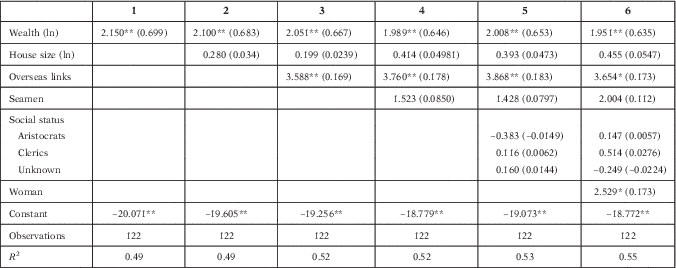
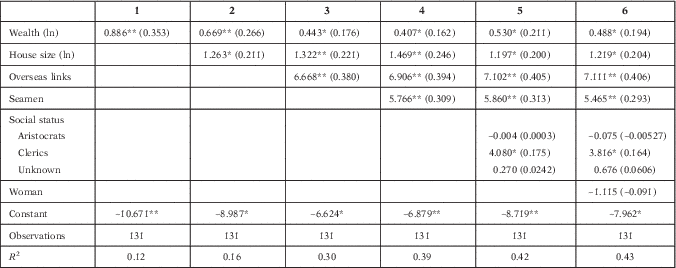
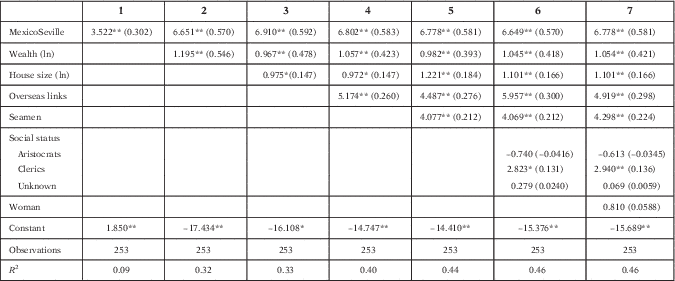
Tables 2, 3 and 4 show the results of the OLS regressions run on data for value of Asian goods per probate inventory in Mexico City and Seville between 1580 and 1630 following the proposed econometric model. The first two tables depict results of regressions with data for inventories of Mexico City and Seville, respectively. The final table displays results of regressions for all inventories integrated into the same formula, and a dummy variable which distinguishes inventories of Mexico from those of Seville. Let us focus first on the differences between the regressions of Mexico City and Seville before moving on to a consideration of the combined inventories of the two cities in an attempt to interpret overall results.
DETERMINANTS OF THE MARAVEDÍS (LN) VALUE OF ASIAN GOODS IN PROBATE INVENTORIES, MEXICO CITY (1580-1630)
Notes: Normalised β coefficients in parentheses.
Independent variable transformations: those with (ln) have been transformed into natural logs; household size is computed as the number of beds times 2, with those inventories having no beds coded as 1; Overseas links is a dummy variable coded 1, 0, with people without links in the Philippines as reference category; Seamen is a dummy variable coded 1, 0, with people who had no jobs related to sea (captains, sailors, and so on) as reference category; Social status category is a dummy variable coded 1, 0, with «middle elites» as the reference category; and Woman is a dummy variable coded 1, 0, with women as reference category.
*Significant at 5%; **significant at 1%.
Source: AGI, Contratación, Bienes de Difuntos; ANotDF, Protocolos, AGN, Intestados; and AGN, Bienes de Difuntos.
DETERMINANTS OF THE MARAVEDÍS (LN) VALUE OF ASIAN GOODS IN PROBATE INVENTORIES, SEVILLE (1580-1630)
Notes: Normalised β coefficients in parentheses.
Independent variable transformations: those with (ln) have been transformed into natural logs; household size is computed as the number of beds times 2, with those inventories having no beds coded as 1; Overseas links is a dummy variable coded 1, 0, with people without links in the Americas as reference category; Seamen is a dummy variable coded 1, 0, with people who had no jobs related to sea (captains, sailors, and so on) as reference category; Social status category is a dummy variable coded 1, 0, with «middle elites» as the reference category; and Woman is a dummy variable coded 1, 0, with women as reference category.
*Significant at 5%; **significant at 1%.
Source: AHPS, Protocolos.
DETERMINANTS OF THE MARAVEDÍS (LN) VALUE OF ASIAN GOODS IN PROBATE INVENTORIES, MEXICO CITY AND SEVILLE (1580-1630)
Notes: Normalised β coefficients in parentheses.
Independent variable transformations: those with (ln) have been transformed into natural logs; MexicoSeville is a dummy variable coded 1, 0, with people from Mexico City as the reference category; household size was computed as the number of beds times 2, with those inventories having no beds coded as 1; Overseas links is a dummy variable coded 1, 0, with Mexicans without links in the Philippines and people from Seville without links in the Americas as reference category; Seamen is a dummy variable coded 1, 0, with people who had no jobs related to sea (captains, sailors, and so on) as reference category; Social status category is a dummy variable coded 1, 0, with «middle elites» as the reference category; and Woman is a dummy variable coded 1, 0, with women as reference category.
*Significant at 5%; **significant at 1%.
Source: AGI, Contratación, Bienes de Difuntos; ANotDF, Protocolos, AGN, Intestados; AGN, Bienes de Difuntos; and AHPS, Protocolos.
Tables 2 and 3 show six regressions on the Asian goods value contained in probate inventories of Mexico City and Seville, respectively. The main difference between the results of this model in Mexico City and that of Seville has to do with R 2 values —goodness-of-fit — and some variables which are most correlated with having more Asian goods in the two cities. Each regression adds one independent variable to the previous regression. The sixth regression, which introduces all variables, yields an R 2 value of 0.55 in Mexico City and 0.43 in Seville. Thus around 55 per cent of value variation for Asian goods owned by sampled people of Mexico City can be attributed to selected variables (Table 2); this number drops to 43 per cent in the case of Seville (Table 3). The regression for Mexico City fits the proposed model better.
Another difference between the results of Mexico City and those of Seville involves the relevance of the independent variables «wealth», «OverseasLinks» and «seamen» in explaining the dependent variable. These are the variables which mostly explain variation in value of Asian goods in inventories of the two Hispanic cities, as can be seen in the regression which includes all variables, the last column of each table. In Mexico City (Table 2) wealth of customers is the most correlated variable with variation in value of Asian goods — standardised β coefficient of 0.635. It is much more correlated than variables that propose familial and strictly non-commercial links of the recorded Mexican elites with people of the Philippines as a factor in having more Asian goods — «OverseasLinks» and «seamen», with β coefficients of 0.173 and 0.112, respectively. Furthermore, the «seamen» variable in the regression run in the Mexican sample has a weak significance level. This is coherent with the fact that not all Mexican seamen were bound for the Philippines, but most were bound for Seville, where Asian goods were more expensive and scarcer than in New Spain. However, in Seville (Table 3) variables which take into account elites’ participation in global networks, either by having personal contacts with people living in New Spain or by being a seaman, as a means to access Asian goods, have a higher coefficient than the variable that counts wealth of people — the «OverseasLinks» and «seamen» variables have β coefficients of 0.406 and 0.293, respectively, and «wealth» a coefficient of 0.194.
The impact of these two variables on the results of the model when applied to the sample of Seville indicates that above mentioned forms of Asian goods transfer such as gift- and order-transferring and commissions of Asian goods from New Spain to Castile had a strong impact on the spread of demand for Asian manufactures in the Andalusian city, and most likely in other large Castilian cities too, in c.1600. This fits with the fact that retail supply of Asian goods was barely developed in Seville. Not one probate inventory of Seville retailers had Chinese silks among supplies — although some did retail other imports such as Italian silksFootnote 22. This contrasts with the situation in Mexico City where products such as Chinese silk and porcelain were sold in shops and also on city streets by peddlers and hawkersFootnote 23. In other words, although demand for Asian goods was likely to grow in Seville in the early 17th century as new global routes connected the Atlantic World and the rest of the world, demand was not high enough for retail supply of Asian goods to cover such demand as it did in Mexico in the early 17th century. This gap was filled by the supply of these goods by relatives and trustworthy people living in the Americas. A few examples will help to illustrate the way the elite of Castile accessed Asian goods in markets still in formation. In 1618, the Count of Santiago sent his wife, who lived in Castile, several pieces of Chinese silk, two folding screens, two writing desks from Japan, and one chest from JapanFootnote 24. As mentioned above, not only entitled aristocrats used these networks to get Asian goods that were scarce in Castile. In 1603 Lucio Gutiérrez, a resident of Jalapa, sent his sisters in Castile several pieces of Chinese silk, damasks and Chinese silk circletsFootnote 25. Commoditisation of Asian goods was less advanced in Castilian cities like Seville than in American cities like Mexico City, so that the elites of Seville recurrently turned to relatives and acquaintances living in the Americas to satisfy their growing taste for Chinese silk, porcelain and other Asian manufactures.
Table 4 integrates data of all inventories from Mexico and Seville into the formula. The seventh regression of the table offers some important information, since the R 2 value is relatively high at 0.46. The variable «MexicoSeville», which distinguishes inventories of Mexico from those of Seville, presents the highest standardised coefficient (0.581), which demonstrates that consumer demand for Asian goods among the elites of an American city like Mexico was much more widespread than among the elites of Seville in the early 17th century. Of course, this had to do with the point mentioned above: prices of Asian goods were lower in Mexico City than in Seville. Other variables which also appear to be especially important are «wealth», «HouseSize», «OverseasLinks», and «seamen». Most have already been commented on in the comparison between Mexico City and that of Seville. The correlation between «wealth» and the value of Asian products is the second most important — standardised coefficient of 0.421. The correlation between size of household and the dependent variable is also high at 0.166 — having more parlours, chambers, and rooms implied the need for more furnishing, and Asian textiles and pieces of furniture played an important role in decorating rich homes, especially in Mexico City (Curiel Reference Curiel2007).
With regard to the variable «SocialStatus», it must be noted that the group of reference in regressions is that of «middle elites» — craftsmen, shopkeepers, professionals, civil servants — and therefore the correlation coefficient of other social groups — aristocrats and clerics — is high or low in relation to the coefficient of «middle elites». Furthermore, data on social status have to be interpreted carefully because of a weak significance level, the only exception being clerics. Belonging to the aristocrat social group — the category which comprises high municipal elites, nobles and wholesale traders — appears to be barely important (Table 2) or a negatively correlated variable (Tables 3 and 4) to increasing value of Asian goods in comparison with other «middle elites», the low significance level of the correlation notwithstanding. Studies on 18th-century consumption have shown in recent years that explanations based upon «trickle down» emulation do not help to explain the spread of new goods and consumption patterns in 18th-century European societies (Fine and Leopold Reference Fine and Leopold1993; Weatherill Reference Weatherill1996). The results of this paper indicate that such explanations do not work at the early stages of the presence of Asian textiles and objects in New Spain or Castile either. In the Spanish Empire «middle elites» such as shopkeepers, craftsmen and above all the clerics, instead of nobles and wholesale merchants, appeared to purchase Asian manufactured goods more eagerly, and therefore pioneered integration of Chinese silk and Japanese furnishings in terms of clothing fashions and house decorative patterns.
Particularly interesting is the case of clerics who, regardless of purchasing power, acquired an average of more Asian products than «middle elites» and many more than aristocrats. There are three related reasons for this. First, friars and priests were enthusiastic purchasers of Chinese silk, usually used for chasubles and robes and to dress Virgins and saints (Díaz Rodríguez Reference Díaz Rodríguez2010). Second, the Church was one of the most global institutions of the time, whose members and organisations were very closely connected from the Philippines to Castile through the Americas and through the Cape route. And last but not least, Church officials comprised the only social group — apart from the king — that enjoyed the privilege of sending and receiving gifts duty-free from port to port. Gift transfers to ecclesiastical institutions were the only ones not charged avería taxes (Tomo 1791, p. 113). This seems to have favoured Church clerics, who had cheaper access to Asian products than other members of society.
Finally, the value of last variable, «women» is rather meaningless in the regression for all Mexican and Seville inventories, since its significance level is low. This makes it difficult to interpret whether women purchased more Asian goods than men, or vice versa for the entire sample. When the two samples are separated, however, the variable presents a positive coefficient (0.172) and also a significant level (p<0.5) in the case of Mexico City (Table 2). This might lead us to situate some historiographical discoveries of 18th-century Europe back in time and in other continents. As 18th-century English women were pioneers in consuming and spreading taste for product novelties such as Indian calicoes in their country (Lemire Reference Lemire1991), probate inventories of Mexico City suggest that wealthy women played a role in the diffusion — as customers — of Asian goods such as Chinese silks and porcelains while the trade of Asian products in the Atlantic World was less developed. Although data of probates are not decisive and future research will have to confirm the pioneering role of Mexican women in distributing Asian goods, the results of the regressions point to such a conclusion.
5. CONCLUSIONS
Addressing the central role of China and Chinese demand for silver from the 16th century onwards, increasing connections between Europe, Asia, the Americas and Africa, and consumer demand for market novelties, such as imports from Asia and the Americas into European countries and also imports of American crops into China in the early modern era, allowed scholars to offer new explanations for changes in the structure of world trade in the early modern era so as to give new answers to the old question about the timing and development of modern economic growth. However, little was still known about the way commoditisation and market formation of scarcely known goods that were hardly traded, such as Asian goods, took place in Europe and the Americas in the 18th century. This article contributes to understanding how access to Asian manufactures such as Chinese porcelain and Chinese silk were realised, and demand for them expanded in New Spain and Castile, in an early context in which Asian imports and their imitations were scarce in European markets and far from integrated into marketing systems.
Configuration of European market trade in Asian manufactured goods was possible because, before the 18th century, demand for these products extended through a complex process in both time and form. The opening of the Manila Galleon route across the Pacific Ocean in the last quarter of the 16th century extended Asian manufactures in colonial Latin America as had not hitherto been the case in European countries, with Portugal as a probable exception. This drives us to qualify some explanations about the ways new products and consumption habits extended in the Atlantic World. For instance, it seems that the richest elites of society were relatively unimportant compared with «middle elites» was not a novelty of 18th-century north-western European countries, since they can be traced in late 16th- and early 17th-century New Spain. A certain amount of Asian goods was not purchased by elites of the Spanish Empire through retail means. Commercial and merchant houses were not the only suppliers of Asian goods to the markets of the Spanish Empire, especially the Iberian markets of Castile in the early 17th century. Considering the conditions of underdeveloped markets and means of transport, as well as strong dispersion of prices, during the early modern era, the simple fact that Asian goods could be purchased more easily by those who took advantage of fortuitous locations in global networks, like seamen and people who had relatives in the Americas and the Philippines, was a prime determinant for expansion of demand. The analysis has revealed that, regardless of the importance of other factors such as wealth and size of one’s house, private and familial contacts and shipment of Asian gifts, as well as commission on special orders, had strong impacts on the spread of Asian goods in the Spanish Empire, especially in areas farthest from Asia, such as Seville, in the late 16th and 17th centuries. These contacts facilitated expansion of tastes for Asian products in the Spanish Empire at a time of scant retail activity, despite the fact that their presence was still rare, and prices high in Europe.
The later integration of Chinese porcelain and its imitations in specialised retail and marketing systems of Europe was a step forward in a process of economic modernisation that had started centuries earlier. Commoditisation of Asian and Asian-like goods produced in Europe culminated in the 18th century, when demand for them extended enough to integrate market mechanisms such as fashion, branding and shopping. To reach such a point, demand for Asian goods had to expand through mechanisms that initially had to do, not only with the market, but also with the possibility of having relatives and trustworthy people living in distant places and moving across oceans and continents.
SOURCES
A total of 122 probate inventories of Mexico City dated between 1580 and 1630 were collected in Archivo General de Indias (AGI), Seville, Contratación, Bienes de Difuntos, files 221–937; Archivo de las Notarías del DF (ANotDF), Mexico City, Protocolos, notarios Juan Bautista Moreno (375), Andrés Moreno (374), Juan Porras Farfán (498), José Rodríguez (555), José de la Cruz (106), Juan Pérez de Rivera (497) and Hernando de Arauz (4) (some probates were analysed in the archive in situ, others consulted on MIJARES, I., ed., 2005-2006: Catálogo de protocolos del Archivo General de Notarías de la Ciudad de México, 3 volumes, México: UNAM); and Archivo General de la Nación (AGN), Mexico City, Intestados, caja-exp.: 4808–031, and Archivo General de la Nación (AGN), Mexico City, Bienes de Difuntos, caja-exp.: 4705–001 and 1191–008.
Totally, 131 probate inventories of Seville were collected in Archivo Histórico Provincial de Sevilla (AHPS), Seville, Protocolos, several files (legajos) from 169 to 16,140 (years 1580-1630).
«Inward registers of ships to Seville from New Spain» (registros de venida de Nueva España) from 1587 to 1641 have been collected in Archivo General de Indias (AGI), Seville, Contratación, 1793 to 1929B.
Archivo General de la Nación (AGN), Mexico City, Indiferente Virreinal, Industria y Comercio, caja-exp. 4371–022, 5964–076 and 3681–045.
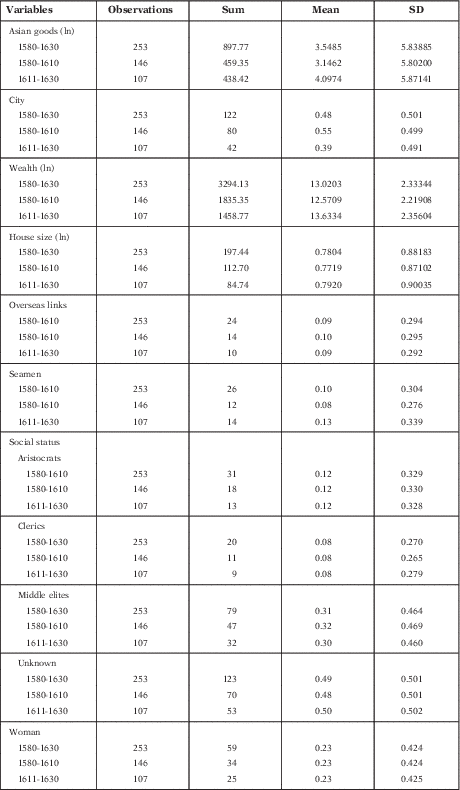
STATISTICAL DESCRIPTION OF VARIABLES OF OLS REGRESSION RUN ON VALUE IN MARAVEDÍS (LN) OF ASIAN GOODS IN MEXICO CITY AND SEVILLE, 1580-1630 (TABLE 4)
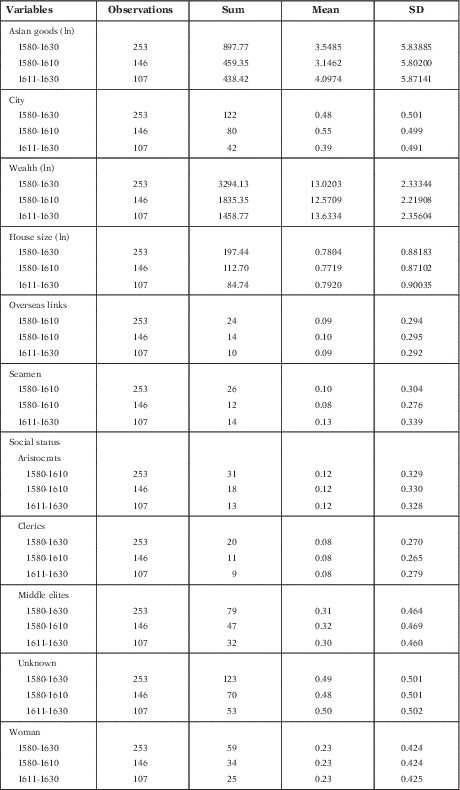
Notes: OLS: ordinary least squares. Data are presented in three time blocks: 1580-1610, 1611-1630 and 1580-1630. Regressions are run with all data in one chronological block from 1580 to 1630.
Source: AGI, Contratación, Bienes de Difuntos; ANotDF, Protocolos, AGN, Intestados; and AGN, Bienes de Difuntos.
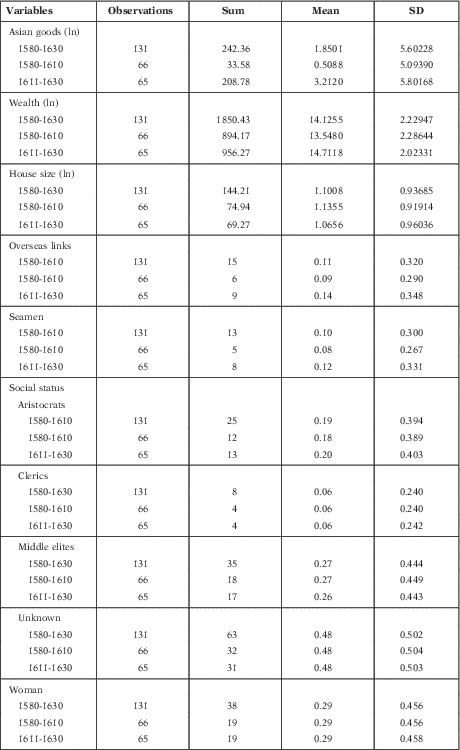
STATISTICAL DESCRIPTION OF VARIABLES OF OLS REGRESSION RUN ON VALUE IN MARAVEDÍS (LN) OF ASIAN GOODS IN SEVILLE, 1580-1630 (TABLE 3)
Notes: OLS: ordinary least squares. Data are presented in three time blocks: 1580-1610, 1611-1630 and 1580-1630. Regressions are run with all data in one chronological block from 1580 to 1630.
Source: AHPS, Protocolos.
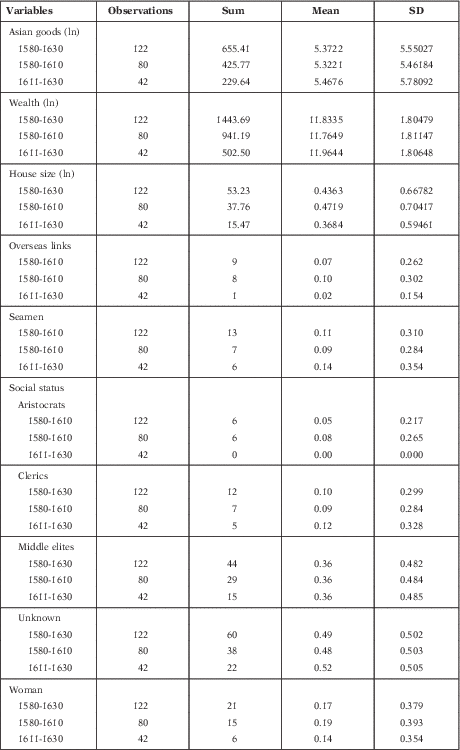
STATISTICAL DESCRIPTION OF VARIABLES OF OLS REGRESSION RUN ON VALUE IN MARAVEDÍS (LN) OF ASIAN GOODS IN MEXICO CITY, 1580-1630 (TABLE 2)
Notes: OLS: ordinary least squares. Data are presented in three time blocks: 1580-1610, 1611-1630 and 1580-1630. Regressions are run with all data in one chronological block from 1580 to 1630.
Source: AGI, Contratación, Bienes de Difuntos; ANotDF, Protocolos, AGN, Intestados; AGN, Bienes de Difuntos; and AHPS, Protocolos.
APPENDIX 1
Problems of heteroscedasticity in OLS regressions of Tables 2, 3 and 4 have been reduced with the logarithmic transformation of the independent variable (LnAsianGoodsValue) and the dependent variables «LnWealth» and «LnHouse».
The application of the econometric model to data does not present problems of autocorrelation. It was checked by running the Durbin–Watson statistic, which tests autocorrelation in the residuals, in each of the three samples containing all the variables. According to the Durbin–Watson test, values close to 2 mean absence of autocorrelation. All values resulted from applying the Durbin–Watson statistic to the three samples are close to 2 — Durbin–Watson statistic coefficient of Table 2 is at 1.867, Durbin–Watson statistic of Table 3 is at 2.267, and Durbin–Watson statistic of Table 4 is at 2.187.
The application of the econometric model to data does not present problems of multicollinearity either. The degree of multicollinearity was checked by looking at three statistical tests: Tolerance, variance inflation factor (VIF) of each independent variable and Condition Index. According to Kleinbaum (Reference Kleinbaum, Kupper, Nizam and Muller2013, pp. 368-369) and Belsley (Reference Belsley2004, p. 105), Tolerance values very close to 0 — less than 0.1 — and VIF values of 5-10 indicate major collinearity issues, and Condition Indices >30 reflect moderate collinearity or worse. In Table 2, Tolerance values of variables are between 0.6 and 0.9, VIF values are between 1.1 and 1.6, and the highest condition index is 21.8; in Table 3, Tolerance values of variables are between 0.5 and 0.8, VIF values are between 1.1 and 1.8, and the largest condition index is 22.9; and in Table 4, Tolerance values of variables are between 0.5 and 0.8, VIF values are between 1.1 and 1.9, and the largest condition index is 23.3.