Implications
Abrupt weaning at 4 weeks of age or earlier is a considerable stressor for piglets resulting in impaired intestinal integrity and growth depression. To overcome these problems weaning at an older age seems self-evident. In this study, it is shown that stress at the time of weaning is lower and feed intake is improved when piglets are weaned at 7 weeks and fed creep feed. Intestinal integrity, however, is not or only partly improved by weaning at 7 weeks. Therefore, increasing weaning age to 7 weeks does not improve intestinal functionality.
Introduction
Under natural conditions weaning is a gradual process and the average weaning time of piglets is more than 17 weeks (Jensen and Recén, Reference Jensen and Recén1989). In modern pig husbandry, weaning occurs abruptly by separating the piglets from the sow at a much younger age of 7 to 35 days (within the EU a minimum of 28 days; Colson et al., Reference Colson, Orgeur, Foury and Mormède2006). Besides the abrupt separation from the sow and consequently a change in diet, additional stressors, such as changes in the physical (moving to an unfamiliar pen or barn) and social (mixing with unfamiliar pen mates) environments have to be faced (Weary et al., Reference Weary, Jasper and Hötzel2008). As a consequence, feed intake during the first days post-weaning does not meet the energy requirement and the integrity of the intestinal tract is impaired (van Beers-Schreurs and Bruininx, Reference van Beers-Schreurs and Bruininx2002). Therefore, post-weaning problems such as growth depression and the occurrence of diarrhoea are still widespread in the modern pig husbandry (van Beers-Schreurs and Bruininx, Reference van Beers-Schreurs and Bruininx2002).
To overcome these problems weaning at an older age seems self-evident (Everts et al., Reference Everts, van Beers-Schreurs and Vellinga1999). For modern pig production this is not appropriate in view of economic sustainability, but the situation may be different when relevant characteristics, such as health and welfare of the piglets, are also valued (Everts et al., Reference Everts, van Beers-Schreurs and Vellinga1999). In organic pig husbandry, weaning age is 6 to 7 weeks based on the purported beneficial impact on health and welfare (Hovi et al., Reference Hovi, Sundrum and Thamsborg2003).
In a pilot experiment, in which piglets were weaned at an age of 4 or 10 weeks and not given creep feed, weaning at 4 weeks resulted in a limited food intake and an arrest of growth, while after weaning at 10 weeks food intake started directly and body weight (BW) gain was not impaired. However, in piglets weaned at 10 weeks and not given creep feed, a growth reduction at 6 to 7 weeks of age occurred. Therefore, it is hypothesized that weaning at an age of 7 weeks causes less stress, improves feed intake after weaning and, as a consequence, the integrity of the intestinal tract will be maintained.
The objectives of this study were to compare weaning at an age of 4 weeks with weaning at an age of 7 weeks with or without creep feeding with respect to feed intake and BW gain, cortisol levels as an indicator of stress and intestinal morphology, fluid absorption in non-infected and enterotoxigenic Escherichia coli (ETEC)-infected intestinal segments and intestinal (macro)molecular permeability as indicators of small intestinal integrity.
Material and methods
All procedures involving animal handling and testing were reviewed and approved by the ASG-Lelystad Animal Care and Ethics Committee (Lelystad, The Netherlands).
Animals and treatments
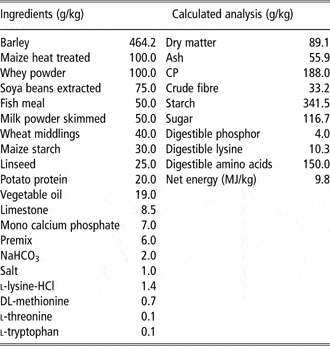
Four groups of four sows (Dalland) each were weighed and housed in individual farrowing crates in the Lelystad Centre for Pig Husbandry. After farrowing a few piglets were cross-fostered to ensure that each sow nursed 10 piglets and that each group contained 40 piglets. Piglets had access to nipple waters, were checked twice daily by animal care technicians and were weighed once a week. At 2 days of age each of the 160 piglets were subjected to a back test to measure the resistant score (Hessing et al., Reference Hessing, Hagelso, Schouten, Wiepkema and van Beek1994). The classification of the resistant score (44% resistant, 48% intermediate and 8% non-resistant piglets) was used for mixing at the day of weaning. From 12 days of age onwards piglets from two groups of sows were offered creep feed in plastic creep feeders. On 10, 6 and 3 days before weaning faecal samples were taken and observed for colour (Bruininx et al., Reference Bruininx, Binnendijk, van der Peet-Schwering, Schrama, den Hartog, Everts and Beynen2002). Piglets of two groups of sows (one offered creep feed and one not creep fed) were weaned at 4 weeks of age (4+ and 4−, respectively) and piglets of the two other groups of sows at 7 weeks (7+ and 7−, respectively). The creep feed offered was a pelleted barley-based starter diet with 1% chromic oxide (Table 1). This diet was appropriate for the piglets that were weaned at 7 weeks of age. As it was not the aim to study different creep feeds at different weaning ages, the same diet was used for the piglets weaned at 4 weeks although creep feed intake in 4 weeks weaned piglets is known to be affected by diet composition (Fraser et al., Reference Fraser, Feddes and Pajor1994).
Ingredients and calculated chemical analysis of the creep feed

At weaning (day 0) the piglets were removed from the sows and the sows and the piglets were weighed. For each treatment, the piglets were mixed and housed in four crates containing 10 piglets each. In each crate two or three piglets of one sow were housed. In the four crates the number of male and female piglets, the average BW of the piglets and the average resistant score of the piglets were equalized. After weaning all piglets were offered the same diet as the creep feed.
Feed intake per crate was recorded daily. BW was measured on the day of weaning, on days 5, 7 and 11 after weaning and at 16 weeks of age. Blood samples were taken by vena puncture the day before weaning, on the day of weaning 2 h after mixing and on days 1, 4, 7 and 11 after weaning. On days −1, 3 and 6, seven piglets from each group were selected, taking into account that from the creep feed-offered groups only those piglets were selected that showed that they had eaten creep feed. The piglets were transported from the farm to the institute. Taking into account that the piglets were not mixed, they were housed in boxes and fasted overnight. On days 0, 4 and 7, three piglets of each group were anaesthetized with a mixture of nitrous oxide, oxygen and sevoflurane administered through a facemask and a midline abdominal ventral incision was made. Intestinal samples were taken to measure (macro)molecular transport and villous height and crypt depth. Samples to measure (macro)molecular transport and villous height and crypt depth were also taken from the other four piglets, but in these piglets this was combined with measuring the intestinal fluid absorption.
Cortisol and intestinal fatty acid binding protein (I-FABP)
On days −1, 0, 1, 4, 7 and 11 blood samples were taken; on day 11 in each group blood samples were taken from the 19 remaining animals. For sampling, special care was taken to minimize pain and stress. In order to perform the blood samplings as softly and quickly as possible, a trained personnel gently cradled the piglet in its arms in dorsal recumbence position while remaining close to the pen. A blood sample was obtained via jugular vein puncture. The whole procedure, including handling and sampling, took <2 min. The blood samples were immediately chilled on ice. The blood was centrifuged for 10 min at 2000 × g and aliquots of plasma were stored at −70°C for later analysis of cortisol and I-FABP, a marker for mild intestinal injury (Niewold et al., Reference Niewold, Meinen and van der Meulen2004). Plasma cortisol concentration was measured using a time-resolved fluoroimmunoassay (Ruis et al., Reference Ruis, de Groot, te Brake, Dinand Ekkel, van de Burgwal, Erkens, Engel, Buist, Blokhuis and Koolhaas2001) and plasma I-FABP concentration was measured using a human commercial ELISA test kit (Niewold et al., Reference Niewold, Meinen and van der Meulen2004).
Villous height and crypt depth
On days 0, 4 and 7 from seven piglets of each group five samples of intestinal tissue were taken along the small intestine at 10%, 25%, 50%, 75% and 95% of the length. The tissue was cut on the mesenteric side, pinned with the serosal side to a piece of cork and placed in a formalin solution with the mucosal side down to fix the villi vertically. After fixation, a piece of each sample was embedded in paraffin wax. Each sample was stained with haematoxylin and eosin and the villous height was measured from the tip of villous to the villous–crypt junction and the crypt depth from this junction to the base of the crypt (Nabuurs et al., Reference Nabuurs, Hoogendoorn, van der Molen and van Osta1993a).
(Macro)molecular permeability
On days 0, 4 and 7 an intestinal tissue sample from seven piglets was taken from about 50% of the length of the small intestine to measure (macro)molecular transport. It was cut along the mesenteric border and stripped of muscle layers. Flat sheets of tissue free of Payer’s patches were mounted in Ussing-type chambers. The exposed area of the intestine was 0.7 cm2. Both sides of the epithelium were perfused with Ringer solution and gassed with 5% CO2 and 95% O2. Solutions were maintained at 37°C with water jackets and circulated (total volume 4.7 ml on each side). Sodium fluorescein isothiocyanate (Na-FITC, 376 Da, Sigma, St. Louis, MO, USA) and horseradish peroxidase (HRP, 40 kD; type VI, Sigma) dissolved in Ringer solution were added mucosally at a final concentration of 10−3 and 10−5 M, respectively. The small molecule Na-FITC was transported both trans- and paracellularly and the large molecule HRP was transported paracellularly (Verdonk et al., Reference Verdonk, Bruininx, van der Meulen and Verstegen2007). Serosal samples of 400 μl were taken at 30, 60, 90 and 120 min and were replaced by 400 μl of fresh Ringer solution to keep the volume constant. An arithmetical correction for the dilution of the buffer was applied to calculate the amount of Na-FITC and HRP at the serosal side correctly. In the serosal samples Na-FITC was determined by measuring the fluorescence and HRP was measured enzymatically (Bijlsma et al., Reference Bijlsma, Kiliaan, Scholten, Heyman, Groot and Taminiau1996).
The apparent permeability coefficient (P app) was determined on the basis of the appearance at the serosal side according to the following equation: P app = P/(A × C 0), where P app = permeability coefficient from the mucosal to the serosal side (cm/s), P = permeability rate (net passage per unit of time in mol/s), A = exposed intestinal area (cm2) and C 0 = initial mucosal concentration (mol/ml).
Fluid absorption in non-infected and ETEC-infected intestinal segments
Net intestinal fluid absorption on days 0, 4 and 7 of four piglets of each group was measured in the small intestinal segment perfusion (SISP) test as described before (Nabuurs et al., Reference Nabuurs, Hoogendoorn, van Zijderveld and van der Klis1993b). The piglets were tranquillized with azaperone (2 mg/kg BW) and anaesthesia was induced and maintained with sevoflurane and nitrous oxide. The piglets were placed in dorsal recumbence and an incision was made in the abdomen lateral to the linea alba. The abdominal cavity was opened and the first intestinal segment was prepared approximately 40 cm caudal to the ligament of Treitz. A thin cranial tube (inflow) was placed and a wide tube (outflow) was placed about 20 cm distal to the first. Caudal from and adjacent to this tube a 2-cm piece of intestine was removed and cut on the mesenteric side to measure the circumference and for the measurement of villous height and crypt depth. A second segment was prepared in the same way adjacent to the first and these two segments formed a pair (at 10% site). Paired segments were prepared at the 25%, 50%, 75% and 95% sites. Moreover, a 5-cm piece of the intestine was removed to determine the receptor status to bind ETEC (Sellwood et al., Reference Sellwood, Gibbons, Jones and Rutter1975).
Fifteen minutes before perfusion started the cranial segment of each pair was injected with 5 ml ETEC (CIDC culture 1000 : O149 : K91 : K88ac; 109 CFU/ml phosphate buffered saline (PBS), producing heat-labile toxin and heat-stable toxin b) whereas the caudal segment of each pair was injected with 5 ml PBS (Nabuurs et al., Reference Nabuurs, Hoogendoorn, van Zijderveld and van der Klis1993b). Simultaneously, the 10 segments were perfused with 64 ml of the perfusion fluid (saline supplemented with 1 g/l glucose and 1 g/l amino acids to assure bacterial growth; Nabuurs et al., Reference Nabuurs, Hoogendoorn, van Zijderveld and van der Klis1993b) over a period of 8 h. The non-absorbed fluid drained freely into the corresponding drainage bottles. At the end of the experiment the fluid remaining in the segments was blown out into the drainage bottles (outflow). The piglets were killed by the injection of sodium pentobarbital (200 mg/kg BW) and the length of the small intestine and the segments was measured. Net fluid absorption in each segment was calculated from the difference between the volume of inflow and the volume of outflow, divided by the surface area (length × circumference) of the segment.
Statistical analysis
Data were subjected to analysis of variance (ANOVA) using the GenStat statistical package for Windows (release 6.1, 6th edition, VSN International Ltd, Oxford, UK). The experimental unit for assessing parameters of feed intake and BW gain was the crate, and the data were analysed according the following model:

where μ is overall mean, Wi is the weaning age with i = 1, 2; Cj is creep feed with j = 1, 2; and eij is the residual error. The experimental unit for assessing the parameters of (macro)molecular permeability, villous height and crypt depth and intestinal fluid absorption was the piglet and data were analysed according the following model:

where μ is overall mean, Wi is weaning age with i = 1, 2; Cj is creep feed with j = 1, 2; Dk is the day after weaning with k = 1…3 and eijk is the residual error. Including the receptor status as covariate in the ANOVA model to analyse intestinal fluid absorption in ETEC-infected segments did not affect the levels of significance. Therefore, for intestinal fluid absorption in ETEC-infected segments the reported estimated means are also the result of ANOVA according to the model described. The experimental unit for assessing blood parameters was piglet and data were analysed as repeated measurements (AREPMEASURES) according to the following model:

where μ is overall mean, Wi is weaning age with i = 1, 2; Cj is creep feed with j = 1, 2; Dk is day with k = 1…6 and eijk is the residual error, with log transformation of data on cortisol before analysis. The results are given as estimated means.
Results
Feed intake and BW gain
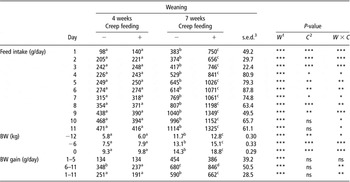
On the basis of the colour of the faeces a limited number of 4+ piglets consumed creep feed before weaning at 4 weeks: 10 and 3 days before weaning only 5% and 41%, respectively, of 4+ piglets consumed creep feed. On 10 and 3 days before weaning at 7 weeks, respectively, 68% and 90% of 7+ piglets consumed creep feed. The day before weaning 4+ piglets consumed 104 ± 88 g/day creep feed and at the same time, 21 days before weaning, 7+ piglets consumed 85 ± 48 g/day. The day before weaning, the intake of creep feed by 7+ piglets was 580 ± 138 g/day. The day after weaning, the feed intake by 4+ piglets was not different compared with 4− piglets (Table 2). Thereafter, in both groups, feed intake increased gradually and was not different for 4− and 4+ piglets. Feed intake after weaning was higher (P < 0.001) in 7 weeks than in 4-week-weaned piglets. During 9 days after weaning at 7 weeks, feed intake of 7− piglets was lower (P < 0.05) than that of 7+ piglets.
Effect of the age of weaning and creep feeding on feed intake, BW and BW gain after weaning

ns = non-significant.
1W = age of weaning.
2C = creep feeding.
3s.e.d. for the W × C interaction.
a–dValues in the same row not sharing a common superscript are significantly different (P < 0.05).
*P < 0.05; **P < 0.01; ***P < 0.001.
At weaning BW of 4− and 4+ piglets was not different and lower (P < 0.001) than in piglets weaned at 7 weeks, with a higher (P < 0.001) BW for 7+ compared with 7− piglets (Table 2). In the first 5 days after weaning, BW gain in 4-week-weaned piglets was <150 g/day and lower (P < 0.001) than in 7-week-weaned piglets. For 6 to 11 days after weaning there was a weaning age by creep feeding interaction (P < 0.01), with for 4-week-weaned piglets offered creep feed a lower BW gain than for 4-week-weaned piglets withheld creep feed and a higher BW gain for 7+ compared with 7− piglets. After weaning BW gain of 7+ piglets was not different compared with the BW gain of these piglets in the last 2 weeks before weaning (681 ± 158 g/day). In 7− piglets BW gain in the first 10 days after weaning was higher than before weaning (197 ± 70 g/day). At 16 weeks of age BW of 7+, 4− and 4+ piglets (69.7 ± 5.7, 69.3 ± 7.9 and 70.3 ± 7.2 kg) did not differ but was lower (P < 0.05) for 7− piglets (61.1 ± 6.4 kg). From weaning to 16 weeks of age BW gain of 4+, 4−, 7+ and 7− piglets was on average 753 ± 86, 744 ± 76, 882 ± 106 and 809 ± 150 g/day.
Cortisol and I-FABP
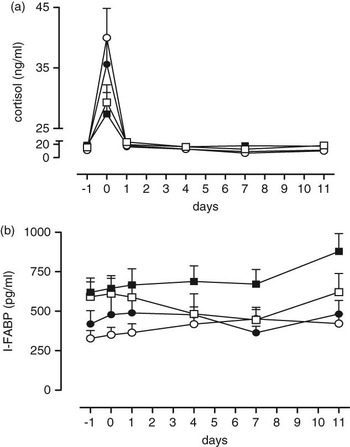
There was no effect of creep feeding on plasma cortisol (Figure 1a). There was a weaning age by day interaction (P < 0.001). At the day of weaning plasma cortisol was increased and was higher (P < 0.001) for the piglets weaned at 4 weeks compared with the piglets weaned at 7 weeks. After weaning, plasma cortisol concentration was lowered in all four groups.
Plasma cortisol (a) and intestinal fatty acid-binding protein (I-FABP) (b) concentrations (mean ± s.e.m.) in piglets weaned at 4 weeks and offered creep (●) or not (○) in the suckling period and weaned at 7 weeks and offered creep feed (▪) or not (□) in the suckling period.

There was no effect of day after weaning, weaning age and creep feeding on plasma I-FABP concentrations (Figure 1b).
Villous height and crypt depth
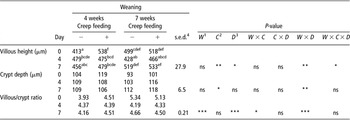
Both villous height and crypt depth reduced in size from the cranial to the caudal part of the small intestine. On day 4 after weaning villous height was reduced compared with the day of weaning and recovered on day 7, whereas crypt depth was not affected by day after weaning (Table 3). Compared with weaning at 4 weeks, villi were higher after weaning at 7 weeks but this was only significant (P < 0.05) at 25% and 50% of the site along the small intestine (data not shown). There was no effect of age of weaning on villous height and crypt depth and creep feeding resulted in higher (P < 0.01) villi and increased (P < 0.05) crypt depth. Villous/crypt ratio was highest on day 4 and recovered on day 7. Villous/crypt ratio was greater for weaning at 7 weeks compared with 4 weeks (P < 0.001).
The effect of the age of weaning and creep feeding on intestinal villous height, crypt depth and villous/crypt ratio at days 0, 4 and 7

ns = non-significant.
1W = age of weaning.
2C = creep feeding.
3D = day.
4s.e.d. for the W × C × D interaction.
a–fValues not sharing a common superscript are significantly different (P < 0.05).
*P < 0.05; **P < 0.01; ***P < 0.001.
(Macro)molecular permeability
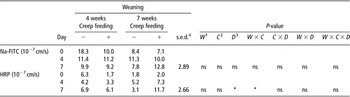
The mucosal-to-serosal permeability coefficient of Na-FITC was not affected by the time after weaning, the age of weaning or creep feeding (Table 4). The mucosal-to-serosal permeability coefficient of HRP increased with time after weaning. HRP permeability was not affected by the age of weaning and creep feeding.
The effect of the age of weaning and creep feeding on intestinal permeability coefficients for Na-FITC and HRP at days 0, 4 and 7

Na-FITC = sodium fluorescein Isothiocyanate; HRP = horseradish peroxidise; ns = non-significant.
1W = age of weaning.
2C = creep feeding.
3D = day.
4s.e.d. for the W × C × D interaction.
*P < 0.05.
SISP test: intestinal absorption
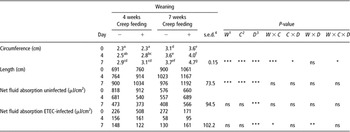
The small intestine was longer (P < 0.001) when the piglets were offered creep feed (Table 5). After weaning, the length of the small intestine increased with time. All along the small intestine the circumference was greater after weaning at 7 weeks compared with 4 weeks and when the piglets were offered creep feed.
The effect of the age of weaning and creep feeding on intestinal length and circumference and intestinal net fluid absorption in uninfected and ETEC-infected state at days 0, 4 and 7

ETEC-infected = enterotoxigenic Escherichia coli infected; ns = non-significant.
1W = age of weaning.
2C = creep feeding.
3D = day.
4s.e.d. for the W × C × D interaction.
a–gValues of the same parameter not sharing a common superscript are significantly different (P < 0.05).
*P < 0.05; ***P < 0.001.
Net fluid absorption was highest at the 75% and 95% site along the small intestine (data not shown). Net fluid absorption was not affected by the age of weaning and there was no difference in net fluid absorption between piglets offered creep feed and piglets withheld creep feed. In all four groups net fluid absorption decreased with time after weaning.
Piglets with receptors to bind ETEC were present in all four groups on every day. The number of 4+, 4−, 7+ and 7− piglets with receptors to bind ETEC was, respectively, 5 (42%), 10 (83%), 5 (42%) and 8 (67%) out of 12 piglets. As in non-infected segments net fluid absorption in ETEC-infected segments was highest at the 75% and 95% site along the small intestine. In all four groups and at all sites along the small intestine net fluid absorption in ETEC-infected segments was lower (P < 0.001) than in non-infected segments. Net fluid absorption in ETEC-infected segments was not affected by the age at weaning and creep feeding and therefore not significantly different for the four groups. In all four groups net fluid absorption in ETEC-infected segments decreased with time after weaning.
Sows
The BW of the sows was not different among the four groups at farrowing (246, 236, 221 and 242 kg for 4+, 4−, 7+ and 7− sows, respectively) and at the time of weaning (194, 188, 179 and 187 kg for 4+, 4−, 7+ and 7− sows, respectively) and loss of BW was not different for the four groups. All sows were inseminated 4 to 5 days after weaning and only one sow (weaned at 4 weeks and no creep feed for the piglets) returned to oestrus and had to be inseminated again.
Discussion
Comparing weaning at 4 weeks with weaning at 7 weeks implicates not only comparing an effect of the duration of suckling, but also an effect of a different physiological age. Since a change in duration of suckling is coupled with a change in physiological age, it has to be kept in mind that all measured parameters may be affected both by the duration of the suckling period and physiological age.
Feed intake and BW gain
To facilitate the transition from milk to a solid diet after weaning, creep feeding is often recommended (Hampson and Kidder, Reference Hampson and Kidder1986; Appleby et al., Reference Appleby, Pajor and Fraser1991; Bruininx et al., Reference Bruininx, Binnendijk, van der Peet-Schwering, Schrama, den Hartog, Everts and Beynen2002). The benefits of creep feeding for post-weaning performance and health, however, are still unclear. The high variability in creep feed intake within and between litters is one of the reasons for the inconsistent effect of creep feeding (Bruininx et al., Reference Bruininx, Binnendijk, van der Peet-Schwering, Schrama, den Hartog, Everts and Beynen2002). In our study less than half of the piglets consumed creep feed (in an amount of not more than 100 g/day) 3 days before weaning at 4 weeks. Consequently, BW at weaning and feed intake after weaning were not different between piglets weaned at 4 weeks with or without creep feed, while the higher BW gain in piglets withheld creep feed 6 to 11 days after weaning most likely was related to gut filling. When a more complex diet is used, instead of a standard starter diet, intake of creep feed by piglets weaned at 4 weeks might have been higher (Fraser et al., Reference Fraser, Feddes and Pajor1994). In addition, with a more complex creep feed, however, intake in 3- and 4-week-old piglets is <100 g/day and is variable within litters (Fraser et al., Reference Fraser, Feddes and Pajor1994). The piglets weaned at 7 weeks showed that intake of creep feed became substantial after 4 weeks of age. At the time of weaning at 7 weeks all piglets consumed a substantial amount (on average almost 600 g/day) of creep feed to fulfil their nutrient requirement. As a consequence piglets weaned at 7 weeks and offered creep feed were heavier at the time of weaning and feed intake after weaning was higher compared with piglets from whom creep feed was withheld. Offering creep feed to piglets weaned at 7 weeks of age is necessary as indicated by the BW at 16 weeks of age. Apart from that, BW at 16 weeks of piglets weaned at 7 weeks and offered creep feed is not different from piglets weaned at 4 weeks, as has been shown before for the organic piglets (Andersen et al., Reference Andersen, Jensen, Jensen, Dybkjaer and Andersen2000). Although suckling did not fulfil their nutrient requirement, piglets weaned at 7 weeks without creep feed seemed not to have stripped the sows. At the time of weaning the BW of the sows nursing piglets 7 or 4 weeks was not significantly different nor the weaning-to-oestrus interval. In addition, in organic farming, BW and body condition of sows lactating their piglets for 7 weeks are not different compared with sows lactating 5 weeks (Andersen et al., Reference Andersen, Jensen, Jensen, Dybkjaer and Andersen2000).
Stress
Weaning caused a significant increase in cortisol levels in all piglets. An increase in plasma cortisol at weaning is in accordance with earlier observations (Herskin and Jensen, Reference Herskin and Jensen2002; van Erp-van der Kooij et al., Reference van Erp-van der Kooij, Kuijpers, van Eerdenburg, Dieleman, Blankenstein and Tielen2003). The increase in cortisol levels in our study is not related to the way in which samples were taken, as samples were taken from all piglets in the same way and an increase in cortisol was also measured in stress-free collected saliva samples (van Erp-van der Kooij et al., Reference van Erp-van der Kooij, Kuijpers, van Eerdenburg, Dieleman, Blankenstein and Tielen2003). As weaning is a known stressor for mammals, such an increase in cortisol at the time of weaning is not surprising (van Erp-van der Kooij et al., Reference van Erp-van der Kooij, Kuijpers, van Eerdenburg, Dieleman, Blankenstein and Tielen2003). The increase in cortisol was not affected by creep feeding but when weaning took place at 7 instead of 4 weeks, the increase in cortisol levels was limited. Although increased cortisol levels may be possibly harmful for the piglets by its immunosuppressive action (van Erp-van der Kooij et al., Reference van Erp-van der Kooij, Kuijpers, van Eerdenburg, Dieleman, Blankenstein and Tielen2003), increased cortisol levels around weaning have also been attributed to an increased synthesis of citrulline from glutamine in enterocytes (Wu et al., Reference Wu, Meininger, Kelly, Watford and Morris2000b) and an enhanced intestinal polyamine synthesis (Wu et al., Reference Wu, Flynn and Knabe2000a), which may be of physiological importance for intestinal adaptation.
Small intestinal integrity
As a consequence of the two functions of the small intestine, absorption of nutrients and exclusion of pathogenic compounds (antigens, toxins and bacteria), it is difficult to measure small intestinal integrity (van Beers-Schreurs and Bruininx, Reference van Beers-Schreurs and Bruininx2002). Commonly used indicators of small intestinal integrity are villous height, crypt depth, number of goblet cells, mucus production, permeability, inflammation and brush border enzyme activity (Vente-Spreeuwenberg and Beynen, Reference Vente-Spreeuwenberg and Beynen2003), whereas the more complex SISP test may also be used as an indicator of small intestinal integrity (van Beers-Schreurs and Bruininx, Reference van Beers-Schreurs and Bruininx2002).
After weaning at 4 and 7 weeks net fluid absorption decreased with time after weaning as described before (Nabuurs et al., Reference Nabuurs, Hoogendoorn and van Zijderveld1994). When creep feed intake is achieved by intermittent suckling, net fluid absorption improves (Nabuurs et al., Reference Nabuurs, Hoogendoorn and van Zijderveld-van Bemmel1996; Kuller et al., Reference Kuller, van Beers-Schreurs, Soede, Langendijk, Taverne, Kemp and Verheijden2007). In our study, the net fluid intake was not improved by creep feed, probably as a consequence of the low level of creep feed intake compared with creep feed intake by intermittent suckling (Kuller et al., Reference Kuller, Soede, van Beers-Schreurs, Langendijk, Taverne, Verheijden and Kemp2004). The reduced net fluid absorption in ETEC-infected segments, especially 4 and 7 days after weaning, represents the greater sensitivity of weaned piglets compared with suckling piglets to ETEC-induced diarrhoea (Nabuurs et al., Reference Nabuurs, Hoogendoorn and van Zijderveld1994). This study shows that when piglets are weaned at 7 weeks an increased sensitivity for ETEC-induced diarrhoea also exists. This has been shown before for piglets weaned at 6 or 7 weeks and challenged with ETEC, with a longer-lasting ETEC excretion in 4-week-weaned piglets than in 6-week-weaned piglets (Wellock et al., Reference Wellock, Fortomaris, Houdijk and Kyriazakis2008; Sørensen et al., Reference Sørensen, Vestergaard, Jensen, Lauridsen and Højsgaard2009). That creep feeding did not diminish the reduction in net fluid absorption by ETEC in our study but creep feed intake achieved by intermittent suckling did (Nabuurs et al., Reference Nabuurs, Hoogendoorn and van Zijderveld-van Bemmel1996; Kuller et al., Reference Kuller, van Beers-Schreurs, Soede, Langendijk, Taverne, Kemp and Verheijden2007), implies that either the amount of creep feed consumed and/or the way of weaning is important for diminished fluid absorption by ETEC after weaning.
The reduction in the size of both villous height and crypt depth from the cranial to the caudal part of the small intestine, the reduction in villous height on day 4 after weaning followed by a recovery on day 7 and the increase in crypt depth on day 7 after weaning correspond with earlier studies (Kelly et al., Reference Kelly, Smyth and McCracken1991; Nabuurs et al., Reference Nabuurs, Hoogendoorn, van der Molen and van Osta1993a; Pluske et al., Reference Pluske, Thompson, Atwood, Bird, Williams and Hartmann1996b). The higher villi in piglets offered creep feed is consistent with the higher feed intake of these piglets after weaning, as in underfed piglets villous height is decreased (Kelly et al., Reference Kelly, Smyth and McCracken1991; Pluske et al., Reference Pluske, Williams and Aherne1996a; Vente-Spreeuwenberg et al., Reference Vente-Spreeuwenberg, Verdonk, Bakker, Beynen and Verstegen2004). The increased crypt depth in creep-fed piglets is consistent with a decreased crypt depth on underfeeding (Kelly et al., Reference Kelly, Smyth and McCracken1991; Verdonk et al., Reference Verdonk, Bruininx, van der Meulen and Verstegen2007), although for underfed piglets also an increased crypt depth has been reported (Pluske et al., Reference Pluske, Williams and Aherne1996a). Compared with weaning at 4 weeks of age, weaning at an older age resulted only in higher villi in the first half of the small intestine but not all over the small intestine. This is in agreement with an earlier study showing an increased villous height in the duodenum and the proximal part of the jejunum when weaning took place at an older age and an increased crypt depth all over the small intestine (Gu et al., Reference Gu, Li and She2002). Recently, wider villi and deeper crypts were reported for 6-week-weaned piglets compared with 4-week-weaned piglets (Miller et al., Reference Miller, Toplis and Slade2009).
The transepithelial permeability of Na-FITC is not affected by the age of weaning and creep feeding, which corresponds with the fact that post-weaning feed intake does not affect intestinal permeability of small molecules (Verdonk et al., Reference Verdonk, Bruininx, van der Meulen and Verstegen2007). The increased permeability of HRP on day 7 after weaning is not congruent with data of tube-fed weaned piglets in which the permeability of HRP dropped 2 days after weaning and stayed at that level for the following 14 days (Boudry et al., Reference Boudry, Péron, Le Huërou-Luron, Lallès and Sève2004), but is in agreement with an increase of permeability of mannitol after weaning as observed before (Spreeuwenberg et al., Reference Spreeuwenberg, Verdonk, Gaskins and Verstegen2001; Verdonk et al., Reference Verdonk, Spreeuwenberg, Bakker and Verstegen2001). Increases in macromolecular permeability is associated with stress (Kiliaan et al., Reference Kiliaan, Saunders, Bijlsma, Berin, Taminiau, Groot and Perdue1998; van Kalkeren, Reference van Kalkeren2002) and underfeeding (Vente-Spreeuwenberg and Beynen, Reference Vente-Spreeuwenberg and Beynen2003) in rats and piglets. Although underfeeding may occur when piglets are weaned at 4 weeks, this is not the case for creep-fed piglets weaned at 7 weeks. At 7 weeks there is no difference in HRP permeability on the day of weaning between creep-fed and non-creep-fed piglets and after weaning the increase in HRP permeability is higher in creep-fed than in non-creep-fed piglets.
Plasma I-FABP concentration has been suggested as a sensitive marker of (mild) damage to the intestinal mucosa (Niewold et al., Reference Niewold, Meinen and van der Meulen2004). Two hours after mixing of the piglets on the day of weaning and on the following days after weaning no significant increased plasma I-FABP concentrations were measured, which is in agreement with a recent finding that plasma I-FABP concentrations were not different for weaned and suckling 3-week-old piglets (Berkeveld et al., Reference Berkeveld, Langendijk, Verheijden, Taverne, van Nes, van Haard and Koets2008). This indicates that the process of weaning itself does not result in intestinal injury as occurs during ischaemia. Weaning-associated villous atrophy is believed to be caused primarily by reduced cell division at the base of the villi, while the shedding at the extrusion zone proceeds, ultimately resulting in the shortening of the villi (Berkeveld et al., Reference Berkeveld, Langendijk, Verheijden, Taverne, van Nes, van Haard and Koets2008).
Conclusions
When piglets are weaned at 7 instead of 4 weeks of age, stress at the time of weaning is lower, and there is no affect of creep feed on the stress response at the time of weaning. At 7 weeks weaning, creep feed increases post-weaning feed intake but at 4 weeks weaning there is no effect of creep feed on post-weaning feed intake. On the other hand, creep feed improves villous height and crypt depth in piglets weaned at both 7 and 4 weeks of age.
Weaning at 7 v. 4 weeks does not affect villous height and crypt depth and functional parameters of intestinal integrity (macromolecular permeability and net fluid absorption in non- and ETEC-infected segments). This indicates that increasing weaning age of piglets from 4 to 7 weeks reduces stress, increases post-weaning feed intake but does not improve intestinal functionality.
Acknowledgements
This study was supported by the Ministry of Agriculture, Nature and Food Quality and by the European Union (project HEALTHYPIGUT No. QLK5-CT2000-00522). The technical assistance of E. Ellen is gratefully acknowledged.