Implication
Enterotoxigenic Escherichia coli (ETEC) is a type of pathogenic bacteria causes diarrhea in piglets, and result in big economic loss. We performed a genome wide association study to identify significant loci associated susceptibility of pigs to ETEC F41 at 6.95 Mb on chromosome 4. We also investigated ZFAT as a candidate gene underlying this quantitative trait loci. The results and data presented here was a significant step toward final characterization of functional mutation for ETEC F41 susceptibility in pigs.
Introduction
Diarrhea resulting from Enterotoxigenic Escherichia coli (ETEC) is a prevalent disease in piglets and causes considerable economic losses in the pig industry (Baker et al., Reference Baker, Billey and Francis1997). The bacteria colonize on epithelial cells of pig small intestine through its surface fimbriae, produce enterotoxins which lead to the loss of water and electrolytes in enterocytes, and finally result in diarrhea (Moon et al., Reference Moon, Hoffman, Cornick, Booher and Bosworth1999). Different fimbriae type of ETEC including F4, F18, K99 and F41 have been isolated from diarrhea pigs.
In 1997, Baker et al. (Reference Baker, Billey and Francis1997) proposed an in vitro microscopic enterocyte adhesion test to identify susceptible or resistant pigs toward ETEC strains. Their experiments demonstrated that genetic factors have substantial contribution to variation in susceptibility of pigs to ETEC. To date, many studies have been implemented to detect loci associated with susceptibility of pigs to ETEC F4 and F18. As early as 2000, FUT1 was proposed to be the responsible gene for the porcine F18 susceptibility (Meijerink et al., Reference Meijerink, Neuenschwander, Fries, Dinter, Bertschinger, Stranzinger and Vogeli2000). More recently, we demonstrated that susceptibility to F4ac is affected by the MUC13 gene in pigs (Ren et al., Reference Ren, Yan, Ai, Zhang, Huang, Ouyang, Yang, Yang, Han, Zeng, Chen, Guo, Xiao, Ding and Huang2012). However, ETEC F41 had been received less attention, despite that it was also prevalent (15.8%) in diarrhea pigs (Chen et al., Reference Chen, Gao, Jiao and Liu2004). To our knowledge, there is only one quantitative trait loci (QTL) mapping study on the loci for ETEC F41 susceptibility in pigs (Yang et al., Reference Yang, Huang, Yan, Ren, Yang, Zou, Zeng, Ou, Huang and Huang2009). In that study, we detected a genome wide significant QTL for ETEC F41 susceptibility on pig chromosome 4 in a White Duroc×Erhualian F2 cross using 183 microsatellite markers covering the whole genome. However, the confidence interval of the QTL was large (~12 cM), which hampered the characterization of the underlying genes.
Recently, genome-wide association studies (GWAS) have emerged as a powerful tool to identify genetic loci contributing to complex traits in both humans and domestic animals. GWAS have been successfully used in pigs. For instance, we identified the responsible gene (TYRP1) for the brown coat color in Chinese indigenous pigs using GWAS and identical-by-descent mapping assay (Ren et al., Reference Ren, Duan, Qiao, Yao, Zhang, Yang, Guo, Xiao, Wei, Ouyang, Ding, Ai and Huang2011). Moreover, a number of single nucleotide polymorphisms (SNPs) associated with production phenotypes have been detected by GWAS in pigs (Fan et al., Reference Fan, Onteru, Du, Garrick, Stalder and Rothschild2011).
In this study, we performed a genome wide association study to identify loci associated with variation in susceptibility of pigs to ETEC F41 in a White Duroc×Erhualian F2 cross, and investigated ZFAT as a positional candidate gene in the significant QTL region on chromosome 4 in additional 287 unrelated pigs representing 15 breeds.
Material and methods
All animal work was performed according to the guidelines for the care and use of experimental animals established by the Ministry of Agricultural of China.
Animal and phenotype measurement
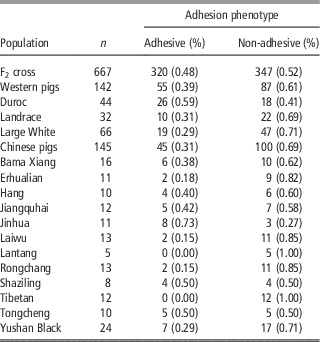
The animals used in this study were from a White Duroc×Erhualian F2 cross and 287 outbred pigs representing 15 breeds. The F2 resource population consist of 1912 F2 animals that were derived from two White Duroc and 17 Erhualian as founders (Guo et al., Reference Guo, Mao, Ren, Yan, Duan, Yang, Ren, Zhang, Yang, Ouyang, Brenig, Haley and Huang2009). The 15 outbred populations represent a broad genetic background of Chinese and Western pigs (Yan et al., Reference Yan, Huang, Ren, Ouyang, Yang, Han and Huang2011) (Table 1). In this study, 835 F2 animals at age of 240 days and 287 outbred piglets at 6–8 weeks old were recorded for their ETEC adhesion phenotypes.
Distribution of ETEC F41 adhesion phenotypes in experimental populations

The ETEC F41 strain (0101:K30:F41) was provided by China Institute of Veterinary Drug Control. The presence of F41 fimbriae on the surface of the bacteria was verified by a routine agglutination assay. The microscopic enterocyte adhesion test that determined ETEC F41 adhesion phenotypes was described in previous work (Zhang et al., Reference Zhang, Ren, Yan, Huang, Ji, Peng, Zhang and Huang2008). Briefly, a 2 cm segment of the jejunum of each animal was collected within 30 min postmortem, then the epithelia brush borders were isolated. Afterwards, the suspensions of bacteria-brush border admixture was examined using a phase contrast microscopy (Leica, Wetzlar, Germany). For each specimen, the total number of bacteria adhered to 20 randomly selected brush border vesicles were recorded as proposed by Baker et al. (Reference Baker, Billey and Francis1997). A pig was classified as adhesive if at least two out of the 20 brush borders adhered to more than two bacteria. Pigs were treated as non-adhesive animals if no brush border bonds to more than one bacteria. Otherwise they were judged as weakly adhesive animals. A total of 168 pigs judged as weakly adhesive were excluded from subsequent GWAS.
Genotyping of porcine 60K SNP chips
DNA was extracted from ear tissues using a standard phenol and chloroform method. We genotyped all the 835 individuals for 62163 SNPs using Illumina PorcineSNP60 BeadChips according to the manufacture’s protocol. Animals with SNP call rates>0.9 and familial Mendelian error rates<0.05, and SNPs with call rates>0.9, minor allele frequencies>0.05, P values not significantly deviating from Hardy–Weinberg equilibrium (>10−6) and Mendelian error rate <0.1 were retained. As 168 individuals judged as ‘weak adhesion’ were removed from analysis. Finally, 39454 SNPs on 667 F2 pigs measured with ETEC F41 susceptibility trait were used for subsequent analysis.
Statistical model for GWAS
The genome wide association analysis was performed by ROADTRIPS program Version 1.2 (Thornton and McPeek, Reference Thornton and McPeek2010). This program conducts single SNP test while adjusting for population structure using a covariance matrix derived from genome-wide SNP data. Given that there are familial relationships among individuals in the F2 cross, ROADTRIPS is hence suitable for our data. ROADTRIPS computes three different test statistics: RM, RX and RW based on a
 $\chi _{{\rm 1}}^{{\rm 2}} $
distribution for each SNP. RM test was adopted in this study as recommended by authors. To validate the results from ROADTRIPS, GWAS was also performed using mmscore function in R package GenABEL (Aulchenko et al., Reference Aulchenko, Ripke, Isaacs and van Duijn2007). Bonferroni corrected P-value (0.05/39454=1.27×10−6) was adopted as genome wise significance threshold. The suggestive significance threshold was set to be 2.53×10⁻⁵ (1/39454). The linkage disequilibrium (LD) between significant SNPs was calculated using Plink v1.07 (Purcell et al., Reference Purcell, Neale, Todd-Brown, Thomas, Ferreira, Bender, Maller, Sklar, de Bakker, Daly and Sham2007). The pig genome assembly 10.2 (Groenen et al., Reference Groenen, Archibald, Uenishi, Tuggle, Takeuchi, Rothschild, Rogel-Gaillard, Park, Milan, Megens, Li, Larkin, Kim, Frantz, Caccamo, Ahn, Aken, Anselmo, Anthon, Auvil, Badaoui, Beattie, Bendixen, Berman, Blecha, Blomberg, Bolund, Bosse, Botti, Bujie, Bystrom, Capitanu, Carvalho-Silva, Chardon, Chen, Cheng, Choi, Chow, Clark, Clee, Crooijmans, Dawson, Dehais, De Sapio, Dibbits, Drou, Du, Eversole, Fadista, Fairley, Faraut, Faulkner, Fowler, Fredholm, Fritz, Gilbert, Giuffra, Gorodkin, Griffin, Harrow, Hayward, Howe, Hu, Humphray, Hunt, Hornshoj, Jeon, Jern, Jones, Jurka, Kanamori, Kapetanovic, Kim, Kim, Kim, Kim, Larson, Lee, Lee, Leggett, Lewin, Li, Liu, Loveland, Lu, Lunney, Ma, Madsen, Mann, Matthews, McLaren, Morozumi, Murtaugh, Narayan, Nguyen, Ni, Oh, Onteru, Panitz, Park, Park, Pascal, Paudel, Perez-Enciso, Ramirez-Gonzalez, Reecy, Rodriguez-Zas, Rohrer, Rund, Sang, Schachtschneider, Schraiber, Schwartz, Scobie, Scott, Searle, Servin, Southey, Sperber, Stadler, Sweedler, Tafer, Thomsen, Wali, Wang, Wang, White, Xu, Yerle, Zhang, Zhang, Zhang, Zhao, Rogers, Churcher and Schook2012) was used to annotate SNP positions.
Characterization of the ZFAT gene
Total RNA was extracted from the jejunum of a purebred piglet with the RNeasy Mini Kit (Qiagen Hilden, Hilden, Germany). First-strand cDNA was subsequently synthesized with the primer (Kathiresan et al., Reference Kathiresan, Willer, Peloso, Demissie, Musunuru, Schadt, Kaplan, Bennett, Li, Tanaka, Voight, Bonnycastle, Jackson, Crawford, Surti, Guiducci, Burtt, Parish, Clarke, Zelenika, Kubalanza, Morken, Scott, Stringham, Galan, Swift, Kuusisto, Bergman, Sundvall, Laakso, Ferrucci, Scheet, Sanna, Uda, Yang, Lunetta, Dupuis, de Bakker, O’Donnell, Chambers, Kooner, Hercberg, Meneton, Lakatta, Scuteri, Schlessinger, Tuomilehto, Collins, Groop, Altshuler, Collins, Lathrop, Melander, Salomaa, Peltonen, Orho-Melander, Ordovas, Boehnke, Abecasis, Mohlke and Cupples2009) 18 V using the Omniscript RT Kit (Qiagen). Six primer pairs were designed according to the porcine ZFAT mRNA sequence (GeneBank accession no. XM_001927674) to amplify the partial coding sequence of porcine ZFAT using RT-PCR method. The full-length cDNA sequence was obtained by the alignment of 5’RACE and 3’RACE fragments with RT-PCR fragments. To identify coding polymorphisms of the porcine ZFAT gene, we used the 6 primer pairs (Supplementary Table S1) to amplify cDNA sequences of two adhesive and two non-adhesive animals from both Erhualian and White Duroc breeds. The PCR products were purified with the NucleoSpin PCR Purification Kit (Macherey-Nagel, Düren, Germany) and sequenced. SNP were called by comparing obtained sequences. Seven SNPs namely c.60T>C, c.630C>A, c.660T>C, c.1077C>T, c.1416C>T, c.2337T>C and c.2935G>C were identified.
Genotyping of ZFAT coding SNPs
Seven PCR primer pairs and seven SNaPshot primers (Supplementary Table S2) were designed for genotyping the seven SNPs. Amplification was performed in a routine way with optimal annealing temperatures. All polymorphisms were genotyped through SNaPshot ddNTP primer extension procedure with the SNaPshot Multiplex Kit (Applied Biosystems, Foster City, CA, USA). Extension products were separated by capillary electrophoresis on a 3130XL Genetic Analyzer and recorded with GeneMapper 4.0 software (Applied Biosystems).
Association analysis
The online SHEsis software (Shi and He, Reference Shi and He2005) was used to calculate standardized LD values (r 2) among polymorphisms. Haplotypes were reconstructed with PHASE (Stephens et al., Reference Stephens, Smith and Donnelly2001). The association analyses in outbred populations were performed by the SHEsis software (Shi and He, Reference Shi and He2005) in a case-control way.
Results
Distribution of the adhesion phenotypes in experimental populations
As shown in Table 1, the proportion of adhesive (susceptible) animals was 48% in the F2 population. For outbred populations, the average percentage of adhesive piglets was higher in International commercial pigs than Chinese indigenous pigs (38.7% v. 31.0%). Suggesting considerable proportions of International commercial pigs and Chinese indigenous pigs were susceptible to ETEC F41.
GWAS refined the significant locus on chromosome 4
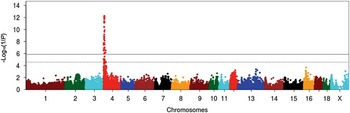
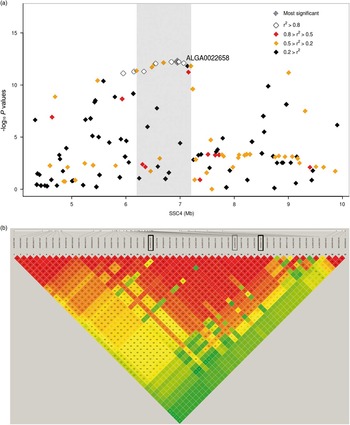
We detected a highly significant region on chromosome 4 in the F2 cross. The most significant SNP (ALGA0022658, P=5.59×10⁻¹³) is located at 6.95 Mb on this chromosome (Figure 1), this replicate the QTL previously detected based on microsatellite markers (Yang et al., Reference Yang, Huang, Yan, Ren, Yang, Zou, Zeng, Ou, Huang and Huang2009). A total of 52 SNP on chromosome 4 achieved the genome wise significance (Supplementary Table S3), while no significant association was identified on the other chromosomes (Figure 1). The 52 SNP reside within in a 16.2 Mb interval (0.4 to 16.6 Mb). We examined LD patterns around the critical interval (Figure 2), and found that 18 SNPs in high LD (r 2>0.5) with ALGA0022658 constitute a 1.21 Mb interval delimited by ALGA0022520 (5.95 Mb) and ASGA0017783 (7.16 Mb). The association test statistics (−1og10 P value) of SNPs outside of the 1.21 Mb region dropped more than 2 quickly (Figure 2). Therefore, we believed that the 1.21 Mb interval harbors the causal variants for ETEC F41 susceptibility.
Manhattan plot for genome-wide association analysis for ETEC F41 susceptibility trait in the White Duroc×Erhualian F2 intercross. The solid (dashed) horizontal line represents the genome-wide (suggestive) significance threshold. Chromosomes are indicated by different colors on the x-axis, and –log10 P values that measuring the significance of trait-single nucleotide polymorphisms (SNP) associations are shown on the y-axis.

Genomic region significantly associated with ETEC F41 susceptibility on chromosome 4 in the White Duroc×Erhualian F2 intercross. (a) Regional plot of the 6 Mb region around the most significant single nucleotide polymorphisms (SNP) (ALGA0022658). Diamonds represent the trait-SNP associations, y axis represents the association strength measured by –log10 P value, and x-axis represent the genomic positions. The colors of diamonds indicate the extent of linkage disequilibrium (LD) between corresponding SNPs and ALGA0022658. The 1.21 Mb region is highlighted by a shadowed rectangle. (b) A LD heat map plot of the 52 SNP achieved the genome-wise significance level. ALGA0022658 is marked by gray rectangle. ALGA0022520 and ASGA0017783 that defined the 1.21 Mb critical region are highlighted by black rectangles.

Investigation of ZFAT as an interesting candidate gene
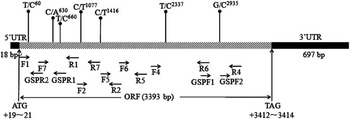
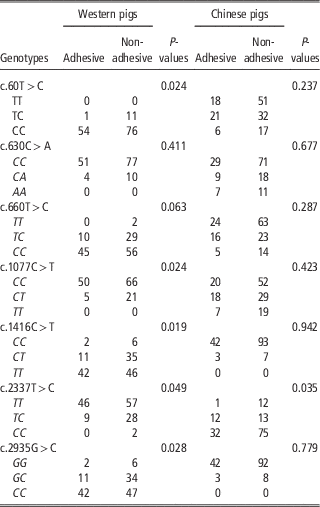
We found two annotated genes, KHDRBS3 and ZFAT, within the 1.21 Mb interval. RT-PCR analysis showed that both KHDRBS3 and ZFAT are expressed in porcine small intestine (data not shown). A literature and database search for the two genes at www.genecards.org suggests that KHDRBS3 encodes a RNA-binding protein involved in regulation of alternative splicing, and may function as a negative regulator of cell proliferation, ZFAT is a zinc finger protein coding gene which have critical roles in immune response and endothelial cell assembly. Considering that ZFAT is more functionally plausible, and proximal to ALGA0022658 than KHDRBS3 in physical distance, we investigated ZFAT as a positional candidate gene. First we isolated the complete 4108 bp cDNA sequence of ZFAT by RACE assay. The sequence contains a 3393 bp open reading frame encoding a protein of 1130 amino acids. We sequenced ZFAT cDNA of four pigs, two susceptible (One White Duroc and one Erhualian) and two resistant pigs (One White Duroc and one Erhualian), and identified seven coding SNPs including one missense mutation and six synonymous variants: c.60T>C, c.630C>A, c.660T>C, c.1077C>T, c.1416C>T, c.2337T>C and c.2935G>C (Figure 3). We genotyped the seven SNPs and tested their association with ETEC F41 susceptibility phenotype in 287 ourbred pigs. LD among the seven SNPs in International commercial pigs were higher than those in Chinese indigenous pigs (Supplementary Figure S1). We further tested the association between these seven SNPs with susceptibility phenotype (Table 2). The results showed that only c.2337T>C had significant (P=0.035) association in Chinese native pigs (Table 2). In comparison, five variants except for c.630A>C and c.660T>C had significant association (P<0.05) in international commercial pigs.
Schematic representation of pig ZFAT cDNA and locations of polymorphic loci. The black boxes represented the untranslated regions. The shaded box represents translated region. The start codon (ATG) locates at position 19~21, and the stop codon (Margolin et al., Reference Margolin, Wang, Lim, Kustagi, Nemenman and Califano2006) locates at position 3412~3414, The identified single nucleotide polymorphisms (SNPs) and Primers (arrows) were depicted above and below the shaded box, respectively.

Association of ZFAT SNPs with ETEC F41 adhesion phenotypesFootnote a

SNP=single nucleotide polymorphisms.
a SNPs refer to GenBank accession No. XM_001927674.
Discussion
GWAS have been successful to identify genomic loci for a variety of phenotypic traits including body composition, boar taint and reproductive traits in pigs (Fan et al., Reference Fan, Onteru, Du, Garrick, Stalder and Rothschild2011; Grindflek et al., Reference Grindflek, Lien, Hamland, Hansen, Kent, van Son and Meuwissen2011; Onteru et al., Reference Onteru, Fan, Du, Garrick, Stalder and Rothschild2012). In this study, we performed GWAS to identify genomic loci for ETEC F41 susceptibility in a White Duroc×Erhualian F2 pig across. GWAS implemented in the same experimental population have helped to reveal significant loci for different traits like fatty acid compositions (Yang et al., Reference Yang, Zhang, Zhang, Fan, Xie, Ai, Ma, Xiao, Huang and Ren2013) and vertebrae number (Fan et al., Reference Fan, Xing, Zhang, Ai, Ouyang, Ouyang, Yang, Li, Chen, Gao, Li, Huang and Ren2013), indicated that the performance of GWAS in F2 population is robust. Compared to QTL mapping based on microsatellite markers, GWAS hereby have higher marker density (40 Kb/SNP), and is free of the assumption that the genotypes of causal variant is alternatively fixed in founder animals. GWAS is expected to have higher power than the QTL mapping in revealing genomic regions associated with ETEC F41 susceptibility. We identified a highly significant region (P=5.59×10⁻¹³) on chromosome 4. The most significant SNP was in high LD (r 2>0.5) with a cluster of nearby SNPs that constitute a 1.21 Mb interval. The association strength (−log10 P value) of SNPs outside this interval dropped quickly below 10. Hence, we considered the 1.21 Mb interval is the most likely region that contains the underlying causal gene and mutation(s). Compared with 12 cM interval in the previous QTL mapping study (Yang et al., Reference Yang, Huang, Yan, Ren, Yang, Zou, Zeng, Ou, Huang and Huang2009), GWAS in the present study remarkably refined the region for ETEC F41 susceptibility on SSC4. This would facilitate the further characterization of causal genes.
We noticed that most significant SNPs, ALGA0022658, did not absolutely distinguish susceptible animals from resistant individuals (Supplementary Table S4). One apparent possibility is that the significant SNP is not in complete LD with the causal variant in the F2 cross. On the other aspect, we also can not rule out the possibility of incomplete penetrance that causes the imperfect association.
ZFAT is a positional candidate gene within the 1.21 Mb critical interval. We re-sequenced the coding region of ZFAT and identified seven coding SNPs. These SNPs were genotyped in 287 unrelated pigs from 15 diverse populations measured with ETEC F41 susceptibility phenotype. We found different association profiles of the seven SNPs between Chinese pigs and Western pigs. Five SNPs had significant associations with the susceptibility phenotype in international commercial pigs, in comparison, only one polymorphism showed significant association in Chinese pigs. This discrepancy could be caused by the population heterogeneity of ETEC F41 susceptibility loci or different LD patterns within Chinese indigenous pigs and International commercial pigs. For example, we recently showed that LD extent measured by genomic distance corresponding to LD statistics r 2=0.3, is much shorter in Chinese pigs than that in International commercial pigs (10.5 v. 125 kb) (Ai et al., Reference Ai, Huang and Ren2013). The significant SNPs provide novel markers for selecting ETEC F41 resistant animals in the pig breeding scheme. It is worth noting that those significant SNPs do not have obviously functional significance. Further studies are needed to identify the causal variant(s) underlying the SSC4 susceptible locus.
Conclusion
We performed GWAS to identify the loci affecting susceptibility of pigs to ETEC F41 in a F2 pig cross. We refined susceptible locus on chromosome 4 to a 1.21 Mb region. We investigated ZFAT in the 1.21 Mb region as candidate gene. Several ZFAT coding variants had significant association with ETEC F41 adhesion phenotypes across International commercial pigs. The results improve our understanding of the genetic basis of ETEC F41 susceptibility in pigs. However, the underlying gene and causal variants remained to be uncovered.
Acknowledgments
This work was supported by National 863 Program of China (2011AA100304-4), National Natural Science Foundation of China (31201786), and Program for Changjiang Scholars and Innovative Research Team in University (IRT1136)
Authors’ contribution: Conceived and designed experiment: J.R. and L.H. Performed the experiments: H.J., B.Y., X.Y., J.O., M.Y., X.Z., W.Z., Y.S., K.Z. Analyzed the data: J.R., J.H., B.Y., Z.Z. Contributed reagents/materials/analysis tools: S.X. Wrote the paper: J.R., B.Y., H.J., L.H.
Conflicts of Interest
The authors declare no competing interests.
Supplementary material
To view supplementary material for this article, please visit http://dx.doi.org/10.1017/S1751731116000306