Introduction
Early intensive rehabilitation is important following neurological injury to enhance neuroplasticity (Saposnik, Levin, & Outcome Research Canada Working Group, Reference Saposnik and Levin2011). Evidence-based clinical guidelines recommend task-specific training for at least 2 h per day early after stroke to optimise recovery (Stroke Foundation, 2020). Task-specific and occupation-based training engage people in repetitive practice of relevant and meaningful activities, leading to motor learning, generalisation to other tasks and improved functional outcomes (Hubbard et al., Reference Hubbard, Parsons, Neilson and Carey2009; Song, Reference Song2015). The incorporation of everyday objects into training supports salience, the principle that when something is important to the individual training and recovery are enhanced which promotes neuroplasticity (Kleim & Jones, Reference Kleim and Jones2008). Equally, the incorporation of everyday objects is consistent with knowledge that pre-shaping of the hand occurs in preparation for grasp of the target object in synergy, and often early in the reaching movement of the arm (van Vliet & Sheridan, Reference van Vliet and Sheridan2007). Health care teams working within the hospital environment can experience challenges with access to objects that support training relevant to, and aligned with, individual stroke survivor environments and occupations. This is largely due to limited access to the home environment which provides structure, meaning and an enriched source of informational support, and improved motor skill retention and transfer (Turton et al., Reference Turton, Cunningham, Heron, van Wijck, Sackley, Rogers and van Vliet2013).
This knowledge has encouraged exploration of augmented reality as a rehabilitation tool that may support training with objects from home. Augmented reality ‘allows users to view and interact in real time with virtual images seamlessly superimposed over the real world’ (p.1) (Lukosch et al., Reference Lukosch, Billinghurst, Alem and Kiyokawa2015). Augmented reality provides opportunities for patients to view and interact with items from their familiar home environment superimposed over the physical hospital setting, and the inclusion of haptic technology would further support this interaction providing real-time sensory feedback with objects or the environment (Collins et al., Reference Collins, Hoermann and Regenbrecht2016; Hondori et al., Reference Hondori, Khademi, Dodakian, Cramer and Lopes2013). A review of the literature identified 18 previous studies of augmented reality for stroke rehabilitation, nine that explored clinical feasibility and user experience (Gorman & Gustafsson, Reference Gorman and Gustafsson2020). Users reported mixed experiences with many reporting that is was motivating, usable, and with therapeutic value, while others found difficulties with the technology such as limited variability and progression (Gorman & Gustafsson, Reference Gorman and Gustafsson2020). These reports are consistent with user response to virtual reality game-based interventions that recommend retention of therapeutic principles within the games, including graded intensity, and feedback (Lewis & Rosie, Reference Lewis and Rosie2012).
Augmented reality for rehabilitation is a novel technology in the prototype stage of development (Al-Issa et al., Reference Al-Issa, Regenbrecht and Hale2012). End user input into all stages of understanding the need, developing and incorporating technology into clinical practice is essential for outcomes and implementation. There are a range of participatory approaches that underpin this process. An approach not yet commonly applied within health-based research is an anticipatory method, one that is commonly used within the policy context to explore views and attitudes to emerging technologies (Macnaghten, Reference Macnaghten, Barbour and Morgan2017). Commonly data are collected from participants with limited to no experience of the technology as a means to reduce technological risk and to inform if further research and development should occur. This study was positioned within an anticipatory method and explored the need and acceptability of augmented reality from the perspectives of health professionals and stroke survivors during inpatient stroke rehabilitation.
Methodology
A qualitative descriptive design supported a naturalistic and flexible approach to discovering the subjective perspectives of participants in focus groups (Sandelowski, Reference Sandelowski2010) and the development of rich and focused descriptions (Kim et al., Reference Kim, Sefcik and Bradway2017). This low inference design allows data to be translated to inform intervention development tailored to the needs of the population (Neergaard et al., Reference Neergaard, Olesen, Andersen and Sondergaard2009; Willis et al., Reference Willis, Sullivan-Bolyai, Knafl and Cohen2016). Ethics approval was received from the Metro South Health Human Research Ethics Committee (Reference: HREC/2019/QMS/47014) and Griffith University (Reference: 2019/097).
Participants
Convenience sampling recruited participants from the inpatient setting of a large metropolitan hospital in Australia. All health professionals working on the rehabilitation ward and all people with stroke who were inpatients at the time of the study were eligible to participate. Participants with stroke were only excluded if they were unable to participate in the focus group due to inability to speak and/or understand English or if they did not have sufficient cognitive ability to effectively participate. Participants were not required to have previous experience using either VR or augmented reality technology. All participants provided written informed consent at the commencement of focus groups.
Data collection
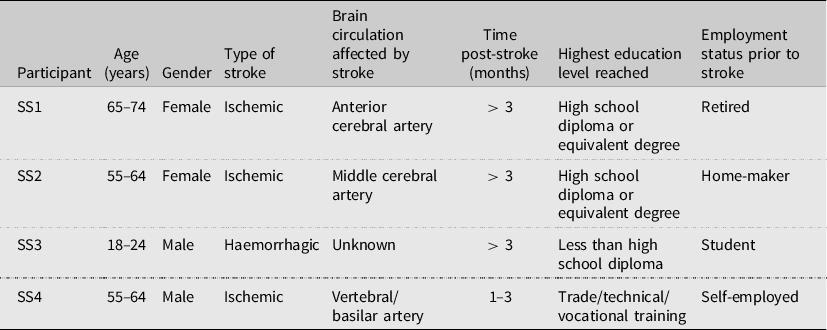
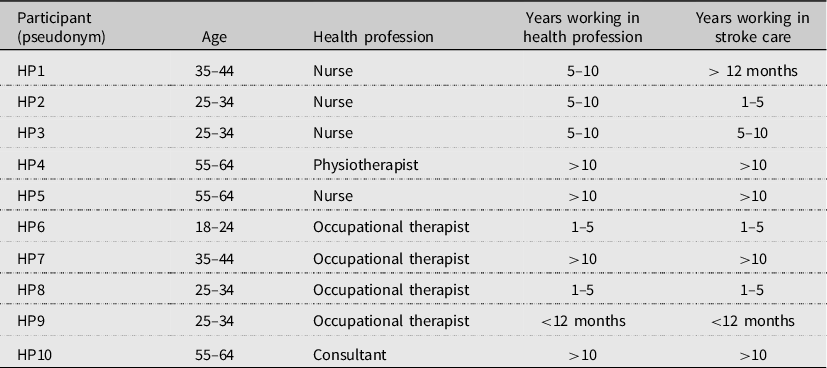
Demographic information (Tables 1 and 2) and qualitative data were collected at three focus groups; one focus group with stroke survivors (n = 4 plus one caregiver) and two with health professionals (n = 6; n = 4). The focus groups were conducted in meeting rooms in the clinical setting with only researchers and participants present. Two focus groups were scheduled for health professionals to accommodate different work schedules. Participants were told that the reason for the research was to explore understanding and feasibility of incorporating augmented reality into stroke rehabilitation. The focus groups commenced with a definition of augmented reality and as required throughout the focus groups, practical examples of augmented reality in rehabilitation from a recently published review (Gorman & Gustafsson, Reference Gorman and Gustafsson2020) were described to promote further consideration and discussion. They included examples with or without a head-mounted display such as stepping over virtual obstacles while on a treadmill, catching virtual butterflies with a virtual net or transforming a table with a virtual environment that responds to the user’s movements and supports interaction with objects. (Gorman & Gustafsson, Reference Gorman and Gustafsson2020).
Characteristics of stroke survivors

Characteristics of health professionals

A semi-structured interview guide informed the direction of the focus groups, which were otherwise designed to be participant-led. The interview guides were based on the Technology Acceptance Model (Davis, Reference Davis1989) and explored participants’ current technology use (How do you feel about using technology in general? How proficient do you feel you are at using technology?), general feelings towards and understanding of technology (What do you think about augmented reality (and why)? How willing would you be to use this technology within the hospital setting? Is there anything that you can think of that might stop you from using this technology?), and perspectives of the technology use (Can you think of any particular ways you would like this technology to be used? What types of rehabilitation do you envisage this technology would be most helpful with? Is there anything you would like to share that you haven’t been able to in relation to the use of augmented reality for your rehabilitation?). Focus groups were recorded and transcribed verbatim.
Developer input is an essential step for new technologies. However, this study adopted a participatory stakeholder approach applying focus groups as an anticipatory methodology (Macnaghten, Reference Macnaghten, Barbour and Morgan2017). This allowed health professional and stroke survivor participants to explore the possibilities based on their personal experiences and without the technology or developers influencing this exploration (Kildea et al., Reference Kildea, Battista, Cabral, Hendren, Herrera, Hijal and Joseph2019). The intent was not that this project would lead to technology development, but rather the participants would engage in future-focused thinking and imagining to underpin subsequent projects. Open-ended questions created discussion amongst the group, and probing questions were asked to illicit further information to promote richness of the data. Data collection was a dynamic process whereby data collected from early focus groups were incorporated into subsequent focus groups. One health professional participated in a focus group and then withdrew from the study, with no explanation provided. The corresponding data were removed from analysis.
Reflexive statement
The focus groups were conducted by LG an experienced qualitative researcher, occupational therapist, and expert in stroke rehabilitation and recovery, and CG a novice researcher and student occupational therapist. The researchers were female, Caucasian, had no previous experience with augmented reality and had no bias towards a specific technological solution. The researchers did not work at the data collection site and had no pre-existing relationship with the majority of the participants. LG had previously taught or collaborated with some of the occupational therapy participants, but this was not considered problematic for this research question.
Data analysis
An inductive content analysis (Hsieh & Shannon, Reference Hsieh and Shannon2005) supported an iterative and recursive process, with each researcher completing line-by-line coding and meeting to discuss preliminary codes. Researcher reflective journals were referred to during this process and highlighted the ebb and flow of the focus groups highlighted in the second theme. The discussion supported focused coding to systematically reduce the data from 12 finalised codes to 3 emergent themes, which became the final themes that reflected manifest content of the data (Graneheim & Lundman, Reference Graneheim and Lundman2004). A summary of the findings was sent to the participants for member checking to ensure the findings were an accurate reflection of their perspectives and to minimise researcher bias (Lincoln & Guba, Reference Lincoln and Guba1985). No feedback was received from the participants.
Trustworthiness
Strategic decisions and careful planning in relation to sampling, data collection, and data analysis were made to ensure they aligned with the research aim and questions. These decisions were clearly articulated to enhance transparency in the approach, implementation and evaluation of the study to ensure dependability and transferability (Vaismoradi et al., Reference Vaismoradi, Turunen and Bondas2013). Other strategies such as the use of verbatim quotations to support themes developed by the researchers, member checking, and independent, iterative and recursive data analysis by researchers enhanced confirmability of the study (Milne & Oberle, Reference Milne and Oberle2005). Maintenance of a reflective journal and regular meetings with the research team also ensured reflexivity, reflection, and critical appraisal of decisions and perspectives throughout the research process (Vaismoradi et al., Reference Vaismoradi, Turunen and Bondas2013).
Results
The focus groups were conducted for between 45 min to 1 h. Three themes reflected the perspectives of the participants: 1) everything is computerised these days; 2) the possibilities are endless…but what about?; and 3) Bringing the outside into the hospital.
Theme 1: Everything is computerised these days
The participants reported a range of experiences and levels of comfort with technology, using at least a mobile phone and computer. All participants acknowledged technology was increasingly part of everyday life and most used it out of necessity rather than by preference, particularly within the workplace. Stroke survivor (SS) 2 suggested technology ‘…gives you access to everything’ and ‘…you’re just lost without a computer or your phone these days’, with other participants echoing this sentiment by suggesting tasks such as banking and accessing government departments were much easier, and expected to be completed online. This led to discussion about the increasing pressure to use technology and that ‘…there’s lots of new technology coming out all the time and I think we just feel overwhelmed with it…’ (SS2). Participants across all focus groups identified these feelings could be related to age, suggesting younger generations may be more accepting of, and comfortable with technology.
The stroke survivors reported that their technology use had increased post-stroke due to the hemiplegia such as using the phone to access social media and YouTube (SS4). SS2 commented ‘My parents bought me a Kindle and I’ve been really anti those because I love my books, you know, but now that I only have one arm, Kindle’s been a lifesaver…’. All participants described feelings of frustration due to insufficient knowledge or issues associated with the technology itself, such as voice-activated systems that did not register voices correctly. Participants described a range of ways to mitigate these issues, including seeking assistance from others for set-up, demonstration and troubleshooting, or others preferred ‘trial and error’ (health professional (HP) 8). Finally, health professionals identified that technology currently available on the ward was not utilised due to time inefficiencies regarding set-up and staff resistance to learning an additional skill. The importance of having a champion to mitigate these issues was identified.
Theme 2: The possibilities are endless…but what about?
Each focus group had an ebb and flow of participants’ attitudes with excitement and idea generation and then returning to pragmatic concerns with comments such as ‘The possibilities are endless and I think it’s definitely the way of the future” (HP2) to “…how it helps their rehab, I’m not sure’ (HP4). Despite the definition provided and supporting discussion, some participants found it difficult to vision application of the technology stating ‘… it’s hard to comment or to, sort of, comment on something that we don’t really know what it looks like’ (SS1). As participants were encouraged to explore the possibilities, the discussions progressed towards a range of technological solutions that may or may not have been relevant to augmented reality ranging from a planning diary through to building confidence with community access.
The health professionals wondered if augmented reality could allow controlled exposure to unsafe situations, such as practice crossing a road, or include integrated features such as sensors or prompts that alerted the user with perceptual difficulties, neglect or inattention.
If someone’s got a home environment … someone with neglect or inattention and they’ve got projecting cupboards or something, how do you in the virtual reality recognise they banged their head on that when they’re walking around? (HP 10)
In contrast, and consistent with neurological training approaches, they discussed linking augmented reality and sensorimotor feedback to prompt engagement of certain muscle groups and enhance motor recovery. The potential to increase practice and reduce boredom outside of therapy times was identified by both participant groups; however, the need for set-up by busy nursing staff and concerns regarding safety were raised. Unsupervised training, particularly when mobilising, was an identified concern with suggestions that augmented reality may be better suited to upper limb therapy. The potential of a head-mounted display to cause claustrophobia, nausea or dizziness was raised, and all focus groups queried the acceptability of augmented reality for rehabilitation given the older age demographic and prevalence of cognitive impairment in the inpatient rehabilitation population.
Pragmatic matters raised by health professionals included legal issues, staff training, funding and how to allocate devices. Concerns were raised regarding the risk to confidentiality if sharing devices resulted in images from one patient’s environment being seen by another patient. The authenticity of the interaction between augmented reality and the physical environment was questioned, with suggestions it would be difficult to accurately integrate vision of the home environment onto the physical hospital environment. HP7 commented, ‘… I’m imagining picking up the kettle you’ve got at home, you’d have to make sure your kettle’s in the exact spot…’. It was suggested that augmented reality could support certain aspects of a task, such as pre-shaping and reach; however, the importance of receiving real time and realistic feedback was then introduced.
Theme 3: Bringing the outside into the hospital
Participants agreed that practicing goal-orientated functional tasks in a contextually relevant and meaningful environment would increase motivation and engagement in therapy. They wondered if augmented reality could train safe access around areas of the home such as kitchen or bathroom. Health professionals considered it valuable if the augmented reality supported a ‘reality check’ and promoted goal setting and training.
The health professionals considered that superimposing aspects of home, such as a family pet for the stroke survivors to ‘pat’, would provide motivation and perhaps alleviate home sickness. In contract, the stroke survivors described the distress they would feel at seeing aspects of their home environment whilst in hospital: ‘…if I was sitting and looking at all the stuff that I had at home, I’d want to go home’ (SS4). Despite this emotional response, the stroke survivors suggested isolating selected aspects of rooms or de-personalising the vision as strategies to overcome this issue. Health professions considered altering the vision to make it look less realistic (more like a schematic cartoon), as well as timing delivery of the intervention based on stage of recovery and when discharge destination was known.
When considering technology use, stroke survivors wondered if augmented reality could support caregivers to experience life in a wheelchair and in hospital, to promote a better understanding of the experience. There were feelings of isolation and frustration due to a lack of understanding by their family or caregivers regarding the experience of their stroke and discussed how vulnerable they felt when considering ‘life outside these walls’. SS2 agreed with this sentiment, commenting:
Yeah, getting around, say, shops … in a wheelchair is very confronting and normally you’re in a push chair - - - with somebody pushing you around and it would be good for them to understand what everything’s like from your height and get racks in the face and people’s handbags…
SS4 reflected on a recent trip to get a haircut and wondered if augmented reality could allow him to practice this outing within the safe confines of the hospital, enabling him to build confidence and therefore decrease his anxiety.
Discussion
This study explored stroke survivor and health professional perspectives regarding augmented reality for stroke rehabilitation. All participants engaged in technology use in their everyday life and anticipated that technology would continue to become more commonplace in society. The use of augmented reality for stroke rehabilitation is an emerging concept (Al-Issa et al., Reference Al-Issa, Regenbrecht and Hale2012; Gorman & Gustafsson, Reference Gorman and Gustafsson2020); therefore, the anticipatory nature of the focus groups supported participants to imagine the future with augmented reality. This approach led participants to introduce possibilities inconsistent with, or beyond, the current state of the technology. Despite this ambiguity and questions in relation to the pragmatics, most participants were optimistic about the benefits of using technology such as augmented reality within future rehabilitation.
A meta-ethnographic study highlighted that exposure to new realities after stroke has a significant effect on transition and adjustment (Hole et al., Reference Hole, Stubbs, Roskell and Soundy2014). This includes the ability to practice tasks to build problem-solving skills, confidence, self-esteem and self-efficacy (Wottrich et al., Reference Wottrich, Åström and Löfgren2012). Discharge planning for return to home from inpatient stroke rehabilitation should prepare people to engage with occupations in a range of environments including home and community. This was highlighted when participants explored that technology might allow practice navigating certain routes within the wheelchair with feedback relating to environmental factors such as hills and crossing roads. The group wondered if the technology could support practice of community access within the safe confines of the hospital, to build confidence and better prepare them to then engage in the actual task. Although these suggestions from the participants may be beyond current augmented reality technology, they represent an identified need that could guide the development of future technologies for stroke rehabilitation.
The differing expectations and reactions to inclusion of aspects of home, or pets, within the training was an important finding. Assumptions that this would motivate by the health professionals were in contrast to the negative impact on well-being expressed by stroke survivors. This finding foregrounds the importance of shared decision-making, a key element of client-centred care, and the balancing of health professional power with the autonomy of the client (Kristensen et al., Reference Kristensen, Tistad, von Koch and Ytterberg2016). The successful uptake of technology in rehabilitation requires both therapist and patient commitment, support, and perceived benefit (Hamilton et al., Reference Hamilton, McCluskey, Hassett, Killington and Lovarini2018) and it is therefore essential that both are involved in the design and implementation phase.
Unexpectedly, the stroke survivors also explored how technology could support caregivers to develop a greater understanding of their experiences post-stroke. Further research is required to explore this phenomenon, including how technology may serve as a catalyst to support understanding, acceptance and validation of the challenges experienced and better support the caregivers to appreciate and prepare for the practical aspects of discharge (Lutz et al., Reference Lutz, Young, Cox, Martz and Creasy2011). Finally, the health professionals cited pragmatic concerns consistent with Levac et al. (Reference Levac, Glegg, Sveistrup, Colguhuon, Miller, Finestone and Veikonja2016) who identified that a knowledge translation approach is important to ensure implementation and continuing support for the technology. Greenhalgh and colleagues (Reference Greenhalgh, Maylor, Shaw, Wherton, Papoutsi and Taylor2020) have devised practical tools that are an extension of the non-adoption, abandonment, scale-up, spread, and sustainability (NASSS) framework (Greenhalgh et al., Reference Greenhalgh, Wherton, Papoutsi, Lynch, Hughes, A’Court and Shaw2017). The framework and subsequent complexity assessment tools are intended to understand, guide, monitor and evaluate technology projects, including implementation, within health care and may support future research with augmented reality.
Limitations, strengths and future directions
This research was conducted at one hospital and further investigations to develop the technology should be conducted over multiple sites supporting a broad representation of perspectives across all age ranges, professional groups and the continuum of care. The participants did not have experience with the technology and although this may be considered a limitation it is representative of the general population. The anticipatory methodology approach sought to promote testing of need, acceptability and future-focused idea generation. This study did not seek to commence actual technology development and as this technology evolves it will be essential that developers are included in the end user-led discussions.
Conclusion
Health professionals and stroke survivors were interested in exploring how augmented reality may enable contextually relevant practice before returning home. Barriers were discussed, and uncertainties regarding the possibilities of the technology were identified including some that are beyond the current capabilities. Regardless, this study allowed the perspectives of two key stakeholders in stroke rehabilitation to contribute to the discussion regarding augmented reality technology of now and into the future. The suggestion that augmented reality could be used to share experiences with their caregivers and to build confidence and self-efficacy prior to community engagement could be used to inform future developments.
Financial support
This study received support from the Griffith University School of Allied Health Sciences Honours Fund
Conflict of interest
None.
Authorship statement
All authors contributed to design of this study, data collection or analysis, and development and final approval of this manuscript.
Ethical standards
The authors assert that all procedures contributing to this work comply with the ethical standards of the relevant national and institutional committees on human experimentation and with the Helsinki Declaration of 1975, as revised in 2008.