Introduction
Understanding how changing climate influences earth ecosystems depends critically on how plants respond to gradients of temperature and moisture (Parmesan et al., Reference Parmesan, Gaines, Gonzalez, Kaufman, Kingsolver, Townsend Peterson and Sagarin2005; Bykova et al., Reference Bykova, Chuine, Morin and Higgins2012; Silvertown et al., Reference Silvertown, Araya and Gowing2015). This puts the question of which adaptive traits of seed plants correspond to climatic niches at the core of functional ecology (Jump and Penuelas, Reference Jump and Penuelas2005; McGill et al., Reference McGill, Enquist, Weiher and Westoby2006; Chuine, Reference Chuine2010; Gallagher et al., Reference Gallagher, Beaumont, Hughes and Leishman2010). If we want to predict plant responses to changing temperature and moisture, we need to know how the interaction of traits and the environment translates into realized niches (García-Baquero et al., Reference García-Baquero, Silvertown, Gowing and Valle2015; Silvertown et al., Reference Silvertown, Araya and Gowing2015). The underlying trade-offs and the evolutionary constraints of traits related to climatic niches have been studied (Wright et al., Reference Wright, Reich, Westoby, Ackerly, Baruch, Bongers, Cavender-Bares, Chapin, Cornelissen, Diemer, Flexas, Garnier, Groom, Gulias, Hikosaka, Lamont, Lee, Lee, Lusk, Midgley, Navas, Niinemets, Oleksyn, Osada, Poorter, Poot, Prior, Pyankov, Roumet, Thomas, Tjoelker, Veneklaas and Villar2004; Evans et al., Reference Evans, Hearn, Hahn, Spangle and Venable2005; Donoghue and Edwards, Reference Donoghue and Edwards2014), but the implication of regeneration traits in relation to climatic features is little explored despite its potentially decisive role in successful regeneration (Holt and Chesson, Reference Holt and Chesson2014; Huang et al., Reference Huang, Liu, Bradford, Huxman and Venable2016).
Whereas traits of adult plants related to climate are studied on a worldwide scale (Wright et al., Reference Wright, Reich, Westoby, Ackerly, Baruch, Bongers, Cavender-Bares, Chapin, Cornelissen, Diemer, Flexas, Garnier, Groom, Gulias, Hikosaka, Lamont, Lee, Lee, Lusk, Midgley, Navas, Niinemets, Oleksyn, Osada, Poorter, Poot, Prior, Pyankov, Roumet, Thomas, Tjoelker, Veneklaas and Villar2004; Chave et al., Reference Chave, Coomes, Jansen, Lewis, Swenson and Zanne2009; Sack et al., Reference Sack, Scoffoni, John, Poorter, Mason, Mendez-Alonzo and Donovan2013), our understanding of the link between reproductive traits and climate is more limited – with the exception of seed size (Moles et al., Reference Moles, Ackerly, Tweddle, Dickie, Smith, Leishman, Mayfield, Pitman, Wood and Westoby2007). This contrasts with findings that show adaptations of seeds and seedlings determining range limits, community assembly, and population dynamics (Morin et al., Reference Morin, Augspurger and Chuine2007; Poorter, Reference Poorter2007; Donohue et al., Reference Donohue, Rubio de Casas, Burghardt, Kovach and Willis2010; Huang et al., Reference Huang, Liu, Bradford, Huxman and Venable2016; Jiménez-Alfaro et al., Reference Jiménez-Alfaro, Silveira, Fidelis, Poschlod and Commander2016). Harper et al. (Reference Harper, Williams and Sagar1965) and Grubb (Reference Grubb1977) demonstrated how important ‘regeneration niches’ and ‘safe sites’ are by showing that biotic and abiotic environments of plants during germination, establishment of seedlings and onward growth determine position and success of adults. Whereas studies focusing on ‘survival niche’ of seedlings revealed the importance of climatic niches (Leishman and Westoby, Reference Leishman and Westoby1994; Bykova et al., Reference Bykova, Chuine, Morin and Higgins2012;), the role of adaptations and trade-offs at the germination process with climate has received comparatively little attention (Kruk et al., Reference Kruk, Insausti, Razul and Benech-Arnold2006; Holt and Chesson, Reference Holt and Chesson2014; Huang et al., Reference Huang, Liu, Bradford, Huxman and Venable2016).
In contrast to dormancy, which gives the larger seasonal timing of germination (Donohue, Reference Donohue2002; Baskin and Baskin, Reference Baskin and Baskin2014), germination is a short-term process transforming seeds into seedlings that are more vulnerable to environmental hazards (Sarukhan and Harper, Reference Sarukhan and Harper1973; Harper, Reference Harper1977; Mazer, Reference Mazer1989). Germination timing influences the adaptation to environmental conditions that individuals will experience for long periods afterwards (Donohue, Reference Donohue2002). Hence the regeneration niche determines the survival niche of seedlings and even trait contrasts in adults (Poorter, Reference Poorter2007). This further underlines the importance of carrying out studies on the links between germination requirements, seed traits and the interaction with adult plant traits.
Germination of seeds depends primarily on climatic variables such as temperature and moisture conditions in the seed bed (Kruk et al., Reference Kruk, Insausti, Razul and Benech-Arnold2006; Saatkamp et al., Reference Saatkamp, Affre, Baumberger, Dumas, Gasmi, Gachet and Arène2011a; Baskin and Baskin, Reference Baskin and Baskin2014; Huang et al., Reference Huang, Liu, Bradford, Huxman and Venable2016). The latter are particularly crucial germination cues as they also influence later growth (Poorter and Nagel, Reference Poorter and Nagel2000; Rustad et al., Reference Rustad, Campbell, Marion, Norby, Mitchell, Hartley, Cornelissen and Gurevitch2001). Germination timing of non-dormant seeds can be modelled effectively as a function of time passed above threshold values such as base temperature (T b) and base water potential (ψb) (Steinmaus et al., Reference Steinmaus, Prather and Holt2000; Bradford, Reference Bradford2002; Trudgill et al., Reference Trudgill, Honek, Li and Straalen2005). Hydrothermal time models (HTT models) rely on T b and ψb and have previously been used to model crop emergence and germination of agricultural weeds from soil seed banks (Bradford, Reference Bradford2002; Kruk et al., Reference Kruk, Insausti, Razul and Benech-Arnold2006) and according to recent analysis also play an important role in persistence in the soil seed bank (Saatkamp et al., Reference Saatkamp, Affre, Dutoit and Poschlod2011b). Parameters of germination models are of growing interest in comparative germination ecology as they appear to be specific adaptations of plants to their environment (Allen et al., Reference Allen, Meyer, Khan, Black, Bradford and Vázquez-Ramos2000; Huang et al., Reference Huang, Liu, Bradford, Huxman and Venable2016). Although the fundamental functional and comparative value of germination traits has been identified, little is known about the relationships between germination traits such as T b, ψb and other seed traits, such as seed size.
Seed size has notably been related to light and moisture conditions that seedlings experience during establishment (Salisbury, Reference Salisbury1942; Foster and Janson, Reference Foster and Janson1985; Metcalfe and Grubb, Reference Metcalfe and Grubb1995). Seed size is related to fitness of seedlings, as individuals producing larger seeds benefit from better seedling establishment and higher seedling survival in relation to smaller seeds that are more numerous (Lloret et al., Reference Lloret, Casanovas and Penuelas1999; Moles et al., Reference Moles, Falster, Leishman and Westoby2004; Moles and Westoby, Reference Moles and Westoby2004). Beyond such advantages, greater seed size has been suggested as an adaptive trait in the reduction of between-year variation in mortality in the framework of bet-hedging when rainfall varies from year to year (Venable and Brown, Reference Venable and Brown1988; Leishman and Westoby, Reference Leishman and Westoby1994; Metz et al., Reference Metz, Liancourt, Kigel, Harel, Sternberg and Tielbörger2010). Seed size has also been linked to moisture niches of plants (Baker, Reference Baker1972), notably by conferring a higher rate of survival of large seedlings under drought (Leishman and Westoby, Reference Leishman and Westoby1994; Lloret et al., Reference Lloret, Casanovas and Penuelas1999). Taken together, this suggests that larger seeded plants can successfully reproduce in drier environments or environments with unpredictable drought compared with small seeds which would need more moisture. Thus large seeds should germinate at lower soil water potentials, and hence lower base water potentials (ψb) than small seeds. In addition, if risk reduction is an important selective pressure for the evolution of seed size, then perennials should exhibit a stronger correlation between base water potential ψb and seed size than annual plants, because perennials can survive as adults for several reproductive seasons and produce seed in other years. Among the few studies that have explored the link between germination niche and seed traits, Daws et al. (Reference Daws, Crabtree, Dalling, Mullins and Burslem2008) illustrated for a guild of tropical pioneer trees that large seeds can germinate in drier conditions than small seeds by having lower base water potentials (ψb), as a consequence of their higher drought resistance. However, for other bioclimatic zones, such as nemoral (temperate humid regions), Mediterranean and dry tropics, the relationships between germination traits such as base water potential and base temperature, seed size and lifespan have not yet been explored.
Moreover, beyond the ecological significance, information on the evolution of thermal and hydric aspects of the germination niche remains scarce. Some authors (Donohue et al., Reference Donohue, Dorn, Griffith, Kim, Aguilera, Polisetty and Schmitt2005) have shown that a shift from autumn to spring germination due to different levels of dormancy can undergo rapid local adaptation. However, studies on dormancy classes highlighted that these traits display a strong phylogenetic signal (Baskin et al., Reference Baskin, Baskin and Xiaojie2000; Forbis et al., Reference Forbis, Floyd and Queiroz2002; Finch-Savage and Leubner-Metzger, Reference Finch-Savage and Leubner-Metzger2006; Baskin and Baskin, Reference Baskin and Baskin2014). Across the entire seed plant phylogeny, climatic niche evolution shows inertia due to features inherited from ancestors (Prinzing et al., Reference Prinzing, Durka, Klotz and Brandl2001; Qian and Ricklefs, Reference Qian and Ricklefs2004; Schnitzler et al., Reference Schnitzler, Graham, Dormann, Schiffers and Peter Linder2012), more commonly referred to as phylogenetic signal (Losos, Reference Losos2008). Unlike realized adult niche, the evolution of thermal and hydric aspects of germination niche has been less studied, with the notable exception of Rosbakh and Poschlod (Reference Rosbakh and Poschlod2014) who found no clear phylogenetic signal for their initial temperature (i.e. the minimum temperature allowing 5% germination of a seed lot) which calls for a broader evaluation of phylogenetic conservatism for germination traits. In contrast, several analyses of the evolution of seed size (Leishman et al., Reference Leishman, Wright, Moles, Westoby and Fenner2000; Moles et al., Reference Moles, Ackerly, Webb, Tweddle, Dickie, Pitman and Westoby2005) revealed a strong phylogenetic signal. Altogether, these contrasting findings raise the question whether germination traits show a phylogenetic signal and to what extent they are related to seed size and other fundamental plant traits.
In order to address the functional link between germination traits and seed mass, we asked four questions. (i) Do germination traits show a strong phylogenetic signal, and how does it compare with the phylogenetic signal of seed mass? (ii) Are the germination base temperature and base water potential negatively related to seed mass? (iii) What is the relationship between germination traits (T b and ψb) and seed mass, and does this relationship differ between annual and perennial plants? (iv) How do bioclimatic zones influence the relationships between germination traits, seed size and lifespan?
To answer these questions, we compiled a data set on base temperature T b and base water potential ψb, based on published germination experiments under controlled conditions of seed plants, as well as information on seed mass, lifespan and distribution in bioclimatic zones.
Materials and methods
Base temperatures, base water potentials and seed masses
We performed a literature search on studies reporting experimental data on hydrotime and thermal time models and found 82 publications, including the important database recently published by Dürr et al. (Reference Dürr, Dickie, Yang and Pritchard2015). We searched for studies using the keyword ‘germination’, combined with one of ‘temperature, thermal time, base temperature, water potential, moisture, base water potential, hydrotime, hydrothermal time, model’; we accessed Google Scholar and ScienceDirect databases until June 2015, and our search covers data until that date. This resulted in 201 species for T b and 102 species for ψb, and a total of 240 species were taken into account in our study. The number of species was necessarily limited because of the high number of experimental conditions and replicates needed for estimating T b and ψb and the need for having complete trait sets for comparison among traits. Nevertheless, our data covered 49 families and all major clades of seed plants, several species-rich biomes and plants with native ranges in contrasting rainfall and temperature conditions. There is, however, a lack of data for plants from arctic-alpine habitats, tropics, tropical mountains and extreme deserts. In most published work, authors studied thermal and hydric time models separately, which explains the difference in sample size between T b and ψb. The HTT model is a population-based model describing the germination course of a seed lot in terms of temperature and moisture. Among the possible parameters of HTT models, here we only use base temperatures (T b) and base water potentials (ψb), above which thermal time and hydric time accumulates until germination can occur. Although we present here the thermal time and hydrotime models separately, temperature and moisture parameters can be modelled together in HTT models (Bradford, Reference Bradford2002). However, base water potential refers to a fraction of a seed lot, conventionally 50%, and ψb50 is the minimum water potential necessary to promote the germination of 50% of a seed lot. For convenience, in this paper we refer to the base water potential of the 50% fraction (ψb50) simply as the base water potential (ψb). At sub-optimal temperatures, the ψb does not vary as a function of temperature; however, when temperatures rise above the optimal temperature the ψb increases with temperature and finally reaches a value of 0 MPa (free water) for all seed fractions, which prevents germination of seeds. Both T b and ψb can change according to dormancy status of the seed lot (Batlla and Benech-Arnold, Reference Batlla and Benech-Arnold2003; Bair et al., Reference Bair, Meyer and Allen2006). In both cases, dormancy breaking tends to lower base temperatures (Batlla and Benech-Arnold, Reference Batlla and Benech-Arnold2003) and base water potentials (Bair et al., Reference Bair, Meyer and Allen2006) for germination. To quantify the influence of dormancy on our results, we therefore ran two analyses, one with mean and the other with the minimum base temperatures for germination when several different entries per species were available. However, Thompson (Reference Thompson1970a,Reference Thompsonb) showed that fresh seed lots showed more contrasted germination niches in terms of minimum and maximum temperatures for germination compared with seed lots for which dormancy was alleviated by dry storage. We excluded from our analysis the data from studies that estimated base water potentials indirectly, by comparison of species under greenhouse or field conditions and/or by holding other thermal or hydro-time parameters constant, without using different levels of base water potentials, notably the important data in Köchy and Tielbörger (Reference Köchy and Tielbörger2007). We therefore expect that residual dormancy does not change the results in terms of phylogenetic signal or trait–trait relationships.
We extracted seed masses for the 240 species of our study from the Kew Garden database (Royal Botanic Gardens, Kew, 2014) and obtained missing values from the LEDA seed trait database (Kleyer et al., Reference Kleyer, Bekker, Knevel, Bakker, Thompson, Sonnenschein, Poschlod, van Groenendael, Klimeš, Klimešová, Klotz, Rusch, Hermy, Adriaens, Boedeltje, Bossuyt, Dannemann, Endels, Götzenberger, Hodgson, Jackel, Kühn, Kunzmann, Ozinga, Römermann, Stadler, Schlegelmilch, Steendam, Tackenberg, Wilmann, Cornelissen, Eriksson, Garnier and Peco2008).
Finally, to assess the potential differences in the germination behaviour as a function of adult longevity, we distinguished perennial (108 and 46 for T b and ψb, respectively) from annual plants (93 and 56 for T b and ψb, respectively). We also attributed each plant to a major climatic type: nemoral, Mediterranean, dry tropic and wet tropic, according to their distribution given in regional floras of Europe (Tutin et al., Reference Tutin, Heywood, Valentine, Walters and Webb1964) and China (Flora of China: http://flora.huh.harvard.edu/china/). We excluded from our analyses the only representative from the arctic-alpine biome, Dryas octopetala (Rosaceae).
Seed plant phylogeny
We compiled a phylogeny using the dated, ultrametric supertree for 4685 European vascular plants based on 518 recent molecular phylogenies by Durka and Michalski (Reference Durka and Michalski2012). We first completed this tree for the 89 species in our data set that were missing in the tree following the methods of Durka and Michalski (Reference Durka and Michalski2012), based on molecular phylogenies. We then reduced this tree to the 240 species in our data set belonging to 49 families (Supplementary Figure S1). Phylogenies were pruned in each analysis to a more restricted species set using the comparative data algorithm implemented in the caper package (Orme, 2013).
Phylogenetic signal and evolution of climatic niche and seed mass
We used Pagel's λ and maximum likelihood (Pagel, Reference Pagel1999; Freckleton et al., Reference Freckleton, Harvey and Pagel2002) to test whether more closely related species across the seed plant phylogeny are more likely to share similar features of base temperature, base water potential and seed mass. Pagel's λ uses an explicit evolutionary approach which indicates the influence of phylogeny in the between-species covariance for a given trait. The λ parameter varies between 0, indicating that the evolution of the trait is independent of phylogeny, without phylogenetic signal, and 1, trait evolution following Brownian motion. Any value of λ significantly higher than zero indicates phylogenetic signal approaching Brownian motion to a different degree.
Germination traits and seed mass links
We applied phylogenetic generalized least square (PGLS) models (Felsenstein, Reference Felsenstein1985; Grafen, Reference Grafen1989) to study the relation between germination traits and seed mass when residual errors of the regressions were not independent between observations, as suggested by Revell (Reference Revell2010); otherwise, we used an ordinary least square (OLS) model. We used PGLS to study the relationship between T b and seed mass in the whole data set and to distinguish annual from perennial plants. We also used PGLS to study the relation between germination traits (T b and ψb) and seed mass in the dry tropic and nemoral data subset. All other relations showing any conditions cited above were tested using OLS. We computed all statistical analyses using R Core Team software (2014).
Results
Germination traits and seed mass evolution
Our results showed a strong phylogenetic signal for seed mass with a λ significantly different from zero and equal to unity (λ = 1, P < 0.001). The germination traits T b and ψb displayed contrasting results. Whereas we found a strong phylogenetic signal for base temperature (λ = 0.96, P < 0.001), we detected no phylogenetic signal for base water potential (λ = 0.35, P > 0.1). We present values of seed mass, T b and ψb mapped on the phylogeny (Supplementary Figures S2, S3 and S4). The phylogenetic signal remained strong and significant when we used minimum values for base temperature (λ = 0.95, P < 0.001). When we replaced mean by minimum values for base water potential, still no phylogenetic signal was detected, with minimum instead of mean values (λ < 0.01, P > 0.1).
Seed mass, base temperature and base water potential for germination
Whereas we found a weak positive relation between base temperature and seed mass using ordinary least squares (n = 230, R 2 = 0.05, slope = 0.8, P < 0.001), this relationship was not significant in phylogenetic least squares regression (n = 192, R 2 < 0.01, slope = –0.11, P = 0.697, maximum-likelihood adjusted λ = 0.931).
In contrast, we found a weak but significant relationship between base water potential and seed mass (n = 93, R 2 = 0.039, slope = –0.14, P < 0.05).
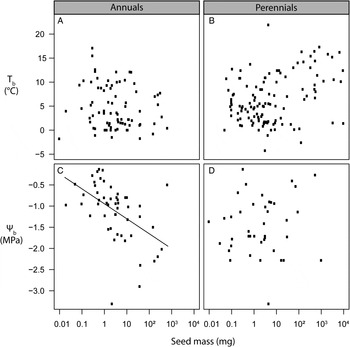
No significant relationship was found between base temperature and seed mass in either the annual (Fig. 1A) or perennial data subset (Fig. 1B). We found a significant negative relationship between ψb and seed mass only in the annual data subset (Fig. 1C), while perennials did not show any relationship (Fig. 1D).
Phylogenetic least square regression of the base temperature (T b) on seed mass (log10 transformed); (A) across the annual data subset (n = 82; not significant, n.s.) and (B) across perennial data subset (n = 121; n.s.). Ordinary least square regression of the base water potential (ψb) on seed mass (log10 transformed); (C) across the annual data subset (n = 52 ; R 2 = 0.23 ; slope = –0.36 ; P < 0.001) and (D) across perennial data subset (n = 41; n.s.).

Separate analyses for the four biomes showed a negative relationship between T b and seed mass in the nemoral (n = 112, R 2 = 0.093, slope = –1.28, P < 0.01) and Mediterranean biomes (n = 50, R 2 = 0.22, slope = –2.18, P < 0.001) but not in dry or wet tropics. In contrast, we found a positive relationship between T b and seed mass for the dry tropic biome (n = 11, R 2 = 0.55, slope = 3.17, P < 0.01) and no relationship in the wet tropic data set. The regression analyses between ψb and seed mass revealed a significant negative relationship in nemoral (N = 36, R 2 = 0.114, slope = –0.201, P < 0.05) and Mediterranean biomes (N = 34, R 2 = 0.16, slope = –0.302, P < 0.05) but no significant relationship for data from dry or wet tropics.
When we separated annual from perennial plants within biomes, our analyses showed significant negative relationship between Tb and seed mass only for perennial plants from the nemoral biome (N = 70, R2 = 0.16, slope = −1.43, P < 0.001) and annual plants from the Mediterranean species (N = 35, R2 = 0.26, slope = −2.06, P < 0.01) but a positive relationship for perennials from the dry tropics (N = 8, R2 = 0.54, slope = 3.589, P < 0.05). The other combinations of lifespan x biome types had few data points and yielded no significant test.
The regression analyses between ψb and seed mass revealed a significant negative relationship for Mediterranean annuals (n = 26, R 2 = 0.26, slope = –0.37, P < 0.01). There was no relationship for nemoral and tropical plants. None of the regression results related above changed when we used minimum instead of mean values for T b and ψb (see Supplementary Material).
Discussion
Evolution of base temperature and base water potential
Here, we provide first evidence of a phylogenetic signal in base temperature, a key temperature-related germination trait, in a worldwide data set for seed plants. This suggests that germination traits related to temperature are more phylogenetically conserved than base water potential and show a phylogenetic signal as strong as seed mass.
The strong phylogenetic signal of base temperature for germination may be the result of a multitude of different enzymatic processes involved in germination itself (Holdsworth et al., Reference Holdsworth, Finch-Savage, Grappin and Job2008), each based on many different proteins having their own thermal characteristics (Daniel and Danson, Reference Daniel and Danson2010). Thermal characteristics of enzymatic processes may receive contrasting selection pressures, since several of the involved proteins are also expressed in later life stages (Schmid et al., Reference Schmid, Davison, Henz, Pape, Demar, Vingron, Schölkopf, Weigel and Lohmann2005) and are thus part of a plant's general adaptation to temperature. Our findings develop and extend data presented by Rosbakh and Poschlod (Reference Rosbakh and Poschlod2014), who found no phylogenetic signal using Blomberg's K statistic for 50 species but found significant differences among some plant families for ‘initial temperature’, i.e. the lowest temperature at which they observed germination. Our results go beyond previous findings since we used base temperature, T b, which is known to be a fundamental physiological trait synthesizing the response of germination to temperature (Trudgill et al., Reference Trudgill, Honek, Li and Straalen2005). In addition, we used Pagel's λ to quantify phylogenetic signal, which is more efficient than Blomberg's K (Münkemüller et al., Reference Münkemüller, Lavergne, Bzeznik, Dray, Jombart, Schiffers and Thuiller2012) in the detection of the phylogenetic signal. It has been shown that T b and ψb change according to dormancy status of the seed lot (Batlla and Benech-Arnold, Reference Batlla and Benech-Arnold2003; Bair et al., Reference Bair, Meyer and Allen2006), and one might argue that this impedes their use in comparative studies. However, studies on germination in Silene (Thompson, Reference Thompson1970a,b) showed that fresh seed lots showed more contrasted germination niches in terms of minimum and maximum temperatures for germination compared with seed lots in which dormancy was alleviated by dry storage. Comparable analysis of traits brings important understanding of plant function although they are variable, e.g. specific leaf area also shows large variation in values according to water status of leaves, plant growing conditions, but which do not change the relative ranking of species (Roche et al., Reference Roche, Diaz-Burlinson and Gachet2004). Moreover, the strong phylogenetic signal across a large data set indicates that base temperature for germination has a species-specific value that varies in a small range, and our data indicate that closely related species can be a predictor of that value.
The greater evolutionary lability of ψb can be understood as a consequence of more rapid local adaptation in response to a rapid shift in moisture conditions of the environment and its high spatial variability. Although there are no data on rapid evolution and local adaptation for ψb itself, studies on other drought resistance traits show their high heritability and rapid evolution (Thomas, Reference Thomas1990). Moreover, Agrawal et al. (Reference Agrawal, Johnson, Hastings and Maron2013) have shown rapid evolution of life history traits in the evening primrose Oenothera biennis (Onagraceae), partly due to genotypic variation in seed germination. Thus it seems possible that ψb varies greatly among populations of closely related species due to rapid evolution, overriding a long evolutionary history.
Base temperature and seed mass
Here, we provide evidence that the base temperature T b increases weakly with seed mass across all angiosperms, but this pattern appears to be related to larger seed mass of tropical compared with temperate clades and becomes non-significant when phylogeny is taken into account. When separating these data for different biomes, base temperature decreases with seed mass in seasonal climates, this relation being stronger for perennials than for annual plants in the nemoral biome, and stronger for annuals than for perennial plants in the Mediterranean biome. A plausible explanation for a stronger effect for perennials is that perennial plants cannot escape extreme temperatures such as frost since they usually must grow for at least two growing seasons before reproduction, spanning times of frost or drought, which annuals can overcome in the soil seed bank. A higher base water potential of perennial plants may contribute to later germination and this leaves time for potential dispersal to a wetter site. The necessary important short-distance dispersal in the seed bank has been quantified by Olano et al. (Reference Olano, Caballero and Escudero2012). This idea is also sustained by research showing that seedlings in their first year are highly vulnerable to climatic hazards (Lodge and Whalley, Reference Lodge and Whalley1981). Germination timing should thus coincide with seasons that optimize survival of seedlings to following climatic hazards (Baskin and Baskin, Reference Baskin and Baskin2014). This is in line with the observation that seedlings of perennials allocate most seed resources to survival in contrast to annuals, which allocate more to growth and reproduction (Primack, Reference Primack1979; Garnier, Reference Garnier1992) and invest more in extensive root systems (Roumet et al., Reference Roumet, Urcelay and Diaz2006). Since seedlings from larger seeds also survive frost better (Aizen and Woodcock, Reference Aizen and Woodcock1996), it becomes plausible that adaptation to different temperatures is influenced by seed size.
In our data set for perennials, the lower base temperature of large compared with small seeds suggests that they can germinate at colder temperatures than small seeds. Germination at colder temperatures exposes seedlings necessarily to colder initial environments or even to higher risks of frost. However, some seeds of winter annuals can be very small (e.g. Carophyllaceae, Brassicaceae) and seedlings live and grow even under snow (Baskin and Baskin, Reference Baskin and Baskin2014). Larger seeds might withstand these adverse seasons better by allocating more seed resources to adaptations against cold temperatures (Canham et al., Reference Canham, Kobe, Latty and Chazdon1999), such as larger root systems, higher tissue density, apoplastic proteins and increased concentration of soluble sugars (Larcher, Reference Larcher2003). Annuals also show a larger and less predictable realized climatic niche compared with perennials, resulting in lower vulnerability to climatic changes (Broennimann et al., Reference Broennimann, Thuiller, Hughes, Midgley, Alkemade and Guisan2006; Hanspach et al., Reference Hanspach, Kühn, Pompe and Klotz2010; Boulangeat et al., Reference Boulangeat, Lavergne, Van Es, Garraud and Thuiller2011), again increasing the range of optimal temperature conditions at germination initiation. Altogether, this suggests that seedlings and juveniles from perennial plants are subject to stronger selective pressures with regard to temperature conditions than annuals, leading to a narrower range of temperatures for germination, and hence their optimal temperature for germination is influenced by seed size.
In Mediterranean climates, small-seeded species displayed higher base temperature values than large-seeded species. For Mediterranean annual species, Marañón and Grubb (Reference Marañón and Grubb1993) showed that small-seeded species had higher relative growth rate (RGR) than large-seeded species. Therefore, small-seeded species could delay germination with higher value of T b and accomplish the life cycle before drought. On the other hand, to complete their life cycle, large-seeded species with smaller RGR might germinate earlier by lower values of T b than small-seeded species.
In tropical climates, larger seeds are more weakly associated with higher germination temperatures than small seeds, which leads to slower germination for larger seeds compared with small seeds. Also, larger seeds have been shown to germinate more slowly than small-seeded species (Norden et al., Reference Norden, Daws, Antoine, Gonzalez, Garwood and Chave2009). Thus larger seeds slow germination by increasing the germination temperatures. Whereas the evolutionary constraints for slower germination of larger tropical tree seeds still need to be studied, previous work suggests a positive relationship between small seeds and high drought sensitivity (Daws et al., Reference Daws, Crabtree, Dalling, Mullins and Burslem2008). This suggests that smaller seeds select for faster development in order to escape unfavourable conditions.
Base water potential and seed mass
The base water potentials (ψb) of seed plants, and especially those from Mediterranean climate zones, show that ψb decreases with seed mass. However, our analyses also highlight that lifespan critically influences this relationship, since only annual plants show a base water potential–seed mass relation in our data set.
A lower base water potential enables seed populations to germinate earlier and faster under dry conditions, as suggested by hydrotime models (Bradford, Reference Bradford2002). By germinating under drier conditions, seedlings from seeds with low base water potential are exposed to higher risks, since subsequent dry conditions or droughts might kill them (Daws et al., Reference Daws, Crabtree, Dalling, Mullins and Burslem2008; Mollard and Naeth, Reference Mollard and Naeth2015). However, earlier germinating seedlings might also have higher fitness (Luis et al., Reference Luis, Verdù and Raventós2008), because they produce more offspring and are larger or have higher survival rates at the end of the first growing season. Larger seeds are known to generate seedlings with higher survival rates in dry environments (Leishman and Westoby, Reference Leishman and Westoby1994) and are even known to be associated with drier environment in local moisture gradients (Baker, Reference Baker1972). This makes it clear that lower base water potentials enable large-seeded plants to exploit the advantages of the drought adaptation larger seeds confer on them. This is clear for the Mediterranean subset of our data, but probably applies to all climates with a marked dry season. The higher drought resistance of seedlings from larger seeds may be explained by their capacity to store more water or develop a more extensive root system, exploring larger volumes of soil to counterbalance lack of water (Leishman and Westoby, Reference Leishman and Westoby1994; Saverimuttu and Westoby, Reference Saverimuttu and Westoby1996).
Models of evolution of seed banks suggest that large seeds act as a risk-reducing trait to withstand unpredictable drought and diminish the importance of other risk-reducing traits such as seed banks or dispersal (Venable and Brown, Reference Venable and Brown1988; Philippi and Seger, Reference Philippi and Seger1989). High base water potential might also be a risk-reducing trait: it will lead to germination in much moister conditions and in this way prevent seedlings from being exposed to dry conditions in the beginning. In this sense base water potential and seed size can be seen as alternative risk-reducing traits. In contrast to annual plants, perennials rely on a longer lifespan and reproduction at greater age due to adaptations permitting their persistence through adverse seasons, such as storing organs, extensive root systems, dormant buds or extreme drought resistance (Larcher, Reference Larcher2003). These adaptations might further decrease the importance of adaptations at the seed stage due to selective interactions (Venable and Brown, Reference Venable and Brown1988) and hence might lead to the observed picture of no relation between seed size and base water potential in perennials compared with a negative relation for annuals. Finally, since water conditions show a much higher inter-annual and spatial variability than temperature conditions, the resulting contrasting selective pressures for ψb may also contribute to the absence of phylogenetic signal in ψb. Moreover, our data suggest that the adaptive value of ψb differs between annuals and perennials. Since the shift from perennials to annuals is a frequent convergent feature in many seed plant lineages, this additionally contributes to the evolutionary lability of ψb.
When we separate different biomes, the importance of the seed-size water-potential relationship varied among biomes and our analyses highlight its importance for the Mediterranean and nemoral climate. Moreover, data for tropical pioneer trees also suggest that high base water potential for germination avoids germination in dry environments even for these perennial plants, for which small seeds have higher base water potential (Daws et al., Reference Daws, Crabtree, Dalling, Mullins and Burslem2008). The negative relationship between seed size and base water potential for tropical pioneer trees is blurred in our data set by data from tropical plants from other habitats than pioneer trees, and we were thus not able to retrieve the same relationship.
Thermal aspects of germination niche, in contrast, have been proposed to be a close covariate of a plant climatic niche (Rosbakh and Poschlod, Reference Rosbakh and Poschlod2014), which is known to be highly phylogenetically conserved (Prinzing et al., Reference Prinzing, Durka, Klotz and Brandl2001; Qian and Ricklefs, Reference Qian and Ricklefs2004; Schnitzler et al., Reference Schnitzler, Graham, Dormann, Schiffers and Peter Linder2012), as the result of historical-geographical constraints on niche evolution. Clearly, this reflects in our data set into higher T b for tropical compared with temperate species and between tropical and temperate seed plant clades (Supplementary Fig. S3). This gives support to the idea that T b evolved in response to similar selection pressures as the plant's climatic niches when comparing tropical with temperate species.
Base temperature turned out to be as phylogenetically conserved as seed size, implying that thermal aspects of regeneration by seeds might show slow adaptation and therefore be associated with high species replacement along gradients. Future studies might evaluate if changing the time for germination by modifying the level of dormancy can compensate and make seeds germinate in seasons or burial depths in accordance with their thermal germination requirements (Donohue et al., Reference Donohue, Rubio de Casas, Burghardt, Kovach and Willis2010; Saatkamp et al., Reference Saatkamp, Affre, Baumberger, Dumas, Gasmi, Gachet and Arène2011a). Water relations turned out to be more labile and seem to compensate for the evolutionary conservation of seed sizes; if this compensation mechanisms holds true, base water potential should increase in environments with decreasing moisture or increasing rainfall variability and be one of the traits increasing soil seed banks as a risk dispersion mechanism (Venable, Reference Venable2007; Saatkamp et al., Reference Saatkamp, Affre, Dutoit and Poschlod2011b; Saatkamp et al., Reference Saatkamp, Poschlod, Venable and Gallagher2014; Huang et al., Reference Huang, Liu, Bradford, Huxman and Venable2016).
Supplementary material
To view supplementary material for this article, please visit: https://doi.org/10.1017/S0960258517000083
Acknowledgements
We thank Michael Paul for revising the English of our manuscript. A.S., L.A. and F.A. were supported by the Région Provence-Alpes Côtes d'Azur, Gévoclé program, and Aix Marseille Université; A.S. and A.D. are funded by the European Union ENPI CBC-MED GREAT-MED program. The authors declare no competing interests.