The 1950s stand out as the “Golden Years” in the collective memory of many Brazilians. Sandwiched between the authoritarian periods of the Estado Novo dictatorship led by Getúlio Vargas (1937–45) and a military dictatorship (1964–85), the decade was a time of great optimism for the country's future. Many hoped that the country would enjoy a lasting democratic system accompanied by the ever-increasing trappings of modernity. Indeed, a surge of economic growth and industrial development during Vargas's return as a democratically elected president (1951–54), followed by a massive industrialization program crowned by the construction of the ultramodern capital of Brasília under Juscelino Kubitschek (1956–61), gave true believers reason for optimism.
Adding to the era's allure, Hollywood stars made the posh hotels, nightclubs, and beaches of Rio de Janeiro's upscale Zona Sul a playground of international glamor and intrigue. The sounds of bossa nova, which had taken the world by storm, provided the soundtrack for the country's push for progress. With Brazil now at center stage of all things fashionable, many felt certain that the country was finally taking its place among modern nations and leaving its backward agricultural past behind.
The era's notable accomplishments, however, could not negate the unintended consequences of uneven development, nor hide the centuries-old legacies of extreme inequality. Brazil's cities, especially Rio and São Paulo, groaned under the weight of millions of destitute migrants pouring in from the countryside, many fleeing starvation from the chronically drought-stricken and underdeveloped Northeast. In Rio, many of these newcomers packed into hillside shantytowns called favelas, which grew to previously unimaginable proportions. Meanwhile on the city's periphery, large numbers of new arrivals began to settle increasingly further from the city center, converting rural areas into urban sprawl as far as the eye could see. Paul Gillingham and Benjamin Smith observe that the magnitude of societal transformation that resulted from this rapid large-scale industrialization and urbanization is better understood in terms of a longue-durée epoch, indicating a rate of change normally measured in centuries or more.Footnote 1 Brazil, along with other countries of Latin America, experienced this shift in the span of a few short years.
Overwhelmed by these unforeseen developments, Rio's elite and middle classes scapegoated the newcomers for the unintended consequences of uneven modernization policies.Footnote 2 The affluent classes resented the urban blight caused by the increasingly ubiquitous colonies of shacks on the hillsides and on the city's periphery. They agonized over the increased demand on already limited resources and feared the newcomers for what they perceived as their propensity for criminality and violence. Consequently, the elite reacted by isolating the newcomers and their new shantytowns as much as possible.
Recent scholarship has explored the conceptual framework of inventions, the complex processes through which elite groups identify, stigmatize, and segregate lower-class groups and the places they inhabit. By propagating selective myths and stereotypes of both a place and people, mainly through various forms of media, elite groups set into motion a negative feedback loop of environmental, social, and racial determinism: the people define the place, and the place defines the people. With the space thus “invented” and its residents effectively marginalized, the area can be effectively cordoned off socially, and at times physically, and its inhabitants more easily contained within that space. Inventions, however, are not simple matters of top-down control, as Durval Muniz de Albuquerque Jr. demonstrated in The Invention of the Northeast. Footnote 3 They involve the interplay of many competing interests, conflicting political and economic agendas, hegemonic negotiations, official and de facto government policies, and the tacit or unwitting participation of the target group itself. Despite intensive rivalries within the elite and the absence of a master plan, inventions are social constructs that ultimately work to uphold elite interests and maintain the status quo.
This article explores the invention of the Baixada Fluminense, the predominately urbanized lowlands which lie just north of the city in the state of Rio de Janeiro. This region, a periphery of a periphery of Rio, epitomized the metamorphosis of the urban fringe that began in the mid twentieth century.Footnote 4 The invention of the Baixada was itself linked to two other previous inventions: the favela and the Brazilian Northeast.Footnote 5 Albuquerque Jr. argues that Brazilians began to think about the Northeast as a distinct social and geographic space in the first decades of the twentieth century, when various forms of media beholden to the dominant elite of the Rio-São Paulo metropolitan axis led an intensive campaign of “othering” against the region. Of course, Northeasterners themselves participated in this process as well. For example, novelist José Lins de Rego, a vocal critic of discrimination against the region, nevertheless contributed to its social construction through the glorification of its past—a glorification that incorporated many of the stereotypical characterizations propagated by those in the Southeast.Footnote 6
Lidia do Prado Valladares, taking a similar approach in The Invention of Favela, chronicles the ongoing social, political, and cultural processes that contribute to the creation and perpetuation of the “favela” and its separation from the “formal” city. Tracing the origins of favela to the first decade of the twentieth century, Valladares analyzes numerous policies and debates that have identified these communities and contributed to their social separation. For example, she notes that during the democratic era of mid-century, elites began to see favela residents as potential participants in the political process rather than as simply a threat to their security. Nevertheless, she notes that social separation carried on as usual, as this re-characterization tended to brand them as vulnerable to manipulation by populist demagogues, and by implication, incapable of acting in their own interests.Footnote 7
Both authors demonstrate that various forms of the media beholden to elite class interests of metropolitan Rio and São Paulo played a central role in the development and propagation of negative stereotypes about the favela and the Northeast. Both regions became associated with filth, violence, criminality, poverty, disease, and racial degeneration.Footnote 8 In the 1940s, when millions of Northeasterners began to migrate into the shantytowns of Rio and São Paulo, elites associated the new favelas with these same negative characteristics. The invention of the Baixada drew on these existing and widely accepted stereotypes of the Northeast and favelas, but it also constituted a new development in the stigmatization and isolation of a lower-class people and place.
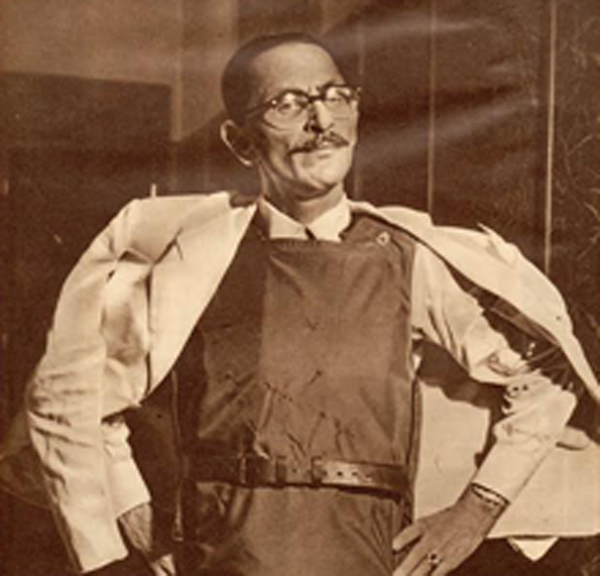
Enter Natalício Tenório Cavalcanti de Albuquerque (1909–87), a pistoleiro (gunman) turned congressman from the Baixada municipality of Duque de Caxias, who became a point of convergence for the issues surrounding the rapid social change of the 1950s on both the local and national levels (see Figure 1).Footnote 9 As a migrant from the Northeast with a well-earned reputation for violence and eccentricity, he flew headlong against the national program of modernity, making him the most unlikely of candidates for national celebrity status. However, he also became the most visible figure of his party, the socially conservative União Democrática Nacional (National Democratic Party, or UDN), often surpassing party firebrand Carlos Lacerda in terms of media attention, much to the disgust and horror of many of his fellow udenistas. Footnote 10 Yet, it was precisely his outlandishness that caused the country to become transfixed on the “Man in the Black Cape” and his ever-present sidekick “Lurdinha,” a Nazi-era MP-40 submachine pistol. Riveting the country with their reports of shootouts, ambushes, and drive-by machine gun assassinations, the media could not get enough of the “Congressman from Caxias” and the Baixada, which it rebranded as Brazil's Wild West.
Tenório Wearing Bullet-Proof Vest, 1953

Through an examination of Tenório's early career, and a series of events in late 1953 in particular, this article demonstrates the intricate processes of the invention of the Baixada. By focusing on Tenório's complicated relationships with the media and his party, his rise to national prominence, and the selective way that the expanding and powerful Carioca media portrayed him and his region, I argue that various actors with diverse and conflicting interests contributed to the creation and perpetuation of class-based stereotypes of the Baixada, serving the interests of the Rio-São Paulo metropolitan elite and contributing to the region's marginalization.Footnote 11 To understand this complex process, we must first examine the many entangled roots of the social creation of the Baixada, including the “invention” of Tenório Cavalcanti himself.
Setting the Stage: Rio, the Baixada Fluminense, and the Northeast
The Baixada Fluminense, roughly translated as the “Rio de Janeiro lowlands,” consists today of nine predominantly low-lying municipalities that lie beyond Rio's northern city limit but within the state of Rio de Janeiro.Footnote 12 The informal region stretches from the uppermost reaches of Guanabara Bay in the east, and follows the northern boundary of the state of Rio de Janeiro to the furthest extremes of the city's western zone (Zona Oeste) and beyond. Moving north away from Rio, the region changes from one of completely urbanized flatlands to unpopulated mountainous wilderness in the outermost reaches of the larger municipalities of Duque de Caxias and Nova Iguaçu.Footnote 13 According to the 2010 census, the region had a population of 3,366,280 inhabitants—more than half that of its neighboring city of Rio de Janeiro— representing a staggering 2,400-percent increase in population since 1940, when the region consisted of a smattering of small towns and rural holdings totaling 140,606 residents. By 1960, just 20 years later, the region had already swollen by over 600 percent to 883,298 inhabitants, transforming its rural landscape into a massive urban sprawl and stretching available resources far beyond capacity.Footnote 14
The Baixada's geography has factored heavily into its special but often strained relationship with Rio proper. The region almost completely surrounds the city by land, ensuring that anyone traveling to or from the interior passes through its historically difficult and dangerous terrain. Notorious during the colonial and imperial periods as a swampy, disease-infested haven for highwaymen, shady tavern owners, and marauding runaway slaves, the Baixada has long endured an unsavory reputation.Footnote 15 This sordid past has contributed to its occupying the lowest position in the informal social hierarchy of the city of Rio and its outlying areas, beneath the city's Zona Sul, Centro, Zona Norte, and Zona Oeste, respectively.Footnote 16
This longstanding negative characterization, however, denies the region's complexity. The Baixada is not a favela (although many exist throughout the region), nor a suburbio, despite its often being lumped in with the working-class suburbs that predominate in Rio's North and West Zones. Nor is it comprised wholly of destitute migrants from the Northeast and their descendants.Footnote 17 It is, in fact, home to many middle- and upper-class neighborhoods, boasts numerous industries, and serves as a major hub for highway transportation. Nevertheless, the rapid and near complete urbanization that overwhelmed the region at mid-century not only confirmed its reputation for those predisposed to see it as a haven for violence, but also ensured that the Baixada would not emerge as a winner in the industrialization and modernization processes.
The path of the region's development, however, was not a foregone conclusion, nor did it go uncontested. Middle-class and elite boosters in the region during the 1950s, for example, sought to create a new identity for their municipalities, one that reflected their worldview, with the goal of rehabilitating the Baixada's reputation. Visionaries from Duque de Caxias, for example, saw an opportunity to get their municipality on the modernization bandwagon. They reasoned that its proximity to Rio, its flat terrain, and its relatively cheap real estate, along with its numerous transportation and infrastructure development projects in the works, meant that Caxias could be fashioned into a US-style suburb, thus keeping pace with the developed world. The newspaper Folha de Caxias and the Caxias Chamber of Commerce led the way in the battle for respectability.Footnote 18 The newspaper frequently featured editorials heralding the municipality's thriving business community, posted advertisements for future middle-class housing developments, and fended off attacks and slights directed against the municipality and the region.Footnote 19
Nevertheless, the circumstances that conspired against these proponents of gentrification, including the region's reputation for violence, an epidemic of shady real estate practices, and the increasing influx of destitute internal migrants, ensured that their vision did not stand a chance. They also discovered that their most implacable foes were their class counterparts in the city of Rio, who were already predisposed to scorn the region. The Carioca press, when it reported on the region at all, highlighted crime, real estate scams, dysfunctional local governments, and its infrastructural problems.Footnote 20 Indeed, the Folha de Caxias was no match for the powerful Carioca press, which leveraged national influence and wielded the ability to shape public opinion. Viewing the happenings in the region as anathema to the vision for Rio that it promoted for its own city, the Carioca press simply conflated the seedy reputation of the Baixada and the well-established negative stereotypes of the Northeasterner, while ignoring the region's middle class. The Baixada's promoters, in the face of such a powerful press, were powerless to stop it.Footnote 21
The issues surrounding the relationship of the Baixada and Rio proper in the 1950s occurred in the context of a long-running struggle between the Northeast and the Southeast for political, economic, and cultural dominance of the country. For centuries the economic engine of Brazil, the Northeast was in full decline by the 1950s, having been eclipsed by the Southeast in both agriculture and industry.Footnote 22 Faced with few development projects and much hardship, millions of people loaded themselves onto the backs of trucks to seek opportunities in Rio and São Paulo. The rough-and-tumble rural Northeast, it seemed, was moving south.Footnote 23 The Baixada, with its available space, burgeoning industries, and access to Rio by rail, quickly became a principal destination of the newcomers.Footnote 24 As fortune would have it, the region housed the terminus of the newly inaugurated Rio-Bahia highway (ironically, built to stimulate development in the Northeast), which inadvertently encouraged settling in the region.Footnote 25
In spite of Rio and São Paulo's growing need for industrial workers, these newcomers received a less than enthusiastic welcome from middle-class residents of those cities, who as Barbara Weinstein argues, often saw them as buffoonish and dangerous, and in extreme cases as foreigners or even as members of a “sub-race.”Footnote 26 Meanwhile, elite industrialists (especially in São Paulo, while happy enough to take advantage of the growing pool of cheap labor, viewed the Northeast as a socially backward economic burden. The São Paulo elites, erronously, blamed the region for hindering economic progress and disproportionately draining its share of country's wealth, which the industrialists believed they had almost exclusively produced.Footnote 27
The fears and frustrations of many in the Rio-São Paulo metropolitan axis with regard to the Northeast became embodied in a tradition of high-profile “villains” who served as all-encompassing scapegoats for the country's problems. Albuquerque Jr. and Valladares both acknowledge the role of the millenarian uprising led by Antônio Conselheiro at Canudos, Bahia (1896–97) in the inventions of the favela and the Northeast. More precisely, they observe that Euclides da Cunha's widely read account of the events at Canudos, Os sertões (The Backlands) (1902), unwittingly served as a benchmark for Northeastern stereotypes.Footnote 28 A generation later, the widespread practice of banditry known as cangaço, epitomized by the legendary bandit Lampião, stigmatized the region's image. Personified by these notorious figures, the “unruly” Northeast for many signified a thorn in the side of the country's social progress.Footnote 29 The military razed Canudos after four major campaigns and cangaço came to an end in 1940 with the assassination of Corisco, the most fearsome of Lampião's lieutenants. Their legacies, their use in the marginalization the Northeast, as well as the underlying environmental, economic, and social issues that spurred these movements into existence continued, with no end in sight.
The ghosts of Conselheiro and Lampião may have had the last laugh, however, with the Northeastern “invasion” of Rio and São Paulo during the mid twentieth century.Footnote 30 Consequently, it did not take long for another Northeastern “villain” to appear in the context of the changing times. Tenório, an urbanized Northeastern migrant who carried a machine gun and managed to access the mechanisms of legitimate power as a federal congressman, served as the Northeast's latest, modern monster. But this time, instead of terrorizing the distant backlands of the Northeast, this next-generation bogeyman and his minions moved closer: they encamped at the gates of the capital.
Tenório, the UDN, and the Press
Long before Tenório became a cultural phenomenon, he was one of the countless people fleeing the deteriorating conditions of the Northeastern interior. Born in 1909 in the backlands of the state of Alagoas to a family who owned a general store, he enjoyed some modest resources, including the political connections of distant relatives. As a result, he was poor but not destitute when he moved to Rio in the late 1920s. After working at various odd jobs, he became a property manager in the Baixada, where he organized firewood collection and fought off land-grabbers, the latter actions resulting in numerous violent confrontations that culminated in full-blown land wars. Tenório had plenty of opportunities to perfect his skills with firearms against fearsome rivals, becoming a respected figure in his own right. He eventually amassed a small fortune through land acquisitions of his own and moved to the small town of Duque de Caxias, where he opened a construction supply business and began to dabble in local politics in the mid 1930s.Footnote 31
Tenório's fortunes changed, however, with the onset of the Estado Novo in 1937. Problems began when Vargas, now dictator, appointed his son-in-law Ernâni de Amaral Peixoto as Rio's interventor, a state chief executive answerable to only Vargas. Amaral provided Tenório's business competitors, who happened to be loyal supporters of the interventor, with advantages—at Tenório's expense. Not one to take such matters sitting down he became an outspoken enemy of Amaral, his fearsome enforcer, the state chief of police Agenor Barcelos Feio, and the Estado Novo in general. As a result of his opposition, Tenório suffered several assassination attempts and endured beatings by police in the regime's notorious prisons.Footnote 32
On the other end of the political spectrum, the elite Carioca press also found itself in the Estado Novo's crosshairs. Vargas understood the potentially devastating power of an unfavorable press and consistently maintained a hard line with the entire group.Footnote 33 As the capital's press elite became increasingly critical of him, he responded with onerous restrictions and escalated levels of intimidation.Footnote 34 The case of José Eduardo Macedo Soares, the owner of the Diário Carioca, epitomizes this acrimonious relationship. Tension between the two came to a head in 1944 when Macedo Soares, unrelenting in his criticism of the Estado Novo, suffered a brutal attack by thugs in the service of the dictator. As the newspaper owner convalesced in the hospital, Tenório paid him a visit, introducing himself as a kindred spirit in the struggle against the dictatorship and offering his protection services.Footnote 35 The relationship between Tenório, a Northeastern upstart of modest origins, and Macedo Soares, the scion of an old aristocratic family from the state of Rio, exemplifies how the Estado Novo unified those opposed, oppressed, or excluded, despite the numerous differences that otherwise would have likely precluded such an alliance.
By late 1945, the Estado Novo had begun to collapse. Vargas, in a desperate bid to hold onto the presidency, legalized political parties. The gambit failed, and he was removed from office by a coup shortly thereafter. Nevertheless, the three major parties that emerged, the Brazilian Labor Party (Partido Trabalhista Brasileiro, or PTB), the Social Democratic Party (Partido Social Democrático, or PSD), and the aforementioned National Democratic Party (UDN) served as the cornerstones of the 19-year democratic period that followed. The first two parties consisted of Vargas supporters of different interests: the PTB championing the working class; the PSD representing segments of the middle and upper classes; and the UDN, which served as an umbrella for people and groups of all stripes that had an axe to grind against the former dictator. Tenório and Macedo Soares, along with virtually all the owners of the Carioca presses, joined the UDN upon its inception in 1945. The party quickly shed all but its socially conservative elements, but it retained the services of Tenório, seeing his influence in the increasingly important Baixada as an asset.
The introduction of this democratic system complicated matters for the elite of the Rio-São Paulo metropolitan axis. As the new parties sorted out their political identities and courted the electorate, the electoral importance of the growing urban working class became increasingly apparent, resulting in a shift towards populist politics. This development was particularly problematic for the UDN, whose platform ran counter to trends resulting from the large-scale social and demographic transformations under way at the time. Aghast at even the thought of courting the urban working class, the party suffered repeated losses at the ballot box, particularly in the face of the strong pro-Vargas PTB-PSD alliance that endured for most of the 1950s. The UDN desperately needed to establish a connection with the swelling ranks of the working class, but its unwavering principles required that it do so without compromising its conservative and elitist social agenda. It had a powerful trump card, however, in the support of much of the country's media, especially the Carioca press.Footnote 36 Still, the party needed votes from the urban working class if it hoped to survive. Tenório quickly came to function as a link between the two groups in the Baixada and, with the help of the press, as a de facto general connection with the working class.
Tenório's alliance with Macedo Soares and the UDN began to bear fruit in July 1945 when Tenório, after suffering an assassination attempt, first appeared in the Diário Carioca. The newspaper described how “troublemakers in the service of the Rio state government” provoked the confrontation by trying to prevent Tenório from establishing a UDN campaign office in the municipality.Footnote 37 The situation escalated, culminating in an ambush that killed one and wounded four others, including Tenório himself, who suffered life-threatening injuries.Footnote 38 The Diário Carioca portrayed Tenório as a wounded hero in the struggle for democracy and published positive stories in a similar light for much of the following year. It also framed the conflict in Caxias as “political cangaço,” blaming Amaral for the “completely unacceptable” insecurity at the gateway to the capital.Footnote 39 This coverage allowed readers the opportunity to follow the drama and become acquainted with its principal protagonist, Tenório, as well as his (and Macedo Soares's) enemies. It also openly associated the Baixada with negative Northeastern stereotypes, a characterization that quickly gained traction in the print media.
When Tenório became a state deputy in 1947, the Diário Carioca frequently reported on his speeches on the floor of the state legislature. During this early phase of his career, coverage was somewhat balanced. For example, the newspaper published his commentary regarding such commonplace topics as the need for a waterworks in Duque de Caxias and other day-to-day concerns.Footnote 40 Tenório became aware, however, that flamboyant behavior attracted more attention, and he ratcheted up his rhetoric accordingly. The daily was all too happy to print his diatribes against the large-scale graft and corruption for which the Amaral faction had earned notoriety, at least in the eyes of the UDN.Footnote 41 By the end of his tenure as a state deputy in 1951, rarely a week passed without one of Tenório's “grave accusations” appearing in the newspaper.Footnote 42
Other Rio newspapers followed the Diário Carioca's lead, taking a greater interest in the region. By focusing on the personalities involved in the conflicts, sensationalizing the violence, and framing it in the language of wildly popular Western movies (and occasionally gangster films), the carioca press became morbidly fascinated with the region.Footnote 43 For example, in a man-on-the-street style interview conducted by the Diário de Notícias, a respondent declared that “the law does not enter here … Dr. Tenório is the man who calls the shots in Caxias.” O Globo, leading with alluring headlines such as “The Politics of Blood, Hate, and Death” and “Commerce in Human Life,” reported that residents from the Northeast opined that the violence in the Baixada was “worse than the [Northeastern] backlands,” from which many had fled. References to Tenório as a “suburban-style Al Capone” and Caxias as Brazil's Wild West only whetted the public's appetite for more action in the Baixada.Footnote 44
This dramatic reporting of the violence just beyond the gates of the capital fell into an established framework of reporting on spaces in the processes of becoming marginalized. Lidia do Prado Valladares argues that in the early decades of the twentieth century the print media characterized favelas as being beyond the reach of official state authorities where a strongman from outside imposes order. She also observes that type of coverage is part of a formula of “othering” that dates back to Canudos and its aftermath.Footnote 45 The depictions of Tenório and the Baixada in the Wild West motif served in this evolving process, but did so in a modern, almost lighthearted way by incorporating the worldwide popularity of movies about the US West at the time. This style of reporting also reflected the multiple agendas in play. The UDN found a way to connect with the growing working class and win votes without compromising its socially conservative agenda; the Carioca press found (or created) a hot story while supporting its party, and Tenório's public visibility increased. By employing easily recognizable formulas that had been used to write about favelas and the Northeast for decades, however, this selective and stylized reporting stigmatized the Baixada and its people.
O Cruzeiro and the Invention of Tenório
O Cruzeiro, the country's premier photojournalism magazine, recognized the appeal and significance of Tenório and the Baixada. Effectively co-opting the narrative, it brought Tenório and the Baixada into the national consciousness. Tenório's appearance in the magazine, an unheard-of honor for anyone other than an international celebrity or its equivalent, introduced the country to the star of Brazil's Wild West show. By mid decade, scarcely an issue went by without at least a cameo appearance of the “Congressman from Caxias.”Footnote 46 O Cruzeiro's coverage of Tenório largely followed the formula of marginalization discussed earlier, but, in light of the new circumstances of the era, did so without overt negativity. The magazine played up Tenório's Northeastern origins by highlighting the violent stereotypes associated with the region and using Northeastern slang (condescendingly) in its reporting. O Cruzeiro's writers did not have to exert much effort, however, because Tenório himself demonstrated great willingness to play the part of the rough-and-tumble Northeasterner who had achieved success through an urbanized version of cangaço, as it fit the image that he wanted to convey to both his constituents and his enemies.Footnote 47
O Cruzeiro, which like most of the press favored the UDN, published its first Tenório feature article shortly after he won a bid for a seat in the national congress in the contentious election of 1950.Footnote 48 By providing the backstory for the struggles for dominance in Caxias and Tenório's long-running conflict with Vargas and his supporters, the magazine set the stage for an ongoing serial of the wild and woolly Baixada. Christening Tenório the “Deputado Pistoleiro” (gunslinging congressman), it opened the article with a photograph of Tenório ducking under a border crossing gate separating Caxias from Rio, stating that “the free territory of Caxias, governed by Natalício Tenório Cavalcanti, begins here.”Footnote 49 With its full-page photographs of Tenório and his trusted bodyguards, all Northeasterners, posing menacingly with their weapons, the article stoked memories of cangaço. The article claimed that, for some, Tenório was “a cangaceiro [bandit] who killed for pleasure or merely to test his marksmanship.” It also noted that one of his most trusted men was the brother of the legendary Corisco, the most feared of Lampião's men, thus establishing a direct connection to cangaço. Going further, O Cruzeiro referred to Tenório as the “president” of the “Republic of Caxias,” very likely an allusion to references sarcastically characterizing Lampião as the “governor of the backlands” two decades earlier.Footnote 50 The magazine also phrased questions in Northeastern slang for effect. For example, a reporter asked Tenório to name the cabra mais macho (manliest tough guy) that he ever had to face in a gunfight. He obliged.Footnote 51
The magazine's follow-up story, “The Lawless Land of Caxias,” took the stereotype of Northeasterners’ violence to new heights by perpetuating the legends of the man and the city, framing the struggle in the now familiar imagery and lexicon of the Wild West.Footnote 52 It also featured Tenório's enemies as part of the cast of characters in the struggle for dominance in Caxias, a rogues’ gallery that included two women, Abigail de Carvalho and Olga Sueli Dantas. The magazine reported that Abigail, the daughter of one of Tenório's archenemies allegedly killed on his orders, had sworn revenge. Printing a photograph of her holding a large revolver, it claimed that she made Tenório “shake with fear upon the mere mention of her name.”Footnote 53 Meanwhile, Olga, the sister of José and Manoel Dantas, two of Tenório's most fearsome foes, achieved fame in her own right by murdering her fiancée and her would-be father-in-law in a fit of rage. Her trial, a spin-off of the Tenório media coverage, captivated the country a few months later.Footnote 54 By enticing a national audience to enjoy the morbid spectacle of the Baixada, O Cruzeiro perpetuated the notion that a line separated (or should separate) the lawful, civilized capital from the chaotic, violent backlands of the Baixada, a place where even women carried guns and exacted blood vengeance.
Tenório as Federal Deputy and the Imperato Affair
Tenório's appearance on the national stage and the public's morbid fascination with the Baixada created a new dynamic for his political career. Nevertheless, the continuing coverage he sought was anything but a certainty. It ultimately hinged on effective service to the UDN. Moreover, he now had to take great care in what he said and did in the presence of reporters, who increasingly sought out the Deputado Pistoleiro, while simultaneously addressing the often legally questionable demands of his personal and political life. It became evident, however, that it was the lawlessness and outrageous behavior that the media sought. Once Tenório got a taste of limelight, he happily obliged by playing up these elements, in spite of the risk of legal exposure to his enemies.
This sensationalizing of the political conflicts in Caxias, nevertheless, was not simply to stage a show. Serious and dangerous tension existed between Tenório and his rivals, becoming exacerbated in 1951 when Tenório's arch-enemies Amaral Peixoto and Barcelos Feio returned to power as Rio's governor and secretary of public security, respectively. By this time, however, the print media was not only poised to capture the unfolding drama and shape it according to its needs, but also ready to contribute directly to the conflagration by stoking the flames of discord. A major crisis began when Barcelos Feio appointed Albino Imperato de Souza, a young and energetic lawman from São Paulo, as Caxias's municipal police chief. His mission was to pacify the unruly municipality and, as Imperato almost certainly understood, to protect the interests of Amaral and Barcelos Feio in Caxias.Footnote 55 Unlike his predecessors, Imperato proved capable of the task. He successfully backed Tenório down on several occasions, earning Tenório's scorn as well as his grudging respect.Footnote 56 The print media, recognizing vast potential for hot copy, quickly framed the conflict in the Wild West motif. On February 2, 1952, the Diário da Noite, epitomizing the spirit of the moment, ran a political cartoon heralding the “Return of the Tenório Kid” in a mock movie poster advertising The Terror of Caxias, co-starring Imperato.Footnote 57 As the crisis worsened over the next year, it became clear that, indeed, there was not room in town for the two of them.Footnote 58
The media's reporting of this new round of tensions reveals yet again how it participated in the creation of the Baixada's negative image. It also demonstrates that the elite, although hardly unified, shared a sense of superiority over the criminals and violent thugs they imagined to inhabit Rio's outskirts. The media's framing of the conflict as one between Tenório, the Northeastern cabra, and Imperato, the lawman from São Paulo, was certainly not lost on many readers. It represented a battle that pitted the chaos and violence of the Northeast against the rule of law, order, and modernity. Although the media never presented the conflict in such flagrant terms, it did not have to. The symbolism was present in tropes and stereotypes now all too familiar, for anyone inclined to see them.
The media, moreover, was not content to wait around for the Wild West show to begin. It practically egged on Tenório to create a spectacle for the entire country by publicly, but subtly, challenging his honor. In O Cruzeiro's February 2, 1952, “Peace Reigns in the Land of Blood,” for example, it suggested that Imperato had gotten the better of him by having largely neutralized Tenório's influence in Caxias, and thereby pacifying the troubled municipality.Footnote 59 It also brought Imperato into the narrative as an increasingly important figure, framing him as the man who could outgun the Deputado Pistoleiro. The magazine's editors, understanding the high level of importance placed on personal honor in the Northeast, very likely wagered that Tenório would react to the provocation. Moreover, Imperato, with no small measure of macheza in his character, was put on the spot as well. Both sides very likely felt pressure to perform (and on a national stage, no less), further reducing the potential for a peaceful resolution to their differences, and, intentionally or not, encouraging further violence in a region already pigeonholed as threatening.
If spectacle was the media's goal, it got its wish. A week after the O Cruzeiro article appeared in print, Tenório and his men stormed into the police station, demanding that Imperato, conveniently being interviewed by reporters at that very moment, arrest one of the Dantas brothers, whom Tenório claimed had tried to assassinate him. Imperato retorted that no evidence existed to implicate the man and that he would not take him into custody. The ensuing argument reached a crescendo when a furious Imperato demanded that Tenório show him proper respect by removing his hat. Reports differ as to whether the lawman knocked the offending hat from Tenório's head, whether it fell off as the result of a shove, or whether he actually capitulated and removed it. Regardless, the hat came off, and the press captured the moment.Footnote 60 Tenório and his men, outnumbered, retreated across the street to the deputy's house-fortress and opened fire on the police station. The firefight terrified reporters, but resulted in no casualties, despite the fact that over 1,000 shots had been fired.Footnote 61
Tenório undoubtedly learned about dangers of the double-edged sword of the media on this occasion. The Deputado Pistoleiro, whom the UDN-leaning press had cultivated as the party's unstoppable force in Caxias, had publicly backed down from a confrontation and was humiliated in the process. If Tenório chose that moment to confront Imperato in the presence of the press with the hopes of garnering publicity or to counter O Cruzeiro's implication that Imperato could hold him in check, the plan had backfired. The UDN-leaning press did not undermine its party's agenda by publicizing the incident and reported on it only minimally.Footnote 62 It did, however, almost completely drop coverage of Tenório, an abandonment that lasted for a year and a half. Even Macedo Soares and the Diário Carioca, Tenório's most loyal and enduring allies, distanced themselves.Footnote 63 The UDN's investment in Tenório as its charismatic tough guy in Caxias, it appeared, had become a liability. He had publicly disappointed the party, and he would be punished for it.Footnote 64
In spite of this embarrassment, many party members certainly breathed a sigh of relief when the media distanced itself from the party's less-than-ideal public spokesman. Many udenistas had become increasingly leery as they watched Tenório overstep his bounds as a local strongman and his fame grow out of proportion to this charge. Putting an epitaph on the Tenório era two weeks later, during Carnaval, the Tribuna da Imprensa featured a photograph of a man with a crutch, wrapped in bandages, riddled with bullet holes, and covered in blood makeup, with the word “Caxias” emblazoned across his chest. There was no mention of Tenório.Footnote 65
O Cangaceiro, the Imperato Affair, and the True Return of the “Tenório Kid”
Tenório may have been pulled from the national stage, but the invention of the Northeast continued unabated during his absence. Epitomizing this trend was the release of O Cangaceiro (1953), a film depicting the life and exploits of the fictitious Capitão Galdino (a thinly disguised Lampião) and his outlaw gang.Footnote 66 The film was an overnight sensation, becoming the movie event of the year in Brazil and going on to win several international awards, including “Best Adventure Film” at Cannes and “Best Motion Picture” at the Edinburgh Film Festival.Footnote 67
As a product of Companhia Cinematográfica Vera Cruz, an ambitious São Paulo-based motion picture production company bent on creating a “Brazilian Hollywood” that reflected and propagated the values of the São Paulo elite, it is not surprising that the film depicted Northeasterners in terms of the standard negative stereotypes as brutish and violent. Albuquerque Jr. in The Invention of the Northeast, argues that O Cangaceiro became wildly popular in São Paulo and Rio precisely because it so thoroughly reaffirmed the worldview of the better-heeled classes regarding the Northeast and the dichotomy between the “savage” frontier and the “civilized” city.Footnote 68 The São Paulo and Carioca presses propagated this view, while recognizing its potential for international recognition. They could not heap enough praise on the film.Footnote 69
Nevertheless, critical voices quickly began to make their presence felt. José Lins do Rego, a novelist from the Northeast, summed up the situation by saying that “in Rio, the movie is an action-adventure, in the Northeast, it is a comedy.”Footnote 70 More tellingly, Claude Mauriac, a French critic at the Cannes festival, asked rhetorically why the film did not offer some background as to the causes of cangaço.Footnote 71 Apparently for Vera Cruz, this matter was irrelevant or, in terms of regional and class identities, already understood by the target audiences in Rio and São Paulo.
O Cangaceiro was a rekindling of collective memories of Lampião and his gang, who quite literally reared their ugly heads in the media during the height of the film's popularity, and not by choice. Lampião had met his fate in a 1938 ambush along with several lieutenants. The police then decapitated the victims and sent the severed heads to an institution specializing in the phrenology of criminality. After the institute staff measured and photographed the heads, they sent them on a tour around the country, mostly in the Northeast. They drew large crowds wherever they went, and eventually became a permanent display in Salvador where, for a fee, the public could gawk at the final ghastly expressions of Lampião and eight of his companions.Footnote 72
By the early 1950s, articles on cangaço, many featuring photographs of the heads taken during their 1938 tour, began to reappear in the press, reaching a peak volume during the O Cangaceiro craze.Footnote 73 O Cruzeiro's “The True Story of the King of the Cangaceiros” provided a full-page spread of the macabre display, conveniently placed alongside a group photo on the opposite page, allowing readers to compare the gang in life and death.Footnote 74 The magazine, playing a double game, questioned the moral and ethical decision of the permanent display of the heads, while simultaneously providing a national audience and free advertising for the grisly exhibit.Footnote 75
The matter of the cangaço heads, however, went beyond issues of morals, ethics, modernity, and even the forbidden gratification of a morbid freak show. Their use in the media sent messages to two distinct groups. For the affluent classes in Rio and São Paulo, the heads and the re-emergence of a discussion of cangaço served as a warning about the supposedly horrific, violent people flooding into their cities. It also reassured them that the Northeastern menace could be defeated, and reminded them of how it was done the first time. Meanwhile, Northeasterners received a clear message about what would happen if they, as natural-born criminals, stepped out of line.
Tenório's Triumphant Return
With the O cangaceiro craze in full swing and the images of the severed heads as a backdrop, Tenório unexpectedly returned to the limelight in late August 1953, a year and a half after being blackballed by the UDN-leaning press.Footnote 76 This cold-shouldering ended dramatically when Imperato and several associates attempted to assassinate Tenório as he left the Caxias Chamber of Commerce.Footnote 77 The would-be killers bungled the attempt and, because numerous witnesses put Imperato at the scene, he lost his political cover. Barcelos Feio, now potentially vulnerable himself, forced Imperato to resign. The matter could have ended there, but Imperato, very likely in an attempt to save face, returned to Caxias later that night. Within an hour, the disgraced lawman met his fate in a drive-by machine gun attack. For the press, it was manna from heaven; the Wild West had now fully merged with urban gangland. The Diário da Noite christened Caxias the “‘Chicago’ of the State of Rio,” a characterization that both reflected the pace of urbanization in the Baixada and provided hot copy for newspapers and magazines all over the country.Footnote 78 The murder and its aftermath became one of the biggest media sensations of the decade, propelling Tenório to lifetime celebrity status. His return to the public eye, however, prompted one reporter to determine the number of empty grave sites in Caxias in ominous anticipation of what was surely to follow.Footnote 79
Tenório may have returned to the spotlight, but he found himself in hot water because of the drive-by incident. All evidence suggested that he not only planned the attack, but also personally wielded the machine gun that took the lives of both Imperato and his bodyguard. Moreover, his archenemy Barcelos Feio was in charge of the investigation. Had Barcelos Feio followed proper procedures and not alienated both the national congress and the press, Tenório's return to the spotlight might have simply ended in a murder conviction. Instead, Barcelos Feio, likely believing that he had Tenório right where he wanted him, ignored his immunity as a congressman and unilaterally ordered hundreds of police and heavily armed soldiers to Tenório's house-fortress on the night of September 2 with the ultimatum that if he did not surrender by 6:00 a.m., the soldiers would open fire on the residence.Footnote 80 For good measure, he also ordered his men to prevent the press from any contact with Tenório, an order that resulted in the roughing up of reporters and cameramen.Footnote 81
The result of Barcelos Feio's authoritarian missteps was a dramatic standoff. His actions further alienated the press and even high-ranking members of his own party (PSD) who, fearing a backslide into an Estado Novo-style dictatorship, sneaked through the cordons and holed themselves up in the house-fortress in solidarity with Tenório and numerous reporters. Barcelos Feio quickly found himself under severe pressure from high-ranking members of the national government, forcing him to call off the attack.Footnote 82
The story and its aftermath went on for months. With the help of the UDN-leaning press, Tenório rebranded himself as a beleaguered defender of democracy and an uncompromising champion of “the people” against the oppression of Vargas and his supporters.Footnote 83 The story also coincided with tensions between the UDN and Vargas, escalating to dangerous levels and primarily playing themselves out in the press. Lacerda and the Tribuna da Imprensa took the lead by launching an unrelenting media campaign against Vargas, which ultimately culminated in an assassination attempt on Lacerda, and Vargas's suicide the following year. As far as Lacerda was concerned, any weapon against Vargas was a good one, even if it potentially compromised his principles. The Tribuna da Imprensa and the rest of UDN-leaning press took full advantage of the incident in Caxias to this end, so much so that Lacerda's wife Letícia, normally supportive of her husband's controversial journalism, suggested that his newspaper was dedicating “too much space” to the defense of Tenório, a comment that reflected the Deputado Pistoleiro's importance as well as the limits of his usefulness to the UDN.Footnote 84
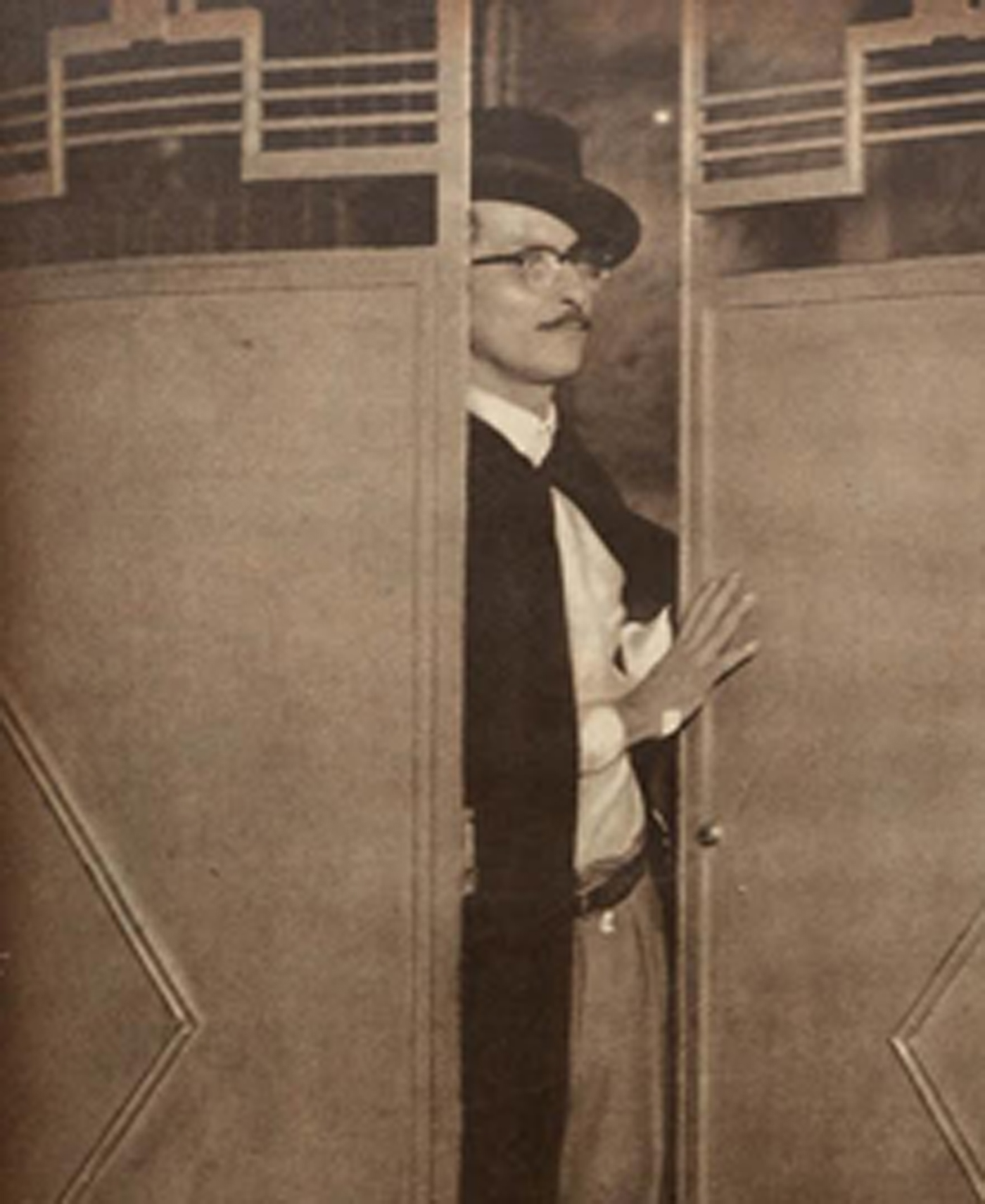
The invention of Tenório reached its apogee in the days following the standoff as “Tenório fever” gripped the country. It was during this time that he acquired his most enduring nickname, “The Man in the Black Cape,” when he appeared at his door sporting a cape during the showdown (see Figure 2). O Cruzeiro quickly captured the moment, featuring the strange scene in a full-page spread.Footnote 85 “Lurdinha,” his famous sidekick machine gun, and almost certainly the weapon that took Imperato's life, found her way into the media shortly thereafter (see Figure 3).Footnote 86
Tenório Debuting His Famous Black Cape

“Lurdinha” Posing on a Sofa (undated)

In the days that followed, the print media recorded the sudden appearance of Tenório look-alikes all over the country. These doppelgangers reported significant changes in their lives since the standoff, with people now fearfully hustling out of their way.Footnote 87 The Diário da Noite, capturing the spirit of the moment, published a cartoon depicting a scene at an opera house where the conductor had climbed the curtain rope in terror. The assistant below reassured him: “Maestro, for the love of God, come down! I said ‘Here comes the tenor, not Tenório!’”Footnote 88 The country's fixation on the horrors and delights of the Man in the Black Cape reached a peak in early 1954 with the release of Carnaval em Caxias, a low-budget movie whose protagonist, Honório Boa Morte (Honório Good Death) masqueraded as a thinly disguised Tenório.Footnote 89
Incident at the São Paulo Law School
Tenório was riding high in late 1953. He had restored his honor by standing up to Barcelos Feio and Amaral Peixoto on the national stage, a movie about him was in production, and it looked as though he might have gotten away with the murder of his chief rival. It seemed that the more outrageous and daring his actions, the more he was rewarded. Nevertheless, Tenório was about to discover the limits of his social mobility. He would also learn that playing up the stereotype of the violent Northeasterner came at a price. Now fully the human face of Caxias (which, in turn, represented the Baixada), his actions and their interpretations in the media—over which he had little control—had come to represent life in the region. Tenório unexpectedly found himself in another showdown in October, one from which he would not only back down, but one that revealed the processes of the inventions of both the Northeast and the Baixada in action.
Tenório accepted an invitation to speak at the Centro Acadêmico XI de Agosto, colloquially known as the São Paulo Law School. The institution had a long tradition of opposition to Vargas and had become a hotbed for young, ambitious UDN partisans to launch their careers.Footnote 90 At first look, the law school appeared to be the perfect venue for the high-profile UDN deputy to pontificate on party issues and, having recently completed a law degree himself, enjoy an easy repartee with his audience. This reasoning, however, proved to be a grievous error in judgment. Despite the superficial similarities, Tenório and the law school students could not have been much further apart in terms of their deeper class and regional identities. He also discovered that his UDN support (or tolerance) in Rio simply did not apply in São Paulo.
Tenório's presence in the city created a sensation. Throngs of working-class people flocked to catch a glimpse of the Man in the Black Cape, along with about 20 bodyguards and numerous reporters in tow.Footnote 91 Away from the cheering crowds, however, Tenório found himself on the defensive. During a speech at the state legislature prior to the law school event, deputies hostile to the UDN recognized an opportunity to publicize their causes. Labor Party deputy Cid Franco set the tone by stating that the assembly should be ashamed of itself for receiving a celebrity thug such as Tenório, “known to all Brazilians for having committed the most cowardly of crimes.” He then led a walkout protest.Footnote 92
By the time Tenório arrived at the law school, the organizers had already lost control of the proceedings. They had planned the event to be held outside the school in nearby São Francisco Plaza, but in order to prevent a massive popular gathering from occurring, they decided to move it into the law school auditorium.Footnote 93 This change did not, however, prevent Tenório's admirers from attempting to gain entry in order to catch a glimpse of the “Congressman from Caxias.” Meanwhile, inside the auditorium, rival student organizations began to engage one another, firecrackers exploded, and a general climate of expectation rippled through the crowd.Footnote 94 When Tenório finally arrived, he had to enter through a side door because of the commotion both inside and outside the auditorium.
When the time came to start the program, the law school president could not begin because of repeated interruptions.Footnote 95 A shouting match had broken out among students regarding the appropriateness of Tenório's presence. The anti-Tenório faction demanded to know how a known killer, charlatan, and propagator of violence could be invited to speak at an institution considered to be the vanguard of justice and democracy. Their rivals countered that an institution that promoted democracy should let the man speak, regardless of his views. Students in the opposition retorted by shouting “Captain Galdino!” and “Cangaceiro!,” clear references to O Cangaceiro and allusions to Tenório's Northeastern origins, eliciting gales of laughter throughout the auditorium. In the general din of merriment and shouting, José Gregório, the spokesman for the anti-Tenório faction, yelled, “No cangaço allowed here,” provoking a fierce reaction from those opposed to these obstructionist tactics. Fights broke out in the gallery. Determining that delivering his speech would be impossible, Tenório quit the auditorium along with his bodyguards who, by some accounts, had their weapons drawn. The state governor, in an effort to avoid further mayhem, ordered the police to escort Tenório to the airport, from which he beat a hasty retreat back to Rio.
The incident was ultimately a minor episode in Tenório's eventful career, and he suffered no lasting ill effects because of it. Nevertheless, the students’ reaction to his presence provided a glimpse into the mindset of the affluent classes of the Rio-São Paulo metropolitan axis and exposed their prejudices against the “invading hordes” from the Northeast. Tenório had, in their eyes, illegitimately gained power through urbanized cangaço, chicanery, and populist charlatanism. He had flagrantly murdered a police chief (who, as luck would have it, was an alumnus of the law school), cheated the system by taking advantage of the legitimate protections of a congressman, and infiltrated their party, turning it into a cheap sideshow. Tenório constituted the realization of their worst nightmares.Footnote 96 The speaking engagement provided the perfect opportunity for the UDN's budding partisans to lash out against the “encroachment” of the Northeast on their cities, region, and beloved party.
The weapons they chose—cultural references to O Cangaceiro—merit further examination. The fact that the hecklers invoked the name of the fictitious Galdino (and not Lampião) suggests that their understanding of cangaço emanated largely from the film. Vera Cruz had infused the movie with stereotypes of the Northeast, which resonated with the law school students in terms of their class and geographical identities. The film, therefore, not only reinforced the preconceptions that the students had absorbed growing up as well-to-do members of their society (they had certainly heard of Lampião and cangaço prior to the film), but provided them with a powerful cultural weapon that proved more effective than the Black Cape and “Lurdinha.” The students established a connection from Lampião to Tenório (via O cangaceiro), who as the “Congressman from Caxias” effectively linked the invented Northeast to the Baixada.
Commentaries in the press and on the floor of the federal legislature regarding the incident also reveal much about the apprehensions of the affluent classes. The most scathing attacks came from A Província, a newspaper based in Niterói, Rio de Janeiro's state capital and Amaral Peixoto's stronghold. Stating that Tenório was “expelled” from the law school by students yelling “clown” and “murderer,” it argued that if Tenório “were not such a cold-blooded killer, he could be considered one of the greatest clowns in the entire country.”Footnote 97 Pulling no punches, this commentary effectively combined the predominant Northeastern stereotypes of violence and buffoonery into a single statement.
Members of congress also used the incident to vent their class-based anger and frustration. José Loureiro Jr., a former professor at the law school, took particular exception to the entire episode. Exasperated that Tenório would even be permitted to “preach his methods of violence in a temple of law once graced by the great Rui Barbosa and Rio Branco,” he asked rhetorically if it was possible that “we have forgotten the lessons left to us in the magnificent pages of Os sertões? … and that we vindicate those who consider the use of firearms the greatest expression of valor?”Footnote 98 Describing the “expulsion” of Tenório as glorious, Loureiro Jr. concluded by recriminating the media and congress itself: “What moral authority does a police chief in our interior have that confiscates from the caboclo [dark-skinned person of mixed race] the knife and the pistol, if tomorrow he opens O Cruzeiro and sees machine guns and the discourse of this congress affirming the use of weapons in the nation's capital as we stand by in silence? We are demoralizing public authority and, are we not, more than anything, tearing up our own laws?Footnote 99”
The UDN-leaning press in Rio handled the matter more gingerly but still revealed its own ambiguity toward Tenório. The Diário da Noite, for example, played a double game in its article “Violent Indictment Against Tenório.” The newspaper gave the impression that the accusations were unfair, but then printed lengthy excerpts from Loureiro Jr.’s speech, without any attempt to refute his claims.Footnote 100 The Tribuna da Imprensa, meanwhile dodged the issue by characterizing the episode as “democracy in action.”Footnote 101 This dubiousness exemplifies the uneasiness with which many supporters of the UDN viewed Tenório's rise to fame, a sentiment unabashedly expressed by the law school students. UDN-leaning newspapers certainly had more tact than the irreverent students in their criticism of Tenório, but behind this cover lay similar concerns about the Man in the Black Cape, the Baixada, and what they had come to represent.
Conclusion
The inventions of the favelas, the Northeast, and the Baixada, despite their complexities and contradictions, ultimately served the interests of the dominant metropolitan Rio and São Paulo elite. In each case, the created images of the locations and the people who lived in them, bolstered—albeit in an incomplete and imperfect fashion—the dominance of Brazilian elites over lower-class groups. The invention of the Baixada, itself an offshoot of an ongoing and evolving meta-invention that included the established practices of marginalization and isolation of the favela and the Northeast, constituted a response to the new developments of rapid urbanization on the periphery of the 1950s. It also highlighted the conundrum faced by Rio's upper classes as a result of the push for modernization. They needed the new migrants for their labor and as electoral constituents, but they also viewed them as a threat to their privilege and a taint on their vision of a modern Brazil. Because of their increasing electoral power, their need for access to resources, and their demand for respect of their legal rights, however, the masses of new residents of the Baixada could not simply be ignored.Footnote 102 Compromises had to be made, and Tenório, as the public face of the Baixada, was both a reflection of and a driving factor in that process.
As the 1950s rolled on, the media, led by O Cruzeiro, continued to provide ample coverage of Tenório, often featuring him in slice-of-life pieces that reflected his celebrity status.Footnote 103 This quotidian coverage of Tenório, nevertheless, belied the ongoing process of marginalization of the Baixada, which periodically came back into focus. When the army invaded Tenório's house-fortress yet again in 1957, O Globo, for example, referred to the line that separated Rio from Caxias as the “38th Parallel,” an allusion to the demarcation line of the Koreas established at the end of the Korean War.Footnote 104 This characterization invoked the supposed horrors occurring north of the line, including a not-so-subtle hint of Communist activity.Footnote 105 The journalistic targeting of the Baixada reached its apogee in 1962 when the Última Hora (Niterói) published a 16-part series titled “The Baixada Fluminense: The Northeast without the Drought.” Written in over-the-top style, each article featured a scathing exposé of the region, ultimately culminating in an attack on the region's most vile and reprehensible feature of all—Tenório Cavalcanti. He was running for state governor at the time.Footnote 106
Tenório, however, was far from blameless with regard to the negative characterization of the Baixada in the media. In an effort to control his public image, he launched his own newspaper, Luta Democrática, in 1954 (see Figure 4). His gazette did not lack for sensationalized stories of sex and violence—it was alleged that its pages would drip with blood if wrung out. This joke did not help the Baixada's reputation, but it did highlight the participation of the group targeted for marginalization, the newspaper's working-class readership, in the process of its own invention.
Tenório at Printing Press of His Newspaper Luta Democrática, 1954

The contradictions of Tenório's alliance with the UDN also continued to take their toll. The party, never comfortable with Tenório beyond recognizing him as a local strongman and out of sync with populism, nevertheless found itself compelled to find common ground with the working class in order to survive. Spearheaded by what Bryan McCann describes as Lacerda's “middle-class populism,” the UDN attempted to take a populist turn in 1957.Footnote 107 Nevertheless, party leaders left Tenório, who was well positioned to be a natural leader or at least a visible figure in this shift, conspicuously out of the picture.Footnote 108 A palpable fatigue of dealing with him had become evident within the party by that time. He was wearing out his welcome.
The situation came to a head in 1960, when Tenório, not having formally announced his separation from the UDN, ran for governor of the newly created state of Guanabara on the Partido Social Trabalhista (Social Labor Party) ticket, against Lacerda himself.Footnote 109 The circumstances of Tenório's candidacy remain shrouded in controversy. Because his entry divided the working-class vote between him and Labor candidate Sérgio Magalhães, it pushed Lacerda over the top when the final ballots were counted. Regardless of whether Tenório had rebelled against his party of 15 years or made an inside deal to help Lacerda, he officially split with the UDN a short time later.Footnote 110
By the time of Tenório's death in 1987 at the age of 79, he had long since become a creature of the past that no longer frightened the public. The favelas that proliferated on Rio's hillsides and the sprawl on the urban periphery were consummated facts. These neighborhoods continued to inspire fear, loathing, and a morbid fascination, but the circumstances had changed. In the case of the Baixada, the number of violent deaths that resulted from warfare between rival drug trafficking gangs, street crime, militias, and stray bullets reached levels in the early 1990s that led the United Nations to classify it as a war zone.Footnote 111 In 2016, the Baixada section of the Rio-Petropolis highway was recognized as one of the most dangerous stretches of road in the entire country in terms of violent crime.Footnote 112 Urban planning that fostered isolation and malign neglect by various levels of government has allowed a self-fulfilling prophecy to take place.Footnote 113
By contrast, Tenório is now often remembered as a part of a carefree Golden Age. As one commentator aptly noted in his obituary, “Just the mere mention of his name invokes intense nostalgia for the 1950s.”Footnote 114 Certainly, it would be an overstatement to suggest that the Baixada's development would have been radically different without Tenório. Other urban peripheries throughout Brazil and Latin America suffered similar fates when resources were simply too limited and unevenly allocated, and when overwhelmed with rural in-migrants. Tenório did not cause the problems of the Baixada, but he helped, wittingly or not, to provide justification for policies that marginalized and isolated the region.