Most adult learners are less likely to achieve nativelike ability in a second language (L2; Sagarra & Ellis, Reference Sagarra and Ellis2013; Selinker, Reference Selinker1972). For decades, linguists have made persistent efforts, from different perspectives, to propose theories to explain this issue, such as age of acquisition, nonaccess to Universal Grammar, cross-linguistic interference, restricted input, and so on (DeKeyser, Reference DeKeyser2013; Schwartz & Sprouse, Reference Schwartz and Sprouse1996; see the review by Gass & Selinker, Reference Gass and Selinker2008). However, none of them is able to account for the reduced L2 competence in its entirety. The present study, under the framework of usage-based linguistics, attempts to probe into other potential factors that may constrain L2 development. Specifically, it examines why L2 learners are less capable of using constructions as creatively as native speakers do. Recent findings have demonstrated that even very advanced L2 learners are more conservative than native speakers in using English, suggesting that the constrained grammar of English affects their language use (Balcom, Reference Balcom1998; Zhang, Reference Zhang2014).
-
(1) Greek translates easily. (Balcom, Reference Balcom1998, p. 7)
-
(2) Only two coffees are sold in this store. (Zhang, Reference Zhang2014)
-
(3) They bricked the path.
In Examples (1)–(3), the underlined ergative use of translate, count use of coffee, and verbal use of brick (denominal verbs, the focus of this study) that are judged as acceptable by English native speakers are often viewed unfavorably by L2 learners, party because these constructions are novel, diverting from repeated use of the transitive verb translate, the mass noun coffee, and the noun brick from the L2 learners’ perspective (Belcom, Reference Balcom1998; Zhang, Reference Zhang2014). L2 learners do not judge these constructions as acceptable in the way native speakers do, which may be attributed to factors such as age of acquisition, restricted input, an so on. However, from a developmental perspective, L2 learners’ conservative judgments on L2 constructions as illustrated by those underlined in Examples (1)–(3) may possibly occur as a result of the influence from repeated use of the transitive [TRANSLATE], the mass [COFFEE], and the nominal [BRICK], respectively, as well as influence from competing forms like the passive voice of translate, the measure words in two cups/types of coffee, and the locative pave the path with bricks, because these repeated uses and competing alternatives are well attested and frequently used in everyday communication. Effects of repeated use of a construction (entrenchment) and of competing alternatives (preemption) have recently come under close scrutiny in language learning studies (e.g., Brooks, Tomasello, Dobson, & Lewis, Reference Brooks, Tomasello, Dodson and Lewis1999; Ellis & Sagarra, Reference Ellis and Sagarra2010, Reference Ellis and Sagarra2011; Goldberg, Reference Goldberg2006; MacWhinney, Reference MacWhinney, MacWhinney and Bates1987; Shanks, Reference Shanks1995). Theoretically, both entrenchment and preemption focus primarily on the role of distributional information in language input and its consequences on language development (Brooks et al., Reference Brooks, Tomasello, Dodson and Lewis1999; Goldberg, Reference Goldberg2006; Tomasello, Reference Tomasello2003).
These two basic cognitive mechanisms have been found to play differing roles in keeping children from extending acquired constructions into novel uses (e.g., Ambridge & Blything, Reference Ambridge and Blything2016; Ambridge, Pine, & Rowland, Reference Ambridge, Pine and Rowland2012; Blything, Ambridge, & Lieven, Reference Blything, Ambridge and Lieven2014; Bowerman, Reference Bowerman and Hawkins1988; Tomasello, Reference Tomasello2003). In addition, the two mechanisms have been considered to be potential factors that contribute to the constructional island phenomenon in first language (L1) development, during which children are less likely to make generalizations across specific linguistic items in the early stages (Tomasello, Reference Tomasello2003; Tomasello & Brooks, Reference Tomasello, Brooks and Barrett1999). Usage-based linguistics assumes that the acquisition of both L1 and L2 is statistically driven and that learners’ linguistic knowledge is characterized as being continuously adapted to the structure of linguistic input (Ellis, Reference Ellis2002; Pajak, Fine, Kleinschmidt, & Jeager, Reference Pajak, Fine, Kleinschmidt and Jaeger2016). In this line of reasoning, entrenchment and preemption are likely to play a part in L2 development, an issue that was noted by Rutherford (Reference Rutherford1989) almost 30 years ago. However, to date only a few studies have examined this issue in L2 development of English locatives (Ambridge & Brandt, Reference Ambridge and Brandt2013), English atypical transitives (e.g., The magician vanished/disappeared the rabbit; Robenalt & Goldberg, Reference Robenalt and Goldberg2016), and English un– prefixation (Zhang, Reference Zhang2017). The current study attempts to contribute to this line of inquiry by further examining whether, and to what extent, these two focal mechanisms constrain the process by which Chinese speakers acquire English denominal verbs (DVs). The two focal mechanisms associated with language learning are discussed in detail below.
ENTRENCHMENT AND PREEMPTION IN LANGUAGE DEVELOPMENT
Entrenchment, which refers to the establishment of a linguistic structure via repeated occurrences, is closely related to frequency effect. As Langacker (Reference Langacker1987) comments, “Every use of a structure has a positive impact on its degree of entrenchment” (p. 57). Entrenchment has been employed to explain L1 development (Blumenthal-Dramé, Reference Blumenthal-Dramé2012), predicting that repeated use of a linguistic form in one structure minimizes the possibility that this form could be used in another structure (Braine & Brooks, Reference Braine, Brooks, Tomasello and Merriman1995). For instance, repeated occurrences of fall in I/you fall and she/he falls help children build the inference that I/you/she/he fall(s) the book is unacceptable. Following this, the inference based on the attested use is in keeping with the associative learning theory, which predicts that if A has been coupled with X, it is difficult for people to pair A with Y (Kording & Wolpert, Reference Kording, Wolpert, Doy, Ishii, Pouget and Rao2011; Shanks, Reference Shanks1995). By inference, when a linguistic form is repeatedly used in Context A, one might implicitly recognize that this form may be less acceptable in Context B (Tomasello, Reference Tomasello2003). The effect of entrenchment becomes prominent when a form occurs frequently in one construction, helping people rapidly build the inference that this form is less often used in others. This view has enjoyed empirical support from both artificial and corpus-based language learning studies.
For artificial language learning, Wonnacott, Newport, and Tanenhaus (Reference Wonnacott, Newport and Tanenhaus2008) taught adults novel verb argument constructions (VACs) in either a one-construction condition where most verbs appeared in only one construction, or an alternating condition where most verbs alternated between two constructions, finding that the adults in the one-construction condition were more conservative than those in the alternating condition in extending these verbs for novel use. Such conservatism was possibly triggered by the entrenchment effect, because participants received more tokens of the same VAC in the one-construction condition than in the alternating condition. Similar findings have been observed with children in Wonnacott (Reference Wonnacott2011). Matthews, Lieven, Theakston, and Tomasello (Reference Matthews, Lieven, Theakston and Tomasello2005) explored the ability of children aged 2 years 6 months to extend English verbs into novel subject–object–verb constructions, finding that children were more likely to extend low-frequency verbs into the subject–object–verb construction. For corpus-based studies, Ambridge (Reference Ambridge2013), Ambridge et al. (Reference Ambridge, Pine and Rowland2012, Reference Ambridge, Bidgood, Twomey, Pine, Rowland and Freudenthal2015), Ambridge, Pine, and Rowland (Reference Ambridge, Pine and Rowland2011), Ambridge, Pine, Rowland, Freudenthal, and Chang (Reference Ambridge, Pine, Rowland, Freudenthal and Chang2014), Ambridge, Pine, Rowland, Jones, and Clark (Reference Ambridge, Pine, Rowland, Jones and Clark2009), and Ambridge, Pine, Rowlan, and Young (Reference Ambridge, Pine, Rowland and Young2008) have detected that L1 users’ generalization of English un– prefixation, causatives, datives, locatives, and passives decreases as the overall frequency of the related verb increases. Brooks et al. (Reference Brooks, Tomasello, Dodson and Lewis1999) also observed that children were more inclined to generalize late age of acquisition English verbs (e.g., arrive and strike) into novel use than early age of acquisition verbs (e.g., come and hit). This was further consolidated by Theakston (Reference Theakston2004), who asked adults and children to make grammaticality judgments on erroneous VACs containing high- and low-frequency verbs (e.g., *That joke was so funny it really laughed/giggled me). Results suggest that both adults and children rated overgeneralized errors with low-frequency verbs as more acceptable than those with high-frequency verbs.
However, the findings regarding the entrenchment effect on L2 development seem mixed. Ambridge and Brandt (Reference Ambridge and Brandt2013) collected the judgment data from German speakers on English locatives (e.g., She filled the cup with water vs. *She filled water into the cup). German speakers were unable to infer the ungrammaticality of the nonattested use of a verb based on its repeated grammatical use, demonstrating that entrenchment was ineffective. However, Zhang (Reference Zhang2017) found that Chinese speakers’ judgments on the acceptability of English un– verbs (e.g., unclose) were negatively correlated with the frequency of bare forms (e.g., close), revealing that entrenchment was effective in the process where Chinese speakers learned to reject ungrammatical un– verbs. Furthermore, Ellis, O'Donnell, and Römer (Reference Ellis, O'Donnell and Römer2014) have argued that L2 speakers’ use of VACs is sensitive to VAC–verb contingency, and verb–token frequency (entrenchment).
Unlike entrenchment, the preemption account assumes that the higher the frequency of competing alternatives of the target form, the less likely that this form is produced, and the less acceptable is this form. Preemption was originally proposed as one of the factors that inhibits word learning associated with derivational lexical formations, where well-attested linguistic usages (e.g., pyjamas) progressively block children's coinages (e.g., *sleepers) that convey the same meaning (Clark & Clark, Reference Clark and Clark1979). Statistically, X is avoided in Condition A if Y with the same function is consistently used in this condition (Ambridge et al., Reference Ambridge, Pine, Rowland, Freudenthal and Chang2014; Brooks & Zizak, Reference Brooks and Zizak2002; Goldberg, Reference Goldberg2011). Clark and Clark's (Reference Clark and Clark1979) preemption principle holds that “if a potential innovative use would be precisely synonymous with a well-established use, the innovative use is normally preempted by the well-established use, and is therefore considered ungrammatical” (p. 798).
Evidence suggests that preemption is operative in children's avoidance of overgeneralized errors of English a-adjectives (Boyd & Goldberg, Reference Boyd and Goldberg2011), transitive and intransitive verbs (Brooks et al., Reference Brooks, Tomasello, Dodson and Lewis1999; Brooks & Zizak, Reference Brooks and Zizak2002), dative, ditransitive, locative and caused-motion VACs (Ambridge et al., Reference Ambridge, Pine, Rowland and Young2008, Reference Ambridge, Pine, Rowland, Jones and Clark2009, Reference Ambridge, Pine and Rowland2011, Reference Ambridge, Pine and Rowland2012; Brooks & Zizak, Reference Brooks and Zizak2002; Goldberg, Reference Goldberg2006; Robenalt & Goldberg, Reference Robenalt and Goldberg2016) as well as English un– prefixed verbs (Ambridge, Reference Ambridge2013; Blything et al., Reference Blything, Ambridge and Lieven2014). For instance, I'm gonna make this fall on her blocks *I'm gonna fall this on her and the boy that is asleep blocks *the asleep boy. The role of preemption was also evidenced in L2 acquisition of verbal inflections. Ellis and Sagarra (Reference Ellis and Sagarra2011) and Sagarra and Ellis (Reference Sagarra and Ellis2013) observed that temporal adverbials block L2 acquisition of Latin verb inflections: hodie (today) preempting cogit o /cogit as (I/you think)/cogit at (he thinks), heri (yesterday) preempting cogita vi /cogitavi sti /cogita vit (I/you/he thought), and cras (tomorrow) preempting cogita bo /cogita bis /cogita bit (I/you/he will think), and that learners’ L1 like Chinese, which lacks verb tense morphology, blocks L2 learning of Latin inflectional cues when adverbial and verbal cues are available. Robenalt and Goldberg (Reference Robenalt and Goldberg2016) investigated L2 users’ judgments on the transitive use of intransitive verbs, finding that English native speakers and advanced L2 users tended to judge novel sentences with a readily available alternative to be less acceptable than novel sentences with no competing alternatives, while less proficient L2 users showed no evidence of taking competing alternatives (e.g., The professor explained/recited the assignment) into account when judging atypical transitives (e.g., Amber explained/recited Zach the answer). The less proficient L2 users’ performance suggests that preemption is ineffective in the early stage of L2 development. However, Zhang (Reference Zhang2017) examined the effects of preemption in Chinese speakers’ acquisition of English un– prefixation, finding that competing verbs (e.g., open) did not appear to be linked to both second- and fourth-year English majors’ and English teachers’ judgments of the acceptability of ungrammatical un– verbs (e.g., unclose), indicating that preemption is not operative even in advanced English-L2 learners.
The above review reveals that entrenchment and preemption are psychologically real in L1 development, while their effects remain controversial in L2 development of VACs (Ambridge & Brandt, Reference Ambridge and Brandt2013; Robenalt & Goldberg, Reference Robenalt and Goldberg2016), inflectional morphemes (Ellis & Sagarra, Reference Ellis and Sagarra2011; Sagarra & Ellis, Reference Sagarra and Ellis2013), and English un– prefixation (Zhang, Reference Zhang2017). These inconsistencies and the huge number of constructions in English merit further detailed research to extensively evaluate whether and to what extent these two focal mechanisms impact the L2 learning process. It is valid to note that most extant studies examining the effects of these two mechanisms on L1/L2 development focus on how learners recover from ungrammatical utterances with the purpose of offering potential explanations for the no-negative-evidence problem (Bowerman, Reference Bowerman and Hawkins1988). Nevertheless, according to the account of both entrenchment and preemption (Braine & Brooks, Reference Braine, Brooks, Tomasello and Merriman1995; Brooks et al., Reference Brooks, Tomasello, Dodson and Lewis1999; Langacker, Reference Langacker1987), repeated use of a form in one construction helps learners to gradually form a probabilistic inference that this form is not used in other novel constructions, and if learners have learned to use a given form to denote a specific meaning, this knowledge often blocks them from using other novel forms to express the same meaning. From the developmental perspective, the uniqueness of “novel constructions” involved in both accounts depends on learners’ prior knowledge. Both grammatical and ungrammatical forms could be novel to L2 learners if they have not encountered them before. The effects of entrenchment and preemption may be possible between grammatical forms, between ungrammatical forms, or even between grammatical and ungrammatical forms.Footnote 1 Following this line of thinking, entrenchment and preemption may have a role to play in restricting L2 acquisition of grammatical constructions. However, to date, no studies have been conducted to examine whether, and to what extent, entrenchment and preemption constrain the novel use of L2 constructions. This study is thus motivated to contribute to this line of research by testing the effects of entrenchment and preemption in L2 acquisition of English DVs.
TARGET CONSTRUCTION: ENGLISH DVs
The present study targeted English DVs, since most English nouns are easy to turn into verbs. Some DVs, such as to sheet the furniture and to towel himself dry, are more established than others, such as to sweater the child and broom the floor. Namely, some DVs are context bound (Clark & Clark, Reference Clark and Clark1979). It is such innovative usages that reflect the creativity of English constructions. However, the modern Chinese language seldom employs DVs. For instance, if the meaning of water as in Example (4) is intended, Chinese speakers always use different words or phrases like jiao shui (pour water into/onto) to fulfill this purpose.
-
(4) Lucy watered the rose.
-
露西给玫瑰浇了水。
-
Lucy gei mei gui jiao le shui
-
“Lucy give rose pour-ASP water”
Example (4) demonstrates that English and Chinese encode the meaning of “actions” differently at the lexical level. From the perspective of L2 learning, Chinese speakers should establish a new DV category where they may make little use of L1 knowledge. To acquire English DVs, Chinese speakers should learn them basically from language input. What is more, after comparing the use of English DVs in both the Brown corpus and the Chinese Learner English Corpus, Sun (Reference Sun2012) found that the DVs used by English native speakers are far more frequent than those used by Chinese English-L2 learners. Based on this observation, Sun concluded that Chinese English-L2 learners are inclined to avoid using English DVs. However, the factors that contribute to Chinese English-L2 learners’ avoidance of English DVs remain unknown, and therefore merit further attention. Based on the above analysis, English DVs may act as a good lens through which the effects of preemption and entrenchment could be tested when Chinese speakers learn to use English DVs.
THE PRESENT STUDY
The present study addresses the following two research questions:
-
1. Does preemption restrict L2 learners’ use of DVs, and if so, how?
-
2. Does entrenchment restrict L2 learners’ use of DVs, and if so, how?
Note that entrenchment assumes that the novelty of a construction is probabilistically constrained by the well-attested use of this construction, while preemption predicts that this novel use is blocked by the synonymous linguistic forms of this construction (Ambridge, Reference Ambridge2013; Blything et al., Reference Blything, Ambridge and Lieven2014). In line with these assumptions, preemption and entrenchment are expected to be two effective predictors of learners’ acceptance or rejection of DVs. Accordingly, in the current study, preemption was operationalized as the combined frequency of competing alternative (e.g., repair+ sew for patch), and entrenchment as the total frequency of the relevant nominal forms (e.g., patch/patches for patch).
METHOD
Participants
Participants for this study were 20 fourth-year English majors (7 males, 13 females; ages: M = 21.65, SD = 0.49), and 20 teachers of English (12 males, 8 females; ages: M = 30.4, SD = 1.47) from three universities in northwest China. All participants were Chinese native speakers with at least 8 years of English learning in middle and primary schools. In addition, the fourth-year English majors had learned English at undergraduate level for 3.5 years before the current study was carried out. The teachers also had learned English for at least 7 years in the university and had at least 6 months learning or working experience in English-speaking countries. The fourth-year English majors took English lectures delivered by English native speakers, and read English newspapers almost every day.
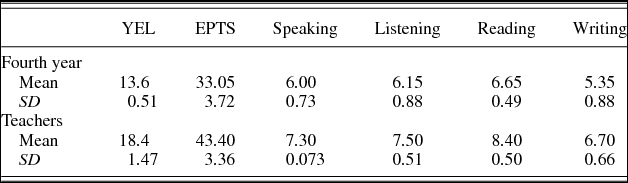
To objectively measure the participants’ English proficiency, the English proficiency test, known as the College English Test Band—4, was adopted for its sound validity and reliability (Yang & Weir, Reference Yang and Weir1998). Only its 30-item vocabulary and structure and 20-item cloze subtests were chosen, as these were highly predictive of L2 learners’ overall English proficiency (Yang & Weir, Reference Yang and Weir1998).Footnote 2 Participants were required to self-evaluate their English proficiency in terms of speaking, listening, reading, and writing on a 10-point scale with the following range: 1 = minimum, 10 = nativelike. Descriptive data is presented in Table 1. A t test on the scores from this written proficiency measure showed that the teachers outperformed the fourth-year learners (t = 9.231, df = 38, p < .001). The same pattern was also found after a comparison of the two groups’ self-rating scores for speaking, listening, reading, and writing.
Participants’ personal information

Note: YEL, years of English learning; EPTS, English proficiency test scores
Materials
Target verbs were selected from Clark and Clark (Reference Clark and Clark1979). There are 75 locatum DVs whose parent nouns are in the objective case in clauses that describe the location of one thing with respect to another, and 75 location DVs whose parent nouns denote the place where something happens or is situated, as illustrated in Example (5).
-
(5)
-
a. Locatum DV:
-
They watered the flowers.
-
Nominal use:
-
They poured water on the flowers.
-
b. Location DV:
-
Lisa boxed the apples.
-
Nominal use:
-
Lisa put the apples into the box.
-
These two categories of DVs were chosen on the grounds that, although they are often encountered by L2 learners more than other types of DVs according to the judgments of the learners’ instructors, Chinese speakers still have difficulty learning them (Sun, Reference Sun2012). Frequency of these DVs obtained from the British National Corpus (BNC) reveals that both DVs vary greatly from zero (e.g., newspaper) to 18,174 times (e.g., cover). That is, these target words constitute a continuum in terms of DV use. Investigating such a large variance in DV use could be more suitable for the present study to examine the effect of entrenchment and preemption on English-L2 DV development, since the effects of entrenchment and preemption are assumed to be related to the frequency of the target construction.
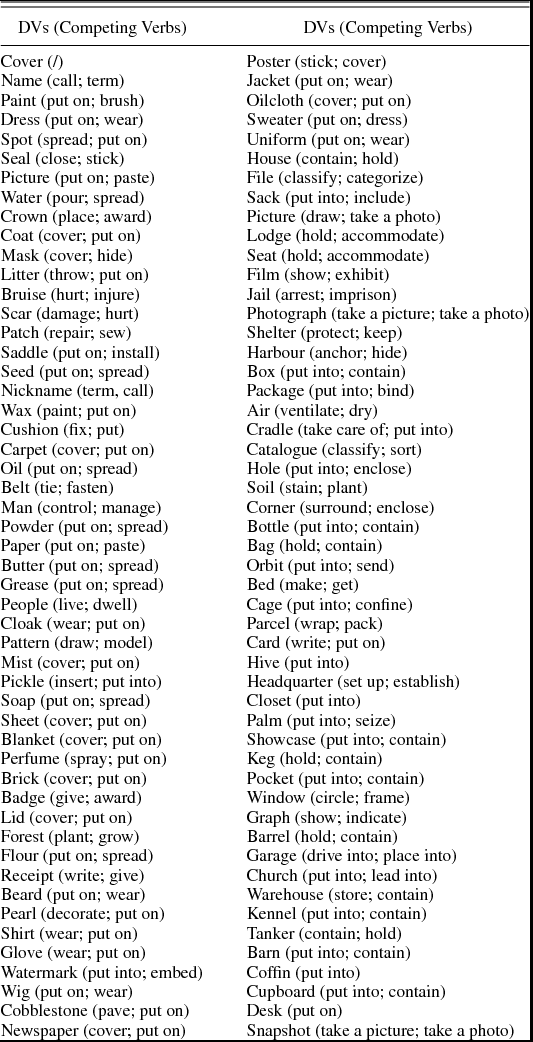
Another group of fourth-year English majors judged the familiarity of these 150 words on a 5-point scale (Wang & Koda, Reference Wang and Koda2005), with the following range: 5 = known (I think each of us knows this word and can use it productively), 4 = very familiar (I think most of us are familiar with this word), 3 = familiar (I think many of us are familiar with this word), 2 = not likely familiar (I think many of us are not familiar with this word), and 1 = not at all familiar (I don't think most of us have seen this word before). Scores obtained from this familiarity judgment task for each target word were averaged by participants. If the final averaged score for a word was below 3, then this word would be excluded. Finally, there were 56 locatum DVs and 46 location DVs that met the selection criterion and were incorporated in the present study. These words are listed in Appendix A.
Procedures
Prior to testing, participants were told that they should rate the acceptability of the 102 underlined verbs based on the sentences where the verbs occurred. The instructions for the test were that “There are 146 sentences, each with some words underlined. To complete the task, please score each sentence from 1 to 5 according to the following criteria: 1 = totally unacceptable, 2 = very poor English, 3 = poor English, 4 = almost correct English, 5 = completely acceptable. For instance, Tom broke the cup (5/5; completely acceptable). Please judge the acceptability of the underlined part based on the meaning conveyed by the sentence, then select a related number standing for your judgment and mark it out.” The two categories of DVs were distributed across List A and List B and randomly presented on the computer screen. Each list contained 28 locatum DVs and 23 location DVs. All the DVs were presented in the past tense except that house and seat were presented in the simple present tense, considering that house and seat tend to denote habitual actions. Two English native speakers also suggested that houses and seats are more appropriate than housed and seated in The hall room houses 9 people and The theatre seats 570 people. During the test, one half of the participants in each group finished List A, then List B. The other half did the test in the reverse order. All participants completed three practice sentences before testing. Testing sentences can be found in Appendix B.
Predictor variables
To test the effects of entrenchment and preemption in the development of English DVs, linear mixed-effects models were used to analyze the data. The dependent variable was ratings of the acceptability for each DV. Note that the present study is intended to adopt the frequency of the target constructions and the related competing synonyms to evaluate the effect of both entrenchment and preemption. Both corpus and L2 learners’ introspective frequencies were used to fulfill this purpose. This was done because, as Schmitt (2010) pointed that, no corpus can exactly mirror one's language exposure and one's psychological “impression” of the frequency of a word. The related frequency/frequencies in a corpus is/are not always consistent, namely, that different individuals, especially L2 learners, may have different exposure to particular constructions on some settings. It is therefore difficult for even extremely large corpora to provide a full picture of the usage for every construction, since corpora are usually biased toward easy-to-collect language types, while difficult-to-collect language types, like some personal conversations, are seldom included. Given these limitations, Schmitt pointed out that in some cases, it may be more reasonable to use learners’ intuitions to determine the frequency of target constructions. Moreover, Wang and Koda (Reference Wang and Koda2005) have argued that intuition-based information is a useful means to estimate learners’ exposure to L2. Accordingly, the researcher used learners’ introspective frequency on the target words as a supplement to measure the amount of Chinese speakers’ exposure to English. The variables involved to test the effects of these two proposed mechanisms are detailed below.
Entrenchment
In this study, entrenchment was measured by tallying the lemma frequency of each noun in the BNC regardless of contexts. The lemma frequency of each noun was subjected to the natural log-transformation. Alderson (Reference Alderson2007) has suggested that the best introspection-based indicator should be to average the frequency judgments of a group of raters due to the variability of individual ratings. Another 10 Chinese teachers of English were invited to rate the frequency of each target word used as nouns. They decided for each word how frequently it occurs as a noun per million words of English on a 20-band scale with example frequencies for some common English words as reference points (1= less than 10 times per million words, 20 = more than 1000 times per million words).Footnote 3 To test the reliability of this judgment task, 10 Chinese teachers of English were equally divided into Group A and Group B. Their judgment scores were averaged for each item. The correlation coefficient between the two groups’ averaged judgment scores was 0.83.
Preemption
For each DV, the same 10 Chinese teachers of English were asked to think up as many words as possible that convey the same meaning of this action, that is, to paraphrase the DV based on the test sentence. Even in instances where participants had difficulty coming up with suitable alternative words, they were encouraged to come up with at least one, even if it was not precisely the right meaning. The results show that participants suggested no competing verbs for cover and only one competing verb for coffin, closet, desk, and hive, respectively. For other DVs, the two most commonly suggested competing forms were chosen (see Appendix C). For instance, the top two suggested competing forms of name are call and term. The advantage of including the two most commonly suggested forms instead of all is that it excludes other marginal examples that were only suggested by one or two individuals (Ambridge, Reference Ambridge2013). Then, the teachers decided how frequently each competing verb occurs per million words of English on a 20-band scale.Footnote 4 The procedure for obtaining the counts of these verbs was the same as that used to obtain the frequencies of the nominal occurrences for entrenchment. The frequencies of the two competing forms were also retrieved from the BNC. Then, the frequencies of the two competing forms were summed up separately for corpus and introspection estimation, and subjected to the natural log-transformation. This yielded the preemption measure. The correlation coefficient of averaged judgment scores for the combined frequency of the two competing verbs between Group A and Group B was 0.79.
DV frequency
For the target words that exist in verb form, participants are likely to give higher acceptability ratings to the more frequently encountered forms. The frequency from the BNC/based on introspection for each DV was included in the models in order to test whether the effects of preemption and entrenchment account for additional or greater effects than those that result from simple DV alone. The frequency of each DV was subjected to the natural log-transformation because they were in a skewed distribution. Procedures for obtaining the DV frequency were the same as those for obtaining the frequency of nominal use for the entrenchment measure. The correlation coefficient of averaged judgment scores for the frequency of each DV between Group A and Group B was 0.77. If learners did not form a productive generalization and simply based their acceptability ratings on how often they have encountered particular DVs, this predictor would capture the vast majority of the variance in judgments, with other predictor variables adding little or nothing.
RESULTS
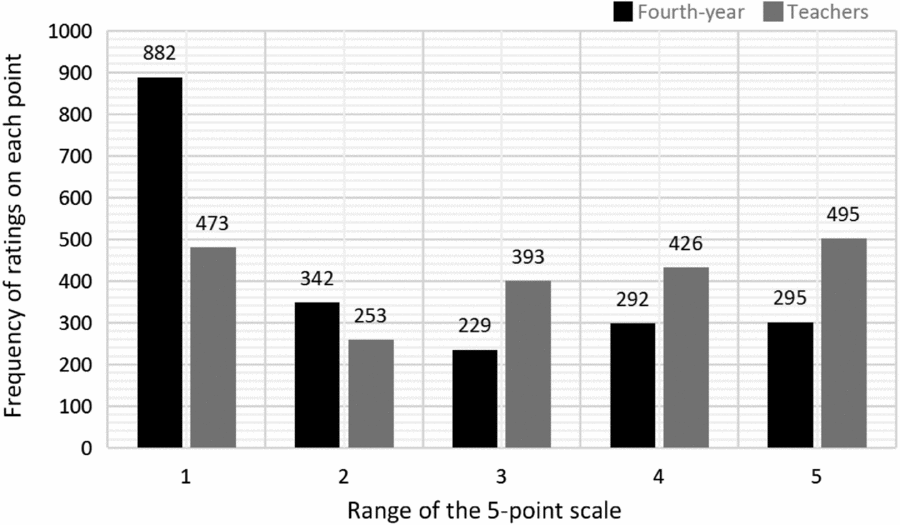
The frequency of the participants’ ratings on the acceptability of the two categories of DVs from each of the 5 points was counted and presented in Figure 1. It can be seen from this figure that the fourth-year learners judged most of the locatum and location DVs as unacceptable. The pattern for the teachers is different. Their ratings on the locatum and location DVs are somewhat evenly distributed across the 5 points. Comparatively, the teachers were more likely to accept these two types of DVs than the fourth-year learners. Thus, the teachers still treated most of the DVs as either totally unacceptable, very poor English, or poor English; so, it is intriguing to test whether and how preemption, entrenchment, and DV frequency influence the L2 speakers’ DV generalization. All of the participants’ ratings were not normally distributed. They were natural log transformed. The mixed-effects analyses were performed via the statistics package lme4 in the R environment (Barr, Levy, Scheepers, & Tily, Reference Barr, Levy, Scheepers and Tily2013; R Core Team, Reference Core Team2015). Data analyses consist of an overall analysis of English DVs for all the participants and separate analyses of English DVs for each group. Correlations between the predictor variables are presented in Table 2. For the fourth-year learners, nine residual outliers for corpus frequency and seven residual outliers for introspective frequency were eliminated. For the teachers, eight residual outliers for corpus frequency and nine residual outliers for introspective frequency were eliminated. The correlations between preemption and DV frequency, and between entrenchment and DV frequency, were significant for all the participants under the condition of both corpus and introspective frequencies. The correlations among all the predictor factors were weak except that the correlation between the introspective DV frequency and entrenchment was moderate (r = –.61) for English DVs. Collinearity diagnostic analyses for the both DVs showed that no multicollinearity existed among all predictor variables, with the condition index value less than 22 (David, Reference David1991).
Frequency of ratings of all denominal verbs on each point for fourth-year learners and teachers; 5-point scale range: 1 = totally unacceptable, 2 = very poor English, 3 = poor English, 4 = almost correct English, 5 = completely acceptable.

Correlation matrix of the fixed variables for corpus/introspective frequency

Note: DV, denominal verb.
*p < .05. ***p < .001.
An omnibus analysis for all participants
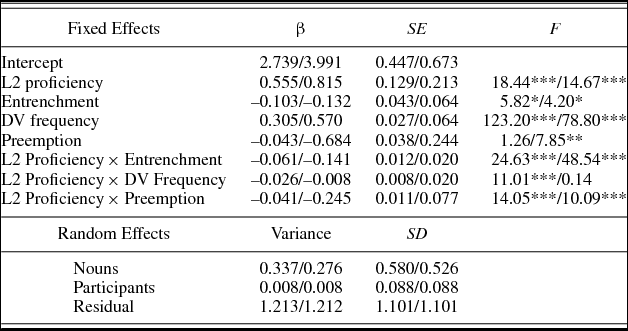
The maximal random-effects structure for which the model would converge was employed (Barr et al., Reference Barr, Levy, Scheepers and Tily2013). DV frequency, entrenchment, preemption, and L2 proficiency (fourth-year/teachers) were treated as fixed effects, and participants and DVs as random effects. L2 proficiency was a categorical variables, so it was centered using sum coding (–1, 1) to make interactions interpretable. The R 2 values were obtained with the r.squaredGLMM function from the statistics package MuMIn. In addition, p values were obtained by likelihood ratio tests of the full model with the effect in question against the model without the effect in question. Model comparisons were carried out with the mixed function from the statistics package afex. As shown in Table 3, the linear mixed-effects model based on corpus frequency yielded significant effects for L2 proficiency (β = 0.555, F = 18.44, p < .001), DV frequency (β = 0.305, F = 123.20, p < .001), and entrenchment (β = –0.103, F = 5.82, p < .05). The effects for the two-way interactions between L2 proficiency and entrenchment (β = –0.061, F = 24.63, p < .001), between L2 proficiency and preemption (β = –0.041, F = 14.05, p < .001), and between L2 proficiency and DV frequency (β = –0.026, F = 11.01, p < .001) were significant. Results of the linear mixed-effects model based on introspective frequency demonstrated that there were significant effects for L2 proficiency (β = 0.815, F = 14.67, p < .001), DV frequency (β = 0.570, F = 78.80, p < .001), entrenchment (β = –0.132, F = 4.20, p < .05), and preemption (β = –0.684, F = 7.85, p < .01), and for the two-way interactions between L2 proficiency and entrenchment (β = –0.141, F = 48.54, p < .001) and between L2 proficiency and preemption (β = –0.245, F = 10.09, p < .001). The marginal R 2 shows that the fixed effects in the two models account for 30.6% and 33.2% of the data variance, suggesting that these fixed variables are important factors that influence L2 learners’ acceptance of English DVs.
Mixed-effects modeling all learners’ judgment on the acceptability of English DVs for corpus/introspective frequency

Note: DVs, denominal verbs; L2, second language. Model based on corpus frequency: R 2 marginal = .306; R 2 = .459. Model based on introspective frequency: R 2 marginal = .332; R 2 conditional = .458.
*p < .05. **p < .01. ***p < .001.
Significant effects for various types of interactions under the two models suggest that L2 proficiency, entrenchment, preemption, and DV frequency might play different roles in the process whereby the participants judged the acceptability of English DVs. To find out how these factors influence the learners’ judgments on the English DVs, the mixed-effects modeling was carried out for the fourth-year learners and the teachers separately.
Fourth-year learners
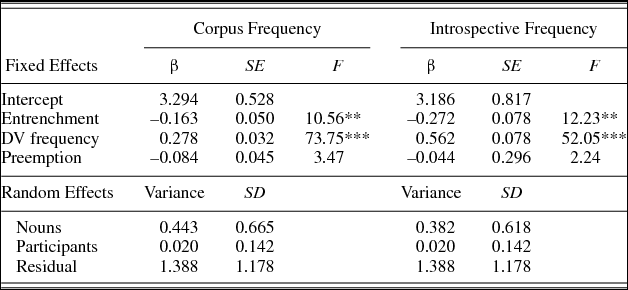
The data was analyzed in the mixed-effects model. The maximal random-effects structure for which the model would converge was employed. DV frequency, entrenchment, and preemption were treated as fixed effects and participants and DVs as random effects. As shown in Table 4, results based on both corpus and introspection frequencies yielded the same pattern. The effects of DV frequency (corpus: β = 0.278, F = 73.75, p < .001; introspection: β = 0.562, F = 52.05, p < .001) and entrenchment (corpus: β = –0.163, F = 10.56, p < .01; introspection: β = –0.272, F = 12.23, p < .01) were significant, while the effects of preemption were not significant (corpus: β = –0.084, F = 3.47, p > .05; introspection: β = –0.044, F = 2.24, p > .05), demonstrating that (a) the more frequently the target words were used as English DVs, the more likely the fourth-year learners were to accept the related DV uses; (b) the more frequently the target words were used as nouns, the less likely the fourth-year learners were to accept the related DVs; and (c) the fourth-year learners’ acceptance or rejection of English DVs were not significantly related to the frequency of the synonyms of the DVs. However, whether these observed patterns are also true for the teachers remains unknown. In what follows, the teachers’ ratings on the acceptability of English DVs are analyzed with the mixed-effects model.
Mixed-effects modeling the fourth-year learners’ judgment on the acceptability of English DVs

Note: DVs, denominal verbs. Model based on corpus frequency: R 2 marginal = .188; R 2 conditional = .391. Model based on introspective frequency: R 2 marginal = .214; R 2 conditional = .390.
**p < .01. ***p < .001.
Teachers
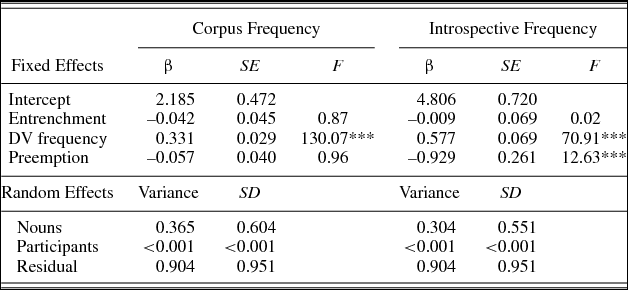
The procedures for data analysis for the teachers were the same as those for the fourth-year learners. The maximal random-effects structure for which the model would converge was also utilized. As shown in Table 5, the effect of DV frequency was significant in the mixed model based on both corpus (β = 0.331, F = 130.07, p < .001) and introspective (β = 0.577, F = 70.91, p < .001) frequency, indicating that the teachers were likely to accept the high-frequency English DVs than those of the low frequency. However, the effect of preemption (β = –0.929, F = 12.63, p < .001) was only significant in the analysis based on introspective frequency. This suggests that the teachers’ judgments on the acceptability of English DVs were negatively influenced by the competing forms. That is, the higher frequency of competing forms, the less likely it was for the teachers to rate the related English DVs as acceptable. The effect of entrenchment was no longer significant in the teachers’ use of such structures.
Mixed-effects modeling for the teachers’ judgment on the acceptability of English DVs

Note: DVs, denominal verbs. Model based on corpus frequency: R 2 marginal = .325; R 2 conditional = .519. Model based on introspective frequency: R 2 marginal = .356; R 2 conditional = .606.
***p < .001.
Interim summary
The above analyses clearly show that DV frequency is a significant factor that assists all participants in accepting English locatum and location DVs. For the effects of preemption and entrenchment, the two groups of participants manifested different patterns. The results based on both corpus and introspective frequency demonstrate that the effect of entrenchment was reliable in the fourth-year learners when they rated the acceptability of both locatum and location DVs but became nonsignificant in the teachers when they did the acceptability judgment task. Results based on introspective frequency show that the effect of preemption was absent in the fourth-year learners but present in the teachers in learning English DVs.
DISCUSSION
A key issue in L2 acquisition research concerns why learners lack nativelike abilities to generalize already acquired knowledge into novel formulations. To examine this issue, this study, under the framework of usage-based linguistics, tested the effects of entrenchment and preemption in L2 acquisition of English DVs. The most significant findings of the present study are as follows: the fourth-year learners’ judgments on the acceptability of all DVs were significantly constrained by entrenchment, while the teachers’ judgments on the acceptability of all DVs seemed negatively influenced by the preempting forms of DVs. These results were taken as evidence for the effects of entrenchment and preemption. In what follows, the potential mechanisms involved in L2 acquisition of English DVs are discussed in detail.
Effect of entrenchment
Entrenchment has been found to be effective in restricting the generalization of verbs in novel uses in L1 development (e.g., Ambridge et al., Reference Ambridge, Pine, Rowland and Young2008, Reference Ambridge, Pine and Rowland2012; Braine & Brooks, Reference Braine, Brooks, Tomasello and Merriman1995; Brooks et al., Reference Brooks, Tomasello, Dodson and Lewis1999; Theakston, Reference Theakston2004). This effect has also been evidenced in the present study where the fourth-year learners judged the acceptability of two types of DVs. That is, the major factor restricting the fourth-year learners from learning or using an English locatum or location DV is the nominal use of this verb. Usage-based linguistics argues that like L1 development, L2 learning is also a statistically driven process where learners implicitly resort to the statistical information of L2 input to guide their acquisition of new constructions (Ellis, Reference Ellis2002). Meanwhile, it is heavily influenced by L2 learners’ inference based on their prior linguistic knowledge and is itself continuously revised based on new input from any language (Pajak, Reference Pajak2012; Pajak et al., Reference Pajak, Fine, Kleinschmidt and Jaeger2016). The words targeted in the present study are far more frequently used as nouns than verbs. From the high-frequency nominal tokens of the target words (i.e., some/much/more water) in daily use, the fourth-year learners may infer that the probability of these nominal uses is high while the occurrence of the related verbal use (i.e., water/waters/watering/watered) is rare. In doing the acceptability judgment task, these DVs are likely to be treated as unacceptable. This is also in line with the Bayesian statistical inference model that people acquire a linguistic structure by analyzing its frequency distributions and the related existing linguistic knowledge (Dowman, Reference Dowman, Gleitman and Joshi2000). Statistically, that a word is repeatedly used as a noun constitutes indirect negative evidence for its novel use (Pinker, Reference Pinker1979). In other words, in the initial learning stage, it is the entrenched nominal use that makes L2 learners conservative in extending a noun into a DV use.
As the DV tokens accrue, entrenchment becomes ineffective as observed in the teachers. The Hebbian learning rule postulates that weight of the connection between the verb use and the target form is enhanced as a result of successive DV input (Hebb, Reference Hebb1949). Chances are that the accumulated DV use overshadows the effect of entrenchment in the teachers. Such a pattern has also been observed by Zhang (Reference Zhang2017), who found that entrenchment is operative in the intermediate L2 learners but absent in advanced L2 learners in the development of English un– prefixation. Even so, one possibility is that the reliable effect of entrenchment observed in the fourth-year learners is a combined effect of both entrenchment and preemption. In the present study entrenchment was measured as the total nominal frequency of a DV, while preemption was the combined frequency of competing verbs that convey the same meaning as this DV. One condition is that the alternative verbs take the nominal uses of this DV. For instance, to water was treated as less acceptable by L2 learners not only due to its nominal use (e.g., Can I have some water, please?) but also due to this nominal use followed by the alternative verb as in He poured some water on it. Preemption and entrenchment, as Ambridge et al. (Reference Ambridge, Bidgood, Twomey, Pine, Rowland and Freudenthal2015) noted, may work jointly in language development, which merits more attention in future studies.
Effect of preemption
Effects of preemption have also been observed in L1 VAC development and word learning (e.g., Ambridge, Reference Ambridge2013; Ambridge et al., Reference Ambridge, Pine and Rowland2011, Reference Ambridge, Pine and Rowland2012; Boyd & Goldberg, Reference Boyd and Goldberg2011; Braine & Brooks, Reference Braine, Brooks, Tomasello and Merriman1995; Brooks & Zizak, Reference Brooks and Zizak2002; Robenalt & Goldberg, Reference Robenalt and Goldberg2015; Stefanowitsch, Reference Stefanowitsch2011). The competing forms constitute a significant factor that would restrict learners from generalizing verbs into new VACs or other novel uses. The present study found that preemption was effective only in the teachers. The lack of this effect in low-level or intermediate learners such as the fourth-year students in this study was also reported by Ambridge and Brandt (Reference Ambridge and Brandt2013) and Robenalt and Goldberg (Reference Robenalt and Goldberg2016): less proficient L2 users were unlikely to take into account the competing alternatives (e.g., She filled the cup with water) conveying the same meaning as the novel construction (e.g., *She filled water into the cup).
The effect of preemption is predicated upon a large amount of related constructional knowledge in the learners’ linguistic repertoire and comparisons between the target verb and its competing alternatives. It is absent in low-level or intermediate L2 learners like the fourth-year students due to several factors. The first one is associated with the way constructions are learned under formal learning settings. When learning the target construction like English DVs, low-level L2 learners are prone to memorize context-free words without paying much attention to the context where the target word occurs. The fourth-year learners in the present study were formally instructed and required to prepare for English proficiency tests (e.g., Test for English Majors—4). They often prepare for these tests by intensively memorizing large numbers of isolated words (Gong, Reference Gong2007). Such a way of learning may lead them to simply memorize the “pure” meaning of words, but fail to gain the information of how words are used in context. In language use, they are inclined to focus on the “pure” meaning of the intended word rather than its appropriateness in the perceived context. The second factor has a bearing on the representation of L2 knowledge. L2 lexical knowledge is largely phonologically and morphologically based. Low-level learners tend to produce phonologically related or morphologically related word pairs instead of semantically related word associations in the free association task (Meara, Reference Meara1983; Zhang, Reference Zhang2017). It is less likely for them to compare the competing alternatives with the target construction in judging the acceptability of English DVs. The third factor has to do with formal teaching. Initially, learners were instructed to treat nouns and verbs as distinct categories. This rigid dichotomous lexical classification may easily induce learners to think that nouns are inconvertible, which will exert negative impact on the DV use. All these factors conspire to constrain the English DV learning process, making it less likely for L2 learners to compare how a verb is being used and how it might have been used. As learners gradually become more proficient in English, they begin to restructure the representation of English DVs and their competing verbs. The effect of preemption was reliable in the teachers based on introspective frequency, demonstrating that they began to consider the appropriateness of DVs with reference to the competing forms. Another finding worthy of emphasizing is that the results obtained from both corpus and introspective frequencies are generally convergent except for the effect of preemption for the teachers. Thus, L2 learners’ introspective intuition on the frequency of English DVs could evaluate the amount of English exposure. Both Schmitt (Reference Schmitt2014), and Wang and Koda (Reference Wang and Koda2005) argue that making use of advanced L2 learners’ intuition on frequencies of target constructions is reliable to estimate the amount of learners’ exposure to L2.
As argued at the onset of this article, most adult learners are less likely to achieve nativelike ability in an L2. Findings of the present investigation suggest that explaining the limited attainment of adult L2 learning should not only require reference to age of acquisition, nonaccess to Universal Grammar, and L1 transfer but also take into account the constraints of entrenchment and preemption or other general cognitive mechanisms as well. Usage-based linguistics assumes that the acquisition of both the L1 and the L2 is a statistically driven and experientially adaptive process whereby language learners make use of the statistical information from input to establish linguistic form–meaning mappings (Ellis & Larsen-Freeman, Reference Ellis and Larsen-Freeman2009; Tomasello, Reference Tomasello2003). Of most relevance to this process is the frequency of target constructions and the frequency of competing constructions. To be specific, in most cases, the higher frequency of a construction, the more likely for learners to acquire it. The high frequency of this construction (i.e., more entrenched) in one structure, in turn, minimizes the possibility that this construction could be used in another (Braine & Brooks, Reference Braine, Brooks, Tomasello and Merriman1995). In the same vein, the higher the frequency of the competing alternatives that convey the same meaning as this construction, the more likely for these competing alternatives to block the use of this construction. MacWhinney's (Reference MacWhinney, MacWhinney and Bates1987) competition model for language learning also posits that language is learned through the competition of linguistic cues between lexical items, phonological forms, and syntactic patterns in the presence of a rich linguistic environment. Accordingly, when two forms denote the same meaning, it is more likely for learners to use the oft-used form to express this meaning. Although entrenchment and preemption in our research have been found to play different roles in distinct L2 learning stages, based on the above discussion, we believe that the frequency of nouns and competing alternative verbs constrain the process by which L2 learners acquire English DVs, thus contributing to their limited attainment.
Conclusion
This study adopted both corpus and learners’ introspective frequency to measure the effects of constraining factors in L2 acquisition of English DVs by Chinese speakers. Although the developmental trajectory of English DVs seems complex, we found that the effects of entrenchment and preemption are significant in the distinct stages of English DV development. For the fourth-year learners, entrenchment is a key factor constraining them from generalizing English nouns into novel use. However, for the teachers, only the effect of preemption is prominent. These findings together with other recent work (Zhang, Reference Zhang2017) that entrenchment is a factor associated with the preference of fourth-year college English majors and Chinese teachers of English to judge the grammaticality of English un– verbs may give insights into the possible constraining variables involved in L2 learning from the usage-based perspective. Based on these findings, we suggest that L2 learning theories should take into account the effects of entrenchment and preemption when accounting for L2 learners’ failure to achieve native like proficiency.
The present study has certain limitations. First, only a receptive task was used to measure learners’ English DV knowledge. The findings would be more convincing if both receptive and productive tasks (e.g., primed production task in Blything et al., Reference Blything, Ambridge and Lieven2014) are used to test the effects of entrenchment and preemption in L2 acquisition of English DVs. Second, results regarding entrenchment and preemption are only suggestive, because only Chinese speakers and English DVs were involved. Researchers should be cautious to generalize these findings for other constructions, languages, and L2 learners. More research is warranted to test the effects of these two focal factors on L2 development of other constructions. Third, the semantics of DVs may be an important factor, as Shibtani and Pardeshi (Reference Shibatani and Pardeshi2002) argue that a verbal use is more acceptable if this use easily causes an action. For instance, it is difficult to see how one forces a man to wear a beard (Homer bearded the actor) but easy to see how one repairs a jacket by adding patches (Lily patched the jacket).Footnote 5 This semantic constraint needs more attention in future studies. Despite all of these imperfections, this study has revealed that L2 learners’ ability to generalize a well-attested construction into its novel use is significantly constrained by the frequency of this construction and its competing alternatives.
APPENDIX A
Locatum DVs
Cover, name, paint, dress, spot, picture, seal, water, crown, coat, mask, litter, bruise, scar, patch, saddle, seed, nickname, wax, cushion, carpet, oil, belt, man, powder, paper, butter, grease, people, cloak, pattern, mist, pickle, soap, sheet, blanket, perfume, brick, lid, badge, forest, flour, receipt, beard, pearl, shirt, watermark, glove, wig, cobblestone, poster, newspaper, oilcloth, sweater, jacket, uniform
Location DVs
House, shelter, sack, picture, lodge, seat, film, jail, photograph, headquarter, harbor, box, package, air, cradle, soil, catalogue, hole, corner, bottle, bag, orbit, bed, cage, parcel, card, hive, closet, file, palm, showcase, keg, pocket, window, barrel, graph, garage, church, warehouse, kennel, tanker, barn, coffin, snapshot, cupboard, desk
APPENDIX B
Testing sentences

APPENDIX C
English DVs (competing verbs suggested by second language learners)

ACKNOWLEDGMENTS
We are deeply grateful to Dr. Therese Grüter, the editorial team of Applied Psycholinguistics, and four anonymous reviewers for their excellent suggestions in revising this manuscript. We also thank all of the students and teachers who participated in this study and Wulin Ma (Sichuan International Studies University) and Yan Jiang (Chongqing RTV University) for their help in data collection. This research was supported by Award 15CYY018 from the National Social Science Foundation of China (to X.Z.).