Current demographic trends in the United States indicate an increase in the number of children who are bilingual and speak Spanish as their first language (US Census Bureau, 2000). Some of these children will be affected by developmental delays, including language-learning difficulties affecting both their native language and English. Bilingual speech–language pathologists strive to accurately and reliably identify children at risk of language impairment (LI). Research on this growing Latino population has shown that bilingual children with LI have deficits in different linguistic domains, such as morphosyntax, narratives, and semantics (Goldstein, 2004). However, valid and reliable assessment tools for this population continue to be scarce (for a review, see Restrepo & Gutiérrez-Clellen, 2004). In particular, it is unknown whether any of these measures, alone or in combination, may be useful as clinical identifiers of LI.
To assess the identification accuracy of an assessment tool, statistically significant group differences in the scores between children with typical language development (TLD) and children with LI are not sufficient. Sensitivity and specificity must be considered. Sensitivity is the proportion of true positives that are correctly identified by the assessment tool, whereas specificity refers to the proportion of true negatives that are correctly identified by the same task. The discrimination power of a clinical measure can be statistically tested through the use of discriminant function analysis (Bedore & Leonard, 1998; Dunn, Flax, Sliwinski, & Aram, 1996; Gavin, Klee, & Membrino, 1993; Plante & Vance, 1994). Given the social and educational consequences of a diagnosis of LI, it is important not to miss a true case and at the same time not to make a false positive diagnosis. Plante and Vance (1994) suggested that, for a diagnostic measure to be fair, its sensitivity and specificity should be at or above 80%.
DIAGNOSTIC ACCURACY OF LANGUAGE MEASURES
The clinical accuracy of spontaneous language measures has been studied in children speaking a variety of languages. For example, in English, children with LI exhibit more difficulties with the acquisition and use of finite verb morphology than children with TLD (Conti-Ramsden & Jones, 1997; Leonard & Eyer, 1997; Rice, Wexler, & Cleave, 1995; Rice & Oetting, 1993). Rice (2003) characterizes the finite verb deficits in children with LI as a “delay within delay,” that is, a selective and extraordinary difficulty with tense and agreement marking in addition to general language learning difficulties. Based on this research, a composite of finite verb morphology in a discriminant function analysis was found to be a reliable clinical marker with good sensitivity and specificity (Bedore & Leonard, 1998). A verb morphology composite and mean length of utterance (MLU) accurately identified 95% of the affected children and 95% of the TLD group, and these results were replicated with other children as well.
Research on English-speaking children has shown that combining MLU with percentage of ungrammatical utterances identified children with LI with better sensitivity than the traditional discrepancy between chronological age and language age based on standardized psychometric tests (Dunn, Flax, Sliwinski, & Aram, 1996). In this study, the grammatical measure included omissions of articles, prepositions, auxiliary verbs, and contractions, and incorrect usage of word order and negatives. A model combining use of Stage 1 major utterances (simple one-word commands, comments, and questions), use of three-element noun phrases, verb phrase errors, and age also had good classification accuracy (Gavin, Klee, & Membrino, 1993).
These studies demonstrated that measures of finite verb morphology were crucial in identifying the specific difficulties of these children. These deficits have been interpreted as evidence for the existence of an extended optional infinitive stage in which affected children continue to use root infinitives for finite verbs (Rice & Wexler, 1996). An extended optional infinitive stage has also been documented in the language of German-speaking children with LI (Rice, Ruff-Noll, & Grimm, 1997). However, not all children with LI replace finite verbs with infinitives. Null subject language speakers with LI exhibit deficits in other aspects of morphology in addition to limited utterance length measured by MLU. For example, affected Cantonese-speaking children were accurately identified using measures of lexical diversity and syntactic complexity (rather than inflected morphology). A combination of age, MLU, and a lexical diversity (D) measure correctly classified 44 of 45 (97.8%) children (Klee, Stokes, Wong, Fletcher, & Gavin, 2004). Italian children with LI were identified with good sensitivity and specificity using morphological markers including definite singular articles and third-person plural verbal inflections (Bortolini, Caselli, Deevy, & Leonard, 2002). Yet, these data were collected using elicited probes rather than spontaneous language samples.
SPANISH MORPHOLOGICAL MEASURES WITH CLINICAL POTENTIAL
Unlike in English LI, verb morphology alone is not expected to be a good clinical marker for Spanish LI. From a developmental perspective, SS children start to use accurate verb inflections with their first word combinations (Serra, Serrat, Solé, Bel, & Aparici, 2000) and do not go through an optional infinitive (OI) stage. In effect, the OI account has been updated to accommodate null subject languages, such as Spanish (Wexler, 2003). Based on Wexler's theoretical framework, lexical verbs in Spanish are not predicted to be substituted by infinitives. Indeed, verb use by SS children with LI is accurate and does not reach the typical verb error rates reported for English-speaking children (Bedore & Leonard, 2001, 2005; Restrepo & Gutiérrez-Clellen, 2004). SS children with LI were found to produce verbs with high accuracy (range = 91–94%; Bedore & Leonard, 2005; Bosch & Serra, 1997; Gutiérrez-Clellen, Restrepo, Silva, & Del Castillo, 2000), whereas the frequency of correct verb morphology in English-speaking children with LI ranges from 32 to 63% (Conti-Ramsden & Jones, 1997; Leonard, Bedore, & Grela, 1997; Rice et al., 1995).
In contrast, SS children with LI exhibit significant difficulty with articles (Anderson & Souto, 2005; Bedore & Leonard, 2001, 2005; Restrepo & Gutiérrez-Clellen, 2001). There is no agreement on whether omissions or gender substitutions are more prevalent, although omissions appear to be more frequent (Anderson, 1999; Anderson & Souto, 2005; Bedore & Leonard, 2005; Restrepo & Gutiérrez-Clellen, 2004). Within Wexler's conceptual framework (i.e., the extended unique checking constraint [UCC] account of LI; see Wexler, 2003) children may consider articles to be optional for an extended period of time (Anderson & Souto, 2005) and agreement errors may be because of optionality of feature checking for agreement marking (Bedore & Leonard, 2005).
Other free-standing morphemes reported to be problematic for SS children are clitic pronouns. Clitics are syntactically independent and phonologically dependent morphemes (Zagona, 2002). Romance languages typically have a large repertory of clitics. Some may be verb objects (e.g., lotengo—I have it, direct object; ledigo que venga—I told him/her to come, indirect object). Others are not objects, as is the case with the clitic “se.” This clitic appears in a variety of constructions. It assists in the formation of reflexive and reciprocal sentences (e.g., el perroselava—the dog washes himself; sequieren—[they] love each other), impersonal statements (e.g., secome bien en ese barrio—one eats well in that neighborhood), and middle and passive sentences (e.g., la ventanasecerró—de golpe—the window suddenly closed; sevenden estas casas—These houses are being sold). The clitic “se” may also mark lexical aspect (e.g., secomió—la sopa—[s/he] ate the [whole] soup; Zagona, 2002). Appendix A provides examples of the Spanish object clitics and the “se” clitic. Among linguists, there is controversy regarding the position in which clitics are generated in the syntactic architecture, the manner in which they are grammatically linked to an argument position, and their syntactic features (Zagona, 2002). Thus, it is not clear what type of syntactic deficit underlies the omission of clitics (i.e., movement, thematic assignment, lexical entry of the verb). In addition, pragmatic constraints affect clitic production in spontaneous language. In conversation, clitics frequently refer to previously mentioned objects or persons. Thus, difficulties with discourse cohesion may, in addition, affect clitic production. In the present study, no distinction is made across these different syntactic functions of clitics.
SS children with LI demonstrate both omissions and substitutions of clitics in spontaneous and structured tasks (Bedore & Leonard, 2001; Bosch & Serra, 1997; Jacobson, 2002). Clitic substitutions are not compatible with Wexler's UCC account of LI. This linguistic account predicts a high rate of omissions but no substitutions (Wexler, 2003). Clitic accuracy also varies depending on the language tasks used (above 96% for both children with LI and TLD controls in spontaneous language samples; 37% correct for LI, and 80% for controls on structured tasks; Gutiérrez-Clellen, Restrepo, Bedore, Peña, & Anderson, 2000).
Direct assessment of clitics can be difficult because on many occasions their use is not obligatory. Bedore and Leonard (2001) reported that children with LI avoided the targeted use of the clitic in a transitive structure by using an intransitive verb with the appropriate meaning. For example, after the examiner's prompt “The lady sees a mouse and …, ” the expected response was “she chases it.” However, children with LI used an intransitive verb as in “she runs.” In other cases, the direct object was expressed with a full noun phrase rather than with a clitic.
Furthermore, use of clitics may vary depending on the child's level of exposure to and use of a second language. There is some evidence that a form that is optional in one language may become less optional if it is obligatory in the other language (Müller & Hulk, 2001). As a result, children may exhibit a greater use of these forms because they may be reinforced in the input. If object pronouns are more obligatory in English than in Spanish, one may predict greater clitic pronoun accuracy in children who are bilingual than in children who are monolingual. At the same time, gender substitutions in both clitics and articles may be expected in bilingual children. There is evidence that gender associations between Spanish articles and nouns may loose strength when children are exposed to English, a language without gender marking (Anderson, 1999). Research is needed to examine these issues.
Research is also needed to examine the clinical value of verb argument structure. Omissions of clitic pronouns functioning as arguments may actually reflect incomplete thematic assignment of verbs. That is, in some contexts, the omission of a clitic may actually be the omission of a mandatory theme (e.g., Tenía un juguete y *Ø [lo] perdí—(I) had a toy and lost *Ø [it]) or beneficiary argument functioning as a direct object (e.g., Entró en el cuarto y *Ø [la] abrazó—[he] stepped in the room and hugged *Ø [her]) or indirect object (e.g., Buscó su dirección y *Ø [le] mandó la carta—[he] looked for his address and sent the letter *Ø [to him]). In standard Spanish, object drop is not allowed with definite objects (Montrul, 2004, p. 189). With indefinite objects, object drop is permissible (Campos, 1986). For example, the answer to the question? ‘Trajiste el libro? (Did you bring the book [definite object]?) must include a direct object such as Sí, lotraje (Yes, I brought it). In contrast, the question? ‘Trajiste libros? (Did you bring books [indefinite object]?) may be answered without the direct object such as Sí, traje (Yes, I brought Ø). Children with LI may take longer than TLD children to learn when it is appropriate to drop objects.
A few studies of English-speaking preschoolers with LI found occasional omissions of arguments in spontaneous language (Lee, 1976; Leonard, 1998; Rice & Bode, 1993). Younger children omitted more arguments than older children (Lee, 1976), and objects were omitted more frequently than subjects (Rice & Bode, 1993). Subject omission was increased in phrases with unacussative verbs (that is, verbs having a theme argument as a subject, such as “The boy fell”; Grela & Leonard, 1997). The overall omission rate however, is low. For example, in Rice and Bode (1993), only 3% of the total verbs presented argument errors. King and Fletcher (1993) found errors in fewer than 3% of the verbs used. Thordardottir and Weismer (2002) analyzed the verb argument structure produced by children with LI, who were 5 years and 5 months (5;5) to 9;8, in spontaneous language samples. Ninety-three percent of the verbs were used with all obligatory arguments. Omission of agent and theme arguments was more frequent in English-speaking children with LI than in controls.
The presence of grammatical arguments depends on the lexical properties of the verb (i.e., intransitive versus transitive versus ditransitive versus directed motion verb) and the discourse context. The number of obligatory arguments licensed by the verb indicates the level of complexity of a verb. For example, transitive verbs are more complex than intransitive verbs because they require both an agent and a theme, whereas intransitive verbs only require an agent. Ditransitive verbs require more than two arguments. For instance, the verb “give” requires an agent, a theme, and a beneficiary. As a verb phrase requires more arguments, language processing is deemed to be more effortful and vulnerable to limitations in lexical access, grammatical encoding, and working memory. For example, English-speaking children with LI omitted auxiliaries more frequently than MLU-matched controls with ditransitive verbs than with intransitive or transitive verbs, even when sentence length was controlled (Grela & Leonard, 2000). In another study, these children used significantly fewer types of three-place argument structures (including ditransitives) than did age-matched children and MLU-matched children with TLD (Thordardottir & Weismer, 2002). Impoverished argument structure may not be merely attributable to performance limitations related to increased utterance length, but may reflect partial representation of complex verbs. This may explain why children with LI demonstrate overall correct but less sophisticated use of verbs.
Research with SS preschoolers with LI has shown similar trends in their use of verbal arguments as well. Five-year-old children with LI omitted almost 30% of the obligatory verbal arguments in spontaneous conversations (Sanz Torrent, 2002). Of these omissions, theme arguments were the most frequently absent (21% of all obligatory arguments). In contrast, age-matched controls omitted 9% of theme arguments and MLU controls 7%. Agent arguments may not present extraordinary difficulties because in pro-drop languages such as Spanish, overt subjects are semantically and pragmatically salient (Montrul, 2005). These effects have been replicated in Spanish–Catalan bilingual preschoolers with LI in a scene description task (Badia & Serra, 2005). These children showed decreased use of target verbs and obligatory arguments as well as high use of general purpose verbs. Both theme omissions and use of complex verbs may contribute to the identification of SSLI. There is evidence that affected children show reduced use of complex verbs (i.e., ditransitive) when compared to age-matched and MLU-matched controls (Sanz-Torrent, 2002).
In summary, SS children with LI present with deficits in morphology and verb argument structure. However, there is limited research on the accuracy of these measures for the identification of SS children with LI. Restrepo (1998) investigated the discriminant accuracy of lexical learning (novel vocabulary and bound-morpheme learning), morphosyntactic measures (MLU in words [MLUW] and number of morphological errors per T-unit [NETU]), and parent concern regarding their child language on a sample of 62 children (mean age = 6;2). The variables that accurately discriminated between children with TLD and children with LI were parental report of their child's speech and language problems and family history of the same and the morphosyntactic measures (MLUW and NETU). The discriminant model classified 21 of 23 LI as LI, indicating that the model had a sensitivity of 91.3%; whereas it classified all children with TLD as such, indicating a specificity of 100%. The same accuracy could be maintained with only evidence of parent concern and NETU as diagnostic indicators. According to Restrepo (1998), NETU in isolation had a sensitivity of only 69.57%. The measure accounted for errors in both noun and verb phrase and thus, it cannot inform us about which specific combination of grammatical forms should be assessed or what levels of accuracy should be expected to differentiate typical from atypical performance. In addition, it is not known how accurate these measures may be with younger children.
More recent research has found that grammatical accuracy on articles, pronouns, verbs, and conjunctions in an elicited task had good discrimination accuracy for SS children between ages 4 and 6 years. Sensitivity was 86% for children ages 4 to 5 years, and 94% for the group ages 5 to 6. Specificity was above 86% for both age groups (Gutiérrez-Clellen, Restrepo, & Simon-Cereijido, 2006). Although the measure evaluated clitic accuracy, the study did not examine the role of verb argument structure in the identification of the disorder.
The present study was designed to evaluate the discrimination accuracy of spontaneous language measures with SS preschoolers. Specifically, this research aimed to (a) tease out what specific grammatical measure(s) were responsible for the LI deficits, and (b) determine the role of verb argument structure and syntactic complexity in identifying SS children with LI. A secondary purpose was to investigate whether these measures could be used to identify the disorder in SS children who are learning English as a second language, as is the case with the SS population in the United States. To assess the accuracy of these measures, two sets of experiments were planned. In the exploratory study (Experiment 1), the measures of interest were analyzed using discriminant function analyses. The second phase of the study (confirmatory study or Experiment 2) aimed to replicate the findings of the exploratory analysis with a separate group of children. The next sections describe the characteristics of the participants and the procedures used in both exploratory and confirmatory studies.
METHOD
Participants
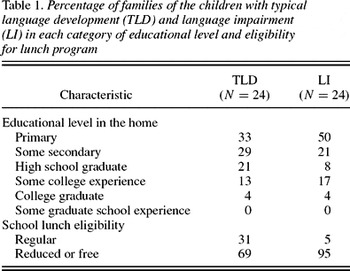
Forty-eight SS children (24 with TLD, 24 with LI) and their families were sampled from a larger study that included children from California and Texas. Study participants were selected based on age and language background because previous research found no language differences by site (Gutiérrez-Clellen et al., 2006). Most children were from low socioeconomic status (SES) backgrounds and they were equally represented in each ability group. This was done because there is evidence that income level and maternal education are risk factors for language development (Dollaghan et al., 1999; Jewkes, 2005; Payne, Whitehurst, & Angell, 1994). School lunch program status was used as a metric for income level. Each school independently determined lunch program qualification status, which was based on family income and the number of occupants in the household. Table 1 lists the parent educational level and lunch status of the participants by group. The distribution of lunch eligibility indicates great variability within groups. Because of this variability, differences in SES are not likely to impact group comparisons. The majority of the participants were of Mexican American descent. Only one child was of Honduran descent. The two groups were age matched by ±3 months (TLD M = 55.2, SD = 4.2; LI M = 53.7, SD = 4.5). Only children whose parents gave informed parental consent (based on approved protocols by Institutional Review Boards at the University of California, San Diego, San Diego State University, and University of Texas, Austin) were selected for participation in the study.

The sections below provide a description of the language characteristics of the participants. First, we indicate the procedures and criteria for assigning bilingual status based on parent and teacher questionnaire data. Second, we describe the criteria used to identify the children with LI.
Procedures and criteria for establishing bilingual status
The bilingual status of all the children in the experimental and control groups was determined using parent and teacher reports based on previous research with these measures (Gutiérrez-Clellen & Kreiter, 2003). Parents or guardians were interviewed using a parent questionnaire that addressed the children's general language use across settings and interlocutors as well as history of developmental delay, hearing loss, or any concerns about speech or language skills. The parent questionnaire also served as a measure of exposure to and use of each language at home. Parents were asked to rate proficiency of each language spoken by each member of the household with whom the child had the opportunity to interact, and the child's language proficiency and use using a 5-point rating scale for each measure (0 = no use or proficiency, 4 = use all the time and nativelike proficiency). They also reported the number of hours the child interacted with each member of the household and the language spoken during those interactions. The children's teachers were also given a questionnaire to rate the participants' use and proficiency of each language using the same 5-point scale. In addition, they provided an estimate of the percentage of time that the child was exposed to each language as a measure of input in school. To verify the accuracy of the questionnaire data (e.g., amount of input by language during the week; language exposure estimates across contexts at school), at least one-half of all questionnaires were independently rescored by a second bilingual research assistant. Item-by-item reliability checks yielded above 90% agreement between the two judges.
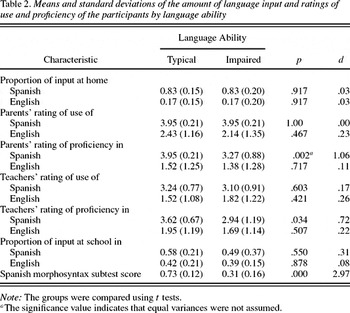
Table 2 describes the language characteristics of the children based on the questionnaire data. Both groups of children (i.e., the group with TLD and the group with LI) were Spanish speaking with limited English proficiency. There were no group differences on their exposure to and use of English, as reported by the parent and teacher questionnaires. As expected, the children with LI had significantly lower proficiency ratings in their Spanish (their primary language) compared to the children with TLD. Across sites, the majority of the children attended bilingual classrooms with SS aides. However, there was great variability in the use of Spanish across individual classrooms.

Criteria for identification of children with LI
Given the fact that there are no valid standardized tests to identify SS children with language disorders, the procedures used for identification were based on the following criteria: (a) evidence of parent concern and/or teacher concern; (b) clinical judgment based on observations of trained bilingual speech–language pathologists (e.g., reported evidence of limited responsiveness in conversational samples, modifiability, etc.); and (c) below cutoff scores on Spanish and English morphosyntax subtests of the Bilingual English Spanish Assessment (Peña, Gutiérrez-Clellen, Iglesias, Goldstein, & Bedore, 2006) as determined by previous research with these measures (Gutiérrez-Clellen & Simon-Cereijido, 2006; Gutiérrez-Clellen et al., 2006). Seventeen children in the LI group presented with phonological delays. The observed phoneme omissions or substitutions did not affect the production of the targeted morphemes or sentence structures. Phonological errors were not penalized. In addition, all children presented adequate oral–motor skills based on clinician's observations. Children were assigned to Experiment 1 or 2 randomly.
None of the children evidenced hearing impairments, mental retardation, emotional disturbance, motor difficulties, or neurological deficits, according to parent report and school records. About one-third of these children were in the caseloads of trained bilingual clinicians. The remaining children had just been referred for a diagnostic evaluation because of parent and/or teacher concerns. Both the children with LI and their typically developing peers were recruited from the same classrooms and schools. The children with TLD were learning their language(s) without difficulty based on parent and teacher reports as well as clinical observation. Upon verification that they met the criteria, they were age matched with the children with LI.
Procedures
Children produced narratives based on two different wordless picture books: Frog Goes to Dinner (Mayer, 1974) and Frog on His Own (Mayer, 1973). A bilingual research assistant first told Frog on His Own and the child was encouraged to retell the story with assistance of the book. The second sample was a spontaneous narration of the second book. Children were encouraged to produce at least one utterance per picture.
Only spontaneous utterances were included in the sample. Children with LI produced samples with a mean of 56.8 (SD = 19.0) utterances. The samples of the TLD group had a mean of 69.1 (SD = 17.1) utterances. On average, samples included 63.8 (SD = 22.7) utterances with finite verbs. Samples were transcribed using the systematic analysis of language transcripts (SALT; Miller & Chapman, 2000) and coded to obtain MLUW, ungrammaticality index (UNGRAMM) based on the percentage of ungrammatical utterances, percentage of correct use of theme arguments, and proportional use of ditransitive verbs (DITR). One word, unintelligible, or mixed utterances were excluded from the analysis and the MLUW calculation to improve stability of MLU measurement and developmental sensitivity (Johnston, 2001).
The UNGRAMM was obtained based on the percentage of utterances with grammatical errors in obligatory contexts found in the sample. Ungrammatical utterances included errors with articles, verbs, clitics, prepositions, adjectives, nouns, and conjunctions. Article errors were omissions and substitutions of gender and number. Verb errors included omissions, substitutions of person, number, and tense, and overgeneralizations. Clitic errors were omissions of the clitic in obligatory clitic doubling contexts (e.g., “*dio a él una manzana” for “le dio a él una manzana”—“s/he gave him an apple”), and in “se” constructions in which omission of the clitic “se” rendered the sentence ungrammatical (e.g., “*el barco hundió” for “el barco se hundió”—“the boat sank”). In the language samples, omissions of the clitic “se” exclusively occurred in middle voice contexts. Clitic errors, in addition, included substitutions of case, person, gender, or number, and clitic additions. Each utterance was coded independently from discourse context.
The percentage of correct use of theme arguments was based on their use in obligatory contexts. Obligatory contexts for theme production were coded by identifying every instance of transitive and ditransitive verb use. Transitive or ditransitive verbs that were optionally and grammatically used as intransitive verbs were not included in the count of obligatory contexts. Theme argument omissions included omissions of theme in obligatory contexts such as “*Juan agarró” for either “Juan lo agarró” (“Juan took it”) or “Juan agarró + noun phrase” (“Juan took + noun phrase”). See Appendix A for examples of error codes. Omissions of direct objects were not coded as clitic omissions but as theme omissions because it is not possible to establish reliably whether the child aimed to produce a clitic or a noun phrase.
Ditransitive verbs were identified when there was evidence of three arguments (agent, theme, and goal/beneficiary) acting as subject, direct object and indirect object in the child's utterance. The total number of ditransitive verbs found was divided by the total number of verbs to obtain an estimate of the use of complex verb argument structure across children.
About one-half of the transcripts were independently transcribed by a second examiner to achieve at least 90% item-by-item transcription agreement. Disagreements between transcribers were related to intelligibility issues and were resolved by consensus with a third judge. Coding reliability was calculated as a percentage of agreement (point-by-point) for each measure based on 25% of the transcripts randomly selected and recoded by an independent rater. Coding reliability was 93%.
Given the fact that the data were based on percentages, all analyses were conducted using arcsine transformations.
RESULTS
Exploratory study
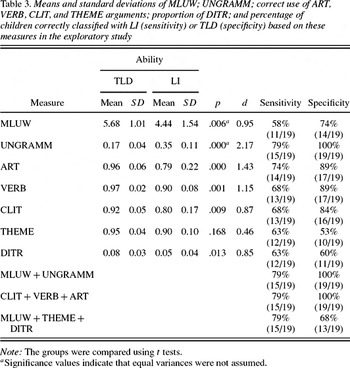
The exploratory study was based on 38 children (19 with TLD, 19 with LI) matched by age (TLD M = 53.95, SD = 4.26; LI M = 55.63, SD = 4.07) and drawn randomly from the original pool of 48 children. Independent t tests were used to verify that the groups differed on the measures to be used to classify the groups. Table 3 includes the untransformed means, standard deviations, and effect sizes for all the measures. There were significant differences between groups for all measures with the exception of theme omissions. However, theme omission was kept as a potentially important clinical variable because it had a medium effect size (d = .46). Statistically significant differences do not necessarily indicate that the relationship between two variables is large or important (Snyder & Lawson, 1993), and they may not be found when comparing small samples (because of limited statistical power).

Linear discriminant function analyses evaluating group classifications (i.e., TLD children; children with LI) were performed on the percentage correct scores. These scores were first entered into separate discriminant function analyses for the different variables, and the generated canonical discriminant function coefficients were used to classify participants into groups. These coefficients maximize differences between groups relative to differences within groups (Tabachnick & Fidell, 1989). A participant was classified into the TLD group if his/her discriminant function score was above zero and into the LI group if the discriminant function score was below zero.
Table 3 shows the percentage and actual number of children correctly classified in each group (i.e., sensitivity and specificity). Measures that have discriminant accuracy for TLD and LI children above 90% were considered “good” discriminators, and those that discriminate with an accuracy of 80% and above were considered “fair” discriminators (Plante & Vance, 1994). Based on the exploratory study results, the only individual variable that approached fair sensitivity and good specificity was UNGRAMM. This model replicates Restrepo's (1998) measure, because by definition, all the children had parent and/or teacher concern. The canonical correlation for the model was .728 and the calculated discriminant function was significant, χ2 (1) = 26.7, p = .000, showing that the model was highly predictive of group membership. The combination of MLUW with UNGRAMM did not improve classification. Neither VERB nor ART nor CLIT had adequate sensitivity in isolation. However, sensitivity was fair and specificity was excellent using a morphological composite that included ART, CLIT, and VERB. The canonical correlation of this model was high as well, .663, χ2 (3) = 19.9, p = .000. Fair sensitivity was also found combining MLUW, THEME, and DITR. For this discriminant function, the canonical correlation was moderate, .572, χ2 (3) = 13.7, p = .003. However, the specificity was only 68%.
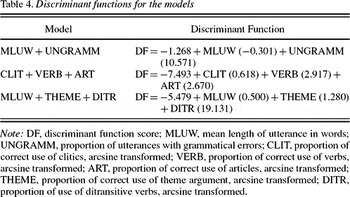
In summary, the exploratory models with the best sensitivity and specificity were either MLUW + UNGRAMM, or CLIT + VERB + ART. MLUW + THEME + DITR had fair sensitivity but inadequate specificity. Table 4 provides the weights and constants for the three models.

Confirmatory study
To further test the discrimination potential of these variables, a confirmatory study was conducted with a second group of children. The classification of these children was evaluated using the weights and constants generated by the exploratory study. In the confirmatory study the goal was to determine if the discriminant functions derived from the exploratory dataset were able to predict group membership with an independent sample of children. The exploratory discriminant analysis generates canonical discriminant function coefficients and constants that maximize differences between groups relative to differences within groups (see Table 4). Thus, in the confirmatory analysis we multiplied the original test scores by the coefficients and then added the constant to obtain a discriminant function score for each (Tabachnick & Fidell, 1989). These scores were computed manually for 10 age-matched participants: 5 with TLD (age M = 53.40, SD = 3.9) and 5 with LI (age M = 53.00, SD = 5.7), drawn randomly from the original pool of children but not included in the exploratory study. All children were speakers of the Mexican dialect of Spanish.
The narratives of these children were obtained and coded using the procedures described earlier. The samples for the children with LI had a mean of 52.60 (SD = 17.18) utterances in length and the TLD group had a mean of 68.60 (SD = 14.05) utterances in length.
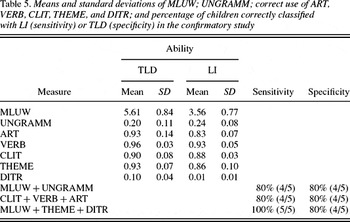
Table 5 shows the scores obtained on the measures of interest as well as the percentages of correctly classified children by the three models using the weights and constants derived from the exploratory study. Both the MLUW + UNGRAMM model and the morphological model had 80% sensitivity and specificity. The semantic–syntactic model targeting argument structure and MLUW (i.e., MLUW, THEME, and DITR) had a sensitivity of 100% and a specificity of 80%.

Post hoc comparisons related to bilingual status
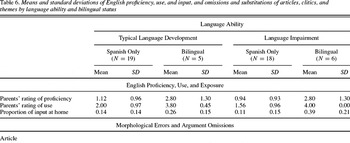
In both TLD and LI groups, there was a subset of children who had parents' ratings of English proficiency and use above 2, indicating better than limited English proficiency and somewhat frequent English use and exposure. This group of 11 children (5 with TLD, 6 with LI) will be labeled “bilingual” in contrast to the other 37 SS children who had minimal exposure and use of English. Table 6 shows the means and standard deviations of English proficiency, use, and input by language ability and bilingual status for all groups. The table lists the Spanish errors predicted to be related to the child's exposure and use of English (i.e., article and clitic substitutions; theme omissions). We expected that the bilingual children would show greater rates of article and clitic substitutions and fewer theme omissions than the children with limited English exposure and use. However, the analysis showed that gender and number substitutions occurred at a similar rate in the experimental and control groups for both bilingual children and Spanish speakers with minimal English exposure. The large standard deviations for these measures indicate great variability across subjects. Theme omissions were very infrequent, but within the small number of occurrences, the bilingual children with TLD appeared to omit themes less frequently than their peers with limited English exposure.

Table 6 also compares the groups on their omission errors to see if the children with LI exhibited more omissions of articles and clitics than their peers with TLD (as predicted by Wexler's UCC account). Most children with LI produced a larger number of article omissions (M = 5.71, SD = 6.37) than substitutions (M = 1.67, SD = 2.74). Similar trends appeared to exist for clitic use. The children with LI produced more clitic omissions than substitutions.
DISCUSSION
This study aimed to evaluate the discrimination accuracy of spontaneous language measures with SS preschoolers, to identify the specific grammatical measure(s) responsible for the LI deficits. Two sets of experiments were conducted on the spontaneous language samples of SS preschoolers with and without LI. In the exploratory study, the target measures were analyzed using discriminant function analyses. In the confirmatory study, we replicated the findings of the exploratory analysis with a separate group of children.
Although, there were significant group differences for MLUW, VERB, CLIT, ART, and DITR, the discriminant function analyses revealed that these measures in isolation did not have sufficient sensitivity and specificity to be considered clinical markers. However, specific combinations of measures approached fair sensitivity. These results are congruent with previous research reporting a small frequency of grammatical errors in SS children with LI (Bedore & Leonard, 2001, 2005; Restrepo & Gutiérrez-Clellen, 2004). In contrast to the extraordinary deficits of English LI on finite verb morphology reported in the literature, the results for SS LI in the present study did not reveal any specific grammatical features that could accurately differentiate the groups. Although these results need to be replicated with larger samples of children, the findings do not support the idea that SS LI can be characterized as having a delay for specific forms within a general language delay.
The first model that successfully classified the groups combined the UNGRAMM and MLUW. These measures are similar to those used in previous research by Restrepo (1998) with older children. The UNGRAMM is a measure comparable to Restrepo's NETU. Combining MLUW and ungrammaticality classified children with LI and TLD children with fair sensitivity and specificity. The results replicate Restrepo's findings and provide additional evidence for the clinical usefulness of these measures with a younger age group (3;11–5;1 years) compared to Restrepo's results with older children (5;0–7;1 years). In addition, the present study evaluated the model with children exhibiting a wide range of severity, from mild to moderate level (in contrast to Restrepo's study, which included affected children with a diagnosis of moderate to severe LI). The results indicated that the model misclassified the children with mild impairments (i.e., children with morphosyntax subtest scores around the cutoff score (M = 0.45, SD = 0.06). Thus, for these children, the measures should be supplemented by additional testing.
The next step was to identify the specific combination of grammatical measure(s) that were responsible for the LI deficits. The analysis revealed two alternative combinations of measures that equally approached fair sensitivity: a morphological model and a semantic–syntactic complexity model. The morphological model included correct percent use of verbs, articles, and clitics. The semantic–syntactic complexity model (i.e., MLUW, theme omission, use of ditransitive verbs) also had fair sensitivity and specificity for the identification of Spanish LI. A closer look at the cases of misclassification indicated that two-thirds of the children with LI (16 of 24) were correctly classified by either of the two models, but seven affected children were only correctly classified by one model. There were three children who were classified as LI only by the morphological model (ART, VERB, and CLIT) and four children who were classified as LI only by the semantic–syntactic model (MLUW, THEME, and DITR). Of the seven children, the three children classified by morphology only (i.e., misclassified by semantic–syntactic complexity) had a higher MLUW (M = 6.32, SD = 0.84) than the four classified by semantic–syntactic complexity only (i.e., misclassified by morphology; M = 4.00, SD = 1.15). This is congruent with previous research showing grammatical errors with increased complexity, and thus longer MLUs (e.g., Masterson & Kamhi, 1991). The four children misclassified by morphology used short and simple phrases, omitting theme arguments and with a paucity of ditransitive verbs. These children may not exhibit morphological errors because they seem to rely on simple syntax, reflected in low MLUW scores. Simple phrases with copula and intransitive verbs (i.e., “ahí está la rana”—“the frog is over there”; “la rana brincó”—“the frog jumped”) characterized most of their utterances. Theme omissions and limited use of ditransitive verbs may reflect language processing limitations related to the complex processing demands characteristic of narrative discourse contexts. Bishop (1997) indicated that in story tasks, children with LI have difficulty using prior context and selecting relevant from irrelevant information (i.e., difficulties with “constructive processing”). These difficulties may result in a greater use of simple utterances and verbs. This type of trade-off among linguistic areas (e.g., use of simple syntax in complex discourse contexts; increased morphological errors in sentences with complex clause structure) has been reported in previous research (Masterson & Kamhi, 1992) and support a limited capacity model (Crystal, 1987; Loebell & Bock, 2003).
In contrast, the children correctly classified only by morphology appeared to use more complex utterances, as reflected by a large MLUW. Their utterances provided an opportunity for a greater number of morphological omissions and substitutions. As pointed out by Leonard and Finneran (2003), increased MLUW may not only reflect complex syntax but also increased opportunities to err.
Is the high grammatical accuracy in Spanish a factor affecting the overall sensitivity of specific features in LI identification? Frequency of grammatical errors in Spanish spontaneous language is lower than in English. Spanish is a highly inflected language, a characteristic that may prompt children to focus on agreement and inflection to a greater extent than in English. However, although the discrimination approached by these measures is only fair, this study demonstrated that SS children with LI can be identified based on both morphosyntactic accuracy and complexity of their language samples. It is also possible that a combination of grammatical and language processing measures may improve classification accuracy (Conti-Ramsden, 2003). Further research should explore these possibilities.
Finally, it was important to examine the performance of the 11 bilingual children to determine whether the models that were found to be sensitive for the identification of the SS children with limited English proficiency would help identify LI in children who are exposed to and use English on a daily basis (i.e., children who may be considered bilingual). The results indicated that 100% of the bilingual children were correctly classified by the morphological model and 82% (9 of 11) were correctly classified by the semantic–syntactic model. Only two bilingual children were misclassified by the semantic–syntactic model (one LI, one TLD), and none were misclassified by the morphological model. In addition, the only child misclassified by the two models was a Spanish-only speaker. Thus, the bilingual children in this study were not found to behave differently than the children with minimal or no English proficiency based on these analyses.
Based on the literature, we expected that SS children who may be experiencing cross-language influence from English would exhibit greater rates of agreement errors in articles and clitic pronouns compared to their peers who have minimal or no English use. Gender agreement errors have been observed in the language of SS children with TLD undergoing language loss (Anderson, 1999). However, in our samples, both groups of children exhibited a similar number of article substitutions (see Table 6). For clitics, the bilingual children with TLD appeared to make a greater number of clitic gender and number substitutions (M = 3.00, SD = 3.08) than their TLD peers with minimal English exposure (M = 1.00, SD = 1.45). Yet, the bilingual LI group did not produce any clitic substitution (see Table 6). If bilingual children were experiencing cross-linguistic influence, we should have found similar patterns of error substitution for both bilingual groups (i.e., bilinguals with TLD, bilinguals with LI). In addition, a closer look at the errors produced by the individual bilingual children indicates that only three out of the five bilingual children with TLD and none of the six bilingual children with LI produced clitic substitutions. Future studies with larger samples of bilingual children would be needed to examine these issues further.
Cross-linguistic influence might also affect production of theme arguments. In specific contexts, Spanish allows object drop (Campos, 1986) whereas English does not. Thus, one may predict that bilingual children will have a decreased number of theme omissions in Spanish because of English influence. Table 6 shows that theme omissions were extremely variable within groups. In all groups, the standard deviations were as large as the means. Future studies with larger samples should explore this question.
To summarize, this study found that (a) MLUW and UNGRAMM in combination are fair to good discriminators of SS preschoolers with LI; (b) the combination of correct use of articles, verbs, and clitics also has fair discrimination accuracy but may miss children who have limited syntactic complexity; (c) semantic–syntactic complexity measures, such as MLUW, omissions of theme arguments and proportion of ditransitive verb use, should be considered in the identification of children with LI; and (d) English exposure and use does not appear to affect classification accuracy.
The results of the study are promising considering the limitations of the study regarding the size of the language samples and the limited opportunities for examining different grammatical forms. For example, the narratives obtained targeted a limited type of verbs, noun phrases, and inflections. Other syntactic contexts such as questions and negations, and elicited probes may help reveal the grammatical difficulties of the affected children as observed in other languages, such as English and Cantonese (Deevy & Leonard, 2004; Van der Lely, 1998; Wong, Leonard, Fletcher, & Stokes, 2004). Structured elicitation tasks may be a more effective approach than narratives. Thus, sensitivity and specificity of these measures may improve with structured elicitation tasks in combination with spontaneous language samples. Further studies should elucidate these methodological issues.
Regarding clinical implications, this study provides evidence for the usefulness of language sample analysis for the diagnostic assessment of SS preschoolers. In addition, comparison of the measures included in the morphological and the semantic–syntactic models may provide insights as to the nature of the child's difficulties as well as specific directions for planning interventions.
APPENDIX A

APPENDIX B

This research was supported by NIH/NIGMS SDSU MBRS Program 5 R25 GM58906-06 and NIDCD 1-DC-8-2100. We thank Lorena Cataño for valuable assistance with reliability checks and the anonymous reviewers for their insightful comments and suggestions.