Introduction
Obesity is a major contemporary health issue because of the prevalence and impact of its medical and psychological complications. It is one of the most prevalent chronic diseases in childhood and it can increase morbidity and cause premature mortality in adulthood (Baur, Reference Baur2005). In Brazil, the prevalence of childhood obesity has been rising steadily and it already represents a new challenge to the national health system. Recent data indicate that up to 17.5% of school-age children may be obese in the country (Ronque et al., Reference Ronque, CyrinoI, Dórea, Serassuelo, Galdi and Arruda2005). The causes of obesity are not sufficiently understood. It is known that it occurs when energy intake exceeds energy expenditure, but there are multiple aetiologies for this imbalance: genetic factors, environmental factors, lifestyle preferences and culture (Dehghan et al., Reference Dehghan, Akhtar-Danesh and Merchant2005).
The family environment plays a major role in children's development. It is the primary context for providing children's needs and, consequently, is of great importance for the development of health-related behaviour (Wake et al., Reference Wake, Nichols, Hardy and Smith2008). Already in intrauterine life, the mother's behaviour can increase the risk of metabolic abnormalities, including obesity, in a child. Breast-feeding may have a protective effect against obesity (Lindsay et al., Reference Lindsay, Sussner, Kim and Gortmaker2006). In early childhood, the baby's life depends on the parents; the adult is responsible for the baby's first food experiences, and the child will be influenced by the parents' preferences and selections (Birch & Davidson, Reference Birch and Fisher2001). The baby normally rejects new food, and it is the role of the caregiver to present new flavours several times, until they are eventually accepted (Birch & Davison, Reference Birch and Davison2001). The parents/caregivers, therefore, exercise environmental control. Offering healthy food, proposing physical activity and limiting the time of television viewing depends on the family (Dietz & Robinson, Reference Dietz and Robinson2005; Lindsay et al., Reference Lindsay, Sussner, Kim and Gortmaker2006).
Parental obesity is associated with increased prevalence of obesity in children (Burke et al., Reference Burke, Beilin and Dunbar2001). The relationship between parents and children can contribute to a child's coping skills. Attitudes like criticism by family and peers can contribute to reducing physical activity and influence other behaviours (Flodmark, Reference Flodmark2005).
The best time to treat and prevent obesity is during childhood. Lifestyle interventions show better results in 7- to 12-year-old children as compared with adolescent and adult life (Wilfley et al., Reference Wilfley, Stein, Saelens, Mockus, Matt and Hayden-Wade2007). If the thinking and practices of the parents are well understood, interventions can be developed and techniques proposed to improve children's education (including health education). Understanding how parents perceive their children's feeding and how they educate them may help in establishing both treatment and prevention strategies. This study explores the associations between parents' attitudes, parents' BMI and children's weight condition, in an attempt to find potentially modifiable patterns.
Methods
Subjects
The subjects were taken from those participating in a survey of around 2300 schoolchildren between the ages 6 and 10 in the city of Porto Alegre, Brazil, in which the children are weighed and measured as part of the protocol. A group of survey children were selected and their parents (or legal caregivers) were invited to take part in the current study. Since there have been very few previous reports on this topic, it was decided to take a convenience sample of around 100 subjects, composed of those parents/caregivers and children who promptly accepted the invitation. This figure was chosen based on several previous studies of a similar nature, many of which actually included fewer than 100 subjects (Clark et al., Reference Clark, Goyder, Bissell, Blank and Peters2007). The survey included one adult per household. All participants gave their informed consent. The study was approved by the local ethics committee.
Measures
Questionnaire
To register the parents'/caregivers' attitudes and behaviour, the Child Feeding Questionnaire (CFQ; Birch et al., Reference Birch, Fischer, Grimm-Thomas, Markey, Sawyer and Johnson2001) was used, which is a self-report instrument. It groups parental beliefs, attitudes and practices into seven factors: perceived responsibility (e.g. ‘When your child is at home, how often are you responsible for feeding him/her?’), perceived parent weight (e.g. ‘How was your own weight in your childhood – 5 to 10 years old?’), perceived child weight (e.g. ‘How was your child during the first year of life?’), concern about child weight (e.g. ‘How concerned are you about your child eating too much when you are not around him/her?’), restriction (e.g. ‘I have to be sure that my child does not eat too many sweets’), pressure to eat (e.g. ‘My child should always eat all of the food on her plate’) and monitoring (e.g. ‘How much do you keep track of the sweets that your child eats?’). The CFQ was translated into Portuguese, back-translated into English to ensure correctness, and then checked by a panel of three experts before being put to use. The internal consistency was high (Cronbach's Alpha=0.789).
Weight parameters
Children were measured and weighed in light indoor clothes, without shoes, using a calibrated anthropometric scale. Body mass index (BMI, kg/m2) was calculated as weight (in kg) divided by height (in metres), squared. To classify the children, the criteria of the Centers for Disease Control and Prevention (CDC) were used, which define overweight as at or above the 95th percentile of BMI for age, and risk for overweight as between the 85th percentile and 95th percentile for BMI for age (Kuczmarski et al., Reference Kuczmarski, Ogden, Grummer-Strawn, Flegal, Guo and Wei2000). For the parents, BMI categories, as recommended by the World Health Organization, were employed (overweight as BMI>24.9 kg/m2, obesity BMI≥30.0 kg/m2) (WHO, 2000). The respondents' height and weight were self-reported (Fonseca et al., Reference Fonseca, Faerstein, Chor and Lopes2004; Peixoto et al., Reference Peixoto, Benício and Jardim2006).
Economic class parameters
The Brazil Economic Classification Criterion (ANEP, 2000), a standardized measure based on the family's purchasing power and on parents' schooling, was used to define economic class. Points were given to each of several criteria and the respondents were classified into categories A1, A2, B1, B2, C, D and E. This method does not classify social class but economic class. Due to the sample size, sub-classes 1 and 2 were grouped together (in both A and B).
Statistical analysis
Data analyses were performed using SPSS version 13.0 (SPSS Inc, Chicago, US). Data are presented as means±standard deviations unless otherwise stated. A p-value of 0.05 was chosen for significance.
Results
One-hundred and nine children (53 males, 56 females) were examined, and one parent or caregiver was interviewed for each child. All the respondents lived with the child and the mother was the respondent in 85.3% of the cases. In 14.7% (15/109), the respondent was a legal caregiver (grandparent, uncle/aunt, or authorized caretaker). The children were 6–10 years old with a mean age of 8.2 years and 51.4% were girls; 33.9% of the children were in one of the CDC's excess weight categories; 32.7% of the parents had a BMI>24.9 kg/m2. Boys were more often in an excess weight category than girls (24.5% of girls vs 46.2% of boys, χ2, p=0.025). In this sample, families were from economic classes A (31.3%), B (45.5%) and C (23.2%). Classes D and E were not represented.
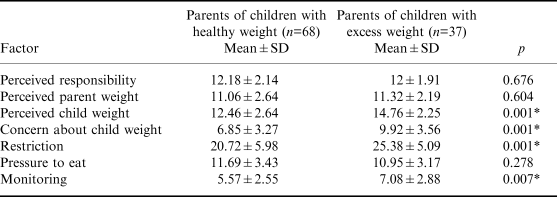
Comparing parents of children with healthy weight and parents of children with excess weight (Table 1)
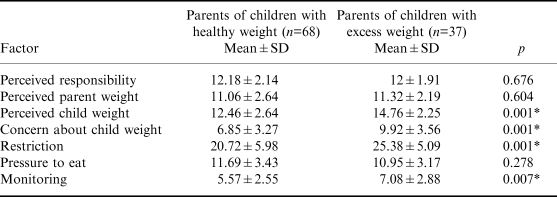
When the responses of parents of children with healthy weight were compared with the responses of parents of children at risk for overweight or at risk of being overweight, no significant differences were found in: perceived responsibility, perceived parent weight, pressure to eat and monitoring. Perceived child weight, concern about child weight, restriction, and monitoring scored higher in parents of children in both categories of excess weight.
Comparing the factors between parents of children with healthy weight and parents of children with excess weight (t-test)
* Significant at p<0.05.
Comparing parents with healthy weight and parents with excess weight (Table 2)
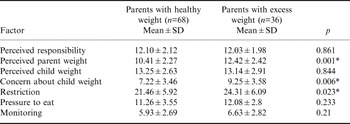
When the parents' responses were analysed according to their own weight (BMI<25 kg/m2 vs BMI≥25 kg/m2), perceived parent weight, concern about child weight and restriction were all statistically higher in the parents with excess weight. Perceived responsibility, perceived child weight, pressure to eat and monitoring did not differ between these two groups.
Comparing the factors between parents with healthy weight and parents with excess weight (BMI>24.9 kg/m2) (t-test)

* Significant at p<0.05.
Comparing classes A, B and C (Table 3)
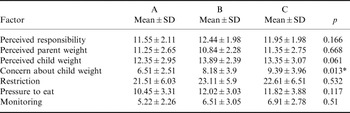
When comparing economic classes A, B and C, there were differences between A and C in relation to concern about child weight. In this sample, class C was more concerned with the weight of the child. Class B scored intermediately but this was not significant. No differences were found in the other factors.
Comparing the factors between economic classes A, B and C (n=109) (ANOVA)

* The mean difference is significant at the 0.05 level between classes A and C.
Logistic regression with the child's weight status as the dependent variable (Table 4)
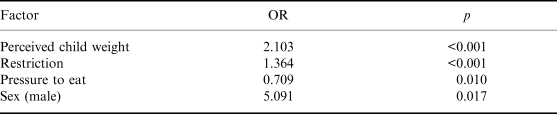
The logistic regression indicated that some variables were independently associated with excess weight of children: perceived child weight, restriction and male sex. Pressure to eat was negatively associated with the outcome. Other variables were entered in the model but were excluded: parent weight status (normal vs excess weight), economic class (A, B or C), perceived responsibility, perceived parent weight, concern about child weight and monitoring.
Logistic regression (multivariate odds ratios) with the child's weight status (excess weight) as the dependent variable (n=109)
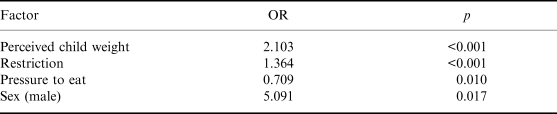
Variables that were excluded from the model: parent's weight status (normal vs excess weight), economic class (A, B or C), perceived responsibility, perceived parent weight, concern about child's weight, monitoring.
Discussion
In this sample of parents/caregivers of south Brazilian school-age children (6–10 years old), a pattern of attitude can be identified when the child is at risk for, or is already, overweight: the parents are more concerned and tend to be more restrictive and to monitor their child more intensively.
The parental perception of the weight of the child is different when the child has excess body weight. This perception is unaffected by the parent's own weight. When the parents are themselves overweight, they show higher perception of parent weight, concern about child weight and restriction.
These results are in agreement with other studies that found associations between the practice of restriction and childhood obesity (Fisher & Birch, Reference Birch and Fisher2000; Fisher & Birch, Reference Fisher and Birch2002; Faith et al., Reference Faith, Scanlon, Birch, Francis and Sherry2004). In this cross-sectional study, causality cannot be determined, but other studies have found a relationship between restriction and weight, and have suggested that restriction may precede child weight gain (Clark et al., Reference Clark, Goyder, Bissell, Blank and Peters2007). Restricting access to some foods may promote the child's attention to these foods, and the child may eat that particular food, when left unattended, even if not hungry (Lindsay et al., Reference Lindsay, Sussner, Kim and Gortmaker2006).
In this sample, pressure to eat is associated with a lower probability of being in the excess weight category. The literature is very poor with respect to this factor. Pressure to eat has been cross-sectionally associated with a higher intake of fruit and vegetables and lower fat intake by children (Bourcier et al., Reference Bourcier, Bowen, Meischke and Moinpour2003). Experimental and retrospective studies have linked pressure to eat with negative feelings and rejection of certain foods by children (Batsell et al., Reference Batsell, Brown, Ansfield and Paschall2002; Galloway et al., Reference Galloway, Fiorito, Francis and Birch2006) but no studies have prospectively examined the relation of pressure to eat with body weight. Parent control of the child's diet is associated with higher intake of both healthy and unhealthy foods (Brows & Ogden, Reference Brows and Ogden2004). It is not possible to entirely rule out that the parents of children with normal and low/normal weight put more pressure to eat on their children, thus driving the association. One could speculate that, in a country recently emerged from underdevelopment, a subjective perception by the parents that a child is ‘thin’ (i.e. ‘malnourished’) might lead to pressure to eat, and this, in turn, would bring into the multivariate model an association between pressure to eat and normal/low body mass. This association remains to be explained.
Parents' eating style, and their food preferences and choices, act as a model for children. Parent eating style, associated with child feeding practice, forms the child eating behaviour. A child's food preferences are influenced by the parents' food selection patterns. Finally, a child's eating pattern and weight status influence each other (Birch & Davison, Reference Birch and Davison2001). Family choices can facilitate or inhibit a child's consumption of food through the availability of food in the home (Cullen et al., Reference Cullen, Baranowski, Rittenberry, Cosart, Owens, Hebert and Moor2003). As the instrument employed in this study focuses on parental attitudes toward the children, rather than on the adults' eating style, the data do not allow speculation on the direction of parental eating style.
Another important parental behaviour relates to the meal size and time spent with the child during meals. Until the age of 3, intake is not determined by the parents' offering; the child can self-regulate. But around 5 years of age, giving big portions influences the meal size option for the child and the self-regulation is lost (Birch & Davison, Reference Birch and Davison2001).
Parents' behaviour towards their children is probably not the only factor that is relevant to child development in the family environment because there are other important people that can influence the child and other stimuli too (Birch & Davison, Reference Birch and Davison2001).
In bivariate analysis, it was observed that concern about child weight is greater in economic class C. This association is not maintained in the multivariate analysis. Economic class has been proposed to affect the risk for obesity through some specific aspects, such as marital status, living conditions and parental education. This study's data suggest that the parental attitude factors operate independently of economic class, and this happens throughout the distribution from class A to class C. Classes D and E were not represented in the sample, probably because the poorest children were less likely to be regular school attenders. This of course brings a bias to the evaluation of the effect of economic class and limits the conclusions to classes A to C.
The study has some limitations. The questionnaire was answered by just one parent, usually the mother. In urban regions of south Brazil, the mother is still the main person responsible for feeding and educating the children at home. The father is less often present when the children eat (Birch & Fisher, Reference Birch and Fisher2000; Azevedo & Arrais, Reference Cullen, Baranowski, Rittenberry, Cosart, Owens, Hebert and Moor2006). Therefore, having mostly mothers answering the survey probably does not negatively affect the results and may actually bring more confidence to the findings. As the study is cross-sectional, causality cannot be determined.
The use of self-reported weight for adults is acceptable but can lead to some underestimation of actual weight (Ronque, Reference Ronque, CyrinoI, Dórea, Serassuelo, Galdi and Arruda2005). Nevertheless, because of the logistics of the study, it would have been impossible to measure directly all the parents' weights and heights. On the other hand, a slight underestimation of weight does not have a significant impact on the results.
In the sample, being a boy was more often associated with having excess body mass. This is in agreement with other studies, which found a higher prevalence of excess body weight in boys in comparison with girls (Balakrishnan et al., Reference Balakrishnan, Webster and Sinclair2008; Hui et al., Reference Hui, Schooling, Leung, Mak, Ho, Lam and Leung2008). Epidemiological studies suggest that excess weight and obesity may be decreasing in girls (Sjöberg et al., Reference Sjöberg, Lissner, Albertsson-Wikland and Mårild2008). Genetic studies have not disclosed a different genetic pattern towards obesity in boys and girls, although males tend to expend more energy (Sweeting, Reference Sweeting2008). Recent data from Brazil show that the prevalence of obesity in children aged 5–9 years is 16.6% for boys and 11.9% for girls; the same survey found a 34.9% prevalence of excess weight in boys and 32% in girls of the same age range (IBGE, Reference Fonseca, Faerstein, Chor and Lopes2010). The reason for the apparent difference of prevalence in boys and girls in the present sample may rely on several factors. First, the sampling of this study was not designed to evaluate the prevalence or distribution of excess weight in children. Only families giving formal consent were interviewed. Families and/or children with excess body weight might – speculatively – have more often refused to participate due to concerns related to body image, low self-esteem or peer pressure (Pinheiro & Giugliani, Reference Pinheiro and Giugliani2006). The sample, as mentioned above, does not comprise the entire socioeconomic range, as the national survey did. Recent epidemiological data from Pelotas, a major city of the Rio Grande do Sul province (where Porto Alegre is located), show that the prevalence of excess body weight is lower in women with either more years of schooling or in the upper strata of the socioeconomic distribution (Gigante et al., Reference Gigante, Dias-da-Costa, Olinto, Menezes and Macedo2006). Therefore, we can only speculate on the association between gender and excess weight in the children, and one should not read these findings as evidence of any particular prevalence in this population. Nevertheless, the study was not designed to study prevalence but only the association between parental/caregiver attitudes and excess body weight in children. This association is supported by the findings.
Eating style may also be a confounder. Parental eating style is a classical risk factor for childhood obesity, and, in many ways, this is a pattern of attitude (example rather than intervention). The instrument employed has been designed to assess interventional attitudes and this is what has been disclosed in the study. Interactions between parental eating style and parental attitudes have to be further explored.
Conclusion
In Porto Alegre, a major city of south Brazil, parental perceptions and attitudes may be independently associated with excess body weight in children age 6–10 attending fundamental school.
Acknowledgment
Fabiana Silva Costa was recipient of a CAPES (the Brazilian Ministry of Education Coordination of Post-Graduate training programs) scholarship.