Introduction
The polished section that contains grains of gachingite Au(Te1–xSex), 0.2 ≈ x ≤ 0.5, comes from the Gaching ore occurrence of the Maletoyvayam deposit, located in the southwestern part of the Koryak Highland of the central Kamchatka volcanic belt, Far East, Russia (60°19′51.87″N, 164°46′25.65″E). Gold-rich aggregates containing gachingite were obtained by crushing mineralised rocks and panning the resulting material into a heavy fraction using hydroseparation, followed by concentration using heavy liquids. Gachingite was found in polished sections made from the heavy mineral concentrate, which was obtained from a 20 kg sample of alunite–quartz rock. Gachingite was found in the same material as the recently described mineral maletoyvayamite (Tolstykh et al., Reference Tolstykh, Tuhý, Vymazalová, Plášil, Laufek, Kasatkin, Nestola and Bobrova2020).
Both the mineral and its name (symbol Gac) were approved by the Commission on New Minerals, Nomenclature and Classification of the International Mineralogical Association (IMA2021-008, Tolstykh et al., Reference Tolstykh, Tuhý, Vymazalová, Plášil, Laufek, Košek and Sidorov2021). The name gachingite (Cyrillic – гачингит) is after its type locality, the Gaching occurrence of the Maletoyvayam deposit in the Kamchatka peninsula, Russia.
Holotype material with gachingite (polished section) and its synthetic analogue (Exp AU4) are deposited in the Central Siberian Geological Museum (CSGM) of the VS Sobolev Institute of Geology and Mineralogy of the Siberian Branch of the Russian Academy of Sciences (IGM SB RAS), Novosibirsk, Russia, catalogue number V–10/1.
Occurrence
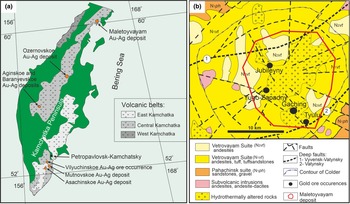
The Maletoyvayam deposit, like most of the Au–Ag deposits of the Kamchatka Peninsula, is located in the Oligocene–Quaternary Central Kamchatka volcanic belt, which extends along the direction of the modern subduction trend (Okrugin et al., Reference Okrugin, Kokarev, Okrugina, Chubarov and Shuvalov1994; Khanchuk and Ivanov, Reference Khanchuk and Ivanov1999). All Au–Ag deposits located in this belt: Ozernovskoe, Aginskoe, Baranyevskoe, Asachinskoe, Rodnikovoe etc (Fig. 1a), except for the Maletoyvayam deposit, belong to the epithermal low-sulfidation (LS) type with a wide development of near-surface mineralisation of the telluride subtype (Takahashi et al., Reference Takahashi, Matsueda and Okrugin2002, Reference Takahashi, Matsueda, Okrugin and Ono2007; Goryachev et al., Reference Goryachev, Volkov, Sidorov, Gamyanin, Savva and Okrugin2010; Okrugin et al., Reference Okrugin, Shishkanova and Yablokova2015). The Maletoyvayam deposit is located in the southwestern part of the Koryak Upland (Melkomukov et al., Reference Melkomukov, Razumny, Litvinov and Lopatin2010) in the Vetrovayam volcanic zone and is hosted by the rocks of Vetrovayam Suite (andesites, tuff and tuff-sandstones). It is the only Au–Ag deposit known in Kamchatka that belongs to the epithermal high-sulfidation (HS) type (Tolstykh et al., Reference Tolstykh, Vymazalová, Tuhý and Shapovalova2018; Sidorov et al., Reference Sidorov, Borovikov, Tolstykh, Bukhanova, Palyanova and Chubarov2020). The Maletoyvayam deposit combines four ore occurrences in the ore field: Gaching, Yubileyny, Yugo-Zapadny and Tyulul (Fig. 1b). The main gangue minerals are quartz, alunite, native sulphur and kaolinite. Vuggy silica was identified in the central part of the ore field, transitioning outwards into quartz–alunite, quartz–kaolinite, quartz–sericite–kaolinite and then to argillic- and propylitic-altered rocks (Melkomukov et al., Reference Melkomukov, Razumny, Litvinov and Lopatin2010). The Gaching ore occurrence, in which the minerals maletoyvayamite and gachingite were found, is located at the head of the Gachingalhovayam River.
(a) Location of Au–Ag deposits (Okrugin et al., Reference Okrugin, Shishkanova and Philosophova2017) within the volcanic belts (Tsukanov, Reference Tsukanov2015) in the Kamchatka Peninsula; and (b) geological map of the Maletoyvayam deposit modified after Lyashenko and Mikhaylova (Reference Lyashenko and Mikhaylova1972).

The Maletoyvayam deposit, specifically the Gaching occurrence, differs from other epithermal deposits in Kamchatka by having a significant mineral variety. Native high-grade gold, including the hypergene mustard gold, is not dominant in these ores, whereas Au and Ag chalcogenides, Cu–Sb–As–Te sulfosalts, as well as complex metastable Au-containing oxides, and other associated rare or unique phases are the most common (Tolstykh et al., Reference Tolstykh, Vymazalová, Petrova and Stenin2017, Reference Tolstykh, Vymazalová, Tuhý and Shapovalova2018, Reference Tolstykh, Palyanova, Bobrova and Sidorov2019, Reference Tolstykh, Tuhý, Vymazalová, Plášil, Laufek, Kasatkin, Nestola and Bobrova2020; Shapovalova et al., Reference Shapovalova, Tolstykh and Bobrova2019; Sidorov et al., Reference Sidorov, Borovikov, Tolstykh, Bukhanova, Palyanova and Chubarov2020). A mineral having a similar composition to gachingite was described as an unnamed phase Au(Te,Se) by Tolstykh et al. (Reference Tolstykh, Vymazalová, Tuhý and Shapovalova2018). It should be noted that such a compound has never been found before in any other epithermal deposit. Such unique compounds require special conditions for their formation: an abundant source of Au and Se and a high oxidising environment. Gachingite, embedded in gold, is related to the gold-bearing productive stage of ore mineralisation, which is stable at 250°C in log$f_{{\rm S}{\rm e}_ 2}$ range of −12.4 and −5.7. A further increase of $f_{{\rm O}_ 2}$
 leads to oxidation of Au-tellurides to Au–Ag–(Sb,As,Te,S) oxides and the formation of mustard gold (Tolstykh et al., Reference Tolstykh, Vymazalová, Tuhý and Shapovalova2018, Reference Tolstykh, Palyanova, Bobrova and Sidorov2019). Thermometric studies of fluid inclusions in quartz showed that the range of conditions during the formation of the gold-bearing productive stage are: fluid inclusions salinity of 4.3 wt.% NaCl eq, temperature of 255–245°C, and pressure of 39–32 bar (Sidorov et al., Reference Sidorov, Borovikov, Tolstykh, Bukhanova, Palyanova and Chubarov2020).
Appearance, physical and optical properties
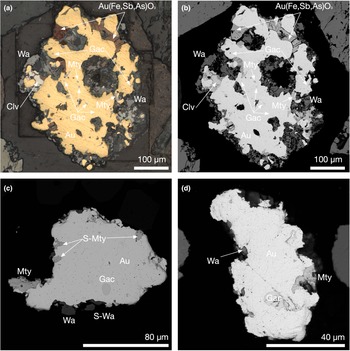
Gachingite forms individual droplet-like grains of sizes from 2 to 10 μm embedded in native gold (Au–Ag), in association with calaverite, maletoyvayamite, watanabeite and Au–Sb oxides. The aggregates do not exceed 100 μm in diameter. Reflected light and back-scattered electron images of the described mineral are shown in Fig. 2.
Images of gachingite (Gac) in association with maletoyvayamite (Mty), watanabeite (Wa), calaverite (Clv) and Au(Fe,Sb,As)O3 included in native gold. (a) Reflected light; (b–d) back-scattered electron images.

Gachingite is opaque, brittle, with a metallic lustre. The density calculated on the base of the empirical formula is 10.47 g/cm3. In plane-polarised reflected light, gachingite is grey with a bluish tint, has strong bireflectance, strong anisotropy with rotations tints blue to dark blue to brown. It exhibits no internal reflections.
Reflectance was measured in the air relative to a WTiC standard using Zeiss 370; spectrophotometer MSP400 TIDAS mounted to Leica microscope, objective 50× (National Museum in Prague, Czech Republic). Data are given in Table 1 and plotted in Fig. 3.
Reflectance data for gachingite.

Reflectance data for gachingite.*

*The values required by the Commission on Ore Mineralogy are given in bold.
Synthetic analogue
The small size of gachingite grains (2 to 10 μm) and its intergrowths with gold prevented its extraction and direct investigations by means of X-ray diffraction. Therefore, the relevant crystallographic and structural investigations were performed on the synthetic analogue of gachingite Au1.00(Te0.50Se0.50).
The synthetic Au1.00(Te0.50 Se0.50) phase was prepared using the evacuated silica glass tube method in the Laboratory of Experimental Mineralogy of the Czech Geological Survey in Prague. Gold (99.95%; additionally, refined at the laboratory using the digestion-precipitation technique), tellurium (99.999%) and selenium (99.999%) were used as starting materials for the synthesis. The evacuated silica-glass tube with its charge was sealed and heated at 400°C. Three times during the experiment, after cooling by cold-water bath, the charge was ground into powder in acetone using an agate mortar and mixed thoroughly to homogenise. The pulverised charge was sealed in an evacuated silica-glass tube again and heated at 400°C for four months. Finally, the experimental product was quenched rapidly in a cold-water bath.
Chemical composition
The electron probe microanalyses data of gachingite were obtained using a JEOL JXA–8230 microprobe (beam size ≈ 1 mm) at 20 kV and 50 nA at the Analytical Center for Multi-Elemental and Isotope Research at the VS Sobolev Institute of Geology and Mineralogy SB RAS (IGM SB RAS) in Novosibirsk, Russia (analyst V. Korolyuk). The following X-ray lines (and standards) were used: SeLα (Bi2Se3), TeLα (AgTe2), AgLα (Ag), SKα (CuFeS2) and AuMα (Au). These results were processed using ZAF correction. Values of the minimum detection limit are <0.05% for all the elements analysed. The accuracy and reproducibility of the analytical procedures were evaluated with special tests (Lavrent'ev et al., Reference Lavrent'ev, Karmanov and Usova2015). Additional data were collected on the Tescan Mira3 GMU equipped with a wavelength dispersion spectrometers (WDS) spectrometer (based at the Czech Geological Survey) under the conditions of 15 kV accelerating voltage and beam current of 8.7 nA.
A synthetic analogue of gachingite was examined using an electron probe microanalyser (EPMA, CAMECA SX-100) equipped with WDS. Quantitative data and chemical analysis were obtained using 15 kV acceleration voltage and 10 nA beam current (diameter: 1–2 μm). For Au and Te calibration, pure metals were used. Selenium was calibrated using Bi2Se3 and S using FeS2. No other elements with atomic numbers higher than eight were detected.
Preliminary analyses of gachingite and associated minerals were also examined using a LEO-413VP scanning electron microscope with INCA Energy 350 microanalysis system (Oxford Instruments Ltd., Abingdon, UK) equipped with EDS (analyst M. Khlestov) at IGM SB RAS. The operating conditions were: an accelerating voltage of 20 kV, beam current of 0.4 nA, 50 s measuring time and beam diameter of ~1 μm.
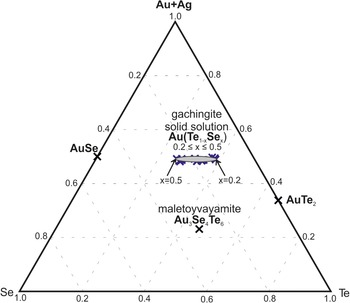
The EPMA data of gachingite and its synthetic analogue are given in Table 2. The composition of gachingite shows a limited solid solution from Au(Te0.5Se0.5) to Au(Te0.8Se0.2). EPMA data of gachingite are plotted in the Au–Te–Se diagram in Fig. 4. The empirical formula, calculated for the mean composition (n = 18; measured on 7 different grains) on the basis of the sum of all atoms is equal to 2 atoms per formula unit (apfu) is (Au0.96Ag0.02)Σ0.98(Te0.65Se0.37)Σ1.02 for gachingite, the simplified chemical formula is Au(Te1–xSex) with the range 0.2 ≈ x ≤ 0.5.
EPMA data for gachingite, plotted in the Au–Te–Se diagram.

Chemical composition of gachingite (wt.%) and its synthetic analogue.*

* The 18 EPMA results correspond to gachingite formula: (Au0.96Ag0.02)Σ0.98(Te0.65Se0.37)Σ1.02. Grains 3 and 4 were used for Raman analyses and grains 3 and 6 for EBSD measurements.
X-ray crystallography
A fragment 17 μm × 12 μm × 7 μm of synthetic Au1.00(Te0.50Se0.50) was mounted on a glass fibre and examined using a Rigaku Super Nova single-crystal diffractometer with an Atlas S2 CCD detector utilising monochromatised MoKα radiation from the microfocus X-ray tube. The ω rotation scans were used for the collection of three-dimensional intensity data. From 1109 reflections, 229 were classified as unique with I > 3σ(I). Corrections for background, Lorentz effects and polarisation were applied during the data reduction in the Rigaku program CrysAlis. The crystal structure was solved with the charge-flipping method using the program Superflip (Palatinus and Chapuis, Reference Palatinus and Chapuis2007) and subsequently refined by the full-matrix least-squares algorithm of Jana2006 program (Petříček et al., Reference Petříček, Dušek and Palatinus2014). The crystal structure solution indicated one independent Au position (8e) and one Se/Te mixed position (8f) in the Cmce space group. The refinement of Se/Te position yielded 0.468(10) and 0.532(10) occupancy factors for Se and Te, respectively. All atoms were refined with anisotropic displacement parameters. Final refinement for 13 parameters converged to R = 0.0182 and wR = 0.0390 for 229 independent reflections. Details of data collection, crystallographic data, and refinement for the synthetic analogue of gachingite are given in Table 3. Table 4 and Table 5 show atomic positions and anisotropic displacement parameters, respectively. The crystallographic information file has been deposited with the Principal Editor of Mineralogical Magazine and is available as Supplementary material (see below).
Single-crystal data collection and structure refinement details for synthetic analogue of gachingite, Au1.00(Te0.50Se0.50).

Atom coordinates and equivalent displacement parameters (Å2) for the synthetic analogue of gachingite, Au1.00(Te0.50Se0.50).

Anisotropic displacement parameters (Å2) for the synthetic analogue of gachingite, Au1.00(Te0.50Se0.50).

Powder X-ray diffraction data of synthetic analogue of gachingite Au1.00(Te0.50Se0.50) were collected in Bragg-Brentano geometry using a Bruker D8 Advance powder diffractometer. Nickel filtered CuKα radiation was used, a 10 mm automatic divergence slit and a Lynx EyeXE detector. Data were collected in the angular range from 10 to 140° of 2θ with a 0.01° step. Refined unit-cell parameters of synthetic Au1.00(Te0.50Se0.50) are the following: a = 7.5569(2) Å, b = 5.7448(1) Å, c = 8.9253(2) Å and V = 387.47(1) Å3. Powder X-ray diffraction data are given in Table 6.
Powder X-ray diffraction data (CuKα, Bragg-Brentano geometry) for the synthetic analogue of gachingite, Au1.00(Te0.50Se0.50).*

* Strongest lines are given in bold.
Structure description
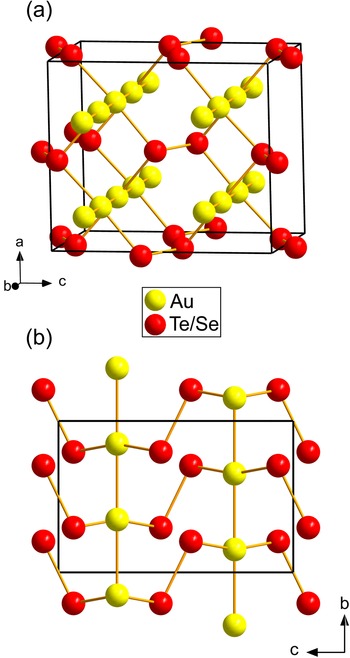
The framework crystal structure of gachingite (Fig. 5) contains one crystallographically independent Au and one Se/Te mixed position (0.468/0.532 occupancy parameters). Au is almost linearly coordinated by two Se/Te atoms at 2.526 Å. The Se/Te–Au–Se/Te bonding angle is 166.10° instead of 180° for perfect linear coordination. The Au shows the additional two Au contacts at 2.87 Å, which is comparable to that of 2.88 Å found in native gold by Straumanis (Reference Straumanis1971), indicating strong Au–Au interaction in the gachingite structure. As is evident in Fig. 5b, Au atoms form [Au–Au–Au] chains oriented along the b-axis. Se/Te atoms form a group (Se/Te)2–2, with a strong covalent Se/Te–Se/Te bond with a distance of 2.526 Å. The Se/Te atoms are further coordinated by two Au atoms at 2.526 Å, forming trigonal pyramidal coordination. These three short bonds are accompanied by two considerably longer Te/Se–Au contacts (3.471 Å). This asymmetric coordination of Se/Te atoms might suggest the stereoactivity of lone electron pairs at Se and Te atoms. Considering the (Se/Te)2–2 group, the gachingite chemical formula can be alternatively written as Au2(Se/Te)2. Au shows an oxidation state of + I and not +II. This agrees with the approximately linear coordination of Au in gachingite, which is typical for Au+1 with d 10 electronic configuration (Rabenau and Schulz, Reference Rabenau and Schulz1976; Schutte and de Boer, Reference Schutte and de Boer1988).
Crystal structure of the synthetic analogue of gachingite, Au1.00(Te0.50Se0.50). Note the [Au–Au–Au] chains oriented along the b-axis.

It is interesting to note that the presence of [Au–Au–Au] chains with the strong Au–Au bonds in the crystal structure of gachingite points to a special group of materials, which are known as ‘one-dimensional metals’. Such materials show metallic conductivity in one direction and do not possess metallic conductivity in perpendicular directions (i.e. conductivity is strongly anisotropic). This phenomenon requires strong orbital overlap on neighbouring atoms within a chain and negligible interaction between chains. Whereas the first condition is met in the gachingite structure (i.e. strong Au–Au bonds), the second is only partially fulfilled (i.e. interconnections of chains by Se(Te) atoms). Nevertheless, the 1D-character of metallic bonds is a hallmark of the gachingite crystal structure. Gachingite forms a limited solid-solution from Au(Te0.5Se0.5) to Au(Te0.8Se0.2), where Se–Te substitution occurs. Its stability field does not include the AuSe phase. Both Se and Te atoms are essential for gachingite formation. Crystal structure analysis confirms the Se/Te mixed position; no indication of Se and Te ordering has been observed. Therefore, we have chosen Au(Te1–xSex), 0.2 ≈ x ≤ 0.5 (Z = 8) as the simplified chemical formula of gachingite. It is interesting to note that an orthorhombic Au2SeTe phase with Z = 4 and similar unit-cell parameters to gachingite was synthesised by Cranton and Heyding (Reference Cranton and Heyding1968). However, no crystal structure analysis was performed at that time. It is worth noting that the crystal structure of maletoyvayamite Au3Se4Te6 (Tolstykh et al., Reference Tolstykh, Tuhý, Vymazalová, Plášil, Laufek, Kasatkin, Nestola and Bobrova2020), another ternary phase from the Au–Se–Te system, is based on molecular [Au6Se8Te12] clusters and hence differs considerably from that of gachingite. Another distinction between these two mineral species concerns the Au coordination by chalcogen atoms. Though Au is linearly coordinated in the gachingite, the maletoyvayamite structure contains [AuTe4] squares. On the other hand, both structures contain covalent Se–Te bonds indicating relatively high stability of these atomic interactions in the Au–Se–Te system.
Raman spectroscopy
The spectroscopic investigation of gachingite was carried out using a Renishaw inVia Reflex Raman system coupled with a Leica microscope. Individual grains of gachingite were measured with a 100× objective lens with excitation provided by a 514.5 nm Ar-ion laser and the signal was recorded by a thermoelectrically cooled CCD detector (100–4000 cm–1 spectral wavenumber, the spectral resolution of 2 cm–1). To achieve an enhanced signal-to-noise ratio, 30 scans were accumulated, each 20 s exposure time, with laser power at the source, kept at a maximum of 2 mW to avoid thermal degradation. A polystyrene standard was used to check the wavenumber calibration and the spectra obtained were analysed using the GRAMS/AI 9.1 software package (Thermo Fisher scientific).
Raman spectra were measured for two distinct gachingite grains (Fig. 6, labelled as grain 3 and 4) and the synthetic analogue. The following intense bands were observed at 142, 169, 210 and 243 cm–1 for grain 3; and 141, 174, 209 and 241 cm–1 for grain 4. Almost identical bands were also observed for the synthetic analogue: 142, 170, 211 and 242 cm–1. The obtained spectra are shown in Fig. 6. Interestingly, the intensities of bands are slightly different for both natural grains and synthetic counterparts. Otherwise, the bands are well-resolved, and the spectra are very distinct from maletoyvayamite (Tolstykh et al., Reference Tolstykh, Tuhý, Vymazalová, Plášil, Laufek, Kasatkin, Nestola and Bobrova2020). Similar spectral shapes are reported for Se–Te glasses as well as Se–Te mixed crystals where the dominant spectral features are attributed to the Se–Se, Se–Te, and Te–Te vibrations in the 100–300 cm–1 region (Geick et al., Reference Geick, Steigmeier and Auderset1972, Tverjanovich et al., Reference Tverjanovich, Cuisset, Fontanari and Bychkov2018). The observed Raman bands are therefore tentatively assigned to the Se–Se, Se–Te and Te–Te vibrations, however the contribution of Au–Te/Se vibrations can also be considered. The intensity changes and small shifts probably arise due to the variable content of Te and Se in the measured grains. The Raman spectra of gachingite and its synthetic analogue Au1.00(Te0.50Se0.50) are in agreement and further supports the structural identity between synthetic and natural material.
Raman spectra of gachingite in comparison with its synthetic analogue, Au1.00(Te0.50Se0.50).

Electron back-scatter diffraction (EBSD)
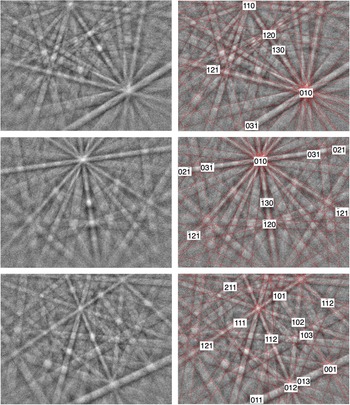
A TESCAN Mira 3GMU scanning electron microscope combined with an electron back-scatter diffraction (EBSD) system (NordlysNano detector, Oxford Instruments), the Czech Geological Survey, was used on gachingite. The polished section surface was polished using OP-S colloidal silica and subsequently carbon-coated, ca. 10 nm thick. The EBSD patterns collected on gachingite (25 spot analyses) were found to match those calculated based on the refined structural model for synthetic Au1.00(Te0.50Se0.50) (Fig. 7). The values of the mean angular deviation (MAD, i.e. the goodness of fit of the solution) between the calculated and measured Kikuchi bands range between 0.14° and 0.45°. These values reveal a very good match; if values of mean angular deviation are <1°, they are considered as indicators of an acceptable fit (HKL Technology, 2004). The EBSD measurements further support the structural identity between gachingite and its synthetic analogue.
EBSD images of gachingite at the different grain orientations; in the right pane, the Kikuchi bands are indexed.

Acknowledgements
This paper is dedicated to Evgenyi G. Sidorov (1955–2021), without whom the fieldwork, collection of samples and finding of this mineral at Kamchatka would not be possible. Unfortunately, he passed away before the mineral was accepted by the IMA–CNMNC. The authors acknowledge Ritsuro Miyawaki, Chairman of the CNMNC of IMA and its members for helpful comments on the submitted data. We thank the Principal Editor Stuart Mills, Structural Editor Peter Leverett, Igor V. Pekov and one anonymous reviewer. The authors are grateful to E. Petrova (RPE “Ekekhim”) and N. Stenin (Lead metallurgist and Interminerals LLC) for the samples provided for this study. The studies were carried out within the framework of the state assignment of the IGM SB RAS financed by the Ministry of Science and Higher Education of the Russian Federation and the Czech Geological Survey, Czech Republic. The authors would like to thank V. Korolyuk and M. Khlestov (IGM SB RAS), O. Pour (Czech Geological Survey) and Z. Korbelová (Czech Academy of Sciences) for the WDS and EDS analyses and L. Vrtiška (National Museum in Prague) for reflectance measurements. This research was supported by the Russian Foundation of Basic Research projects No 19-05-00316, by the Grant Agency of the Czech Republic (project No. 22-26485S), by the Strategic Research Plan of the Czech Geological Survey (DKRVO/ČGS 2018–2022) and by institutional funding from the Center for Geosphere Dynamics (UNCE/SCI/006). We acknowledge CzechNanoLabResearch Infrastructure supported by MEYS CR (LM2018110) for financial support for the collection of diffraction data.
Supplementary material
To view supplementary material for this article, please visit https://doi.org/10.1180/mgm.2022.9