The [court] system is set up to be very disempowering for the families of people facing charges and for the person facing charges. … It’s a very isolating experience. It’s a very intimidating process. It’s not a space created for them. … The work that I do [as an organizer] is to transform the landscape within the court system to shift that power from the judge, DA, and public defender to the person facing the charges, their families, and community. … We’ve seen when community members show up and pack a courtroom. Judges make comments like, “Wow, I didn’t realize you had this much support.” It makes the court players more accountable when they know they’re being watched.
— Formerly incarcerated organizer
Introduction
Criminal justice activism in the United States has traditionally focused on policing at the front end of the criminal legal process or prisons at the back end. Consequently, research tends to center social movement efforts to challenge police violence or mass incarceration (Kilgore Reference Kilgore2015; Taylor Reference Taylor2016; Beckett Reference Beckett2018; Phelps Reference Phelps2024). More recently, however, activists have expanded their efforts to the criminal court, which they see as mediating the path from arrest to incarceration or release. Through grassroots efforts like court watch, participatory defense, bail funds, and district attorney (DA) accountability, activists aim not just to incrementally improve the court’s efficiency or fairness but, rather, to disrupt its power, embed defendants in networks of support, and “transfer agency and control” over criminal legal processes to system-impacted communities (Simonson Reference Simonson2016, 1609). In this article, I turn attention to this emergent site and type of collective action by examining how activists in Oakland, California, have diagnosed and countered the problems of the criminal court.
To understand the dynamics of court activism, I bridge research on punishment and society with research on law and social movements. Most criminal court studies focus on a set of formal legal “insiders”: judges, prosecutors, and defense attorneys (Eisenstein and Jacob Reference Eisenstein and Jacob1977; Feeley Reference Feeley1979; Ulmer Reference Ulmer1997). The court is depicted as an insulated site of social reproduction where court officials have near total power over how justice is carried out (Van-Cleve Reference Van Cleve2016; Kohler-Hausmann Reference Kohler-Hausmann2018; Clair Reference Clair2020). However, by studying new forms of collective resistance in the court, this article examines the court as a permeable site, amenable to intervention by activist “outsiders” who aim to transform it. Social movement scholars often distinguish between legal and extralegal mobilization, debating the costs and benefits of either approach (Taylor and Van Dyke Reference Taylor, Van Dyke, David, Sarah and Kriesi2004; McCann Reference McCann2006; Albiston Reference Albiston2010; Tilly and Tarrow Reference Tilly and Tarrow2015). In this article, I complicate this tidy dichotomy by focusing on activism that does not rely on existing legal avenues for effecting change or operate fully outside of them (for example, litigation versus direct action). Rather, this type of activism identifies gaps in legal processes and, within them, creates new avenues for honing and exercising collective power. Following Erik Olin Wright’s (Reference Wright2010) and Matthew Clair and Amanda Woog’s (Reference Clair and Woog2022) theories of change, I call this approach interstitial power shifting.
Drawing on two years of ethnography and twenty semi-structured interviews with activists in Oakland, California, I find that activists engage in power shifting on two levels. Ideologically, they challenge the hegemonic idea of courts as just institutions and thus reduce its symbolic power. They attribute the court’s injustice to its power to obscure its activities from the public, dehumanize defendants, and evade accountability to system-impacted communities. Materially, they work to address these injustices using three strategic interventions: court watch, participatory defense, and DA accountability. Each intervention appropriates and subverts aspects of the case process to shift power from court officials to defendants and their loved ones. But this work is not without its challenges. Activists negotiate tensions between seeking immediate harm reduction—which risks reproducing penal logics to appeal to court officials—and pushing for long-term structural transformation.
In addition to bridging punishment and society, law and social movements, and critical sociology, this article adds to the growing scholarly and public discourse on abolition. The summer of 2020—amid the devastation of the pandemic and the surge of anti-police violence protests after George Floyd’s murder—marked the spread of abolitionist ideas and practices on an unprecedented scale (Kaba Reference Kaba2020; Taylor Reference Taylor2021). Broader segments of the public began to question punishment as the taken-for-granted response to crime, and activists fought to reduce the power, scope, and resources of penal institutions with the goal of eventually dismantling them. An in-depth empirical study of interstitial power shifting in criminal court activism helps us better understand how abolition is enacted on the ground as well as the practical challenges and tensions of this work. The theory of interstitial power shifting also expands socio-legal conceptions of collective action beyond the case of court activism. That is, it offers a framework for analyzing strategic approaches that do not operate fully within or outside of official legal or political avenues but, rather, through building new forms of social empowerment in the margins and cracks of existing institutions.
This article proceeds as follows. First, I construct a framework for studying criminal court activism by bridging punishment, social movements, and abolitionist scholarship. I then explain why a qualitative study of activists in Oakland is well suited for uncovering the dynamics of this struggle. Next, I introduce the concept of interstitial power shifting and show how activists’ efforts to diagnose and counter the problems of the court reflect this strategic approach. Finally, I discuss implications for research and activism around criminal courts and legal institutions more broadly.
Literature review
Criminal courts and activism
Classic criminal court studies describe the courtroom workgroup as a set of actors—judges, prosecutors, and defense counsel—whose relationships, while adversarial in theory, are largely collaborative in practice due to shared tasks and goals, patterns of interdependence, and a sense of familiarity (Eisenstein and Jacob Reference Eisenstein and Jacob1977; Feeley Reference Feeley1979; Ulmer Reference Ulmer1997). In this account, courts produce outcomes according to internal goals and logics as much as formal legal doctrine. For example, Malcolm Feeley (Reference Feeley1979) finds that, due to organizational constraints, court agents see defendants’ experiences of procedural burdens (for example, lost wages or wasted time) as a sufficient administration of justice, even absent formal adjudication or punishment (for example, fines or sentences). Recent studies build on these foundations to show how courts reproduce social inequality—whether via managerial techniques that discipline low-income defendants into governable subjects (Kohler-Hausmann Reference Kohler-Hausmann2018), a legal culture that ascribes racialized morality to defendants (Van Cleve Reference Van Cleve2016), or the raced and classed dynamics of attorney-client relationships (Clair Reference Clair2020). However, these studies tend to portray the court as an insular space where legal officials exercise near total power over how justice is carried out. By shifting the focus from how court insiders reproduce inequality to how activist outsiders intervene to disrupt these processes, I complicate this traditional model of the criminal court.
Most socio-legal research on criminal justice activism focuses on efforts that target policing or incarceration. These studies reveal a range of tactics that social movements use to try and change how these penal institutions operate. For example, movements may leverage formal legal or political avenues, like ballot initiatives, litigation, or consent decrees to improve prison conditions, reduce mass incarceration, and enforce police accountability (Schoenfeld Reference Schoenfeld2010; Bell Reference Bell2017; Beckett Reference Beckett2018). Movements may also use direct action to raise public awareness of injustices and pressure political officials to intervene, such as by organizing prison hunger strikes or anti-police brutality protests (Reiter Reference Reiter2014; Taylor Reference Taylor2016). Finally, movements may create new avenues to shift power from the penal system to the community, like countersurveillance against the police or campaigns to defund penal agencies (McDowell and Fernandez Reference McDowell and Fernandez2018; Brown et al Reference Brown, Doane, Fleming, Trent and Valerio2020; Gonzalez and Deckard Reference Gonzalez and Deckard2022). I focus on this third type of approach in the understudied case of criminal court activism. Building on a small growing body of research on grassroots efforts like court watch, participatory defense, bail funds, and the progressive prosecutor movement (Moore, Sandys, and Jayadev Reference Moore, Sandys and Jayadev2015; Bazelon Reference Bazelon2020; Levine Reference Levine2020; Simonson Reference Simonson2023), I study collective resistance and democratic participation in the criminal court process. To build a deeper understanding of these forms of collective action, their varying relations to law, and their benefits and drawbacks, I turn to law and social movements literature.
Legal and extralegal mobilization
Social movement research often focuses on either legal or extralegal mobilization—that is, strategic approaches that operate within or outside formal legal systems and frameworks.Footnote 1 In law and social movements research, a key debate asks whether legal mobilization produces meaningful change or de-radicalizes movements (McCann Reference McCann2006; Albiston Reference Albiston2010). Some scholars contend that successful movements use legal frames to build legitimacy and tactics like litigation to secure long-lasting institutional change (Sarat and Scheingold Reference Sarat and Scheingold2004; Pedriana Reference Pedriana2006; Leachman Reference Leachman2013). They argue that, although legal strategies may reshape the focus of activism, they are more culturally resonant and structurally privileged than extralegal strategies and still benefit movements overall. Other scholars argue that, even if legal mobilization effectively influences policy and gains public support, it comes with drawbacks. For instance, litigation privileges well-resourced repeat players, courts have limited capacity to practically carry out reforms, and legal frames exclude more radical interests and preclude more fundamental change (Galanter Reference Galanter1974; Ferree Reference Ferree2003; Rosenberg Reference Rosenberg2008).
Another body of research in sociology focuses on social movements whose tactics eschew the formal legal-political avenues where marginalized groups have historically lacked access and influence (McAdam and Snow Reference McAdam and Snow1997; Tilly and Tarrow Reference Tilly and Tarrow2015). These studies examine extralegal tactics like protests, sit-ins, occupations, and strikes that aim not only to secure formal rights but to change broader cultural beliefs and social relations and create new institutions (Morris Reference Morris1984; Amenta and Poletta Reference Amenta and Polletta2019). While this research also shows how legal and extralegal approaches can be stitched together into strategic repertoires (Taylor and Van Dyke Reference Taylor, Van Dyke, David, Sarah and Kriesi2004), it still tends to construct a dichotomy between legal tactics operating within the state and extralegal tactics operating outside of it. But there are forms of activism—like the grassroots court interventions in this study—that do not map neatly onto either category. To develop a framework for analyzing strategies that fall outside of this legal-extralegal dichotomy, I draw on critical sociology and abolitionist theory.
Interstitial power shifting: a theoretical intervention
Wright (Reference Wright2010) theorizes an approach to social transformation that does not operate fully within or outside of dominant institutions.Footnote 2 He defines interstitial strategies as efforts to “build new forms of social empowerment in the niches, spaces, and margins” of existing structures in order to transform them (211). While “established institutions can be harnessed to facilitate this process,” interstitial change is oriented towards expanding and deepening collective power, rather than strengthening those institutions (229). Similarly, abolitionists use the term “non-reformist reform” to describe efforts to “undermine the prevailing political, economic, and social order, construct an essentially different one, and build democratic power toward emancipatory horizons” (Akbar Reference Akbar2022, 2497). In the case of the penal system, non-reformist reforms aim to reduce reliance on punishment, build supportive social institutions and community-based non-carceral systems of safety and accountability, and lay the ground for complete abolition (A.Y. Davis Reference Davis2003; Gilmore Reference Gilmore2007; Kaba & Ritchie, Reference Kaba and Ritchie2022).Footnote 3 A key principle of non-reformist reform is power shifting or the idea that “the power to define and manage social harm should be administered in a democratic process that centers marginalized communities” (Clair and Woog Reference Clair and Woog2022, 28). More specifically, power shifting in criminal courts includes the cultural work of “exposing injustice and everyday violence in courts” (35) and the material work of “wresting the authority over accountability for harm from court authorities into the hands of local communities” (34).
I posit that there is an analytic affinity between the concepts of interstitial change and power shifting. I define interstitial power shifting as a strategic approach to effecting social change that creates new spaces for honing and exercising collective power in the margins and cracks of existing institutions and uses these spaces to shift power from these institutions to marginalized communities. Applying this framework to the case of criminal court activism, I ask: (1) how do activists define the court as an unjust institution; (2) what strategies do they use to contest the court’s injustices; and (3) how do their efforts represent a novel approach to transforming legal institutions?
Data and methods
Research site and context
To answer these questions, I conducted a study of criminal justice activists in Oakland, a site with a rich tradition of collective action. While activists’ focus on courts may seem new in the context of activism in the Black Lives Matter era, criminal court activism has a longer history in Oakland. In fact, one of the main courthouses targeted by activists in this study is the same one where the Free Huey rallies took place (Bloom and Martin Reference Bloom and Martin2016). In 1967, Huey Newton, cofounder of the Black Panther Party, was charged with voluntary manslaughter for an altercation with the police. In response, the Panthers organized a multiracial coalition in support of Newton, raised legal defense funds, and held courthouse rallies with thousands of attendees. Although they sought to “exhaust all legal channels” to exonerate Newton, the “principle behind the case would be political … to put America on trial and expose its inherent racism and injustice” (104). They argued that Newton’s prosecution was an act of political repression, that all-white juries reflected systemic racism, and that police should be held accountable for inflicting violence against Black communities. After three years of collective struggle in the streets and in the courts, Newton’s charges were dismissed. Although the Free Huey campaign exposed systemic racism in the criminal court process and drew attention to alternative visions of justice, many issues that it highlighted with the criminal court continue today.
In this study, I focus on activists in a coalition of community-based groups in Alameda County (where Oakland is located), whose work builds on these political traditions.Footnote 4 Its mission is to replace punishment with systems of public safety that center on community well-being.Footnote 5 Most member organizations are based in Oakland. The coalition is led by Black, Latino, and other people of color directly impacted by incarceration. The coalition also emphasizes youth leadership, and many activists are in their teens and early twenties. However, membership varies across types of organizations (for example, grassroots community organizing, legal or policy advocacy) and their demographic composition (for example, race, age, relation to criminal legal system).Footnote 6 These groups work on a range of issues, including reentry, restorative justice, and youth justice, but, in this study, I focus on their court-related programs: court watch, participatory defense, and DA accountability. These programs build on tactics popularized by the Panthers: countersurveillance against penal officials through cop watch; community support through the Free Breakfast program; and demanding structural solutions to injustices in their Ten-Point Platform.
Alameda County is also home to well-known DA and public defender (PD) offices. At the time of this study, the DA was Nancy O’Malley, who was appointed in 2009 as the county’s first woman DA and is known as a strong advocate for victims’ rights. The PD was Brendon Woods, who was appointed in 2012 as the county’s first Black chief PD and is outspoken about ending mass incarceration and systemic racism. During this study, the coalition regularly engaged with the DA and the PD. Similar efforts can be found across the United States, with prominent court watch programs in cities like Los Angeles, New Orleans, and Baltimore; over forty hubs in the national participatory defense network; and groups in jurisdictions across the country organizing for progressive prosecutors. However, given the rich tradition of activism in Oakland and the level of activist-court engagement at the time of the study, Oakland represents a strategic research site (Merton Reference Merton1987).
This study took place between March 2020 and June 2022 when the COVID-19 pandemic produced an exogenous shock that destabilized courts’ regular operations.Footnote 7 During this period of crisis, the struggle over issues of the criminal court was especially pronounced, which provided a unique opportunity for studying how system injustices are contested in moments of rupture. During my fieldwork, a major shortage of court staff led to fewer operational courtrooms and a constant backlog of cases. The DA’s office continued over a thousand cases weekly and made “COVID” plea bargains to resolve cases quickly. Public defenders were less equipped to provide quality representation due to rising caseloads and COVID restrictions on client meetings. Activists also faced challenges since they could not meet in person or go into courts, which were closed to the public for two years. However, the convergence of the pandemic with the George Floyd uprisings created an opportunity for this emerging movement to expand its reach and build lasting structures for engaging the court.
Data collection and analysis
In this study, I use ethnography and semi-structured interviews. For two years, I conducted fieldwork focused on the coalition’s three criminal court interventions: court watch, participatory defense, and DA accountability. I spent around 150 hours observing and participating in these three programs and related meetings.Footnote 8 For context, in court watch, volunteers observe and document court proceedings and outcomes. In participatory defense hub meetings, defendants’ families and hub coordinators navigate the case process together. In DA accountability meetings, activists advocate for hub participants and make prosecutorial policy recommendations. Due to COVID-19, these programs largely took place on videoconferencing platforms or live audio streams.Footnote 9 Through participant observation, I participated alongside activists in these programs. In doing so, I became embedded in their social world and developed a deep practical understanding of the “underlying assumptions, motivations, and processes” of their work (Uldam and McCurdy Reference Uldam and McCurdy2013, 942). Further, by providing research support on activists’ programs, I aimed to challenge extractive research dynamics and contribute not only to research that identifies social problems but also to grassroots efforts that address them.
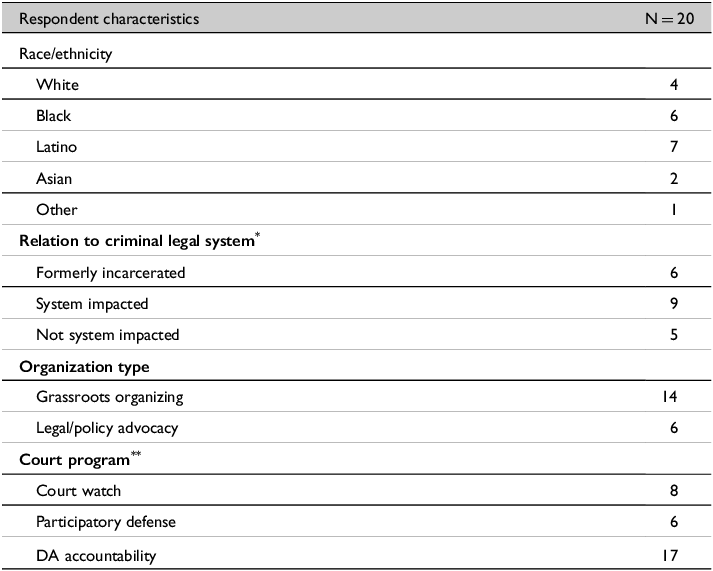
While my ethnographic work revealed the explicit strategies that activists engaged in, twenty semi-structured interviews with activists allowed me to examine how they make sense of their work. In interviews, I asked activists about what they saw as the biggest problems with the US criminal legal system, how they defined justice, and why they chose community organizing as the avenue to realize their visions of justice. These respondents represent most of the activists working on the coalition’s court programs at the time, and interviews reached saturation (Low Reference Low2019). I recruited interviewees from my fieldwork, then used snowball sampling and sampling for range to ensure that the data represented the views of subcategories of interest—that is, people who worked on each of the three court programs (Small Reference Small2009). Interviews were conducted on Zoom, lasted one to two hours, and were recorded and transcribed. Table 1 lists respondent characteristics.
Interview respondent characteristics

Table 1. Long description
A table summarizing characteristics of interview respondents. The table has 10 rows and 2 columns. The columns are labeled ‘Respondent characteristics’ and ‘N = 20’. The rows are labeled with categories and subcategories. Row 1: Race/ethnicity. Row 2: White, 4. Row 3: Black, 6. Row 4: Latino, 7. Row 5: Asian, 2. Row 6: Other, 1. Row 7: Relation to criminal legal system. Row 8: Formerly incarcerated, 6. Row 9: System impacted, 9. Row 10: Not system impacted, 5. Row 11: Organization type. Row 12: Grassroots organizing, 14. Row 13: Legal/policy advocacy, 6. Row 14: Court program. Row 15: Court watch, 8. Row 16: Participatory defense, 6. Row 17: DA accountability, 17.
Notes:
* I use “formerly incarcerated” to describe people who have spent time in jail or prison; “system-impacted” for family members of incarcerated people or people who have had system contact (for example, arrest) but have not been incarcerated; and “not system impacted” for people who have no prior criminal legal system contact.
** Interview respondents participated in one or more of the three court programs.
To analyze ethnographic and interview data, I used Nicole Deterding and Mary Waters’s (Reference Deterding and Waters2021) flexible coding approach. First, I deductively mapped key concepts from research questions onto index codes (for example, court problems, court interventions, abolitionist approaches). I then coded interview transcripts and ethnographic fieldnotes using these index codes. During the close reading process, I wrote analytic memos about recurring themes and patterns and compiled a list of analytic codes based on these themes. For example, under the index code “abolitionist approaches,” analytic codes included “counterhegemony,” “power shifting,” and “harm reduction.” Next, I reread each of the transcripts and fieldnotes and coded them using the analytic codes. Through the process of iterative coding and analytic memo writing, I was able to connect activists’ diagnoses of the court’s injustices, their strategies for addressing them, and broader abolitionist principles.
Findings
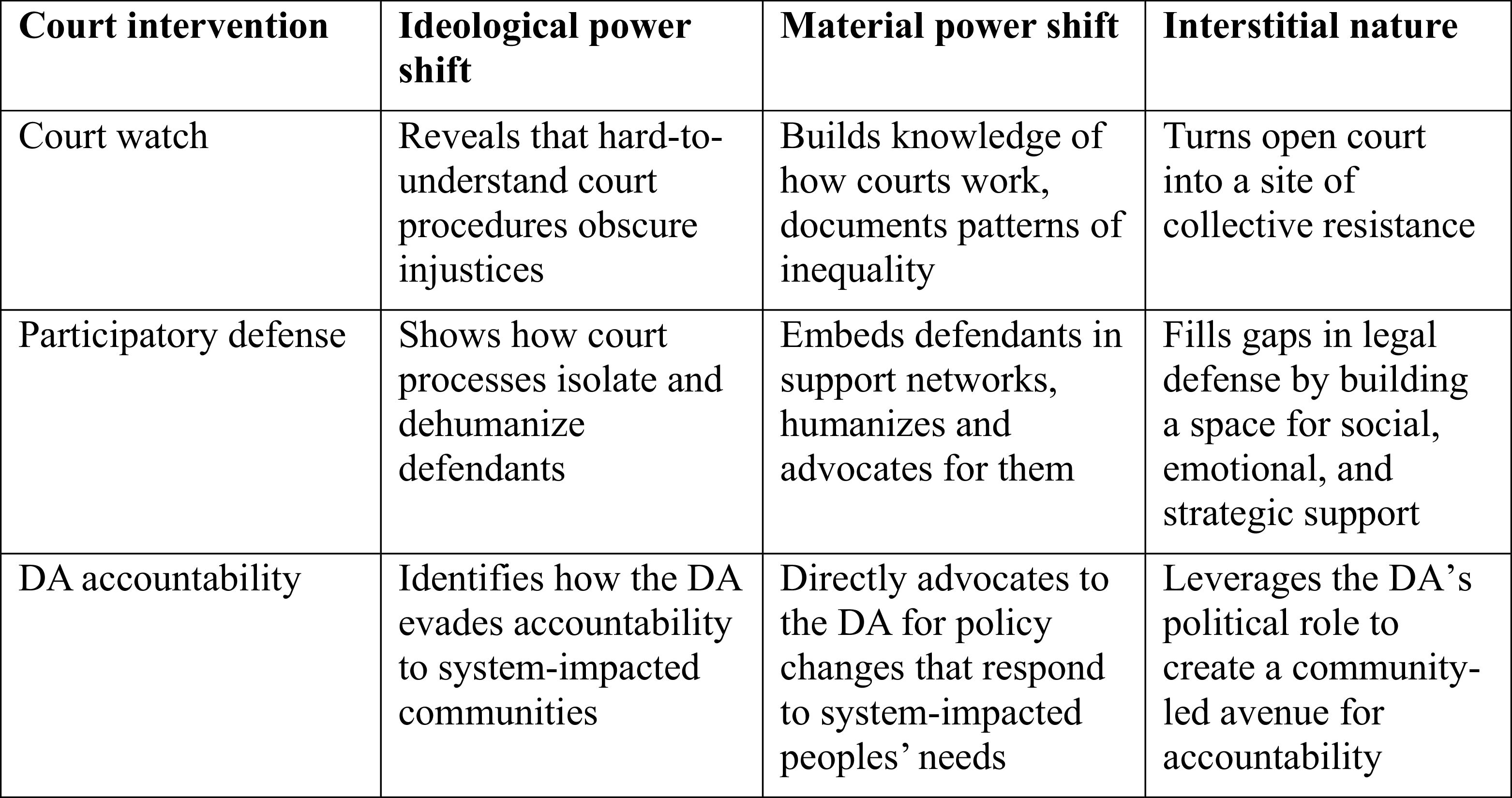
In the following sections, I examine how activists engage in interstitial power shifting. In each section, I focus on one of the coalition’s three court interventions—court watch, participatory defense, or DA accountability. First, I reveal a key problem with the court that activists identify and analyze how this diagnosis enacts ideological power shifting or challenging the common idea of the court as a just institution. Second, I show how activists try to address that problem using the court intervention and examine how that strategy enacts material power shifting or increasing community power in the criminal courts. Third, I explain how this power shifting is interstitial in nature or how it creates new avenues for collective action in the cracks of the court process. In Figure 1, I outline these strategic interventions, the types of power they try to shift from the court to the community, and how they appropriate and subvert existing legal avenues to do so.
Interstitial power-shifting strategies

Court watch
The “black box” of the court
Activists in this coalition see the criminal court as a “gateway” between police and prisons, mediating the path between arrest and incarceration, community supervision, or release. However, despite the crucial role that the court plays in the criminal legal process, activists also describe it as a “black box,” which is hidden from public attention and relatively overlooked by social movements. Luis,Footnote 10 a Latino man and formerly incarcerated organizer, explains: “People are doing stuff at the front end with the policing issue and with the mass incarceration issue to change things on the back end. … So there was a huge need in the middle, which was the court process. That part has been left largely unattended.” Activists explain that courts are a black box because the public often has little understanding of how they work, in part because courts are shrouded in technical legal language and procedures. Olivia, a system-impacted Latina organizer, expands on this point:
You have a courtroom lingo and etiquette you don’t understand. You don’t learn what an arraignment is in school. You don’t know the significance of a preliminary hearing. Unless you’re studying law, you’re not gonna know what these things are and how they affect your community or loved one. You don’t really know until it’s too late and you’re in the moment.
Activists see the black box nature of the court as a problem because it allows the court to obscure how it functions as an unjust institution under the shroud of legality.
One dimension of injustice described by activists is the court’s reproduction of broader systems of race and class oppression. Carlos, a Latino formerly incarcerated organizer, shares:
I know institutions like the criminal justice system are made to deal with people they don’t want to be part of society: Black, Brown, immigrant folks. … Some rise to the top, contribute in ways they want us to. But a lot of us don’t, so they lock us up. People make whole careers out of it, wardens, CEOs. It’s a market they create that a lot of people benefit from.
Luis explains that courts play a key role in this system of social control, exclusion, and exploitation by “overprosecuting, overcharging, and oversentencing young Black and Brown people.” Some activists see these practices as stemming in part from what Nicole Gonzalez Van Cleve (Reference Van Cleve2016) refers to as the racial segregation between an “all-white cast” of court officials and the people of color “consumers of criminal justice.” Abel, a Black policy advocate, reflects on this stark image:
You go to any courthouse, it’s like Black person, Brown person in and out every day. The judges are white, DAs are white, even a lot of PDs are white. … So, you look at slavery, it’s white people here, Black people here. And you go to the criminal legal system, it’s white people here, Black people here. … It’s like the clearest vision of this system, it has nothing to do with justice, it’s a tool of racial oppression and class oppression.
Further, activists argue that courts produce unequal punishment not only in formal outcomes but also through the criminal case process itself. Abel states: “They keep you in jail. Your bail is set super high. You can’t get out fast enough. Your car is towed. You lose your job. You lose custody of your children, even if you’re innocent and you win your case. You have already lost so much, so you lose even when you win.” As Feeley (Reference Feeley1979) also discussed, they stress the collateral consequences that defendants face, particularly those detained pretrial because they do not have the resources to make bail.
However, activists see the court’s injustices as going deeper than its reproduction of inequalities, which could ostensibly be addressed through reforms to improve fairness. On a deeper ideological level, activists call into question the common idea of courts as arbiters of justice that redress harm. Layla, a law student activist, explains the problems with the adversarial system:
If it’s adversarial, there are sides to it, you can’t go after the actual truth. Defense attorneys are just fighting as hard as they can for their client, prosecutors are trying to do the thing most profitable for them. Nobody benefits, not even victims. They hardly ever see redress, they’re going to be retraumatized in court, and they’re not going to get support for it.
To these activists, punishment does not prevent or redress harm. In fact, it works counter to those goals. The fact-finding process focuses narrowly on determining guilt and assigning punishment, while neglecting the messier work of acknowledging the nuanced dynamics of harm and trying to repair it. Max, an Asian American system-impacted organizer, echoes a common refrain in activist circles: “Harmful institutions beget harmful people. People who cause harm have often been harmed before, whether by other people or conditions created by these systems.”
In sum, by portraying courts as reproducing race and class inequality, activists counter the hegemonic idea of courts as neutral arbiters of justice. Importantly, activists not only problematize how courts unfairly or imperfectly administer justice but also challenge the taken-for-granted idea that harm can be addressed and justice can be achieved through the criminal court process. In doing so, they begin to reduce the ideological power of the court.
“The eyes of the community”
Activists use court watch to try and unveil the black box of the court, thus revealing how it reproduces inequality and inflicts harm. Sofia, a Latina system-impacted organizer, shares:
The court is the body that is supposed to serve as some sort of oversight to make sure that there is due process, right? But we know folks haven’t been receiving their full rights. We also know that the court system in itself is racist…. Observing these entities that are supposed to serve us highlights how they actually contribute to the problem. … So, it’s folks like court watchers who are the real oversight. A lot more people would be getting heinous charges and convictions, if [the court] didn’t have the eyes of the community on them.
While Sofia expresses concern about due process, she makes clear that the goals of court watch are broader than legal compliance. For these activists, exercising the right to observe court is the means to an end, not the end itself. They use court watch as an avenue to develop an understanding of how the court works, uncover its injustices, and pressure court officials to be less punitive.
The court watch program began in 2018 when, due to a lack of data collection and sharing by court agencies, coalition activists took the task of documenting court proceedings into their own hands. In the summer of 2020, with the onset of the pandemic, they shifted to observing online hearings. Over the first two years of the pandemic, court watch focused on arraignments to monitor whether courts were adhering to the emergency bail schedule (that is, “zero bail”) or detaining people pretrial as COVID rates were spiking in the county jail. Before the first pandemic court watch, the coalition posted on social media—likening the Black Panthers’ cop watch as a way to protect the community from police violence to court watch as a way to protect the community from “cops with suits”—that is, prosecutors. Here, the activists make clear their strategic inspiration and apply the Panthers’ countersurveillance tactic in a new site of the criminal legal system: the court.
For many court watchers who lack formal legal training, the technical aspects of the court process are confusing at first. This confusion was compounded while courts struggled to transition to remote hearings in the early pandemic. The morning of the coalition’s first online court watch session was marked by delays and technical difficulties—one of the courtroom’s livestreams was not working, and another was silent. Court watchers spent half an hour troubleshooting together before everyone was able to access the livestreams. Once arraignments started, the court launched into a whirlwind of cases as the judge and attorneys rattled off legal jargon in rapid-fire exchanges before setting bail for one case and immediately moving onto the next. During the hearings, court watchers texted the group with clarifying questions about certain legal terms, googled penal codes together, and voiced concerns about the difficulties of court watching in the COVID era.
While court watch training sessions include primers on legal terminology and instructions on how to access the court calendar and attend remote hearings, court watchers actually develop a practical sense of how courts work through watching hearings and processing their observations with one another in post-court watch meetings. Emily, a Latina organizer, describes this learning process: “Everything was going by so fast. I didn’t know how to read the court calendar or what they meant by OR, FTA, or med scratch. I had to ask [a lawyer in the coalition], ‘What does that mean?’ But slowly, I started to get there.” By pulling back the shroud of legal language and procedure, activists can more clearly identify how courts reproduce inequalities. For example, one court watcher describes the economic injustice of a case where an unhoused person was charged with looting for taking toothpaste from a drugstore the day after it was broken into, despite being uninvolved in the initial break-in. Another identifies racial injustice in a case where a public defender requested zero bail for an older Black defendant who would face serious health risks in a COVID-ridden jail. However, the prosecutor recommended a bail of fifty thousand dollars because of the man’s decades-old criminal record and failures to appear, which they argued made him a public safety risk. Activists saw these practices as putting low-income people of color at increased risk of not only incarceration but also illness or even death.Footnote 11
Activists share these observations with various audiences to show what happens in courts day to day and to mobilize system change. Through public-facing reports, social media posts, and community events, activists raise public consciousness around the court as an unjust institution and highlight specific, actionable demands for community members to organize around, such as decline-to-charge policies and increased diversion programs. They also present these findings directly to the DA and PD to support their policy recommendations, like ensuring the consistent use of emergency bail and reducing barriers to accessing online court hearings. Finally, activists share court watch findings with activist groups in other jurisdictions, compare patterns in their courts’ practices, and swap insights about how to build community power in the court process.
In addition to documenting the racialized and classed dynamics in court, activists uncover issues with the adversarial system. During a court watch session of a sexual assault trial, I observed a public defender ask the victim about details of the assault. “I don’t remember, it was seven years ago,” she said, frustrated, tears rolling down her face. The prosecutor went up for a redirect: “How does it feel to read your statement, what does it represent?” The woman responded, voice breaking: “A terrible thing that happened in my life.” Later, the public defender pointed to holes in her story and her job as a sex worker in an apparent effort to discredit her. She started sobbing. “Slow down your breathing, would you like to take a break?” the judge asked, his concerned eyes peeking over a black mask. But not even thirty seconds later, he instructed the public defender to continue. After this line of questioning, one court watcher told the group: “This is a tough case to listen in on. Got me thinking how there’s so many other transformative ways to address this type of harm, and this system just ain’t it.” Many of these activists do not believe in retribution, but they recognize that accountability requires acknowledging and grappling with harm in a way that enables healing both for the person harmed and the person who caused harm—something the existing system does not allow.
Finally, court watchers engage in what Shannon Malone Gonzalez and Faith Deckard (Reference Gonzalez and Deckard2022) call “witnessing” or a form of countersurveillance used to de-escalate state violence and promote accountability. Jess, a white law student activist, explains: “There’s a lot of pressure on [court officials] knowing that there’s people in there keeping an eye on what they’re doing. We try and put pressure on them to change.” I saw the power of witnessing when a group of about twenty activists gathered for a court watch action before the start of the pandemic. For months, they had been following the case of a deputy sheriff who illegally recorded conversations between youth and their attorneys. Their goal was to pressure the judge to hold the sheriff accountable, rather than give him “a slap on the wrist.” They invited me to join them, and, as we filled in two rows of the courtroom gallery, the attorneys glanced back at us and whispered to each other. When the hearing was pushed to a later date, the group stood up in unison and walked out silently, followed closely by the eyes of everyone else in the room. Afterwards, the group huddled in a circle in the hallway to debrief. A lead organizer glanced around quickly—to check if any attorneys or judges were around—before offering her reflections: “I don’t think the judge realized we were all there for the case until we walked out together and he saw how many of us there were. That matters. Let’s double our numbers next time.”
Despite the symbolic power of actions like this one, the concrete impact of court watch is difficult to assess. Thousands of cases go unobserved, and it is hard to measure whether activists’ presence in courtrooms, especially online, is noticed by court officials and affects their behavior. Still, activists look to other jurisdictions with more established court watch programs to see what impact is possible. For example, an organizer from another court watch program explained that it took them fifteen years to build credibility, gain access to court data, mobilize public pressure, and hold court officials accountable for punitive practices (for example, filing a lawsuit against the DA for prosecuting victims who refused to testify). In part, having this sort of blueprint for a path forward motivates activists to continue in their struggle. There are also tensions in leveraging “objective” court watch data to render the “subjective” experiences of system-involved people more legitimate to the court and the public. Activists risk reproducing the rising valorization of data in criminal justice, which scholars and activists have criticized for legitimizing harmful practices (Klingele Reference Klingele2015; Schenwar and Law Reference Schenwar and Law2021). But while activists strategically leverage data to support their critiques of the court, they do not privilege this form of knowledge over the lived experience of system-impacted people.
Ultimately, court watch transforms the legal space of open court into a site of collective contestation. Here, activists accrue knowledge about how the court works, document and publicize its injustices, and use their watchful presence to pressure court officials to be less punitive. In this repurposed legal site, activists work to reduce the power of the court to obscure its injustices from the public and increase their own power to demand system change.
Participatory defense
“Stripping away humanity”
Activists view the court as problematic not only for its role as a black box that obscures systemic injustices but also for the ways in which it isolates and dehumanizes defendants on an individual level. Jada, a Black system-impacted organizer, describes the common experience of defendants going through the court process alone: “Seeing defendants really out there on their own, especially when they’re in custody. You always see them look out into the audience, see the disappointment when they don’t see a familiar face.” The intimidation of navigating an unfamiliar institution is amplified by the emotional weight of facing a high-stakes situation without any support. But even when defendants have family by their side, the court process can feel isolating and overwhelming. Olivia reflects on her experience when her father was arrested: “I wanted to protect my family, but I didn’t have the means or avenue to do so. … I realized how powerless and hopeless I felt at that moment.” Like Olivia, many people want to help their loved ones get through the court process safely, but they lack the knowledge, capacity, or sense of efficacy to do so in the face of such a powerful institution. Further, while trying to help, defendants’ family members often also become subject to the court’s subjugating force, similar to what Megan Comfort (Reference Comfort2008) calls “secondary prisonization.”
In part, defendants and their families feel alone navigating the court process because they lack sufficient support from their defense attorneys. Activists explain that this problem stems from the structural disadvantage of public defenders relative to prosecutors. Among other issues, they explain that public defenders have higher caseloads, fewer resources, and less access to evidence than prosecutors, who also have closer ties to law enforcement. At a town hall with the chief PD, someone asked about funding disparities between the PD and DA offices. PD Brendon Woods replied in an impassioned tone: “Imagine if this office was funded the same way as the prosecutor’s office, it would be revolutionary! Give me more social workers, more immigration staff. We could change criminal justice in Alameda County. Start funding the group that will end mass incarceration!” But without these types of structural changes, activists see public defenders as lacking the capacity to offer the personalized support and close guidance that defendants and their families seek.
Besides the material issue of insufficient institutional support for defendants, activists note a deeper ideological issue with the court. They see the retributive mode of justice as unjust because it pathologizes crime and dehumanizes those who engage in it. Jada expresses this concern:
These folks in power, I feel they’re so used to just looking at paper, at the docket number, that they paint this picture of someone. … For example, I was [working] with someone. She was saying, “The DA called me a menace to society. That’s not who I am.” And just seeing her and hearing her voice crack, you can just tell that that broke her.
Dehumanization emerges in part from the bureaucratic nature of the court as legal officials plow through huge caseloads and treat defendants as the sum of their case details. Layla explains that law students are trained to assess criminal cases through narrow legal frameworks that “strip away the humanity and stories behind each case, divorced from root issues.” The dehumanizing effect of courts also derives from correctional logics, which understand crime as the product of individual deficiencies. Activists critique court officials for failing to consider structural issues that lead to crime in the first place (for example, lack of secure housing, employment, mental health care). Steven, a formerly incarcerated Asian American organizer, states: “Many of them don’t understand why people of color and low-income people are funneled into their system. … You can’t punish these people for the system that has been designed to make them fail.”
To conclude, activists show that, despite the right to counsel and fair trial, defendants often go through court without sufficient support. Further, they unpack the implicit logics of the criminal court process, which, by focusing narrowly on the facts of a case, can dehumanize defendants and take their actions and lives out of a broader social context. By exposing these gaps between legal ideals and lived realities of the case process, activists challenge the legitimacy of the court.
“Half tactical exchange, half support group”
Activists counter the isolating, dehumanizing power of the court by embedding defendants and their families in networks of support. Participatory defense is an organizing model “for people facing charges, their families, and communities to impact the outcomes of cases and transform the landscape of power in the court system.”Footnote 12 Antoine, a Black formerly incarcerated organizer, reflects on this strategy:
It’s a totally different experience when you have to do it alone, [versus] not only do I got my family behind me, I got community behind me. … On top of that, for public defenders to know when they in court fighting for their client, they got a whole community there. That sends a different message. This person is a beloved person in the community. This person has family. This person has friends. This person is someone that’s important to everybody.
By creating a space for defendants’ families to navigate the court process together, participatory defense fosters strong bonds between system-impacted people, equips them with tools to advocate for their loved ones before the court, and contributes to legal defense strategies. Where court watch aims to raise public consciousness about systemic inequalities in court practices and mobilize community members around decarceral demands, participatory defense aims to shift how system-impacted families think about the court process. It helps them challenge the idea that their loved one is defined by their charges or that they have little power over the criminal case process. Instead, it mobilizes families toward advocacy for their loved one’s freedom and, for some, toward broader efforts to transform the criminal legal system.
At the Oakland participatory defense hub (“the hub”), which was founded in 2018, up to a dozen family members attend each weekly meeting and are able to receive support for as long as their case lasts. Target outcomes include dropped charges and enhancements, diversion, or resentencing, all which aim to secure people’s immediate freedom from incarceration. While the hub supports cases in the initial adjudication and post-conviction stages, Luis discusses the urgency of intervening early in the criminal legal process at the “gateway” between arrest and incarceration: “If you work with somebody after the fact, sometimes it’s too late, in the sense that if they’re already convicted, it closes a lot more doors. The options, the avenues to bring a loved one home are a lot less.” Activists describe the hub as “half tactical exchanges, half support group.” On the tactical side, hub participants provide case updates, and hub coordinators help answer questions, review legal documents, and attend court hearings with them. A key tactic is creating a “social bio packet,” a collection of letters and photos in support of a defendant from their family and friends. As with character letters in a mitigation package, a social bio packet offers the court a more holistic image of a defendant than simply what is in their case file, thereby humanizing and situating them in a broader social context.
But rather than being compiled by the defense attorney, social bio packet creation is spearheaded by the defendant’s loved ones, with support from hub coordinators. In contrast to character letters written by individuals who may not know what to include or how to frame their statements given their unfamiliarity with the format, social bio packets are collectively constructed and draw on years of experience of the coordinators and other families in the hub. Loved ones learn how to strategically bring together materials and perspectives to tell a clear and compelling story about their loved one that supports the defense’s arguments to dismiss charges, reduce sentences, request diversion, or other goals. While social bio packets can be shared with public defenders to support their mitigation work, or even sometimes presented in court (for example, in sentencing hearings), activists also present the packets directly to the DA in an avenue outside of the formal case process.
In a meeting with the DA, I observed nearly a dozen people take the floor to advocate for their loved one who was seeking resentencing. They spoke about his personal growth while in prison, shared photos of the children for whom he has been a caring father, and explained how they would support him upon release. A family friend would bring her skills as a trauma therapist to provide emotional support, a pastor who worked with a group of formerly incarcerated people would bring social support, another family friend would use her expertise as a professor to support the defendant in his educational pursuits, a grassroots reentry organization would help him search for job opportunities, and a restorative justice organization would commit to holding a healing and accountability circle. The restorative justice organizer concluded: “You know the proverb that it takes a village? We will be that village and provide the ongoing moral, material, and emotional support necessary for reentry. One important part of this approach is that the safety net is broader. There will always be someone there to support him, he will never be alone.” The hub coordinator thanked everyone for sharing their testimonies: “Y’all are a true example of what community looks like, especially when we need to support our loved ones.”
On the support side of participatory defense, the hub serves as a space of connection for people who might otherwise be going through the case process alone. In one hub meeting, a woman gave updates about her son who was seeking resentencing. She and the hub coordinators discussed next steps for putting together a social bio packet, and the coordinators shared their insights from previous experiences advocating for the resentencing of hub participants. The mother stayed afterwards, even though she did not have any more questions, and reflected: “I like to hear what others have thought of, that I haven’t, so I can learn from them. It makes me feel like I’m not the only one going through this. I felt like I was being closed in on, like I wasn’t doing enough, but we can talk about that here.” A hub coordinator affirmed: “You’re not alone, we’re glad you come.”
At the participatory defense hub, participants receive support not only from coordinators but also from one another. Besides swapping tactical insights, they share feelings of frustration and fear while fighting a case or joy and relief when loved ones return home. Some continue coming to the hub even after their loved one’s case is resolved in order to pay forward the support they received. By fostering new types of social relations and institutions centered on collective care, participatory defense enacts what abolitionists call “prefigurative politics” in that it begins to “incrementally realize the changed world that we want to live in” (McLeod Reference McLeod2018, 1623).
The support that families receive through participatory defense is crucial when they do not have sufficient guidance from their overburdened public defenders. While the hub is not formally partnered with the PD’s office, some attorneys refer clients to the hub. At a participatory defense training session, nearly eighty public defenders were in attendance. One public defender shared how he integrated participatory defense into his legal strategy: “Partnering with clients’ community is so helpful for getting better outcomes for folks. We have a lot of cases, so it’s hard to know how to do this with every one of them. But if a family is actively advocating for their loved one, that should trigger a referral to the hub.” He and the hub coordinators described several cases in which the participatory defense hub and public defenders worked together to get charges dropped, secure alternatives to incarceration, or negotiate early release. As the public defender stated, “when we work together, the outcomes are better than otherwise possible.” At the end of the session, the hub coordinators explained how public defenders could refer their clients to the hub, and attendees sent enthusiastic messages in the chat: “What fantastic results!!” “This was galvanizing!” “Absolutely amazing stories, free them all!”
While they may make referrals, attorneys do not attend hub meetings, and their involvement in participatory defense is more akin to what Scott Cummings (Reference Cummings2017) calls “movement lawyering” than legal mobilization or legal service provision. In fact, hub coordinators begin each meeting with a disclaimer that centers on system-impacted peoples’ perspectives and agency in participatory defense: “We know the criminal legal system can be stressful and confusing, but we’re here for support, not legal advice. We’re organizers, not attorneys. We want to be thought partners and empower you to take the lead in advocating for your loved one’s freedom.” Forty hubs across the national participatory defense network proudly claim that, over ten years, they have achieved a total “time saved” of 25,869 years of incarceration.Footnote 13 Although participatory defense helps reduce harms caused by the penal system to the many families it supports, its impact is limited since it operates on a case-by-case basis and can only support a small segment of people going through the court process. There are also situations where family members’ visions of justice and ideal case outcomes differ from those of activists. At a participatory defense training session, a hub coordinator explained:
We don’t tell people what to do, but we guide and offer support, empower them to be their own best advocate. … Approaches and what defines a win may look different with each case. We let the families take the lead, and sometimes they wanna take a [plea] deal and we think they should fight for it, but we’re gonna support them in that, because that’s a win for them.
Although activists may have different goals than family members (for example, pursuing case dismissal versus negotiating a plea), they adhere to a core principle of participatory defense—that the strategy is family centered and led—rather than imposing their own visions of justice. Finally, participatory defense also poses potential tradeoffs between material gain (for example, securing shorter sentences) and ideological concession (for example, using legible frames of deservingness). While activists believe it is crucial to humanize system-involved people, some note that there is a tension in tying someone’s worthiness of non-punitive treatment to their level of social support. Further, many defendants do not have the social ties to leverage a participatory defense strategy. But, in an abolitionist vision of justice, they should not be punished either. Jess reflects on this tension:
I struggle with the idea having to go into court and be like, “This person deserves this thing because they go to church, or have a job, all things that give them value.” I think the court’s sense of justice is, “Are these the people we think are good? Are these the people we deem worthy of not having to deal with [punishment]?” But my vision is fighting for the dignity of someone just because they’re here sharing [life] with us.
Like Jess, many abolitionists have grappled with the idea of balancing immediate needs for harm reduction and longer-term goals of structural change. But many activists in this coalition see the risks of incarceration, especially during the pandemic, as being too high to ignore for the sake of ideological purity. As in court watch, activists strategically engage with institutional logics to advance their goals of getting people out of prison but without reifying them.
In sum, participatory defense fills in gaps in legal defense by creating a new space outside the court where families can navigate the case process together. Further, the tactic of compiling social bio packets turns a legal practice (mitigation packets) into an organizing strategy, over which community members, rather than court officials, have power and agency. Through this new support system, activists work to reduce the court’s power to isolate and dehumanize defendants and their families and increase their power to advocate for less punitive case outcomes.
DA accountability
“The gatekeepers”
While activists aim to unveil the black box of the criminal court as a whole, they shine the brightest spotlight on the DA, who they understand to be the most powerful player in the court and at the center of many problems with the court. That is, the black box nature of the court obscures how discretionary prosecutorial practices create race and class disparate outcomes, and prosecutors are often the ones who are dehumanizing and decontextualizing defendants in efforts to secure convictions. Even worse, prosecutors are able to perpetuate these injustices without accountability, particularly to system-impacted communities. Max explains the prosecutor’s power through an analogy:
In basketball, if the other team averages most of their points off slam dunks, you need to know who’s dunking all day. If you find out it’s one person doing 90 percent of the dunks, you gotta figure out how to stop them, to defend yourselves in the game. … Recently, people realized it’s the DA who keeps dunking on everyone in the courtroom. … They have so much power and discretion, they really are the gatekeepers of who goes into the system and who doesn’t, who’s given a pass or a light touch and who’s getting the book thrown at them.
Because prosecutors determine whether and how to charge, make plea offers, and recommend bail and sentences, activists see them as the gatekeepers to mass incarceration.
But without an avenue for the community to engage with the DA, critique their practices, and make demands for decriminalization or decarceration, it is unlikely that prosecutors will enact such changes on their own. Historically, in the county and nationally, DA-community engagement has been limited, despite the DA being an elected official who represents “The People” (Bazelon Reference Bazelon2020). Jada reflects on this contradiction: “You campaigned for this position, you really wanted it, you made promises to communities. You need to follow through, you’re obligated to community. Like, our safety and our lives are at stake in your hands.” While DAs claim to promote collective values like public safety and justice, coalition activists say that they do so without considering the perspectives of system-impacted communities. Olivia states:
The lack of willingness from DAs to acknowledge the systemic harm they caused in the search for “public safety” is something. I say that in quotations because we as a public can define what public safety really means, not necessarily with a punitive lens like the DAs have, but because we lived it, and we know how we can heal.
Amy, a white activist, explains why she thinks this lack of DA accountability exists:
DAs don’t have to worry because the appellate process, even at its best, takes so long. By the time they might possibly have something pushed back on them, they may already be a judge or politician. They can’t be put in jail unless they do very specific stuff and even then, they don’t end up in jail. They can’t have their license taken. Besides not getting reelected, there’s no consequence there. So, they are basically operating without any consequences.
Here, as in studies by scholars like Angela J. Davis (Reference Davis2007), prosecutorial accountability through formal legal channels has historically been weak because of insufficient enforcement mechanisms.
In short, activists call attention to the fact that, despite their formal position as an elected official, the DA is not regularly engaged with, or accountable to, system-impacted communities. In this definitional and representational struggle, activists begin to undermine the ideological power of the DA, which is rooted in their claim to represent “The People.”
“Designing and setting the table”
However, more recently, activists have started turning public attention toward the injustices perpetuated by prosecutors and creating new modes of accountability. While participatory defense disrupts the path from arrest to incarceration on a case-by-case basis, DA accountability aims to change how the court processes entire categories of cases. In 2018, Alameda County DA Nancy O’Malley was up for reelection and faced a challenger: Pamela Price, a Black, system-impacted, civil rights lawyer vocally committed to social justice. The coalition saw this as an opportunity for change in the DA’s office and launched a political education campaign. Using community outreach and townhalls, they worked to increase public awareness of the DA’s power, discretion, and role in mass incarceration, and stressed the importance of voting in the election. When O’Malley won, activists accepted that they would have to work with her for the next four years. They created a DA accountability program, which would continue political education efforts and begin holding community meetings with the DA. Two to three dozen people attend each monthly meeting where they bring together individual-level stories from participatory defense and system-level analyses from court watch to push forth decarceral prosecutorial policies.
The origin story of DA meetings is an organizational legend. Initially, the DA repeatedly ignored the coalition’s requests to meet until a group of youth organizers marched into her office and asked to speak with her. When her secretary said she was not available, the group staged a sit-in, chanting and refusing to leave until they got a meeting. Soon after, the DA appeared and met with them. Isa, a Latina system-impacted organizer recounts: “There were students like me who had experiences [with the criminal legal system], even formerly incarcerated themselves. It was powerful to be able to share our stories and say why we were there. From then on, she was very consistent in [meeting] with us.” Here, the traditional extralegal tactic of direct action paves the way for creating a new avenue to engage with the DA. Max explains the importance of this avenue:
I’ve always been told that real negotiation happens in the street. … But there needs to be a place where direct confrontation can happen between us and the person with power to make change. We’ve designed a table, set it, and demanded they sit and hear our demands. Other folks engage in existing venues like public safety meetings. But [legal officials] run those spaces, have control over how they operate, create the agendas. So, in and of itself, it feels successful to create something of our own that’s informed by community, not the system.
Challenging what Steven Lukes (Reference Lukes1975) calls the second face of power—activists, not legal officials, run these meetings. As such, they open up space to voice concerns about ongoing injustices from the perspective of system-impacted people and present community-driven proposals to address them.
Monthly DA meetings include time for hub participants to advocate for their loved ones directly before the DA. Some activists believe that the best way to move the DA is through the moral power of narratives. Steven explains: “The heart of it is storytelling, the connectedness of humans. [The DA] is still a person, right? We’re appealing to their moral side. … I’m sharing my story as a gift, I want to connect with you on a human level.” During these testimonials, the DA listens, nods along intently, and smiles occasionally at touching anecdotes. While she does not explicitly commit to fulfilling requests, she often expresses gratitude for the chance to talk with families: “It’s helpful when families share a broader image of people than what’s on paper. I share this with others in the office. It’s been very helpful. We’ve been able to move forward on a lot.”
This narrative work extends beyond advocacy around individual cases and is also used to support policy recommendations, which activists also raise in meetings with the DA. On one occasion, activists gathered to reflect on their work over the first several months of the pandemic and develop priorities and plans moving forward. One person shared that inviting families to speak with the DA was effective: “On an individual level, that’s good, but there’s always more to fight for. Broader policy needs to change.” The group discussed using court watch data as an empirical basis for their claims and citing best practices in other jurisdictions to pressure the DA to change their policies. Another person chimed in: “A counterpart is narrative shifting to broader public and key stakeholders, telling powerful stories that highlight how cruel our justice system is and how much more effective it’d be to have community-based solutions.”
At the time of this study, the coalition was focused on eliminating status enhancements, ending youth transfers to the adult system, increasing diversion, and decarcerating jails and prisons during the pandemic. In a meeting with the DA, a policy advocate walked through a proposed policy to end gang enhancements. The DA replied: “I appreciate when you all put these [proposals] together. In the past, we’ve adapted our policies accordingly, but gang activity is a very serious issue in Alameda County, and I can’t give a blanket statement that we won’t pursue enhancements.” The advocate tactfully thanked her and continued: “I want to reiterate that there is no evidence that enhancements deter people from being in gangs. Our policy centers rehabilitation and bringing people home, not locking them up.” The DA cut in: “There are programs in prison that can help people separate from a gang.” A formerly incarcerated activist spoke up: “Going through a program isn’t the only way someone can drop out of a gang. I know, as someone incarcerated on gang enhancements. I hope your office doesn’t see that as a requirement.” In these meetings, activists speak in a language legible to the DA and use institutional paths like policy proposals to effect change. However, legal frames are always utilized alongside human-centered ones, like personal testimonies about the real-life implications of these policies, and in service of transformative goals.
As with court watch and participatory defense, it is difficult to assess the immediate effects of DA accountability. Some concrete policy changes emerged from the coalition’s efforts, like one requiring prosecutors to consider immigration consequences during plea bargaining. However, the DA rarely commits to amending policies and opts instead for boiler-plate responses that her team will “look into it” but “can’t make promises.” This raises the question of whether the DA is merely symbolically placating activists or actually considering their demands. Relatedly, activists vary in their views about prosecutors as levers for change. Some see the DA as functionally opposed to transformational goals because their central task is to charge and incarcerate. Jess states: “I don’t even believe in progressive prosecutors. I think the most progressive thing a prosecutor can do is quit. The thing for me is, at the end of the day, they wake up and incarcerate people.” Still, others hold that, while prosecutorial discretion is the mechanism by which raced and classed punishment is meted out, it can also be redirected in service of decarceration. Antoine explores this idea:
The DA makes a recommendation what to charge this person with. But they also have the ability not to charge at all. That’s the part people lose sight of. They don’t have to charge. They don’t have to stack [multiple charges]. They don’t have to look for the high end of the sentence. They have some level of discretion on how to address individuals one by one.
Again, activists regularly navigate tensions between engaging with legal institutions in order to push forth immediate decarceral goals and rejecting dominant logics and processes altogether. Still, these activists view the creation of a community-led space for engaging the DA, where there previously was none, as a crucial victory. As seen in social movements throughout US history, the creation of new institutions to hone collective power and build political efficacy is a fundamental step toward later material gains (Morris Reference Morris1984; McAdam Reference McAdam1999).
Leading up to the 2022 DA election—one of the most heated DA races in county history, with four final contenders—the coalition held town halls where constituents could ask the candidates about their policy stances and goals. In the end, voter turnout was a record high, and Price, the progressive challenger to O’Malley in 2018, won. Activists aimed to use the power they built through their work with O’Malley to push for more transformative changes during Price’s term. They began by creating a set of community priorities for the new DA, a similar tactic to the Panthers’ Ten-Point Platform. These included ending youth criminalization and sentence enhancements, declining to charge certain non-violent offenses, increasing diversion, and enforcing police accountability, all of which were aimed at decarceration and ending racialized punishment.Footnote 14
In sum, DA accountability uses the political process of DA elections as an opportunity for political education to increase public awareness of the role of the DA in mass incarceration. They also leverage the formal political role of the DA to create a new avenue for direct engagement. In this new avenue, activists try to reduce the power of the court to evade accountability to system-impacted communities and increase their collective power to shape prosecutorial policies.
Discussion: interstitial power shifting and defining “success”
Through diagnosing the problems of the criminal court, activists challenge what Clair and Woog (Reference Clair and Woog2022, 5) call the “mythologizing [of courts] as institutions that afford justice.” To these activists, the problems of the court are rooted in its operating logics and structure and, thus, cannot be solved through incremental reforms. As Abel explains, “the criminal legal system is a vehicle for ensuring that capitalism and white supremacy rule under the facade of lawfulness. It all has to be abolished.” Here, activists engage in cultural power shifting, which is a key step toward abolition that “reduces the ideological power” of the criminal court as a “necessary institution in society” and “spurs material shifts in power relations” between the court and marginalized communities (Clair and Woog Reference Clair and Woog2022, 30–35). Via court watch, participatory defense, and DA accountability efforts, activists engage in material power shifting or the redistribution of authority and power in criminal court processes from legal officials to “local communities in a democratic and just way that centers the most vulnerable” (34). These strategies are interstitial by nature, in that while they engage with the court, they do so by building “new forms of social empowerment in the niches, spaces, and margins” of the court (Wright Reference Wright2010, 322). In these community-created and community-led spaces, community members can exercise collective power in the criminal legal process.
However, this work is not without its challenges and tensions. First, while the coalition tends to maintain a unified front in their public-facing efforts, member organizations and activists vary in their visions of justice and strategies for pushing forth those visions. Navigating these differences is a key part of coalition work. Shannon, a white legal advocate, explains:
Most organizations and people [in the coalition] are abolitionists. Some organizations have expressed that they’re not abolitionists but are very much in favor of huge decreases in the prison population. And, I don’t know, there’s been a little tension on occasion about what our ultimate goal is, but realistically speaking, we’re not going to abolish prisons tomorrow. So, deciding how much incremental change is acceptable and trying to get there is a topic for debate, rather than a wall or a line that people won’t cross.
Disagreement can be productive as it allows the coalition to identify shared goals and core values. Both reformist and abolitionist coalition members aim to reduce harm to system-involved people. Though they may diverge on the ends of this work—to eliminate punishment altogether or to reduce incarceration while keeping the system intact—their immediate next steps are aligned. In cases where the coalition decides not to move forward together on a particular issue, Shannon explains: “You always have the back up of even if [the coalition] as a whole doesn’t sign on, fifteen of seventeen orgs will send their individual support for whatever it is.” That is, while it is strategic to build a broad coalition to coalesce power, there are also situations where coalition members opt to take separate stances and approaches, thus allowing what social movements scholars call the “radical faction” of the coalition to advance more transformational visions of justice, even absent support from the moderate faction (Van Dyke and McCammon Reference Van Dyke and McCammon2010).
Points of tension also emerge as activists carry out the court programs. They try to balance immediate harm reduction through strategic appeals to institutional logics (for example, using frames of deservingness in social bio packets to convince the DA to release people from prison) and longer-term transformative goals (for example, advancing policies to end youth incarceration or expand alternatives to incarceration). Social movement scholars theorize the distinction between resonant and radical frames—the former that align with dominant beliefs and the latter that subvert them (Ferree Reference Ferree2003). For example, Michelle Phelps, Anneliese Ward, and Dwjuan Frazier (Reference Phelps, Ward and Frazier2021) show how some Black Lives Matter activists use reformist frames that identify the problem of policing as rooted in bias or poor training, while others use abolitionist frames that depict policing as an unreformable institution. I find that, in this coalition’s court interventions, activists use both resonant and radical frames, which, in practice, they see as complementary rather than contradictory. For them, abolition entails a dual praxis—trying to “get people free” now while creating the conditions that make carceral systems obsolete in the future.
Finally, in the absence of major changes in court officials’ conduct due to court watch, mass decarceration due to participatory defense, or new policies due to DA accountability, some might argue that this power shifting has not been successful. But when asked how they measure success, activists do not give a single, formal metric. Shannon explains:
One way is official policy change, but it’s not always that obvious. Increasing the number of people who get out without a conviction, that’s a win. Having an event and getting more community members involved in a campaign is a win. Putting more knowledge out there about what a DA does is a win. Success can be defined in a lot of ways.
Coalition activists see building new types of knowledge, relations, and practices that decenter punishment and center community care as victories because they build collective power, increase their sense of political efficacy, and lay the foundation for structural change. This multifaceted conception of success aligns with research that shows that, in the early stages of social movements, expanding political opportunity structures, cultivating political efficacy, building social networks, and creating new institutions to hone collective power, even in the absence of more “concrete” wins, can pave the way for formal legal and policy changes down the line (McAdam Reference McAdam1999; Morris Reference Morris2000). As Wright (Reference Wright2010) explains, interstitial strategies begin to “build the new society within the shell of the old” and produce the “necessary conditions for sustainable emancipatory ruptures” like complete abolition (327–29). Antoine offers a similar reflection:
The thing is, this [work] is like never ending. … But what I’m optimistic about is that, over the next couple of years, folks in the community will start feeling even more empowered to advocate for themselves, start demanding justice, demanding that they have their needs met, and we’re able to build really, really strong communities going forward. Now, we’re not necessarily relying on the system to do the right thing and so called “protect and serve” us. But we already are in a situation where we’re able to protect and serve ourselves.
Conclusion
The criminal court, once a black box, is gradually being revealed as a lynchpin in mass incarceration and thereby a target of social movement intervention. Criminal justice activists are also increasingly taking approaches that aim to shift power away from penal institutions into the hands of system-impacted communities. In this article, I study this emergent type of criminal court activism, analyzing how activists in Oakland come to see the court as an unjust institution and work to shift its power into the hands of defendants, their families, and communities.
Against the hegemonic idea of courts as fairly adjudicating and redressing harm, upholding defendants’ rights, and representing the interests of “The People,” activists critique courts for reproducing inequality and inflicting harm, dehumanizing defendants, and evading accountability to system-impacted communities. Activists then try to address these problems with three strategic interventions. Court watch reveals the court’s injustices, participatory defense socially embeds and contextualizes defendants, and DA accountability leverages data from court watch and stories from participatory defense to advocate for decarceral policies. I call these strategies interstitial power shifting as they carve out new spaces for exercising collective power in the cracks of the court process. I argue that because these spaces are interstitial—maintaining points of contact with the court while largely remaining under community control—activists can engage the court in ways that chip away at its power, while building their own power in the criminal legal process.
This article contributes to socio-legal scholarship on punishment, social movements, and abolition. First, in contrast to punishment research that focuses on the subjugating relation between the criminal court and defendants, it reveals how activists reduce the court’s power by embedding system-impacted people in networks of support. When defendants and their families are equipped with knowledge of how courts work, tools for advocacy, and the support of a social movement, they are imbued with a greater sense of agency and efficacy during the court process. Second, I complicate the tidy analytic dichotomy in social movements research between legal and extralegal mobilization. That is, I illuminate how activists maneuver the criminal court in creative ways that create new avenues for building and exercising community power in the margins and cracks of existing court processes. Third, building on scholars who outline principles for abolition, I produce a rich account of activists’ efforts to enact power shifting in practice, which helps render the abstract idea of abolition more concrete. I also uncover practical challenges of this work, like the struggle to shape court processes and outcomes on a broader scale and the tensions between immediate harm reduction and long-term structural transformation.
Findings from this study also have broader implications for criminal justice activists and officials. Amid growing discourse around abolition, court watch, participatory defense, and DA accountability offer a model for other activists trying to implement power-shifting strategies in the criminal court or other penal institutions. By operating in the spaces and cracks of the court, these strategies have the potential to reduce harm in the current penal system while working toward its replacement. Further, findings may be informative for public defenders or other legal professionals interested in incorporating grassroots movement lawyering into their practice as well as for criminal court agencies trying to increase democratic engagement in the criminal legal process.
While this study provides valuable insights into the dynamics of criminal court activism, it also has limitations that highlight opportunities for future research. Given the distinct sociopolitical context of Oakland, activists’ struggle in this site may not be generalizable. However, activists in Oakland have often offered a model of social change that activists in other jurisdictions emulate. For example, the Black Panther Party and Critical Resistance, founded in Oakland in 1966 and 1997 respectively, inspired the formation of local chapters in other cities and helped spread abolitionism across the United States. Thus, it is useful to understand how struggle unfolds at the forefront of a movement to develop an analytic framework for efforts likely to follow. Additionally, this study is focused on activists and only offers one perspective on struggles over issues of the court.
Future research could explore how court officials understand and respond to these efforts. In line with the courtroom work group’s research, this work could reveal organizational or political barriers to implementing more fundamental system change. Research on the politics of policing and prisons could explore how tactics like cop watch or campaigns to close jails and prisons erode the power of these penal institutions from their margins by challenging assumptions about their necessity or reformability and creating new avenues for exercising collective power over the criminal legal process. Finally, the framework of interstitial power shifting could be applied to explore collective action in the interstices of other powerful institutions like immigration detention, family regulation, and school disciplinary systems. This represents a quintessential law and society approach. That is, it can be used to reveal how law, power, and institutional processes operate in practice, rather than focusing solely on formal doctrine or legal proceedings. Further, it highlights how everyday people understand, navigate, contest, and reshape legal institutions.
As Ruth Wilson Gilmore (Reference Gilmore2022, 481) writes, “abolition starts from the premise that freedom is a place,” where people affected by organized abandonment can coalesce their resources and capacities to “make places where they were into places they wish to be.” By highlighting the creative ways in which activists are already building these places of possibility in the margins and cracks of the criminal legal system, this study offers a glimpse into a world where everyday people—particularly those from historically marginalized communities—have the power to reimagine and reshape our systems of safety and accountability, pushing us closer to the horizon of abolition.
Acknowledgments
Thank you to Catherine Albiston, Armando Lara-Millán, Michael Rodríguez-Muñiz, and Loïc Wacquant for their guidance and support on this project. I am also grateful to Audrey Augenbraum, Aukeem Ballard, Jenae Carpenter, Renee Clarke, Caylee Hong, Deborah Freedman Lustig, Clara Perez, Khoi Quach, Ever Reyes, Jasmine Sanders, and Lilly Yu for their thoughtful feedback on this article; those who provided comments on earlier versions at the 2022 Law and Society Association Annual Meeting, the 2023 Abolitions Conference, and the 2024 American Sociological Association Annual Meeting; and the three anonymous reviewers whose generative engagement helped sharpen and strengthen this article. Finally, I thank the activists who shared their stories and spaces with me. This research was supported by University of California, Berkeley’s Center for the Study of Law and Society, Greater Good Science Center, and Institute for the Study of Societal Issues - Asian American Research Center. This study received Institutional Review Board approval from the University of California, Berkeley’s Committee for the Protection of Human Subjects (Protocol no. 2020-12-13919).