INTRODUCTION: OLBIA PONTICA AND THE CULT OF APHRODITE
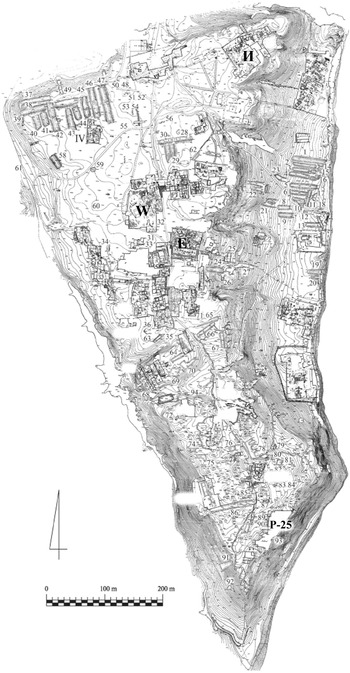
Olbia Pontica was one of the most important ancient Greek settlements on the north coast of the Black Sea. The religious life of its civic community was concentrated at its central and western temene (Fig. 1), where many terracottas, moulds for their production and a coroplast's workshop have been discovered. The two temene were situated in the centre of the upper part of the city and were divided from each other by a central street. The western temenos functioned from the early the sixth century bc (M.V. Rusyaeva Reference Rusyaeva2006; Buiskikh Reference Buiskikh2015b, 6) and contained the sanctuaries of Apollo Ietros, the Mother of the Gods, and lesser ones of Dioskouri, Hermes and Aphrodite, as well as of Aphrodite with other gods. Two inscriptions provide evidence of an abaton of Aphrodite in the western temenos (A.S. Rusyaeva Reference Rusyaeva2005, 299). The central temenos started functioning later, during the third quarter of the sixth century bc; in the Hellenistic period it became a place for the worship of Apollo Delphinion, Zeus and Athena (Levi Reference Levi1985, 71–88). These temene constituted the elements of a single sacral zone and functioned simultaneously throughout the history of the polis.
Map of Olbia Pontica (based on Kryzhytskyi and Kariaka Reference Kryzhytskyi and Kariaka2017), marking findspots of bust thymiateria: И; Р-25 (the area of southern temenos); W (western temenos), E (eastern temenos).

Over one-thousand terracottas, many of them broken into pieces, have been discovered in the deepest bothros of the central temenos; they are in need of comprehensive study. So far, only the best-preserved finds have been published (Levi Reference Levi1959; Reference Levi1970, 42–8; Reference Levi1985, 82–3). Like that at the western temenos, the bothros of the central temenos was constructed within a former cistern which was out of use (for references see cat. nos 7 and 11). Modern interpretations of the central bothros initially associated it with cults of the Mother of the Gods, Aphrodite, and Demeter. However, a recent comprehensive analysis cast doubt upon the interpretation of terracottas as representations of Demeter or Persephone (this included the bust thymiateron whose cups were previously interpreted as Demeter's head-dress; see Khudiak Reference Khudiak and Yachmenev1940, 89–90; Shevchenko Reference Shevchenko, Posokhov and Sorochan2015b with literature analysed). In this paper, I focus upon a series of identical terracottas of the bust thymiaterion type depicting Aphrodite, some of which were found in the bothros (cat. nos 7, 10 and 13).
Discussion of this material coincides with ongoing research at the southern sacral area in Olbia dedicated to Aphrodite (Bujskikh Reference Bujskikh2015a). Its study commenced almost 20 years ago, but its interpretation as a sacral territory was proposed at a later point (A.S. Rusyaeva Reference Rusyaeva2005, 300; Krapivina Reference Krapivina, Petropoulos and Maslennikov2010; Buiskikh Reference Buiskikh2015b). A range of archaeological materials found there have been published recently (Buiskikh Reference Buiskikh2015b, with references; A.S. Rusyaeva Reference Rusyaeva2015). Terracotta images of Aphrodite and other deities are most commonly dated to the Hellenistic period (Khudiak Reference Khudiak and Yachmenev1940; A.S. Rusyaeva Reference Rusyaeva1992; Skudnova, Slavin and Kleiman Reference Skudnova, Slavin and Kleiman1970; Shevchenko Reference Shevchenko2016b). The series of busts discussed here derive from the late period of this temenos’ functioning, from the late third to the first half of the second century bc. Other Hellenistic materials from the area (also known as ‘area P-25’) also derive from a bothros (Krapivina Reference Krapivina2012, 239–40).
The evidence for Aphrodite's cult at Olbia derives from temene and private houses. A public cult of Aphrodite is attested in the Bosporan Kingdom and other Pontic cities (Kharko Reference Kharko1946; Ustinova Reference Ustinova1998, 29–35; Braund Reference Braund2018, 187–255). She was a patroness of colonisation, and there is epigraphical evidence for her epithet Ourania from Panticapaeum and Phanagoria. The existence of a cult of Aphrodite Nauarkhis in Gorgippia suggests an association with seafaring. Temples of Aphrodite without any epithets are epigraphically and archaeologically attested in Borysthenes and Tauric Chersonesos (see Shevchenko Reference Shevchenko2011, 147–8 with further references).
Aphrodite Ourania was associated by Herodotus (4.59) with the cult of a local deity worshipped by the Scythians occupying the lands next to Olbia and other cities of the north Black Sea littoral. However, this does not necessarily indicate that the cult had a significant place in Olbian religious life: Herodotus often designated local deities with Greek names in order to make it easier for his audience to understand the nature of non-Greek cults. Indeed, the epithet Ourania is not evidenced by a single Olbian inscription. Nor is she known in other cities of the north-western coast of the Black Sea (A.S. Rusyaeva Reference Rusyaeva2005, 300). Nevertheless, the images preserved on the thymiateria published here – of a mature lady, chastely dressed in chiton and himation, with Erotes on her shoulders – seem to correspond to the descriptions of Aphrodite Ourania outlined by some ancient authors (Plato, Symposion, 180d–e; Hesiod, Theogony, 176–206; Shevchenko Reference Shevchenko2011, 51–2). In the Bosporan Kingdom the epithet Ourania is well-attested and is sometimes related to depictions of Aphrodite with Erotes on her shoulders (Alekseeva Reference Alekseeva2014). The related epithet Apatouria may have been used in Olbia, where there was a month called Apatourion (A.S. Rusyaeva Reference Rusyaeva1992, 104). Furthermore, Aphrodite Demia, probably a private cult of love and fertility, is attested in fifth-century Olbia (A.S. Rusyaeva Reference Rusyaeva2015, 35–7). Two private dedications, one from Olbia and the other from Borysthenes, mentioning also Aphrodite Syria, are associated by scholars to the cult of Aphrodite Ourania in the area (A.S. Rusyaeva Reference Rusyaeva1992, 104; Reference Rusyaeva2015, 35 with references; Braund Reference Braund2018, 191 n. 18). However, as private dedications made by a single person, they amount to scant evidence for the nature of this cult or its public form.
Other epithets of Aphrodite are attested in the period of the thymiateria: during the third and second centuries bc she was worshipped in Olbia as Pontia and Euploia (IPE I 2, 168; A.S. Rusyaeva Reference Rusyaeva1992, 103–6; Reference Rusyaeva2005, 298, 309 with references) and Glykeia (Knipovich and Levi Reference Knipovich and Levi1968, nos 68, 69; A.S. Rusyaeva Reference Rusyaeva1992, 104). There was a temple and an altar dedicated to Aphrodite Glykeia erected in the third century bc (Knipovich and Levi Reference Knipovich and Levi1968, no. 69). The inscriptions offer no information on the physical details of the places of cult activity related to Aphrodite, and we can presume only that one of the pre-existing temene was used. No architectural remains uncovered by archaeological research have yet been related to this epigraphically evidenced temple, though there is an assumption that it may have been located in the southern temenos (A.S. Rusyaeva Reference Rusyaeva2015, 38). Alternatively, the bothros in the central temenos containing numerous images of Aphrodite may have been related to a proximate temple of Aphrodite.
During the second century bc, the Olbians also addressed Aphrodite as Euploia, the patroness of seafaring, as an inscription shows (IPE I 2, 168). Her statue was set up within the abaton at the western temenos (A.S. Rusyaeva Reference Rusyaeva1992, 105; Reference Rusyaeva2015, 36). Graffiti of the period from the sixth to the fourth centuries bc demonstrate that there was a sanctuary of Aphrodite together with Hermes in the same location (A.S. Rusyaeva Reference Rusyaeva1992, 102). The amount of graffiti on black-glazed pottery declined in the Hellenistic period. Consequently, the records of these deities’ cults could obtain other forms.
The worship of Aphrodite as Euploia and Pontia alongside Hermes may indicate a concern with seaborne trade at Olbia in the Hellenistic period. The cult of Aphrodite appears to have been worshipped on a polis level: her male priests were elected, as is indicated by an inscribed dedication (Knipovich and Levi Reference Knipovich and Levi1968, no. 68). Aphrodite was also worshipped as Pontia in Histria and Kyzikos (A.S. Rusyaeva Reference Rusyaeva1992, 105). Security of sea-trade routes in the Pontic region was highly valued: Eumelos, basileus of the Bosporus from 309 to 304 bc, subdued piratical activity in the area, which was one of the reasons for his glorification by Diodorus (20.25.2). Despite the public prominence of Aphrodite at Olbia in the Hellenistic period, she remained a goddess of private and family life and was never depicted on Olbian coins.
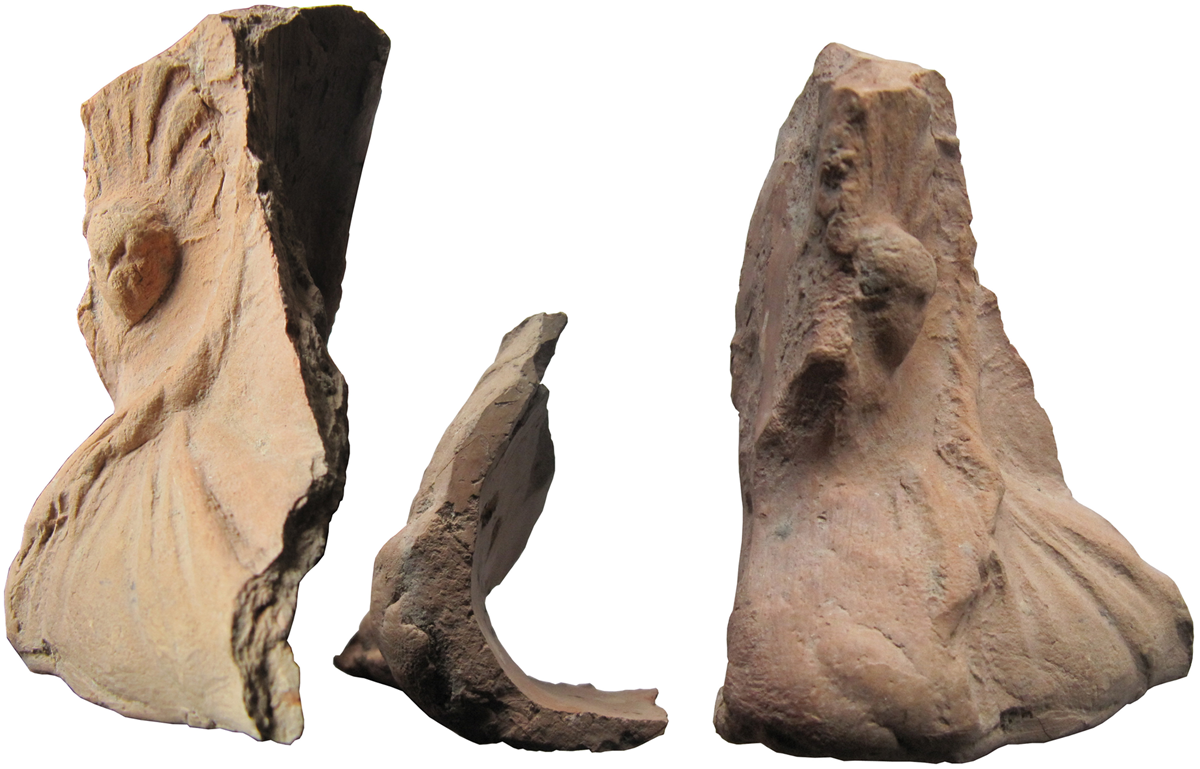
Terracotta representations of Aphrodite of the Hellenistic period depict her as a modest matron, not nude as a goddess of love was supposed to be, and with Erotes mounted upon her shoulders. The series of terracottas published here for the first time take this form. Such bust thymiateria are attested widely across the Greek world; however, those from the Black Sea region have received little attention. In Olbia, the busts have handmade cups added on top of their heads. We identify two distinct types marked out by their ways of depicting the Erotes and the style of levelling the area around the thymiaterion cup. The first type depicted Aphrodite with Erotes sitting on her shoulders; the second type depicted Aphrodite with stylised Erotes’ heads with a background of palmettes (first type: cat. nos 1–8; second type: cat. nos 9–13).
The identification of the thymiateria which are the subject of this article is made on the basis of the depiction of Erotes as well as the emphasis on jewellery, including earrings (cat. nos 2, 3 and 8) and a necklace in the second type of her image (cat. no. 13). Smaller fragments were attributed on the basis of the similarity of details and their size, as well as on traces of production technology which are equivalent across the whole series (see Appendix for the details). Similarities in structure, composition and the analysis of fragments from parts adjoining the back side and the lower and upper edges of the larger pieces also support the view of these terracottas as a single series. Other distinctive features include a distinctive hand (cat. nos 1–7), style of the lower edge (cat. nos 1 and 2), levelling of the surface around the cup's stem (cat. nos 2 and 3) and decoration with holes of the join between the front and back sides (cat. nos 2, 3 and 8). Traces suggest that a single mould was used for cat. nos 11 and 12. The image of a mature lady with emphasis on her children may well make reference to the cult of Aphrodite Ourania. But it is quite plausible that Aphrodite Pontia and Aphrodite Euploia, worshipped in Olbia at a polis level in this period, could be depicted in such a way.
THE THYMIATERIA
First Type
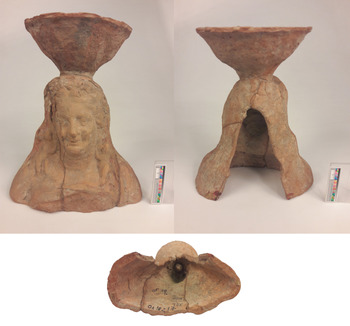
Most of the thymiateria-busts of the first type were found in the sacred areas. There is a single almost intact example from the whole series. It was found during the excavations in 1940 at Area И, which was occupied with dwelling houses (Fig. 2; field inv. no. О-40/455; inv. no. Ол-8217), by T.N. Knipovich (Reference Knipovich1940) and is now exhibited in the State Hermitage, Saint Petersburg. The rest of the terracottas are partially preserved. Most of them come from the excavations at the central temenos headed by E.I. Levi and A.N. Karasev (cat. nos 1–7) and are stored in the Scientific Repository of the Institute of Archaeology of the National Academy of Sciences, Ukraine (IA NASU). An upper part of another one with a hole from the thymiaterion cup (field inv. no. O-36/2936; inv. no. B3-1329) was found by the excavations in 1936 by M.M. Khudiak in the lower part of the city built up with private houses. It is kept in the National Museum of Ukrainian History (NMUH) and is not included into the Catalogue here. A one-sided terracotta with absolutely the same image and size was discovered in a bothros at the western temenos (cat. no. 8) during the excavations in 1974 by A.S. Rusyaeva (Reference Rusyaeva1979, 53, fig. 29:1). It never belonged to a bust thymiaterion, but it is very close to this series and was found in the same context with two thymiateria of the second type (cat. nos 11 and 12). Therefore it is listed in the Catalogue (no. 8).
Bust thymiaterion depicting Aphrodite. Excavations at the area И by T.N. Knipovich. Photo by I.I. Ilina. © The State Hermitage, Saint Petersburg, 2020.

One of busts of the first type was found in a stoa at the central temenos (cat. no. 1). Another was in the deepest bothros at the central temenos (cat. no. 7). The largest number of such were discovered at the area around sacral structures within the area of the central temenos (cat. nos 2, 3, 4, 5 and 6). Consequently, all the thymiateria busts of the first type, except the two deriving from the area of dwelling houses (inv. nos O-40/4550 and O-36/2936), were found at the territory of public sanctuaries.
All examples of the first type appear to have been produced in Olbia, in a single workshop situated perhaps not far from the bothros at the area of central temenos (Levi Reference Levi1985, 83–4). They are similar in their appearance and technology of manufacture (cat. nos 1–7).
Fragments of only two of these images of Aphrodite (cat. nos 2 and 8) have previously been published (Levi Reference Levi1970, 45, table 19:4, no. 28; A.S. Rusyaeva Reference Rusyaeva1979, fig. 29:1). These publications failed to identify them as bust thymiateria (see Shevchenko Reference Shevchenko2015a). Therefore, the interpretation of such terracottas as thymiateria is new to the research of the North Pontic region (Bilde Reference Bilde2007; Shevchenko Reference Shevchenko2015a; Shevchenko Reference Shevchenko, Posokhov and Sorochan2015b) but is well known elsewhere.
Second Type
The second type of bust thymiateria was serially produced in Olbia (cat. nos 9–13; Khudiak Reference Khudiak and Yachmenev1940, 91, no. 9, fig. 69). They were found at areas of cult activity, most of them within bothroi. Two were discovered in the deepest bothros at the central temenos (cat. nos 10 and 13), two at the western temenos (cat. nos 11 and 12) and one in a private house with other cultic objects (cat. no. 9). Busts from the western temenos were recorded in the same context, with the protome (one-sided bust) resembling those of the first type (cat. no. 8). A bust from a private area was found alongside two other bust thymiateria of the first half of the second century bc, crowned with Dionysiac wreaths (see cat. no. 9; Shevchenko Reference Shevchenko2020). They were used probably in a cult performed by members of an oikos.
Examples of the second type exhibit some simplification in terms of their iconography: while in the first type Erotes were depicted at full length with attention to detail (see cat. nos 1, 2 and 6), in the second type they are shown schematically, in the shape of heads with a background of palmettes on the goddess’ shoulders or with their wings shaped as palmettes (see cat. nos 9 and 10). Examples of the second type were produced in approximately the same period: towards the end of the third or during the first half of the second century bc.
The image of Erotes shaped as heads on Aphrodite's shoulders are known in Italian coroplastics (Winter Reference Winter1903, 252, no. 4). On a bust from Palermo, the goddess wears a necklace made of long pendants, similar to the Olbian example О-55/2979 (cat. no. 13). Heads of Erotes were made there in separate moulds and added to the main part of terracotta on the very edges of shoulders. Busts from Olbia, however, depict Erotes sitting on shoulders close to Aphrodite's neck, the way they are presented when at a full length.
The second type of bust thymiateria depicting Aphrodite with Erotes is also known also in Beliaus, a hillfort at the chora of Tauric Chersonesos, where an example is dated to the second half of the second century bc and is made of Chersonesan clay (Dashevskaia Reference Dashevskaia1970, 65, table 2:1). The bust from Beliaus is of a later date than those studied here and is stylistically different, but Aphrodite's clothing is depicted in the way it is on the Olbian bust thymiateria of the second type (cat. nos 10 and 13) with chiton with a triangular upper edge around the neck.
In the first publication of one such of Aphrodite's busts (cat. no. 9), the goddess was incorrectly identified as Demeter, due to the interpretation of her headdress as a kalathos (basket), which was interpreted as a symbol of prosperity and fertility (Khudiak Reference Khudiak and Yachmenev1940, 91, no. 9, fig. 69). Moreover, bust thymiateria found in the area of the western temenos (cat. nos 11 and 12) were previously considered to be depictions of the Mother of the Gods (A.S. Rusyaeva Reference Rusyaeva1979, fig. 53:1,3). This interpretation was based upon the high headdress which resembled the polos (a cylindrical crown) of the Mother of the Gods (Shevchenko Reference Shevchenko2015a, cat. nos 16 and 17). However, the similarity of these examples to cat. no. 9 is striking: they may even have been produced by the same mould. A low polos of a similar shape is known also in images of Aphrodite with Erotes on her shoulders on protomai from the Greek settlement at Albesti near Callatis, also dated to the third century bc (Buzoianu and Bărbulescu Reference Buzoianu and Bărbulescu2008, 224, pl. LXXXV, R21) and on a bust from Locris discussed below (Higgins Reference Higgins1954, no. 1228). Aphrodite wearing such a headdress covered atop with a veil was depicted on Panticapaean coins (Braund Reference Braund2018, figs 16 and 17).
ORIGIN AND ANALOGIES
These thymiateria-busts have sometimes been associated with the cult of Demeter (Khudiak Reference Khudiak and Yachmenev1940, 89–90), Hera (Cantone Reference Cantone2015, 95 with references) or the Mother of the Gods (e.g. cat. nos 11 and 12). As already noted, some are still incorrectly associated with Demeter on the grounds of the supposition that the cup upon her head is a headdress in the shape of a kalathos (for discussion, see Shevchenko Reference Shevchenko2015a). Nevertheless, there is no reason at all to interpret in this way images of a female with winged infants which undoubtedly indicate her attribution as Aphrodite. The image of Erotes on Aphrodite's shoulders has an extensive history that it is necessary to consider in assessing the wider context of the Olbian examples.
The depiction of Aphrodite with Erotes on her shoulders may derive from representations where she holds her twin children in her arms, an image known in black-figure vase painting (Carpenter Reference Carpenter1986, 125). Eros and Anteros, Aphrodite's sons, were often depicted in pairs as gods of love and requited love. The image of the latter differed in his wings’ shape: not a bird's wings as Eros has, but those of a butterfly. On the other hand, images of Eros and Himeros, love and desire, did not usually differ from each other. Therefore, they are designated simply as Erotes in discussion of them. Sometimes, Aphrodite appeared with just a single Eros on her shoulder (Pfrommer Reference Pfrommer2001, 2–3, fig. 3). An early protome from Olynthos, dated to the early fifth century bc (Robinson Reference Robinson1952, 85, no. 21, pls 15, 16), depicts Aphrodite with Erotes as small figurines on her arms; this is how they appear in Olbian terracottas. Protomai depicting Aphrodite with Erotes on her shoulders became popular in the wider Pontic region. In Olbia, apart from the bust thymiateria published here, several such fragments were found in the context of the bothros at the central temenos. Depictions of Aphrodite with Erotes on her shoulders are also known from vessels bearing reliefs (Canarache Reference Canarache1969, nos 11 and 52), and from metalwork (Alekseeva Reference Alekseeva2014) of the Hellenistic period. Indeed, the second type of thymiateria discussed here may have its origins in representations in metalwork of Erotes looking out over Aphrodite's shoulders while flying behind her (Alekseeva Reference Alekseeva2014, figs 5 and 6).
Separate bust thymiateria had appeared by the end of the fifth century bc in Halicarnassus (Higgins Reference Higgins1954, 128, no. 444, pl. 62; Romano Reference Romano1995, 17–18). Thymiateria with images of Aphrodite with Erotes on her shoulders are known also from the south of Italy (Schmidt Reference Schmidt1994, 238, no. 437, pl. 80abc). Having reached Tarentum, they influenced the iconography of Alexandria and the eastern Greek world in the period from the fourth to the second century bc (Bedello Tata Reference Bedello Tata1990, 4, 39). Over the course of several centuries and under the influence of local coroplastic schools, bust thymiateria developed peculiarities. Olbian examples evidence this supposition (see especially cat. nos 1–7; Shevchenko Reference Shevchenko2015a; Reference Shevchenko2018). The comparandum that resembles most closely the Olbian busts is the thymiaterion found in Italy (Schmidt Reference Schmidt1994, 238, no. 437). Its thymiaterion cup is mould-made, unlike those of the Olbian examples, and is not well centred on the head; the edges of the cup are flattened, even folded. Aphrodite's arms hang down along her body and are represented as low as her elbows. Small Erotes placed on her shoulders stretch out their arms to her face. This bust is also close to the Olbian ones in terms of its size (cat. no. 2). Moreover, her clothes are arranged similarly to those Olbian bust thymiateria, which lack attributes except jewellery made of separate pieces of clay (Shevchenko Reference Shevchenko2018). Similar also is the sleeveless V-shape chiton which encircles the neck and is tied up beneath the breasts, a style often used in large-scale sculpture showing quite relaxed images (Thompson Reference Thompson1963, 23, 80).
Italian Hellenistic coroplastics appear to influence the depiction of Aphrodite in the thymiateria: a round pendant relief of the first half of the fourth century bc depicts Aphrodite with Erotes standing on her shoulders (Eberhard Reference Eberhard1959, cat. no. 9); similar also is a bust with an Eros preserved sitting on the goddess’ shoulder (Winter Reference Winter1903, 253, no. 3). On both examples, Erotes appear as slim youths with their wings raised. Aphrodite wears earrings consisting of a round upper part and a pointed pendant, which closely resemble those on the Olbian thymiateria (cat. nos 4, 7 and 10–12). She wears the sleeveless chiton, and her hair is tied on the top of her head in a way that resembles the three projections around the hole on the head of a large semi-figure from Olbia (A.S. Rusyaeva Reference Rusyaeva1979, fig. 32; Shevchenko Reference Shevchenko2018, figs 7–9). Another terracotta Aphrodite with Erotes has the same hairstyle and chiton similarly arranged on her shoulders (cat. nos 10 and 13). She is presented in the background of her himation (Leyenaar-Plaisier Reference Leyenaar-Plaisier1979, 411, pl. 147, no. 1141). These traits may be the consequence of the dissemination of a style across the Greek world but also reflect traditions concerning Aphrodite that circulated in myth and beliefs about her.
An Italian terracotta depiction of Aphrodite with Erotes in the Greece and Rome Department of the British Museum (Higgins Reference Higgins1954, no. 1228) seems to be something in between a protome and a half-figure. This terracotta has a back side separately made, but very closely added to the facial side, so the figurine is flat and could hardly be placed on a horizontal surface. The face side is in low relief and the flat back is joined together, leaving just a narrow space inside. The bust is dated to 420 bc and is said to be from Locri. The left leg of each of the Erotes is standing on the shoulder of Aphrodite, while the right one is hanging. Their heads are turned towards the goddess. Their wings and facial features are invisible. Their heads look like globular projections, which could be the deliberate result of the moulding: their faces could hardly have been eroded during the terracotta's usage, as the image of the Aphrodite is untouched and looks carefully worked out. There is also a possibility that the details of their faces were highlighted with paint.
This kind of schematism of the Erotes’ depiction contrasted with Aphrodite's image points to a parallel with the Olbian bust thymiateria with stylised Erotes with palmettes on her shoulders (cat. nos 9–13). Their faces do not reveal any features, but other details of the image are clearly seen (cat. nos 9 and 10). Moreover, the presentation of Aphrodite on the Italian terracotta in a flat and wide polos resembles the headdress of the Olbian examples (cat. nos 9, 11 and 12).
LOCAL ASPECTS OF THE IMAGE
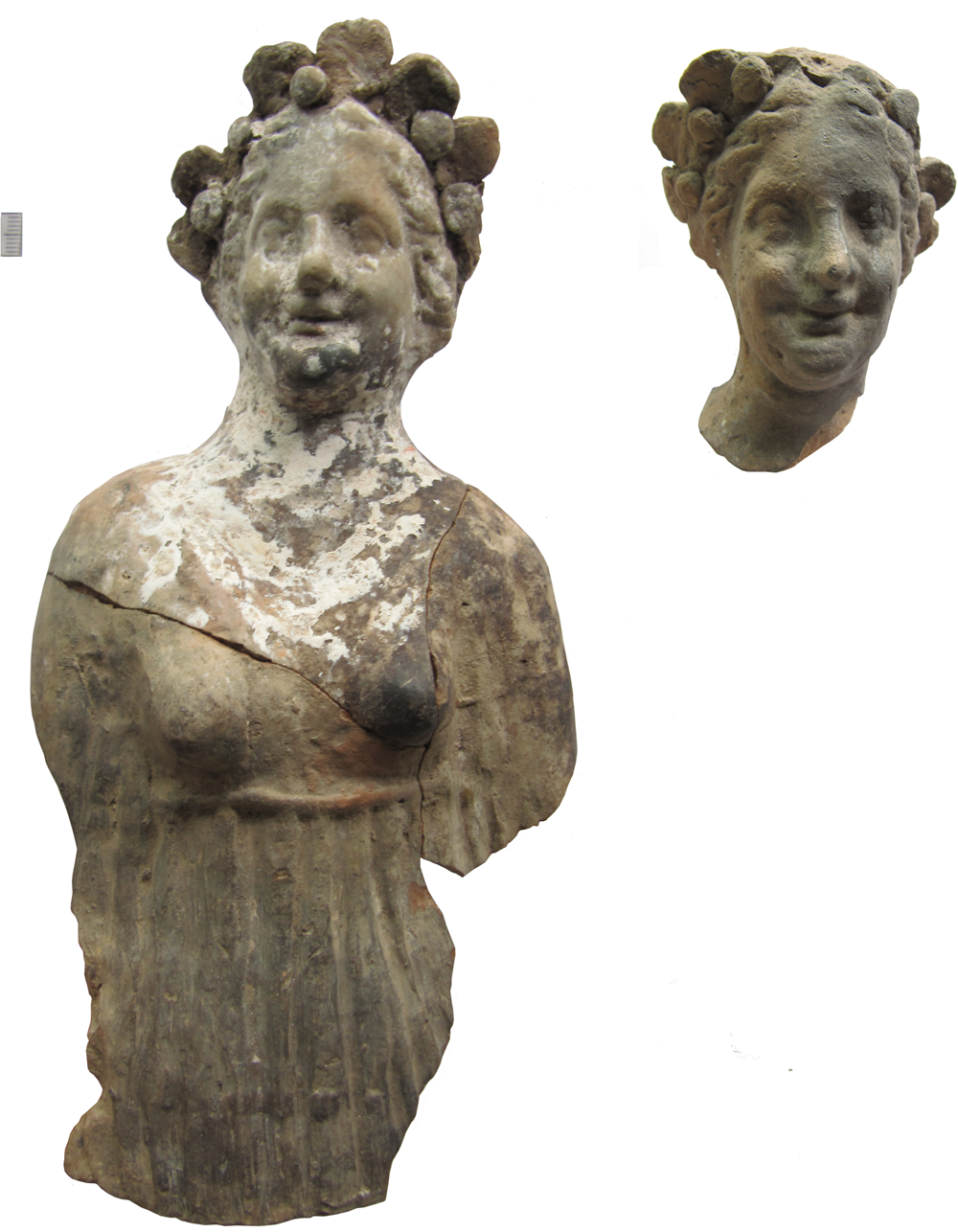
In terms of the representation of the face of Aphrodite, the Olbian image of the first variant is unique (see cat. nos 2, 3, 4, 5 and 8). It finds parallels only within Olbia in the shape of two half-figures produced in a single mould and found near the agora (Fig. 3; Shevchenko Reference Shevchenko2016a, 44–5, figs 1 and 2, with references). The handmade ivy wreaths which they wear appear to make reference to Dionysus’ cult. The pomposity and maturity of this woman's face, including round cheeks, heavy chin and thick neck, led to a previous identification of the wreathed figures as Demeter (A.S. Rusyaeva Reference Rusyaeva1979, 51). However, it is now recognised that appearance and emotions do not necessarily make reference to a particular cult: Aphrodite, shown young and tender by one artist, looks almost stout in works of another, for instance in the series of busts currently discussed (best preserved on cat. nos 2 and 8).
Semi-figures with handmade wreaths from the area near the agora. Excavations by L.M. Slavin. IA NASU.

Aphrodite on bust thymiateria appears as a smiling full-faced woman, with heavy eyelids, round protruding cheeks and chin, thick neck, slightly open mouth and a more expressed upper lip (clearly seen on Fig. 2, for instance). The emotionally expressive faces depicted upon the series of terracottas discussed here are not known anywhere else. They may have been based on a life-size portrait statue of Aphrodite.
The bust thymiateria of Aphrodite discussed here are contemporary with half-figures found in a dwelling area near the agora by the excavations headed by L.M. Slavin (Fig. 3). The resemblance of their faces suggests the hand of a single coroplast or his workshop. These half-figures were made in a mould and adorned with handmade details including leaves and globular fruits to create a wreath traditional for the cult of Dionysus. Such details helped to produce the depiction of participants in the thiasos of Dionysus. Moreover, females with Dionysiac wreaths and corymbs were also shown in Olbia in a shape of bust thymiateria. At least ten serially produced terracottas of this type were found in different parts of Olbia (Shevchenko Reference Shevchenko2020).
FUNCTIONS
Both types of Aphrodite's busts studied here were crowned with thymiateria cups. Most of them are broken away now. Only their stems are preserved on some of the terracottas (cat. no. 12). Otherwise, we can just find a hole from these functional parts (cat. nos 2, 3, 9 and 11). There are more than 30 cups and their fragments from bust thymiateria found in the bothros at the central temenos. They are similar to the one wholly preserved on a find from a private house (Fig. 2). These cups could have belonged to other types of thymiateria found in this context, not necessarily those depicting Aphrodite; accordingly they are not published here. The fragments published here bear holes which would have supported the thymiateria cups (cat. nos 2, 3, 11 and 12). All of them were made if not by a single coroplast, then by a single workshop at the same period of time. The cup on bust thymiateria from Italy was usually mould-made and took the shape of a flower. This was the reason to designate such terracottas as ‘flower women’ (Cantone Reference Cantone2015). However, Olbian cups, with a single exception (the earliest bust: Khudiak Reference Khudiak and Yachmenev1940, 89, no. 6, fig. 66; Shevchenko Reference Shevchenko2020, 51, fig. 3), are simple and handmade. They lack depictions or reliefs in the shape of petals.
Among the thymiateria cups detached from their busts and found in the bothroi at Olbia, only several contained traces of burning. Italian scholars have concluded that such terracottas were used for burning incense, but this is not applicable to all examples (Cantone Reference Cantone2015, 108). While the traces of soot are recorded most often on busts from Paestum, none of such items from Capua were used for burning (Bedello Tata Reference Bedello Tata1990, 38). Bust thymiateria could have been used, not for burning incense, but for its diffusing: accordingly, the essential oil could be poured into the open cup of the thymiaterion for long-term diffusion (see further Shevchenko Reference Shevchenko, Posokhov and Sorochan2015b). The interpretation of such terracottas as ritual devices used in various contexts (sanctuary, house, burial) with various meanings (cults of different gods) (Cantone Reference Cantone2015, 108–9) is valid for the Pontic region and the wider Greek world. These functions distinguish them from most terracottas, whose cultic function is usually demonstrated by other finds from their context.
CONCLUSION
The series of bust thymiateria published here can be interpreted as images of Aphrodite, rather than Demeter or the Mother of the Gods, and were perhaps relevant to the worship of Aphrodite Ourania. Found in the area of public sanctuaries, such terracottas indicate the worship of Aphrodite not only at the southern temenos where her sanctuary functioned, but also at the central and western temene. It is possible that such terracottas, however, were made as offerings in the sanctuaries of the other gods. Some of these votives may never have been taken out of the temenos or ever used. Five of them had fallen into the bothroi within the borders of the sacred precincts. One of these bothroi was situated not far from the coroplast's workshop (cat. nos 7, 10 and 13). Perhaps they were disposed of after the coroplast failed to sell them (if they were broken or had become obsolete). Indeed, the bothros served as a place for burying remains from the sacred area, so these bust thymiateria had evidently lost their value before being placed in this archaeological context.
It should be noted that, in this bothros, thymiateria representing Aphrodite were found together with other thymiateria depicting a goddess without identifying attributes but with long hair and stephane (crown). The question arises whether the images of the not-identified figures were simplified images of Aphrodite: depictions on bust thymiateria in Olbia appear to have become simpler and more schematic and less reminiscent of Italian patterns as time went on (Shevchenko Reference Shevchenko2015a). However, the simplification never affected the general appearance of thymiateria: they still preserved the shape of busts, and never resembled heads alone, as was the case in Italy (for example: Bedello Tata Reference Bedello Tata1990, table IV,3).
Peculiar for Olbia was the usage of bothroi in the cult of Aphrodite. Finds of her images in a bothros are recorded in all the temene: the central, the western and the southern ones. Each bothros was filled up with relics from cultic practices and old votives, as they were not allowed to be taken away from the sacral precincts. In addition, these structures were further used as primitive altars for making offerings and libations. Some of the bothroi discussed were arranged in disused cisterns; some of them contained images of other popular gods of the Hellenistic period.
The numerous terracotta images with Erotes on her shoulders may correspond perhaps not to an erotic deity but to a mother-goddess who was associated with childbirth. Such bust thymiateria show another peculiarity of her worship in this period, the diffusion of incense in cult activity. The bust thymiateria studied here demonstrate that cultural and religious activity pertaining to Aphrodite at Olbia had much in common with that in the wider Greek world.
ACKNOWLEDGEMENTS
I am thankful to Peter Liddel, David Braund and the two anonymous reviewers, whose comments on my paper were very useful. I am grateful also to Peter Higgs of the Greece and Rome Department of the British Museum and to Olha Puklina, the deputy chief curator of the National Museum of Ukrainian History, for their support in my work on terracottas in the Museums’ collections. Many thanks to Ioulia Ilina, the curator of the Olbian collection in the State Hermitage, St Petersburg, for the picture of a terracotta (Fig. 2) she kindly shared with me and to the administration of the State Hermitage for the permission to include it in this publication.
APPENDIX: CATALOGUE
First type
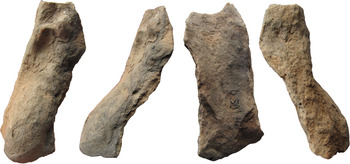
1. Fragment of a bust thymiaterion of Aphrodite (inv. no. О-59/4341). Fig. 4. Excavated by E.I. Levi and A.N. Karasev in Reference Levi and Karasev1959. Most likely this was the fragment mentioned in the Report (Levi and Karasev Reference Levi and Karasev1959, 50) where it was interpreted as analogous to the bust thymiateria depicting Dionysiac figures exhibited in the Archaeological Museum of the IA NASU and in the National Historic and Archaeological Preserve ‘Olbia’ (Shevchenko Reference Shevchenko2020, fig. 1). Height 6.5 cm, width 4.5 cm, depth 3.5 cm. The clay is exfoliated, brown, burnt to grey on exterior surface, with admixtures of mica and quartz. There are small traces of white slip and red paint. The left side of the bust is preserved. It consists of the right shoulder of the goddess and an Eros sitting on it. The upper layer of clay is destroyed on most of the exterior surface. The terracotta was made in a mould and is hollow. Its back is almost flat. The line where the back was stuck to the facial side is protruding. The lower edge is rounded on a small preserved area. There is a baby Eros sitting on Aphrodite's right shoulder with his rounded wings folded. He is half-turned to the goddess’ face. He extends his arm and his body towards her. His muscles and gracefully raised head are visible despite the damage to the upper layer of clay.
No. 1. Fragment of a bust thymiaterion of Aphrodite (inv. no. О-59/4341). Excavations of E.I. Levi and A.N. Karasev at the area E2, a big stoa. Scientific Repository of the IA NASU.

2. Fragment of a bust thymiaterion of Aphrodite (inv. no. О-55/1958). Fig. 5. Excavated by E.I. Levi and A.N. Karasev at the area to the east of the Apollo temple at the central temenos (Levi Reference Levi1970, 45). Height 10.8 cm, width 8.5 cm, depth 5.2 cm. The clay is light brown, with small particles of mica. The surface is covered with lime deposit. The upper part of a head with a hole from the thymiaterion cup, a left part of a face and a shoulder with Eros’ figurine are extant. The upper layer of clay is damaged in the area of the face. The hollow terracotta was made in a mould. The back is not worked in detail; the contour of the head and shoulders are not represented. The back part of the terracotta is divided from the facial side by the edges of himation, which covers the head and hangs down along the shoulders. Its upper border is on the level of the head's crown and takes the form of a wide stripe (2.7 cm wide). On the facial side, there are depressions (made with a narrow, rounded instrument) along the upper border of the depiction made on the uncooked clay after the terracotta was taken out of the mould. They form the decoration of a wreath on the goddess’ head. At the centre of the head there is an opening with diameter 1.5 cm: this was used for attaching the thymiaterion cup.
No. 2. Fragment of a bust thymiaterion of Aphrodite (inv. no. О-55/1958). Excavations of E.I. Levi and A.N. Karasev at the central temenos. Scientific Repository of the IA NASU.

A smiling goddess with small Eros on her shoulder is depicted. Several strands of hair lie across her temples. The hair frames the face, which is represented in high relief. Cheeks are especially protruding and emphasised with deep hollows near corners of the lips. Eyes are schematically depicted, probably owing to the nature of the mould. Eyelids are thick and almost closed. A late date is suggested by the upper lip projecting over the lower one. The overall depiction is highly picturesque: the head of Aphrodite is slightly inclined to her right shoulder, on which baby Eros is sitting. He extends his right arm across his whole body to the goddess’ earring hanging near his left shoulder. The earrings consist of a spherical base and a conic pendant. This shape was quite common for Olbian terracotta semi-figures of the third century bc (Shevchenko Reference Shevchenko2016a, figs 3 and 4). The figure of Eros is identified through its general features: plump arms and legs, rounded wings raised over his shoulders and his head turned to the goddess. On the basis of stylistic features, the terracotta should be dated to the end of the third century or the first half of the second century bc. First published by Levi (Reference Levi1970, 45, table 19:4, no. 28).
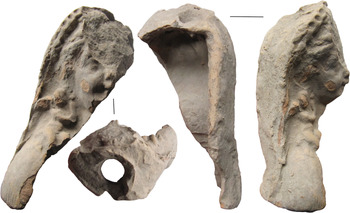
3. Head from bust thymiaterion of Aphrodite (inv. no. О-55/2155). Fig. 6. Excavated by E.I. Levi and A.N. Karasev in 1955 at the central temenos in pit 65, together with an archaic terracotta fragment and amphorae sherds (Levi and Karasev Reference Levi and Karasev1955). Height 6.8 сm, width 5.0 сm, depth 5.2 сm. Clay is exfoliated, dark orange, with admixtures of quartz and insignificant amount of mica. Preserved is a face and a left part of a head with an opening for the thymiaterion in the head crown. The hollow terracotta was made in a mould. The back is not worked in detail. A line of shallow depressions was made with a thin rounded instrument along the joint of back and facial sides, apparently before the clay was cooked. This line forms a depiction of a thin wreath on the goddess’ head. The surface of the facial side is damaged on the upper part of the depiction, so the relief of the wreath and hair is seen only on the temples. The hair framed a high round forehead. The eyes are placed quite close to each other; the cheeks and lips are pronounced. On the basis of stylistic features, the terracotta should be dated to the end of the third century or the first half of the second century bc.
No. 3. Head from bust thymiaterion of Aphrodite (inv. no. О-55/2155). Excavations of E.I. Levi and A.N. Karasev at the eastern temenos. Scientific Repository of the IA NASU.

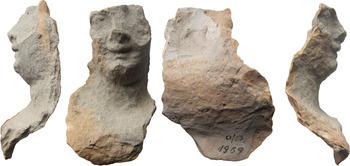
4. Front part of a bust of Aphrodite (inv. no. О-55/1959). Fig. 7. Excavated by E.I. Levi and A.N. Karasev at the central temenos in 1955. Context is the same as in cat. no. 2. Height 6.8 сm, width 4.5 сm, depth 3.5 сm. Clay is friable, exfoliated, containing very small particles of mica and limestone. The surface is covered with lime deposit. The fragment is broken on three sides; the preserved length of the lower border is 1.2 cm, though its thickness is not fully preserved. The depiction of the face (especially the lower part of its left side), neck and breast is extant. The upper left part of the face is missing. The upper layer of clay on the facial side is lost, owing to the exfoliated fabric, especially in the lower part of the bust. This caused the blurring of features, comparing to analogous terracottas inv. nos О-55/2155 and О-55/1958. The hollow terracotta was made in a mould.
No. 4. Front part of a bust of Aphrodite (inv. no. О-55/1959). Excavations of E.I. Levi and A.N. Karasev at the central temenos. Scientific Repository of the IA NASU.

A smiling lady with her head slightly inclined to her right shoulder is depicted. The preserved part of the face shows the full cheeks. The features present an image of a mature woman. The eyes bulge, the lips are quite close to the nose, the upper lip protrudes over the lower one. The upper border of garment is almost horizontal around the neck. The folds over the breast emphasise the femininity of Aphrodite's image. The lower part of the bust projects, forming a wide base for the terracotta. This was necessary for the sake of stability, as the back side was insignificantly rounded in plan and almost vertical in profile. The protruding face (where the clay was thicker) and the thymiaterion cup on the head's crown required additional support in the shape of a precipitous curve at the bottom of the bust. On the basis of stylistic features, the terracotta should be dated no earlier than the end of the third century bc.
5. Fragment of Aphrodite's face (inv. no. О-60/3373). Fig. 8. Excavated by E.I. Levi and A.N. Karasev in 1960 at the central temenos. Not mentioned in the Report; no documentation is available on the context of its discovery. Height 5.4 сm, width 2.6 сm, depth of relief 3.0 сm. Clay is light brown. Surface is covered with lime deposit. There are traces of white slip. Fragment is broken all around, a right half of the face and the neck of the goddess are extant with an arm of a little Eros sitting on her shoulder. Brows and chin are broken away. The hollow terracotta was made in a mould.
No. 5. Fragment of Aphrodite's face (inv. no. О-60/3373). Excavations of E.I. Levi and A.N. Karasev at the central temenos. Scientific Repository of the IA NASU.

A smiling goddess with quite sharp features, a large face and a heavy neck. The cheeks are prominently expressed, and lips are protruding, especially the upper one. The chin is also significant. The nose follows a straight line. The eyes are partially preserved. This is peculiar for an image of Aphrodite on analogous bust thymiateria from the temenos. End of the third century bc.
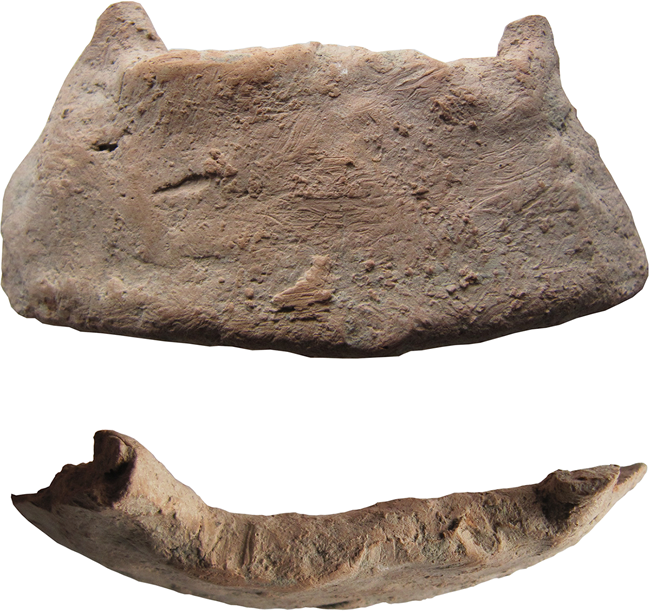
6. Lower part of Aphrodite bust with Eros on her shoulder (inv. no. О-55/2044). Fig. 9. Excavated by E.I. Levi and A.N. Karasev at the central temenos in 1955. Found alongside other terracotta fragments, including a fragment of thymiaterion cup with inv. no. 2048 (Levi and Karasev Reference Levi and Karasev1955). Height 3.7 сm, width 4.7 сm, depth of relief 2.5 сm. Clay is dense, of dark pink colour. Surface is covered with lime deposit. There are traces of white slip. The lower right side of terracotta is preserved. It contains the depiction of the left part of the goddess’ breast and Eros’ legs near her left shoulder. The hollow terracotta was made in a mould. The lower edge was levelled by a cutting instrument.
No. 6. Lower part of Aphrodite bust with Eros on her shoulder (inv. no. О-55/2044). Excavations of E.I. Levi and A.N. Karasev at the central temenos. Scientific Repository of the IA NASU.

The goddess is represented wearing a himation entwined around her breast. Its upper border, gathered into a fold, flows from the right shoulder towards the left elbow. This fold is somewhat straightened over the breast and entwined in several places. A small figure of Eros stands on the fold of the garment. He is depicted sideways, with his left foot taking a step before the right one. The baby is plump, and the protruding belly and hip add to his comeliness. This detail is similar to the wholly preserved bust (Fig. 2) inv. no. О-40/455 found at the Area И (Knipovich Reference Knipovich1940).
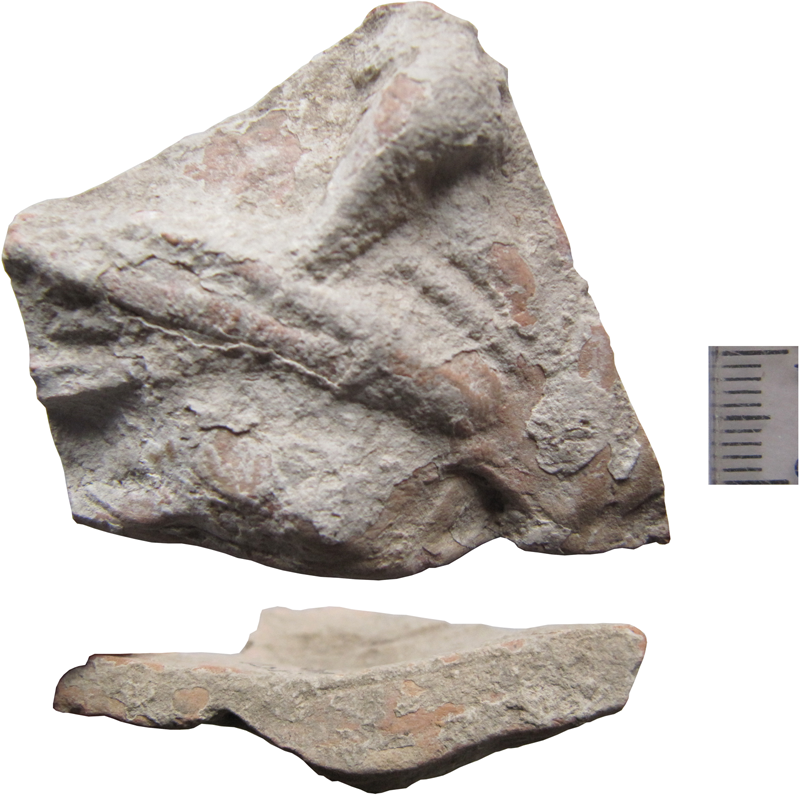
7. The lower edge of the back of a bust (inv. no. О-55/2989). Fig. 10. Excavated by E.I. Levi and A.N. Karasev in Reference Levi and Karasev1955 in the bothros at the central temenos. Found in the context of the bothros among more than 2000 fragments of terracottas, of which at least 10 were bust thymiateria. The bothros also contained clay loom-weights, discs, breads, beads, a figured handle from a bronze mirror, a marble slab with a dedication to Apollo Delphinion, a bull's skull with perforations, etc. (Levi Reference Levi1959). Height 3.8 сm, length 8.2 сm, thickness 0.8 сm. Clay is light brown, with admixtures of quartz and insignificant amount of mica. The fragment forms a central lower part of the bust's back; its sides are broken off. This detail is handmade, levelled with rolling and smoothing with fingers at the inner side. The lower border is not quite flat; it was not levelled by an instrument. The detail is slightly bowed to follow the rounded shape of the busts’ back. The upper part of the fragment was also not cut but pressed with an instrument. The detail that is preserved forms the lower border of the technical hole (width 4.3 cm) of the terracotta. Its partial preservation makes identification of this fragment as a bust thymiaterion hypothetical, as this part is not preserved on a whole bust (Fig. 2). Nevertheless, taking into account the structure of the preserved busts and the similarity of the construction of their back, consisting of vertical side walls and horizontal lower wall, the thickness, the bowed base, the technique of production, the size, etc., such a hypothesis appears to be reliable. Third or second century bc.
No. 7. lower edge of the back of a bust (inv. no. О-55/2989). Excavations of E.I. Levi and A.N. Karasev at the bothros of the central temenos. Scientific Repository of the IA NASU.

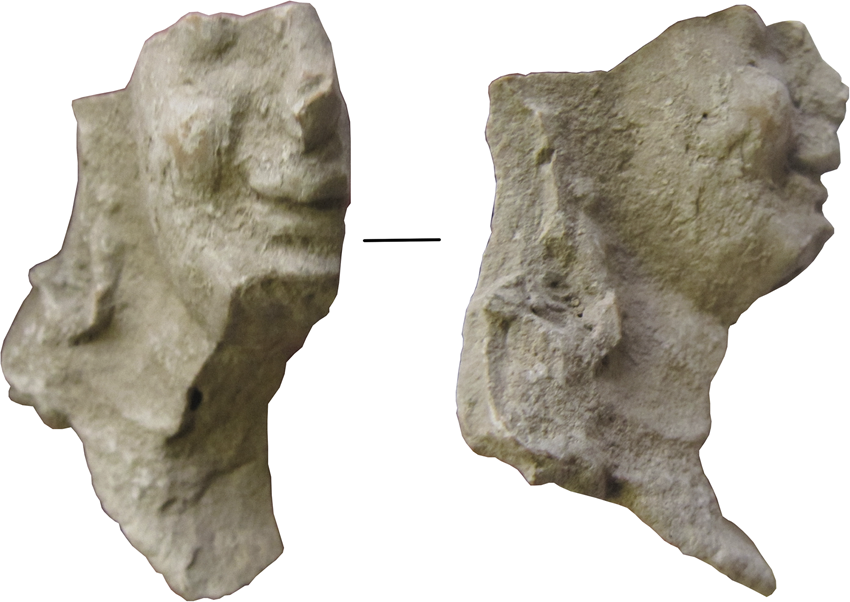
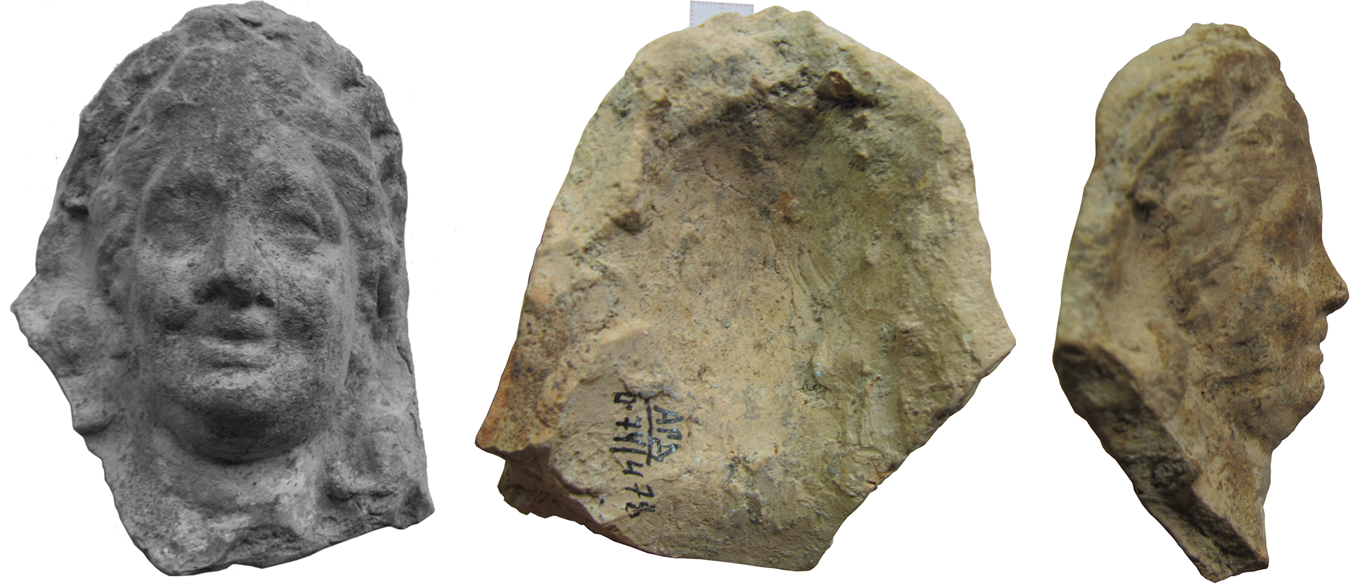
8. The upper part of protome of Aphrodite with Erotes (inv. no. О-74/АГД/478). Fig. 11. Excavated by A.S. Rusyaeva at the western temenos in 1974. Found in a cistern, at a depth of 4.70–5.0 m, together with fragments of black-glazed jars, mould-made cups, casting moulds and terracottas including inv. nos 476 and 477 (fragments of thymiateria depicting Aphrodite with Erotes’ heads and palmettes; cat. nos 11 and 12), nos 479 and 482 (fragments of terracottas depicting the Mother of the Gods) and over 20 fragments of other terracottas (nos 480, 481 and 483). Height 8.5 сm, width 7.0 сm, depth of relief 4.3 сm. Clay is beige, dark orange inside. The surface is covered by a deposit. There are traces of white slip and white paint at the area of the neck. Fragment contains the upper part of protome depicting the head of the goddess and partly preserved figurines of Erotes. Made in a one-side mould; the back is concave.
No. 8. Upper part of protome of Aphrodite with Erotes (inv. no. О-74/АГД/478). Excavations by A.S. Rusyaeva at the western temenos. Scientific Repository of the IA NASU.

A smiling lady with her head slightly inclined to the right shoulder is depicted. As on the bust thymiateria, her headdress is emphasised by the (relatively small) pits pressed into the raw clay. The Eros on the right shoulder is reaching with his hand to the pointed end of the conic pendant on the earring. A head and an arm are preserved from each of the Erotes. First published as an image of Demeter: A.S. Rusyaeva Reference Rusyaeva1979, 53, fig. 29:1; M.V. Rusyaeva Reference Rusyaeva2006, 155, fig. 160:1.
Second type
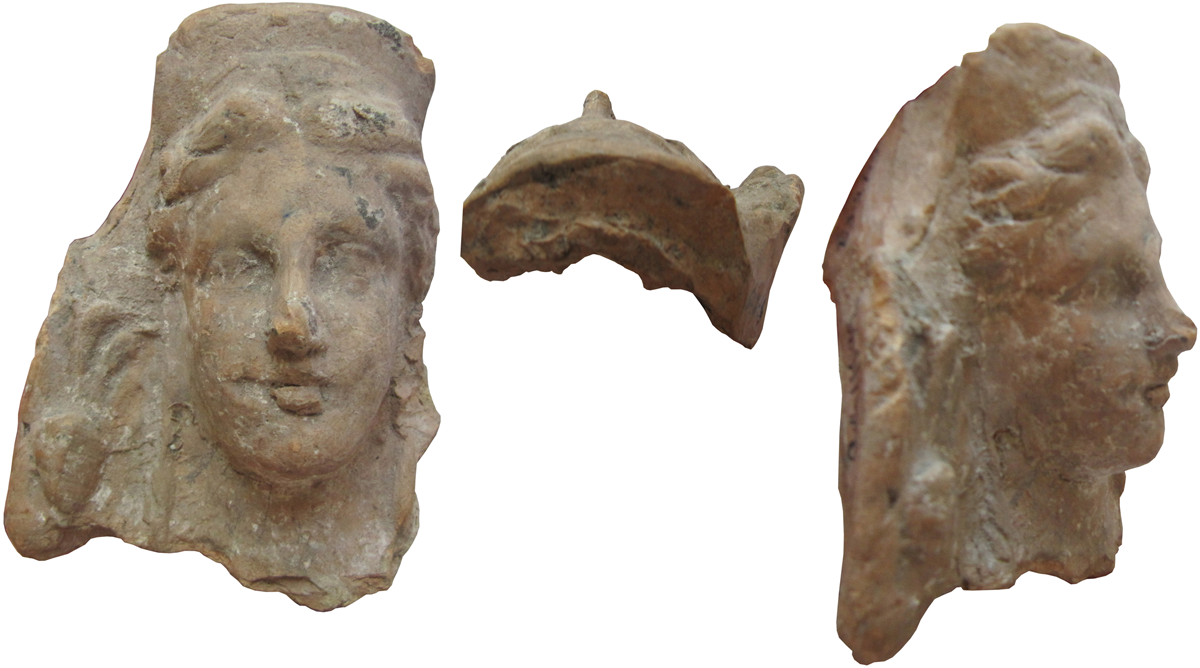
9. A bust thymiaterion of Aphrodite with heads of Erotes and palmettes as their background on her shoulders (field inv. no. О-36/1970, inv. no. Б3-2719). NMHU. Fig. 12. Excavated by M.M. Khudiak in an expedition led by L.M. Slavin in 1936. Found at the area И, in a big northern house, where two other bust thymiateria with other female images were also found (Khudiak Reference Khudiak and Yachmenev1940, 89–92, nos 7 and 11; Shevchenko Reference Shevchenko2020). Height 10.7 сm, width 6.7 сm, depth of relief 5.0 сm. Clay is exfoliated, its colour varies from light brown to dark orange. Preserved in two fragments. Its top is broken off. The hollow terracotta was made in a mould. Before the clay was cooked, the object was worked with an instrument: the lower lip was added with a small piece of clay and smoothed.
No. 9. Bust thymiaterion of Aphrodite with heads of Erotes and palmettes on her shoulders (field inv. no. О-36/1970, inv. no. Б3-2719). Excavations by M.M. Khudiak at the area И. The National Museum of Ukrainian History.

A goddess is depicted with a high stephane band with a ribbon. She wears earrings consisting of a rounded top and a thin conic pendant 1.6 cm long. Her face is long, her eyes are somewhat swollen and her mouth is placed quite close to her nose. Apparently, the upper part of the stephane was levelled with the head, in the same fashion as the second-century bust thymiateria depicting a goddess with long hair. Aphrodite's hair, similarly to these busts, is arranged in double strands over her temples and in entwined strands down her shoulders. Part of the opening for the thymiaterion cup on the top of the head is preserved. There is a depiction of a small head over the goddess’ shoulder on a background of a palmette. The petals of the palmette resemble Eros’ wings raised over his head. Situated on both shoulders, the Erotes take a position typical to the images of Aphrodite. First published as Demeter's image: Khudiak Reference Khudiak and Yachmenev1940, 91, no. 9, fig. 69.
10. Fragment of Aphrodite's bust with Eros’ head and a palmette (inv. no. О-55/3103). Fig. 13. Excavated by E.I. Levi and A.N. Karasev in 1955 in the bothros at the central temenos. The context is the same as that of cat. no. 7. Height 8.3 сm, width 4.0 сm, depth of relief 5.6 сm. Clay is dark pink, with small particles of mashed shells in the fabric. A right part of the bust with shoulder, neck and bust of a female is preserved. The terracotta was made in a mould, the back was handmade; it is hollow. A technical opening occupied the most part of the back. Before firing, the clay was smoothed inside with a sharp instrument, with circular motions in the lower part and vertically in the area joining the face and the back. The edges of technical opening were smoothed with fingers. The back is slightly convex in plan and almost vertical in contour. The facial side was widest at the area of the breast which was the most protruding in the central part.
No. 10. Fragment of Aphrodite's bust with Eros’ head and a palmette (inv. no. О-55/3103). Excavations of E.I. Levi and A.N. Karasev at the bothros of the central temenos. Scientific Repository of the IA NASU.

A goddess is depicted wearing a chiton with triangular opening around her neck. The folds shape a protrusion in the central part. They are shown clearly in relief. The himation is put over the shoulders. An entwined strand of long hair goes down the shoulders. The most interesting detail is the depiction of Eros over the goddess’ shoulder. His eyes and mouth are shown by the barely visible hollows. His head is depicted with a six-petalled palmette in its background.
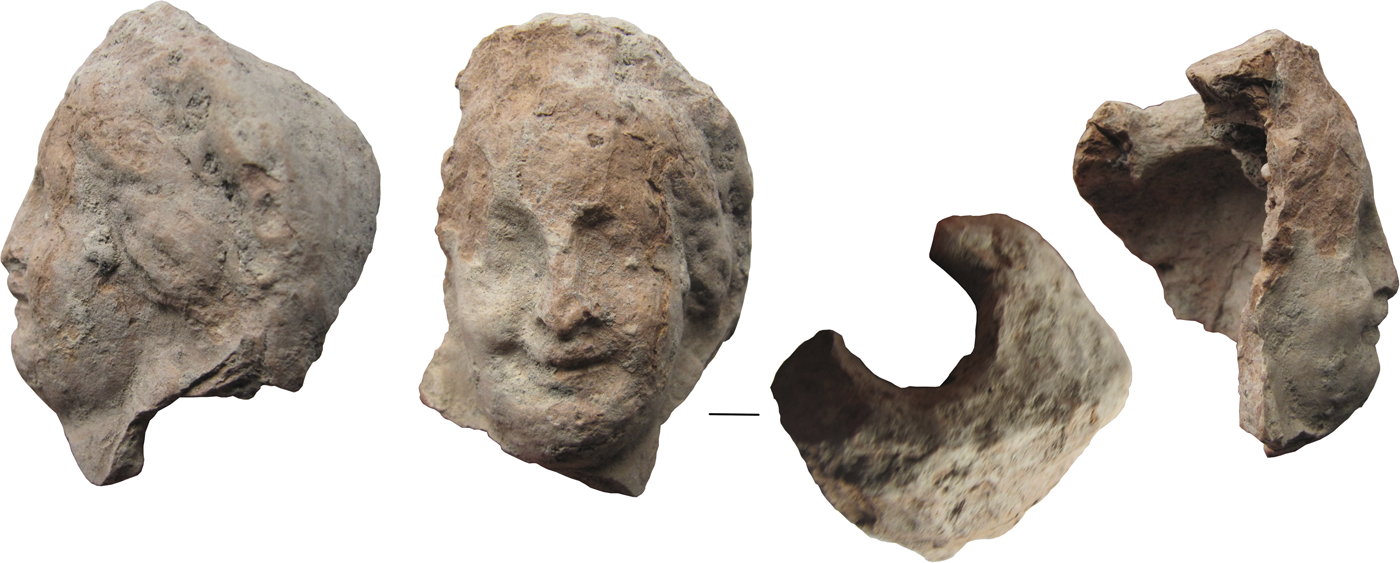
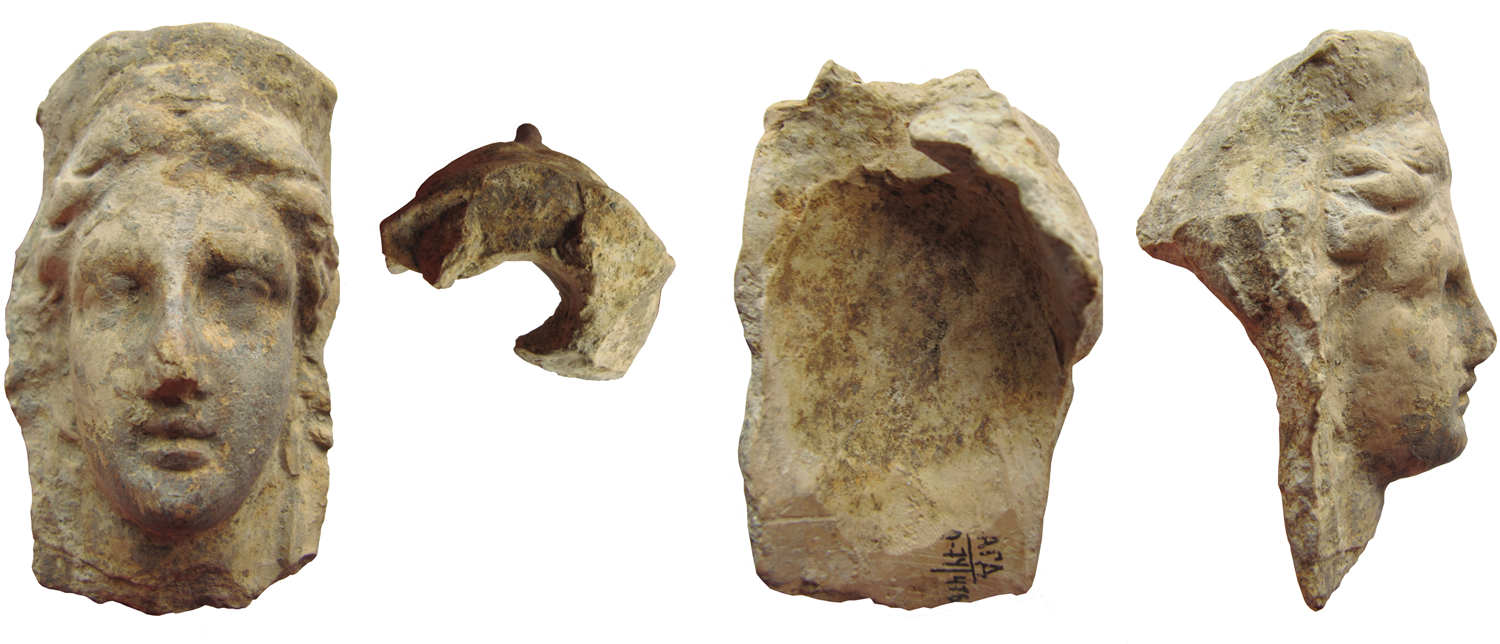
11. Face from a bust thymiaterion (inv. no. О-74/АГД/476). Fig. 14. Excavated by A.S. Rusyaeva at the western temenos in 1974. Found in a cistern, at a depth 4.7–5.0 m, together with fragments of black-glazed jars, mould-made cups, casting moulds and terracottas inv. nos 477 and 478 (fragments of a similar thymiaterion depicting Aphrodite with Erotes’ heads and palmettes, cat. no. 12, and a protome of Aphrodite, cat. no. 8), nos 479 and 482 (fragments of terracottas depicting the Mother of the Gods) and over 20 fragments of other terracottas (nos 480, 481 and 483). Height 8.4 сm, width 5.1 сm, depth of relief 5.1 сm. Clay is dark pink, with light surface. Fabric contains admixtures of mica and quartz. Preserved is a facial side of the upper part of terracotta depicting the face, the neck and, partly, the head.
No. 11. Face from a bust thymiaterion (inv. no. О-74/АГД/476). Excavations by A.S. Rusyaeva at the bothros of the western temenos. Scientific Repository of the IA NASU.

This item is better preserved than the similar bust from the same context (О-74/АГД/477, cat. no. 12). The base of a headdress was framed with a ribbon, and there are earrings composed of two parts: a spherical one and a conic pendant beneath it (the one on the right side is better preserved). Jewellery is the same on bust thymiateria with more realistic depictions of Erotes (cat. nos 1–6). Hair is framed around the forehead with clear strands. The stephane on Aphrodite's head is quite high and led to the mistaken identification if it as a low polos peculiar to the Mother of the Gods (A.S. Rusyaeva Reference Rusyaeva1979, fig. 53:1,3; Shevchenko Reference Shevchenko2015a, cat. no. 17, fig. 9). This fragment contains the preserved petals of palmettes which resemble those on the similar bust thymiaterion found at the area И in Olbia (О-36/1970, cat. no. 9). The depiction is delicate; the face is harmonious and prolonged. Forehead is high; eyes and lips are deeply placed. Mouth is placed quite close to the nose. The upper lip is well modelled and slightly bigger than the lower one. The representation of the eyes is unclear; eyelids are thick with outer angles of eyes down. First published picture: A.S. Rusyaeva Reference Rusyaeva1979, fig. 53:1,3.
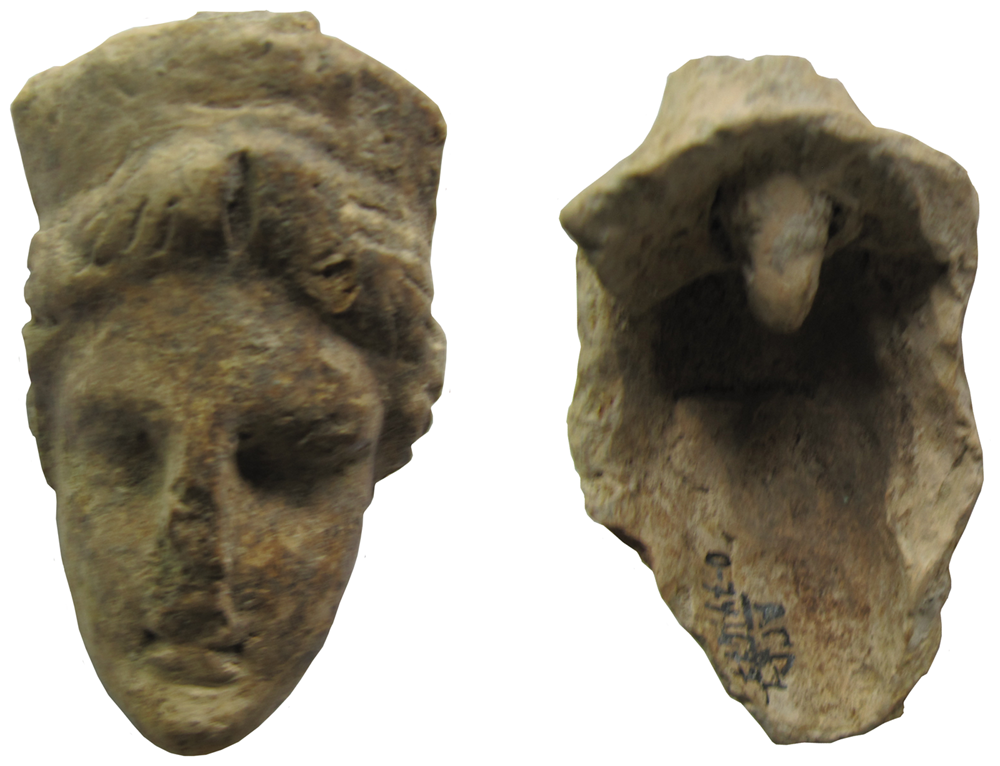
12. A face from a thymiaterion-bust (inv. no. О-74/АГД/477). Fig. 15. Excavated by A.S. Rusyaeva at the western temenos in 1974. The context is the same as cat. no. 11. Height 7.9 сm, width 4.3 сm, depth of relief 4.2 сm. Clay is dark pink at the cuttings, with admixture of mica and quartz. The surface is light, but with dark stains on the area of the face. Face is broken away from the hollow figurine; nose and lips are split away. After the terracotta was taken out of the mould, some cuts were made on the uncooked clay: a deep vertical one on the parting of the hair and some shallow cuts at an angle to show the hair strands arranged around the forehead and over the temples. The uncooked clay was also pressed inwards at the angles of the mouth. A cup of thymiaterion was placed on the top of the head, of which the stem (2.4 cm inside the hollow terracotta) is preserved.
No. 12. Face from a thymiaterion-bust (inv. no. О-74/АГД/477). Excavations by A.S. Rusyaeva at the bothros of the western temenos. Scientific Repository of the IA NASU.

A female is depicted with a long, idealised face. Her forehead is high, and her eyes are mild and not expressive. Only the upper eyelids are made in relief; the inner angles of the eyes are deepened. The chin is rounded and protruding when seen in profile. The goddess wears a stephane. Owing to its height and the preservation only of the central part, it was interpreted as the polos of the Mother of the Gods (Shevchenko Reference Shevchenko2015a, cat. no. 16, fig. 6). This fragmented terracotta is absolutely identical to a more complete bust depicting Aphrodite with Erotes behind her shoulders (О-36/1970, cat. no. 9). First published picture: A.S. Rusyaeva Reference Rusyaeva1979, fig. 53:1,3.
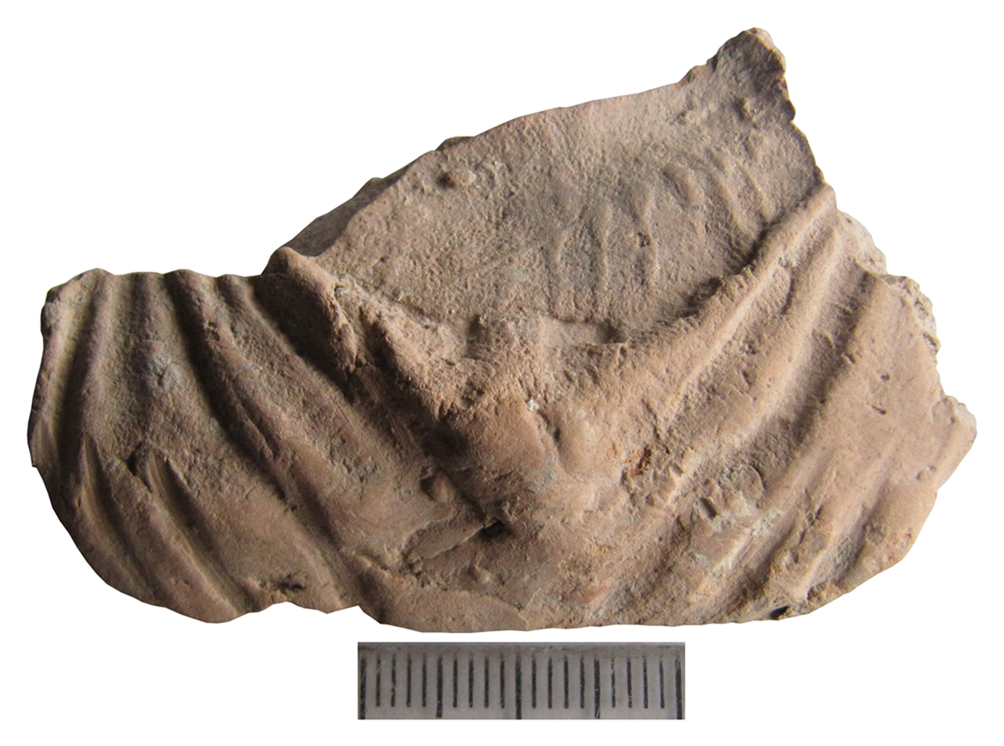
13. A fragment of bust from a thymiaterion (inv. no. О-55/2979). Fig. 16. Excavated by E.I. Levi and A.N. Karasev in 1955 in the bothros at the central temenos. Context is the same as in cat. no. 7. Height 3.9 сm, width 6.0 сm, thickness 1.0 сm. Clay is light brown with pink hint, with insignificant additions of limestone. The fragment consists of the lower central part of the bust. The surface of the back is almost completely broken away. The terracotta is hollow and was made in a mould. The raw fabric was pressed by a blunt instrument in the gaps between the clothes’ folds along the lower edge of terracotta.
No. 13. Fragment of bust thymiaterion of Aphrodite (inv. no. О-55/2979). Excavations of E.I. Levi and A.N. Karasev at the bothros of the central temenos. Scientific Repository of the IA NASU.

A female is depicted wearing a chiton pinned onto the shoulders and fastened beneath the breast. The chiton formed a wide V-shaped opening around the neck. Its folds, clearly shown, were most protruding in the central angle. The relief of the necklace is much lower. This jewellery is composed of 1.0 cm-thin pendants. The necklace may have been emphasised with paint no longer extant. The image is analogous to the better-preserved fragment of bust thymiaterion depicting Aphrodite with Erotes and palmettes О-55/3103 (cat. no. 10).