INTRODUCTION
Blockchain technology is a distributed ledger documenting technology (Walport, Reference Walport2016). It is used to record transactions in a secure, transparent, decentralized, efficient, and low-cost way (Schatsky & Muraskin, Reference Schatsky and Muraskin2015). Blockchain technology framework 1.0 is based on a decentralized architecture and distributed computing paradigm. It was originally used to record historical transactions of encrypted digital money, such as Bitcoin. The technology is actively being developed based on cryptography, network topology, and consensus algorithms (Zhang, Reference Zhang2016).
Blockchain technology has been touted to address a key concern of Transaction Costs Economics for its potential to construct trust between agents in the chain without requiring costly monitoring and verification or building deep personal trust relationships with every agent in the network (Wallace, Reference Wallace2004). The Italian fashion industry – with its exclusive Made in Italy creativity and originality – gives a good example of using blockchain technology. In Intellectual Property (IP) heavy industries, such as the fashion industry, blockchain could be used for IP protection via blockchain-based IP registries. By registering IP rights on a distributed ledger, the information could be linked to actual use of products, so that use in trade/commerce requirements could be updated immediately. Blockchain technology is equally important within the context of unregistered IP rights that an original designer can upload the design document to an industry-specific blockchain, creating a time-stamped record as evidence of originality (Burstall & Clark, Reference Burstall and Birgit2017). Further, blockchain technology provides a more trusted and transparent supply chain, showing every manufacturing detail from origin of the raw materials to producing the finished product in Italy.
The smart contract is the essential technology for enhancing trust between parties and drastically minimizes transaction costs in two ways: the facilitation of direct transactions between ‘trustless’ parties via smart contracts (Pilkington, Reference Pilkington, Olleros and Zhegu2016); using token incentives to create efficient incentive-aligned marketplaces. Blockchain technology creates an internet of value where each transaction keeps the user's information anonymous with each transaction recorded publicly. Therefore, some scholars consider blockchain technology as a paradigm shift, promoting the fifth disruptive innovation in computing paradigm (Yuan & Wang, Reference Yuan and Wang2018).
BLOCKCHAIN IN CHINA
In China, the rapid development of blockchain technology has caught the attention of all sorts of organizations, including the government, financial institutes, and technology companies. China started the blockchain initiative in 2013, when Yi Gang, the Vice President of the People's Bank of China, talked about Bitcoin in a conference. On December 15, 2013, the People's Bank of China and the Ministry of Industry and Information Technology published the ‘Notice on Preventing Bitcoin Risk’. In 2016, the Chinese government started to change its attitude towards blockchain technology, and the initiative was formally included it in the 13th five-year plan, by outlining a road map for national development from 2016 to 2020.
China has the single largest market of information of internet in the world in terms of raw internet user numbers. According to the China Internet Network Information Center (2018), as of the end of December 2017, the number of internet users in China reached 772 million, while the second largest market, the US market, has only 272 million in 2017. However, considering the user/population ratio and internet penetration ratio, the US and Japan is still ahead of China. In any case, the massive base market of the internet in China provides the necessary fundamentals for the development of blockchain industries. In addition, the internet using experience is in need of transparency, higher efficiency, and more trustable transactions.
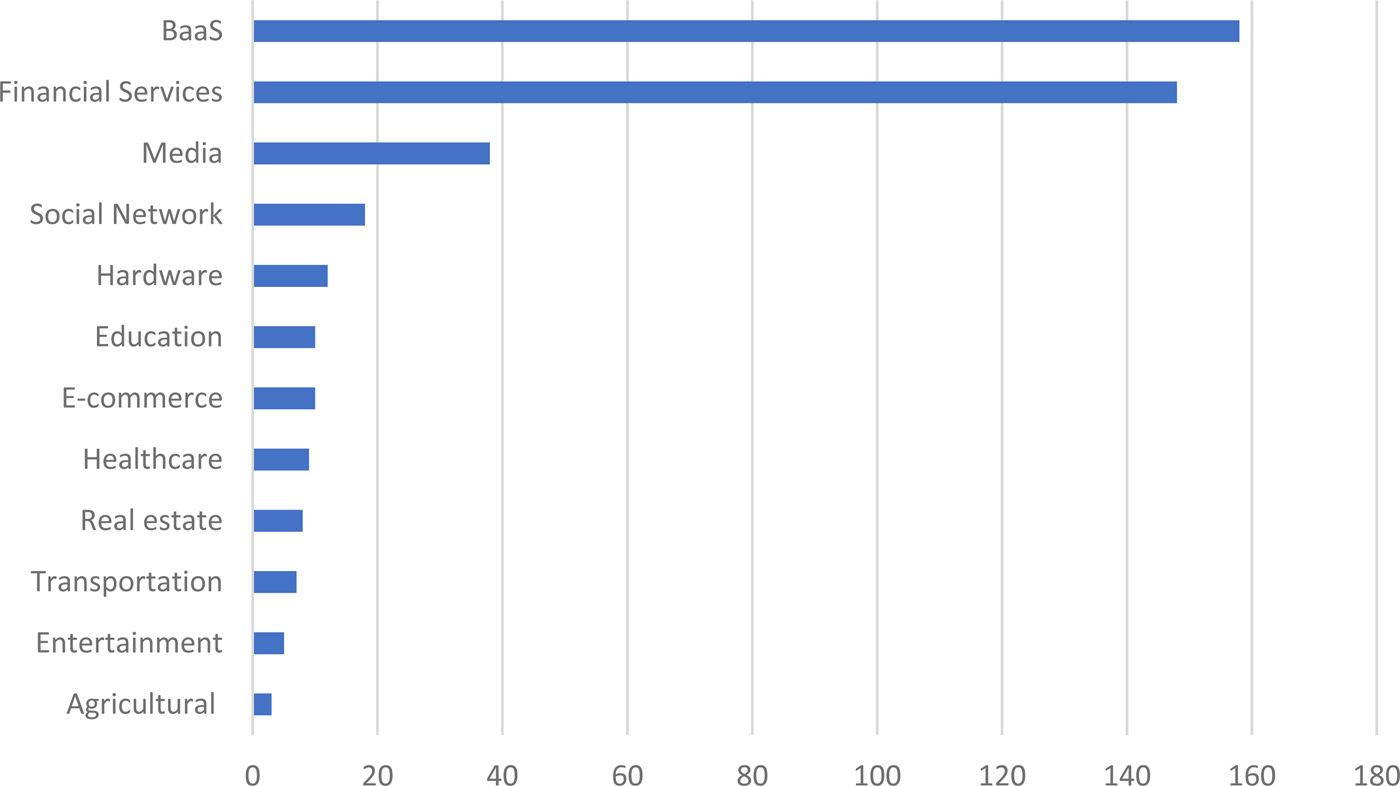
The development of blockchain applications by local Chinese firms has concentrated on BaaS (Blockchain as a Service) and financial services. Traditional Chinese dot-com powerhouses such as Tencent, Alibaba, and JD.com all have ambitious BaaS projects and implementation pathways. Figure 1 shows the proportion of BaaS applications compared with applications in other areas.
Number of blockchain applications in 2018 in China (the numbers calculated are exclusive for each industry)

Tencent initiated blockchain based supply chain financial service to solve the ‘crowdfunding problem’. The traditional crowdfunding platforms experience trust problems in the use of funds raised, while profit distributions to the crowdfunding participants are also unclear and controversial. With the BaaS in crowdfunding, Tencent is able to list projects through unchangeable and transparent blockchain and eliminate trustless projects. Further, profit distribution rules are designed and integrated in the smart contract, ensuring the correct distribution of profit from the projects. Tencent is also implementing a more trustable supply chain finance platform ensuring data credibility and enhancing privacy protection. Data authenticity and security are ensured with blockchain features of distribution, encryption, and untampered. The platform also integrated resources from Tencent's payment and social networking products to offer services for supply chain management, cross-border payment, clearance, etc. (Zhu & Zhou, Reference Zhu and Zhou2016). In 2018, Tencent has incorporated a blockchain electronic invoice system in WeChat (a social messaging, media and payment app that has 1 billion monthly active users in China). At the same time, the city of Shenzhen is the first city in China to experiment with this blockchain solution. WeChat users can file an application and register with Shenzhen's local taxation authority to simplify the invoicing process while eliminating fake invoices and prevent duplicate requests for reimbursement. The blockchain solution can also keep track of the entire issuance process for further inspection and auditing use if needed.
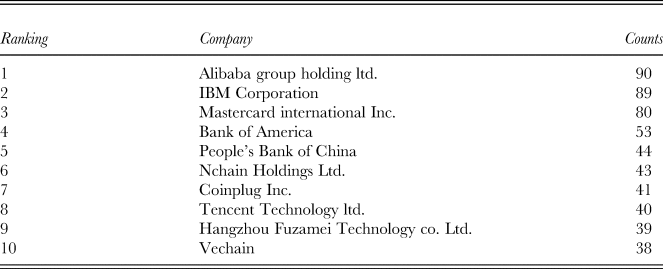
According to Cintelliq's Blockchain patent landscape 2008–2018 report, 5,767 patents have been filed since 2008 and granted by more than 1477 assignees, with about 40% of the patents published in China. Table 1 shows the top 10 global companies and the number of Blockchain Patents in 2018.
2018 top 10 global companies in number of blockchain patents

Source: 2018 Company Ranking of Blockchain Patents top 100, IPRdaily.cn
Alibaba Group has the most blockchain patents in China with a total of 90 patents focused on blockchain related technologies. From the study of Alibaba's patents, we find that the group is focusing on 7 tracks: consensus protocol, cryptology, trusted assembly, cross-chain technology, smart contract language and safety, blockchain and Internet of Things (IoT), and multiple blockchain safety solutions. While Tencent is building its BaaS eco-system based on financial services, Alibaba is nurturing an BaaS eco-system around merchandise. With the support of huge archival data, Alibaba signed global Merchandise Traceability protocols with different partners to build a transparent, traceable cross-border food supply chain. For example, with Alibaba's BaaS, Tmall Luxury Pavilion can integrate and record the data of raw material manufacturing, circulation, and marketing processes in blockchain. Every single piece of brand information has a unique blockchain ‘ID card’, with the digital signature and timestamp for query and verification by consumers. The third e-commerce conglomerate, JD.com has also finished the development of its blockchain focusing on product traceability. The company has also collaborated with the New Jersey Institute of Technology (NJIT) and the Institute of Software at the Chinese Academy of Sciences (ISCAS) to establish a blockchain technology lab. These initiatives not only serve the company but also operate as an open platform of BaaS that are open to the public. Counterfeit products and IP piracy are long-term, inherent problems in China and blockchain technology seems to offer a key role of counteracting these problems.
The convergence of blockchain and IoT is on the agenda for many companies. The blockchain technology acts as a supplementary technology to the future IoT in three ways: it builds trust between parties and devices, it reduces costs by removing intermediaries, it accelerates transactions by reducing settlement time to instantaneous (https://www.ibm.com/downloads/cas/VAWXOMBR).
Haier, the global Chinese appliance manufacturer, started to adopt blockchain into its IoT strategy in 2018. On one hand, Haier's COSMOPlat system, a global industrial Internet solution platform, will adopt blockchain technology in four ways: identifying IoT terminal equipment, secure the data transaction process, tracing manufacturing quality control, and enhancing process efficiency. Another use of blockchain technology is in Haier's Smart Family system. This smart home IoT system acts as the ‘CPU’ that connects, monitors, and manages all Haier devices in the home. Combined with blockchain technology, the interaction and troubleshooting process will work automatically through smart contracts. Also, computing power can be distributed into each device and enhance efficiency.
POLICY UNCERTAINTY
The Chinese government has always been encouraging the exploration and exploitation of frontier technologies ever since the internet era began. On May 28, 2018, China's President Xi Jinping pointed out the need for China to become a global center of science and innovation in the 19th Academician Conference. In the speech, he specifically directed attention to blockchain technology as one of the most important breakthrough technology forces to implement. Further, the Chinese State Council formally embraced blockchain in the 13th Five-Year Plan. Chinese policymakers, therefore, appear eager to set the framework and standards that accelerate industry adoption of blockchain technology while protecting and educating investors amid the nascent and unregulated cryptocurrency ecosystem.
However, despite a spate of enthusiasm for blockchain technology, many companies are keeping a low profile for their involvements in blockchain-related products due to policy uncertainty. While paving the way in several industrial parks for the development and experiment with blockchain technology, the policy makers are strictly prohibiting ICOs (Initial Coin Offering is a way of crowdfunding through offering crypto tokens to participants) and anything related to cryptocurrency. These actions reflect the principle of China's policymaking in the face of future technology: take the essence, discard the dregs. China is discarding the ‘dregs’ of Bitcoin exchange and ICOs in order to maintain financial stability and keep an emergency break in the system but take the ‘essence’ of blockchain technology in coinless businesses (Ehrlich, Reference Ehrlich2018). However, the explicit regulatory frameworks of China haven't been launched and are yet to be standardized. In the future, the Chinese government should create a standardized framework for blockchain use and establish an official entity as an authority to encourage and regulate related business in the industry.
FUTURE RESEARCH
Future research on blockchains are still not transparent. Apparently, it will trigger research on all areas of subjects. First of all, blockchain technology has the potential to change the way of knowledge management, developed by serving as a technology intermediation and as an appropriate management of intellectual properties. Network-centric open innovation has become the mainstream trend globally in all business areas (Tapscott & Tapscott, Reference Tapscott and Tapscott2016). Thus, the integration of blockchain and smart enterprise have the potential to become key competitive advantages while blockchain serves as the important mediation during the process of integration between knowledge and technology. Therefore, finding the appropriate mechanism of connecting and managing knowledge using blockchain could have a positive effect on innovation management.
The safety dilemma of blockchain technology is a controversial topic. The application of cryptology technology and hash algorithm are new tools to guarantee security and privacy concerns for the storage of data. However, as we are still in the early stages of researching this technology, hacker events and safety problems frequently occur because some company participating in a blockchain network doesn't have in place a full security plan or state of the art security procedures and systems. Do hacker events happen because the technology itself is vulnerable, or because local nodes are the weak points in the system? This is still an unexplored space but strategically important vulnerability which must be mastered before mass adoption and routinization of blockchain technology.
Another future research topic involves the future policy and regulation of blockchain technology and cryptocurrency in China. The Chinese government is positive in embracing new technology in order to not miss any disruptive innovation opportunity as blockchain technology which was included in the 13th Five-Year Plan in 2016. But the government is also closely monitoring for any failure because of the perception of huge risks, especially because the large upscaling of the technology. The freedom to tinker has never been unlimited, but various bureaucratic habits have undermined some experiments of new technology. The experimental process and ‘finding the way’ methodology will decide the prosperity of blockchain technology in China (The Economist, 2018). Thus, the future policy on blockchain and cryptocurrency in China is an interesting topic worth tracking closely.
In the future, more blockchain technology will be used pragmatically and bringing a large number of users, and it will also bring potential challenges to China. The development of blockchain technology to improve efficiency has reached consensus among early adopters, but is blockchain technology still efficient when it is widely adopted as the use of the internet today? Does the technology encounter limitations as scale increases exponentially and will demand for computing power keep up? Can the limitations to scaling blockchain applications be overcome, and how?