INTRODUCTION
The key elements in palliative care are defined as concerning patients' experience of relief, prevention of their suffering, and improvement of their quality of life (Pastrana et al., Reference Pastrana, Jünger and Ostgathe2008). Our study explores how the hospital environment can become part of the palliative care provided for patients experiencing a life-threatening illness.
In palliative care, hospices traditionally pay particular attention to creating an aesthetically pleasing and homelike environment as part of caring for patients and enhancing their well-being during serious illness (Saunders, Reference Saunders and Saunders1978; Birkelund, Reference Birkelund and Birkelund2010; Østergaard Steenfeldt, Reference Østergaard Steenfeldt2013). The hospital environment, on the other hand, is often dominated by clinical sensory impressions, with less attention given to aesthetics and homeliness (Heslet & Dirckinck-Holmfeld, Reference Heslet and Dirckinck-Holmfeld2007). This is probably due to the major focus on treatment during hospitalization; palliative care is often not the main concern. However, hospital departments that offer care and treatment to patients experiencing a life-threatening illness should be concerned with the environment as part of palliative care (Rasmussen & Edvardsson, Reference Rasmussen and Edvardsson2007). In light of this, the hospital environment in general has significant potential for optimization, making it a better setting for supportive and palliative care.
Background
The awareness of a relation between patients and the environment has been prominent in nursing since the earliest theories emerged with the thoughts of Florence Nightingale (Reference Nightingale1859/1992). She was convinced that, in order to recover from illness, the patient needed positive and aesthetic elements in their environment—such as flowers at the bedside, natural light, a beautiful view—which underlies the sensory dimension of nursing. Nursing theory has maintained this focus on the environment as a crucial part of patients' health and well-being (Rogers, Reference Rogers1970; Watson, Reference Watson1985; Wikström, Reference Wikström2002). A hospital environment that stimulates the senses in terms of form, color, and decoration has been associated with the ability to positively affect patients' mood and will to live (Martinsen, Reference Martinsen and Wyller2001; Reference Martinsen and Larsen2005; Reference Martinsen2006). More recent theory has moved in the direction of practice-relevant concerns in nursing, that is, how the experience of well-being in patients is perceived as closely related to a sense of homeliness provided by the physical hospital environment (Todres & Galvin, Reference Todres and Galvin2010; Galvin & Todres, Reference Galvin and Todres2011).
The existing empirically based research also reflects a growing recognition of the interrelationship between patients and the hospital environment regarding healthcare outcomes (Devil & Arneil, Reference Devil and Arneil2003), quality of life (Rowlands & Noble, Reference Rowlands and Noble2008), and the quality of hospital life (Spichiger, Reference Spichiger2009). Allowing cancer patients to bring objects of personal value to the hospital environment and create a personal space and thus a sense of privacy and home has been shown to be very important (Høybye, Reference Høybye2013). A welcoming, calm, familiar, and less hospital-like environment has been found to make patients feel more positive (Edvardsson et al., Reference Edvardsson, Sandman and Rasmussen2005). Accordingly, an aesthetically pleasing hospital environment has been documented as generating positive emotions for cancer patients in a vulnerable situation (Timmermann et al., Reference Timmermann, Uhrenfeldt and Birkelund2012). Wilted flowers on a table, dust balls on the floor, or a single nail in a bare wall, on the other hand, have been perceived as conveying messages of death, danger, shame, stigma, and lack of concern for the patient (Edvardsson et al., Reference Edvardsson, Sandman and Rasmussen2006).
Conclusively, existing theory as well as empirical research point to the hospital environment as influencing patients' health and well-being. Still, research into palliative care does not satisfactorily reflect and discuss how the hospital environment can become part of caring for patients and supporting their well-being. Our paper will contribute to the existing body of knowledge by advancing insights into how the hospital environment can influence patients. Accordingly, the objective of this study was to explore how patients experience being in the hospital environment and the meaning they assign to the environment during serious illness.
THE STUDY
Design
In this qualitative study, we applied a phenomenological-hermeneutic design. To generate new knowledge about the patient experience of being in a hospital environment, broad and open-ended qualitative interviews (Fog, Reference Fog2007; Kvale & Brinkmann, Reference Kvale and Brinkmann2009) were conducted and combined with observations of the hospital environment (Spradley, Reference Spradley1980; Hammersley & Atkinson, Reference Hammersley and Atkinson2007). The interpretation of the interviews and observations understood as texts was inspired by Paul Ricoeur's (Reference Ricoeur1979) phenomenological-hermeneutic theory of interpretation.
Participants and Setting
Twelve patients of both genders participated in the study from May to December 2011 while hospitalized in a Danish teaching hospital. The study took place on two different medical wards. The general medical ward, situated on the seventh floor, had a capacity of 40 patients. The capacity of the cardiac medical ward on the second floor was 21 patients. Both wards had patient bedrooms designed for one to four patients, corridors housing medical equipment, clusters of chairs, and small tables, as well as a common room where patients could eat and drink, relax, read, watch television, or join a conversation.
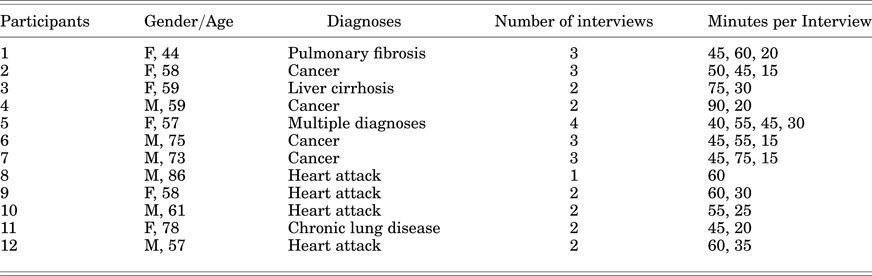
Individuals diagnosed with such potentially life-threatening illnesses as cancer, liver cirrhosis, severe lung disease, and cardiac embolisms were included in our study. Persons with elucidation of illness, confusion, or in serious distress due to their condition were excluded. Six women and six men aged 44–86 participated (Table 1). None of the invited patients declined to participate.
Characteristics of the 12 participants
Data Collection
Broad and open-ended interviews were chosen in which patients were asked to describe how they experienced being in the hospital environment (Kvale & Brinkmann, Reference Kvale and Brinkmann2009). To allow the patients to nuance their accounts, they were interviewed multiple times (Table 1), except for one patient who was transferred and thus interviewed only once.
To stimulate the patients' descriptions of their experiences, the first interview was opened with a couple of guiding open-ended questions (see Table 1): “How do you experience the room you are staying in?” and “Please tell me about your first impression of the room you are staying in.”
The qualitative interviews were documented by means of field notes or recorded and subsequently transcribed. The interviews lasted from 15 to 90 minutes (Table 1). Twenty-eight of the interviews took place in shared patient rooms, while one interview took place in a private room at the request of the patient. The study included a total of 29 interviews (Table 1).
The purpose of the observations was to add concrete judgments about the physical environment to the interview material. These observations made it possible to note which personal belongings the patients brought along to the hospital environment as well as where in the hospital space they preferred to relax, eat, or perform other private tasks.
Observations of the patient rooms were performed as a natural extension of the interviews; observations of the common rooms/dining area and the corridors were carried out separately. Observations were documented by means of field notes.
Ethical Considerations
All participants were informed about the study orally and in writing, and they were asked to provide a written informed consent. They were told that it was possible to withdraw from the study at any time; also, all personal data were disguised, guaranteeing them strict confidentiality. The study was not categorized as a medical research study. Consequently, Danish law did not require ethical approval according to the Regional Committee for Medical Research Ethics. Approval from the Danish Data Protection Agency was obtained (journal number 2007-58-0010), and their requirements for safe storage and destruction of data were followed. The study met the Northern Nurses' Federation ethical guidelines for nursing research in Nordic countries (Northern Nurses' Federation, 2003).
Data Analysis
Inspired by Ricoeur's (Reference Ricoeur1979) theory of interpretation, our analysis and interpretation of the text comprised an ongoing three-level process starting with a naïve reading, followed by a structural analysis, and concluding with a comprehensive understanding.
The naïve reading involved reading and rereading the texts several times (Ricoeur, Reference Ricoeur1979). This process provided a general sense of the texts as a whole as well as an overall initial understanding of the meaning of the hospital environment from the point of view of patients experiencing serious illness.
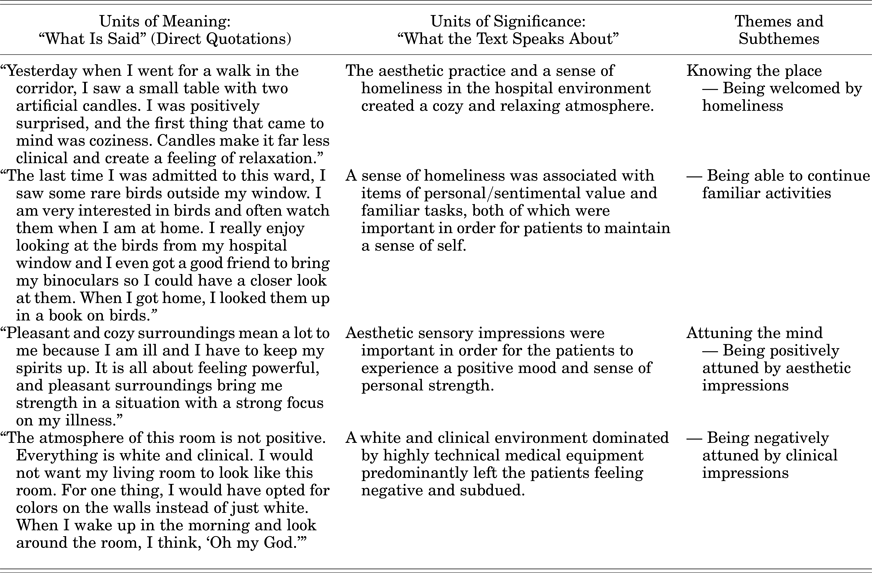
The initial understanding of the patients' experiences of being in the hospital environment was validated through the structural analysis. This was done by gathering sections of text into larger meaning units, consisting of text portions across the interviews. The extracted meaning units were illustrated by patient quotes presented under the heading “what is said”; the meaning of the text was then further explained and categorized as units of significance under the heading “what the text speaks about” (Ricoeur, Reference Ricoeur1979) (see Table 2). As can be seen from this table, the structural analysis revealed two individual but closely related themes and subthemes. The main themes were: (1) “knowing the place” and (2) “attuning the mind.”
Examples of the analysis process: From quote to theme

At the comprehensive understanding stage, the identified themes and subthemes were interpreted and discussed in the light of relevant theories and existing research. This theoretical abstraction unveiled a new explanatory position in the text (Ricoeur, Reference Ricoeur1979) and thus new insights into how patients with a life-threatening illness experience being in the hospital environment and the meaning they assign to it.
Given the themes and subthemes identified in relation to the aim of our study, we used Norberg-Schulz's phenomenological theory (Reference Norberg-Shulz1971; Reference Norberg-Schulz1980; Reference Norberg-Schulz1985) on the meaning of home and dwelling and Løgstrup's phenomenological philosophy (Reference Løgstrup1987; Reference Løgstrup1976/1995; Reference Løgtrup and Dess1995) on sense perception to add perspective to the interpretation and thus arrive at a more comprehensive understanding of patients' experiences of being in the hospital environment.
Within the phenomenological tradition of architecture, Norberg-Schulz (Reference Norberg-Shulz1971) described how man's center of the world is “home.” Home represents the known as opposed to the unknown and somewhat frightening world around us. Being at home is experienced as “what it is to know a place, to belong to a place” (Norberg-Schulz, Reference Norberg-Schulz1985, p. 9). The experience of knowing a place and belonging to that place is what makes life meaningful. It is this connection that adds meaning to life. The meaning of home is thus closely tied to sense of self, according to Norberg-Schulz (Reference Norberg-Schulz1985). The experience of knowing and belonging is what makes it possible for man to experience the ability to dwell in the context of finding an existential foothold. Norberg-Schulz points out that “existential foothold and dwelling are synonyms (. . .) Man dwells when he can orientate himself within an environment or, in short, when he experiences the environment as meaningful” (Reference Norberg-Schulz1980, p. 5).
According to the Danish phenomenologist Knud Ejler Løgstrup, man exists emplaced in the world with his senses (i.e., vision, hearing, smell, and taste). In its purest form, sensation comes entirely stripped of any interpretation or understanding (Løgstrup, Reference Løgtrup and Dess1995). These faculties of sensing the environment form a crucial point in Løgstrup's (Reference Løgstrup1976/1995) philosophy on sense perception as he argues that sensation is always attuned (Da: stemt). This means that sensory impressions from the environment come with a certain ambience, for example, a particular mood in a certain situation. The ambience experienced has the potential to affect us and shape the emotions that govern our sense of personal strength, courage of life, or joy (Løgstrup, Reference Løgstrup1976/1995). The environment thus has the power to attune man (and in this case the patient) on a continuum from a positive to a more negative mood. In Løgstrup's own words, ”The sensory impressions in the environment have the ability to either strengthen the individual mentally or to degrade the individual mentally” (Reference Løgstrup1987, p. 89).
Rigor
As the instrument of data collection, the interviewer's behavior and attitude toward the participant determined the reliability of interviews and the data accumulated (Fog, Reference Fog2007). The interviewer consciously tried to create a relaxed atmosphere by being open, smiling, and approachable through appropriate body language. Throughout the interview process, the interviewer was aware of the importance of repeating words and phrases that the patient used to obtain further nuances from their statements and encourage them to elaborate on their experiences (Fog, Reference Fog2007; Kvale & Brinkmann, Reference Kvale and Brinkmann2009).
In a qualitative research design, assessing credibility is closely connected to the analysis process, which is why each step of the process is carefully described (Kvale, Reference Kvale1997; Fog, Reference Fog2007). Furthermore, the interviews performed by the first author were subsequently discussed with the other coauthors during the analysis process to challenge our pre-understanding and confirm the interpretation of texts by critically discussing different possibilities of interpretations.
RESULTS
The naïve reading of the texts revealed that aesthetic sensory impressions formed a sense of homeliness in the hospital environment. This sense of homeliness was perceived by the patients as carrying a positive meaning as they associated it with what they referred to as a welcoming and cozy atmosphere. Clinical markers in the environment, on the other hand, were generally associated with unfamiliarity and experienced as creating a negative mood.
Observations revealed that the patients preferred to eat, relax, or converse in small cozy spots that they perceived as homey. The patients reflected upon the aesthetics of the hospital environment in relation to the aesthetics of their own homes, and some explained that paintings or colors on the walls were important for their experience of a positive mood, both at home and in the hospital environment. However, it became clear that their personal preferences could differ regarding choice of colors, furnishings, or paintings. Still, the patients seemed to be able to make a clear distinction between what they perceived as homey as opposed to that which felt clinical. The observations also revealed that patients often brought items of personal value to the hospital environment and placed them close by and within view (e.g., on a bedside table). It seemed as if the patients tried to make the hospital environment into a more familiar place; a temporary living space where their everyday life could unfold to some degree.
Two themes were identified in the structural analysis—(1) knowing the place and (2) attuning the mind—both of which contained subthemes, which will be elaborated in the following paragraphs.
Knowing the Place
Being Welcomed by Homeliness
In general, the patients experienced that colorful decorations and small cozy spots for conversation evoked a sense of homeliness, which they appreciated in an otherwise cold and clinical hospital environment. A more homelike environment created what one of the patients called a “good atmosphere”; several others referred to it as “cozy.” The perception of coziness seemed to be closely linked to a sense of peace and relaxation that resonated with the patients, tuning their minds to positive emotions. One patient who had been hospitalized several times because of a series of heart attacks expressed it thus:
Yesterday when I went for a walk in the corridor, I saw a small table with two artificial candles. I was positively surprised, and the first thing that came to mind was coziness. Candles make it far less clinical and create a feeling of relaxation.
Another patient who was hospitalized due to cancer reflected on the significance of a homey and cozy atmosphere in this manner:
The warm color of the floor makes the room friendly and welcoming. Had the floor been more hospital-like, one might get a sense of distance. It does something positive to the room if you can make it at little more homelike. I would use the word “coziness.” Some medical equipment is of course necessary, but if you get a sense of homeliness, the clinical impressions become less dominant.
The atmosphere of the environment created by clinical impressions or impressions of a more homelike environment thus shaped patients' experiences of being in the environment.
To sum up, it is thus clear that patients were generally negatively affected by the clinical instruments in the hospital environment and positively affected by a homey or cozy atmosphere.
Being Able to Continue Familiar Activities
Both observations and patient statements revealed that being able to continue familiar tasks and routines was important to patients. Aspects of the hospital environment that they experienced as recognizable and meaningful empowered them to retain a sense of self in the face of serious illness and hospitalization. Some patients liked to watch television, one focused on her knitting, and others brought several books and crossword puzzles to the hospital. When asked what it meant to be able to continue familiar routines, one patient said, “It makes me feel more like myself; the more I can continue to do what I used to do, the more I feel like myself.” The importance of being able to continue cultivating personal interests facilitated by the hospital environment was also emphasized. Another patient expressed joy at being able to keep up her interest in wild birds:
The last time I was admitted to this ward, I saw some rare birds outside my window. I am very interested in birds and often watch them when I am at home. I really enjoy looking at the birds from my hospital window, and I even got a good friend to bring my binoculars so I could have a closer look at them. When I got home, I looked them up in a book on birds.
Whether patients were able to continue familiar routines in the hospital environment to a large degree depended on the setup of patient rooms (e.g., presence of chairs and tables). One patient described feeling “homeless” when deprived of a usual routine such as simply sitting at a table and reading, as this seemed important as far as maintaining some kind of daily rhythm and thereby preserving a sense of self.
Attuning the Mind
Being positively attuned by aesthetic impressions
Several patients reflected on the atmosphere of the hospital environment and on how adornments such as paintings and colors on the walls evoked a positive mood. One cancer patient used his own home as an example when reflecting on his experience of the hospital environment. He explained that he had a painting in every room of his house and that this influenced his mood in a positive way. He believed that paintings in the hospital environment could have a similarly positive effect on his mind. He explained,
I can imagine that a painting in the patient room could lift the room as a whole. It would also be nice with some colors on the walls instead of the white and clinical theme. Art and colors lift one's spirit and induce a positive mood—you simply become more positive. You could say that something positive happens both in your body and mind when you see something beautiful.
Aesthetic decorations and small cozy spots also seemed to create a relaxed atmosphere that filled patients with a sense of personal strength in a vulnerable situation, as expressed by another patient:
Pleasant and cozy surroundings mean a lot to me because I am ill and I have to keep my spirits up. It is all about feeling powerful, and pleasant surroundings bring me extra strength in a situation with a strong focus on my illness.
The aesthetic practice of the environment was thus accredited with the potential to evoke positive meaning as the appearance of the environment had the power to attune their minds positively.
Being negatively attuned by clinical impressions
In contrast to the more aesthetic expressions, more clinical surroundings were described as triggering predominantly negative thoughts and feelings. Patient rooms dominated by highly technical medical equipment made some patients feel sad. Being totally bedridden and surrounded by technical equipment because of a serious multifactorial illness made one patient compare the room to a “rainy day.” She described a subdued mood caused by her clinical surroundings and thus confirmed a strong connection between environment and mood. She elaborated on her comments by comparing the hospital environment to her own home, emphasizing that she would not want her common room to look like her patient room. She described how she had different colors in every room of her house and would have welcomed some colors on the walls of her patient bedroom:
The atmosphere of this room is not positive. Everything is white and clinical. I would not want my living room to look like this room. For one thing, I would have opted for colors on the walls instead of just white. When I wake up in the morning, and look around the room, I think, “Oh my God.”
Similarly, a cluttered room characterized by a clinical interior design could evoke a feeling of discomfort. One patient went as far as describing this type of environment as “unsympathetic” in the sense that it was experienced as unwelcoming and not a place for social interaction.
DISCUSSION
Discussion of Findings: A Comprehensive Understanding
The objective of our study was to explore how patients experienced being in the hospital environment and the meaning they assigned to the environment during a serious illness. Our findings provided a basis for discussing this within the framework of palliative care.
Hospital admission provided the patients a temporary living space where they tried to live their lives as normally as possible. They would try to make the surroundings familiar and keep some of their known daily routines. We found that the hospital environment had the potential to offer relief when providing a meaningful space for daily life during serious illness. The experience of a meaningful space depended on an aesthetically pleasing environment that evoked a sense of homeliness in patients. A homey and cozy atmosphere enabled patients to gain an existential foothold in a vulnerable life situation and made them feel at ease and relaxed, albeit only momentarily. Being able to maintain personal interests as well as having personal items close at hand further supported a familiar daily rhythm. Furthermore, being able to continue part of their everyday routine during hospitalization allowed patients to maintain a sense of self, which was important to sustain their general well-being. The physical environment thus had the potential to create an experienced positive emotional space that could be supportive and thereby be a part of the palliative care.
In light of Norberg-Schulz's theory about the meaning of homeliness (Reference Norberg-Shulz1971; Reference Norberg-Schulz1980; Reference Norberg-Schulz1985), we will reflect on and discuss why a sense of homeliness has such a strong impact on the patients' positive emotions and how this could become important in palliative care. We found that the aesthetics of the hospital environment evoked in patients a feeling of “knowing” their surroundings and to some extent belonging to them, which made things seem less alienating. This sense of homeliness allowed patients to navigate the environment as it resembled something known and familiar, in contrast to the unknown and somewhat alienating sensory impressions derived from the clinical setting. Further, the sense of homeliness achieved through the aesthetics of the hospital ward enabled patients to “dwell” for a while, relaxed and peaceful. Following Norberg-Schulz (Reference Norberg-Schulz1980), the experience of dwelling created a positive space in their minds, which equipped them with an existential foothold in a vulnerable situation.
Martinsen elaborated on this sense of dwelling in a caring context by describing it as becoming acquainted with one's environment and feeling secure within it. Creating this sense of dwelling in the hospital environment could offer patients a welcome, caring shelter in which to experience a sense of peace (Martinsen, Reference Martinsen2006). This experience of peace and dwelling is an important part of experiencing relief during serious illness, and our findings showed how aesthetics and a sense of homeliness in the hospital environment might offer this kind of relief.
In line with Norberg-Schulz (Reference Norberg-Schulz1980; Reference Norberg-Schulz1985) and Martinsen (Reference Martinsen2006), Galvin and Todres (Reference Galvin and Todres2011) discussed patients' experience of well-being during hospitalization in a caring context. They argued that a sense of well-being in the hospital environment can be equated to a sense of “being at home.” An important part of this sense of “being at home” is the space and what it contains (e.g., familiar objects and personal items close at hand) (Galvin & Todres, Reference Galvin and Todres2011).
The aesthetic impressions of their private homes comprised the yardstick by which patients measured the way in which the hospital environment engendered a feeling of homeliness and promoted positive energy. The aesthetics of the hospital environment were perceived to have the ability to attune patients' emotions in a positive manner, thus creating a sense of power and personal strength. Clinical elements, on the other hand, seemed to lead to negative thoughts and feelings. This attuning of patients' emotions through the physical space, in line with Løgstrup's thinking (Reference Løgstrup1987; Reference Løgstrup1976/1995; Reference Løgtrup and Dess1995), revealed a fundamental relationship between the environment and patients' emotional comfort or discomfort. Following Løgstrup (Reference Løgtrup and Dess1995), this could be explained by the fact that the patients existed in the hospital environment via their senses—their vision, touch, and hearing. This sensory emplacement thus evoked an emotion or certain mood.
Previous research has similarly described how places can shape the health and healing of breast cancer survivors by evoking positive emotions. The recovery process for cancer patients was accelerated when they created and accessed their own individual landscapes of healing, and these landscapes could be located in their homes, their communities, or in nature (English et al., Reference English, Wilson and Keller-Olaman2008). Høybye (Reference Høybye2013) provided another example involving cancer patients creating a healing environment by adding personal and cherished belongings to their personal space, which evoked a sense of well-being.
This interplay between emotions and place has also been identified by Edvardsson and coworkers (Reference Edvardsson, Sandman and Rasmussen2005), who found that hospitalized patients ascribe importance to a more familiar hospital environment. They demonstrated how furnishings, aesthetic expressions, and the possibility of maintaining personal interests such as reading and watching television could overrule patients' experiences of a depersonalized environment. A dilapidated, dirty, and aesthetically neglected hospital environment, on the other hand, produced negative emotions in patients (Edvardsson et al., Reference Edvardsson, Sandman and Rasmussen2006).
Our findings have confirmed this strong interplay between the hospital environment and patients' experience of well-being as a result of positive emotions or their experience of discomfort in the case of negative emotions. Patients' experience of being in the hospital environment and the meanings they assign to their surroundings was clearly shaped by the physical space and the practices determining the furnishings, decoration, and general interior.
Our results further add to the existing body of knowledge by offering new insight into how the hospital environment can become part of palliative care when aesthetically pleasing and homey. Patients' experience of homeliness as a result of the aesthetic practice of the hospital environment was shown to be essential to their ability to maintain parts of a familiar daily rhythm while hospitalized. This in turn was important to their sense of well-being and relief, and other positive emotions.
LIMITATIONS OF THE STUDY
Through employing a qualitative study design, this investigation explored how patients experienced being in the hospital environment during serious illness. It could be argued that a sample consisting of only 12 patients is too small to allow formulation of any generalizations. However, in qualitative research, Kvale (Reference Kvale1997) argues that analytical generalization is a possibility, which means that the results of a study can be considered “indicative” or transferable in relation to other similar situations or settings. We argue that the findings of our study do make it possible to formulate an analytical generalization to similar situations or settings as they confirm existing research. In addition, they provide a deeper understanding of how patients experience being in a hospital environment.
Another limitation of our study in relation to transferability may be cultural differences. Helman (Reference Helman2007) found that culture has a decisive influence on health and illness beliefs, health practices, and care. For the purpose of overcoming the challenges of cultural differences within healthcare, Albarran and colleagues (Reference Albarran, Rosser and Bach2011) sought to develop a cultural care framework that embraces the understanding of individuals in their various cultural contexts. Reflections on the cultural context are thus essential when the transferability of a study is to be assessed.
CONCLUSION
Our findings stress the importance of a heightened awareness of the role of an aesthetically pleasing and homelike hospital environment in palliative care. Since the hospital environment appears to be an important contributor to patients' general well-being, relief, and positive emotions in the context of a vulnerable life situation, there is an urgent need to focus on ways to transform this environment into a setting that can foster improved palliative care. New policies are an important step on the path to developing appropriate care settings. Finally, the management of implementation and sustenance in such settings should also be taken into account.
ACKNOWLEDGMENTS
We are most grateful for the productive discussions with Professor Kari Martinsen in Harstad, Norway (September 2012).