Slavery established a measure and a ranking of life and worth that has yet to be undone. If slavery persists as an issue in the political life of black America, it is not because of an antiquarian obsession with bygone days or the burden of a too long memory, but because black lives are still imperiled and devalued by a racial calculus and a political arithmetic that were entrenched centuries ago. This is the afterlife of slavery—skewed life chances, limited access to health and education, premature death, incarceration, and impoverishment. I, too, am the afterlife of slavery.
—Saidiya Hartman
Introduction: The Silencing of Black Women and Children in Cuba's Afterlife of Slavery
Cuba, in the second half of the nineteenth century, proved to be a unique site where the Spanish colonial government and the island's Creole planter class elaborated on multifarious methods of maintaining and expanding slavery. Efforts to maintain Cuban slavery depended on conferring diverse legal states of servitude for black and indigenous populations, all the while drafting a painfully slow transition from legal bondage toward paid labor via a two-decade long process of gradual emancipation that culminated in 1886.
In Lose Your Mother: A Journey Along the Atlantic Slave Route, Saidiya HartmanFootnote 1 theorizes that the afterlife of slavery, persisting within the political life of former slave holding nations, is characterized by the enduring presence of slavery's racialized violence. I am drawing on Hartman in order to address what is “not there” in terms of archived and sourced history, yet is still, nonetheless, there. As the historian Nancy Mirabal has noted, though the archive offers little solace, it is what often goes unnoticed and unstudied that reveals the most.Footnote 2 The questions this paper asks are: Why is the history of women and children held in bondage difficult to locate within historical accounts informed by the archives of slavery and emancipation? If we were to better identify and include this history, how does it change our definitions of freedom? For Hartman, the archival erasure of racial and sexual violence, alongside prolonged and continual states of bondage is a necessary strategy for safeguarding a colonial writing of history and definitions of racial truths. As such, I read Hartman's text as opening avenues of exploration regarding perpetually deferred freedom and applicable to the seldom addressed questions about childhood for people of color at the end of the nineteenth and beginning of the twentieth centuries in Cuba. Hartman's book, Lose Your Mother, holds various suggestive interpretations, including that of calling for an analysis of children of color made vulnerable to exploitation. It suggests an acknowledgment of those haunted by the racialized bodies of enslaved, “apprenticed,” and “free” women and children of color, held in various conditions of legal and/or social servitude. And, it permits a recognition of the enslaved women and children often left unaccounted for—their presence ephemeral within the available historiography.
Applying Hartman's description of the afterlife of slavery to the Cuban context proves useful in showcasing the ways in which the perpetuation of servitude and imperiled existence amid, and long after, legal emancipation produced “… skewed life chances, limited access to health and education, premature death, incarceration, and impoverishment. …” Moreover, the afterlife of slavery has shaped the omission of childhood during slavery and its afterlife, the unprotected status of black womanhood and the neglected role and place of sexual exchange for survival/“freedom” existing alongside segregated, controlled, and legislated prostitution. When looking at Cuba, this list can be augmented to include the mendacious re-branding of captivity whereby the language of freedom, proclaiming “labor as freeing,” strategically obfuscates re-enslavement and continual exploitation.
Hemispheric Bondage: Kidnappings and Re-Enslavement
Addressing the life and afterlife of bondage in Cuba, and the rise of new states of enslavement in the midst of emancipation, also requires an analysis of the trafficking of “free-peoples” from US and Mexican territories during the last two decades of gradual emancipation on the island. With the suppression of the slave trade, the resulting decrease in the transportation from Africa of new slave labor, alongside the end of the Mexican-American War in 1848 and the US Civil War in 1865, Cuban slave traders and planters turned toward new categories of servitude and re-enslavement as a method of augmenting profits and productivity.
Practices of manipulating and circumventing freedom abounded in both Cuba and the United States, as both plantation economies were determined to evade actual black emancipation. The interconnections between American and Cuban slaveowners can be found as early as 1854, when US government officials met with Cuban slaveowners invoking US troops into Cuba to prevent emancipation.Footnote 3 The pro-slavery politics of both Cuban planters and slaveowners, as well as politicians in the United States, influenced efforts for expanding slavery in Cuba. White political and economic investment was joined by incentives to increase white migration to the island as a method to ward off “another Haiti.” Mirabal has noted that within the United States, Martin Delany and Frederick Douglass protested what they saw as the public declaration of slave expansionism to Cuba and connected US imperial design to political and economic efforts to promote continual conditions of slavery in Cuba and other regions of Latin America.Footnote 4
Legal measures to delay emancipation were passed just five years after the United States had legally abolished slavery, when Cuba's Moret Law—which initiated a process of gradual abolition through “apprenticeships”—aimed to appease abolitionist opinion, turning its attention toward Cuba, while in practice not threatening Cuban slavery and Cuba's reputation as a safe haven for the trafficking of kidnapped people of color.Footnote 5 It was not unusual, for slaveowners facing emancipation to violate the legal terms that put an end to bondage by selling soon to be “freed” slaves to regions where racial slavery was still in place. Slaveowners resorted, for such purposes, to kidnappings and illegal transfers of ownership and, some US Slaveowners, like the De Hart family of New Orleans, moved and relocated to Cuba during the Civil War. For US Slaveowners concerned about losing their investments, Cuba provided a new destination to continue slavery by eluding the US emancipation proclamation. After emancipation, American citizens of color willing to migrate for better labor opportunities were enticed by US labor recruiters promising to pay as much as $3 per day. Some, once transported to their new labor site (usually port cities with established water routes to Cuba) were abducted, transported against their will, then sold into Cuban slavery. Kidnappings, alongside the establishment of Black Codes (withholding freedom, among other means, via vagrancy laws) and oppressive contracts, were deployed as attempts to reestablish conditions of slavery.
For US slaveowners relocating or selling their slaves to Cuba, children of working age would have been deemed malleable, docile, dependent, and young enough to work for decades to come. The concern over the trafficking of free children and adults from the United States to Cuba resulted in the 1866 US Senate Report on kidnappings,Footnote 6 which noted that former Confederate officers and some US Southern slaveowners had either sold people of color as they could on the Cuban market, or moved and relocated operations to Havana.Footnote 7 Cuban planters absorbed trafficked US free peoples into the Cuban slave population. The New York Times reported that the kidnapping of children of color was a “frequent occurrence” in New Orleans. In addition, women and children were especially vulnerable to kidnappings as the price paid for slave children in Havana rose. For example, a girl named Juana la Americana—as she was called by her fellow slaves once in Cuba—was sold into Cuban bondage at the age of ten alongside her mother. Her very naming denotes recognition of her virtual free status in the eyes of those enduring late nineteenth-century Cuban slavery. Juana's case was reported to US investigators, but did not yield her, or her mother's rescue, despite the official abolitionist commitments of the post-Civil War United States. The US government did suspect collusion between the traffickers, the governments of previously slaveholding states, and federal officers, “for the purpose of taking negroes out of the US.”Footnote 8 The bulk of those kidnapped and sent to Cuba would be held in legal bondage on the island until 1886. The persistence of slavery and black servitude in Cuba worked to rejuvenate the entire paradigm of hemispheric racial slavery, belying the letter of abolitionist legislation. The newly emancipated US citizens (adults and children of color) were re-enslaved once trafficked into Cuba as part of a deliberate attempt by post-Civil War US capitalists and state interests to find ways to continue profiting from slavery, while enacting efforts of depopulating the former slaveholding states of free people of color.
Kidnapped free people of color from the Untied States and indebted free indigenous populations (indios libres) from the newly established US/Mexico border region were both trafficked into Cuban bondage. For indigenous populations, the intense need for labor in Cuba alongside the painfully gradual end of Cuban slavery yielded the redeployment of coercive labor systems developed at the dawn of colonization. As such, would-be “free” indigenous groups found themselves beyond freedom's reach, held within a system that looked and felt more like repartimiento Footnote 9 from centuries past. Indigenous coerced labor and displacement co-existed alongside African enslaved labor, giving yet another example to Shona Jackson'sFootnote 10 argument that antiblackness within Caribbean societies cannot be fully understood apart from the subordination of indigenous peoples.Footnote 11 It is difficult to account for the magnitude of indigenous labor in late nineteenth-century Cuba, especially that of women and children, because so very little is known.Footnote 12 However, the displacement of indigenous peoples from Mexico and the US Southwest worked in parallel with the trafficking of slaves to Cuba. Accounts from the end of the nineteenth century specifically note that Yacatec Mayan women and children were coveted for domestic work, and that while women and children were designated for domestic service, indigenous men often worked alongside African slaves subjected to backbreaking, hard manual labor, harvesting cane and tobacco, constructing roads, or hauling stones. Their legal status as indios libres (free Indians) proved to be a contradiction and concealed the conditions under which they had been brought to Cuba. For example, by the late nineteenth century, Mayas, fighting the Mexican government, were brought to Cuba against their will, tied up, dragged off, and guarded by soldiers. Some had been sold into servitude in Mexico, still others were debtors arrested and sentenced to labor for military officers who then sold them to work in Cuba.Footnote 13
By the end of the nineteenth century, the desire for indigenous labor on the island was marked by insistent and specific requests made by colonialists to Spanish authorities for the free allocation (neo-repartimiento) of indigenous women and children brought from Mexico and the US Southwest as “wards of their masters,” classified as being indebted for their care and Christianization. Adding to the preference for indigenous labor was the fact that at the end of the century populations from the new US/Mexico border and those in conflict with new republics born out of independence struggles against SpainFootnote 14 were seen as less troublesome compared to Chinese labor, which was seen as foreign, non-Christian, prone to supporting independence from Spain and joining rebel forces. The indigenous population sent to Cuba during the end of the nineteenth century provided a buffer between the labor needs of slaveowners, slaves engaging in revolts, and the anxiety over the “foreignness” of Chinese labor.
Socially and economically, the legacy of slavery was palpable well into the middle of the twentieth century. “Freed” peoples were, when not legally held against their will, held via economic bondage and rebranded conditions of servitude. Indebtedness had previously proven successful in the labor extraction and exploitation of colonized populations, and it would yield prolonging labor extraction again. Economic bondage fueled the growth of a late nineteenth- and early twentieth-century economic system of indebted servitude, which bolstered the expansion and success of the post-emancipation “plantation store.”Footnote 15 For black and indigenous populations indebtedness tied to the plantation store became a tool of direct economic control, a way to limit access to mobility and information. Indebtedness tied to the plantation store weaponized the 1880 rules on stipends, which made it possible for workers to be forced to accept credit in lieu of wages and pay could be withheld or delayed due to indebtedness. Doing so produced a system of indebtedness in which formerly enslaved and indentured workers, compelled to procure basic goods on credit, were, long after legal slavery, trapped by indebtedness to the plantation store and bound to generations of coercive labor practices. Indebtedness to the plantation store shaped life and labor well into the middle of the twentieth century.
By the beginning of the twentieth century, the afterlife of Cuban slavery maintained segregation and would prove apparent via the joint US and Cuban military operation of 1912 that massacred members of the Partido Independiente de Color (PIC), the only Afrodescendant political party to have attempted to organize on the island. The afterlife of Cuban slavery also extends into the modern-day practices of racialized and gendered labor exploitation in Cuba. Social inequalities on the island have for decades been well documented by Cuban scholars working on labor segregation within an economy that exchanges access to housing, education, and healthcare for the “right” to workFootnote 16 and within a national discourse that deems Afrodescendants to be merely “beneficiaries” of white revolutionary efforts and social reformation, omitting populations of color as initiators and actors within national liberation struggles. The afterlife of Cuban slavery is characterized by repeating cycles of deferred freedom, recasting bondage despite the waves of revolutionary efforts that mark the island's nineteenth and twentieth centuries efforts toward independence. Meaningful liberation from labor exploitation, alongside emancipation from sanctioned forms of discrimination, must, as colonial slaveowners argued, “wait, until better times.”
A popular colloquial saying that circulates on the island to this day captures the awareness and sentiments of populations in Cuba that have been historically racialized as nonwhite and compelled to work. Usually said in jest as a way to acknowledge oppressive working conditions, a worker will ask another “how is it going?” and in response hear “aquí, trabajando como negra/o para vivir como blanca/o (“I am here, working like a black woman/man [servant] so I can live like I'm white [free].”). The phrase is a reminder of the afterlife of slavery and colonialism's casta system, a schema of racialization that produced a unique “new world” lexicon to organize bondage, social status, and labor during colonial Spanish rule. Here the definition of “white” and “black” are more than mutually exclusive social categories, instead they signal the legacy of casta racialization, which sits at the center of Cuban legal and social racial status. The phrase captures labor as ideology and practice, it recalls the legacy of antiblackness, as well as the eradication of indigenous bodies within the society (as such, a similar phrase “working like an Indio” would prove to be an unintelligible statement within the white supremacist logic that makes indigenousness invisible and blackness hypervisible on the island). The phrase captures the racial logic that determines the dynamics of black hypervisibility within white supremacist discourse and indigenous invisibility due to the dominant narratives of historical annihilation of the original indigenous population on the island and the simultaneous erasure of displaced and trafficked indigenous populations during the nineteenth century. Additionally, the phrase captures the assigning of hard labor to those racialized as nonwhite and evokes the social advantages and access enjoyed by “whites,” based on legal “biological” racial categories established at the dawn of Spanish colonial settlement. In short, access to rights and advantages of full whiteness in Cuba has historically been connected to the ordering of labor; the phrase trabjando como negra/o captures the racialized division of labor that assigns arduous labor and care work to populations considered racially inferior. It is important to note that as with any system, there may be exceptions, such as that of the Afrodescendant anti-colonial and anti-slavery military general Antonio Maceo, his life celebrated as evidence of mobility within Cuba's white supremacist society.Footnote 17 But, notable historical exceptions aside, the bulk of the population of color on the island has lived under a schematized racial and gendered division of labor that dates back to the early colonial period.
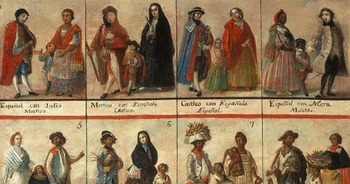
The logic and structure of the casta system can be analyzed via the surviving colonial portraits detailing the ordering of races. As visual guides designed to organize and instruct Spanish colonial societies, casta paintings instructed a mostly illiterate colonial settler society on the process of organizing labor along racial/casta lines. The paintings represented as many as sixteen racial categories, each with their own legal appellation, access to labor rights, and predetermined states of servitude within the colonial system (Figure 1).
Eighteenth Century Casta Paintings.

The casta system classified degrees of individual ancestry in order to legally and socially distinguish between the parents and the offspring and, as such, between Indian, Black, Mulatto, Pardo, Moreno, Mestizo, Prieto, Morisco, Sambo, Lobo, etc.). Evolving from the Medieval Spanish idea of “limpieza de sangre,” the Spanish casta system in the Americas predestined legal states of bondage and organized access to rights and privileges. The system evolved out of the violence and ideology developed during the Spanish Reconquista's systemic annihilation of purported religious impurity, which ejected Jewish and Muslim populations from Spain. In Cuba, the system determined those legally and racially classified as pardos and morenos as “free” people of color, while negros and mulattos were designated as enslaved.Footnote 18 The system determined which bodies deserved access to gradations of freedom, all the while positing Spanish ancestry as a predictor for intellectual capacity, behavior, personality, and social and labor status. During the early colonial period, indigenous peoples and populations from Africa were the primary foci of the system. Between 1868 and 1886, this long-established system proved useful in defining states of bondage for indigenous and Afrodescendant populations during the prolonged process of “emancipation,” and the racial logic established by the system would continue as part and parcel of the ceaseless afterlife of Cuban slavery. The ways in which servitude and labor were organized under the Spanish casta system informed colonial and post-colonial society, fashioning the foundations upon which forms of colorism, classism, and labor oppression would intersect within Cuba, Latin America, and the Spanish Caribbean. Moreover, anxieties over the expanding Afrodescendant population produced feverish concerns over maintaining white rule. Whiteness (blanqueamiento), as argued by the Cuban philosopher José Antonio Saco, required the sexual and social subordination of free and enslaved women of color.Footnote 19 Whiteness in Cuba under the casta system required concubinage, or “intermarriage,” between white men and women of color as a tool for whitening the population, setting off a language of race that privileged whiteness and whitening as significant factors in Cuban social mobility. As such, the phrase trabajando como negra/o… (working as a black woman/man) in order to “live as if one was white and therefore free” references the blanqeamiento project of whitening the work force and offers a profoundly pessimistic view of gaining freedom and social mobility via labor. For those who must sell their labor, and/or offer their bodies/reproduction to the interests of whiteness, the pretense of social mobility via whitening was, in the end, a cruel and annihilating farce; arduous work instead has been the constant experience.
Saco's proposition to coerce black women's bodies into a violently racialized domesticity, and force them into the labor of producing whiteness, belies emancipation through “free” labor. Saco offered elite whites on the island, fearful of a racial black majority, the fantasy of a docile and whiter-looking working population, presumed to be loyal to whiteness. The lighter children of black women, Saco reasoned, would allow Cuba to enter the community of white nations as an equal—revealing via his writings the era's redeployment of the early colonial casta system.
By the end of the nineteenth and beginning of the twentieth century the racial classifications developed under the casta system were fully interwoven into Cuban social life. As such, “… trabajando como negra/o …” reveals a hidden transcript among workers enduring the afterlife of slavery, enacting critiques about deferred freedoms, the futility of arduous labor, and the persistence of social, political, and economic exploitation. Hence, the phrase “… trabajando como negra/o …” defies dominant social mobility discourses that propose that one can access freedom via work and signals the ways in which for people of color work is antithetical to “liberation”; it boldly marks the position that, within the context of white supremacy, work offers, at best, a façade and a dissatisfying simulacrum of “freedom.”
The limitations of much of the historiography on Cuban slavery includes the absence of a critique of the afterlife of slavery, it is silent on black kinship, the strategies black women deployed to advocate for themselves and their families, and the experiences of childhood in bondage. There is, however, an emerging feminist scholarship within the field of Cuban/Caribbean history that has started to unearth valuable information on the lives of women of color.Footnote 20 A survey of the accessible feminist historiography provides information on notable aspects of the lives of women of color, such as applications for self-manumission and the purchase of property. Such transactions, involving property and juridical status, produce a stream of documentation from which feminist scholars interpret the desires of women held in bondage. Feminist scholars engaging with children's history have also begun to make inroads into the often-ignored area of childhood and adolescence. Scholars of children's history contend with the fact that work on childhood requires additional rigorous culling from a myriad of sources, and, as such, children's history has proven challenging, because as a population children were silent and invisible, unable to write or speak for themselves.Footnote 21 Feminist scholars of children's history have noted that while archived legal cases provide a window into self-manumission efforts by women, in the case of children, except for bills of sale, the sources that mention children are scarce, requiring scholars interested in the lives of children to seek them out across various sources—including but not limited to, legal cases, newspapers, census returns, plantation records, the manuscripts of planters, traveler narratives, accounts within Afrodescendant publications (national and international), and post-emancipation narratives of slavery. Wilma King has argued that as we engage the history of children and adolescents, scholars are compelled to ask different questions regarding the lives and vulnerabilities of younger populations.
The historiography on Cuban slavery that has made mention of enslaved children relies on available documentation of slave ships' logs, which, as early as the seventeenth century, recorded the legal and illegal disembarkment in Cuba of large cargos of enslaved children. Historian Luis Martínez Fernández has found that while it was common for slave cargos to include children, one ship, the San Pedro which landed in Havana in 1628, held 230 slaves, 72 percent of whom were children, half of whom were nursing babies. According to Martínez Fernández' findings, these children were sold to at least 149 different individuals, including military officers, a priest, a barber, and a midwife. As per Martínez Fernández' account, one boy among the enslaved would be purchased by Francisco de Noriega, himself a former slave.Footnote 22 The presence of children has been estimated to constitute over 12 percent of the Africans transported during the early colonial period, increasing to 73 percent by the beginning of the nineteenth century.Footnote 23 Yet, the historiography and statistical evidence leaves untouched information about the ways in which children were trafficked to Cuba, the ways their labor and loyalty were extorted, or the ways in which enslaved children, endured a dearth of physical and emotional care, working and birthing in the service of their masters.
Antiblack Emancipation History: The Afterlife of an Undying Colonialism
Hartman's theorization of racialized violence and deferred freedom within the political life of black populations can be combined with Davies and Jardine'sFootnote 24 analysis of the Caribbean region's “undying” colonialism and imperialism. The conversation between these critiques creates new theoretical possibilities. On the one hand, they combine to better interrogate the interconnections between systems of domination in the Caribbean and in the United States, and, on the other hand, they can be fused to produce a theoretical framework applicable to Cuba, as one of the western hemisphere's oldest slave societies, a site still reeling from slavery, of undying colonialism and imperialism, with a long history of Afrodescendant-led antislavery, anticolonial, anti-imperialist efforts. Within Cuban/Caribbean studies, the merging of an “undying” colonialism and slavery's afterlife (in the United States and in the Caribbean) yields a transhistorical theoretical understanding that showcases the ways in which social and labor oppression remained relatively untouched in the midst of anti-colonial revolution and emancipation. The transhistorical continuities of enslavement, exploitation and colonialism inform and remind scholars of the persistence of racial, social and labor oppression, as well as the deferment of freedom across epochs. Merging an analysis of the afterlife of slavery and the Caribbean region's undying colonialism allows for an assessment of the Cuban nationalist independence struggles as keeping freedom beyond the reach of people of color and actively engaged in maintaining white supremacy. The fusion of an analysis of the afterlife of slavery and an undying colonialism permits scholars to ask new questions about the justifications and success of revolutionary efforts amid colonial rule, as well as the long-term impact of colonialism/imperialism on racial and gendered divisions of labor. Such an approach permits an assessment of multigenerational servitude and racially restricted labor options that, long after slavery has ended, bolstered practices of exclusion and antiblackness.
A transhistorical approach on the life and afterlife of Cuban slavery challenges dominant narratives on the trajectory of late nineteenth century slavery and emancipation. It interrupts the curated series of legal and political events presented as markers for the end of slavery and the beginning of freedom. For example, within the traditional historiography, acts to maintain bondage, such as anti-emancipation efforts and weak legislation (i.e., the Moret Law), have been justified as either the expression of increasing contradictions within the Cuban economic system or as the result of these contradictions intersecting with domestic and international pressures (i.e., international calls for abolition).Footnote 25 However, by analyzing the tactics developed to ensure the deferment of freedom in the interest of white supremacy at the end of the nineteenth and into the early twentieth century through a transhistorical lens that examines the perpetual reinvention of bondage, the effectiveness of such long-held explanations of legal and political contradictions become questionable.
Examples of the antiblackness underlying the seeming contradiction between the desire to liberate “the nation” while keeping former slaves in captivity are provided by the very founding moments of anticolonial struggle. The prevailing narrative of Cuban emancipation within the academic literature, as well as Cuban schools and households, begins with the declaration of emancipation given by Carlos Manuel de Cespedes, celebrated as the “father of the nation” and liberator of slaves, who, frustrated with Spanish colonial rule, economic hardship, and taxation, called for rebellion and subsequently freed his slaves in 1868, incorporating them into a disorganized and poorly armed group of rebel fighters during what would come to be known as the Ten Years' War (1868–1878) against Spain. By comparison with other planters, de Cespedes held few slaves (fewer than sixty, by some accounts), and his rebellion required that a group of fellow planters follow him by also freeing their slaves.Footnote 26 Some planters, instead of liberating their slaves, compromised with de Cespedes by having them, particularly children and women,Footnote 27 cater for the needs of the rebel army by laboring in work gangs and as servants to the rebels. Meanwhile, other white rebels in eastern Cuba decreed the death penalty for anyone caught inciting slaves to revolt against slavery.
Those enslaved forced to join the rebel army and fight for anticolonial white planters could not organize independently against white supremacy and the institution of slavery. Instances in which enslaved women were declared “free” proved insignificant because in practice “freed” women were often expected to remain on the estates, serving the interests of their masters. Historian Rebecca Scott reports that in 1869, one official wrote with frustration that, when enslaved men were freed by the rebels, a group of enslaved women had mistakenly assumed they were also free; the women argued, “that the emancipation decree has declared them free and in virtue of their independence they resist returning to that estate. …” The estate's owner was advised to appeal to the military court to recover the libertas (“freed” women).
Although the libertos (freed slaves) as a select group “freed” by their respective owners became a walking challenge to the institution of slavery, some within the white rebel leadership, desperate for fighters, justified the necessity of liberating enslaved men because the rebels otherwise were outnumbered; only one-third of the fighting men were white, and without libertos, they would lose to the Spanish. Under such conditions, the rebel leadership declared their slaves to be free, but only to shortly afterward reframe and revoke the meaning of “emancipation.” By the end of 1869, those “freed” saw a restrictive legislation, called the Reglamento de Libertos (regulation of the freed), which obligated libertos to forced labor.Footnote 28 In some cases, the regulations of the freed compelled libertas to work as personal domestic servants and restricted the right to bear firearms by segregating whites (those born in Spain), white creoles (those born in the Americas), libertos, and Africans, as per the conventions of the casta system. Libertos as a social category implied freedom in name only, as men, women, and children categorized as libertos were seen as necessary but dangerous and were used as coerced labor gangs or combatants within the nationalist rebel cause.Footnote 29 Despite the popular historiography on the matter, the freeing of de Cespedes' slaves in 1868 did not end their state of servitude, nor would the subsequent passage of the Moret Law by the Spanish in 1870 guarantee freedom.
Deferring Freedom Via Cuba's Womb Law
The Moret Law would prove to be one of the core pieces of legislation utilized to defer freedom. The Moret Law of 1870 (a “womb law” passed by Spain similar to measures adopted in Brazil and other parts of Latin America) “freed” children born in 1868 and after—but not their mothers—alongside freeing Those enslaved sixty years and older. Under the Moret Law, “freed” children owed unpaid labor to their masters until they reached eighteen. Articles six and seven of the law stipulated that “… the patrono (owner) has the obligation to give their slaves/’wards’ a basic education necessary to exercise a trade or profession … the patrono acquires all custodial rights, including the right to take advantage of ‘… the freedman's labor without compensation until the age of 18’.” Article eight of the Moret Law clarified that “… upon reaching the age of eighteen, the freedman will earn half the daily wage of a free person in the same trade or profession” (Moret Law 1970). The law simultaneously provided and removed free status by defining “apprentice” as a distinct social and labor category caught between slavery and freedom, or—so to speak—a “half free” condition. Additionally, if enslaved parents won or purchased their freedom, they could not automatically gain custody of their children until the child's completion of the required eighteen years of labor.
Article ten of the Moret Law provided guidelines under which the apprenticeship could be terminated by the owner, for example, “… an apprenticeship will end as a result of marriage, after the age of 14 for girls—and after 18 for boys…” (yet, in the case of girls fourteen and over, it is unclear if owners would allow such marriages to occur, or if the selling of enslaved girls as young brides to white men was practiced as a way to profit from the restrictions imposed by the Moret Law). Article ten's statement on marriage goes on to warn patronos against engaging in the prostitution of their apprentices. The final section of article ten stipulated that if a patrono prostitutes or permits the prostitution of a “patrocinado” (male or female) their slave/patrocinado would be removed from their custody. The inclusion of this warning directed at patronos suggests that the practice of prostituting the enslaved was common enough to warrant the notice. Moreover, it stands to reason that the earlier section of article ten sanctioning marriages at ages as young as fourteen, may have provided a solution to owners engaging in prostitution, whereby owners could negotiate the marriage of a girl and not risk losing the profit of her sexual labor if there was an arrangement with the husband to have her engage in prostitution for mutual profit. Or else, the law suggests that the owner could negotiate the transfer via marriage of a girl, knowing that she would be trafficked by her husband. Article ten of the law, without overtly stating it, excluded prostitution as a form of labor, which under the Moret Law could continue to be extracted by the owner, however, as of yet, there isn't available evidence within the consulted historiography showing that owners/patronos obeyed article ten of the Moret Law, nor whether article ten was enforced by authorities. But, considering the ways historians have proven owners/patronos successfully disobeyed the law, and the ways in which the enslaved lacked means to challenge violations in court on the part of their owners/patronos, it stands to reason that the warning to owners, as well as the protection from sexual exploitation for enslaved girls and boys, may have seldom been heeded or enforced. Additionally, there is silence within the available historiography on prostitution of those enslaved; instead, other aspects of the Moret Law have been centered within the literature.
The “freedoms” the Moret Law declared were illusory both in principle and in practice.Footnote 30 The age of the apprentice was often not known, or was alterable by the owner, who at all times maintained the authority to fabricate dates of birth and thereby deny rights based on the age afforded under the Moret Law.Footnote 31 Moreover, the law masked the social dynamics of life and death experienced by enslaved children—especially death, which was all too common. Colonial white supremacist political ideology factored into the logic of the law on the disposability of black lives; the eighteen years provision maximized productivity and profit for the owners, if the young survived to mature through childhood, adolescence, and adulthood. To borrow the poetic phrasing of Audre Lorde, the infants and toddlers impacted by the Moret Law were “not meant to survive,” and owners anticipated the improbability of most children impacted by the law eventually gaining freedom.
The law established a judiciary body, the Juntas Protectoras de Libertos (“committee for the protection of the freed”), whose members were themselves slaveholders mandated to oversee enforcement, thus unlikely to become champions of the enslaved and legally emancipated. Lack of enforcement of the law and slaveowners' opposition to significant changes meant that appeals for freedom brought forward by the enslaved under the Moret Law were difficult to file and even more difficult to win.Footnote 32 Even when the emancipated were freed, they remained extremely vulnerable socially, politically, and economically. Cuba's governing officials had no desire to preside over rapid and large-scale emancipation.
For white Cubans, enfranchisement yielded barbarism and gradualism avoided what they feared as the evil consequences of abolition, which they detected as the failures of Radical Reconstruction in the United States, when after the Civil War, emancipation provided the newly enfranchised a voice in government.Footnote 33 Legal language cloaked and mystified the persistence of structural antiblack violence under the pretense of free labor. Just as the Moret Law of 1870 had not actually freed those whose emancipation it assumed to declare, similarly, the patronato of 1880 did not protect those whom it declared protected. Under the law, between 1885 and 1888, one quarter of the remaining patrocinados were to obtain their full freedom each year in descending order of age. The slaveowners supported the law's provisions allowing for freedom through self-purchase, but only with their consent. Legally, patronos were to provide education to the young and to pay each patrocinado a small stipend. Yet, nothing was guaranteed, the letter of the law could not ensure the law's enforcement, and ultimately the law left in place the exploitative extractions of labor particular to slavery and the disposability of black bodies. Owners continued to sell their slaves, mete out corporal punishment, and exert full rights toward runaways, while in contrast, patrocinados could not refuse to work, seek another employer, or leave an estate, and their pay was often docked for illness or as punishment.
Sexual Exchange and the Purchase of Freedom
According to the law, patrocinados could purchase themselves via “mutual accord.” More than thirty-five thousand patrocinados achieved their freedom in this way between 1881 and 1886, by paying an agreed upon price. Such self-manumissions, according to Scott, especially occurred during times of economic depression, when owners, desperate to avoid financial ruin in the midst of the anticolonial revolution, increasingly used manumissions to raise capital and pay the meager wages due by law to those they held as patrocinados.Footnote 34 Therefore the owners could minimize their losses by funding, through the price of “freedom” for some, the paltry wages underscoring the continuing servitude of others. Self-purchase ultimately meant self-paying for emancipation and abolition. Contractual manumission through self-purchase allowed for the funding of persistent black enslavement under the patronato system, blurring the line between freedom and slavery. “Freedom,” whether under the “womb law” or patronato, maintained the owners' full control over the racially enslaved, ultimately making purchased or legally granted “freedom” integral, rather than alternative, to black servitude, for which emancipation acted as the prelude to slavery's afterlife, rather than its end.
According to Scott, the cases brought before the courts by those seeking to purchase the freedom of family members provide insight into the myriad strategies women attempted. Over time, sisters appealed for the freedom of brothers; parents, grandparents, and godparents for that of children; older children for that of parents. A patrocinado who had no free relatives might turn to other free persons of color, people with whom he or she might have links through the cabildos de nación (African ethno-religious self-aid societies) or ties of compadrazgo (kinship: biological, fictive, and religious, following the codes of African spiritual communities). Success in these cases was limited as masters successfully resisted the paid manumission of children, often compelling freed parents to remain on the estate where they had been slaves until all members of the family were free.Footnote 35 When masters were recalcitrant to release children, the process could take years. Women wrestling freedom via manumission engaged in what can be theorized as unending acts of emancipation. As soon as they gained their individual “emancipation”—in some cases by engaging in the informal labor of sexual work—they embarked on the long process of “freeing” their children and extended kin from the apprenticeship system.
The patrocinados had few potential sources of funds with which to accumulate the indemnity required and found it nearly impossible to save from their meager monthly wages of one to three pesos. More significant sources of income included self-employment (such as laundry service), small-scale agricultural plots, or farm animals. Plantation account books reflect the importance of these activities, recording the purchase of crops and pigs from patrocinados,Footnote 36 which proved, however, inadequate when compared to other sources of income, such as sex work.
Enslaved men and children were not able to access self-manumission at the same rates as enslaved women. Luz Mena indicates that many more enslaved women obtained their freedom than did their male counterparts. And there were more free black women in interracial marriages/unions than free black men. Scholars have been shy to grapple with what influenced the overtly gendered access to self-manumission, what alternate strategies of securing freedom were at play, and the ways in which these included the selling of sexual services by enslaved women confronting the high financial cost and political or social entrapments of emancipation. Enslavement required that women of color endure subjection in the form of sexual violence and engage in strategies for reclaiming a limited measure of control over their bodies. Slavery, and its afterlife, forced women of color to endure the complex interstices between sexual violence and sexual transaction. The ability of women of color to obtain manumission can then be considered as linked to their place within the sexual economy of the island. Compared to the segregation and sequestering of white women and girls, the selling of sexual services by women and girls of color could have provided the funds necessary to purchase freedom, as the patriarchal and racial structure of society normalized coercive “concubinage,” or selling of sexual services by enslaved women and girls. Historians Martínez FernándezFootnote 37 and MenaFootnote 38 have stated that the social confinement of white women meant that the public presence of women of color as slaves, servants, and workers resulted in being treated as hypersexual and available. As such, unlike their white counterparts, women of color were hypervisible as they were pushed into public spaces. Women and girls of color were left to endure white colonial patriarchy's virgin/whore dichotomy, which targeted, for sexual exploitation, all women, but reserved the cruelties allowable under slavery for black women and girls. Under the logic of colonial white masculinity, women and girls of color were “put to work” in public spaces both because their labor was needed and because their public presence marked the power of whiteness. Following the codes of Spanish colonial society, the physical presence of enslaved black women and girls visibly working in public spaces marked them as unprotected and doubly exploitable. As per Martínez Fernández, since the early colonial period, women of color moved within public spaces providing laundry services, and such work provided by enslaved women and girls often served as fronts for prostitution, blurring the lines between care or service work and sex work.Footnote 39 In addition, according to Garcia and Gullon Aboa, the prostitution of free women of color notably increased during the middle of the nineteenth century due to the economic downturn amid the anticolonial war against Spain. Less attended to by historians of Cuban slavery and anticolonial historiography is the relationship between the rise in prostitution due to the economic downturn and the exchange of sexual services as a means through which enslaved and “free” women and girls sought to purchase freedom.
Garcia and Gullon Aboa's analysis of the Spanish colonial records, specifically detailing prostitution tolerance zones at the end of the nineteenth century, reveals free women of color illegally and informally engaging in unregistered prostitution.Footnote 40 Yet, the colonial government was obsessively preoccupied with white prostitution, and the prostitution of women and girls of color (negras, mulattas, pardas, indias, mestizas) did not engender comparable levels of policing, legislation, control, or moral panic. One explanation as to why colonial authorities ignored prostitution by women and girls of color is that their engagement in prostitution was normalized within the very logic of colonial enslavement, violence, and gendered labor exploitation. The sexual availability of women and girls of color had historically enriched slaveowners via the operation of brothels populated with enslaved women and girls. As such, the exploitation of enslaved women and girls became naturalized, the violence endured by women of color shrouded in the language of seduction and deviancy, and the purity of white women was of greater concern to Cuban white supremacist economic and political interests.
The available historiography on colonial and early twentieth century sex work, or sexual exchanges, relies on police records and cases that came before colonial courts, as well as census data collected by the US government following occupation of the island in 1898. Such sources and accounts highlight the profound anxiety over white prostitution alongside efforts to contain prostitution during the nineteenth century to specific urban zones of tolerance, while the few scholarly works on enslaved women avoid the question of prostitution. For example, the work of Mena offers an assessment of post-manumission property acquisition by women of color and their purchasing power via a number of “respectable” jobs, most notably listing laundry services as a primary method of raising funds to purchase self and property. Yet, nineteenth-century Cuban society provided few social and economic outlets for women and girls of color.Footnote 41 Besides, occupations with a predominance of women of color, such as domestic workers, laundry services, and cooks, were so oppressive that they did not offer protections against sexual exploitation and coercion into the selling of sexual services.
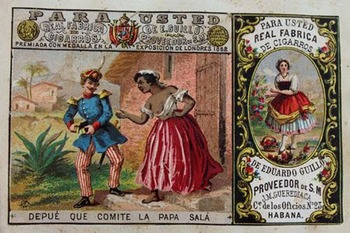
The scholarship on women of color in Cuba during the nineteenth century has primarily endeavored to construct respectable narratives of enslaved and free women of color laboring for their freedom. A critical analysis applying Hartman's theoretical approach toward slavery and its afterlife would be more useful, as it suggests that, for women of color, access to freedom was often linked to sexual domination, and that sexual exploitation was exacerbated by the prospect of manumission, which was itself integral to enslavement rather than a way out of it.Footnote 42 The historian's discomfort with the complexity of sexual services and sexual exploitation can be justifiably explained as based on the lack of available archival material on sexual exchanges performed by women and girls of color. Yet, the archive's silence on the mutually reinforcing connection between sexual and racial violence has yielded narratives of resilience, respectability, and honor among women of color aimed at demonstrating their meritorious access to property, humanity, and citizenship, or their value within dominant ideological considerations of work as equivalent to deserving freedom through property acquisition. And, as such, the narratives on respectability thwart notions of freedom as being more than the right to social respectability and access to reputable labor. Guevara and Mirabal have argued that concerns over respectability and access to citizenship rights are evident in the publication of the nineteenth-century Afrodescendant Cuban women's magazine Minerva.Footnote 43 At the end of the nineteenth century, the publication promoted the voices of thoughtful, well-educated women of color committed to promoting representations of respectable black womanhood deserving of full citizenship rights.Footnote 44 Contributors condemned the racial and sexual exploitation of women of color, and the publication stood against white supremacist claims, like those of Benjamin de Cespedes, that prostitution by women of color was a genetic or biological function of black women's hypersexual nature. As per the scholarship of Guevara, the publication had two phases of existence; during the first phase Minerva, offered an alternative narrative to those all too eager to associate social problems, illness, and poor public health with black women engaging in prostitution. Minerva's preoccupation with respectability during this first phase can be understood as a strategy for women of color to advocate for themselves, even if under the terms set by patriarchal Cuban white supremacy.Footnote 45 Moreover, the publication's concern over respectability can be seen as a manifestation of the committed efforts by free and literate women of color to intervene in the prevailing discourses of naturalized hypersexuality applied to all women of color, which justified sexual violence toward enslaved and free women. Publications like Minerva where an example of what Cuban society could expect from free women of color once they were granted full citizenship, and stood in direct opposition to popular images of enslaved or free women of color selling sex on public streets, such as the costumbrismo drawings of Landaluze, which highlighted a white social order obsessed with the public presence of enslaved and “free” women of color perceived to be engaged in sex work, deviancy, and lesbianism across generations.Footnote 46 Both Minerva, and the visual representations of libidinous women of color it opposed, revealed much about white supremist anxieties over freedom, especially the freedom of black women and girls. An analysis of the publication highlights the antiblackness directed specifically at women and girls of color, the anxiety over legal freedom, and the street presence of working women of color (Figure 2).
Landaluze 1862, La Habana: Costumbrismo Images of enslaved and free women of color prostituting in Havana.

Conclusion
Cuban bondage shaped multiple and overlapping states of service, servitude, apprenticeships, and wage labor—bondage made possible the ability of island elites to prosper and, ironically, to fight for independence from Spain. It also allowed US slavery to obtain a second life, as Cuban slavery would outlive that of the United States by twenty years. By the turn of the century, legal slavery had ended, but enfranchisement for racialized populations and women of color remained a distant prospect, exploitation of child labor was common, and in general, labor conditions did not change much from those of slavery, and US intervention would bring with it the misery of occupation. Indeed, Jim Crow segregation in the United States, once exported to Cuba, produced a powerful amalgam of violence as it collided with Cuba's own brand and history of racism, disenfranchisement, and segregation. Following the US occupation in 1898, US officials objected to public assertions of rights by black Cuban citizens and were especially suspicious of black Cubans in military service. On April 18, 1900, Cuba's electoral law disenfranchised the formerly enslaved; stipulated that voters must be male, over twenty-one years of age, be able to read and write, own property worth $250 in US gold; or have served in the Cuban army prior to July 18, 1898. These restrictions disenfranchised large sectors of the population in general and Afrodescendants in particular. The desire for greater civil rights by Afrodescendant Cubans would lead to the formation of a political party known as the Partido Independiente de Color (Independent Party of Color), advocating for greater political and economic participation; the PIC was the culmination of over a decade of struggle.Footnote 47 The party, however, was accused of racism by white Cubans and US officials alike. Upon organizing one of the largest protests on the island, the PIC was charged with conspiring a black uprising, which lead to a joint US and Cuban military operation in 1912 to eradicate party leaders and members of the PIC in Oriente.Footnote 48
Just prior to the massacre that eradicated the PIC in 1912, and as a method of safeguarding white supremacy on the island, Cuba's government operating under US occupation outlawed the formation and activities of any political party organized by race.Footnote 49 Overnight, the PIC became illegal, and the joint Cuban and US military forces were ordered to exact aggression against the burgeoning black political movement with unyielding violent military force. As many as forty thousand Cuban citizens of African descent were persecuted, jailed, and terrorized, and the leadership of the PIC were hunted and lynched as the US and Cuban military, led by the son of the anticolonial hero Jose Marti, deployed violent tactics long developed by the white planter slave holding class to control slave uprisings. Formed after US occupation to protest exclusion of people of color from Cuban politics and racial subordination, the PIC included Afrodescendant veterans of the war against Spain, as well as a number of women in leadership, such as Elena Sumitiel. Sumitiel would later describe the context as one where Afrodescendants openly protested in 1912, which immediately led the white elites to label the protest as a “race war” between “white civilization” and “black barbarism.” The massacre limited future social protest by terrifying populations of color into conformity and suppressing the retelling of the history of the massacre itself.
The 1912 massacre is generally ignored, and seldom covered within Cuban history. Bernardo Ruiz Suárez, a witness to the massacre, wrote:
All the bitterness, all the hatred, all the ancestral prejudice of the white race against the black, were let loose. While the machine guns of the government troops were mowing down thousands of colored men, not alone those in arms, but the peaceful inhabitants of towns and villages,… [in] the larger cities and even in the Capital of the Republic, white men armed to the teeth went about ordering any and every black man to withdraw from the streets and public places on pain of death, and the mere color of his skin was sufficient reason to send a man to prison on the charge of rebellion. (1922: 43)
Viewing this history from the transhistorical lens of slavery's afterlife means considering exploitation to be an inherent part of Cuban history.Footnote 50 The coercion and extraction of labor that characterizes the “afterlife of slavery” in Cuba has also fueled a tradition of legal and cultural opposition that is visible and palpable well into the contemporary moment. Those engaged in these traditions of opposition contend with dominant framings of Cuban history that reduce people of color on the island to “beneficiaries” of a revolutionary liberationFootnote 51 and exact gratefulness as payment—ensuring that the lives of enslaved and captive women and children remain invisible. Mimi NguyenFootnote 52 has offered the assessment that such approaches to a population's indebtedness precludes the subjects of freedom from escaping colonial and white nationalist histories that deemed them “unfree.” To apply Nguyen's poignant observation, regarding colonial and post-colonial narratives produced to service nationalist white supremacist agendas that extorts from populations of color the “gift of freedom,” is to consider how receiving the “gift of freedom”/gift of emancipation and “gift of labor” is to be indebted without end.
To frame “work” as freedom is to enact strategies of coercion. To borrow the words of Franco Barchiesi, beneath the veneer of legal language, archival evidence, and statistical measures, there is in fact the “afterlife of slavery,” the reproduction of an enslavist devaluation of black life under the guise of “free labor.” To address and critique the humanizing claims of labor, and labor as the price paid for freedom, is part and parcel of the afterlife of bondage and the often-imperceptible bind between working to earn freedom and deserving freedom. As such, Shona Jackson's intervention, applied to the context of Cuban bondage, births a new perspective on apprenticeships and forced work as a continuation of states of servitude, as well as offers scholars a new lens through which to revisit the literature on slavery, emancipation, the “earning” of rights and thereby reconsider the meaning of freedom.Footnote 53