Introduction
Cannabis use is associated with risky sexual behavior (RSB), including earlier age of initiation, more partners, and less frequent use of protection (Copeland & Swift, Reference Copeland and Swift2009). This is of great public health concern, as RSB serves as a vector for STDs and unwanted pregnancies, both of which are more frequently reported in cannabis users than non-users (Reardon, Coleman, & Cougle, Reference Reardon, Coleman and Cougle2004; Wu, Ringwalt, Patkar, Hubbard, & Blazer, Reference Wu, Ringwalt, Patkar, Hubbard and Blazer2009). Despite several reports of elevated sexual risk among cannabis users, little is known regarding potential mechanisms through which cannabis use may confer increased sexual-risk. In this study, we examine the possibility that neurocognitive performance on measures of inhibitory control may influence the extent to which cannabis users engage in RSB.
Investigations in the past decade have shown that cannabis users exhibit neurocognitive deficits in inhibitory control (also called impulsivity), defined as a predisposition toward rapid, unplanned reactions without regard (or sensitivity) to the negative consequences (Moeller, Barratt, Dougherty, Schmitz, & Swann, Reference Moeller, Barratt, Dougherty, Schmitz and Swann2001). These may be the result of functional changes in brain structures important to inhibitory control (e.g., prefrontal cortex, anterior cingulate, and striatum), which are densely populated with cannabinoid receptors, are the target for cannabis’ psychoactive effects, and undergo neuromaturation into young adulthood (Gogtay et al., Reference Gogtay, Giedd, Lusk, Hayashi, Greenstein, Vaituzis and Thompson2004) when significant use of cannabis often emerges. Cannabis users show impairments in several inhibitory control processes including problems with motor inhibition, risk-taking, and decision-making (Crean, Crane, & Mason, Reference Crean, Crane and Mason2011), which may persist even after 28 days of abstinence (Bolla, Brown, Eldreth, Tate, & Cadet, Reference Bolla, Brown, Eldreth, Tate and Cadet2002). Recent data from our group also suggest that individual differences in inhibitory control might contribute to compulsive cannabis use despite negative repercussions (Gonzalez, Schuster, Crane, Vassileva, & Martin, Reference Gonzalez, Schuster, Crane, Vassileva and Martin2012). Taken together, there is a growing body of literature connecting cannabis use to deficits in inhibitory control, which may render cannabis users more vulnerable to risky behaviors.
There are several reasons to suspect that problems with inhibitory control may influence RSB among cannabis users. First, poor inhibitory control may manifest as initiation of RSB without adequate forethought of potential consequences. Second, abstaining from RSB may be more effortful for individuals who overvalue immediate rewards and discount the possibility of long-term consequences, as well as for individuals who have difficulty suppressing reward-driven actions. However, only two studies have specifically examined whether inhibitory control deficits confer increased risk for RSB among substance users. Results reveal that in HIV-seropositive substance abusers with better decision-making, greater emotional distress (Wardle, Gonzalez, Becharea, & Martin-Thormeyer, Reference Wardle, Gonzalez, Bechara and Martin-Thormeyer2010) and sensation-seeking (Gonzalez et al., Reference Gonzalez, Vassileva, Bechara, Grbesic, Sworowski, Novak and Martin2005) are associated with more RSB, providing preliminary evidence that individual differences in inhibitory control may be important in understanding susceptibility to sexual-risk. Because these investigations were limited to HIV-seropositive individuals who used primarily cocaine and heroin, and relied on only one measure of inhibitory control (Iowa Gambling Task), it remains unknown whether similar processes are evident among otherwise healthy cannabis users.
Similar to what has been reported with measures of inhibitory control, problems with episodic memory are commonly reported among cannabis-using samples (Gonzalez, Reference Gonzalez2007; Ranganathan & D'Souza, Reference Ranganathan and D'Souza2006). However, unlike inhibitory control, there are no strong theoretical reasons for suspecting that problems with episodic memory would relate to RSB. Here, we examine potentially divergent patterns in the relationships between inhibitory control and episodic memory on RSB. We hypothesized that worse inhibitory control performance, but not worse episodic memory, would be associated with RSB. Moreover, we suspected that a greater amount of recent cannabis use would be linked with more RSB only among individuals with worse inhibitory control.
Methods
Participants and Procedures
The sample consisted of 66 Chicago-area, cannabis users (CU) who were recruited for a laboratory-based study of cannabis use and neurocognition (PI: R.G.). Participants were recruited through word-of-mouth and printed flyers posted at several universities, coffee shops, stores selling cannabis paraphernalia, and throughout the Chicago metropolitan area. A small subset of participants (3.0%) was also recruited from a large natural history study of the social–emotional contexts of adolescent smoking (PI: RM). Participants were administered a counterbalanced test battery that included toxicology tests, structured interviews, self-report questionnaires, and neurocognitive tests. The study was approved by the Institutional Review Board at the University of Illinois at Chicago and written informed consent (or parental consent and participant assent for minors) was obtained.
All participants underwent a telephone-screening interview to determine eligibility. Those without exclusionary confounds were invited to complete the protocol. Approximately 29% of the screened CU individuals deemed eligible to participate never came into the laboratory, which was consistent with the “no show” rate observed among non-cannabis users in our larger study (23%). All participants were required to be fluent in English, be sexually active and have greater than 8 years of education. Additionally, several inclusionary criteria were implemented to minimize comorbidities that could adversely influence neurocognitive functioning, and included estimated full scale IQ greater than 75, no current use of psychotropic medications, and no formal diagnosis of a learning disability, developmental delay, psychiatric illness (including ADHD), neurological condition, birth complication, or history of loss of consciousness greater than 10 min. Substance use inclusion criteria were also established to obtain a homogenous sample of cannabis users who were relatively naïve for use of other substances of abuse. All participants endorsed no lifetime use of any substance (other than cannabis, alcohol, nicotine, and hallucinogens) more than 10 times. To ensure no recent drug use (other than cannabis), all participants underwent rapid urine toxicology screening to test for recent use of cocaine, opiates, propoxyphene, phencyclidine, methadone, ecstasy, barbiturates, benzodiazepines, oxycodone, and THC (10-panel Drug Check Cup; Express Diagnostics, Blue Earth, Minnesota). No participant tested positive for any illicit drugs other than cannabis. DSM-IV lifetime alcohol dependence was not endorsed by any participant, and there were no reports of drinking more than 3 drinks per day on average during the past 30 days. Additionally, DSM-IV abuse/dependence criteria was not met by any participant for any illicit substance (other than cannabis). No participant showed signs of intoxication during their visit or demonstrated significantly elevated breath alcohol content (BAC Md 0 [0, 0]) as assessed by the AlcoMate Prestige (Model AL6000; Palisades Park, NJ). All CU reported over 200 cannabis use occasions, use of cannabis more than four times per week during peak use, use of cannabis in the past 45 days, no cannabis use on the testing day, and identified cannabis as their drug of choice.
Measures
Demographics and potential premorbid and psychiatric confounds
Participants were queried on age, gender, ethnicity, education, household income, parental education, and medical/psychiatric history. Household income reflected parental income if the participant was living with their parents or their individual income if living independently. The total score from the Wechsler Test of Adult Reading (WTAR; Wechsler, Reference Wechsler2001) was used to estimate premorbid full scale IQ (FSIQ). The Wender-Utah Rating Scale (WURS; Ward, Wender, & Reimherr, Reference Ward, Wender and Reimherr1993) total score was used to evaluate for ADHD symptoms, with scores of ≥46 indicating a possible ADHD diagnosis. The Barratt Impulsiveness Scale-11 (BIS; Patton, Stanford, & Barratt, Reference Patton, Stanford and Barratt1995) total score assessed trait levels of impulsivity. Symptoms of depression and anxiety were assessed using the Beck Depression Inventory–2nd Edition (BDI-II; Beck, Brown, & Steer, Reference Beck, Brown and Steer1996) total score and the Beck Anxiety Inventory (BAI; Beck and Steer, Reference Beck and Steer1990) total score. Trained interviewers administered the mood disorders module of the Structured Clinical Interview for DSM-IV (SCID; First, Spitzer, Gibbon, & Williams, Reference First, Spitzer, Gibbon and Williams2002) to assess for lifetime and current diagnoses of Major Depression and Bipolar Disorder.
Substance use history
Cumulative past 30-day substance use was assessed via detailed interview, which probed for amount of use across 13 different substance classes, similar to methods used in other studies (e.g., Rippeth et al., Reference Rippeth, Heaton, Carey, Marcotte, Moore, Gonzalez and Grant2004). The SCID substance use module was administered to diagnose current and lifetime substance use disorders, with one or more symptoms suggestive of abuse and three or more symptoms indicative of dependence (First et al., Reference First, Spitzer, Gibbon and Williams2002).
RSB assessment
Overall RSB was assessed using the total score of the 5-item, multiple-choice sexual behavior subscale of the HIV-Risk Taking Behavior Scale (HRBS; Darke, Hall, Heather, Ward, & Wodak, Reference Darke, Hall, Heather, Ward and Wodak1991). To obtain a more detailed assessment of RSB, we administered the Risky Sexual Behavior Questionnaire (RSBQ). Because this questionnaire was added to protocol after our study began, a few participants (n = 13) did not have the opportunity to complete this questionnaire. The RSBQ was adapted from the AIDS Risk Behavior Assessment (ARBA; Donenberg, Emerson, Bryant, Wilson, & Weber-Shifrin, Reference Donenberg, Emerson, Bryant, Wilson and Weber-Shifrin2001) and is a nuanced inventory of sexual history with computed variables that estimate an individual's lifetime number of oral, vaginal, and anal sexual encounters (RSBQ-Encounters); frequency of cannabis interference with safe-sex, with options ranging from always to never on a 5-point Likert-type scale (RSBQ-Interference); frequency of use of protection either by the respondent or by his/her partner, with options ranging from always to never on a 5-point Likert-type scale (RSBQ-Protection); and lifetime number of sex-related negative consequences among those who had a history of at least one sex-related negative consequence, such as number of pregnancies and diagnoses of sexually transmitted infections (RSBQ-Consequences). It should be noted that analyses with RSBQ-Consequences were conducted with a smaller sample of participants (n = 19) because most individuals reported no sex-related negative consequences. Higher scores on all RSB parameters suggested greater risk.
Neurocognitive functioning
The Hopkins Verbal Learning Test–Revised (HVLT; Benedict, Schretlen, Groninger, & Brandt, Reference Benedict, Schretlen, Groninger and Brandt1998) measures episodic verbal memory and consists of three groups of four semantically associated words to be remembered after immediate, delayed, and recognition trials. The total words recalled after a 20- to 25-min delay was used in analyses. Measures of inhibitory control included tests of decision-making, risk-taking, motor impulsivity, and delay-discounting. Decision-making was quantified with the Iowa Gambling Task (IGT; Bechara, Damasio, Damasio, & Anderson, Reference Bechara, Damasio, Damasio and Anderson1994). We used a total net score in analyses (choices from good decks minus bad decks), with lower scores indicating worse decision-making or a bias toward immediate reward rather than longer-term rewards. The Balloon Analogue Risk Task (BART; Lejuez et al., Reference Lejuez, Read, Kahler, Richards, Ramsey, Stuart and Brown2002) assessed risk-taking. We used the average number of pumps per balloon, excluding the number of pumps when the balloon “pops,” with higher scores indicative of greater risk-taking. The GoStop Task (Dougherty, Mathias, Marsh, & Jagar, Reference Dougherty, Mathias, Marsh and Jagar2005) is a computerized stop-signal task, measuring motor inhibition. We used the total number of correct inhibitions minus number of “misses” on the “go” trials to adjust for artificially inflated correct inhibition scores among individuals who responded to fewer trials (either on purpose or through inattention). Higher scores were indicative of better motor inhibition. The Monetary Choice Questionnaire (MCQ; Kirby, Petry, & Bickel, Reference Kirby, Petry and Bickel1999) is a self-report measure of delay-discounting or intertemporal choice, which refers to the tendency to reduce the perceived value of rewards as the time delay for reward acquisition increases. The parameter k quantifies individual differences in delay discounting, with a higher value indicating steeper discounting, and log-transformed k-values were used as our outcome measure using established methods (Kirby et al., Reference Kirby, Petry and Bickel1999).
Statistical Analyses
JMP 9.0 (SAS, Carey, NC) was used to conduct analyses. We inspected data for non-normal distribution and outliers and performed square-root transformations or nonparametric procedures when assumptions of normality were violated. To avoid multicollinearity, delayed recall was the only HVLT index included in models, as it was the HVLT index most strongly correlated with RSB. Analyses involved predominately (1) multiple regressions with all indices of neurocognitive performance simultaneously entered as predictors and parameters of RSB as separate outcomes; and (2) moderated multiple regressions with centered scores representing 30-day cannabis use, neurocognitive performance, and their interaction terms as predictors and RSB measures as dependent variables. Additionally, we included theoretically relevant covariates (BDI, BAI, and 30-day alcohol and nicotine use) given that all have been positively correlated with both amount of cannabis use and RSB in previous investigations. To preserve power, non-significant covariates were removed and only reduced models (i.e., with significant covariates) are reported. Results were statistically significant when p-values < .05.
Results
Sample Characteristics
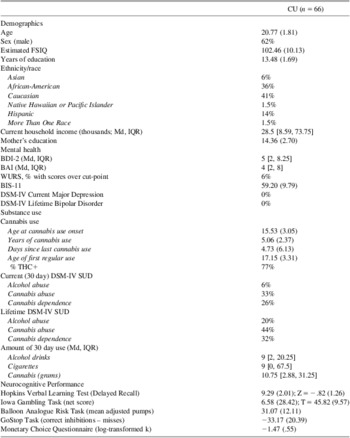
Participants did not demonstrate significantly elevated levels of depressive or anxious symptoms (Table 1), with the mean BDI-II and BAI scores well below their published clinical cut-points (12 and 7, respectively). Importantly, demographics and depression/anxiety measures in this sample were not found to differ from non-users in another study from our group (Gonzalez, Schuster, & Salija, Reference Gonzalez, Schuster and Salija2011).
Sample characteristics

Note. All values are means and standard deviations, unless otherwise noted. CU = cannabis users; Md = median; IQR = interquartile range; FSIQ = Full Scale IQ; BDI-2 = , Beck Depression Inventory-2nd Edition; BAI = Beck Anxiety Inventory; WURS = Wender-Utah Rating Scale; BIS = Barratt Impulsiveness Scale-11th version; DSM-IV SUD = Diagnostic and Statistical Manual IV Substance Use Disorder diagnosis; THC+ = positive rapid urine toxicology testing.
Neurocognitive Functioning and RSB
Pairwise Pearson correlations among neurocognitive measures revealed one significant correlation (IGT and BART, r(63) = −.36; p = .003), all other r-values ranged from 0 to .18; p-values ranged from .07 to .99. Table 1 details the raw score for each of the neurocognitive tasks and the standardized normative scores when available. In a prior study, neurocognitive performance in this sample differed significantly from matched controls on measures of episodic memory, but not those of inhibitory control (Gonzalez et al., Reference Gonzalez, Schuster and Salija2011). There were no associations between neurocognitive measures and RSBQ-Encounters, RSBQ-Consequences and RSBQ-Interference, p-values >.15. However, worse performances on HVLT, β = −.28; t(59) = −2.83; p = .006; and BART, β = .28, t(59) = 2.10 p = .04, were associated with higher HRBS. Additionally, worse HVLT performance was associated with higher risk on RSBQ-Protection, β = −.41, t(46) = −2.94, p = .005. No other neurocognitive tasks were associated with HRBS and RSBQ-Protection, p-values >.24. To examine if these relationships were an artifact of cannabis use severity being a potential “third-variable” related to both measures of neurocognitive functioning and RSB, we conducted the same analyses while covarying for the amount of 30-day cannabis use and the pattern of results was the same.
Interactions Between Amount of Cannabis Use and Neurocognition on RSB
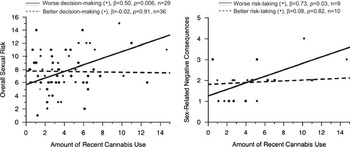
Finally, moderated multiple regression analyses were conducted to determine whether the relationship between cannabis use and RSB varied as a function of neurocognitive functioning. All omnibus models that included interaction terms treated cannabis use and neurocognitive functioning as continuous variables. Significant interactions (Figure 1) emerged between 30-day cannabis use and IGT on HRBS, omnibus: R 2 = .12, F(3,61) = 2.71, p = .05; cannabis use: β = .08, t(61) = .61, p = .54; IGT: β = −.13, t(61) = −.95, p = .35; interaction: β = −.29, t(61) = −2.19, p = .03, and between 30-day cannabis use and BART on RSBQ-Consequences, omnibus: R 2 = .44, F(3,15) = 3.91, p = .03; cannabis use: β = .35, t (15) = 1.70, p = .11; BART: β = .04, t(15) = .20, p = .84; interaction: β = .45, t (15) = 2.19, p = .04. To facilitate a graphical representation of significant interaction terms, the simple slopes of amount of 30-day cannabis use were tested with participants stratified based on a median split of their neurocognitive performance. Those scoring less than 2 on the IGT and greater than 33 on the BART were classified as having worse neurocognitive functioning. The median split results in the group with worse decision-making on the IGT evidencing a mean T-score in the mildly impaired range (T-score = 38; SD = 5.98) and those with better decision-making on the IGT demonstrating a mean performance in the average range (T-score = 52.11; SD = 6.90). The mean adjusted pumps for the better and worse BART groups were 21.58 (SD = 8.00) and 40.62 (SD = 6.77), respectively. Poorer and better performers did not differ significantly on demographics, depressive/anxious symptoms, or substance use factors (all ps > .05), with the exception of those with better IGT scores having consumed more alcohol in the past 30-days (p = .02). Follow-up regressions revealed that more 30-day cannabis use was associated with more overall risk on HRBS among those who performed more poorly on the IGT, β = .50, t(27) = 2.96, p = .006, but not among those who performed better, β = −.02, t(34) = −.11, p = .91. Similarly, more 30-day cannabis use was associated with more sex-related negative consequences among those with higher risk-taking on the BART, β = .73, t(7) = 2.80, p = .03, but not among those who with less risk-taking, β = .08, t(8) = .23, p = .82. No data-point was greater than 3 SD from the mean of the sample. However, RSBQ-Consequences ranged from one to four, and only one participant reported four negative consequences. Because of this, we repeated the analyses censoring the individual with the highest number of sex-related negative consequences. We found the same pattern of results; however, previously significant relationships in moderational analyses with the BART now showed a slightly higher p-value suggesting a trend toward statistical significance. Specifically, the association between more 30-day cannabis and more sex-related negative consequences among those with higher risk-taking on the BART trended toward significance, β = .68, t(6) = 2.24, p = .066, but was not significant among those with less risk-taking, β = .08, t(8) = .23, p = .82. Additionally, because of concerns regarding the distribution of the RSBQ-Consequences variable, we also ran all analyses with RSBQ-Consequences as the outcome using non-parametric procedures (Ordinal Logistic Regression). Again, the same pattern of results emerged with a trend for amount of recent cannabis use related to more sex-related negative consequences among those with higher risk-taking, χ2 = 3.39, p = .065, but not among those with less risk-taking, χ2 = .13, p = .72.
Interactions between amount of recent cannabis use and risky sexual behavior (RSB) by inhibitory control. Note: Sample sizes ranged from 19 to 66, given that analyses with sex-related negative consequences as the dependent variable only included individuals who had reported at least one consequence in their lifetime.

Discussion
To our knowledge, this is the first study that examines whether neurocognitive performance contributes to the link between cannabis use and RSB. Consistent with our hypotheses, we found both direct and indirect associations between aspects of inhibitory control and RSB. The relationships varied according to the dimension of inhibitory control and RSB in question. We found that greater risk-taking was associated with higher overall sexual-risk. Importantly, we found that amount of recent cannabis use was associated with overall sexual-risk, as expected. However, the relationship between amount of recent cannabis use and overall RSB was moderated by performance on decision-making, with significant relationships emerging only among those who performed more poorly. Similarly, amount of recent cannabis use was associated with more sex-related negative consequences only among those who evidenced greater risk-taking. There were no associations between delay-discounting and motor inhibition with RSB, similar to what has been reported with other risk-taking behaviors (Fernie, Cole, Goudie, & Field, Reference Fernie, Cole, Goudie and Field2010). Overall, our results indicate that individual differences in specific aspects of inhibitory control contribute in complex ways to RSB among cannabis users.
Contrary to our hypotheses, the observed effects were not limited to inhibitory control: poorer episodic memory predicted higher overall sexual-risk and decreased use of protection. This may be because episodic memory and some dimensions of inhibitory control cannot be easily disentangled. For example, hippocampal circuits are critical for adequate episodic memory and have been implicated in decision-making that involves future-oriented thinking, the formation and retrieval of choice-outcome associations, and the reliance on contingencies that are complex, unpredictable, and may vary as a function of time and context (Addis & Schacter, Reference Addis and Schacter2008; Gupta et al., Reference Gupta, Duff, Denburg, Cohen, Bechara and Tranel2009). Although speculative, it may be that disrupted hippocampal-cortical signaling may be an underlying problem in cannabis users that renders them less able to form and update representations between RSB and their associated rewards and punishments, which resembles processes required to adequately perform on the IGT and BART, but not the GoStop or delay-discounting measures. It is important to note, however, that although we did not find the expected dissociation between inhibitory control and episodic memory on RSB, results do not suggest nonspecific relationships. Rather, we found very specific patterns relating to the dimension of inhibitory control assessed and the type of RSB queried. Specifically, episodic memory and risk-taking were directly related to overall RSB. However, risk-taking moderated the relationship between amount of cannabis use and number of sex-related negative consequences; whereas decision-making moderated the relationship between amount of cannabis and overall sexual-risk.
Our results support the notion that neurocognitive functioning, particularly in the domains of risk-taking and episodic memory, may influence the degree to which cannabis users engage in RSB. Importantly, these findings persisted even after accounting for amount of cannabis use, suggesting that the relationships between neurocognitive functioning and RSB are not simply due to severity of cannabis use. Results also indicate that more cannabis use may not confer increased sexual-risk universally. Instead, the relationship between cannabis use and RSB is influenced by risk-taking and decision-making.
Our results provide preliminary evidence that episodic memory, decision-making, and risk-taking contribute to greater RSB among cannabis users. However, results should be examined in the context of several limitations. First, given the cross-sectional nature of this study, our ability to draw causal inferences and establish temporal relationships among variables is limited. Future studies will implement a longitudinal design and rely on a more extensive battery of neuropsychological tests to better understand the role of neurocognition in RSB among substance users. Second, it is conceivable that a different pattern of results may have emerged if we modeled other variables not included in the current investigation (e.g., anxiety disorders, sensation seeking, personality disorders). However, we statistically co-varied for several theoretically relevant variables that would likely confound results (alcohol use, nicotine use, and symptoms of depression and anxiety). We also note that our participants demonstrated ample variability in their performance on neurocognitive measures, but the group means of our sample suggested average to low average performances on the HVLT and IGT. Normative data were not available for other tests, thus limiting our ability to fully characterize the relative degree of neurocognitive deficits or impairments evidenced by our sample. Finally, it is important to consider that our sample was relatively small, particularly in follow-up analyses involving sex-related negative consequences, and our sample reported a relatively restricted range of sex-related negative consequences, with most individuals with a history of such consequences endorsing only one or two consequences. This brings into question the clinical relevance of the observed relationships, given the few negative consequences endorsed by our sample. Considering the social, emotional, and financial burden that are often associated with unintended pregnancies and sexually transmitted infections among youth, it could be argued that each additional negative consequence experienced is of clinical significance. It is also worth noting that, in a prior investigation, the sample of cannabis users we describe in the present study were found to endorse significantly elevated levels of RSB compared to matched, non-cannabis using controls (Schuster, Crane, Mermelstein, & Gonzalez, Reference Schuster, Crane, Mermelstein and Gonzalez2012). Despite the potential public health implications of these findings, the small sample sizes and skewness of analyses involving sex-related negative consequences may have diminished our power detect potentially smaller effects and to conduct other important subgroup analyses (e.g., examining potential sex/gender effects). Therefore, future investigations are warranted to replicate our results.
Despite these limitations, our findings indicate that poorer neurocognitive performance on measures of episodic memory and risk-taking are associated with more RSB among young adult cannabis users. Importantly, the relationship of cannabis use with RSB is influenced by decision-making and risk-taking performance, with only those who perform more poorly showing significant relationships. Thus, poorer neurocognitive performance among cannabis users may present a significant public health concern given the role of RSB as a vector for HIV. Our results suggest that strategies aimed at reducing cannabis use or remediating specific neurocognitive deficits may help to reduce RSB and sex-related negative consequences in this population.
Acknowledgments
This publication was made possible by the National Institute on Drug Abuse (NIDA) (F31DA032244-01, PI RMS; K23DA023560, PI RG); and the National Cancer Institute (NCI) (P01CA098262, PI RM). Its contents are solely the responsibility of the authors and do not necessarily represent the official views of NIDA, NCI or the National Institutes of Health. The authors declare no conflicts of interest.