1. INTRODUCTION
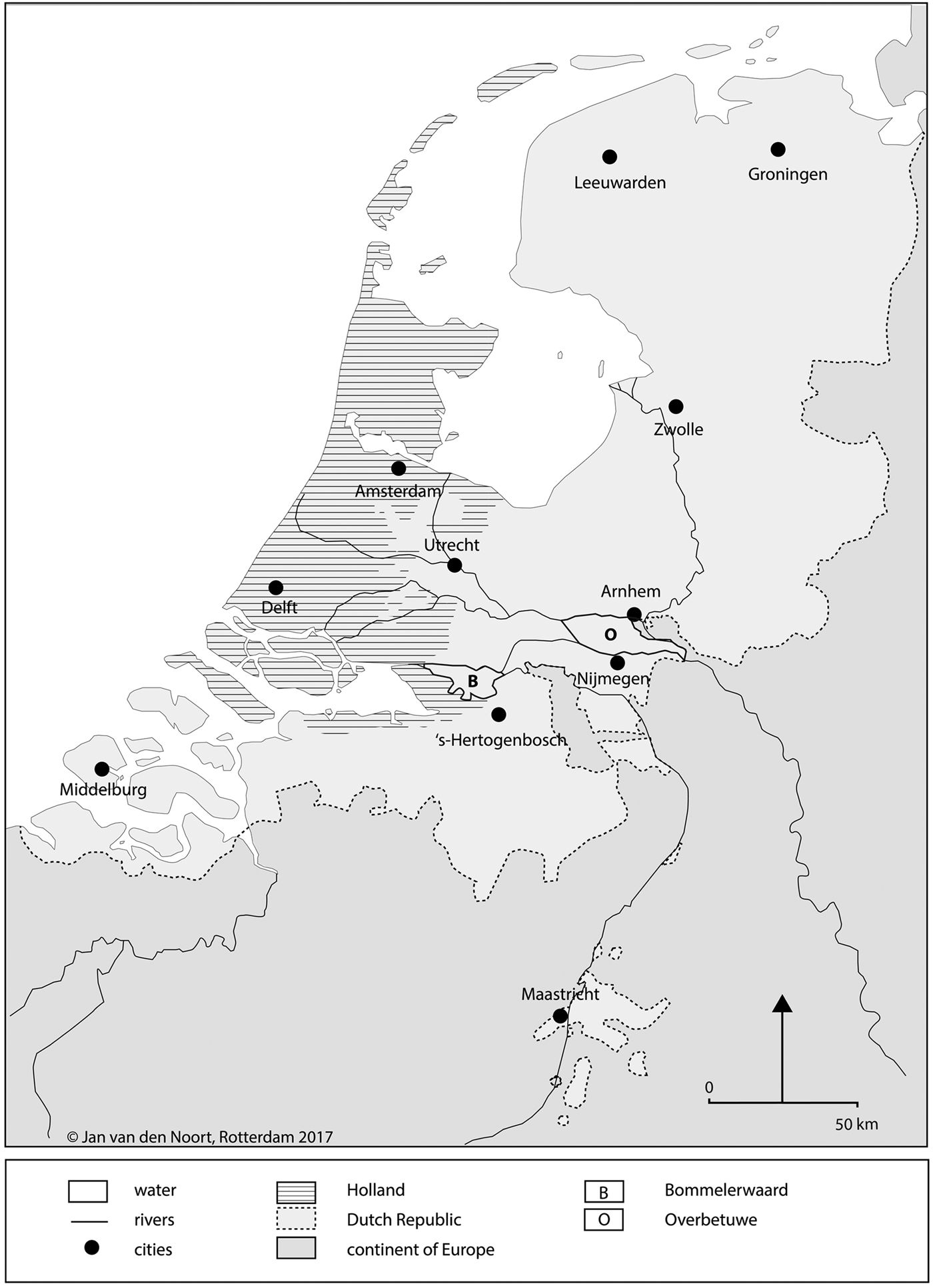
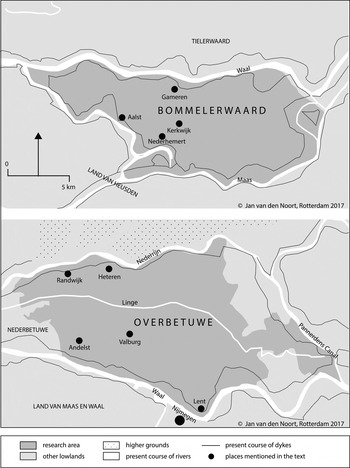
In 1650 the people of Aalst, a village in the district of Bommelerwaard situated in the delta region created by the Netherlands' major rivers, complained to the local and regional authorities about the flooding they had to cope with every year. According to the villagers many fields and grasslands were too sodden to be worked well into the spring, and some were even submerged. The situation did not improve over the years. In 1704, the council of the adjacent village of Nederhemert reported that ‘high waters’ had caused immense poverty in the village and that some families had been utterly ruined by seepage in the winter (for seepage, see below). In the spring of 1720, a large proportion of the lowland in Aalst was completely flooded. Nineteenth-century sources also report unremitting annual floods. Land was not only flooded well into the spring in the low-lying areas along the rivers in the Dutch province of Gelderland, such as Bommelerwaard, but even in the district of Overbetuwe, which lay on higher land further upstream (see Figures 1 and 2).Footnote 1
The Dutch Republic.

Bommelerwaard and Overbetuwe.

The available sources sketch a dreadful picture of water management in the Guelders river area. The inhabitants' battle against water was an almost constant struggle for existence. Agriculture was by far and away their main source of income, but the sector was groaning under the weight of excess water.Footnote 2 It is therefore fair to say that water management was an important, if not the most important, task for those in local government in the region. This raises two questions: how were the problems associated with water tackled, and how were the floods contained?
In this article we do not intend to explain the technologies that were used to control the water, but instead aim to examine the organisational side of water management and the strategies employed. We seek to understand who determined water-related policy, and whether such policies were imposed from the top down, or whether they were implemented after consultations were held and a consensus reached. In addition, we want to know who was involved in the decision-making process and whether ordinary villagers had any say in local council deliberations, and if so, how much?
The following examination of the way water management in the two districts was organised will contribute to the debate concerning the political culture surrounding water boards in the Low Countries. These boards – sometimes they were called polder boards – were established in the Middle Ages. Initially these were local administrative bodies that operated beside the village councils. Mostly the territory of these local boards coincided largely or entirely with the territory of the villages, but the water board had its own responsibility, that is, management of the (excess) water. Only limited research has been done on participation in the local water boards and village councils in the past, and that research concerned the Middle Ages in particular. However, many historians endorse the conclusion that at the local level there was a high degree of participation in the local administrative bodies in some areas during the Middle Ages. Dutch peasants acquired a certain degree of influence in water management and other village affairs during the medieval period in large parts of the county of Holland where land was drained and reclaimed under the leadership of the local authorities.Footnote 3 As a result, there was a certain balance of power across the different strata of society in local government.
Tim Soens reaches a different conclusion in his study of the coastal plain of Flanders, a region with many organisational and institutional similarities to Holland, covering the period between 1240 and 1600. Soens argues that, although initial consultations over water management policies were held between different social groups, when it came to decision-making, the views of the most prominent Flemish citizens, those who owned most land, were decisive. Furthermore, over time the latter group gradually became smaller in number but more powerful, so that property ownership became increasingly concentrated, partly as a result of the increasing commercialisation of society.Footnote 4 Ultimately it was the large urban and ecclesiastical landowners who became most powerful. Soens sees land ownership as the decisive factor in the local balance of power within this region. Since large landowners – unlike the peasants they had edged out – regarded profit-making as more important than investing in safety, the end result was the neglect of water management in Flanders, and in some cases this led to land being lost to natural disasters.Footnote 5
In a recent study of the late medieval development of water management in a number of seigniories in Holland, Carla de Wilt put forward a different argument, suggesting that eligibility for positions on local councils depended to a large extent on how much land a person used either as an owner or a tenant. Although she largely confirmed the findings that a wide cross-section of the population participated in the management of water in Holland – even going so far as to speak of a ‘culture of participation’ – de Wilt nonetheless concluded that local council positions were filled chiefly by those with large amounts of land at their disposal.Footnote 6
The relationship between a person's access to land and the power that they were able to wield is a hotly debated theme in international historiography. The debate centres on what the driving force behind the transition from feudal to capitalist agricultural societies might have been, and how the consequences of this transition, which differed from one country to the next, are best explained. In 1976 Robert Brenner argued that the distribution of rights to land between lords and peasants was the key determinant of developments in the rural economies of Europe. This hypothesis elicited a long-running discussion, which has become known as the ‘Brenner debate’.Footnote 7
As part of this debate a conference was held in 1994 to consider Brenner's view on developments in the Low Countries and in 2001 a volume of the conference papers was published, including an additional essay by Brenner himself. In his article he adapted his hypothesis to take account of the situation in the Low Countries and attempted to refute the arguments of his detractors. He described the transition to agricultural capitalism in the counties of Holland and Flanders and the duchy of Brabant as the result of the struggle between lords, peasants, town dwellers and the state. The fiercest critic of his argument was Jan de Vries, who championed the role of those ‘peasants’ who, finding themselves free to create their own markets, developed into ‘farmers’. Brenner had supporters, however. In his contribution to the same volume Bas van Bavel concluded that social developments in the Guelders river area in the late Middle Ages and early modern period were primarily determined by the distribution of land ownership.Footnote 8
Brenner's hypothesis still has adherents today. A recent volume, edited by van Bavel and Richard Hoyle, on rural and agricultural developments in north-western Europe between ad 500 and 2000, has the telling title Social relations: property and power. Following Brenner, van Bavel and Hoyle identify rural society in the Middle Ages and early modern period as ‘being divided between the owners and the occupiers of the same land’ and they consider that the ‘competition between them for the profits of farming’ was a principal factor in society. They add: ‘what is important is not merely who possessed … property and exercised the power latent in its possession, but how that property was distributed. We need to recognise that the social distribution of land differs wildly from area to area and its distribution produces vastly different political dynamics within the countryside.’Footnote 9
Developments in the Low Countries seemed to confirm this observation. In the same volume, van Bavel, with his co-authors Piet van Cruyningen and Erik Thoen, reached the conclusion that differences in property relations from one region to the next determined the regional differences seen in rates of participation in local administration. Within the county of Holland, they observed, there was ‘broad participation in village government, since virtually all peasant households possessed their own holding and social polarisation was (at least initially) very limited’. In the more elevated parts of the Guelders river area ‘this was not the case at all, creating a sharp divide in political authority’.Footnote 10
Until the present study, however, no research had been conducted on the political participation of villagers in the Guelders river area although there are good grounds for assuming that this was also an area where there was ‘broad participation in village government’. In the villages of Holland and western Utrecht the threat posed by high water levels made cooperation an unavoidable necessity, as the same authors remark.Footnote 11 But was this cooperation not also essential, we might ask, in the more elevated parts of the Guelders river area, where the threat of high water levels and flooding was substantial?Footnote 12
While water management has primarily been studied as a topic within Dutch and Belgian historiography, there has recently been a growth in the attention paid to the subject in other countries around the North Sea, as increasing numbers of historians acknowledge that the history of the organisation of water management and land drainage can reveal a great deal about the development of the political culture of these countries. These countries shared, as Greg Bankoff put it, a history of risk from storms, floods and erosion, all forces of nature that shaped and reshaped the landscape. People living in these areas had to find ways to deal with the natural threats and responded by creating special institutions, such as the waterringen (water boards) in Flanders, the polderbesturen and dijkbesturen (polder and dyke boards) in Holland and the Commissions of Sewers in the lowlands of England, that is, ‘communitarian associations that developed around the care and upkeep of the sea walls, dykes and ditches’. The flood-prone areas, said Bankoff, needed a ‘degree of cooperation that extended beyond the bare requirements necessary to manage water’.Footnote 13
John Emrys Morgan has recently written an article about cooperation in the Commissions of Sewers in Gloucestershire and Lincolnshire in the early modern period. In his paper he concludes: ‘The growth of the early modern English “participatory society” is typified by the rise of the number of people engaging with Courts of Sewers as jurors.’Footnote 14 In Gloucestershire these commissions were staffed by a large number of ‘ordinary’ people, among them yeomen, husbandmen and craftsmen. However, Morgan argues, as customary knowledge became codified over time, and decisions about water management became founded on written precedent, ordinary people, who were mostly illiterate, found themselves increasingly unable to influence decisions concerning water management.
A key focus of the research on which this article was based was the extent to which the balance of political power in the villages in the Guelders river area was determined by the exigencies of water management. In districts where natural conditions caused major problems every year, did the inhabitants choose to share administrative power and responsibilities, regardless of any social distinctions, in order to overcome the problems they faced? To answer this question, and the others posed above, let us consider the developments in two districts within the wider Guelders river region: Bommelerwaard in the west and Overbetuwe in the east (Figures 1 and 2).
One of the reasons for singling out these two districts was the marked differences between their formal administrative structures.Footnote 15 There were further differences, described in the literature, in the form and development of their agriculture.Footnote 16 These differences suggest that at the local level, the balance of power within their administrative systems would also be very different. Furthermore, property relations in Bommelerwaard might be expected to display features similar to those of neighbouring Holland, while earlier research has shown that this was certainly not true of property relations in Overbetuwe.Footnote 17
The current article focuses on the years between 1650 and 1795, a period in which the Northern Netherlands were known as the Dutch Republic. This choice was inspired by the sources available, which do not provide any clear information regarding those participating in local administration until the latter half of the seventeenth century. The year 1795 terminates the research period, because that year witnessed the French invasion that ended the Dutch Republic, and radical administrative reforms were introduced. Another reason for looking at the early modern period is that scarcely anything has been written about participation in local government during this period. The literature that does exist on the subject is extremely brief and couched in vague terms.Footnote 18
In the remaining sections of this article the formal administrative structures in Bommelerwaard and Overbetuwe will be charted, before the social developments in the two regions in terms of the changes in land ownership and land use, as measured by farm size, are described. The focus then shifts to an examination of the extent to which the populations of the two districts participated in their local village councils and how this affected the policies that were adopted in relation to water management.
2. FORMAL ADMINISTRATIVE STRUCTURES IN BOMMELERWAARD AND OVERBETUWE
In order to measure the rates of participation by members of the population in the administration of their local area, as an indication of the balance of power within that community, the distribution of administrative positions within the various villages of both Bommelerwaard and Overbetuwe had to be considered. The number of inhabitants in each village who were holding administrative office at any one time, and how long they were expected to remain in each post, had to be established. The social strata from which local officials were drawn had to be identified, as well as whether they owned or worked the land, the responsibilities that each post entailed, and the qualifications required of the individuals applying. First, however, the formal administrative structures of Bommelerwaard and Overbetuwe should be mapped out.
Both districts were run by their own district council, headed by an ambtman, who represented the Executive of the Kwartier of Nijmegen, the highest regional administrative authority in the province of Gelderland.Footnote 19 For the purposes of this study, it is more relevant to consider organisation at a more local level. In Bommelerwaard 16 of the 20 villages were seigniories (heerlijkheden). Each seigniory was headed by a lord who owned the seigniorial rights, which, for instance, gave him jurisdictional rights and the privilege of appointing officials in the village. The other four villages in Bommelerwaard were baronies (hoge heerlijkheden); seigniories with wider jurisdictional powers. In Overbetuwe, in contrast, seigniories and baronies were insignificant; in 1650 they contained only 7 per cent of the population.Footnote 20
The villages in Bommelerwaard appointed more administrative officials than those in Overbetuwe. In Bommelerwaard the lord administered the civil justice, along with the magistrates (schepenen), who were appointed from the village population. There were more magistrates appointed in the barony of Nederhemert than in the seigniories. The villages in Overbetuwe had no magistrates; the administration of justice in this district was more centralised. In Bommelerwaard, each village had its own sheriff (schout), appointed by the local lord. Overbetuwe, which included 30 villages, was divided into 4 sheriff's districts or schoutambten, with each sheriff being appointed by the ambtman.
There were also marked differences in the administration of water management between Overbetuwe and Bommelerwaard. In the latter region, the jurisdictions of the local water boards coincided with those of the seigniories and the baronies and therefore these water boards operated as independent administrative and legislative bodies. The responsibilities of the baronies included maintaining the dykes, whereas in the seigniories and the villages in the Overbetuwe this was the responsibility of coordinating or regional water boards (dijkstoelen) whose jurisdiction coincided with that of the district councils. The different forms of organisation influenced the number of official positions that existed in the local administrative bodies. The barony of Nederhemert had five local water authorities (heemraden) while in the seigniories the local water authorities were gradually replaced by two village officials or buurmeesters. The position of buurmeester existed in the Overbetuwe too. They bore the responsibility for the drainage of the rainwater and the seepage, but unlike the seigniories in the Bommelerwaard the villages in the Overbetuwe did not form local water boards. The tasks of the local officials will be examined more closely in the sections below.
Lords in Bommelerwaard had the right to appoint approximately half of the officials sitting on the water boards of their seigniory; the rest of the officials were elected by the villagers. In the barony of Nederhemert the lord appointed more than half of the officials. The buurmeesters in the villages of Overbetuwe were also elected by the villagers. All local officials had to be sworn in by the lords and, in Overbetuwe, by the ambtman. Most official positions fell vacant each year, or every two years.
Bommelerwaard and Overbetuwe each had a water board that oversaw the whole district. At the head of each of these boards was a dyke reeve, but the reeve in Overbetuwe had greater powers and there this position coincided with the post of ambtman.
To sum up: the baronies in Bommelerwaard appointed far more administrative officials than the seigniories in the same district; the villages in Overbetuwe appointed the smallest number of officials; Overbetuwe had a more centralised power structure than Bommelerwaard; and aside from some minor shifts, these administrative systems remained in place throughout the 1650–1795 period.Footnote 21
The administrative differences between Bomelerwaard and Overbetuwe had arisen in the Middle Ages. Little is known about their genesis, but a few conclusions can be drawn on the basis of the existing literature. The differences appear to stem from the period at which the land of each district was first reclaimed. The best, relatively elevated, land such as that in Overbetuwe, was developed during the heyday of the domanial regime, when domanial lords retained strict control of the land worked by serfs. Villages were poorly organised and had scarcely any formal responsibilities. The reclamation of less favourable, low-lying land in the west, such as in Holland and in Bommelerwaard, took place in the post-domanial era (eleventh to the thirteenth centuries), an age of vigorous population growth. Free colonists cultivated the land at the request and under the authority of the local lord, and by doing so they acquired land and influence in the local council. The villages there, which were well organised, possessed a large measure of self-administration. Property relations changed little in the long term. In the areas with large landownership, the land was increasingly leased in large units, in response to the growing influence of the market economy, but the elite maintained its grip on the land. In the west of the country land remained in the hands of small farmers.Footnote 22
In Bommelerwaard land reclamation and the creation of an administrative structure at the village level took place in roughly the same period as the region's dykes were built. Most of Overbetuwe had been reclaimed and was already inhabited before the dykes were built. Once the ring of dykes was completed, around 1300, or possibly even while it was still under construction, it became clear that the problems with water were not over. In a sense, they had become even greater: since the dykes left less space for the river water, the water was being dammed up and forced higher, especially in winter. As a result, the pressure behind the dykes caused the water to come to the surface in the form of seepage. At the same time, drainage had become more difficult to achieve. These problems had to be solved. Furthermore, the new dykes needed a great deal of maintenance. It became clear that specific organisations and mechanisms for permanent water management needed to be created.
In 1327 the first organisation dealing with water management was put in place by the central authority in Overbetuwe. At the same time many other new legal regulations were also implemented in the district, suggesting that the local population had very little power. In the same year, the count of Guelders also imposed certain measures in Bommelerwaard but, because of the decentralised administration and local autonomy that existed in this district, these related solely to water management.
Even in Overbetuwe, a certain decentralisation of administration and water management proved unavoidable because without the knowledge and work of the local people good water management was impossible. In order to mobilise their knowledge and labour effectively some power and responsibility had to be transferred to those working the land. It was in this period, we may assume, that the first buurmeesters were appointed. By the fifteenth century there were two buurmeesters in every village, setting out the contours of local water management and government from then on.Footnote 23
3. SOCIAL DEVELOPMENTS, PROPERTY RELATIONS AND AGRICULTURAL STRATIFICATION
According to some scholars the balance of power in rural areas during the Middle Ages and early modern period was determined by access to, and the distribution of, land. To judge whether this holds true for Bommelerwaard and Overbetuwe the property and the rent relations in these districts need to be considered: who owned and tilled the land and how was the land divided in each?
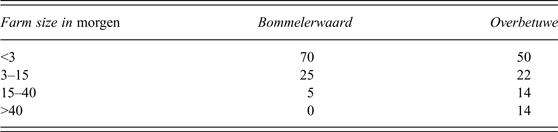
Land tax registers from 1650 show that all the villages in Overbetuwe contained farms with an area of at least 40 morgen (approximately 34 hectares) in extent.Footnote 24 Some farms stretched to between 60 and 80 morgen. According to the same sources, not a single farm in Bommelerwaard covered more than 40 morgen, and farms of over 30 morgen were the exception.Footnote 25 Although a great many people also worked small plots of land in Overbetuwe, land appears to have been fragmented into a greater number of small parcels in Bommelerwaard (Table 1).
The number of farms of different sizes as a percentage of the total, Bommelerwaard and Overbetuwe, 1650

Source: Gelders Archief Arnhem NL (hereafter GAA): Archief Staten van het Kwartier van Nijmegen en hun gedeputeerden 1574–1805 (hereafter AKN), nos. 373, 376; Paul Brusse, Overleven door ondernemen: de agrarische geschiedenis van de Over-Betuwe 1650–1850 (Wageningen, 1999), 49.
Social differences become more significant when the farming systems in the two districts are considered. In both regions agriculture was market orientated, but in Overbetuwe the sector focused on large-scale, labour-extensive cultivation, primarily of cereals, while in Bommelerwaard the numerous small farms grew hops. With a relatively high labour intensity per hectare and relatively heavy manuring, the high clay soil of the district was ideally suited to this crop, which yielded a high profit per hectare. In Nederhemert and Gameren, villages that lay within Bommelerwaard, the percentage of land under cultivation within the dykes used for growing hops was 23 and 17 per cent, respectively. Hops accounted for a high percentage of the villages’ arable acreage: in Nederhemert almost two thirds of such land was under this crop. Hops accounted for a smaller percentage of the arable farmland belonging to the village of Aalst, but in Bommelerwaard as a whole hundreds of small farmers were able to live on the proceeds of hop cultivation.Footnote 26
Clearly, then, Overbetuwe was dominated by large farms, where most of the work was carried out by hired labourers. Bommelerwaard had mostly small farms, worked by the farmers and their families. The question then arises: did the farmers own the land they farmed? In the Bommelerwaard villages of Nederhemert, Aalst, and Gameren, approximately 18, 25, and 46 per cent of the land within the dykes, respectively, was leased to tenants, while in Overbetuwe, some 80 per cent of the land was leased out. In the latter area entire farms, some of them dozens of morgen in extent, were rented out. This practice was almost non-existent in Bommelerwaard where the tenant farmers tended to lease plots of land from several landowners.Footnote 27
Although we cannot determine the precise socioeconomic position of all those who owned land, the following percentages provide a good indication: in Aalst, 36 per cent of the land belonged to the nobility or to institutions; in Gameren 28 per cent, and in Nederhemert 18 per cent. In Overbetuwe the figure was 71 per cent.Footnote 28 It is clear, therefore, that around 1650 the small farmers in Bommelerwaard were mostly owner-occupiers, whereas the large farms of Overbetuwe were primarily owned by absentee landowners and worked by tenant farmers and their labourers.
The mid-seventeenth century ushered in a difficult period for Dutch agriculture. Prices started to fall and it soon became clear that this decline, although subject to the usual annual fluctuations, was structural and long-term. There would be no sign of an upward trend in prices until 1750. The smallholders in Bommelerwaard were also struck by a second calamity: as coffee and tea consumption rose, beer consumption and production went into decline, with a corresponding fall in the demand for hops. Initially, hop growers in the district managed to soldier on; hops were still an important crop in 1698. After that there was a rapid decline in hop cultivation, although some farms in Bommelerwaard were still growing the crop in the nineteenth century. At the deepest point of the depression, between 1730 and 1750, however, many small farmers would have been experiencing severe difficulties.Footnote 29
In the latter half of the eighteenth century, agricultural prices rallied, but the farmers' salvation came mainly in the form of a new crop: potatoes. Like hops, potatoes were ideal for small farms, since potato growing was a labour-intensive business, and a small plot could generate an independent livelihood. Families may have begun by growing potatoes for their own consumption, but they were soon cultivating them for the market. Potatoes were already widespread by around 1770, and had become an important commodity, allowing the long-term survival of small farms in Bommelerwaard and ensuring that this form of land holding continued to prevail in this district.
A comparison of the distribution of land ownership in Nederhemert in 1650 with property relations in the same village at the beginning of the nineteenth century indicates that the situation remained virtually unchanged: the land was still divided among dozens of smallholders, working their own plots, and the lord of Nederhemert was still the only substantial landowner, holding just under 20 per cent of the farmland that he leased to tenants.Footnote 30
In Overbetuwe, in contrast, the responses of the population to the long agricultural depression had far-reaching and longlasting consequences. In order to weather the depression large farmers in this district extended their business operations in order to cut costs. The size of their farms meant that their expenses per morgen were less than those of farmers with medium-sized farms. As a consequence, the largest farms became larger still, and the number of medium-sized farms declined.Footnote 31 At the bottom of the scale, there was a sharp increase in the number of labour-intensive smallholdings. This can be attributed exclusively to the rise of a new labour-intensive crop introduced shortly after 1650: tobacco. The high profits per morgen generated by this crop meant that even farms with fewer than three morgen of land could make an independent living from it, particularly as the price of tobacco remained high over an extended period thanks to the rapid growth in demand. Although those with large farms saw tobacco as a good alternative crop, capable of offsetting their diminishing incomes, they preferred not to cultivate it themselves, because of the high labour costs involved. Instead, they leased out small plots of land to their labourers so they could raise tobacco. There were also a great many labourers who grew tobacco on their own land. The result was that an increasing number of labourers could make an independent living in agriculture as tobacco growers. Indeed, everyone who owned a piece of land started doing so, from stonemasons to carpenters and the local schoolteacher. After 1720, however, once the rapid rise of tobacco growing – and its heyday – were over, the sector did not always flourish, although tobacco growers remained an important group in Overbetuwe society throughout the eighteenth century and beyond.Footnote 32
If the rise of tobacco growing affected property and tenant relations in Overbetuwe, the impact of any changes was negligible since, on balance, tobacco growers did not use much land. Nonetheless, changes did occur in Overbetuwe. Shortly after 1700, large farmers in the district started buying up land, particularly from institutions. In 1650 these farmers owned 27 per cent of the farmland, but by 1790 they owned 44 per cent.Footnote 33 It is clear, therefore, that, unlike Bommelerwaard, the socioeconomic structure and property relations in Overbetuwe changed considerably during the century-and-a-half following 1650.
4. PARTICIPATION IN ADMINISTRATION AND WATER MANAGEMENT IN BOMMELERWAARD
To recap: administrative power in the villages of Bommelerwaard was exercised by the local lords. This power was based on the lords' seigniorial rights. Most of the land in the district was held by owner-occupying smallholders. The lords shared their power with a number of village officials. In Overbetuwe local power was in the hands of four sheriffs, each of whom represented the ambtman in the district for which they were responsible, and two buurmeesters per village. Most of the land was in the hands of large, absentee landowners although, from 1700 onwards, local farmers with large farms were buying up increasing amounts of land.
What were the consequences of these differences for the balance of power, or the division of administrative positions, in the villages of Bommelerwaard and Overbetuwe? How many inhabitants in each village held an administrative post at any one point in time, and how long were they in office? What sort of individuals held these positions, and from which social strata were they drawn? Finally, what responsibilities did local officials take on, and what qualified them for their position?
Participation in village councils can be traced for a limited number of villages by compiling lists of all the councillors' names and noting the number of times the same person was appointed over each generation – a generation being taken as a 20-year period where possible. As far as was possible, annual lists of councillors were compiled and, assuming that only heads of household would be appointed as village councillors, the number of names was correlated with the number of households. Although some figures are incomplete (see below), they provide an illustrative picture of rates of participation in local administration.
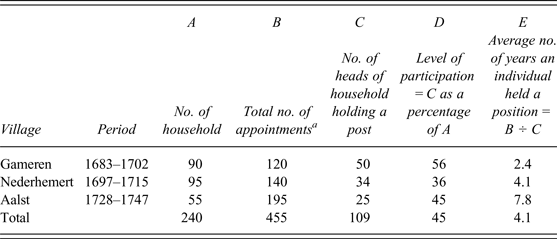
Let us look first at the situation in Bommelerwaard. In Aalst, a seigniory in this district, nine or ten officials were appointed each year from among the local landowners, including two buurmeesters and six magistrates, plus a president and vice-president of the magistrates. In principle, all of these positions were supposed to be rotated every year or two years, but in practice individuals frequently held certain positions for years on end. Between 1728 and 1747, a total of 195 appointments were made in Aalst, involving a total of 25 appointees. These figures indicate a high level of participation, since there were 55 heads of households; in other words, at least 45 per cent of these individuals held appointments in this period, for an average of almost eight years, as shown in Table 2.
Calculation of rates of participation in local administration in Gameren, Nederhernert and Aalst (three villages in Bommelerwaard) (1683–1747)
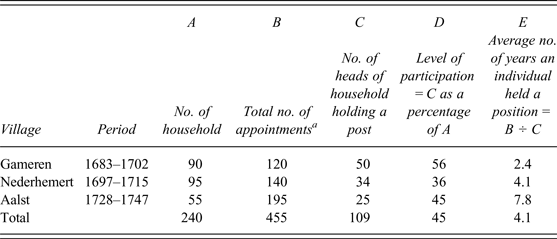
a Sometimes individuals held more than one post. For this table only one appointment to a post per person per year has been counted. These positions included only members of the village councils (for example schepenen) and the local water boards (for example heemraden).
No. of households based on Brusse, Overleven, 388, 398.
Source: GAA AHN, no. 3; Regionaal Archief Rivierenland Tiel NL (hereafter RAR): Archief Geerfden Aalst 1547–1954 (hereafter AGA), no. 1; Archief Geërfden Gameren 1623–1838 (hereafter AGG), no. 585.
In the seigniory of Gameren the six official posts were rotated annually among the heads of household during the period 1683–1702, and this created a very high level of participation with 56 per cent of heads taking on an official role, although the average number of times an individual was appointed was far lower than in the other two villages. Unfortunately the information about the appointments in Nederhehemert is more limited. Therefore the level of participation in the local administration of this barony seems lower than in Aalst and Gameren. However, in Nederhemert a significantly larger number of officials were appointed each year than in Aalst and Gameren, as discussed in Section 2 above. The figures for Nederhemert represent an absolute minimum. Between 1697 and 1715, at least 34 of the estimated 95 heads of household in Nederhemert held an official position at least once, giving a participation rate of 36 per cent.Footnote 34 Many individuals were appointed more than once, and it was not unusual for people to hold several positions simultaneously.
The tax registers, that is, the lists with assessments based on the number of horses or the amount of land that people owned, allow us to study the socioeconomic position of those holding official posts. The paardengeld (literally: horse money) registers reveal that over half of the administrative officials in Gameren did not own any horses, which indicates that the individuals concerned could only have run small farms. Some of the officials in Aalst owned a small plot of land. We may therefore conclude that officials in both of these villages were drawn from all sections of the population. It was probable that an individual needed to own land to be appointed to an official position, or just to have a vote on who was to be appointed, but the amount of land required would appear to have been minimal. In the hamlet of Kerkwijk in Bommelerwaard, which was also a seigniory, it was stipulated in 1774 that in order to vote for an administrative official, and probably also to stand for election, a man must own a house and one morgen (0.85 hectare) of land.Footnote 35
The level of participation in local administration in Bommelerwaard was high, but how was power shared between the lord, or occasionally the lady, of a seigniory and the local villagers? As already said, the lord had the right to appoint approximately half of the officials in the water board/seigniory – more than half in a barony such as Nederhemert. He also appointed the local sheriff, a more long-term post, which did not rotate. Furthermore, the lord gained additional economic power through his seigniorial privileges, such as wind rights, fishing rights, and transit rights.Footnote 36 Sometimes, as we will see below, the lord also possessed power derived from the capital he lent to the village.
Having said all this, the lord did not have many options when choosing local officials. His appointees came from the same pool as that of the villagers – who often delegated representatives to elect their officials rather than doing so themselves. Individuals appointed by the lord to the village council in one year were then appointed by the villagers in the following year. The evidence suggests that anyone who wanted to serve in an official capacity and also met the criteria set was considered eligible. It is not clear, however, whether an individual who had been selected to serve might refuse to do so. A lord in Bommelerwaard would have found it difficult to wield his influence through the officials he appointed, as he would not have had found it easy to build up a relationship of trust with them. This was not the case with the sheriff. Lords were frequently absent; that certainly applied to those who were city-dwellers who had purchased a seigniory. Much was therefore left to the sheriff. It was therefore crucial for the lord that he could trust him. There could be an element of coercion in the relationship as a sheriff was partly dependent on his lord for his position and prosperity. Sheriffs were appointed for life, and some families supplied sheriffs for successive generations. Even so, the sheriff was frequently a villager, and therefore took the local people's interests into account as well.Footnote 37
In each village the administrative officials took care of day-to-day affairs, particularly those relating to water management. They conducted inspections of the waterways and contracted workmen to perform maintenance tasks, or carried out the maintenance themselves, but they also performed a range of other duties, such as compiling the village's tax registers, allocating tax assessments on behalf of the district council, trying minor criminal and civil cases, and convening landowners' meetings. While they often carried out these tasks together with the sheriff, any paperwork generated was left to the village clerk, although each village probably had its own way of dividing up the various tasks between its officials. The officials received a sum of money for their work.Footnote 38
Sometimes local officials were unable to find a solution to a particular problem, as in the case of the annual floods in Aalst. The floods were a constant source of complaint by the villagers and some of them gave up farming. To prevent more people abandoning the land the Executive of the Kwartier of Nijmegen announced a reduction in land taxes for several villages in Bommelerwaard in 1704, with retroactive force from 1702, to last for 20 years. Land taxes were an important source of income for the Kwartier and reduction was only applied to land giving a very poor yield. However this was true of much of the land belonging to the villages concerned. When the 20 years expired the villagers of Aalst found themselves in such dire straits that they applied for a complete cancellation of their property taxes for a further 30 to 35 years. In exchange, they promised to build a mill to drain the land, that is, a so-called polder mill.Footnote 39
The Executive was not willing to meet the villagers' request in full, but did agree to extend the 1704 contract for another 20 years, provided that a polder mill was actually built. The local landowners met and decided to build the necessary mill and the Executive's proposal was accepted. Money had to be borrowed from the lord of Aalst to finance the building of the mill. The windmill would cost almost 7,500 guilders, and the repayments were to be apportioned to the landowners according to the number of morgen of land they held. This would have been a heavy burden for the landowners, but those attending a further meeting approved these arrangements.Footnote 40
Understandably, the landowners' meeting of 1724, at which it was decided to build the mill, was well attended: 24 villagers including two buurmeesters and the sheriff were present when the decision was taken that day, more than 40 per cent of the heads of household in the village. Similar attendance figures are documented for landowners' meetings elsewhere such as that in the village of Gameren in 1713, when a decision had to be taken about an additional tax, possibly to pay for maintenance work on the local groynes (structures built in a river at an angle in order to protect the dyke). That meeting was attended by over half of the household heads from the village.Footnote 41
The landowners' or village meetings just described were called for special reasons, but mostly the meetings were regular gatherings. Although they were poorly documented, it is probable that these meetings were held at least once a year to settle village affairs such as the assessment of the taxes, the division of maintenance tasks and the election of village officials. So far as is known these regular meetings were not well attended. Only about 20 per cent of the household heads in Gameren were present at the village meetings of 1675 and 1677.Footnote 42
5. PARTICIPATION IN LOCAL ADMINISTRATION AND WATER MANAGEMENT IN OVERBETUWE
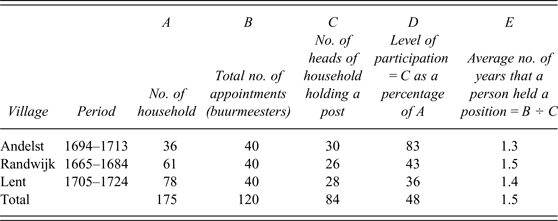
Although scarcely any fewer heads of families held an official position at some point in Overbetuwe than in Bommelerwaard, each person was appointed far fewer times (see Tables 2 and 3). It should be added that the degree of participation was greatly influenced by the size of the village: given a fixed number of officials (i.e. two buurmeesters), the level of participation in small villages was naturally higher, as a proportion of the whole, than in larger ones. This means that as a measure ‘the level of participation in local administration’ is of limited value, particularly as it can be assumed that the level of such participation would have declined in most villages as they experienced population growth. In some villages, population actually doubled. It follows that, if the number of heads of household who held the office of buurmeester in these villages remained the same, then the level of participation in this administrative role must have halved.Footnote 43
Calculation of rates of participation in local administration in Andelst, Randwijk and Lent (three villages in Overbetuwe) (1665–1724)
Source: RAR: Archief Dorpspolders Overbetuwe 1652–1954 (hereafter ADO) nos. 1, 4725, 5595.
No. of households based on Brusse, Overleven, 388, 398.
Despite these caveats it is relevant to look at the level of participation in Overbetuwe during a later period, particularly the latter half of the eighteenth century, when farmers were buying up increasing amounts of land. According to the literature, Overbetuwe witnessed a process of elite-formation, with the emergence of a buurmeester class during the seventeenth and eighteenth centuries. The village of Randwijk is given as a specific example of this process.Footnote 44 However, the rates of participation in Randwijk's local administration did precisely the opposite of what might be expected. In 1665–1684 levels of participation had been just 43 per cent (see Table 3) but by 1746–1765 the level of participation had increased to 55 per cent, even though the population had not changed. In the village of Andelst, the rate of participation declined, partly because of population growth, but still remained well above 50 per cent in 1763–1782. It is not possible to calculate the corresponding figures for the village of Lent in the period after 1750, but the level of participation in the village of Heteren was well over 30 per cent in the period 1775–1794. During the latter period, it should be noted, a change was introduced in Heteren: from 1780 onwards, buurmeesters remained in office for two years instead of one, which would have kept the participation figures relatively low. It is fair to conclude that, despite the different formal administrative structure in Overbetuwe, there was broad participation in local government in this district, just as there was in Bommerlerwaard.Footnote 45
It is striking, in view of the sharp social contrasts in the Overbetuwe, that it was not only large farmers who were appointed as buurmeesters; smallholders were frequently appointed too. In the village of Randwijk, one of the two chosen buurmeesters each year was a small farmer or craftsman. In 1742 the custom of regularly electing a smallholder to one of the posts was formalised when the village council decided that it should become accepted practice, and so it remained into the second half of the eighteenth century.Footnote 46 The pattern of electing a smallholder or craftsman along with a large farmer to the posts of buurmeester each year is also seen in the villages of Andelst and Lent, although occasionally two smallholders or two large farmers were elected. The practice of electing a smallholder continued into the latter half of the eighteenth century in Andelst. Jan Klaase van Beek, who owned only one horse and who was taxed for one fireplace, indicating he did not have a large house, was elected in 1775; Derk Peperkamp, a baker with one horse and one fireplace, became buurmeester in 1776; and Jan Franken, who had no horse at all and only one fireplace, held the post at least three times in the 1780s. In contrast, Peter de Haardt, a large farmer who became buurmeester in 1779, owned eight horses and had been taxed for three fireplaces.Footnote 47
The farmers who became buurmeesters, whatever the size of their farms, did not necessarily own all, or indeed any, of the land that they worked. This shows, remarkably, that it was not only the land a man owned, but also the land that he farmed which qualified him for election. Until at least 1750, most large farmers in Overbetuwe were tenants, and although they may each have owned a few morgen of land, it is clear that it was not this property ownership that counted. In the village of Heteren, farmers were elected buurmeester solely on the basis that they ran their farms as tenants. This meant that the interests of the tenant farmers were safeguarded on the village council – and indirectly, so too were the interests of those who leased the land to them. There was thus a certain balance of power on the village councils of Overbetuwe between the ordinary members of the population and the élite, that is, the absentee large landowners. The social polarisation was less sharply defined than the property relations might suggest. In Overbetuwe a man did not have to own a great deal of land in order to be eligible for the position of buurmeester, although the poorest inhabitants of the village would have been excluded.Footnote 48
This does not mean that every eligible head of household served as buurmeester. The villages in Overbetuwe usually had too many household heads to allow all of them the chance to serve. In some locations individuals appear to have been elected according to a rota. This is suggested by the fact that in 1773, unusually, the widow Van der Kamp from the village of Heteren was appointed as buurmeester. It is likely that her husband had died just before it was his turn to serve, and the position was passed to her as his widow. In practice, Jacob van de Kamp, probably her adult son, served as buurmeester. According to regulations instituted in 1684 village officials were to be nominated by the ambtman, but in Heteren this seems to have been purely a formality.
The position of buurmeester probably came within the reach of increasing numbers of individuals as growing numbers of labourers started cultivating tobacco in Overbetuwe. In both Valburg and Andelst tobacco-growers were elected as buurmeester and, given that the socioeconomic circumstances in these villages were similar to those in other villages in the district, it is plausible that such appointments also occurred in the latter. Buurmeesters had to be reasonably well off, as they had to bear certain risks. They were often expected to advance sums of money, for instance, to meet the costs of maintaining the waterways, and they could not be sure how long they would have to wait to get these repaid. It is not clear whether people elected to serve as buurmeester could choose to decline the honour, but if that were possible, many would undoubtedly have done so.Footnote 49
In Overbetuwe the primary responsibility of the buurmeesters was to ensure that surplus water was drained from the land. They also arranged for the maintenance of waterways and roads. If necessary they would have contracted the work out but it was not uncommon for them to perform some of the work, much of which consisted of dredging the watercourses, themselves. They would have been paid extra for such work, over and above their remuneration as buurmeester.Footnote 50
The buurmeesters had other duties besides those related to water management. In Andelst they were responsible for drawing up the village accounts and for deciding the taxes that were to be paid by the inhabitants. Each village had to pay taxes, such as duties on beer, vinegar and wine, consumer goods, slaughtered livestock, and what was known as ‘family money’, to the Kwartier of Nijmegen and the buurmeesters allocated the contribution to be made towards the amounts involved by each of their fellow villagers. In addition, they drew up the morgentalen, periodic inventories of land ownership, which were used to determine what taxes were due. In short, they were the administrative linchpins of the local community.Footnote 51
Although it is uncertain whether buurmeesters in other villages in the Overbetuwe had the same duties as those in Andelst, it is clear that they were central figures in the running of their communities. In general, the buurmeesters were assisted by a clerk, who was also an important man, often also serving as sexton and schoolmaster. The clerk took care of the necessary paperwork, even if the buurmeesters were literate, which they occasionally were not. Unlike the buurmeesters, clerks were often in post for long periods of time.Footnote 52 In this context – and in response to Morgan's findings in regard to the codification of customary knowledge, illiteracy and the decreasing influence of those who lacked access to textual resources in the lowlands of England – it should be noted that there are no indications that illiteracy among the villagers of the Guelders river area placed any limits on their role in local administration. It is also true, however, that compared to England, rates of illiteracy were low in the Dutch Republic, particularly in the countryside.Footnote 53
Unlike the buurmeesters, Overbetuwe's sheriffs were district officials. They had a variety of legal, fiscal and administrative duties as well as those related to water management, but their responsibilities were not clearly defined. Sheriffs frequently operated in partnership with the buurmeesters. Although the four sheriffs generally came from Overbetuwe, where some owned large farms and many belonged to their village élite, they actually stood above the villages, and were therefore less concerned with the fate of the individual villages within their jurisdiction than their counterparts in Bommelerwaard.
The sheriffs did of course take the villagers' interests into account, if only because the latter paid their wages, and those of their deputies. This latter point was a thorn in the side of the ambtman and in 1728 he proposed putting an end to the sheriffs' dependence on income from the villages. The city envoys who sat on the district council vetoed this plan, however. Why they chose to do so is a matter of conjecture, but as large landowners from the city they were probably not in favour of the sheriffs becoming overly independent. It is interesting that they chose to vote against the proposed change, because by doing so they were, in effect, helping to protect the villagers' interests.
As in Bommerlerwaard, sheriffs in Overbetuwe were appointed for life. Many were professional officials who steadily climbed the social ladder until they finally reached the position of sheriff. Some acquired dynastic inclinations and managed to expand the power of their descendants far beyond the boundaries of the sheriff's district. The succession of sheriffs in the sheriff's office or schoutambt of Bemmel is an illustrative example. Willem Vermeer, who served as sheriff in the mid-seventeenth century, had a large farm and received one of the highest tax bills in Bemmel. He was succeeded at some point in the last quarter of the century by Michiel Franssen van Eck. Van Eck was a schoolmaster who lived in Bemmel, and who had performed a variety of tasks for the schoutambt before becoming sheriff himself. After his death in 1711, he was succeeded by Johan van Meurs, who had served as sexton in Bemmel in the years previous. Both these men were literate and already possessed considerable status in Bemmel before becoming sheriff. Johan van Meurs died in 1734, and a few years later his son appeared to be the sheriff; another of his sons may also have held the post for a time. One of them was eventually succeeded by Johan Frederick Dietz, whose father was the sheriff of Elst. This Johan Frederick held certain administrative positions as well as the office of sheriff. In short, one had to be quite ‘someone’ to become sheriff in Bemmel.Footnote 54 The same applied to other schoutambten. Nevertheless, they cannot be said to have built up a far-reaching concentration of power, particularly as, after two or three generations, the district council would appoint someone from a different family to the position of sheriff, in all probability to prevent the authority of the district council being undermined.Footnote 55
At the local level villagers in Overbetuwe, represented by their buurmeesters, shared power with their sheriff and his deputies, but when matters came to a head, it is likely that the sheriff's decision prevailed. The landowners' meetings also exercised authority, however, making them an institution in each village. A meeting could only be convened with the consent of the ambtman, but gaining this consent appears to have been largely a formality.
At the landowners' meetings in Andelst, contracts for maintenance work were decided, the village accounts were inspected and approved, the tax registers were presented for inspection, commons were leased, loans approved, and complaints voiced about matters that were in need of improvement. Many similar matters were dealt with at the landowners' meetings in Heteren, and also at those in Lent and Randwijk. Clearly, then, these meetings fulfilled an important function.Footnote 56
Interestingly, the Lent village council decided in 1720 that the village papers must be available for inspection at all times by any landowner or buurmeester wanting to consult them. The papers were placed in a special box and handed to the sexton, who received a fee for taking care of them. This meant that the village council's actions were permanently open to scrutiny. Participation in local administration was taken very seriously in Lent. This is also clear from the fact that the agenda of meetings was announced in advance. Documents relating to at least one instance of advance notification survived. They indicate that one of the points to be discussed at the meeting, to be held in Lent on 26 June 1726, was the maintenance of waterways and checks on this maintenance, as there was need for great improvement. Another point that was to be discussed was the excess of food and drink consumed at village meetings at the local community's expense. At the meeting it was agreed that in view of the dire straits of the village's finances, the community would contribute a maximum of six guilders per meeting in future.Footnote 57 This was still probably quite enough to ensure that everyone went home replete and pleasantly befuddled.
As far we can tell, landowners' meetings in Overbetuwe were convened at least once a year, but at irregular intervals. In principle they were only open to landowners, but the buurmeesters generally attended as well, partly as the tenants' representatives. In a few villages, however, the sources refer to meetings of ‘landowners’ and ‘neighbours’, suggesting that tenants too were sometimes welcome. This is quite possible, given the considerable economic power of the large tenant farmers and that they too had to pay for water management and taxes. In any case, some of those present owned very little land.
Attendance at the meetings tended to be poor. Occasionally, however, when the agenda addressed an issue that commanded widespread public interest, attendance would dramatically increase. Landowners were drawn from a wide spectrum of society. In the village of Lent, the distinction was made between large landowners and those owning smaller amounts. The group of ‘large’ landowners comprised a small number of city-dwellers from Nijmegen and those representing institutions. Such differentiation was to be found in virtually all the villages. Often the large landowners were noblemen from outside Overbetuwe. We can be sure that the large estate owners, who would have been better educated and have had closer ties with those sitting on the district council, often dominated the meetings and manipulated them to their advantage, but on occasion they also stood up for the villagers' interests. Some sources refer to ‘landowners with voting rights’, indicating that there were other landowners who were not entitled to vote. The distinction was probably only made between the two groups when certain issues were being discussed. For example, in Andelst, only those who owned at least ten morgen of land were entitled to vote on the appointment of the collector of property taxes, a qualification that would have effectively excluded most of the village's farmers.Footnote 58
6. CONCLUSIONS
The key question addressed in this article was: did having to face natural conditions that caused major problems each year induce people in the Dutch countryside in the early modern period to share administrative power and responsibilities, regardless of social distinctions, in order to find solutions to, or reduce, the problems they faced? To answer this question the balance of power in villages within Bommelerwaard and Overbetuwe, two districts situated in the Guelders river area that had to contend with severe flooding every year, were studied over the period between 1650 and 1795.
The article adds to the growing literature on water management and political culture in the countries around the North Sea. As its starting point it took the literature inspired by the ideas of Robert Brenner, who argued that property relations and the distribution of land ownership determine the balance of power within a society. Van Bavel et al. wrote that in villages in the Low Countries the degree of influence someone possessed depended on how much property he owned, so that the distribution of power reflected the distribution of land ownership. According to such arguments, we would expect to see that in areas where smallholders owned the most land, the population's involvement in local government was substantial, whereas in areas where land was owned by large landowners, this involvement would be weak or non-existent.
Social relations in the districts of Bommelerwaard and Overbetuwe diverged sharply during the early modern period. Landowners in Overbetuwe generally owned extensive estates and farms were either large or medium-sized and worked by tenant farmers. In Bommelerwaard the great majority of farmers were smallholders, working the plots that they owned. Social contrasts were far sharper in Overbetuwe than in Bommelerwaard. In the latter, social relations changed very little across the seventeenth and eighteenth centuries. In Overbetuwe, on the other hand, the largest farms became larger still and, as time went by, they were increasingly owned by those who farmed them. Meanwhile the number of medium-sized farms declined, while the number of tobacco growers with small, labour-intensive farms saw remarkable growth, as this group proved en masse that it was possible to earn an independent living within this sector of the agricultural economy.
If the reasoning of van Bavel et al. is correct, we should have found wide participation in local administration among the population of Bommelerwaard but not in Overbetuwe. As this article has clearly shown, however, a large proportion of the heads of households in Overbetuwe held the position of buurmeester at some point in their lives, during the entire period studied. In Overbetuwe smallholders and craftsmen regularly sat on the village council alongside gentlemen farmers, who often leased the land they farmed. The villagers took the position of buurmeester very seriously; it was a tough job and the post holder bore a heavy burden of responsibility. The buurmeesters, who frequently leased their farms, and the farmers who owned their land attended the landowners' meetings along with nobles and large landowners from the cities, or their representatives. At these meetings, the council running the village was called to account for its actions, points on the agenda were debated, and important decisions were taken. It would appear that neither the amount of land an individual owned nor the size of the farm he worked prevented him from being chosen as a buurmeester; the evidence suggests that only the poorest classes were excluded from holding official positions. This is corroborated by the fact that the changes in property relations and farm sizes did not lead to any change in the composition of the local councils, while the position of buurmeester was opened up to the new group of tobacco growers.
In the Bommelerwaard villages of Gameren, Nederhemert and Aalst at least 45 per cent of heads of household, on average, held positions on the village councils at some point in their lives during the early modern period. Although the local and regional administration was structured quite differently in the two districts studied, almost half of the heads of household in the villages in Overbetuwe also held official positions. In this area in the late Middle Ages a common interest in water management led to a break with the established local power structure and the formation of a new balance of power, in which authority and control were shared. By the seventeenth and eighteenth centuries the responsibilities of local officials had extended beyond water management to include other tasks, such as the collection of taxes and the compiling of village accounts. Having found high rates of participation in local administration across the social spectrum not only in Bommelerwaard, a district where society was relatively egalitarian, but also in Overbetuwe, a district of sharp social contrasts, we can conclude that such levels of participation were quite usual within the Dutch Republic.
ACKNOWLEDGEMENTS
This research forms part of the project: ‘In Search of the Poldermodel: Participation and Representation in Dutch Water-Boards in the Pre-Democratic Era’, financed by the Netherlands Organization for Scientific Research (NWO). The author would like to thank Petra van Dam, Piet van Cruyningen, Marjolein ‘t Hart, Heleen Kole, Maarten Prak, Milja van Tielhof and Jan Luiten van Zanden for their comments on earlier drafts of this article.