


1. INTRODUCTION
The plasma generation through tunnel ionization of gases has been recently utilized for wide ranging applications viz. X-ray recombination lasers (Burnett & Enright, Reference Burnett and Enright1990; Amendt et al., Reference Amendt1991), laser based charged particle accelerators (Gupta et al., Reference Gupta, Suk and Ryu2005), wake field accelerators (Deng et al., Reference Deng, Barnes, Clayton, O'Connell, Decker, Emma, Erdem, Huang, Hogan, Iverson, Johnson, Joshi, Katsouleas, Krejcik, Lu, Marsh, Mori, Mugglil, Siemann and Walz2003), and plasma accelerators (Tajima & Dawson, Reference Tajima and Dawson1979; Joshi et al., Reference Joshi1984). The mechanism of tunnel ionization takes place when the laser field intensity is comparable to but less than the characteristic atomic field (corresponding to ionization) of the gaseous atom; this field may cause the electron to tunnel out of the atom. This process is an effective means for production of highly ionized plasma at low temperatures. As a Gaussian laser pulse passes through a gas, the plasma density increases through ionization, resulting in a minimum in the refractive index on the axis of the pulse which causes defocusing of the laser pulse. During pulse propagation, the electrons experience unequal ponderomotive forces in the trailing and rising parts of the laser pulse; hence the plasma gains net energy. Gildenberg et al. (Reference Gildenburg, Kim, Krupnov, Semenov, Sergeev and Zharova1993) have studied the nonlinear phenomena of harmonic generation and frequency up-conversion associated with the interaction of uniform electromagnetic wave with tunnel ionized gas plasmas. On the basis of experiments and numerical simulation, Leemans et al. (Reference Leemans, Clayton, Mori, Marsh, Kaw, Dyson and Joshi1992) have explained the characteristics of gaseous ionization by tunneling. A series of experiments pertaining to the production, and expansion of tunnel-ionized plasmas and the subsequent formation of a plasma channel have been carried out by Durfee and Milchburg (Reference Dufree III and Milchburg1993). Liu and Tripathi (Reference Liu and Tripathi1994) have examined the self-defocusing of ionizing short laser pulse and laser guidance in the inhomogeneous tunnel ionized plasma channel. The theory of plasma expansion under the influence of the ponderomotive force due to inhomogeneous laser intensity profile has been developed by Annou et al. (Reference Annou, Tripathi and Srivastava1996). Deng et al. (Reference Deng, Barnes, Clayton, O'Connell, Decker, Emma, Erdem, Huang, Hogan, Iverson, Johnson, Joshi, Katsouleas, Krejcik, Lu, Marsh, Mori, Mugglil, Siemann and Walz2003) have studied the effect of tunnel ionization on the wakefield generation and concluded that the influence of tunnel ionization cannot be ignored for short laser pulses. Gupta et al. (Reference Gupta, Suk and Ryu2005) have presented the results of one-dimensional simulation code for the electron acceleration by an intense laser pulse in an inhomogeneous tunnel ionizing gas; the two-dimensional effects in tunnel ionized plasma have been discussed by Parashar et al. (Reference Parashar, Pandey and Tripathi1997). In an interesting note, Liu and Tripathi (Reference Liu and Tripathi2000) have pursued the cumulative effect of tunnel ionization of gases on laser frequency upshift, defocusing and ring formation.
In all the investigations mentioned above, only the generation of electrons has been considered and the annihilation mechanism is ignored. However, it is well known that in a realistic situations, in addition to generation of electrons (e.g., by tunnel ionization), the annihilation of electrons should also be considered. The recombination of electrons with ions in plasma is an important process of electron annihilation; in some cases, electron attachment should also be taken into account. This paper is limited to considering the recombination as the sole mechanism of the electron annihilation; this may change the existing picture of self-focusing. For fast pulses, diffusion (related to the elastic collisions between plasma constituents) may be neglected in the kinetics because the typical time of diffusion is much larger than the duration of the pulse.
Although, the investigations on laser plasma interaction are primarily limited to Gaussian laser pulses, it is worthwhile to extend the study to other types of beams. In recent years, the central dark intensity laser beams (dark hollow beam, DHB) have attracted much attention due to their application in modern optics, atomic, and plasma physics (Soding et al., Reference Soding, Grimm and Ovchinnikov1995; Xu et al., Reference Xu, Wang and Jhe2002; Yin et al., Reference Yin, Gao and Zhu2003; York et al., Reference York, Milchberg, Palastro and Antonsen2008). Theoretical and experimental studies show that the dipole potentials in the hollow beams can be used to guide and trap atoms (Soding et al., Reference Soding, Grimm and Ovchinnikov1995). Numerous methods and experimental techniques (Herman & Wiggins, Reference Herman and Wiggins1991; Wang & Littman, Reference Wang and Littman1993; Lee et al., Reference Lee, Atewart, Choi and Fenichel1994; Paterson & Smith, Reference Paterson and Smith1996; Tikhonenko & Akhmediey, Reference Tikhonenko and Akhmediev1996; Yin et al., Reference Yin, Noh, Lee, Kim, Wang and Jhe1997; Anand, Reference Anand2009), such as geometrical optical method mode conversion, optical holography, transverse mode selection, fiber waveguide, computer-generated-hologram (CGH) and spatial filtering, have been utilized to generate DHBs. In most of the experiments for realizations of the hollow beams the intensity at the center is not absolutely zero; various theoretical models viz. TEM01-mode doughnut beam, higher-order Bessel beams, superposition of off-axis Gaussian beams and dark hollow Gaussian beams (DHGBs) etc. have been introduced (Arlt & Dholakiya, Reference Arlt and Dholakia2000; Zhu et al., Reference Zhu, Tang, Sun, Wang and Liu2002; Ganic et al., Reference Ganic, Gan and Gu2003; Cai et al., Reference Cai, Liu and Lin2003; Cai & Lin, Reference Cai and Lin2004; Mei & Zhao, Reference Mei and Zhao2005); in particular the dark hollow Gaussian beams (DHGBs) can be expressed as superposition of a series of Laguerre Gaussian modes (Cai et al., Reference Cai, Liu and Lin2003). The spatial evolution and transverse focusing of such beams in the plasma environment have been studied extensively (Sodha et al., Reference Sodha, Mishra and Misra2009a; Reference Sodha, Mishra and Misra2009b; Misra & Mishra, Reference Misra and Mishra2009; Gupta et al., Reference Gupta, Sharma, Rafat and Sharma2011a; Reference Gupta, Rafat and Sharma2011b); these studies conclude that the hollow beams are less divergent in comparison to Gaussian beams and hence dark hollow Gaussian laser pulses (DHGPs) can be used to enhance the energy transport in the plasma. On this basis the dynamics of such pulses (viz. DHGPs in particular) in the plasma generated through tunnel ionization of neutral gas should be of significant interest. The present analysis aims at spatiotemporal evolution of various order DHGPs in tunnel ionized plasmas, taking electron ion recombination into account.
In this paper, we have developed formalism of the nonlinear interaction of a finite size, pico-second (ps) intense hollow Gaussian (HG)/Gaussian laser pulse with a tunnel ionizing gas; the effect of electron/ion recombination has in particular been investigated. We show that there is interplay between transverse and temporal localization of laser pulse associated with the laser interaction with ionized gas, which leads to the spatial and temporal evolution of the laser field and triggers three-dimensional nonlinear effects (e.g., self-focusing and filamentation). The composite effect of a non-uniform radial intensity profile of the pulse with relativistic mass variation in laser-plasma interaction drives ponderomotive and relativistic effects simultaneously, resulting the modification in the electron density; this situation leads to the execution of longitudinal pulse compression (in time) in addition to usual transverse focusing (in space); this results in the evolution of pulse profile both in space and time. Our methodology is based on a non-linear Schrödinger wave equation (NLSE) formal description to study the spatiotemporal dynamics of the electromagnetic (em) field envelope. Following the earlier analyses (Sharma et al., Reference Sharma, Borhanian and Kourakis2009; Sharma & Kourakis, Reference Sharma and Kourakis2009; Hefferon et al., Reference Hefferon, Sharma and Kourakis2010; Sharma et al., Reference Sharma, Kourakis and Shukla2010), we introduce a set of trial functions via the intensity profile of the laser pulse and follow their evolution in space and time in the plasma. In order to model the transverse focusing (in space) and longitudinal compression (in time) of the laser pulse and associated energy localization, nonlinear Schrödinger wave equation is derived and solved by using the paraxial like approach (Sodha et al., Reference Sodha, Mishra and Misra2009a; Reference Sodha, Mishra and Misra2009b), analogous to paraxial formalism (Akhmanov et al., Reference Akhmanov, Sukhorukov and Khokhlov1968; Sodha et al., Reference Sodha, Ghatak and Tripathi1974). A pair of appropriate trial functions in form of coupled nonlinear differential equations are defined, accounting for the beam width (in space) and the pulse duration (in time), whose evolution describes the dynamics of the DHGPs. Both longitudinal and transverse self-compression is examined for a finite extent DHGPs through this model; a comparison of these results for different order of DHGPs with those corresponding to Gaussian pulses has also been presented. It is necessary to point-out here that the laser pulse takes few periods to achieve significant ionization of the plasma while in the relativistic regime this can excite wake fields even at very initial stage. However, concerning the prime emphasis of study viz. the contribution from electron/ion recombination on pulse dynamics and keep the analysis/mathematics manageable, this phenomenon of wake field generation has not been considered in this analysis.
Thus in contrast to earlier studies, this investigation takes account of (1) the propagation dynamics of DHGPs in the laser produced plasma, (2) inclusion of the electron ion recombination in addition to tunnel ionization of the neutral atoms, (3) analysis of the nonlinear self-focusing/defocusing, and (4) departure of propagation characteristics of DHGPs from those of Gaussian pulse profile. The results of the analysis are illustrated graphically and a summary of the outcome of this work concludes the paper.
2. PLASMA GENERATION/ANNIHILATION
Consider the propagation of a high intensity laser pulse along the z′ axis through a neutral gas with atomic density n 0; the circularly polarized electric field vector for the electromagnetic (em) pulse can be written as
 $${\bi E}\lpar r\comma \; z^{\prime}\comma \; t\rpar = A\lpar r\comma \; z^{\prime}\comma \; t\rpar \lpar \hat x + i\hat y\rpar exp\lsqb i\lpar kz^{\prime} - {\rm \omega} t\rpar \rsqb\comma$$
where A(r,z′,t) is the complex amplitude of the electric field while ω and k refer to the frequency and wave number associated with the em laser pulse.
This analysis takes into account the situation where the plasma is maintained through the tunnel ionization of the gas by a high intensity em laser pulse (DHGPs or Gaussian intensity profile) and electron ion recombination. Following earlier investigations (Gildenburg et al., Reference Gildenburg, Kim, Krupnov, Semenov, Sergeev and Zharova1993; Liu & Tripathi, Reference Liu and Tripathi2000), the evolution of the plasma density (n e) in the presence of em field can be expressed as
 $$\partial n_e /\partial t = {\rm \beta} _a \lpar n_0 - n_e \rpar - {\rm \alpha} _a n_e^2\comma$$
where βa refers to the rate of tunnel ionization of neutral gas (Liu & Tripathi, Reference Liu and Tripathi2000), αa[=α0 (300/T e)κcm 3/s] is the recombination coefficient of plasma electrons and ions (Gurevich, Reference Gurevich1978), α0 and κ are the constants and T e is the electron temperature.
The first term on the right-hand side refers to the generation of electrons due to ionization of neutral species while the newly added second term corresponds to the depletion of plasma electrons on account of electron/ ion recombination. Following βa have been given for DC field by Landau and Lifshitz (Reference Landau and Lifshitz1978) and for AC field by Keldysh (Reference Keldysh1965) (later modified rate is ADK rate); Gildenberg et al. (Reference Gildenburg, Kim, Krupnov, Semenov, Sergeev and Zharova1993) have used a simplified version. In this analysis the authors have used a simpler expression, used in many investigations (Liu & Tripathi, Reference Liu and Tripathi2000; Verma & Sharma, Reference Verma and Sharma2011), can be expressed as
 $${\rm \beta} _a = s\lpar \left\vert {\bi E} \right\vert /E_A \rpar ^{1/2} exp\lpar \!\!- E_A /\left\vert {\bi E} \right\vert \rpar \comma$$
where s = (π/2)1/2 $\lpar I_0 /\hbar \rpar \comma \; E_A = \lpar 4/3\rpar \sqrt {2m_e } I_0^{3/2} /e\hbar $ is the characteristic atomic field, I 0 is the ionization potential of the neutral species, m e is the mass of the electron,
 $\hbar = \lpar h/2{\rm \pi} \rpar $, h is the Planck's constant and eis the electronic charge.
3. PULSE PROPAGATION: DARK HOLLOW GAUSSIAN PULSE
The initial (i.e., at z′ = 0) complex amplitude of the DHGP can be expressed as
 $$A\lpar r\comma \; 0\comma \; t\rpar = A_0 \lpar r^2 /2r_0^2 \rpar ^n exp\lpar \!\!- r^2 /2r_0^2 \rpar exp\lpar \!\!- t^2 /2{\rm \tau} _p^2 \rpar \comma$$
where r 0 and τp are the beam (in space) and pulse (in time) widths, respectively, n is the order of the DHGP and a positive integer, characterizing the shape of the pulse and position of its maximum intensity; the maximum of |A| exists at r = r max = r 0(2n)1/2.
The em field associated with the pulse in the plasma is characterized by the dispersion relation, i.e., ω2 = (c 2k 2 + ωp2), where ωp represents the plasma frequency, k = (ω/c)ε01/2, ε0 is the dielectric function corresponding to the maximum electric field on the wavefront of the pulse and c refers to speed of light in vacuum.
The propagation of the em pulse in the plasma can be described by the wave equation. Utilizing Jeffreys-Wentzel–Kramers–Brillouin approximation (under which ∂2A/∂z 2 is neglected considering A to be a slowly varying function of z) the electric field vector (Eq. (1)) satisfies the nonlinear Schrödinger wave equation (NLSE) as follows (Sharma et al., Reference Sharma, Borhanian and Kourakis2009)
 $$2ik\displaystyle{{\partial A} \over {\partial z}} + \displaystyle{{\partial ^2 A} \over {\partial {\rm \tau} ^2 }} - \left({\displaystyle{{\partial ^2 A} \over {\partial r^2 }} + \displaystyle{1 \over r}\displaystyle{{\partial A} \over {\partial r}}} \right)- \displaystyle{{{\rm \omega} _{}^2 } \over {c^2 }}\lpar {\rm \varepsilon} - {\rm \varepsilon} _0 \rpar A = 0.$$
In writing the above equation, the relation z′ = z and τ = (ct − z) is used. The second and third terms in the above equation represents the group velocity dispersion (GVD) and diffraction terms respectively; the manifestation of these terms in the plasma nonlinearity (viz. last term), leads to the phenomena of pulse compression and transverse focusing respectively. The nonlinearity in the plasma arises due to non-uniformity in the irradiance distribution in the spatial/ transient pulse profile, which is basically caused due to modification in the electron density. The solution of Eq. (5) can be expressed as
 $${\bi A}\lpar r\comma \; z\comma \; {\rm \tau} \rpar = A_0 \lpar r\comma \; z\comma \; t\rpar exp\lsqb \!\!- ikS\lpar r\comma \; z\comma \; {\rm \tau} \rpar \rsqb \comma$$
where A 0 and S represents DHGP amplitude and eikonal respectively and are real quantities; the eikonal describes the curvature of the em pulse wavefront while the amplitude square i.e. A 02 characterizes the intensity profile.
Substituting for A from Eq. (6) in Eq. (5) and separating the real and imaginary parts, one obtains
 $$\displaystyle{{\partial A_0^2 } \over {\partial z}} + \displaystyle{{\partial S} \over {\partial r}}\displaystyle{{\partial A_0^2 } \over {\partial r}} + A_0^2 \left({\displaystyle{{\partial ^2 S} \over {\partial r^2 }} + \displaystyle{1 \over r}\displaystyle{{\partial S} \over {\partial r}}} \right)+ \displaystyle{{\partial S} \over {\partial {\rm \tau} }}\displaystyle{{\partial A_0^2 } \over {\partial {\rm \tau} }} + A_0^2 \left({\displaystyle{{\partial ^2 S} \over {\partial {\rm \tau} ^2 }}} \right)= 0$$
and
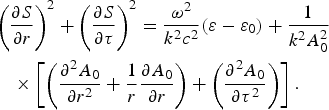 $$\eqalign{&\left({\displaystyle{{\partial S} \over {\partial r}}} \right)^2 + \left({\displaystyle{{\partial S} \over {\partial {\rm \tau} }}} \right)^2 = \displaystyle{{{\rm \omega} _{}^2 } \over {k^2 c^2 }}\lpar {\rm \varepsilon} - {\rm \varepsilon} _0 \rpar + \displaystyle{1 \over {k^2 A_0^2 }}\cr & \quad \times \left[{\left({\displaystyle{{\partial ^2 A_0 } \over {\partial r^2 }} + \displaystyle{1 \over r}\displaystyle{{\partial A_0 } \over {\partial r}}} \right)+ \left({\displaystyle{{\partial ^2 A_0 } \over {\partial {\rm \tau} ^2 }}} \right)} \right].}$$
To proceed further a paraxial like approach (Misra & Mishra, Reference Misra and Mishra2009) analogous to paraxial approximation is adopted where the coordinate system is transformed from (r,z,τ) to (η,z,τ) space such that
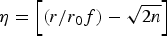 $${\rm \eta} = \left[{\lpar r/r_0 f\rpar - \sqrt {2n} } \right]$$
r 0f(z) is the width of the beam and  $r = r_0 f\sqrt {2n}$ represents the position of the maximum irradiance on the DHGP wavefront as it advances in the plasma. Since the irradiance of the HGP is maximum at
 $r = r_0 f\sqrt {2n}$ and τ = 0; the expansion of the expressions for the relevant parameters around
 $r_0 f\sqrt {2n} $ and τ = 0 are certainly justified in the paraxial like approximation; for n = 0 (Gaussian beam), the expansion is made (like wise) around r = τ= 0 (as usual). Like the paraxial theory, the present analysis is strictly applicable when
 ${\rm \eta} \lt \!\!\lt \sqrt {2n} $. Utilizing the transformation (i.e., Eq. 8), Eqs. (7a) and (7b) reduce to
 $$\eqalign{& \left({\displaystyle{{\partial A_0^2 } \over {\partial z}} - \displaystyle{{\lpar \sqrt {2n} + {\rm \eta} \rpar } \over f}\displaystyle{{\partial f} \over {\partial z}}\displaystyle{{\partial A_0^2 } \over {\partial {\rm \eta} }}} \right) + \displaystyle{1 \over {r_0^2 f^2 }}\displaystyle{{\partial S} \over {\partial {\rm \eta} }}\displaystyle{{\partial A_0^2 } \over {\partial {\rm \eta} }}\cr & \quad + \displaystyle{{A_0^2 } \over {r_0^2 f^2 }}\left({\displaystyle{{\partial ^2 S} \over {\partial {\rm \eta} ^2 }} + \displaystyle{1 \over {\lpar \sqrt {2n} + {\rm \eta} \rpar }}\displaystyle{{\partial S} \over {\partial {\rm \eta} }}} \right)+ \displaystyle{{\partial S} \over {\partial {\rm \tau} }}\displaystyle{{\partial A_0^2 } \over {\partial {\rm \tau} }} \cr &\quad + A_0^2 \left({\displaystyle{{\partial ^2 S} \over {\partial {\rm \tau} ^2 }}} \right)= 0}$$
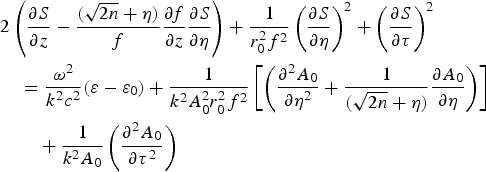 $$\eqalign{&2\left({\displaystyle{{\partial S} \over {\partial z}} - \displaystyle{{\lpar \sqrt {2n} + {\rm \eta} \rpar } \over f} \displaystyle{{\partial f} \over {\partial z}}\displaystyle{{\partial S} \over {\partial {\rm \eta} }}} \right)+ \displaystyle{1 \over {r_0^2 f^2 }}\left({\displaystyle{{\partial S} \over {\partial {\rm \eta} }}} \right)^2 + \left({\displaystyle{{\partial S} \over {\partial {\rm \tau} }}} \right)^2 \cr & \quad = \displaystyle{{{\rm \omega} ^2 } \over {k^2 c^2 }}\lpar {\rm \varepsilon} - {\rm \varepsilon} _0 \rpar + \displaystyle{1 \over {k^2 A_0^2 r_0^2 f^2 }}\left[{\left({\displaystyle{{\partial ^2 A_0 } \over {\partial {\rm \eta} ^2 }} + \displaystyle{1 \over {\lpar \sqrt {2n} + {\rm \eta} \rpar }}\displaystyle{{\partial A_0 } \over {\partial {\rm \eta} }}} \right)} \right]\cr & \qquad + \displaystyle{1 \over {k^2 A_0 }}\left({\displaystyle{{\partial ^2 A_0 } \over {\partial {\rm \tau} ^2 }}} \right)}$$
In the paraxial like approximation, the solution of Eq. (9a) can be chosen as,
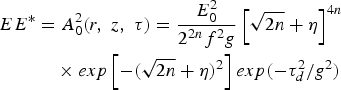 $$\eqalign{ EE^ {\ast} &= A_0^2 \lpar r\comma \; z\comma \; {\rm \tau} \rpar = \displaystyle{{E_0^2 } \over {2^{2n} f^2g}}\left[{\sqrt {2n} + {\rm \eta} } \right]^{4n} \cr & \quad \times exp\left[{ - \lpar \sqrt {2n} + {\rm \eta} \rpar ^2 } \right]exp\lpar - {\rm \tau} _d^2 /g^2 \rpar }$$
and
 $$\eqalign {& S\lpar r\comma \; z\comma \; {\rm \tau} \rpar = \lpar \sqrt {2n} + {\rm \eta} \rpar ^2 \lpar r_0^2 f/2\rpar \lpar df/dz\rpar + \lpar {\rm \tau} ^2 /2g\rpar \lpar dg/dz\rpar + {\rm \varphi} \lpar z\rpar }\comma$$
where the beam (f) and pulse width (g) parameters characterize the modification of the pulse profile in space and time as the pulse advances through the plasma, τL(=cτp) refers to the pulse length and τd = τ/τL.
The first two terms in Eq. (10b) refer to the spherical curvature of the DHGP while φ is the phase describing the departure from the spherical nature. It is necessary to mention that the choice of solutions for A 02 and S are consistent with set of Eqs. (9). In the paraxial like approach the effective dielectric function ε(η,z,τ) around the maximum (i.e., η = 0 and τ = 0) can be expressed as
 $${\rm \varepsilon} \lpar {\rm \eta} \comma \; z\comma \; {\rm \tau} \rpar = {\rm \varepsilon} _0 \lpar z\rpar - {\rm \eta} ^2 {\rm \varepsilon} _{\rm \eta} \lpar z\rpar - {\rm \tau} _d^2 {\rm \varepsilon} _{\rm \tau} \lpar z\rpar \comma$$
where ε0 (z) is the abbreviated form of ε (z,η = 0,τ = 0).
On substituting for A 02, S and ε in Eq. (9) and equating the coefficients of η2 and τd2 on both sides of the resulting equation one obtains
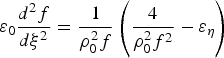 $${\rm \varepsilon} _0 \displaystyle{{d^2 f} \over {d{\rm \xi} ^2 }} = \displaystyle{1 \over {{\rm \rho} _0^2 f}}\left({\displaystyle{4 \over {{\rm \rho} _0^2 f^2 }} - {\rm \varepsilon} _{\rm \eta} } \right)$$
and
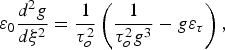 $${\rm \varepsilon} _0 \displaystyle{{d^2g} \over {d{\rm \xi} ^2 }} = \displaystyle{1 \over {{\rm \tau} _o^2 }}\left({\displaystyle{1 \over {{\rm \tau} _o^2g^3 }} - g{\rm \varepsilon} _{\rm \tau} } \right)\comma$$
where τo = (τLω/c) = τp ω, ρ0 = (r 0 ω/c) and ξ (= zω/c).
The above coupled equations (i.e., Eqs. 12) describe the evolution of spatial and temporal envelopes as the pulse propagates in the plasma where the processes of self focusing and compression are simultaneously operative. It is necessary to point out that the equations for f and g are based on the assumption that the pulse profile remains unaltered as it propagates in the plasma; this is consistent with the irradiance profile (as evinced from Eq. 9a). It may be noted that left hand side of Eq. (9b) has a term proportional to η with coefficient [∝ f(∂2f/∂z 2)] but none in the right hand side. This leads to (∂2f/∂z 2) = 0 and an erroneous result that the beam width parameter (f) is independent of plasma nonlinearity and remains unaltered as it traverses through the plasma. Since this is an absurd solution for f hence not considered in the further analysis and treated as redundant.
In case of Gaussian pulse the intensity maximum is exhibited at r = 0; following the earlier analyses based on paraxial approach, the coupled differential equations describing the pulse width parameters in space (f o) and time (g o) corresponding to Gaussian wavefront can be expressed as (Sharma et al., Reference Sharma, Borhanian and Kourakis2009)
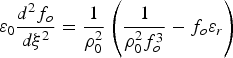 $${\rm \varepsilon} _0 \displaystyle{{d^2 f_o } \over {d{\rm \xi} ^2 }} = \displaystyle{1 \over {{\rm \rho} _0^2 }}\left({\displaystyle{1 \over {{\rm \rho} _0^2 f_o^3 }} - f_o {\rm \varepsilon} _r } \right)$$
and
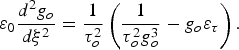 $${\rm \varepsilon} _0 \displaystyle{{d^2 g_o } \over {d{\rm \xi} ^2 }} = \displaystyle{1 \over {{\rm \tau} _o^2 }}\left({\displaystyle{1 \over {{\rm \tau} _o^2 g_o^3 }} - g_o {\rm \varepsilon} _{\rm \tau} } \right).$$
The above equations (Eqs. 13) characterizing f o and g o are consistent with the irradiance profile
 $$A_0^2 = \lpar E_0^2 /f_o^2 g_o \rpar exp\lpar \!- r_d^2 /f_o^2 \rpar exp\lpar \!- {\rm \tau} _d^2 /g_o^2 \rpar$$
with
 $$\eqalign{\varepsilon (r,z,\tau ) &= \varepsilon _0 (z) - r_d^2 \varepsilon _r (z) - \tau _d^2 \varepsilon _\tau (z), \cr r_d & = (r/r_0 ) \;{\rm and} \;\varepsilon _0 (z)=\varepsilon (z,r = 0,\tau = 0).}$$
Using the appropriate expression for ε corresponding to plasma generated through tunnel ionization of the gas and suitable choice of gas/pulse parameters in addition to initial boundary conditions (corresponding to plane wavefront of the pulse at z = 0) viz. f(0) = g(0) = 1 and f′(0) = g′(0) = 0, the set of Eqs. (12 & 13) can be numerically solved to evaluate the beam (f) and pulse (g) width parameters as a function of the propagation distance ξ; the knowledge of f and g leads to the information about spatio-temporal evolution of pulse profile as it propagates in the plasma.
4. EVALUATION OF NONLINEAR PERMITTIVITY (DIELECTRIC FUNCTION)
Following earlier analyses (Borisov et al., Reference Borisov, Borovisiky, Shiryaev, Korobkin, Prokhorov, Solem, Luk, Boyer and Rhodes1992; Brandi et al., Reference Brandi, Manus, Mainfray, Lehner and Bonnaud1993), the effective dielectric function of the plasma characterized by simultaneously operative relativistic and ponderomotive effects, can be expressed as
 $${\rm \varepsilon} \lpar {\rm \eta} \comma \; z\comma \; {\rm \tau} \rpar = \left[{1 - \lpar 4{\rm \pi} e^2 /{\rm \gamma} m_e {\rm \omega} ^2 \rpar n_e \lpar {\rm \eta} \comma \; z\comma \; {\rm \tau} \rpar - \lpar c^2 /{\rm \omega} ^2 \rpar \nabla \lpar \nabla {\rm \gamma} /{\rm \gamma} \rpar } \right]\comma$$
where γ [= (1 + a o2)1/2] is the relativistic factor, a o = (e/m ecω)E = α (E/E A) and α = (eE A/m e cω).
Specifically, the expressions for dielectric function corresponding to DHGPs and Gaussian pulses respectively can be written as
 $${\rm \varepsilon} \lpar {\rm \eta} \comma \; z\comma \; {\rm \tau} \rpar = \left[{1 - \lpar 4{\rm \pi} e^2 /{\rm \gamma} m_e {\rm \omega} ^2 \rpar n_e \lpar {\rm \eta} \comma \; z\comma \; {\rm \tau} \rpar - \lpar 1/{\rm \rho} _0^2 f^2 \rpar \partial _{\rm \eta} \lpar \partial _{\rm \eta} {\rm \gamma} /{\rm \gamma} \rpar } \right]$$
and
 $${\rm \varepsilon} \lpar {\rm \eta} \comma \; z\comma \; {\rm \tau} \rpar = \left[{1 - \lpar 4{\rm \pi} e^2 /{\rm \gamma} m_e {\rm \omega} ^2 \rpar n_e \lpar {\rm \eta} \comma \; z\comma \; {\rm \tau} \rpar - \lpar r_0^2 /{\rm \rho} _0^2 \rpar \partial _r \lpar \partial _r {\rm \gamma} /{\rm \gamma} \rpar } \right]$$
Case-1: For Dark Hollow Gaussian Pulses
Utilizing the paraxial like approach n e, βa and γ can be expanded around the intensity maximum (i.e., η = 0 and τ = 0) and can be expressed as
 $$n_e \lpar {\rm \eta} \comma \; z\comma \; {\rm \tau} \rpar = n_{e0} \lpar z\rpar - {\rm \eta} ^2 n_{e{\rm \eta} } \lpar z\rpar - {\rm \tau} _d^2 n_{e{\rm \tau} } \lpar z\rpar \comma$$
 $${\rm \beta} _a \lpar {\rm \eta} \comma \; z\comma \; {\rm \tau} \rpar = {\rm \beta} _0 \lpar z\rpar - {\rm \eta} ^2 {\rm \beta} _{\rm \eta} \lpar z\rpar - {\rm \tau} _d^2 {\rm \beta} _{\rm \tau} \lpar z\rpar$$
and
 $${\rm \gamma} \lpar {\rm \eta} \comma \; z\comma \; {\rm \tau} \rpar = {\rm \gamma} _0 \lpar z\rpar - {\rm \eta} ^2 {\rm \gamma} _{\rm \eta} \lpar z\rpar - {\rm \tau} _d^2 {\rm \gamma} _{\rm \tau} \lpar z\rpar .$$
Substituting for  $n_e $ and βa in Eq. (2) and equating the coefficients of η0, η2 and τd2 on both sides of the resulting equation yields
 $$n_{e0} = \lsqb \!\!- {\rm \beta} _0 + \lpar {\rm \beta} _0^2 + 4{\rm \beta} _0 {\rm \alpha} _a n_0 \rpar ^{1/2} \rsqb /2{\rm \alpha} _a\comma$$
 $$n_{e{\rm \eta} } = \lsqb {\rm \beta} _{\rm \eta} \lpar n_0 - n_{e0} \rpar /\lpar {\rm \beta} _0 + 2{\rm \alpha} _a n_{e0} \rpar \rsqb$$
and
 $$n_{e{\rm \tau} } = \lsqb {\rm \beta} _{\rm \tau} \lpar n_0 - n_{e0} \rpar /\lpar {\rm \beta} _0 + 2{\rm \alpha} _a n_{e0} \rpar \rsqb .$$
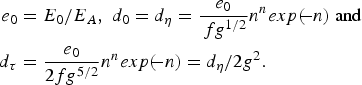
The coefficients (β0, βη and βτ) occurring in the definition of βa can be obtained by substituting the DHGP field profile in Eq. (3) and equating the coefficients of η0, η2 and τd2 by using definition of βa from Eq. (16b). Using Eq. (10a) the DHGP amplitude profile under paraxial like approximation can be expressed as
 $$\eqalign{ \left({\displaystyle{{\left\vert {\bi E} \right\vert } \over {E_A }}} \right)&= \displaystyle{{e_0 } \over {2^n fg^{1/2} }}\left[{\sqrt {2n} + {\rm \eta} } \right]^{2n} exp\left[{ - \lpar \sqrt {2n} + {\rm \eta} \rpar ^2 /2} \right]\cr & \quad \times exp\lsqb \!- {\rm \tau} _d^2 /2g^2 \rsqb \approx d_0 \lpar z\rpar - {\rm \eta} ^2 d_{\rm \eta} \lpar z\rpar - {\rm \tau} _d^2 d_{\rm \tau} \lpar z\rpar \comma }$$
where
 $$\eqalign{ e_0 &= E_0 /E_A \comma \; d_0 = d_{\rm \eta} = \displaystyle{{e_0 } \over {\,fg^{1/2} }}n^n exp\lpar \!\!- n\rpar\ {\rm and}\cr d_{\rm \tau} & = \displaystyle{{e_0 } \over {2fg^{5/2} }}n^n exp\lpar \!\!- n\rpar = d_{\rm \eta} /2g^2.}$$
This leads to β0 = sd 01/2exp[−(1/d 0)], βη = (β0/2)[1 + (2/d 0)] and βτ = (β0 /4g 2 )[1 + (2/d 0)].
Further using the definition of γ [=(1 + a o2)1/2], the coefficients (γ0, γη and γτ) can be expressed as
 $$\eqalign{& {\rm \gamma} _0 = \lpar 1 + {\rm \alpha} ^2 d_0^2 \rpar ^{1/2}\comma \; {\rm \gamma} _{\rm \eta} = {\rm \alpha} ^2 d_0 d_{\rm \eta} \lpar 1 + {\rm \alpha} ^2 d_0^2 \rpar ^{ - 1/2} \cr & \quad {\rm and}\ {\rm \gamma} _{\rm \tau} = {\rm \alpha} ^2 d_0 d_{\rm \tau} \lpar 1 + {\rm \alpha} ^2 d_0^2 \rpar ^{ - 1/2}.}$$
Finally, substituting for n e, ε and γ from Eqs. (16 & 11) in Eq. (15a) and equating the coefficient of η0, η2 and τd2 from both sides in resulting equation one easily gets
 $${\rm \varepsilon} _0 \lpar z\rpar = \left[{1 - \lpar 4{\rm \pi} e^2 /{\rm \gamma} _0 m_e {\rm \omega} ^2 \rpar n_{e0} } \right]+ \lpar 2/{\rm \rho} _0^2 f^2 \rpar \lpar {\rm \gamma} _{\rm \eta} /{\rm \gamma} _0 \rpar \comma$$
 $${\rm \varepsilon} _{\rm \eta} \lpar z\rpar = \lpar 4{\rm \pi} e^2 /{\rm \gamma} _0 m_e {\rm \omega} ^2 \rpar \left[{\lpar n_{e0} {\rm \gamma} _{\rm \eta} /{\rm \gamma} _0 \rpar - n_{e{\rm \eta} } } \right]- \lpar 6/{\rm \rho} _0^2 f^2 \rpar \lpar {\rm \gamma} _{\rm \eta} /{\rm \gamma} _0 \rpar ^2$$
and
 $${\rm \varepsilon} _{\rm \tau} \lpar z\rpar = \lpar 4{\rm \pi} e^2 /{\rm \gamma} _0 m_e {\rm \omega} ^2 \rpar \left[{\lpar n_{e0} {\rm \gamma} _{\rm \tau} /{\rm \gamma} _0 \rpar - n_{e{\rm \tau} } } \right]- \lpar 2/{\rm \rho} _0^2 f^2 \rpar \lpar {\rm \gamma} _{\rm \eta} {\rm \gamma} _{\rm \tau} /{\rm \gamma} _0^2 \rpar .$$
Case-2: For Gaussian Pulses
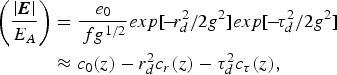
The expressions derived for the coefficients of n e in Eq. (17) are equally applicable for the Gaussian pulses provided n e/βa are expanded around r = 0 and τ = 0 under paraxial approximation and the subsequent coefficients of n e/βa corresponding to Gaussian profile are used in place of DHGP profile coefficients.
For Gaussian pulses, the field amplitude profile (Eq. 14) can be expressed as
 $$\eqalign{ \left({\displaystyle{{\left\vert {\bi E} \right\vert } \over {E_A }}} \right)&= \displaystyle{{e_0 } \over {\,fg^{1/2} }}exp\lsqb \! -\! r_d^2 /2g^2 \rsqb exp\lsqb \!-\! {\rm \tau} _d^2 /2g^2 \rsqb \cr & \approx c_0 \lpar z\rpar - r_d^2 c_r \lpar z\rpar - {\rm \tau} _d^2 c_{\rm \tau} \lpar z\rpar \comma}$$
where
 $$c_0 = \lpar e_0 /fg^{1/2} \rpar \comma \; c_r = \lpar c_0 /2f^2 \rpar\ {\rm and}\ c_{\rm \tau} = \lpar c_0 /2g^2 \rpar .$$
Consequently, following the approach similar to that in case of DHGP, the components of the ionization coefficient (β0, βr and βτ) and relativistic factor (γ0, γr and γτ) for the Gaussian pulse can be expressed as
β0 = sc01/2exp[−(1/c 0)], βr = (β0/4f 2)[1 + (2/c 0)], βτ = (β0/4g 2)[1 + (2/c 0)], γ0 = (1 + α2c 02)1/2, γr = α2c 0c r(1 + α2c 02)−1/2 and γτ = α2c 0cτ(1 + α2c 02)−1/2.
Further utilizing the definition of n e/ε/γ in paraxial regime (i.e., expansion around r,τ = 0), the components of the dielectric function (i.e., Eq. 15b) for Gaussian pulse can be expressed as
 $${\rm \varepsilon} _0 \lpar z\rpar = \left[{1 - \lpar 4{\rm \pi} e^2 /{\rm \gamma} _0 m_e {\rm \omega} ^2 \rpar n_{e0} } \right]+ \lpar 2/{\rm \rho} _0^2 \rpar \lpar {\rm \gamma} _r /{\rm \gamma} _0 \rpar \comma$$
 $${\rm \varepsilon} _r \lpar z\rpar = \lpar 4{\rm \pi} e^2 /{\rm \gamma} _0 m_e {\rm \omega} ^2 \rpar \left[{\lpar n_{e0} {\rm \gamma} _r /{\rm \gamma} _0 \rpar - n_{er} } \right]- \lpar 6/{\rm \rho} _0^2 \rpar \lpar {\rm \gamma} _r /{\rm \gamma} _0 \rpar ^2$$
and
 $${\rm \varepsilon} _{\rm \tau} \lpar z\rpar = \lpar 4{\rm \pi} e^2 /{\rm \gamma} _0 m_e {\rm \omega} ^2 \rpar \left[{\lpar n_{e0} {\rm \gamma} _{\rm \tau} /{\rm \gamma} _0 \rpar - n_{e{\rm \tau} } } \right]- \lpar 2/{\rm \rho} _0^2 \rpar \lpar {\rm \gamma} _r {\rm \gamma} _{\rm \tau} /{\rm \gamma} _0^2 \rpar .$$
5. NUMERICAL RESULTS AND DISCUSSION
This analysis brings out the spatiotemporal dynamics of a finite duration pico-second (ps) intense hollow Gaussian/ Gaussian laser pulse as it advances through a tunnel ionized gas; in this process the phenomena of transverse self focusing and pulse compression are explored. In contrast to earlier investigations this analysis takes account of electron ion recombination in addition to the neutral atom ionization in plasmas. This process (i.e. electron-ion recombination) was ignored in earlier analyses; hence the plasma density kept on increasing due to ionization which leads to decrease in the dielectric function.
In general in the absence of recombination, the nonuniform transverse intensity distribution of the laser pulse causes nonuniform tunnel ionization of the gas resulting in nonuniformity in the refractive index over its wavefront with a minimum at the axis (irradiance maximum); this in addition to diffraction leads to the divergence of the laser and the laser intensity falls off as it propagates in the plasma, i.e., the pulse suffers steady divergence. Intuitively, the inclusion of recombination term may lead to a balance between gas ionization and recombination processes and thus to the steady state situation, characterized by a saturating nonlinear dielectric function which takes finite value, usually larger than the case when it was ignored. In case of nonuniform laser intensity distribution in the transverse plane the recombination effect should be larger on the axis of intensity maximum and decrease radially; this modifies the refractive index in the same way. Hence the manifestation of nonuniform radial intensity profile of the pulse with gas ionization/ recombination processes in addition to relativistic mass correction and ponderomotive effects, results in modification in the background electron density in the transverse plane; this modifies the intensity profile of the wavefront of the pulse in a way that enhances the nonlinear dielectric function and hence the nonlinear propagation characteristics. The nonlinear pulse dynamics and its space-time evolution are described by a set of coupled equations (i.e., Eqs. 12 & 13) where the nonlinearity is triggered by modification in the electron density via the dielectric function (Eqs. 19 & 21). It is also interesting to notice that due to weaker diffraction, the central shadow off axis (higher order hollow Gaussian) pulses shows smaller divergence as compared to the same for Gaussian pulses; thus the DHGPs can be utilized to achieve enhanced energy transport in the plasma. To describe the dynamics of DHG (or Gaussian) pulse, Paraxial like (or paraxial) approach has been adopted which is applicable within the finite region characterized by  ${\rm \eta} \ll \sqrt {2n}$ (or r d ≪ 1) and τd ≪ 1, around the axis of maximum pulse intensity and valid throughout the pulse dynamics as it propagate in the plasma. In this limit all the relevant parameters have been expanded upto quadratic terms (first order in η2 (r d2) and τd2) only in the vicinity of η = r d = 0 = τd and higher order terms are ignored. It is evident from Eq. (9a) that the nature of the pulse profile (i.e. hollow Gaussian/Gaussian) remains unchanged as it traverse in the plasma and this is a natural consequence of paraxial approximation; the numerical results obtained are based on this paraxial formalism.
For a numerical appreciation of the analysis the following standard set of parameters corresponding to Neon gas (Liu & Tripathi, Reference Liu and Tripathi2000; Biondi & Brown, Reference Biondi and Brown1949) have been used for the computations; the effect of various parameters has been studied by varying one parameter and keeping others the same.
n 0 = 1020cm −3, e 0 = (E 0/E A) = 1/2 and 1/3 corresponding to peak pulse intensity I p ≈ 1.52 × 10¹⁶ (a 0 ≈ 1.05) and ≈ 6.75 × 10¹⁵W/cm 2 (a 0 ≈ 0.7) respectively, τp = 10ps, α0 = 2.2 × 10⁻⁶cm 3 sec−1 (corresponding to Neon gas [48]), I 0 = 21.5eV, κ = 1.0, T e0 = 1eV, λ = 10μm, ω = 27πc/λ, r 0 = 10λ, c = 3 × 10⁸m/sec and e = 1.6 × 10⁻¹⁹.
Using the above set of parameters and initial boundary conditions (corresponding to plane wavefront of the pulse at z = 0) viz. f(0) = g(0) = 1 and f′(0) = g′(0) = 0, the set of Eqs. (12 & 13) can numerically be solved to evaluate the pulse compression parameters, describing the pulse width in space (f) and time (g) as a function of propagation distance (ξ); the knowledge of f and g leads to the information about space-time evolution of pulse profile as it advances through the plasma. Further for the illustration purpose normalized irradiance of the pulse is defined as ςa = A 02(z)/A 02(0) while the normalized axial irradiance corresponding to η = 0,τ = 0 is given by ςao[=(1/f 2g)].
The set of Figure 1 illustrates the dependence of the normalized axial irradiance ςao[=(1/f 2g)] on the dimensionless distance of propagation (ξ) for various plasma/pulse parameters as DHGPs advances through the plasma. One of the common features is that the pulse exhibits three regime propagation characteristics (Sodha et al., Reference Sodha, Mishra and Misra2009a) viz. self focusing, oscillatory divergence and steady divergence, in the vicinity of the irradiance maximum. The effect of inclusion of electron ion recombination (characterized by the parameter α0) on the propagation of zero (Gaussian, broken lines) and first order DHGPs (i.e. n = 1, solid lines) has been displayed in Figures 1 and 2 respectively. It may however be emphasized that electrons and ions of a gas at a given electron temperature will have a unique recombination coefficient; the parameter α0 has been varied only to evaluate the importance of the recombination coefficient in focusing as a part of the parametric analysis. The figures indicate that in the absence of recombination (corresponding to black color lines) the Gaussian pulse exhibits steady divergence while DHGPs undergo oscillatory defocusing; nevertheless it can be seen from the figures that the inclusion of electron-ion recombination drives the system to the focusing regime and the effect is more pronounced with increasing recombination coefficient. The figure suggests that both the Gaussian and DHG pulses undergo periodic self focusing with increasing magnitude of the recombination coefficient; this leads to the enhancement in axial irradiance and hence enhanced energy localization as these pulses propagate through the tunnel ionized gas plasmas. The evolution of axial irradiance of the pulse for the propagation of different order DHGPs has been illustrated in Figure 3; it is noticed that the pulse shifts from oscillatory focusing to oscillatory divergence regime with increasing order of DHGP while the Gaussian pulse in the oscillatory divergence regime. It is necessary to point out that the space-time evolution of the em pulse field is sensitive to the choice of magnitude and profile of the intensity pattern and that they evolve differently depending on pulse/plasma parameters. The effect of pulse length (τp) on the axial irradiance of the first order DHGP as it advances through the plasma has been illustrated in Figure 4; it is seen that the oscillations in ςao become symmetrical while the focusing slightly decreases with increasing pulse width. This nature can be attributed to the fact that longer pulses drive the plasma to the steady state where the pulse dynamics is primarily governed by space profile only and temporal evolution becomes insignificant. Further it is also noticed that the focusing length increases with increasing the pulse duration.
(Color online) Dependence of normalized axial irradiance ςao[=(1/f 2g)] of the Gaussian pulse on the normalized propagation distance of (ξ) for e 0 = (1/3) and standard set of parameters as stated in the text; black, brown, green, red, and blue color lines correspond to recombination coefficients α0 = 0, 10−7, 10−6, 10−5 and 10−4 cm3s−1, respectively.

(Color online) Dependence of normalized axial irradiance ςao of the first order DHGP on the normalized propagation distance (ξ) for e 0 = (1/2) and standard set of parameters as stated in the text; black, green, red, and blue color lines correspond to recombination coefficients α0 = 0, 10−7, 10−6 and 10−5cm3s−1, respectively.

(Color online) Dependence of normalized axial irradiance ςao of the DHGP and Gaussian pulse on normalized propagation distance of (ξ) for e 0 = (1/2) and standard set of parameters as stated in the text; blue, red, and green color lines correspond to DHGP of the order n = 1, 2 and 3, respectively, while black line refers to Gaussian pulse (n = 0).

(Color online) Dependence of normalized axial irradiance ςao of the first order DHGP (solid lines) and Gaussian pulse (broken lines) on normalized propagation distance of (ξ) for e 0 = (1/2) and standard set of parameters as stated in the text; blue, red, green, and black color lines correspond to pulse length τp= 0.05, 0.1, 1.0 and 10 ps, respectively.

The set of Figure 5 display the spatiotemporal evolution of the normalized irradiance (ςa) of different order DHGPs at different distances of propagation in a tunnel ionized gas plasma; the dynamics of the pulse can be understood in terms of the mutual collective effect of transverse and longitudinal evolution of laser field leading to compression in space (transverse self-focusing, f) and time (longitudinal pulse compression, g). Figure 5a clearly indicates the broadening of the pulse width in space i.e., the divergence of Gaussian profile pulse (i.e. n = 0) as it advances through the plasma while DHGPs displays the pulse compression in time and space resulting in larger axial intensity. Further it is also seen that the two lobes (characterizing the dipole potential associated with DHGPs) oscillate about the central axis as the pulse propagate through the plasma and lead to convergence of intensity maxima (merging) of DHG pulse about central axis r = 0; this nature has been displayed in Figure 5b for the first order DHGP (i.e. n = 1). It is necessary to point out that the em pulse compression/rarefaction effects displayed in the simulation results in its space/time evolution, are the consequence of modification in pulse width in space (r = r 0f) and time (τ = τ0g) as it advances through the plasma; however this does not distort the nature of the pulse profile and the pulse retains its characteristic profile (i.e. hollow Gaussian or Gaussian) throughout the propagation in the vicinity of paraxial approximation. Further, it should be emphasized that the numerical results displayed are consistent with a particular set of parameters; however various features and effects can be explored by suitable choice of physical pulse/plasma parameters.
(Color online) (A) Demonstration of spatiotemporal evolution of normalized irradiance ςa[=A 02 (z)/A 02 (0)] of the Gaussian pulse (n = 0) and various order DHGPs (n = 1 and 2), as a function of normalized propagation distance (ξ) for the standard set of parameters as stated in the text with e 0 = (1/3) and τp = 10ps; here R(=r/r 0) and T(=τ/τL) while side bar represents the irradiance magnitude of the color index. (B) Demonstration of spatiotemporal evolution of normalized irradiance ςa of the first order DHGP (n = 1), as a function of normalized propagation distance (ξ) for the standard set of parameters as stated in the text with e 0 = (1/3) and τp = 1 ps; here R(=r/r 0) and T(=τ/τL)$ while side bar represents the irradiance magnitude of the color index.

6. CONCLUSIONS
A theoretical study to analyze the spatiotemporal dynamics of various order finite duration hollow Gaussian and Gaussian laser pulses in a tunnel ionized gas plasma has been made; the plasma generation and maintenance is considered to be a consequence of the mutually competing processes of electron-ion recombination and tunnel ionization. The recombination manifests itself in change in the nonuniform intensity profile of the laser pulse, resulting in the decrease in plasma electron density which drives the pulse in the focusing regime; this is in contrast to earlier studies where the pulse diverges. The paraxial like approach is utilized to solve the nonlinear Schrödinger wave equation (NLSE), governing the spatial and temporal evolution of a DHGP as it advances in the plasma. The important outcome of the study is as follows:
(i) By introducing the recombination phenomenon, the characteristic propagation of the pulse (both Gaussian and hollow Gaussian (HG) shifts from steady divergence to the focusing regime, as it advances through the tunnel ionized gas plasma; this feature can be utilized to accelerate the charged particles.
(ii) Short duration pulses lead to smaller focusing length as these propagate through the plasma.
(iii) DHGP displays smaller divergence than the Gaussian pulse as it traverses through the plasma; this may be applicable for large energy transport in the plasma.
(iv) The dipole potential associated with DHGPs oscillates about the central axis (r = 0) and displays the convergence of pulse intensity around the central axis.
ACKNOWLEDGEMENTS
One of the authors (SM) is grateful to Department of Science and Technology (DST) for financial support.



