Introduction
Caribbean societies are ageing rapidly. The share of the region's population aged 60 or more years is currently around 10 per cent, and the figure is expected to reach 16 per cent by 2025, and 25 per cent by 2050.Footnote 1 Information about ageing and older people is essential to assist policy makers, to raise public awareness, and to build support for policy changes (Economic Commission for Latin America and the Caribbean (ECLAC) 2004; United Nations Organization (UNO) 2007). This is especially the case in developing countries, where issues related to population ageing and the welfare of older people have often been neglected. Moreover, it is essential that public health policies and programmes promote healthy ageing. At the population level, advanced old age is associated with chronic diseases, poor health and disabilities, circumstances that not only lower quality of life but also increase medical spending, which jeopardises other health programmes (Pan American Health Organization (PAHO) 2005; World Health Organization (WHO) 2002). In addition, disabilities positively associate with poverty (PAHO 2007). Therefore, both regional and national policies should ensure that social security systems guarantee the economic security of elders and universal access to comprehensive primary health-care services (WHO 2002).
The ‘active ageing’ framework
To guide policy, programmes and research, the WHO developed the concept of ‘active ageing’ as an element of the policy framework on ageing that was presented by the UNO in Madrid in 2002 (Sidorenko and Walker Reference Sidorenko and Walker2004).Footnote 2 WHO (2002) defines ‘active ageing’ as ‘the process of optimizing opportunities for health, participation and security in order to enhance quality of life as people age’.Footnote 3 The concept encompasses not only multiple dimensions of health – the physical, mental and social – but also promotes the full participation of elders in societies and therefore their social integration and rights as citizens. Most of the dimensions of ‘active ageing’ are equivalent to the social determinants of health (Commission of Social Determinants of Health 2008; Wilkinson and Marmot Reference Wilkinson and Marmot2003); that is, the health and social services, and the social and economic environment.
Older people in Caribbean countries
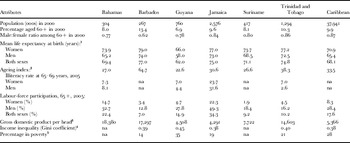
In Caribbean countries, ageing is taking place in a context of low economic performance, changing intergenerational relations, fragile institutional structures, and lessening access to health-care services (Palloni and McEniry Reference Palloni and McEniry2007). Selected demographic and socio-economic indicators for the six countries featured in this paper are presented in Table 1. It shows marked variations in the age structures, economic conditions, and welfare arrangements. When compared to the Latin America and the Caribbean (LAC) region, education expenditure is higher in the English-speaking Caribbean countries but health expenditure is lower (World Bank 2005). In Trinidad and Tobago, for instance, total public spending on health, education, social security and housing is around only six per cent of the gross domestic product, the lowest among the LAC countries, compared to more than 30 per cent in Cuba (PAHO 2007). Since the 1990s, there has been a shift toward the private sector together with reforms of the public sector. In LAC, about 70 per cent of the older population currently lives in urban areas, but unlike the mainland countries, the Caribbean countries have few substantial cities and larger percentages of older people live in rural areas (ECLAC 2004).
Socio-demographic and socio-economic profiles of the six Caribbean countries in the study, early 2000s

Notes: 1. During 2000–2005. 2. Population aged 60+ as a ratio of population aged less than 15 years in 2000. 3. 2005 Purchasing power parity in US $ (2003 for the Caribbean). 4. Perfect equality=0 (most recent survey). 5. Percentage of all-age adult population below poverty line (most recent survey). na: not available.
Regarding ageing policies and programmes, in 1999 the Caribbean Community adopted a Caribbean Regional Charter on Ageing and Health that urged governments to provide a ‘co-ordinated, systematic approach for ensuring the health and full integration and participation of older persons in Caribbean societies and economies’.Footnote 4 PAHO recently adopted a resolution to support ‘active ageing’ (ECLAC 2004), but this regional institution provides only limited resources to Caribbean countries. A regional strategy to carry out the Madrid International Plan of Action on Ageing was adopted by LAC countries in 2003, but so far only a few Caribbean countries have introduced a ‘National Policy on Ageing’, including Trinidad and Tobago. A pervasive problem in many Caribbean countries is that there is little information about the circumstances of older people, which hinders policy development, although Barbados is currently preparing policy papers on ageing (Zunzunegui et al. Reference Zunzunegui, Alvarado, Cloos, Simeon and Eldemire-Shearer2008).
Across the Caribbean, generally speaking older people benefit from public assistance programmes, provided by various ministries or offices for ‘the aged’, such as pension or other economic aid, food packages, accommodation in residential homes, and free medication (ECLAC 2004). The risk of older people becoming poor is high because of the raised likelihood of disability and few income-earning opportunities. Moreover, a large proportion of older people in the Caribbean worked in the informal sector and never contributed to a pension scheme, most particularly those who had been rural, informal and self-employed workers (Palloni and McEniry Reference Palloni and McEniry2007; Pettinato and Cassou Reference Pettinato, Cassou, Desmond Brunton and Masci2006). Additionally, the emigration of young people and the return of older adults after retirement contribute to demographic ageing and mean that family support is irregular, although some elders benefit from remittances from relatives abroad (ECLAC 2004). On the health-care systems, the English-speaking Caribbean countries generally have unified health systems that are financed primarily through taxes and budgetary allocations, and the private sector's role is secondary and complementary (ECLAC 2006). Private health-care insurance and providers are becoming increasingly important, however, as the countries move towards a model in which the wealthiest members of the population seek health care abroad, middle-income groups use private insurance or services, and the poorest rely on the public system (Caribbean Commission on Health and Development 2005).
Regarding living arrangements, data from the Survey of Health, Well-Being and Aging in Latin America and the Caribbean (SABE), a 1990–2000 cross-sectional study that focused on ageing in several LAC cities, indicated that many elderly women lived with their children (ECLAC 2004). More specifically, in Bridgetown, Barbados, 21 per cent of older people lived alone, 36 per cent lived with one person, usually the spouse, 26 per cent lived with two or three people, and 15 per cent lived with five or more others (PAHO 2005). The survey also showed that older people had a high prevalence of chronic diseases such as diabetes (Palloni and McEniry Reference Palloni and McEniry2007), and that poor social circumstances during childhood, poor education, lifelong work as manual workers and, especially, low income, associated with poor self-reported health and frailty (Alvarado et al. Reference Alvarado, Zunzunegui, Beland and Bamvita2008; Hambleton et al. Reference Hambleton, Clarke, Broome, Fraser, Brathwaite and Hennis2005; PAHO 2005; Palloni and McEniry Reference Palloni and McEniry2007).
The focus group discussions
As part of an initiative to deepen the understanding of the situation of elderly people in the Caribbean countries, between 2007 and 2008 we conducted an exploratory study of older people's circumstances and experiences using the ‘active ageing’ framework in six countries: the Bahamas, Barbados, Guyana, Jamaica, Suriname, and Trinidad and Tobago. Background information and statistics were collected from various policy and programme reports and interviews with stakeholders, but the principal method of data collection was 31 focus group discussions with elders in diverse districts of the six countries. This paper presents the themes that emerged from the discussions that pertain to the ‘active ageing’ framework.
Aims, organisation, themes and locations
Teams from the Caribbean Health Research Council, the University of Montreal, the University of the West Indies (Mona, Jamaica) and the College of the Bahamas collaborated in organising and running the 31 groups. Between August 2007 and March 2008, four each were conducted in the Bahamas, Barbados and Suriname, six each in Jamaica and in Guyana, and seven (including one pilot) in Trinidad and Tobago, and each one lasted 90 minutes. Separate focus group discussions were conducted by local moderators in the capital cities and other towns, and 11 of the group discussions were arranged in rural areas. There were mixed-gender and same-gender groups. Following the pilot, the set-up and facilitation procedures were standardised. The data collection manual for each country co-ordinator included guidance on sampling, recruitment, informed consent procedures and the conduct of the focus groups, a topic guide, information sheets for the participants, the consent form, participant profile forms to collect socio-demographic information, and guidelines for data transcription.
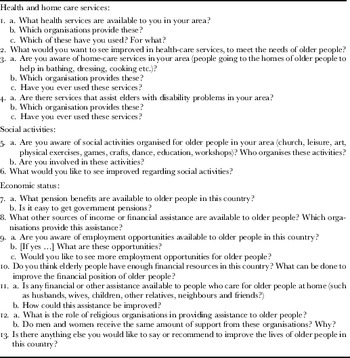
The topic guide that was used for all the groups is summarised in Table 2. It was developed from the ‘active ageing’ framework and has three domains: the availability and use of health and home-care services and of special services for disabled elders, social activities and support, and financial circumstances. Regarding the social environment, the discussion prompts focused on the availability and participation of elders in social and leisure activities, and on the availability of supportive services such as transport. Questions and prompts on economic circumstances focused on financial resources (pension benefits and other financial assistance; income and employment opportunities). Each of the themes was discussed with reference to accessibility, types of providers, utilisation, and barriers to and satisfaction with the services.
Topic guide for the focus groups

Note: A fuller version of the guide with prompts is available from the authors.
The participants were recruited through government departments and from various institutions and non-governmental organisations, e.g. church groups, senior citizens' associations, community groups, sports and music associations, and the Red Cross. In addition, three focus groups were conducted with residents of public and private care homes (one in the Bahamas and two in Trinidad). The two inclusion criteria were that the participants had to be at least 60 years old and able to participate in the group discussion, i.e. not suffering from major cognitive impairment or deafness. All participants provided informed consent and were assured confidentiality.Footnote 5
Data analysis: strategy and validation
The analysis aimed to describe and map the strengths and deficiencies of services and the nature of unmet needs, with particular attention to disparities. The coding started by organising and reducing the data from each focus group using an analytic framework (Coffey and Atkinson Reference Coffey and Atkinson1996) that noted the following elements for each service: availability, use, barriers, positive and negative aspects, needs and the informant's satisfaction with the services and their availability. Constant comparative analysis of the selected data (Glaser and Strauss Reference Glaser and Strauss1967), first within and between the focus groups in each country, and then between the countries, allowed further description and interpretation of the data and the identification of differences by socio-demographic attributes. The categorisation of the data was also guided by the ‘active ageing’ framework.Footnote 6 The results presented in this paper are based on findings that were validated by the focus group facilitators of each country. The final overall report was also validated by country representatives from academic institutions, government agencies and non-governmental organisations who attended a workshop in Port of Spain in March 2008.
The findings
Profiles of the participants
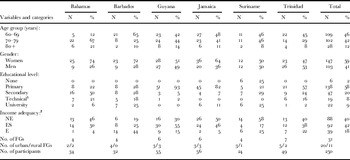
The majority (88%) of the focus group participants were aged between 60 and 79 years, and there were more women (59%) than men (41%) (Table 3). The majority (78%) had primary or secondary schooling as their highest level of educational attainment, and nine per cent had a university education.Footnote 7 Most participants perceived their income as being insufficient to live (40%) or sufficient only if many sacrifices were made (42%). LAC is the world region with the most unequal income distribution (Alleyne et al. Reference Alleyne, Castillo-Salgado, Schneider, Loyola and Vidaurre2002; World Bank 2008), although there are substantial variations between and within the Caribbean countries (see Table 1). The UNO has scored ‘human development’ as ‘high’ in the Bahamas, Barbados, and Trinidad and Tobago, and ‘medium’ in Guyana, Jamaica and Suriname.Footnote 8
Profiles of the focus group participants, six Caribbean countries, 2008

Notes: The percentages are of the number who answered the question. 1. Technical or vocational. 2. NE: ‘I do not have enough money to live’. ES: ‘I have enough money to live but only by making many sacrifices’. E: ‘I have sufficient money to live without many sacrifices/I have enough money to live’. FGs: focus groups.
Availability and use of health-care and social services
The focus group discussions revealed great variation among the countries in the availability of, access to, use of and satisfaction with services, and large differences between urban and rural areas within countries. A woman informant in Barbados said, ‘we do have a very good polyclinic here: I have used the polyclinic and I find I get exceptionally good response in whatever I need’, but in great contrast a Guyanan older man from a rural area said:
There are many things we are facing here regarding the hospital. Someone said there is a hospital, but the equipment is short: the X-ray is not working. We do find ourselves in difficult times regarding our health. You have to carry patients by motor boat and sometimes it is out of service. Right now, I could say that they have people who have broken foot but they send them back because they do not have anything to put on their foot. We need something better; we need better care especially for the elderly people.
These quotes evince, on the one hand, one person's satisfaction with local health-care facilities in Barbados, but on the other hand, an under-resourced public health-care system that impedes access to proper care in a rural area of Guyana. In the Bahamas, nurses were reported to provide daily clinics and visit homes in some rural areas every month while doctors gave weekly consultations. Conversely, some villagers in Guyana and in Suriname said that generally they could access only nursing care, and that hospitals were too far away and overcrowded, under-staffed, lacked medicines and had poor medical infrastructures. Non-governmental organisations such as church groups provided some medical services.
Considerable disparities between the public and the private sector were reported. Many participants used both public and private health-care services, although others could not afford private services. Most elders used public-sector health centres or hospitals either because they are free of charge or because they are the only available services, as characteristically in rural areas. There was a general preference for private services, for reasons explained well by a woman in Barbados:
I think it is a combination of three things: stigma, the long waits and [poor] quality of service. Maybe not so much the quality of service but the long waits. If you go to the polyclinic you have to be prepared to stay there for two, three, four hours, even five. You go to your private doctor if you can afford it, but I am not downing the polyclinics.
The elders used private health-care services for special needs, because of the negative stigma of the public clinics, to get more attention from medical staff, and because waiting times are shorter. It is interesting to note, however, that many doctors work in both the public clinics and private practice.
The emphasis on curative care and discontinuous care
Health-care services in the six countries emphasise curative care. Very few participants mentioned other components such as prevention, health education or health promotion, and there were few indicators of integrated services. Furthermore, the public system in most countries is delivered through clinics that concentrate on the treatment of chronic diseases that are seen as biomedical problems isolated from other issues related to ageing. This feeling that disease is treated without focusing on the patient as a ‘whole person’ was explicitly expressed by a woman informant during a focus group in an urban area of Trinidad and Tobago: ‘They [doctors at the health centre] deal with you as a “chronic case”; they just write the prescription’. In most countries, there is a list of medicines that are supposedly free of charge for senior citizens, as with the Chronic Diseases Assistance Programme in Trinidad and Tobago. A male urban resident explained its limitations:
My doctor gives me a prescription. When I go to the drugstore the pharmacist says, ‘I only have one you know; I do not have the other but you can start with the one I will give you. Regarding the other one, you have to get it somewhere else’. I experienced that a couple if times: you go to a drugstore with your prescription but they do not have what you need.
Not all prescribed medications are subsidised, and as indicated in the quotation, medicines are not always available in the public sector. That means that low income is a serious barrier to accessing needed medication. Moreover, some participants described problems of poor communication and unreliability in the provision of medical care services. A woman in Barbados was reluctant to complain but said, ‘I would not say that we are not satisfied. When the doctors are there [the polyclinic] they are quite efficient, but there is no notice in advance to inform that no doctors would be coming in today’.
Few services to meet the special needs of older people
Most of the evidence collected from the focus groups suggested that across the six countries, health and social services do not cater for the special needs of elders, particularly as regards access, attention and assistance. The many comments about the inappropriateness of existing facilities were exemplified by a woman informant in Barbados. She said, ‘the waiting period is long and if the rain comes, there is nowhere [at the polyclinic] to shelter and you are standing outside. The waiting area is very poor. There is nowhere to rest. You have to wait outside before the clinic opens’. Many informants argued strongly for improvements and new facilities, as with a woman informant in the Bahamas, who said, ‘I would like to see an improvement, if not now at least in the future: an area in the hospital that caters only for the elderly – a special section for seniors and disabled persons’. There were a few accounts of more appropriate and sensitive care, as from a woman in a rural area of Guyana, who said, ‘There is one community health worker who is attached at the hospital and who is very, very interested in people's welfare, and through her visiting we were able to get my husband's blood pressure tested’.
In the Bahamas, Barbados, and Trinidad and Tobago, the public-sector nursing or home-care services provide assistance with cleaning, cooking and bathing. A woman in Trinidad and Tobago reported, however, that ‘the GAPP programme is not well organised. We tried to have somebody from that programme whom we never had’.Footnote 9 It was apparent that public assistance is inconsistent; there seems to be a lack of resources and many deficiencies in the provision of information and communication about the available services. Some home-care services are provided by church organisations, as in Jamaica, but in many cases home care is paid for privately. As a man said during the focus group in an urban area in Suriname, ‘friends of mine hired someone that comes everyday. … All I know is that my friends sometimes complain that it gets expensive, but they have no other choice because his spouse cannot provide the type of care this person does and the children have a very busy life’. Furthermore, in almost all countries, ‘aids and equipment’ – spectacles, hearing aids, wheelchairs or walkers – or special transport are not readily available through the public system. Likewise, public-sector clinics are not designed with the needs of older people in mind, as a male informant in Barbados explained:
Sometimes if an older person comes to the clinic without a family member and they have difficulty in getting around, they either have to battle on their own or they have to depend on other patients at the clinic. I feel that they really have to look at providing assistance – handrails and wheelchairs – for seniors at the clinic.
Some equipment is provided or lent by non-governmental associations such as the Red Cross or Lions Club from time to time, but more often, if equipment is essential it has to be bought privately.
Social support
The participants discussed many issues related to social support. It encompasses the support from personal ties, supportive and intimate relationships, social contacts and networks, and assistance from relatives, friends and outreach services (WHO 2002). The focus group contributions indicated that social support and solidarity vary greatly. The most widespread sources of support of older people are relatives, friends and community-based and voluntary organisations. Many elders stated that they have to depend on relatives or more broadly on younger people. At a focus group in a rural area of the Bahamas one man said, ‘children have to leave the island to make their life, so they are not here to help their parents and care for them’. Across the six countries, many children are living abroad and cannot directly care for their parents. Some elders expressed great concern about isolation when the children leave home to find jobs, as a man living in a rural area of Suriname explained:
It would be helpful if there was someone at the clinic especially for home care, because what will happen to you if you are sick and if your family moved to town and you do not have anybody to look after you? You will just be sick with no help.
Several participants suggested that more use should be made of elders who are willing to assist their peers. Not only do some older people lack family support, some have to provide financial help for their relatives. The informants told us that some people receive support from church networks in which they are involved, but they do not as a rule provide assistance or organise regular social events for older people. According to the respondents, in none of the six countries are there programmes of financial support for family care-givers.
Elders sometimes have to use public or private transport services to attend medical services, but transport is not always available and can be expensive. A woman informant in an urban area of Suriname explained that ‘I need to visit the doctor regularly and I do not have transportation. So the amount of money I spend on taxis is more than my old age pension’. Many elders advocated a better transport system for senior citizens during the focus group discussion. Moreover, some concerns were raised regarding criminality and social exclusion – factors that obviously impede social integration and lead to isolation.
Social participation
Many of the focus group participants were not aware of organised social activities specifically for older people, and expressed a need for more social activities and more places to meet, discuss, dance and pursue handicrafts. Many, however, did engage in informal social activities more or less regularly. When the data from the groups in different countries were compared, it was apparent that the availability of social activities varied by country and region, and that social engagement appeared to be a function of financial situation, association membership and the general health of the person. A woman informant in Barbados explained:
There are a lot of facilities but the private sector is capturing the market here in this island. It mainly caters for the middle class or upper-middle class because they are the ones who can drive and sit down and do this and go home, and have a maid who cooks for them. There are craft classes which I have seen but they have [them] in the evening.
There were indications that urban settings and better socio-economic status associated with more opportunities for engaging regularly in organised social events. As a man in a rural area of Guyana explained, ‘you see here, in this village, we do not have the time to get old, because we do not get sufficient support from the government. We have to keep on working to support our families. So, if we would have something to ease our minds, it would be great’. A woman in an urban area of Suriname was quite active socially, and said, ‘we cannot complain, we go out a lot. There are always a lot of activities. You just decide where you want to go’. The participants also pointed out the importance of making information on social opportunities available to elders, but of course that will not resolve the situation of elders who are isolated and/or marginalised because of disability, poverty or lack of networking. A male informant in Barbados said:
[The] government should provide funding for community groups to put programmes in place to bring senior members into employment. They might not work the whole day but at the end of the day they are getting something to add to their pension. They are coming to work, they are going to eat, they are going to interact in the social setting and everything and at the end of the day the seniors benefit.
It was also suggested that elders should be offered opportunities to enhance their employment possibilities. As proposed in the above quote, public resources should be made available to older people in order to connect social support, social participation and income-generation activities.
Economic conditions, financial circumstances and pensions
The data showed wide variation in access to financial resources, even within countries, as illustrated by two contrasting statements. A woman in an urban area of Suriname said, ‘the government should be ashamed of treating its old people this way: our money is not enough to have a decent life’, whereas a man in the same location said, ‘I live a very comfortable life. I do not only live from my pension but also from my savings or prior investments and I still do some consultancy work for private businesses. So I can say I am doing very well. My wife and I can afford to have vacations overseas [and] our kids live quite comfortably themselves’. There were reports in some places that the amount of support provided by the government to seniors had fallen over the years. A man in an urban area of Guyana said:
Years ago, senior citizens used to travel freely on the transportation services provided by the government. But that programme does not exist anymore; so you can understand that elderly people have to push their hands in their pockets from the little pension they get that cannot even pay for your food, your electricity, your water, and your medical bills. It is inadequate you know, and I think that more should be done by our government or whoever is responsible to help senior citizens.
In most of the studied countries, there are two public-sector pension schemes: a ‘basic’ old-age pension (OAP) and contributory schemes. Regarding the OAP, the focus group informants confirmed that age of eligibility, amount and eligibility criteria vary among the countries. There was also evidence of discontinuous support as a result of bureaucratic failures. As a man from Barbados said, ‘there is a survey [a form] that determines if you would qualify [for pension benefits], and then sometimes they pay it only for six months, and then they stop and review it again, so it is not something that you can really depend on’. Access to the OAP is not universal in all six countries, but on the other hand, some elders benefited from one or more other pensions. For most of the informants, however, even together the OAP and contributory public pensions were insufficient to meet all basic living costs, as is also the case for the levels of public assistance or income support programmes.
Access and attitudes to paid employment in later life
The participants' opinions regarding employment were related to their financial situations and needs and to their physical health. Many had to engage in paid work or other income-generating activities in order to eat and to pay the rent and utility bills, whether or not they had a pension. Some wanted to see more job opportunities for elders, but others did not want to continue working or felt no long capable. A few said it was no longer ‘their duty’ as they had worked hard all their lives, though they still want to keep busy. For many participants of lower formal education, finding regular and manageable employment is a challenge. Furthermore, in some countries, elders cannot draw the OAP if they are working or fear losing their pension benefit if employed, and there were reports of employers that do not employ seniors that receive a pension. An informant during a focus group in an urban area in Trinidad mentioned other conditionalities:
If you have a taxi [use taxis], you are not entitled to OAP. You understand? They are asking you how much money you got from when you were working – I find that is stupid. When you reach 65 in a country, you should get your OAP. That is yours, you worked for that, I cannot understand this … and government is talking about low prices but when you go shopping, prices are going up, right up, you understand? So poor people are really seeing trouble in this country.
The next quotation illustrates differences by level of education. Being well educated and particularly having been in professional occupations provides more income-earning opportunities in old age without compromising one's pension benefits, as a number of former teachers, nurses and consultants described. A man living in an urban area of Suriname said, ‘It is a good thing I still teach. I have a great pension and enough additional income to live a comfortable life’. Some informants said that they would like to start small businesses but had been denied loans. These examples make clear that the socio-economic systems of many Caribbean societies impede the less fortunate from accessing adequate resources and opportunities in old age.
Many of the participants depended on financial assistance from their family, and a few received some support from non-governmental or church organisations. As a rural man in the Bahamas put clearly, ‘some people have children who are fortunate and some are not. Some children cannot do anything even though they may want to give their parents’. There were a few accounts of family members failing to be supportive, and of the elders having to assist their own children. A few participants received food assistance vouchers, and many believed that such schemes should be more generous, for it was widely agreed that many elders by necessity skimp on food. As a woman informant said during a group discussion in an urban area of Guyana:
The elderly need more money to live. The money that they are getting is too little. A lot of them have to go without the basic things like milk and soap. Most elderly people cannot buy milk, they have to drink the black tea which is not good for their health.
Discussion and conclusions
This paper has presented selected findings from the qualitative component of a larger study of the social conditions and access to health-care services of elderly people in the Caribbean. We conducted 31 focus group discussions in six countries to gather people's descriptions and assessments of health-care and social services, and their social and economic environment – all elements of the UNO's ‘active ageing’ framework. The participants were of both genders and diverse socio-economic status and lived in urban and rural areas. One limitation of the study is that many topics were discussed, which enabled only preliminary examinations, but the large number of focus groups and the multi-country approach enabled sufficient data to be collected to support comparisons and contrasts. In this final section, the informants' statements are interpreted further with reference to data from other sources.
Almost ten years after population ageing was declared a priority policy area in the Caribbean, the remarks of the focus group discussants suggest that coherent, multi-sector and comprehensive responses to population ageing are still lacking in the region. Furthermore, there are indications that the factors that promote ‘active ageing’ are very unequally distributed among elders in the six countries, with marked differences between the well-off and the poor and between rural and urban areas. This information is consistent with that reported for the Caribbean region by PAHO (2005, 2007) and ECLAC (2004), which indicates that both geographical location and socio-economic status shape health inequalities.
Most Caribbean countries provide health-care coverage for senior citizens through the public sector. In the Bahamas, the Ministry of Health implements specialised health and social services for older adults, such as community nursing and geriatric clinics, and it provides special equipment. In a few countries, including Barbados and Trinidad and Tobago, some social services such as home care are provided in the public sector (Zunzunegui et al. Reference Zunzunegui, Alvarado, Cloos, Simeon and Eldemire-Shearer2008). The focus group discussions confirmed that the availability of and access to health-care and social services are much more limited in the lower-income countries. The focus group discussions also made clear that, in the perception of older people, health-care services do not achieve continuity, are not comprehensive, are often short of resources, and mainly focus on curative rather than preventive services. These findings are consistent with the PAHO (2007) report, which indicated that most LAC national health systems are segmented and fragmented, which creates barriers that impede access to health care for the very poor, those who worked or work in the informal sector, and marginalised rural and urban residents.Footnote 10
When one takes into account the high prevalence of chronic diseases among elders in the Caribbean (ECLAC 2004; PAHO 2005, 2007), a priority for the health services is to focus on the prevention of chronic diseases and related disabilities (Palloni and McEniry Reference Palloni and McEniry2007). Such prevention would result in significant savings for health-care systems and an improvement in older peoples' quality of life (Zunzunegui et al. Reference Zunzunegui, Alvarado, Cloos, Simeon and Eldemire-Shearer2008). In addition, as indicated by the focus group participants, elders cannot always afford the costs of health-care. As pointed out in the Suriname Country Profile (WHO 2004), continuity of care requires not only repeat medical contacts and onward referrals, but also supportive services such as aids and equipment for elders with mobility restrictions and disabilities and also transport services (to and from clinics), both of which either do not exist in a country or are limited. This was the view of many participants in the focus group discussions. One should note that public transport is free-of-charge for senior citizens in Barbados, Jamaica, and Trinidad and Tobago (Zunzunegui et al. Reference Zunzunegui, Alvarado, Cloos, Simeon and Eldemire-Shearer2008), but bus routes and times are not always convenient for trips to and from clinics. Echoing a point that emerged from the Caribbean Integrated Response of Health Care Systems to Rapid Population Ageing (INTRA) projects (Eldemire-Shearer and the Jamaican Team Reference Eldemire-Shearer2004; WHO 2004),Footnote 11 the focus group participants suggested that the particular needs of elders are insufficiently catered for, since only few physicians and nurses are trained to recognise or address their chronic, multiple and complex conditions, and their treatment and support needs. All Caribbean countries have established training in elderly care, but the scale of the effort and the target professions vary by country (ECLAC 2004; Zunzunegui et al. Reference Zunzunegui, Alvarado, Cloos, Simeon and Eldemire-Shearer2008).
Regarding the social environment, variable intergenerational solidarity was reported during the focus group discussions: some elders benefit from family support while others fear isolation and face deprivation. We do not have data from all six countries, but it seems that multi-generational households are less prevalent than in earlier times. Children's migration to North America and Europe has contributed to the decrease in mean household size, and some elders see social ties and integration as dependent not only on family members but also on others. ECLAC (2004) suggested that in the LAC region, relatives, especially women partners, are the main care-givers for disabled older persons, but many are aged 50 or more years and lack financial resources. Furthermore, no LAC country has either a care-giver support policy or a plan for providing day care to disabled persons. The focus group discussants described the ways in which social ties provide opportunities for support and assistance, on the one hand, and opportunities for agreeable social activities, on the other. Even though many participants claimed that they were socially active, strong variations and disparities in social participation were revealed: the less socially advantaged and those with disabilities were more vulnerable to social exclusion.
There is a reciprocal relationship between health status and social engagement. Participation in the local community through social activities has been shown to have beneficial effects on health, and there is evidence that good social relationships improve longevity, prevent disability and depression, and maintain cognitive function in old age (Berkman and Syme Reference Berkman and Syme1979; Berkman et al. Reference Berkman, Glass, Brissete and Seeman2000; Seeman Reference Seeman2000; Zunzunegui et al. Reference Zunzunegui, Alvarado, Del Ser and Otero2003). Conversely, chronic diseases and related disabilities prevent elderly people from participating in social activities (PAHO 2005; Rose, Hennis and Hambleton Reference Rose, Hennis and Hambleton2008), and the consequent isolation can be harmful (Balfour, Masaki and Launer Reference Balfour, Masaki and Launer2001; Fabrigoule et al. Reference Fabrigoule, Letteneur, Dartigues, Zarrouk, Commenges and Barbeger-Gateau1995; Fratiglioni et al. Reference Fratiglioni, Wang, Ericson, Maytan and Winbland2000; Seeman et al. Reference Seeman, Albert, Lusignolo and Berkman2001). Given this relationship, it is imperative to support and assist the development and roles of social networks (WHO 2002; Zunzunegui et al. Reference Zunzunegui, Koné, Johri, Béland, Wolfson and Bergman2004). Regarding social participation, ECLAC (2004) indicated that elders are generally involved in community organisations and associations for senior citizens, and that the level of volunteering among elders is high in Barbados, especially through churches, but more opportunities could be created for the social integration of elders or, in other words, to increase their social involvement (Zunzunegui et al. Reference Zunzunegui, Alvarado, Del Ser and Otero2003). Governments could provide more assistance to senior citizens' community-based organisations, which would enable more elders to support their peers and organise more social and support activities, as through day-care centres and senior clubs.
There is no doubt that the socio-economic dimension of the ‘active ageing’ concept is one of the biggest challenges for Caribbean countries, especially those with less productive economies. The focus group discussions confirmed that a high socio-economic level provides an older person with more resources and opportunities, such as a better access to goods, income and services. Similarly, higher education provides more employment opportunities and more income benefits in old age. Among low-income older people, many have to choose between basic commodities since they cannot afford them all. As the study participants understood, there are two types of pension systems in the Caribbean: contributory and non-contributory. Some countries offer a universal old-age pension, varying from US $ 30 per month in Guyana to around US $ 250 per month in Trinidad and Tobago, amounts that are insufficient to cover basic needs and, moreover, some elders do not receive the basic pension. ECLAC (2004) estimated that in Barbados, Jamaica, and Trinidad and Tobago, about two-thirds of older people benefit from a pension; but the fraction is much lower in other Caribbean countries (the percentage is as low as 30 in some). Remittances and work are irregular sources of financial resources in all countries, but across the LAC more than 30 per cent of people aged 65 or more years have no income, pension or retirement plans. A higher percentage of urban than rural elders receive some social security benefit. Since ‘social protection’ is for many insufficient to cover basic needs, the necessary result is that a high proportion of elders continue to be active in the work force (ECLAC 2004). It is therefore essential that ‘active ageing’ policies develop lifelong learning and employment strategies; policies that should integrate equity and social justice to avoid increasing social inequalities (Davey Reference Davey2002).
The focus group discussions did not establish clear differences in either the circumstances or the views of men and women. In Suriname, one all-men group with university degrees declared that they had good access to health-care services, employment and financial resources, which was not heard in the groups with less-educated women. As indicated in Table 3, the men were more likely to be employed than women and to receive occupational pensions, and although more women received the public old-age pension, the majority were excluded from pension schemes because many had been home-makers or had worked in the informal sector and not paid contributions. In Trinidad and Tobago, however, women were more likely to receive financial support from relatives than men (ECLAC 2004). Furthermore, as previous authors have suggested, since women live longer, they may be less likely to receive care than older men (Andrews et al. Reference Andrews, Esterman, Braunack-Mayer and Rungie1986). In the Caribbean, however, it does appear that older women are more likely than men to live with their children, and that older men may be at a higher risk of social exclusion (PAHO 2005; Zunzunegui et al. Reference Zunzunegui, Alvarado, Cloos, Simeon and Eldemire-Shearer2008).Footnote 12
This study has shown that the ‘active ageing’ framework is useful not only as a framework for policies and programmes but also as a guide to both exploratory research and in making a broad or holistic assessment of the circumstances of older people, but in all six countries more information is needed about each component of the framework. All the same, as in other places, the Caribbean region has its own specificity and diversity. The strengthening of the public-health sector seems to be a priority to improve the health of older people. At present, however, monitoring the health status of older people hardly takes place and there is little attention to conditions that are most evident in old age such as dementia, depression, incontinence and falls. There is also a dearth of data on the social and economic circumstances of older people in the Caribbean (Zunzunegui et al. Reference Zunzunegui, Alvarado, Cloos, Simeon and Eldemire-Shearer2008). Schmid and Vézina (Reference Schmid and Vézina2007) suggested that more use could be made of data from the national population censuses for the source is under-utilised. More research on ageing and old age is also required to understand the factors that promote and harm the wellbeing and health of older people in the six countries. Finally, we suggest that health promotion strategies be integrated within economic, social and health planning to develop a supportive environment that empowers elders and therefore decreases disparities between them and other groups (Ridde Reference Ridde2007; WHO 2002). As Lyon and Farmer (Reference Lyon and Farmer2005) argued, public health policies and programmes that ignore the deleterious impacts of poverty and social inequality will be ineffectual.
Acknowledgements
The authors thank the focus group participants, the people who assisted in their organisation, and the members of the data collection teams: Doreen Butler, Shirley Curtis, Linda Davis, Margaret Daxon, Dominique Rox and Maggie Turner (Bahamas); Ralph Boyce, Diane Cummins, James Cummins, Kathleen Drayton, Rodney Grant, Sophia Greaves, Ivan Henry and Norma Roach (Barbados), Navindra Persaud and Magda Wills (Guyana); Desmalee Nevins and Jeneva Powell (Jamaica); Tania Campbell, Primnath Ritoe and D. Van der Leende (Suriname); Aileen Clarke, Sylette Henry-Buckmire, Walt Murphy, Jennifer Rouse, Rhonda Thomas and the staff of the Caribbean Health Research Council (Trinidad and Tobago). Thank you also to Christiana Abraham for her assistance in the submission of this paper.