INTRODUCTION
Distinguishing between declaratives and interrogatives is an important ability for language users. In English and many other languages, interrogatives generally involve syntactic structures and word order patterns that are different from declaratives. For example, in English the canonical ordering in simple transitive declarative sentences is subject–verb–object (Slobin & Bever, Reference Slobin and Bever1982), as in Anna likes chocolate. However, this ordering is disrupted in the associated polar interrogative, which inverts the subject and auxiliary verb, and inserts an utterance-initial do, since no auxiliary is present. Thus, Anna likes chocolate becomes Does Anna like chocolate? Moreover, in so-called wh-questions, a grammatical phrase that normally occurs in the declarative form is absent, and its content is queried by a wh-word – e.g. who, what, where, how, etc. – that occurs at the beginning of the sentence (What t does Anna like ti?). (The t stands for ‘trace’, and represents the structural location of the constituent that is related to the wh-word that shares its index – in this case, the direct object of like.) Similar kinds of word order variations occur in many other (primarily Indo-European) languages (e.g. Dryer, Reference Dryer, Dryer and Haspelmath2011; König & Siemund, Reference König, Siemund and Shopen2007).
In many prominent theories of syntax acquisition, children learn basic word order (i.e. the relative placement of subject nouns, object nouns, and verbs) and morphosyntax by bootstrapping off of declarative sentences (typically transitive declaratives) and typical linkages between syntactic positions in simple declarative sentences and elements of the scenes they describe (Fisher, Hall, Rakowitz & Gleitman, Reference Fisher, Hall, Rakowitz and Gleitman1994; Pinker, Reference Pinker1984). Thus, given the differences in word order and morphosyntactic patterning of declaratives and interrogatives, distinguishing the two sentence types is crucial for correctly learning the syntax of both types of utterances. Learning mechanisms that analyzed declaratives and interrogatives as the same type would result in cascading errors in syntax acquisition, since fundamental misanalysis early on would result in incorrect representations in learning as subsequent utterances are processed (Pinker, Reference Pinker1984). Since interrogatives constitute close to half of the utterances in young children's input, in roughly equal proportions of polar interrogatives and wh-questions (23% and 21%, respectively; Newport, Reference Newport, Castellan, Pisoni and Potts1977), understanding when and how learners start to differentiate interrogatives and declaratives is important for understanding grammatical acquisition more broadly.
One way of distinguishing declaratives and interrogatives would simply be to use the word order properties just described as a basis for segregating sentence types. Indeed, 12-month-olds appear to be able to use word order information in just this way (Geffen & Mintz, Reference Geffen and Mintz2015). However, there is reason to doubt that infants could use distributional information of this type as the initial source of information for discriminating sentences. To see why, consider the kind of information infants would have to rely on if they did not already know the distributional properties of declarative syntax. The distributional information involves a small set of highly frequent closed-class words (auxiliary verbs and wh-words) occurring in sentence-initial position. While infants could classify sentences as interrogatives based on this property, it is hard to see how infants could discover this property a priori. For one thing, if such a segregation is based on words rather than categories – i.e. who, what, which, does, etc., rather than wh-word, AUX – then it is not clear how to avoid segregating other sentences that are syntactically similar but differ in their initial words. For example, such a procedure would create distinctions between utterances that start with determiners and those that start with pronouns, despite their shared underlying structure (e.g. sentences like The boy saw the girl vs. You saw the girl). This problem might be avoided with knowledge of the syntactic categories (e.g. wh-operator, AUX, NP), but it is not clear that infants have the requisite category knowledge at a point in acquisition where making sentence-type discrimination would be important. Furthermore, even if infants did have that category knowledge, it is not clear how they would know to use those category distinctions – i.e. wh-word and AUX vs. everything else – and not other distinctions as a basis for segregating declaratives and interrogatives. Indeed, being able to distinguish declaratives from interrogatives might be a prerequisite for successfully learning at least some of those categories in the first place, as well as their correlation with sentence type. Thus, another source of information is likely to be necessary to make initial sentence-type distinctions. There is reason to believe that sentence-level prosody provides just such an information source.
Prosody as a cue to sentence type
Prosody consists of pitch, duration, and intensity. Here we outline the potential role of these components in cueing sentence type.
Pitch
In many languages, the final pitch contour is an important perceptual cue for sentence-type discrimination (American English: Săfárŏvá & Swerts, Reference Săfárŏvá and Swerts2004; Castilian Spanish: Face, Reference Face2007; French: Vion & Colas, Reference Vion and Colas2006). In adult-directed speech, polar interrogatives typically end with a final rise in pitch, while declaratives end with final flat or falling intonation (Bartels, Reference Bartels1999; Hedberg, Sosa & Fadden, Reference Hedberg, Sosa and Fadden2004; Ladd, Reference Ladd2008), although there are some exceptions (e.g. Belfast English: Jarman & Cruttenden, Reference Jarman and Cruttenden1976; Chickasaw: Gordon, Reference Gordon, Ohala, Hasegawa, Ohala, Granville and Bailey1999). The same is true of declarative questions, which differ from declarative statements only in prosody (e.g. Anna likes chocolate?). If speech to infants is similarly organized, prosody could provide a robust tool for initially distinguishing sentence types. Perceptual studies have demonstrated that, while the exact cues adults use to distinguish between declaratives and interrogatives may vary by language, most languages rely on some form of pitch cue (e.g. Gussenhoven & Chen, Reference Gussenhoven and Chen2000). For example, although Russian has wh-words, sentences often do not include lexical or syntactic/grammatical indicators of sentence type (Makarova, Reference Makarova2007). Russian has relatively free word order and no auxiliary verbs (Rojina, Reference Rojina2004), so listeners rely on pitch peak alignment rather than lexical cues to perceive distinctions between declaratives and polar interrogatives (Makarova, Reference Makarova2007; Svetozarova, Reference Svetozarova, Hirst and Di Cristo1998). Declaratives and exclamations have earlier accent pitch peaks (here defined as the F0 maximum along the segmental string of a three-syllable word; Makarova, Reference Makarova2007) than interrogatives (this is also seen in Dutch: van Heuven & Haan, Reference van Heuven, Haan, Gussenhoven and Warner2002). There is also an effect of pitch peak height, where interrogatives have higher pitch peaks than declaratives (Makarova, Reference Makarova2007). In languages like English and French, which do use lexical markings (e.g. auxiliary verbs) to distinguish sentence types, adults primarily rely on fundamental frequency for perceiving distinctions between sentence types (English: Cruttenden, Reference Cruttenden1986; Lieberman, Reference Lieberman1967; French: Vion & Colas, Reference Vion and Colas2006).
In many languages, the final pitch contour is a critical (if not the most important) region for discriminating between interrogatives and declaratives. A gating study with French noun phrases found that listeners' accuracy in making a sentence-type judgment improved nearly 40% (61% to 97%) when final pitch information was introduced at the end of an utterance. In the absence of this final prosodic information, subjects defaulted to a declarative judgment (Vion & Colas, Reference Vion and Colas2006). Various dialects of English also rely on final pitch contours as an important perceptual cue for sentence-type discrimination (British English [e.g. London, Cambridge]: Grabe, Reference Grabe, Gilles and Peters2004; although see Jarman & Cruttenden, Reference Jarman and Cruttenden1976). For example, Săfárŏvá and Swerts (Reference Săfárŏvá and Swerts2004) found that American English speakers were more likely to identify utterances as declarative questions if the utterances ended with a final rise.
Duration
Duration is a secondary prosodic correlate of sentence type in other Germanic languages (e.g. Dutch, Orkney English: van Heuven & van Zanten, Reference van Heuven and van Zanten2005) in which pitch is the primary prosodic cue. For instance, in Dutch, interrogatives typically have a faster speech rate than declaratives, although this difference is more apparent in declarative questions than polar interrogatives. In addition, perceptual studies have demonstrated that 9-month-olds can use syllable duration differences to detect syntactic boundaries, but only in conjunction with other converging cues such as pitch changes (e.g. Hirsh-Pasek, Kemler Nelson, Jusczyk, Cassidy, Druss & Kennedy, Reference Hirsh-Pasek, Kemler Nelson, Jusczyk, Cassidy, Druss and Kennedy1987; Jusczyk, Hirsh-Pasek, Kemler Nelson, Kennedy, Woodward & Piwoz, Reference Jusczyk, Hirsh-Pasek, Kemler Nelson, Kennedy, Woodward and Piwoz1992). Thus, to the degree that duration covaries with pitch in relation to sentence type, infants could potentially use duration in combination with pitch to discriminate declaratives and interrogatives.
Intensity
Intensity correlates with the other dimensions of prosody, especially pitch, and infants appear to be sensitive to this correlation (Fernald, Reference Fernald, Feagans, Garvey and Golinkoff1984). For example, in English, stressed syllables are marked by higher pitch and intensity compared to non-stressed syllables (Hay & Saffran, Reference Hay and Saffran2012). Thus, as with duration, to the extent that intensity correlates with other prosodic cues that differentiate declaratives from interrogatives, intensity could contribute to sentence-type discrimination.
Summary of prosodic cues with respect to sentence type
To summarize the research we have just discussed, in English and many other languages, declaratives and interrogatives give rise to different prosodic patterns, particularly in the final pitch contour. Moreover, adult listeners rely on prosodic information to make sentence-type distinctions in perception. However, with respect to English, the distinguishing prosodic difference between declaratives and interrogatives seems to hold only with respect to polar interrogatives (i.e. yes/no questions), and not wh-questions. Wh-questions usually have a falling or level pitch, and thus have final contours similar to declaratives (Hedberg et al., Reference Hedberg, Sosa and Fadden2004; Ladd, Reference Ladd2008; Ladefoged & Johnson, Reference Ladefoged and Johnson2010), at least in adult-directed speech. One important question we address in this paper is whether similar prosodic patterns across sentence types are evident in infant-directed speech, and how infants might use prosody to discriminate sentence types. Establishing the prosodic characteristics of wh-questions, polar interrogatives, and declaratives is critical for understanding how prosody could be used by infants to classify utterances in syntactically meaningful ways. However, before discussing our analyses, we briefly discuss prior research on infants' sensitivity to prosody.
Infants' sensitivity to prosody
There is some evidence that young infants might start out using prosody as a perceptual cue to sentence-type distinctions. Frota, Butler, and Vigário (Reference Frota, Butler and Vigário2014) tested infants learning European Portuguese, a language which distinguishes between sentence types using only prosodic information, and found that infants as young as five to six months can distinguish between declaratives and polar interrogatives. Soderstrom, Ko, and Nevzorova (Reference Soderstrom, Ko and Nevzorova2011) tested English-learning infants between 0;4·5 and 2;0 years of age and found that they could distinguish declarative statements from declarative questions, which only differ in their prosodic contours, suggesting some ability on the part of infants to discriminate sentence types based on prosody. However, the wide age range of the subjects (between 0;4·5 and 2;0) makes it difficult to determine when this ability begins. Moreover, speakers may modify prosody more sharply to mark declarative questions as questions, compared to more typical interrogative types (e.g. polar interrogatives).
While it remains unclear when English-learning infants begin to use prosodic information to distinguish between sentence types, there is a wealth of evidence demonstrating infants' general sensitivity to prosodic information from an early age. Infants can use prosody to make distinctions between broad rhythmic classes of languages (Mehler, Jusczyk, Lambertz, Halsted, Bertoncini & Amiel-Tison, Reference Mehler, Jusczyk, Lambertz, Halsted, Bertoncini and Amiel-Tison1988; Moon, Cooper & Fifer, Reference Moon, Cooper and Fifer1993; Nazzi, Bertoncini & Mehler, Reference Nazzi, Bertoncini and Mehler1998; see Nespor, Shukla & Mehler, Reference Nespor, Shukla, Mehler, van Oostendorp, Ewan, Hume and Rice2011, for an overview of rhythmic classification). In addition, infants can use their sensitivity to prosodic cues to identify syntactic unit boundaries including clauses (e.g. Hirsh-Pasek et al., Reference Hirsh-Pasek, Kemler Nelson, Jusczyk, Cassidy, Druss and Kennedy1987; Kemler Nelson, Hirsh-Pasek, Jusczyk, and Cassidy, Reference Kemler Nelson, Hirsh-Pasek, Jusczyk and Cassidy1989) and phrases (Gerken, Jusczyk & Mandel, Reference Gerken, Jusczyk and Mandel1994; Jusczyk et al., Reference Jusczyk, Hirsh-Pasek, Kemler Nelson, Kennedy, Woodward and Piwoz1992). Thus, there is ample evidence that infants are sensitive to prosody, suggesting that they could, in principle, use prosodic information to make initial sentence-type distinctions.
OUTLINE OF THE STUDY
The goal of the present study was to evaluate the prosodic properties of declaratives and interrogatives in infant-directed speech in American English, with the aim of understanding whether prosodic information would be useful, in principle, for the initial discrimination of sentence types by infants. There has not, to our knowledge, been any thorough analysis of infant-directed speech that establishes the availability of prosodic cues to sentence type. As we indicated earlier, such information could play an important role in early syntactic acquisition.
Recall that, in adult-directed speech, polar interrogatives and wh-questions have different prosodic properties (Hedberg et al., Reference Hedberg, Sosa and Fadden2004), with wh-questions patterning similarly to declaratives (Ladd, Reference Ladd2008). Therefore, a particular question we address is whether the two question types have similar prosodic properties in infant-directed speech, as well as how they differ from declaratives. To address this question, we examined typical prosodic contours in the speech of three mothers to their preverbal infants. We evaluated the prosodic characteristics of declaratives, polar interrogatives, and wh-questions to determine whether there is a common set of prosodic features that distinguish declaratives and either type of interrogative. Based on the findings with adult-directed speech, we hypothesized that prosodic information would distinguish between declaratives and polar interrogatives, but that prosody would not be a viable source of information for distinguishing between declaratives and wh-questions.
In Analysis 1, we describe the prosodic measures we examined across sentence types, and present results organized as contrasting pairs of sentence types (declaratives vs. polar interrogatives, declaratives vs. wh-questions, and polar interrogatives vs. wh-questions). Broadly, we measured the distribution of pitch (F0), duration, and intensity over the final two syllables of declaratives, wh-questions, and polar interrogatives, in speech addressed to infants, and we present two sets of analyses based on these measurements. To preview our results, we do indeed find that prosodic measures differ between declaratives and polar interrogatives, but not wh-questions. In Analysis 2, we present a linear classification model that, when trained on the prosodic characteristics of a subset of declaratives and polar interrogatives, can classify untrained utterances at above-chance levels. Finally, we examine the implications of our results for infants' sentence-type discrimination ability.
ANALYSIS 1: PROSODIC DIFFERENCES BETWEEN DECLARATIVES AND INTERROGATIVES
METHODS
Input corpora
We evaluated input to three English-learning children from the Brent corpus (Brent & Siskind, Reference Brent and Siskind2001, files s1, s2, and v1) from the CHILDES database (MacWhinney, Reference MacWhinney2000) for the analysis procedure. We selected the Brent corpus because it contains speech to preverbal infants, and provides the largest number of audio-recordings of Standard American English-speaking mother–child dyads of any corpora in the database. We only analyzed utterances of the mother directed towards her preverbal infant, taken from two to three consecutive sessions spanning a 2–4 week period depending on the subject. Infants ages ranged from 0;8·28 to 0;10·04. Recordings were made in the subjects' homes. Mothers were fitted with a small waist pack and a lapel microphone located just below their mouths, and instructed to go about their daily routines while home alone with the child (Brent & Siskind, Reference Brent and Siskind2001).
Selection of utterances
We analyzed approximately thirty utterances per sentence type (declarative, wh-question, and polar interrogative) for each speaker, for a total of roughly ninety utterances per speaker. Sentences had to meet several criteria for inclusion. We based our initial selection criteria on structural properties. Polar interrogatives were characterized by subject and auxiliary inversion, possibly in combination with do-support. Wh-questions were characterized by the typical auxiliary inversion structure of polar interrogatives with a wh-word such as who, what, where, or how in the utterance-initial position. Declaratives followed the canonical transitive word order. There were several exceptions to these criteria. We allowed three declarative sentence fragments – grammatical phrases that were not complete sentences, e.g. some more carrot). We referred to the context and punctuation coded in the transcript to determine that these were indeed declaratives. We also included one polar interrogative fragment: Are you?
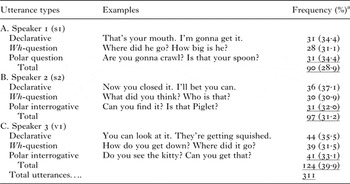
Our analysis primarily focused on the initial instance of a given utterance. (Approximately 11% of utterances (35 out of 311) occurred two or more times in a single session, with the majority of repetitions being questions (19 repeated utterances were wh-questions, 13 were polar interrogatives). Of those thirty-five utterances, we analyzed repetitions of nineteen utterances. The remaining sixteen utterances contained repetitions with background vocalizations that made them difficult or impossible to analyze. Results did not change with the addition of the duplicate utterances.) We narrowed our selection further by listening to the accompanying waveform. Utterances were eliminated if they included vocalization or background noise, making analysis difficult or impossible: For example, laughing, crying, blowing raspberries. We eliminated unintelligible sentences because we used the mother's pronunciation to help define syllable boundaries. We analyzed a total of 311 sentences (See Table 1).
Frequency of utterance types

a Frequency (%) for each sentence type is the percentage of utterances for a given speaker (e.g. declaratives account for 34·4% of the total utterances for Speaker 1). The % total is the percentage out of the total number of utterances analyzed (e.g. Speaker 1's utterances account for 28·9% of the total utterances in the corpus analysis).
Location of analyses within sentences
Separate analyses of each acoustic measure are detailed below. We analyzed the penultimate and final syllables (following the precedent of Fisher & Tokura, Reference Fisher and Tokura1996) given that, in many languages, the final pitch contour is a critical (if not the most important) region in the utterance where prosodic differences between interrogatives and declaratives occur. We reasoned that the final two syllables were likely to contain most of the variability in final pitch contour. For each utterance, coders marked the boundaries for the penultimate and final syllables for analysis by hand. Boundaries were marked by one or two coders, then verified by the first author. Coders initially marked syllable boundaries by examining the spectrogram and listening to the corresponding waveform. Coders also used regions of silence to mark the end boundary of the final syllable. Disagreements were resolved by having all the coders listen to the sentences, followed by a group discussion, and if there was still a disagreement, the first author decided on the appropriate marking. (Discrepancies occurred in approximately 3% of sentences, and were generally off by only a few milliseconds.) Coders labeled each section with a rough English transcription of the syllable. This was a necessary step for information extraction using the ProsodyPro Praat script (Xu, Reference Xu2012), which carried out batch extraction of MeanF0, MaxF0, MinF0, duration, and intensity from each labeled interval within all 311 files (using the default settings, F0 range: 30–400 Hz; F0 sample rate: 100 Hz; Npoints per interval: 10).
Pitch variables
To assess the availability of pitch as a cue to sentence type in infant-directed speech, we measured average pitch (MeanF0) as well as lowest and highest pitch (MinF0 and MaxF0, respectively).
For MeanF0 and MaxF0, we were interested primarily in the change of these values across the final two syllables (see ‘Methods’ section). MeanF0 provides a simple, coarse measure that can be used to identify the general degree of sentence-final pitch rise or fall. MaxF0, while clearly related to MeanF0, provides specific information about pitch peak. Recall that some languages, including Russian (Makarova, Reference Makarova2007; Svetozarova, Reference Svetozarova, Hirst and Di Cristo1998), and Hungarian (Gósy & Terken, Reference Gósy and Terken1994), rely on pitch peak alignment rather than lexical cues to mark distinctions between declaratives and polar interrogatives. Declaratives and exclamations have earlier peaks than interrogatives. There is also an effect of pitch peak height, where interrogatives have higher pitch peaks than declaratives. Even languages like English, which do use lexical markings (e.g. auxiliary verbs) to distinguish sentence types, demonstrate differences in pitch peak location between sentence types. For example, English wh-questions show an earlier pitch rise and final F0 decline (Best, Levitt & McRoberts, Reference Best, Levitt and McRoberts1991). Thus, the location and degree of MaxF0 could be a useful cue for distinguishing between sentence types.
We used MinF0 primarily as a way of calculating the derived measure of pitch excursion across the final two syllables that is based on the most extreme values (see ‘Methods’ section) rather than on averages.
Since infant-directed speech is characterized by exaggerated prosodic contours, including higher mean pitch and expanded pitch excursion (Fernald & Kuhl, Reference Fernald and Kuhl1987), it is an open question which properties of pitch contours that distinguish between sentence types in adult-directed speech are maintained in speech to infants.
For analyzing pitch excursion, we identified the lowest F0 and highest F0 when considering the penultimate and final syllables together. We then subtracted whichever extreme value was in the penultimate syllable from the extreme value that was in the final syllable. Thus, positive pitch excursions indicated rising pitch, and negative pitch excursions indicated falling pitch. For example, if the lowest pitch was 207·9 Hz in the penultimate syllable and the highest F0 was 256·8 Hz in the final syllable, the pitch excursion would be a pitch rise of 48·9 Hz (256·8–207·9). When both extreme values came from the same syllable, we subtracted the extreme that came first from the extreme that came last, resulting in the same correspondence of the sign of the excursion with excursion direction.
MinF0 and MaxF0 were not available for twenty-one sentences (12 declaratives, 1 polar interrogative, and 8 wh-questions) (7%) due to incomplete pitch information extracted by the Praat script (Xu, Reference Xu2012), so they were excluded from the pitch excursion analysis.
Duration and intensity
Duration and average intensity were extracted from the marked syllables in Praat using the ProsodyPro Praat script (Xu, Reference Xu2012) (see section, ‘Location of analyses within sentences’, above).
RESULTS
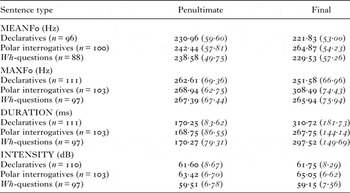
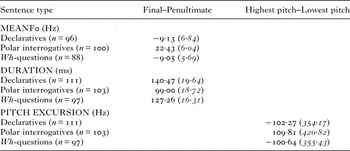
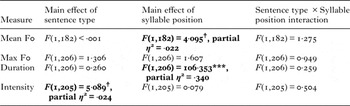
Summaries of all direct measurements are given in Table 2. Summaries of the derived measures are given in Table 3.
Mean and standard deviation by position in utterance

Mean difference scores (standard error) and pitch excursion (standard error)

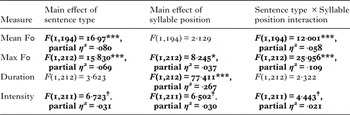
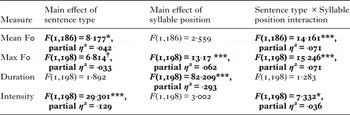
Results are presented as contrasting pairs of sentence types: declaratives versus polar interrogatives, declaratives versus wh-questions, and polar interrogatives versus wh-questions by measure. With the exception of the pitch excursion analysis, which only focused on differences between sentence types, not syllable positions, data were subjected to a mixed 2 × 2 ANOVA with Sentence Type as a fixed effect and Syllable Position (penultimate or final) as a repeated measure. (Adding Speaker as an additional variable did not change the pattern of results.) We were primarily interested in an interaction of Syllable Position with Sentence Type.
MeanF0
Analyses revealed a significant main effect of Sentence Type and a significant Sentence Type by Syllable Position interaction for declaratives compared to polar interrogatives and for polar interrogatives compared to wh-questions. In contrast, analyses revealed a main effect of Syllable Position only for declaratives compared to wh-questions (see Tables 4–6 for details of the ANOVAs). Polar interrogatives had significantly higher mean pitch (M = 264·87, SD = 54·23) for the final syllable compared to declaratives (M = 221·83, SD = 53·0; t(199) = 5·88, p < ·001) and wh-questions (M = 229·01, SD = 57·14; t(189) = 4·46, p < ·001). However, consistent with the significant interaction, there was no significant difference between sentence types in the penultimate syllable. In contrast, there were no significant differences in MeanF0 values for the penultimate or the final syllable in wh-questions compared to declaratives (ps > ·1). There was a fall in mean pitch from the penultimate to the final syllable in declaratives (M = –9·13 Hz, SD = 67·05 Hz) and wh-questions (M = –9·05 Hz, SD = 53·38 Hz), while polar interrogatives showed a rise in mean pitch (M = 22·43 Hz, SD = 60·44 Hz). In adult-directed speech, one of the primary distinctions between declaratives and polar interrogatives is the final prosodic contour – i.e. interrogatives have a final rise and declaratives have a final fall. Wh-questions also typically end with final falling or flat intonation (Bartels, Reference Bartels1999; Hedberg et al., Reference Hedberg, Sosa and Fadden2004). Larger differences in mean pitch between penultimate and final syllables could make it easier for infants to acoustically distinguish between sentence types. These results are consistent with adult-directed speech and demonstrate that MeanF0 can be useful for distinguishing polar interrogatives from declaratives and wh-questions, but not declaratives from wh-questions.
Statistical comparisons for declaratives vs. polar interrogatives

notes: † p < ·05; * p < ·01; ** p < ·005; *** p < ·001. Statistically significant statistics are in bold.
Statistical comparisons for declaratives vs. wh-questions

notes: † p < ·05; * p < ·01; ** p < ·005; *** p < ·001. Statistically significant statistics are in bold.
Statistical comparisons for polar interrogatives vs. wh-questions

notes: † p < ·05; * p < ·01; ** p < ·005; *** p < ·001. Statistically significant statistics are in bold.
MaxF0
Analyses revealed a significant main effect of Sentence Type, a significant main effect of Syllable Position, and a significant Sentence Type by Syllable Position interaction for polar interrogatives compared to declaratives and wh-questions. However, there were no main effects or interactions for declaratives compared to wh-questions (see Tables 4–6 for details of the ANOVAs). Declaratives showed a decline in MaxF0 from the penultimate syllable (M = 262·61, SD = 69·36) to the final syllable (M = 251·58, SD = 66·96), consistent with the prosodic contour of declaratives in adult-directed speech. Polar interrogatives demonstrated a rise from the penultimate syllable (M = 268·94, SD = 62·75) to the final syllable (M = 308·49, SD = 74·43), consistent with the final rise pitch contour in adult-directed speech. Wh-questions did not appreciably differ in MaxF0 between the penultimate syllable (M = 267·39, SD = 67·44) and the final syllable (M = 265·94, SD = 75·94), consistent with the prosodic contour of wh-questions in adult-directed speech. This demonstrates that MaxF0 provides information infants could use to distinguish polar interrogatives from declaratives and wh-questions, but not declaratives from wh-questions.
Pitch excursion
Independent samples t-tests revealed a significant difference in pitch excursion between polar interrogatives and declaratives (t(212) = 4·00, p < ·01) and wh-questions (t(198) = 3·81, p < ·01). However, there was no significant difference in pitch excursion between declaratives and wh-questions (t(206) = 0·033, p = ·97). Polar interrogatives had an average pitch excursion of 109·81 Hz (SD = 420·82 Hz), declaratives had an average pitch excursion of –102·27 Hz (SD = 354·62 Hz), and wh-questions had an average pitch excursion of –100·64 Hz (SD = 355·43 Hz) across the final two syllables. The positive excursion for polar interrogatives indicates a pitch rise, whereas the negative excursion for declaratives indicates a pitch fall.
Duration
Analyses revealed a significant main effect of Syllable Position for all three comparisons. There was also a non-significant trend for Sentence Type for declaratives compared to polar interrogatives (p = ·058) (see Tables 4–6 for details of the ANOVAs). The penultimate syllables did not appreciably differ in duration for polar interrogatives (M = 168·75 ms, SD = 86·55 ms) compared to declaratives (M = 170·25 ms, SD = 83·62 ms; t(212) = 0·128, p = ·898) or wh-questions (M = 170·27 ms, SD = 79·31 ms; t(198) = 0·128, p = ·898). Final syllable durations in declaratives (M = 310·72, SD = 181·73) tended to be longer than in polar interrogatives (M = 267·75, SD = 181·73), although this difference was a non-significant trend (t(207·071) = 1·923, p = ·056). This difference could be due to the fact that the last word was one syllable in most declaratives but two syllables in at least half the polar interrogatives. These results are consistent with adult-directed speech, where declaratives and polar interrogatives also differ in overall duration, with polar interrogatives typically a little shorter than declaratives. This has been shown in a variety of languages (e.g. Manado Malay, Orkney English, and Dutch: van Heuven & van Zanten, Reference van Heuven and van Zanten2005). Final syllable durations in wh-questions (M = 297·52, SD = 149·69) also tended to be longer than in polar interrogatives (M = 267·75, SD = 144·14), although this difference was not significant (t(196·12) = 1·431, p = ·154). In contrast, final syllables (M = 304·57 ms, SD = 167·29 ms) were significantly longer than penultimate syllables (M = 170·26 ms, SD = 81·44 ms) in both declaratives and polar interrogatives, although this durational pattern did not significantly differ across sentence types. These results suggest that duration would not be useful for distinguishing declaratives and wh-questions. However, larger differences in duration, particularly in the final syllable, could make it easier for infants to acoustically distinguish between sentence types. All three sentence types had positive difference scores (see Table 3), indicating that the final syllable was longer for all three sentence types, although the difference scores were not significantly different between sentence types. These results suggest that duration would not be useful for distinguishing declaratives and wh-questions.
Intensity
Analyses revealed a significant main effect of Sentence Type for all three comparisons. There was a significant Sentence Type by Syllable Position interaction for polar interrogatives compared to declaratives and wh-questions. There was also a significant main effect of Syllable Position for polar interrogatives compared to declaratives and a non-significant trend toward a main effect of Syllable Position for polar interrogatives compared to wh-questions (see Tables 4–6 for details of the ANOVAs). Polar interrogatives had slightly higher intensity than declaratives and wh-questions, across positions. Intensity was significantly higher for polar interrogatives (M = 65·05, SD = 6·62) than for declaratives (M = 61·75, SD = 8·29; t(205·905) = 3·225, p = ·001) and wh-questions (M = 59·15, SD = 7·56; t(190·942) = 5·864, p < ·001) in the final syllable, and also in the penultimate syllable for polar interrogatives (M = 63·42, SD = 6·70) compared to wh-questions (M = 59·51, SD = 6·78; t(196·964) = 4·104, p < ·001), as well as a non-significant trend towards a difference from declaratives (M = 61·60, SD = 8·63; t(205·718) = 1·733, p = ·085). In addition, declaratives had higher intensity than wh-questions in the final and the penultimate syllable: declaratives (Final: M = 61·60, SD = 8·18; Penultimate: M = 61·75, SD = 8·29); wh-questions (Final: M = 59·15, SD = 7·56; Penultimate: M = 59·51, SD = 6·78). Polar interrogatives show corresponding rises in intensity and pitch consistent with findings on the correlation between intensity and other prosodic measures (Fernald, Reference Fernald, Feagans, Garvey and Golinkoff1984). Therefore, intensity appears to be a reliable cue for making sentence-type distinctions in conjunction with other prosodic cues.
Summary
Similar to adult-directed speech, in infant-directed speech polar interrogatives differed from declaratives and wh-questions in pitch on the final two syllables, and showed a non-significant trend towards a difference in duration. Polar interrogatives were characterized by higher mean and max pitch, and higher intensity on the final syllable. In contrast, declaratives and wh-questions tended to demonstrate longer duration on the final syllable, although this difference was not statistically significant. In addition, the only prosodic cue that distinguished between declaratives and wh-questions was intensity, with wh-questions displaying a slightly lower intensity than declaratives. Polar interrogatives do not significantly differ from declaratives or wh-questions in the penultimate syllable, and both declaratives and wh-questions had significantly longer final syllables compared to penultimate syllables. These results suggest that prosodic differences between polar interrogatives and both declaratives and wh-questions are controlled largely by the final syllable and its relation to the penultimate syllable. This suggests that there is insufficient prosodic information to distinguish between declaratives and wh-questions in infant-directed speech. However, sentence-final prosody does provide information that distinguishes polar interrogatives from declaratives and wh-questions in infant-directed speech, a point we return to below.
DISCUSSION
This analysis revealed significant differences between declaratives and polar interrogatives for MeanF0, MaxF0, pitch excursion, and intensity, and a non-significant trend between sentence types for differences in duration. Conversely, the only significant difference between declaratives and wh-questions was intensity. However, intensity patterned differently in polar interrogatives and wh-questions in comparison to declaratives, with declaratives and polar interrogatives showing similar intensity profiles. Collectively, these results demonstrate that prosodic information is in principle available to distinguish between declaratives and polar interrogatives. While intensity could be a basis for also discriminating wh-questions and declaratives, it is not obvious how intensity would be used more broadly to distinguish declaratives from interrogatives since it patterns differently across wh-questions and polar interrogatives.
The situation we have just described highlights the challenges in developing a comprehensive account of how infants could use prosody to make useful sentence-type discriminations. Although Analysis 1 shows that a variety of prosodic cues provide information that infants could use to distinguish between declaratives and polar interrogatives, it remains unclear how useful these combinations of cues are for actually categorizing individual utterances. We address this question in Analysis 2.
ANALYSIS 2: SENTENCE CLASSIFICATION FROM PROSODIC INFORMATION
Analysis 1 revealed that there are different prosodic patterns between declaratives and polar interrogatives when considering groups of sentences, but the analyses were not designed to address to what degree any of the cues individually, or in combination, are useful for categorizing individual sentences. To investigate this, in Analysis 2 we used a simple linear discrimination model, using half the sentences as a training set and evaluating categorization success with the other half. To reduce the dimensionality of the data, we first carried out a Principal Components Analysis (PCA) on the acoustic measures. This is a fairly simple classification technique that provides a first attempt to assess how well these acoustic measures classify actual sentences into declaratives and interrogatives.
PCA ANALYSIS AND RESULTS
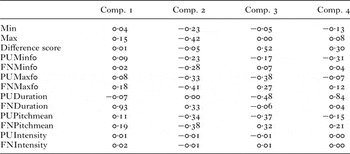
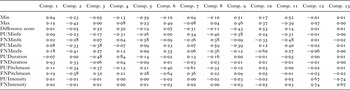
We used PCA to standardize and assess thirteen variables which comprise acoustic properties of declaratives and interrogatives: Penultimate Syllable MinF0, Final Syllable MinF0, Penultimate Syllable MaxF0, Final Syllable MaxF0, Penultimate Syllable MeanF0, Final Syllable MeanF0, Penultimate Syllable Duration, Final Syllable Duration, Penultimate Syllable Intensity, Final Syllable Intensity, Overall Minimum Pitch (across penultimate and final syllables), Overall Maximum Pitch (across penultimate and final syllables), and Mean F0 Difference Score (Final syllable MeanF0 – Penultimate syllable MeanF0). PCA is a procedure analogous to factor analysis with orthogonal rotation; however, devoid of theory, PCA seeks to create latent scores that maximize the variance explained between the variables. Since PCA creates uncorrelated (orthogonal) scores, it can play an important role in reducing the dimensionality of many correlated variables that if modeled individually would suffer from multicollinearity. In this analysis, we used PCA so as to incorporate elements of all the variables into the eventual logistic regression model without concern for the multicollinearity of these related variables. The number of component scores was selected based on the scree plot of the eigenvalues. Four components were considered, comprising approximately 87% of the variance in the variables. Variable loadings on each component were examined to determine the make-up of each score. Component 1 was primarily a function of Final Syllable Duration. Component 2 was a moderate loading on all the variables excluding Mean F0 Difference Score, Penultimate Syllable Duration, Penultimate and Final Syllable Intensity. Component 3 was predominantly composed of Difference Score, and had moderate loadings on all variables excluding Overall Minimum Pitch, Overall Maximum Pitch, Final Syllable MinF0, Final Syllable Duration, Penultimate and Final Syllable Intensity. Component 4 was primarily a function of Penultimate Syllable Duration and had moderate loadings on Mean F0 Difference Score and Penultimate MinF0. See Table 7 for the four composite scores used in Analysis 2 (and see Table A1 in the ‘Appendix’ for the complete table of loadings).
Loadings of individual factors for composites 1–4 for principal components analysis

Before presenting the linear classifier results that use the principal components (PCs), we first present results that verify that these principal components do indeed correlate with sentence type. We conducted two separate linear regressions using the R ‘glm’ function with the binomial link function. In all analyses the first independent variables were the first four PCs, and the dependent variable was a binary contrast of two sentence types. The analyses varied in terms of which two sentence types we analyzed: declarative vs. polar interrogative, or declarative vs. wh-question.
With the dependent variable contrasting declaratives with polar interrogatives (with declaratives as the reference level), PCs 2 and 3 contributed significantly to the model fit (Z = –5·25, p < ·0001, and Z = –3·428, p = ·0006, respectively) whereas PCs 1 and 4 did not (Z = –0·078, p = ·938, and Z = 1·45, p = ·148, respectively). Thus, the PCs that loaded primarily on duration measures did not contribute significantly to the model fit. Nevertheless, in the classification analysis we include all four PCs, since they represent the most significant dimensions of correlated variability across the utterances.
With the dependent variable contrasting declaratives with wh-questions (with declaratives as the reference level), none of the PCs were predictive (for PCs 1–4: Zs = –0·098, –1·56, –0·122, and –0·057, respectively; all ps n.s.). This result is not surprising given the results involving the individual measures in Analysis 1.
Potential confounds with measured variables
Because prosody is controlled by a variety of linguistic domains and levels – e.g. lexical, phonological, syntactic, pragmatic – we wanted to rule out some potential confounds that could be related to our prosodic measures (and the PC variables we derived from them) as well as sentence type. Following the recommendation of an anonymous reviewer, we further coded each utterance for the number of syllables in the final word of the utterance, as well as the location of the nuclear pitch accent. Both variables can affect utterance-final prosodic features, and both could reasonably be assumed to vary with sentence type. The existence of such a confound would not necessarily affect conclusions about the availability of the prosodic cues for sentence-type discrimination, but it might affect the broader theoretical interpretation regarding what properties of utterances infants attend to and use in early language acquisition.
Number of syllables in final word
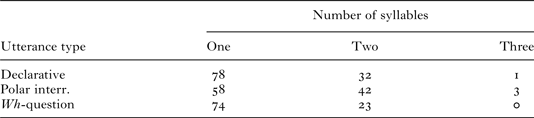
We added an additional variable to each utterance representing the number of syllables in the final word. In our sample, utterance-final words had one, two, or three syllables. The results are summarized in Table 8.
Counts of sentences with one, two, or three syllables in the utterance-final word, organized by sentence type and number of syllables

Pearson's chi-squared tests revealed a non-significant but marginal difference in the pattern of number of syllables comparing declaratives and polar interrogatives (χ 2(2) = 5·0, p = ·082), no difference between declaratives and wh-questions (χ 2(2) = 1·64, p = .44), and a significant difference between wh-questions and polar interrogatives (χ 2(2) = 10·32, p = ·006). Thus, the number of syllables in the utterance-final word does seem to correspond to sentence type to some degree, and could contribute to the correlation of our PCs with sentence type.
Location of nuclear pitch accent
We calculated nuclear pitch accent in each utterance in our sample by first locating the highest pitch peak, and coding location as penultimate syllable, final syllable, or elsewhere (since we had only marked the location of the final two syllables in Analysis 1). The results are summarized in Table 9.
Counts of sentences with highest pitch peak in penultimate syllable, final syllable, or elsewhere, organized by sentence type and highest pitch peak location

Pearson's chi-squared tests revealed a significant difference in the pattern of highest pitch placement comparing declaratives and polar interrogatives (χ 2(2) = 35·10, p < ·0001), no difference between declaratives and wh-questions (χ 2(2) = 0·16, p = ·92), and a significant difference between wh-questions and polar interrogatives (χ 2(2) = 32·08, p < ·0001). Thus, the location of highest pitch, considering the whole utterance, is significantly correlated with sentence type.
Relationship of PCs to sentence type, controlling for confounds
Our analysis of the number of syllables in the utterance-final word and the placement of highest pitch peak showed that both variables correlated with sentence type. Moreover, those variables patterned similarly with our measures in Analysis 1 and the results of our linear regression with PCs: they differed when contrasting declaratives and polar interrogatives as well as wh-questions and polar interrogatives, but not wh-questions and declaratives. Therefore, it is possible that these two simple variables (together or independently) are responsible for the relationship between sentence type and the prosodic measures (and composites) we reported so far. If so, that could impact empirical and theoretical investigations with respect to prosody and sentence type in early language acquisition.
We tested this in the following way. First, we conducted a logistic regression, as described in the previous section, but with number of syllables in the final word (NumSyll) and the placement of highest pitch peak (PitchPeak), as coded above, as predictors. We only analyzed a model with the dependent variable coding for declarative vs. polar interrogative, as this is the contrast that all our prior analyses indicated would be the most promising for distinguishing declaratives and interrogatives. Next, we added the first four PCs to the model, as a group, to see if the composite variables improved model fit. Finally, we removed NumSyll and PitchPeak from the model, to see if they made a significant independent contribution to the fit of the larger model.
Both number of syllables in the utterance-final word and highest pitch peak location indeed accounted for variance in sentence type when they were the only variables in the model (NumSyll: Z = 2·5, p = ·012; PitchPeak: Z = 4·03, p < ·001). However, adding the first four PCs significantly improved model fit (χ 2(4) = 26·68, p < ·0001). When the PCs were entered, NumSyll and PitchPeak no longer significantly predicted sentence type (Z = 1·58, p = ·114; Z = 1·51, p = ·131, respectively). Finally, removing NumSyll and PitchPeak from the full model did not significantly decrease model fit (χ 2(2) = 4·35, p = ·114). Thus, these two variables do not appear to account for any independent variance in sentence type, whereas the PC variables do. Thus, in the linear classifier we now present, we consider only the composite PC variables.
SENTENCE TYPE PREDICTION USING PRINCIPAL COMPONENTS
We used the first four principal components that we calculated in the previous section to predict sentence type in a logistic regression model, within a testing database that was a subset of our total data sample. We used half the declaratives (N = 55) and half the polar interrogatives (N = 51), selected randomly from all three speakers, to set the coefficients. The coefficients from this model were then applied to the remainder of the dataset, with the predicted probabilities of sentence type compared to the observed classification. For Declaratives versus Polar Interrogatives discrimination, this model showed predictive accuracy for approximately 67·5% of the observations. Of the errors, approximately 57% were incorrectly classifying polar interrogatives as statements. Table 10 shows the regression coefficients for the two logistic regressions. For the declarative vs. polar interrogative discrimination, the component that most strongly predicts a question is Component 3. Recall that Component 3 loads heavily on the pitch difference across syllables, as well as other pitch measures, but it also loads negatively on final syllable duration. Thus, in accord with what we would expect from the results of Analysis 1, pitch appears to be the primary determinant of discriminability, but shorter final syllables also predict polar interrogatives. However, it should be noted that the values of coefficients, and thus their respective influences on utterance categorization, do not differ substantially.
Regression coefficients for the logistic regressions on principal components in Analysis 2. Coefficients are in logit units (log odds).

Without a specific theory about how the utterances would be used for further grammatical learning and how robust those learning procedures would be to error in sentence-type discrimination, it is difficult to assess the adequacy of 68% categorization accuracy. Using more components could add to predictive accuracy, although there are additional problems of overfitting as well as multicollinearity when using the raw variables themselves. The main contribution of this analysis, then, is as a benchmark for the kind of information sentence-final prosody provides.
For Declaratives (N = 55) versus Wh-questions (N = 48) discrimination, this model showed predictive accuracy for approximately 51% of the observations. Thus, this model is basically at chance for categorizing declaratives and wh-questions. These results are not surprising given our analysis of the independent variables in Analysis 1, and the logistic regression we reported in the previous section.
These analyses show that a simple linear classifier could use prosodic information that is realized on the last two syllables to discriminate the majority of polar interrogatives and declaratives, at least to some degree. It should be noted that we tested a supervised classification model that was trained on labeled sentences in order to set the coefficient weights to optimize the categorization results. Thus, we do not propose this as a model of sentence discrimination. Indeed, if a learner knew the sentence type of a number of sentences a priori, we suspect that distributional information would be a much more robust cue to sentence type than prosodic information. Rather, in this analysis we show how well a simple linear classifier could perform when considering the kind of prosodic information we targeted.
GENERAL DISCUSSION
The results of this corpus study demonstrate that there is sufficient prosodic information to distinguish declaratives from polar interrogatives in infant-directed speech at above-chance levels, but not from wh-questions. Four of the five prosodic measures and derivatives – MeanF0, MaxF0, pitch excursion, and intensity – significantly differed between declaratives and polar interrogatives, while the durational difference between the two sentence types was a statistical trend. In contrast, intensity was the only cue that distinguished between declaratives and wh-questions, with wh-questions demonstrating lower intensity than declaratives, which demonstrated lower intensity than polar interrogatives. This provides preliminary evidence that infant-directed speech contours follow the same patterns as adult-directed speech contours (Hedberg et al., Reference Hedberg, Sosa and Fadden2004; Ladd, Reference Ladd2008). Specifically, declaratives and wh-questions end with a flat or falling pitch, and polar interrogatives end with a final rise. This suggests that while parents may exaggerate typical speech contours in daily speech to infants, they do not change the shape of the contour. However, further research is needed to determine whether infants are using these prosodic cues and, if so, their relative value for sentence-type discrimination.
The logistic regression model also suggests a multi-cue approach to classifying sentence types. The regression model was intended to narrow down and evaluate what variables these components had in common, to determine which acoustic variables are best at classifying sentence types. However, no single cue turned out to be exclusive for classification purposes. Component 1 was predominated by Final Syllable Duration. Component 4 was primarily a function of Penultimate Syllable Duration and had moderate loadings on two additional variables. Component 3 was predominantly composed of the Pitch Difference Score, but had moderate loadings of six additional variables. Component 2 had moderate loadings of all but four variables. There was no overlap between the predominant variables in Components 1, 3, and 4, and little overlap in moderate loadings of variables either.
These results suggest that sentence-type classification would be most robust when considering a combination of prosodic cues. Further research is needed to determine how well the model performs relative to human ability. Combined with the corpus analysis, these results suggest that infants may rely on multiple prosodic cues to distinguish between sentence types.
Preliminary work evaluating infants' ability to make sentence-type distinctions based on prosody alone failed to find evidence that 7-month-olds use this information to distinguish between declaratives and polar interrogatives (Geffen, Reference Geffen2014). This is not to say that infants cannot use prosody in this way, at this age, but rather that they did not use prosody in that experiment. A potential confound in the study was the greater acoustic variability in declarative stimuli compared to interrogatives, for both familiarization and test items. Further research is needed to address this confound and to further address the question of when infants begin using prosodic information to make sentence-type distinctions.
One factor that showed more variability in declaratives than polar interrogatives was MaxF0. While there is a significant difference between polar interrogatives and declaratives, there is no significant difference in MaxF0 between the final syllable of wh-questions and declaratives. However, the MaxF0 is not limited to the end of an utterance. In languages like Russian, which have relatively free word order and no auxiliary verbs (Rojina, Reference Rojina2004), pitch peak is an important perceptual cue for distinguishing between declaratives and polar interrogatives (Makarova, Reference Makarova2007; Svetozarova, Reference Svetozarova, Hirst and Di Cristo1998). Thus, the location of the pitch peak may be another cue infants could use to make sentence-type distinctions. Perhaps a more fine-grained analysis of pitch peak location than we performed in Analysis 2 would reveal more robust independent effects in English. This may be particularly important for distinguishing between polar interrogatives and wh-questions, given that wh-questions are more prosodically similar to declaratives than polar interrogatives (Bartels, Reference Bartels1999; Hedberg et al., Reference Hedberg, Sosa and Fadden2004; Ladd, Reference Ladd2008). Perhaps wh-questions carry their emphasis, and thus their pitch peak, on the wh-word. For example, infant-directed wh-questions in English show an earlier pitch peak and final F0 decline (Best et al., Reference Best, Levitt and McRoberts1991). It would be fruitful in further research to investigate the informativeness of pitch peak location in greater detail.
Although sentence-final prosody is insufficient to distinguish between declaratives and wh-questions, the ability to distinguish between declaratives and polar interrogatives provides valuable information for making distinctions between other types of interrogatives. As previously discussed, polar interrogatives and wh-questions occur in roughly equal proportions in infant-directed speech (23% and 21%, respectively; Newport, Reference Newport, Castellan, Pisoni and Potts1977), so polar interrogatives are a significant part of learners' input. Moreover, the characteristic inversion of auxiliaries and subjects in polar interrogatives also occurs in wh-questions, after the wh-word (e.g. What did you have for lunch?). Infants could use prosodic information to differentiate polar interrogatives from declaratives, which would then allow them to notice the characteristic subject–auxiliary inversion pattern. They could then detect the same patterns in wh-questions and use the distributional similarity as a basis for distinguishing wh-questions from declaratives, and for treating wh-questions and polar interrogatives as similar. In this way, the learned associations between word order and prosodic patterns in polar interrogatives may allow infants to generalize to wh-questions, given their prosodic similarity to declaratives (Bartels, Reference Bartels1999; Hedberg et al., Reference Hedberg, Sosa and Fadden2004).
As we mentioned earlier, recent work suggests that infants can use distributional cues to discriminate declaratives and polar interrogatives in the absence of prosodic information by age 1;0 (Geffen & Mintz, Reference Geffen2015). It remains to be seen whether infants can make similar distinctions between declaratives and wh-questions at the same age.
CONCLUSION
In summary, the current experiment provides evidence that there is sufficient prosodic information to distinguish declaratives from polar interrogatives with above-chance accuracy. Making this distinction could then, perhaps, provide a foundation for distinguishing wh-questions from declaratives on distributional grounds, as we have found that those sentence types are prosodically similar in infant-directed speech, as they are in adult-directed speech. While infants can make use of prosody to discriminate sentence types in some languages (e.g. Frota et al., Reference Frota, Butler and Vigário2014), it currently remains unclear when English-learning infants can do the same (see our discussion in the ‘Introduction’ regarding Soderstrom et al., Reference Soderstrom, Ko and Nevzorova2011). This ability could provide an important foundation for acquiring syntactic knowledge. Future research is needed to further evaluate the degree to which prosody is sufficient for distinguishing between declaratives and interrogatives in the absence of lexical/semantic information. Finally, by mapping the genesis and development of sentence discrimination abilities in typically developing children, these future studies could lead to the development of a method for assessing individual differences in early language perception for individuals at risk for language impairments.
Appendix
Full loadings of individual factors for principal components analysis